This is a sermon on marriage. When I’ve preached on marriage in the past, I’ve offered a disclaimer, and I’m going to do that again today. This sermon isn’t intended to address all the different aspects of marriage. We’d be here for days and weeks. And this is a mixed audience. Many of you are currently married. Some have been through divorce. Some of you aren’t married, at least not yet. Some of you might never get married; know that Scripture says that remaining single is a good gift from God (see 1 Co. 7). And some of you have been married but are now widowed. You’ll hear in a minute that the reason being widowed is so hard is that you have, very literally, lost a part of yourself. To you, be comforted by Christ and the fact that your spouse will rise again (Jn. 11:23).
My intention with this sermon is show how marriage is God’s idea. Then, I’ll make four assertions about marriage to show how it is a good gift from God. Also, with those four assertions, I’d like to offer some Biblical advice for your marriage. If you have any questions about things I don’t address, feel free to ask me. So, with that said, are you ready?
When God created man (singular) in His image, He created them (plural) male and female (Gen. 1:27). Part of man (and here, please think ‘mankind’ or ‘humanity’) is to have a duality – two parts, or even better two persons. Scripture teaches that there is one God (Dt. 6:4), but three Persons – Father, Son, and Holy Spirit (Mt. 3:16-17; Mt. 28:19). The creation of man (again think ‘mankind) in the image of God is that man has a plurality which we see in Adam, the male, and the woman,[1] the female.
In Gen. 2:18-25, Scripture gives us the play-by-play of the creation of mankind as man and woman. But before the play-by-play we learn how in Gen. 1, God gave Himself a grade each day of creation. Day 1, God sees the light He created and sees that it is good – A+ (Gen. 1:4). Then, Days 2, 3, 4, and 5, God sees what He makes and it’s all good. A+’s all around (Gen. 1:10, 12, 18, 21, 25). Finally, on Day 6 God creates mankind to be the crown of His creation and sees that it was very good (Gen. 1:31) – A+++! But, again, Gen. 2:18-25 gives a little more insight into Day 6. God created Adam and decided it wasn’t good for Adam to be alone (Gen. 2:18). God wasn’t saying that because He made a mistake. He was saying that to show Adam the goodness of what He was about to do.
God put Adam to sleep, removes Adam’s rib (in Hebrew it’s literally Adam’s ‘side’), and from that chunk of Adam, God created Adam’s bride (Gen. 2:21-22). And Adam was really happy when he saw his bride. He said, “This at last is bone of my bones and flesh of my flesh; she shall be called Woman because she was taken out of Man” (Gen. 2:23). Then, we have the statement that gets quoted in this text from Eph., “Therefore a man shall leave his father and his mother and hold fast to his wife, and they shall become one flesh” (Gen. 2:24; Eph. 5:31).
So, from its beginning and institution, God made marriage to be one man, who has given of himself, to have a bride who is literally from his own flesh. Dear saints, this is what marriage is, and it doesn’t matter how the world might try to redefine it. This one man and one woman union, this way that husband and wife complement and complete each other is God’s design, God’s invention, and God’s very good gift to all mankind.
In a real way, we can say that everyone who has ever lived and will ever live is here because of marriage. Even if the conception and birth of a child happened without a marriage (and instead a distortion of it), that individual is procreated by a man and a woman engaging in an act that God gave as a gift for marriage. I’m keeping this sermon PG, but, again, if you have any questions about what I said there, feel free to talk with me.
Keeping in mind what marriage is, we can talk about these four assertions that Scripture makes about marriage.
First, every marriage is God’s work, God’s joining. Jesus plainly says this about marriage. He talks about a man leaving his parents and being joined to his wife and becoming one flesh. Then our Lord says, “What God has joined together, let not man separate” (Mt. 19:6; Mk. 10:9). To you who are married, remember this. Even when things get tough, even when you get into fights and arguments, even when you struggle, remind yourself, “God joined me to that person. My husband/my wife is God’s good gift to me.”
Second assertion, marriage is good. We already know this because God created the institution of marriage before He saw that everything He had made was very good – again that A+++ grade. But can we also see that marriage is good because of how the devil attacks it. I could spend weeks on how he attacks it, but I won’t. The devil hates marriage because he envies humans because we have the ability to procreate and he doesn’t (Mt. 22:30). Satan hates all marriages because they remind him of Christ and the Church. He also hates them because they are how children are procreated, which reminds him of God becoming flesh to crush his head (Gen. 3:15). So, the devil attacks marriage from all directions. Because marriage is good, Scripture’s advice to you who are married is this: defend your marriage against all attacks. Be in God’s Word together as a family. Be quick to forgive each other when you do wrong. Because of the Fall, marriages are built on the foundation of forgiveness. If your spouse does something wrong and apologizes, don’t just say, “Oh, that’s ok.” Instead, say, “I forgive you.” The words ‘sorry’ and ‘I forgive’ need to be normal, regular vocabulary in marriages.
That leads me to the third assertion. Marriage is hard work, but even that is good. It’s an delusion to think that the best marriages happen when a couple is ‘completely compatible’ with each other. It’s a delusion because we are sinners, and no two sinners are completely compatible. Sinners look out for their own interests and not the interests of others. So, in your marriages, sacrifice for each other and for your children. Don’t insist on your own way. Just as God took a chunk of Adam to create marriage, marriages are still a continual, sacrificial giving of self for the benefit of the spouse (Eph. 5:25).
Finally, fourth. Marriage is a mystery (Eph 5:32). We think we know what marriage is, but we can only scratch the surface of the mystery of marriage. Remember, God is the One who joins (Mt. 19:6; Mk. 10:9) a husband and wife together in marriage. It isn’t them making a choice to get married. God joins them, and God continues to join you to your spouse each and every day.
But the greatest mystery of marriage is that marriage is one of the ways that God manifests Himself. In marriage, God manifests Himself as the Groom of you, believer. You, the Church, are His bride. He gives Himself up for you. He sanctifies you, making you holy. He cleanses you by Baptism, by washing of water with His Word.
Dear Charlotte, today in your Baptism, God washed and cleansed you so that you would be His. Because of your Baptism, you are completely and totally unblemished. All you believers here today, God did that for you as well in your Baptism.
Dear saints, you are the unblemished Bride of Christ. The reason you are unblemished is that He has made you unblemished, and God doesn’t make mistakes. He doesn’t cut any corners. So, rejoice that you are His Bride. And strive to make His love for you the foundation upon which you build your marriage. The marriage feast of the Lamb is coming soon. Come, Lord Jesus. Amen.
The peace of God, which surpasses all understanding, will guard your hearts and minds in Christ Jesus (Php. 4:7). Amen.
[1] She isn’t given the name “Eve” until after the Fall in Gen. 3:20.
1 On the third day there was a wedding at Cana in Galilee, and the mother of Jesus was there. 2 Jesus also was invited to the wedding with his disciples. 3 When the wine ran out, the mother of Jesus said to him, “They have no wine.” 4 And Jesus said to her, “Woman, what does this have to do with me? My hour has not yet come.” 5 His mother said to the servants, “Do whatever he tells you.” 6 Now there were six stone water jars there for the Jewish rites of purification, each holding twenty or thirty gallons. 7 Jesus said to the servants, “Fill the jars with water.” And they filled them up to the brim. 8 And he said to them, “Now draw some out and take it to the master of the feast.” So they took it. 9 When the master of the feast tasted the water now become wine, and did not know where it came from (though the servants who had drawn the water knew), the master of the feast called the bridegroom 10 and said to him, “Everyone serves the good wine first, and when people have become drunk, then the poor wine. But you have kept the good wine until now.” 11 This, the first of his signs, Jesus did at Cana in Galilee, and manifested his glory. And his disciples believed in him.
In the name of Jesus. Amen.
This text is so rich; it’s a pile of treasure for preachers. This whole week, I felt like Scrooge McDuck taking a daily swim in all the wealth.
The main point of the text is that Jesus supplies more mercifully and abundantly than we can ask or imagine (Eph. 3:20). Christ manifests His glory by turning 120-180 gallons of water into wine for a bunch of people who are drunk. Most English translations have the master of the feast say in v. 10, “Everyone serves the good wine first, and when people have drunk freely, then the poor wine.” Every other place that word gets used in the New Testament (Lk. 12:45; Eph. 5:18; 1 Th. 5:7; and Rev. 17:2), it is a reference to drinking too much alcohol and is condemned. Do not – I repeat, DO NOT – take this text to mean that Jesus is ok with getting drunk. Instead, see that in turning water into wine, Jesus is giving sinful people good things they do not deserve and cannot fully appreciate. That is the definition and nature of mercy, and God’s glory is to give mercy (Jn. 1:14).
My fellow failures, Jesus gives you the full forgiveness of your sins even though He knows that you will turn around and fall into the same sin tomorrow. And when you fall into the same sin over and over, repent, and confess again. Jesus will answer with His mercy again. That is the main point of this text.
But there are many other gems here. We could consider how Jesus removes all human efforts to purify ourselves. He makes the stone jars that are there for man-made purification rites hold wine instead of water. Or, we could spend a lot of time talking about how much God loves marriage and weddings. Jesus makes sure that the celebration of the union of man and woman as husband and wife keeps going by providing for the feast. God created marriage, He blesses marriage, and He sustains joy in marriage.
Again, this text is a treasure-trove for preachers. But today, we are going to consider what this text has to preach to us about prayer. Yes, Jesus turning water into wine has a lot to teach us about prayer, so let’s get to that.
In Jesus’ day, wedding feasts would last several days, typically a whole week. At some point during this feast,[1] the wine runs out. The custom in Jesus’ day was for the groom and his family to pay for the wedding and the feast that followed. But here, Mary steps in, “They have no wine.” The wine wasn’t Mary’s responsibility. It isn’t one of her kids getting married; if it were, she would have told Jesus, “We have no wine.” But she says, “They have no wine.”
Having no wine is a fairly trivial thing and something we probably wouldn’t think Jesus would get involved in. It isn’t like someone is demon possessed, leprous, blind, lame, or dead. Those are typically the times Jesus steps in for a miracle. Even in the feeding of the five and four thousand, Jesus is concerned that the people won’t make it home because they will faint on the way. No one is in physical or spiritual danger at this feast because they ran out of wine.
Now that being said, running out of wine at a wedding feast in that culture would mean public humiliation and disgrace. It’s impossible to make a direct equivalent between the customs of Jesus’ day and ours, but here’s my best shot. Imagine you get invited to a wedding. You love the couple and excited for their marriage, and you RSVP indicating that you would like the bone-in tomahawk ribeye (rare, of course) and chicken cordon bleu for the reception. (And yes, that would be a really fancy wedding reception.) But after the wedding, you go to where the reception is supposed to be only to find out the party has been cancelled because the couple didn’t pay the caterer and venue, so the doors are locked. For the rest of your life, you would remember that the wedding gift you bought for the couple was way too expensive. (In saying that, I’m assuming the custom is to buy a gift that is similar to the amount spent on the reception.)
Again, Mary has or nothing to do with this quandary of the wine running out. But here, she presents this problem to Jesus as though she is responsible for keeping the feast kept going. And Jesus initially responds, “What is that to you and to Me. My hour has not yet come.” In the Gospel of John, Jesus’ hour is His Passion and cross (see Jn. 12:23, 27; 17:1). In other words, according to Jesus, fixing this problem will cost Jesus His life – eventually. (There is a whole sermon there too.)
Even though His response sounds rude, Mary trusts that Jesus will do what is right and good. So, she steps in a little further telling the servants, “Do whatever He tells you.” Jesus directs the servants to fill the six jars full of water, and He miraculously turns them into wine. This would be equivalent to between 750 and 900 bottles of wine. Jesus steps in because Mary had stepped in seeking Jesus’ help in a problem that is fairly minor and more of a luxury than a need, and Jesus responds with abundance. And this is where the text has something to say about prayer – or, even more importantly, the grace and mercy of our God who answers prayer.
Only a few people know where the wine came from. The servants, the disciples, and Mary knew, but no one else at the feast did. The master of the feast, the guests, and the groom didn’t know the Source of the wine. For the most part, the miracle is done in secret. As best as we can tell, the groom has no clue about the embarrassment and shame he was spared because Mary stepped in by her prayer, and Jesus stepped in to answer her petition. So, here are the two things this text teaches us about prayer.
First, we benefit from the prayers of others when they step in and intercede for us. Dear saints, we are like the groom in this account. The way John records this miracle, the groom is a necessary character, but he’s almost invisible. The groom doesn’t say or do anything except listen to the master of the feast call him an idiot for serving the good wine to guests who can’t appreciate it. The groom goes stumbling through the wedding feast unaware of what is happening behind the scenes and completely dependent on the prayers of others who interceded for him. He simply benefits from Jesus’ miraculous provision because Mary stepped in and prayed.
Now, I don’t think you and I can even begin to imagine how many millions of people have stepped in and prayed for us, maybe not by name, but with a general prayer that God has answered in a way that blesses you. If we could see how God answers those prayers through governing all of creation; by commanding His angel armies to protect and defend us; and by using His infinite power, wisdom, and might to cause all things to work together for our good (Ro. 8:28), if we could see all of that, we would fall on our faces in humility and praise.
And the second thought on prayer from this text is that we should pray for others because Jesus steps in by answering our prayers with His grace, mercy, and abundant provision. Each week in our corporate prayer we pray for all sorts of people we will never meet. We pray that they would hear God’s Word taught and preached; that God would protect families, husbands, wives, children, widows, and orphans; that God would provide our nation with good leaders, good economic conditions, and good laws; that God would heal those who are sick; etc. I don’t know what your thought is about that prayer, but I would encourage you to imagine it as all of us going into battle together. As we pray corporately, we aren’t individual soldiers fighting on our own. We are a while squad or battalion fighting a spiritual battle together as one. So, each week, listen to that prayer, and as it concludes with, “Lord, in Your mercy…” you pray with me, “hear our prayer.”
And as you go through your week, be a soldier fighting the spiritual battles around you through prayer. When you hear of someone in need, pray for them. It can be as simple as, “Lord, have mercy.” When you hear that something good has happened, pray, “God be praised.”
Don’t be concerned with how trivial or silly your prayer might sound to God. In Romans 8:26, Paul says that none of us, and he includes himself in this, none of us know how to pray as we should, but the Holy Spirit intercedes for us with groanings too deep for words. God loves to hear your prayers, the Holy Spirit loves to interpret those prayers, and the almighty God of armies will always answer those prayers in the way He knows is best.
Dear saints, God gives better than we deserve and better than we can even appreciate. And He invites you now to come to this altar where He will do another miracle by giving you His very Body and Blood for the forgiveness of your sin. Here, Christ gives better than you deserve and more than you can appreciate. Come to His table and receive a foretaste of the great wedding feast to come. Amen.
The peace of God, which surpasses all understanding, will guard your hearts and minds in Christ Jesus. Amen.
[1] We don’t know how many days had elapsed during this wedding feast before the wine ran out. When John talks about “the third day” in v. 1, he’s making a connection to the sixth day of creation when God created mankind and instituted marriage. If you go back to John 1, you see John start to number days. Day 1 – Jn. 1:19-28. Day 2 – Jn. 2:29-34. Day 3 – Jn. 1:35-42. Day 4 – Jn. 1:43-51. Day 6 begins in our text with the phrase “on the third day” (i.e. ‘after, but including, day four’).
7 Then the Lord God formed the man of dust from the ground and breathed into his nostrils the breath of life, and the man became a living creature. 8 And the Lord God planted a garden in Eden, in the east, and there he put the man whom he had formed. 9 And out of the ground the Lord God made to spring up every tree that is pleasant to the sight and good for food. The tree of life was in the midst of the garden, and the tree of the knowledge of good and evil.
10 A river flowed out of Eden to water the garden, and there it divided and became four rivers. 11 The name of the first is the Pishon. It is the one that flowed around the whole land of Havilah, where there is gold. 12 And the gold of that land is good; bdellium and onyx stone are there. 13 The name of the second river is the Gihon. It is the one that flowed around the whole land of Cush. 14 And the name of the third river is the Tigris, which flows east of Assyria. And the fourth river is the Euphrates.
15 The Lord God took the man and put him in the garden of Eden to work it and keep it. 16 And the Lord God commanded the man, saying, “You may surely eat of every tree of the garden, 17 but of the tree of the knowledge of good and evil you shall not eat, for in the day that you eat of it you shall surely die.”
18 Then the Lord God said, “It is not good that the man should be alone; I will make him a helper fit for him.” 19 Now out of the ground the Lord God had formed every beast of the field and every bird of the heavens and brought them to the man to see what he would call them. And whatever the man called every living creature, that was its name. 20 The man gave names to all livestock and to the birds of the heavens and to every beast of the field. But for Adam there was not found a helper fit for him. 21 So the Lord God caused a deep sleep to fall upon the man, and while he slept took one of his ribs and closed up its place with flesh. 22 And the rib that the Lord God had taken from the man he made into a woman and brought her to the man. 23 Then the man said,
“This at last is bone of my bones and flesh of my flesh;
she shall be called Woman, because she was taken out of Man.”
24 Therefore a man shall leave his father and his mother and hold fast to his wife, and they shall become one flesh. 25 And the man and his wife were both naked and were not ashamed.
In the name of Jesus. Amen.
In our Gospel lesson today (Mk. 8:1-9), we heard how Jesus fed 4,000 men plus women and children (see Mt. 15:38). In that desolate place, Jesus provided a little taste of the paradise He had created mankind to enjoy. Those crowds had been listening to Jesus teach for three days and now had nothing to eat. So, Jesus temporarily removes the curse of sin. Without having to sweat and toil for their food (Gen. 3:19), Jesus provided bread and fish so the people could eat and be satisfied. Now, this text from Genesis 2 shows how God created Adam and Eve to enjoy life before they brought the curse of sin to every aspect of our lives.
In full disclosure, I extended this lesson (originally it stops at Gen. 2:17) so we can see how God ordered creation in paradise to include two of the Three Estates. First is the Estate of the Church, second is the Estate of the Family (both of those are instituted before the Fall), and the third Estate is the Estate of the State (which was instituted after the Fall). I’ve preached on the Three Estates in the past and, if you’re interested, I can point you to some resources on this topic. But I wanted to take a little time today to focus on the second Estate, the Estate of the Family, and specifically consider the center of the family which is husband and wife living together in holy marriage.
To just briefly recall what the Three Estates are: In this lesson, we heard how God instituted the Estate of the Church when He told Adam to not eat of the Tree of the Knowledge of Good and Evil or he would die. This statement from God established the Church because you cannot be righteous without faith. Scripture repeatedly says, “the righteous shall live by faith” (Hab. 2:4; Ro. 1:17; Gal. 3:11).
Before they sinned, Adam and Eve had everything good from God because of the perfection of creation, so, to be righteous, they needed a promise of God to believe. That promise was implied when God gave the command to not eat from the Tree of the Knowledge of Good and Evil. In other words, God’s command there also included a promise which was, “Evil is bad. Trust Me on this.” So, with this command and promise, Adam and Eve could have by faith what God never intended them to have by experience. God didn’t want humanity to experience evil and death by sight, only by faith. Through the Estate of the Church, God provides eternal life. And even now, after the Fall, God provides eternal life through the Estate of the Church through faith in Christ.
The second Estate, the Estate of the Family, was also instituted by God before the Fall when God took Adam’s rib and formed Eve. God told Adam and Eve, “Be fruitful and multiply and fill the earth and subdue it” (Gen. 1:28). Even after we became sinners through the Fall, we know that God blesses and wants the Estate of the Family to continue because God repeats this command to Noah and his descendants after the Flood (Gen. 9:1). Through the Estate of the Family, God provides physical life as husbands and wives have children.
Just very briefly, the third Estate, the Estate of the State, was instituted only because of and after the Fall. There isn’t a direct passage of Scripture where God establishes the State; however, Scripture does plainly teach that the State is a good gift from God in both Romans 13:1-7 and 1 Peter 2:13-17. In those passages, Scripture teaches that the State is not a terror to good conduct but to bad and that the State carries out God’s wrath on the wrongdoer. The Estate of the State is limited in what it can do. The State cannot give life; it can only preserve and protect life through the threat of punishment.
And this means that the Estate of the State is the only one of the three that is temporary. When Christ returns, there will be no more need of the State because there will be no more sin. So much of our time today is, frankly, wasted focusing on politics and what is going on in our government. Don’t get me wrong, the State is important. The State and the authorities God has placed over us matter, and they are good gifts from God to protect life in a fallen world. But what is going on in your Family is vastly more important than anything that happens in the State. So, let’s put more of our focus and attention there.
With all of that in mind, we’ll focus now on the center of the Estate of the Family – marriage.
In Genesis 1, Scripture gives an overview of the entire creation. We see how, in six days, God created the heavens and earth – sun, moon, stars, galaxies, planets, oceans, continents, plants, birds, fish, animals, and humanity. The conclusion of each day of creation notes that there was evening and morning. Then, God rests on the seventh day, blessing and sanctifying it. The interesting thing about the seventh day is that there is no mention of evening and morning. In a very real way, the picture is that the day of blessing and rest doesn’t end. Now, in Gen. 2, the clock rewinds, and the focus shifts. Here in our text, we move from the big picture of all creation to the little world that we experience – human life. And we see that human life is centered around marriage.
Now, I want to be clear at the outset here. When I say that all human life is centered around marriage, that doesn’t mean that all people grow up in a home where a perfect husband and perfect wife have perfect kids. To be sure, sin has brought a brokenness to the Estate of the Family. God be praised if you grew up in a family with a father and mother and siblings. But even when that isn’t the case, marriage is still the center of human life. If you aren’t married or never will be married, you are here because of a marriage. Yes, some of you have been adopted into a family and are blessed through God’s invention of marriage with a father and mother. But even when that isn’t the case and you grew up without a father or a mother, your parents engaged in sex which an act of marriage. And even when someone is conceived through rape – in other words, someone has committed a grievous sin and stolen an act intended for marriage – that child is a blessing from God (Ps. 127:3). And, please, if you would like a fuller explanation on that statement or need any pastoral or professional psychiatric care if, please, please, please let me know. The many ways that family exists apart from God’s design for marriage just shows how sin has utterly broken what God designed for us.
The second half of this text (v. 18-25) is where God establishes the Estate of the Family and holy marriage. Again, in Gen. 1 we get the big picture of creation, God creates man and woman in His image (Gen. 1:26-30). But in Gen. 2:18, we get the detailed creation of man and woman and family, God creates the man first. Then, God says something totally unexpected. Over and over in the larger picture of creation, God sees what He has made and says, “It is good.” But in v. 18, God says, “It is not good that the man should be alone.” God created Adam first, and knew that Adam needed a helper compatible, complementary, and harmonizing for him.
Man alone is not good. So, God brings all the animals to Adam, and Adam gives them names. But still no suitable helper is found. God puts Adam to sleep and takes part of Adam’s side. Our translation which reads ‘rib’ is a bit polite and sterile. The Hebrew word there means ‘side’ or ‘rib cage.’ The teaching of Jewish rabbis can help explain the significance of this. God didn’t take Adam’s hair to create Eve. Then, she would have been over him. God didn’t use Adam’s feet or toes to create Eve. Then, she would have been below him. Instead, God took Adam’s side, or rib cage, so she would be next to him, beside him, and near his heart.
Take special note, please, of v. 19. God formed every beast of the field and bird of the heavens out of the ground. But Adam was created differently. Look back at Gen. 2:7. Adam, like the animals, was formed out of the dust of the ground, but God added to that dust the breath, or spirit, of life. Now, when God creates the woman, He doesn’t just gather up another bit of earth, form the woman, and breathe life into her. Instead, God takes a part of Adam and forms the woman.
So, follow me here. I know this sounds like repetition, but it isn’t, it’s building: Man alone is not good. That doesn’t mean that man alone is bad, he just isn’t good. To make mankind good, God creates a woman from man’s side to be man’s helper. By the creation of the woman, Adam is less than he was before God put him to sleep. But when Adam wakes up, he is more than he was before. After the creation of the woman, man is good. And this goodness comes about because as a married man, Adam is more than he was before. Now, he is complete, but this complementary, completeness comes from outside of himself. Only after this marriage is creation “very good” (Gen. 1:31).
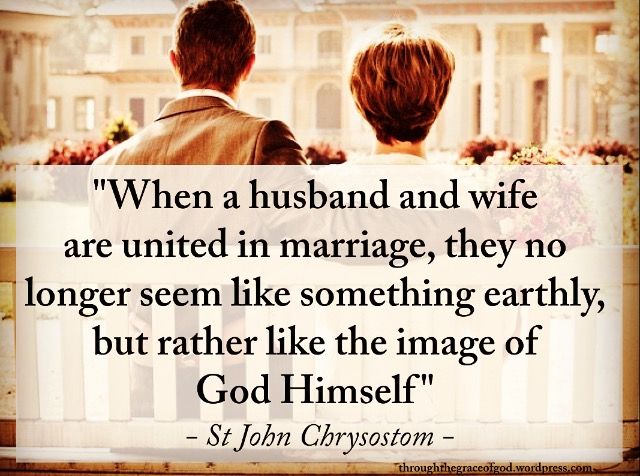
All this action of God is why Jesus says that every marriage is a union that God arranges. When Jesus is asked about divorce by the Pharisees, He quotes Gen. 2:24 and says, “What God has joined together, let not man separate” (Mt. 19:6). And here is why this is important for you. To those of you who are married, and to those of you who will, one day (God willing) be married, you don’t ever have to wonder if you made a mistake along the way. When you are married and look at your spouse, you can always know that your marriage is God’s will for you. God is the One who joined you together as husband and wife. And this is also why being widowed is so painful. When a spouse dies, part of the living spouse is gone. So, God be praised that Christ has come to undo the curse of sin and death.
Also, because God joins husband and wife together, you can know that your marriage is good in the eyes of God. He joined you together, and everything that God does is good. Even when things are hard, this is a sign that your marriage is good because the devil attacks all good things that God has given. In our day, marriage is viewed cynically as some sort of outdated, antiquated institution. Sadly, a lot of people think marriage is restrictive, boring, and painful.
But study after study after study shows that marriage is much more likely to lead to fulfillment and happiness than any other alternative. All the surveys indicate that the number of couples who are happy in their marriage is extremely high. Studies also show that, even of those who are not happy in their marriage, two-thirds of them will become happy if they stay together. There’s a lot of talk today about believing science. Well, the science clearly shows that marriage is much more fulfilling, rewarding, and joy-bringing than what most people think.
Marriage is hard work, but even that is good. Any married couple can tell you this. Sometimes people think that the best marriages happen without any work or effort and when the couple is perfect and completely compatible with each other. And this leads people to think that the best marriages allow each person in that marriage be simply be themself and never change. But love, true love, doesn’t come naturally or easily. Love is work. Love is effort.
If we were perfect, sure, love would be easy. But every husband is an imperfect man, and every wife is an imperfect woman. Everyone here, including myself, we are all imperfect. Each of us is self-centered and self-absorbed. And this isn’t good. Our selfish nature hurts ourselves and those around us, and our self-centeredness never leads to more happiness for ourselves. It leads only to more pain and misery.
But know this: we are most fulfilled when we are emptied of ourselves and pour ourselves out in love and service to another person. People are happiest when they are serving and giving. And God has given no better setting to serve someone else than in marriage.
Yes, marriage is hard. The sinful self revolts against the changes and sacrifices that marriage requires. No two sinners are compatible. Any parent knows that when you put two kids together in a room, it only takes a while for the self-centeredness of each to take over. So, don’t despair if your marriage gets hard. Instead, rejoice because God loves you and has put you into the institution of marriage so you can have Him working on you through your marriage.
Finally, no consideration of marriage would be complete without the truest picture of marriage – Christ and the Church. At the end of Ephesians 5, Paul quotes v. 24 of our text, “Therefore a man shall leave his father and his mother and hold fast to his wife, and they shall become one flesh.” Then, Paul says something absolutely wonderful. He writes, “This mystery is profound, and I am saying that it refers to Christ and the Church” (Eph 5:32).
Dear saints, you are the Bride of Christ. You were formed from what Christ did on the cross. God put Jesus, your Savior, into the sleep of death. And from His pierced side, came water and blood. From that water, you are given the new birth from above, and from that innocent, forgiving blood, you are saved. God has made you to be bone of Christ’s bone, and flesh of Jesus’ flesh. Because of what Jesus has done, you can and do stand before the holy God unashamed, righteous, holy, blameless, and innocent. God be praised! Amen.
The peace of God, which surpasses all understanding, will guard your hearts and minds in Christ Jesus. Amen.
In the name of the Father and of the Son and of the Holy Spirit. Amen.
When Jesus is asked what is the great commandment in the law, He answers by giving a summary of all the Commandments (Mt. 22:34-40), “You shall love the Lord your God with all your heart and with all your soul and with all your mind. This is the great and first commandment. And a second is like it: You shall love your neighbor as yourself.”Commandments 1-3 are summarized as “Love God,” and Commandments 4-10 are summarized as, “Love your neighbor.” And Scripture boils down the law even further in Ro. 13:10 which says, “Love is the fulfilling of the law.” In other words, if you want to keep all the Commandments, love.
We think that the word ‘love’ is such a nice word and much easier to do than to keep all the Commandments. But the word ‘love,’ rightly understood, requires everything. Jesus says, “Greater love has no one than this, that someone lay down his life for his friends”(Jn. 15:13). If you keep a ‘to do’ list and included Christ’s requirements to love God and neighbor, you can never ever check them off as completed.
The devil is always working to tear apart what God has created. Satan is always trying to bring chaos where God has made order. We see this clearly in the 6thand 7thCommandments tonight.
With the 6thCommandment in particular (but with all the commandments really), the devil is trying to drive a wedge between the Ten Commandments and the summary of the law – love. Here is how the devil has worked to bring chaos and disorder to our lives and our society. Today, many people who claim to be Christians will say that we can just ignore the 6thCommandment about adultery. They claim that instead of calling people to repent of their sins (especially when it comes to homosexuality and fornication) we should just love them. That is not love. The devil tries to twist real love into something much less, tolerance or acceptance.
If someone is breaking the 5thCommandment about murder by ruining their life with destructive, harmful drugs, it is not loving to accept them for who they are. They need real love. They need to be called to repentance and the forgiveness that Christ freely gives.
The devil tries to twist our understanding of the word ‘love’ and weaponize it against the Commandments. So, we need to recognize that the Commandments are a full description of what love looks like. The first three Commandments, the first table of the Law, tells us what love for God looks like. It is to have no other gods, to pray in God’s name, and to hear God’s Word. The 4-10thCommandments tell us what love for the neighbor looks like. It is to honor parents, to help our neighbor when he has any need, to lead a chaste and pure life, to assist our neighbor with his property, to defend our neighbor’s name, and to not covet what our neighbor has. So, let’s move to…
The 6th Commandment Thou shalt not commit adultery.
What does this mean? We should fear and love God so that we lead a chaste and pure life in word and deed, and that husband and wife love and honor each other.
Our Old Testament text (2 Sam. 11:1-17) shows how we never break the Commandments in a singular way. It started when David broke the 10thCommandment and coveted Uriah’s wife. David’s sin then moved to committing adultery, breaking 6thCommandment. Then to breaking the 5thCommandment by murdering Uriah. David certainly was not truthful in his actions, so he broke the 8thCommandment. All of this was also breaking the 7thCommandment by stealing Uriah’s wife. It also broke all the first table of the Law as well. Today, breaking the 6thCommandment about adultery is still often followed by breaking the 5thCommandment about murder. Eighty-five percent of women getting abortions are single.
Our culture is almost completely numb to the accusations of the 6thCommandment, and that includes Christians. So, rather than simply detailing the sins of pornography, fornication, homosexuality, transgenderism, etc., I want you to see how greatly God honors marriage and wants to protect it.
First of all, marriage was a gift of God that came before God instituted either the church or the government. So, after life, marriage is the first thing God protects with a Commandment.
Couples, your marriage is to be a picture of Christ and the church. Ephesians 5:31-33says, “’Therefore a man shall leave his father and mother and hold fast to his wife, and the two shall become one flesh.’ This mystery is profound, and I am saying that it refers to Christ and the church. However, let each one of you love his wife as himself, and let the wife see that she respects her husband.”
If you are married, let your marriage be a relationship of continual forgiveness, like Christ and the Church. If you are not married, know that the most precious gift that God will give you after your life is a spouse. Lead a chaste and pure life now to protect marriage in the future – even if it is not your marriage.
The 7th Commandment Thou shalt not steal.
What does this mean? We should fear and love God so that we do not rob our neighbor of his money or property, nor bring them into our possession by unfair dealing or fraud, but help him to improve and protect his property and living.
In the 7thCommandment, God protects your stuff. God has given you everything you have, and He wants you to have it. God wants you to have stuff, though, not just so you can accumulate piles of wealth for yourself. Instead, God gives you stuff to serve your marriage, your family, your life, etc.
Don’t start patting yourself on the back if you haven’t shoplifted or broken into someone’s car and taken their purse. When you are at work, are you working and attentive to your tasks? When your boss pays you for an hour of work, have you worked that whole hour, or are you stealing from your employer? When you see that someone has a need, have you been greedy with what God has given you and stolen from the poor? Repent.
Repent and know that Jesus is the divine thief who has stolen from you. Jesus took what was yours – He is the Lamb of God who takes away the sin of the world. But in an amazing twist, Christ’s thievery is actually a keeping of the 7thCommandment. By becoming sin for you, Jesus has given you everything – mercy, forgiveness, resurrection, and eternal life with Him.
As we sang earlier, “The world seeks after wealth and all that mammon offers yet never is content though gold should fill its coffers. I have a higher good, content with it I’ll be; my Jesus is my wealth. What is the world to me!” Amen.
The peace of God, which surpasses all understanding, will guard your hearts and minds in Christ Jesus. Amen.


 Pastorsamwise
You must be logged in to post a comment.