Luke 14:15-23
15 When one of those who reclined at table with him heard these things, he said to him, “Blessed is everyone who will eat bread in the kingdom of God!”
16 But he said to him, “A man once gave a great banquet and invited many. 17 And at the time for the banquet he sent his servant to say to those who had been invited, ‘Come, for everything is now ready.’ 18 But they all alike began to make excuses. The first said to him, ‘I have bought a field, and I must go out and see it. Please have me excused.’ 19 And another said, ‘I have bought five yoke of oxen, and I go to examine them. Please have me excused.’ 20 And another said, ‘I have married a wife, and therefore I cannot come.’ 21 So the servant came and reported these things to his master.  Then the master of the house became angry and said to his servant, ‘Go out quickly to the streets and lanes of the city, and bring in the poor and crippled and blind and lame.’ 22 And the servant said, ‘Sir, what you commanded has been done, and still there is room.’ 23 And the master said to the servant, ‘Go out to the highways and hedges and compel people to come in, that my house may be filled. 24 For I tell you, none of those men who were invited shall taste my banquet.’”
In the name of Jesus. Amen.
Our God is a God of order (1 Cor. 14:33; Heb 13:20). Because God is eternal, all-powerful, and all-knowing, God is never surprised, never caught off guard. He is always prepared, always ready. This is very basic stuff, but it is good to dwell on it for a bit.
When God created the universe, He didn’t create cows until everything was ready for cows. God waited until the sixth day so cows would have grass, land, atmosphere, and light. God didn’t create fish or birds until He had created the sky and sea for them to dwell in. And God didn’t create Adam and Eve until very last so that they could be brought into a perfectly prepared world and perfectly prepared Garden. God made everything ready for them.
We can go further. When God sent the Flood in Noah’s days, God patiently waited for Noah to build the ark so that it would be ready to save his family and the animals. When God sent Jacob’s family into Egypt, God made everything ready by first sending Joseph down to Egypt so he could rise to power and provide food and a good, safe place for God’s chosen people. And God doesn’t bring His people out of Egypt until the Promised Land is already flowing with milk and honey.
When God drove the inhabitants of Canaan out so His people could dwell there, He doesn’t do it all at once. God said that He would drive the idol-worshipping pagans out little by little so the wild beasts wouldn’t become too many (Ex. 23:29-30; Dt. 7:22-23). On top of that, God also said that would first make the people afraid of the Israelites (Ex. 23:27-28). And when His people got to Jericho, that is exactly what Rahab said had happened (Josh. 2:9-11). God is never in emergency mode. He always makes everything ready.
But even above and beyond all of that, God makes sure that everything is prepared and ready when it comes to the salvation of sinners. Galatians 4:4-5 says, “But when the fullness of time had come, God sent forth his Son, born of woman, born under the law, to redeem those who were under the law, so that we might receive adoption as sons.” God is always ready.
In this parable, Jesus tells us about God’s plan of salvation. The man giving the banquet in this parable had sent out invitations. You can think of this as a “save the date,” even though no exact date was given. The people are simply invited by the host, “I’m going to have a feast, and you are invited.” And the people respond, “Sounds great. We’ll be sure to come when you call us.” That is understood in v. 16.
This initial invitation is God’s repeated promise to send the Messiah, His Son, our Savior, Jesus Christ. God repeatedly invited people to come to Him through Christ, but He didn’t announce exactly when Jesus would arrive.
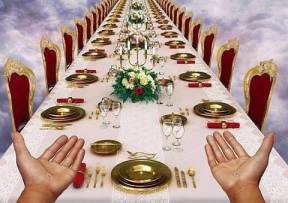 So, the man has sent out this invitation without saying exactly when the banquet would begin. Then in v. 17, the preparations are finished – the food is cooked, the table is set, the decorations are hung, the wine is poured, everything is ready. The man sends his servant to tell all those who were invited, “Come, for everything is now ready.” But they all make excuses, and their excuses are lame and stupid.
No one buys a field without looking at it first to see if it is worth the asking price. No one buys a yoke of oxen without checking if they are old, decrepit, and sickly. And you just got married? Well, bring your wife, you simpleton! Your host won’t mind. Besides, this banquet will be a more exquisite honeymoon than you could afford or imagine.
Now, we need to pause here because a question lies before us: What things keep you from the long-prepared banquet? What do you value more than the kingdom of God? What are your excuses? It doesn’t matter what excuses you have; they are just as lame and stupid as the ones offered in the parable.
Is your schedule so full that you can’t eek out time to pray and study God’s Word for yourself or as a family? God sees that as a rejection of Him. Do you not come to church everySunday because it is your only time to sleep in or because that is when the tournament is scheduled? God sees that as a rejection of Him. Do you withhold your tithe because you don’t know how you would be able to make ends meet even though you can always justify all other kinds of frivolous spending? God sees that as a rejection of Him.
Hear what the master of the feast says, “None of those who were invited shall taste my banquet.”
Repent. Your excuses are all statements that you are perfectly happy and fine as you are and that don’t need a banquet. Confess your excuses for despising the things of God as what they really are – a rejection of the God who personally loves you.
Confess yourself to be poor and unable to pay the debt you owe to God. Confess yourself to be lame and cripple and unable to walk in the way that God’s Law demands. Confess yourself to be blind and unable to grasp the depth of your sin and the heights of God’s mercy toward you.
When beggars – the poor, lame, cripple, and blind – get invited to come to a ready feast, they come. God loves you and has made everything ready for you. God’s feast is ready, and His feast is not sometime in the future. His feast is now.
Jesus tells this parable while He is at a feast. Jesus had just told His host, “When you give a dinner or a banquet, do not invite [people who can] invite you in return and you be repaid. But when you give a feast, invite the poor, the crippled, the lame, the blind, and you will be blessed, because they cannot repay you. For you will be repaid at the resurrection of the just” (Lk. 14:12-14).
Immediately after Jesus says that, another guest responded to Jesus, “Blessed are those who will eat bread in the kingdom of God.” Then, Jesus tells this parable in response to that statement. Now, if you take that statement, “Blessed are those who will eat bread in the kingdom of God,” out of its context, that blessing, that benediction, that beatitude is one-hundred percent true. But in context, that statement is damnably ludicrous.
Whoever it was who said it was, at that exact moment, eating and drinking with Jesus, God in the flesh. The blessing he spoke of was not something in the distant future that would happen eventually. It was already present with him, and he completely missed it.
Because Jesus was there, the kingdom of God was there. The feast was ready, and that man made an excuse to not enjoy what had been made ready for him.
Last week, we heard the parable of Lazarus who desired to eat from the rich man’s table. But God blessed Lazarus in his poverty, hunger, illness, and loneliness. Lazarus’ dissatisfaction with the world made him dependent upon God and ready to receive the joys and comforts of heaven for eternity. This week, we hear a parable of people who have no desire for food. They have been invited to a banquet that is ready, but they are full of excuses.I said it before, but I’ll say it again: When beggars – the poor, lame, cripple, and blind – get invited to come to a ready feast, they come.
We started with the premise that God is always ready. Ready to have mercy, ready to save those who are lost, and ready to usher them into His feast. The only thing that will keep you out of His banquet is your stubborn unwillingness to recognize your need and His gracious invitation.
Sinner, your sin has made you unworthy to come to God’s feast. And God could have made a lot of excuses for leaving you out of His heavenly banquet, but He didn’t. It is His good pleasure to give the kingdom to those who are unworthy.
 Christian, God has ushered you into His paradise. You receive the benefit of the sacrifice of Christ’s death. You are promised the resurrection. And, now, in this feast you are about to receive, God nourishes you and declares you to be the object of His love and His perfect bride.
Your God says to you, His beloved, “Come for everything is now ready.” Amen.
The peace of God, which surpasses all understanding, will guard your hearts and minds in Christ Jesus. Amen.

 There were ten fishermen – five wise who wore their life jackets the whole time they were on the boat and five foolish who drown because they figured they would have enough time to put them on when the storm hit.
 And remember that as the end approaches, as you continually see signs of Christ’s return, remember what that means for you. Christ says it means your redemption is drawing near (Lk. 21:28). The bridegroom is coming, and you are His bride. Jesus has purchased and redeemed you so that you are without spot, wrinkle, or blemish (Eph. 5:27).
 Pastorsamwise
You must be logged in to post a comment.