Holy Work – Sermon on Matthew 20:1-16 for Septuagesima

Listen here.

Matthew 20:1-16

1 “For the kingdom of heaven is like a master of a house who went out early in the morning to hire laborers for his vineyard. 2 After agreeing with the laborers for a denarius a day, he sent them into his vineyard. 3 And going out about the third hour he saw others standing idle in the marketplace, 4 and to them he said, ‘You go into the vineyard too, and whatever is right I will give you.’ 5 So they went. Going out again about the sixth hour and the ninth hour, he did the same. 6 And about the eleventh hour he went out and found others standing. And he said to them, ‘Why do you stand here idle all day?’ 7 They said to him, ‘Because no one has hired us.’ He said to them, ‘You go into the vineyard too.’ 8 And when evening came, the owner of the vineyard said to his foreman, ‘Call the laborers and pay them their wages, beginning with the last, up to the first.’ 9 And when those hired about the eleventh hour came, each of them received a denarius. 10 Now when those hired first came, they thought they would receive more, but each of them also received a denarius. 11And on receiving it they grumbled at the master of the house, 12 saying, ‘These last worked only one hour, and you have made them equal to us who have borne the burden of the day and the scorching heat.’ 13 But he replied to one of them, ‘Friend, I am doing you no wrong. Did you not agree with me for a denarius? 14 Take what belongs to you and go. I choose to give to this last worker as I give to you. 15 Am I not allowed to do what I choose with what belongs to me? Or do you begrudge my generosity?’ 16 So the last will be first, and the first last.”Laborers in the Vineyard getting paid

In the name of Jesus. Amen.

To get at the main point of this parable, I’m going to borrow an analogy. Imagine two waitresses working at a small cafe by themselves. Suddenly, a man brings in eighty of his family members to celebrate an occasion, and those two waitresses have to serve this massive, unexpected crowd. One of the waitresses works hard the whole time. She does her best to get all the drinks and orders. She puts in the effort to make sure all the plates are served to the correct spots. She attempts to keep the glasses full of refills. She promptly comes to wipe up a spill. And even though she is flustered, she does all of this with a friendly smile on her face.

The other waitress is angry about the whole ordeal. She’s mad that such a large party didn’t call ahead to let them know they were coming so the restaurant could be properly staffed. She grumbles when extra napkins are requested. She intentionally lets some of the food sit for several minutes after it was prepared so that it isn’t hot when it is delivered to the table. And she interacts with the party as little as possible and pretends not to hear certain requests. This second waitress actually made the evening more difficult for the first, so difficult, in fact, that it would have been easier for the first waitress to do the whole thing herself.

When the party is ready to leave, the man who brought everyone in walks up to both waitresses and hands each of them a handsome 30% tip. Which of the two is going to complain? Right. The first. She would have preferred for the man to give her a 15 or even 10% tip so long as the second waitress got stiffed. She would rather get less if it meant that all her effort was recognized and appreciated.

Jesus Laid in the Tomb 1Dear saints, welcome to the kingdom of heaven. In the kingdom of heaven, you are never rewarded based on your works or efforts because, if you received what you deserved, you would be sent straight to hell. In the kingdom of heaven, there are no formulas or set, hourly wages. You are given to based solely on the merits of Christ’s work for you. He is the only one who can say that He bore the burden of the day and the scorching heat. His atonement, His mercy, His grace is what you get, nothing less. Because of God’s unmerited, unearned, undeserved, unconditional love freely given to you for the sake of Christ, you are an heir of the kingdom of heaven. God be praised!

That’s the main point of the parable. The sermon could end here, but it won’t. There are other points in the parable. Yes, they are minor points, but I have four that I know will be helpful and comforting to you today. So, I’d like to draw them out a little bit. And these points all come from a small phrase in the parable from v. 6that never jumped out at me before. Notice in that verse that when the master goes out at the eleventh hour, just before the sun begins to set and working day is ending, the master finds more people standing there in the marketplace waiting to be hired and asks them, “Why do you stand here idle all day?” Did you catch it?

“All day.” It means the guys hired at the very end of the day had been there all along. I can’t tell you how many times I’ve studied, taught, and preached on this parable, but I kept missing that phrase. I had figured these guys were lazy. I thought maybe they slept in, maybe they were trying to avoid working during the hot part of the day. But that’s not the case! They were there early in the morning, at dawn, when the master first went out to hire workers. And they were there at the third and the sixth and the ninth hour when he came. Most people would have given up and gone home around the sixth hour (which is noon). But no. When the master asks why they have been standing there idle all day, they say, “Because no one has hired us.”

Here’s the first point we can draw from that: no one who got paid their denarius at the end of the day decided on their own to go work for the master. Every one of them was called and sent only by the initiative of the vineyard owner. No one volunteered themselves for labor when he came, and no one went to knock at his door to ask, “Would you hire me to work in your vineyard?” Nope. good-friday-jesus-comes-to-rescueEach of them was called, and each of them was called at the precise time the owner called them. He went and retrieved them.

So, if you are a worker in the Lord’s vineyard, if you have been called into the service of the kingdom of heaven, i.e. if you are a Christian, you were called by God. Period. He came. He gave you work to do. You didn’t seek to work for Him. God called you into His service when it pleased Him. Some, God brings in early and has them work the whole day, but for some reason – a reason known only to God – He brings others in a later, at the third, sixth, ninth, and eleventh hour. If it had pleased the master to hire all of them at dawn, he could have.

Which brings us to second point. if you think that you are one of the early hires, if you have been a Christian your whole life and faithfully carried out your vocations, if you have been tempted at times to grumble for all your hard work or tempted to pat yourself on the back for what you have accomplished, be careful. Remember that it was not you who offered up yourself to work. You were called by the grace of God. “By grace you have been saved through faith. And this is not your own doing; it is the gift of God, not a result of works, so that no one may boast. You are his workmanship, created in Christ Jesus for good works, which God prepared beforehand, that you should walk in them” (Eph. 2:8-10).

Know this. God is pleased with your work. He designed all those works for you, and He laid them all out before you to serve those who needed God’s work offered through your hands. You will be rewarded, and you will be rewarded far better than you deserve.

The third point: Maybe you think that you are one of those who were called to work late. Maybe you are saddened by how much time you wasted pursuing a life of pleasure for yourself. If you think, “How much more good could have I done if I hadn’t been so foolish? If I had been studying Scripture earlier, I could have been of better service.” Dear saint, don’t get discouraged. easte-jesus-brings-us-out-of-deathGod had a reason for bringing you in when He did. Trust His timing. He brought you into His vineyard exactly when He wanted you.

The fourth point is also along those lines, and I know it will be comforting to many of you, so listen up! If you have been praying for someone who is not in God’s vineyard, or if you have been aching for someone who was once in the vineyard but left – maybe it is a friend or relative. If it seems like your prayers and efforts have been wasted, take courage. Don’t stop praying for them. Yes, God calls some early, but some aren’t called into the vineyard until later. Some are called so late that they only arrive in time to get paid which means they do no more than receive their gracious reward. Be comforted. God has His own timing. Keep praying.

One more thing. I know the most common way the different hours that the workers get hired is understood to be a time in each individual’s life. When it is interpreted this way, the workers hired first represent people who have been Christians their entire lives. They were given faith in baptism and continued in that faith until they died. Those who were hired at the third, sixth, and ninth hour are commonly viewed as those who came to faith later in life – as youth, adults, and seniors. And those hired at the eleventh hour are the deathbed converts. That seems to be a legitimate way to understand that detail of the parable, in fact, that is how this sermon has interpreted that detail up to now.

However, remember this parable is about the kingdom of heaven. 1 John 2:18, written almost two-thousand years ago, says that it is the last hour. In the book of Revelation, we get repeated pictures of the saints who have died and entered into glory, and they are still working by praying for us (Rev. 6:9-11). Also, consider Hebrews 11 that uses the faith and deeds of the Old Testament saints to encourage us. Then, Hebrews 12[:1-2] gives us a picture of the great cloud of saints surrounding us and cheering us on to keep walking in faith. And Revelation 14:13 says that those who die in Christ are blessed because they now rest from their labors, but – and this is the point – their deeds follow them.

Considering all of that, none of us can claim to be those who worked through the heat of the day. Rejoice that God is merciful and has and will continue to give to you far better than you deserve. But also, be encouraged because this means that your labor in Christ is never wasted and is valuable work that lives on after you are gone. Think of the labor done by the authors of Scripture – Moses, David, Isaiah, Matthew, John, and Paul– their labor continues to reap results for the kingdom of God today.

Great Multitude with white robes washed in the blood of the lambAnd it isn’t just their work. Your work, done as a Christian, is holy work. Fathers and mothers, the work you do day in and day out will reap results in the lives in your children, grandchildren, and great-great-great-great grandchildren if Christ tarries. But it will also reap results in the lives of others whom you will never meet because you have shined the light of Christ to those you have met, and they will shine that light elsewhere. You Sunday school teachers, you who are praying for and encouraging our youth, you trustees who are caring for our facility, and everyone who is here encouraging another person is offering holy work that will be used by God until Christ returns. Everyone has a story of being impacted by someone else long after that person has entered into glory. So, take heart, and keep working. The labor that God has called you to is fruitful, holy work. It is holy work that God will multiply and expand. For that, God be praised. Amen.

The peace of God, which surpasses all understanding, will guard your hearts and minds in Christ Jesus. Amen.

Holy Peace Dwelling with Us – Sermon on Luke 2:1-20 for Christmas Eve 2019

Listen here.

Grace, mercy, and peace be to you from God our Father and from our Lord and Savior, Jesus Christ. Amen.

Dear saints, merry Christmas!Incarnation Icon Tonight, and all the days of your life, you can celebrate the fact that Jesus is born. God has taken on your flesh to save you. He has come in your likeness, born of a woman, in order to deliver you from your sin.
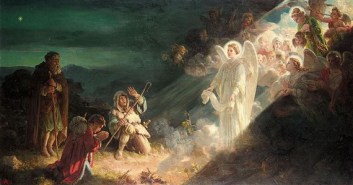
This Gospel text is one of the most familiar passages for Christians. As it was read, you could probably finish most of the phrases from memory, and that is good. But that familiarity can bring with it a loss of the wonder, awe, peace, power, and glory that this text has for us.

Whenever we read the Scriptures, we should be looking for the unexpected. But our familiarity with the text means that almost nothing is unexpected, at least not anymore. We’re so familiar with it that we aren’t surprised even though there are surprises at every turn. It’s surprising that God uses something as normal as a census and taxes to bring Joseph and Mary to Bethlehem to fulfill His promise that the Messiah would be born in the city of David (Mic. 5:2). It is surprising, and saddening, that none of Joseph’s relatives had a place for him and his laboring wife to stay which meant they ended up delivering their Son in a barn. Though those things are familiar to us, they are still shocking, unexpected, and are worthy to have us to pause and consider them more closely. However, tonight we are going to focus on what happens outside of Bethlehem in the fields so that we get a fuller picture of what happened in Bethlehem.

Glory appears to the ShepherdsLuke tells us that those shepherds, who were minding their own business, suddenly found themselves surrounded by the shining, dazzling glory of the Lord. The surprising, unexpected thing is not the existence of God’s glory. God’s glory shining is something that happens throughout the Scriptures.

The glory of God led Israel out of Egypt, but God’s glory was veiled and hidden in a pillar of cloud by day and a pillar of fire by night (Ex. 13:21-22). That same glory, veiled in a cloud, descended on Mt. Sinai when God spoke to the people to give them the Ten Commandments (Ex. 19:9, 16-17). Even though God’s glory was hidden behind the cloud, the people were so afraid of God’s glory that they asked Moses to tell God to not speak directly to them anymore (Dt. 18:15-19). God’s voice along with His glory, even when it was concealed by the cloud, was too much for them to behold.

But God’s glory continued to be with His people. When they built the Tabernacle, that same cloud entered the Tabernacle. And it was this glory of God that led the people through the wilderness during the Exodus. Whenever the cloud would stop, the people would set up their camp and stay there until the cloud was taken up and led them further (Num. 9:17-22).

Every time the people set up their camp, the cloud would enter into the most holy place in the Tabernacle. And God gave strict instructions to Aaron, the high priest, that he wasn’t to enter the holy of holies any time he wanted or else he would die (Lev. 16:2). And even when Aaron, and the high priests after him, were allowed to enter the holy of holies on the Day of Atonement, those high priests were told to burn incense and make a cloud of smoke to serve as an additional barrier between them and the holy presence of God (Lev. 16:12-13).

Glory in Solomon's TempleThis went on for centuries until the King Solomon finished construction of the Temple. When the Ark of the Covenant was brought into the Temple, the cloud descended into the most Holy Place, and the priests had to leave because God’s glory filled the Temple (1 Kgs. 8:10-11; 2 Chron. 5:13-14). God no longer dwelt in the tent of the Tabernacle; now, He dwelled in the house of the Temple which was where heaven and earth intersected. And still, year after year, the high priest would enter the most holy place be the representative of the people and meet with God behind the smoke made by the incense and the cloud that subdued God’s glory (Ex. 25:21-22).

But year after year, God’s people kept serving other pagan gods which defiled them and God’s Temple. And though God repeatedly warned them about their sin, they refused to trust in God alone. So, God sent His people into exile in Babylon. And it was in Babylon that Ezekiel had a vision of the Temple. In that vision, Ezekiel saw the glory of God in that cloud leave the Temple (Ezek. 10:1-19). And shortly after this, Jerusalem was destroyed along with the Temple.

God did bring His people back to their land. They rebuilt Jerusalem and the Temple, but when the second Temple was completed, God’s people had a problem. The cloud of God’s glory didn’t return to dwell there (Ezra 3:10-15; 6:16-18). God did not enter that second, rebuilt Temple. For several hundred years, it went on like this. God’s people had the Temple, but God’s glory wasn’t seen. So, the people didn’t know if God was there for them as He had been with them in the past. Because God’s glory had not entered the Temple, there was confusion and doubt. The people wondered, “Has God forsaken us forever?” And this was a legitimate question.

But now here in Luke 2, outside of the Temple, away from Jerusalem, out in a field, the glory of the Lord reappears. But notice, there is no cloud to veil God’s glory. Why was there no cloud? Well, the cloud was no longer necessary.

The cloud had been there to hide the full glory of God so the people wouldn’t be destroyed by God’s holy presence. Now in the birth of Jesus, the full glory of God is still hidden, but not in a cloud. Now, the glory of God is hidden in the infant Jesus lying in a manger.

Dear saints, tonight we celebrate the fact that God has hidden Himself in your flesh. This is the miracle of Christmas. God hides Himself in your humanity so that He can be with you, dwell with you, and reveal Himself to you. God veils His glory in the body of Jesus so that He can appear as your Savior. God hides Himself so that He can reveal Himself as your Redeemer.

We are sinners. To be found by God in His glory and majesty would be our eternal destruction. But there in Bethlehem is God wrapped in swaddling clothes. Empty Manger With Cross ShadowHe is there so He can grow up and walk among us in the towns and streets of Galilee, Judea, and Jerusalem. He is there so He can be betrayed, arrested, beaten, tried, crucified, loaded up with your sin, die, and rise again.

This is how your God is for you. God does not approach you with His consuming holiness. He hides His holy glory, and He comes in peace so that He can clothe you in His holiness. And clothed in that holiness, you are now the temple of the Holy Spirit who dwells within you (1 Cor. 6:19). God continues to reveal His glory to all creation through you, Christian (Ro. 8:21). Because of what Christ has done for you by making you holy, heaven and earth continue to overlap as God’s glory shines through you (Mt. 5:14-16).

So tonight, we join our voices with the heavenly choir. “Glory to God in the highest, and on earth peace to you.” Behold Christ’s glory which is full of grace and truth. From this Jesus, you receive grace upon grace. For your God is pleased to well with you now and forever. Amen.

The peace of God, which surpasses all understanding, will guard your hearts and minds in Christ Jesus. Amen.

Living in Holy Light & Being Holy Light – Sermon for Midweek Advent 3 2019

Listen here. (The first 30 seconds of tonight’s sermon were not recorded. The missed portion was simply a summary of the previous weeks’ messages.)

The texts for tonight’s service were Isaiah 60:1-5; 2 Corinthians 4:6-12; and John 1:1-14.

In the name of Jesus. Amen.

Tonight, we are continuing the theme from 1 Timothy 4:4-5, “Everything is made holy by the Word of God and prayer.” In the first of these Advent sermons, we considered how God, the Holy One, makes us holy through His Word which cleanses and sanctifies us (Jn. 15:1-5; 17:17). Last week, we saw how God initially created all things good, but nothing created was holy by itself – nothing is inherently or intrinsically holy. So, God places His holy name upon us in our Baptism which makes us holy so we can be in His presence. This not only gives us access to God’s presence, it actually makes us a temple of the Holy Spirit who dwells in us (1 Cor. 6:19). This means, Christian, that you are no longer common. Now, you are sacred.

Tonight’s sermon will give us the picture of what our sacred life looks like according to Scripture especially from the Epistle lesson (2 Cor. 4:6-12). Paul is using imagery that was very common in his day, lamps. In the verses leading up to that text, he says that the Gospel – the good news that our sins are forgiven because of Jesus’ birth, life, death, and resurrection – is a light (2 Cor. 4:1-5). Then our text picks up that image. Look at those verses while I read and comment on them:

The God who said, ‘Let light shine out of darkness,’ has shone (Where?) in our hearts. (Why?) To give the light of the knowledge of the glory of God. We have this treasure – the treasure of God’s glory – in jars of clay.

These jars of clay are the lamps people used in New Testament times. Back then, houses were lit up, not by flipping on a switch but by little clay lamps filled with olive oil. Those clay lamps (or jars) had a small hole for a wick that floated in the oil and fed the flame.

So, God’s holy presence is in us. We have the treasure of His glory and power, but that holiness, that sacredness, that power, and that glory is hidden. You can’t see it just like you couldn’t see the oil inside of that clay lamp. But you know that oil is there as long as the wick continues to burn. If you lit a wick that didn’t have any fuel feeding it, that wick would burn up quickly. But when that wick has fuel, it will burn for hours and hours. Imagine that you didn’t know about the oil in the lamp, you would be surprised at how long the wick can burn.

Back to v. 7, we have this treasure hidden in jars of clay (Why?) to show that the surpassing power belongs to God and not to us. To close out this picture, Paul says that the life we have in Christ is reveled and shown in our suffering. Listen to v. 8-9, “We are afflicted but not crushed. Perplexed, but not driven to despair. Persecuted, but not forsaken. Struck down, but not destroyed.” When we endure suffering, others are able to see this surpassing power of God because of how it is manifested.

Afflictions do not crush us. Instead, they cause us to run to God (Ps. 129:2). Things that are perplexing and confusing do not cause us to despair (Ps. 37:32-33). When we have trials, we don’t need to wonder if God loves us – He does! When we are persecuted, we can know that we are suffering the very same things that Christ did. Jesus said, “If they persecuted Me, they will persecute you” (Jn. 15:20). When we are struck down, we turn the other cheek (Mt. 5:39) because we know that our enemies cannot destroy us – Christ has promised (Mt. 10:28). We have died and our life is hidden with Christ in God (Col. 3:1-4).

You see, dear saints who have been made sacred, God’s glory and power given to you is manifested to this world in your weakness for when you are weak, then you are made strong by God’s power (2 Cor. 12:9-10). Our problem is that this is the opposite of what we normally think. In every other aspect of our lives, growing up means that we move from depending on others to becoming independent. When a child can feed herself, walk, is potty trained, able to dress herself, tie her shoes, etc., we see that she is growing up into an independent woman.

The exact opposite is true of spiritual growth. Growing up spiritually means that we become more dependent upon Christ for everything in every situation. As we mature in faith, we learn to borrow all that we need from Christ which means that we grow in holiness.

As God shines the light of the Gospel into you, that light shines out of you so that you are a light to others. Jesus puts it this way Mt. 5:14–16, “You are the light of the world. A city set on a hill cannot be hidden. Nor do people light a lamp and put it under a basket, but on a stand, and it gives light to all in the house. In the same way, let your light shine before others, so that they may see your good works and give glory to your Father who is in heaven.”

God put the light of His Gospel into you so that you would give light to the dark house of this world. Jesus commands that light within you to shine. English cannot do justice to what the Greek does there. Jesus commands the light He has placed within you to shine so that the people of this world would see your good works and give glory to your heavenly Father.

I want to conclude tonight with one more image of what living in this light looks like by considering. Proverbs 3:5-6 (and I’m going to use a translation that might be different from what you are used to[1]), “Trust in the Lord with all your heart, and do not lean on your own understanding. In all your ways know Him, so that He will straighten your paths.”

These verses picture traveling, but it isn’t the normal traveling from one place to another. It is traveling through life. Throughout your life, you travel on many different roads and paths that seem to have little or nothing to do with each other and it can feel like you aren’t getting anywhere. You go from one thing to another, but it feels like you have no destination.

But these verses invite to you to know the Lord in all your ways. What does that mean? It means that He is present with you in everything. Wherever you go, He is there with you. He is your invisible partner and companion. When you woke up this morning, He was there. When you traveled to work or school, as you ate lunch, while you drove here, He didn’t abandon you. He was right there beside you. You have had lots of little journeys today, and the Lord was with you the whole time.

All the paths of today and yesterday and six months ago, and all the paths of tomorrow and every day of your future are all one journey because God is with you every step of the way. In all your ways, know Him, see Him, expect Him. He is there walking with you leading you along the way. You don’t have to map out your own journey, you can simply trust Him because He is there making your path straight.

The biggest problem you have and that I have is that we think we are traveling by ourselves. We don’t even bother to look for Him because we don’t expect Him to be there. But there He is giving us His light, leading us, guiding us, directing us along our paths. This means that all our paths are sacred because of God’s presence.

All the little paths and bits and tasks of your life are not the story of your journey but the story of Jesus’ journey with you. Live your life in His holy light as you radiate that holy light. Amen.

The peace of God, which surpasses all understanding, will guard your hearts and minds in Christ Jesus. Amen.

[1] Translation from Rev. Dr. John Klienig.

The Name That Makes Us Holy – Sermon for Midweek Advent 2 2019

Listen here.

The texts for tonight’s service were Numbers 6:22-27; Ephesians 1:3-14; and Matthew 28:16-20.

In the name of Jesus. Amen.

Last week, we considered how God, the Holy One, makes us holy through His Holy Word which cleanses and sanctifies us (Jn. 15:1-5; Jn. 17:17). Tonight, we are going to look at Scripture and see what this notion of holiness is all about. So, in order to try get an idea what is holy, we are going to look at Leviticus 10:10 to see how God views everything when it comes to holiness.

But before we can do that, we have to remember that when God finished creation, He stepped back and declared everything to be “very good” (Gen. 1:31). Everything created by God is, by God’s declaration, good as the theme verses (1 Tim. 4:4-5) for these services say. Notice that Scripture doesn’t say that God created things and called them ‘holy.’ Nothing created is inherently or intrinsically holy or unclean; instead created things were all created ‘good.’ However, now that we have brought sin into the world, there are various degrees of holiness and impurity. So, Aaron, the high priest and all the priests after him (Ezek. 44:23), were called by God to make distinctions. Look at Lev. 10:10, “You are to distinguish between the holy and the common, and between the unclean and the clean.”

Holiness SpheresGod’s holiness creates three interlocking spheres which I’ve tried to show with this figure.[1] Because God’s holy presence dwelled in the Tabernacle and later in the Temple, those places became the place where the holy God dwelt with fallen mankind (2 Chron. 6:14-21). They served as a bridge between heaven and earth, and specifically the Holy of Holies was where heaven and earth overlapped. So, in this figure, on the one hand, you have God’s holy presence and on the opposite side, there is the state of impurity which is utterly incompatible with holiness. What is unclean and defiled has been corrupted by sin and the devil. But you will notice there is all sorts of space between God’s holy presence on the one side and Satan and the demons on the other side. That is where we dwell.

Here’s the picture: What is holy is clean, but it is possible for something to be clean yet not holy which means it normal or common, which most things are. And something can be common but also unclean or abnormal.

In this ordering, things that are common must be cleansed of impurity before they can come into contact with God and share in His holiness or else, they are destroyed and consumed by God’s holiness. Last week we briefly considered Isaiah’s call (Is. 6:1-7). That event is helpful in understanding this concept.

When Isaiah was in God’s holy presence, he recognized his uncleanness. Isaiah’s lips were death-dealing, disordering, cursing, and made things around him sick. But the angel came with that coal from the altar (Is. 6:6) – which is an important fact because God had said that anything that touches the altar becomes holy (Ex. 29:37). With that holy coal, the angel touched Isaiah’s lips to purify him from his sins. Made holy by God’s declaration, that coal was life-giving, ordering, blessing, and healing so that Isaiah was made clean. After this encounter with God, Isaiah continued to receive God’s holiness as He received God’s Word, and Isaiah even emanated and transferred God’s holiness to others when He preached God’s Word. Even still today you receive God’s holiness that He dispersed through Isaiah as you hear God’s Word when you read the book of Isaiah. Get the picture?

Let’s fill this out a little more. The closer something comes to God, the holier it becomes. Think of it this way: The high priest was more holy than a normal Israelite, even though God had declared His people to be holy and sanctified them (Lev. 19:2; 21:8), because only the high priest could go into the Holy of Holies while the Israelite could only enter as far as the outer part of the Temple. The same thing was true for different sacrifices. Certain sacrifices and offerings, like peace offerings, were holy, but they were less holy than other sacrifices because they were offered outside of the Temple and didn’t ever come into the Temple.

The opposite is true for things or people that were unclean. Some things were desecrated and defiled – like a person who was a medium (Lev. 20:27) or someone who sacrificed a child to Molech (Lev. 20:2). These were so defiled and unclean that God required the death sentence. But other people who were defiled – like someone who touched a corpse (Lev. 11:31-32) or who had a skin disease (see Lev. 14) – were easily fixed and made clean. That person could be purified of the uncleanness and sanctified.

Now, I can hear some of you saying, “Sure, pastor. But that is all Old Testament stuff. Jesus did away with that kind of thinking.” To which I say, “Not so fast!”

In Mark 7[:1-23] Jesus, our great High Priest, continued to teach about what makes a person clean or defiled.[2] It is true that the incarnation of Jesus meant that the location of God’s holiness moved from the Temple building to Jesus’ body (Jn. 2:21-22). And now, Jesus’ death has ripped open the curtain that guarded the Holy of Holies (Lk. 25:45-46), so the focus of defilement is no longer the physical body, but the human heart.

And Hebrews (9:13-14) addresses this as well: “For if the blood of goats and bulls, and the sprinkling of defiled persons with the ashes of a heifer, sanctify for the purification of the flesh, how much more will the blood of Christ, who through the eternal Spirit Hebrews 9_14 - Christ offered Himself without blemish to Godoffered himself without blemish to God, purify our conscience from dead works to serve the living God.”

In Jesus, God’s holiness entered our common realm so that He could cleanse unclean sinners and expel the demons that brought defilement. And the demons recognized Jesus as the holy one of God who had come into the flesh to undo and cast out the uncleanness they brought with them (Mk. 1:21-27). All of this means that God’s holiness isn’t limited to the Temple building anymore.

Jesus’ incarnation, death, resurrection, and ascension has brought about such a cleansing that now you, believer, are the temple of the Holy Spirit who abides in you (1 Cor. 6:19). So, continue to receive God’s holiness.

One more analogy to help get this across: Today was a bright, sunshiny day. There were no clouds on the sky and the sun’s light wasn’t blocked; it came clearly through the sky and bounced off the snow making everything outside bright. If you braved the cold and went outside you were receiving amazing amounts of light from the sun. It isn’t possible to capture that light – bottle it up or something – and have it to use it later in these short, dark days. To keep receiving the sun’s light, you have to be where the sun is. The same is true with God’s holiness. You have to be where God has promised to deliver His holiness to continue in it.

Hebrews 10_19-23 Jesus our High PriestIn Jesus, God has come into this common world and brought His holiness to you. Because of what Christ has done, God has claimed you as His own so that you can live with Him in His kingdom and serve Him in everlasting righteousness. He placed His holy name upon you when you were Baptized. In your Baptism, you were marked with the name of the Father, Son, and Holy Spirit (Mt. 28:18-20). That holiness, given to you in your Baptism, is now continually delivered to you when you hear and believe God’s holy Word. As you hear the word of truth, the gospel of your salvation, you are sealed with the promised Holy Spirit (Eph. 1:13). God continues to place His name on you as He blesses you, keeps you, makes His face shine upon you, and be gracious to you (Num. 6:22-27). Bearing His holy name, you are brought into His holy presence, and radiate His holiness to those around you.

Christian, you are no longer common. Now, you are sacred. You bear the holy name of God throughout creation as you go about your common life in the midst of common people. Made holy by that name, you bring God’s sacred space to those who need purification and sanctification through Jesus’ blood. Rejoice and proclaim that name so that God’s sacred space continues to spread. Amen.

The peace of God, which surpasses all understanding, will guard your hearts and minds in Christ Jesus. Amen.

[1] The idea for this figure came from this paper by Rev. Dr. John Kleinig.

[2] See also what Jesus says when He washes His disciples’ feet in John 13:8-11. And when Jesus, our High Priest, came to wash His disciples’ feet, Peter objected. Jesus responded, “If I do not wash you, you have no share with me.” So, Peter went all in, “Lord, not my feet only but also my hands and my head!” And Jesus responded, “The one who has bathed does not need to wash, except for his feet, but is completely clean.” (See also Jn. 15:3, 17:17-19.)

The Holy One Makes Us Holy – Sermon for Midweek Advent 1 2019

Listen here.

The texts for tonight’s service were Exodus 3:1-5; 1 Timothy 4:1-10; and John 15:1-5.

In the name of Jesus. Amen.

For a little over two years, I have been mulling over those words we heard from 1 Timothy 4[:4-5], “Everything created by God is good, and nothing is to be rejected if it is received with thanksgiving, for it is made holy by the Word of God and prayer.” These words have a profound impact on how we, as God’s holy people, go about our daily lives and interact with the world.

Every home, every marriage, every relationship, every gift, every possession, every day, every night, all our work, all our sleep, all our joys, and all our sorrows: everything is made holy and sacred by God’s Word.

Tonight, we are going to begin a year-long journey considering God’s holiness: how that holiness comes to us, and the implications of what it means to live as God’s sacred people. Now, I know that a year sounds like a long time. It probably is. But when I was at a conference in the beginning of October, one of the pastors who was presenting mentioned that people have to hear something eight times before they begin to latch on to it. (For me, it is probably more like sixteen times.)

So, these mid-week Advent services will serve as an introduction to that theme: Sacred. And through this Church year I will repeatedly draw on this idea. Hopefully, by the end of it all, I will have touched on this theme often enough that we will have a better understanding of how God’s holiness is given to us in our Baptism, maintained by His Word, sustained in us through ongoing faith, and changes the way we interact with everyone and everything around us.

Now, it’s tempting for me to throw everything at you all at once, but I’m going to try to resist that temptation and remind myself that I have a whole year. So, tonight, we will begin by briefly considering how our holy God makes us holy.

God alone is holy, and, apart from Him, nothing is ever holy. We fallen, sinful humans can only be holy if we receive God’s holiness. Just as a flashlight has no energy to shine unless it has batteries, our holiness is completely dependent to being connected with the holiness of God. Our holiness is never our achievement; it is always a gift from God. And, yes, God wants to give us this holiness.

Exodus 3_14 - Burning BushIn our Old Testament lesson tonight (Ex. 3:1-5), Moses found himself standing on holy ground when God appeared in a bush. That bush was burning because of God’s holy presence, and Moses’ curiosity was piqued when he noticed that though the bush was aflame it was not consumed; it didn’t burn up. In the same way, when God’s holiness comes to us, it burns but God does not want us to be consumed by the fire of His holiness. Instead, He wants us to be changed by it.

Consider when Isaiah found himself in God’s presence (Is. 6:1-7). Isaiah saw the Lord high and lifted up, seated on the throne, the train of His robe filled the Temple, and the seraphim called out, “Holy, holy, holy is the Lord of hosts.” Isaiah knew this put him in a bad place. He cried out, “Woe is me! For I am undone; for I am a man of unclean lips, and I dwell in the midst of a people of unclean lips; for my eyes have seen the King, the Lord of hosts.” God’s holiness does two things to Isaiah.

First, God’s holiness revealed and unmasked Isaiah’s sin, and it wasn’t only Isaiah’s defilement that troubled him. Isaiah knew that because he lived among other sinners, their sinfulness and defilement had rubbed off on him making him more unclean and unholy. And God’s holiness was a fire that would reduce Isaiah to ashes. But God would not have it be this way.

Isaiah 6 - Holy Holy Holy Lips CoalSo, the second thing God’s holiness does to Isaiah is rub off on him. God sent one of the seraphs to fetch a burning coal, take it to Isaiah, and touch his lips with it and give a word of promise, “Behold, this has touched your lips; your guilt is taken away, and your sin atoned for.”

God didn’t appear in His holiness to undo Isaiah and destroy him. Instead, God brings Isaiah into fellowship with Him as He forgave and reconciled Isaiah to Himself making Isaiah holy and sacred to go and proclaim God’s Word.

Like Isaiah, we do not ever possess God’s holiness as our own. It isn’t something we can bottle up and store for later. We continually receive and borrow holiness from God, and God isn’t stingy in sharing His holiness with us. He happily and readily gives us His holiness through His Word making us sacred.

We heard this in the Gospel lesson (Jn. 15:1-5) where Jesus tells us that He is the Vine and we are the branches. There, Jesus gives us a beautiful picture of the holy lives we lead. As we abide in Him, who is the Vine, we bear sacred fruit. And God the Father prunes us so what we may bear more of that fruit. But Jesus doesn’t stop there. He tells us that already we are clean (it’s the same word Jesus used which was translated ‘pruned’). And what is the instrument that prunes us and makes us clean? It is His Word.

This means that Jesus doesn’t make us holy and then leave us to continue being holy on our own. Instead, He meets us where we are, calls us through His Word, and by that Word He joins us to Himself. As we abide in Jesus’ Word, He does everything for us and gives everything to us. Jesus invites us to safely approach our holy heavenly Father in faith with Him. Apart from Him, we cannot accomplish anything spiritually. But with Jesus, we stand on holy ground before God the Father in the heavenly sanctuary. Jesus brings heaven to earth for us so that we can live heavenly lives with Him here on earth.

God’s will for us as His children is to be holy as He Himself is holy (1 Pet. 1:14-16). The good news is that God doesn’t expect us to generate our own holiness. Jesus continually doles out His holiness upon us through His Word which makes us and all we do sacred.

More on that in the weeks to come. Amen.

The peace of God, which surpasses all understanding, will guard your hearts and minds in Christ Jesus. Amen.