
Ephesians 4:1-6
1 I therefore, a prisoner for the Lord, urge you to walk in a manner worthy of the calling to which you have been called, 2 with all humility and gentleness, with patience, bearing with one another in love, 3 eager to maintain the unity of the Spirit in the bond of peace. 4 There is one body and one Spirit—just as you were called to the one hope that belongs to your call— 5 one Lord, one faith, one baptism, 6 one God and Father of all, who is over all and through all and in all.
In the name of Jesus. Amen.
What is your impression of or reaction to the following words: unity; inclusion; oneness; togetherness?
They are all good words and concepts, but those words probably throw up some red flags for you. Who doesn’t want unity? Wouldn’t it be great if our country was really the United States of America? No one wants to be excluded and left on the outside. It’s true that the team that plays together wins together. But would you say that we live in a time of unity? Probably not. We’ve gotten used to hearing that we are more divided now than at almost any other point in our nation’s brief history. Some even speculate that we may be on the verge of another civil war. Who knows?
But the more divided, fractured, and fragmented we become, the higher the desire there is for unity. The biggest obstacle to unity in this world, though, just might be the desire and calls for unity. For there to be unity, there needs to be something people are united on. And because the world is full of sinners who all want our own way, we are going to have a difficult time finding a point of unity. The selfishness, pride, and greed around and within us – yes, even in us Christians who still wrestle with our old Adam – will continue to cause division.
Well, this text doesn’t give us any suggestions for bringing unity to our culture or nation. There is nothing here to help us mend the political, economic, racial, and other divisions that we face in our society and culture today. Sorry. There are other passages of Scripture deal with that. Hebrews 12:14 says, “Strive for peace with everyone.” Romans 12:18 says, “If possible, so far as it depends on you, live peaceably with all.” And Philippians 2:4 probably gives us the best advice in achieving peace in our culture when it says to not look only to your own interest but to the interest of others.
Our text today, when it talks about unity and being one, refers to the unity that exists between Christians, and this unity between Christians is twofold.
First, there is a unity that all Christians simply have. We could call this a ‘vertical unity,’ and this unity consists of how sinners are made one with God. All Christians are sinners who by nature were children of wrath (Eph. 2:3). Christians of all time and in all places are united by the one faith in Jesus who is our Savior, the only Savior. Because Jesus is the only Savior, we are united in Christ who is the Way, the Truth, the Life, and the only access we have to God the Father (Jn. 14:6). When the Holy Spirit works faith in us, this unity simply exists.
All Christians believe that Jesus is the Lamb of God who takes away the sin of the world (Jn. 1:29). Through Him, every Christian of every tribe, language, race, and even denomination is united on the confession that Jesus is the Christ, the Son of the living God (Mt. 16:16). Through that Holy Spirit-wrought faith, every Christian is joined to the one holy Christian Church confessing the one hope of forgiveness and eternal life. That means that every Christian is part of the one body with Christ as the head (Eph. 4:15). This unity exists, but we also recognize that this unity is invisible.
This brings us to the second unity, and that is the unity that all Christians are to strive for. We can call this a ‘horizontal unity’ of how we as Christians are united with one another. This unity is of conviction and true confession. We rejoice in the unity we have here in our congregation, and we have been rejoicing in the unity we have with our sister congregation on the other side of the river as we gather together on Wednesdays. But we also rejoice in the unity we have with Christians of other denominations: Lutheran Brethren, AALC, Missouri Synod, ELS, ELCA, Evangelical Free, Covenant, Baptist, Methodist, Presbyterian, Assembly of God, Catholic, and I could go on and on.
Now, even as I mention all those different church bodies, you are probably thinking, “Pastor, aren’t all the different denominations a sign that we Christians are not united?” To a degree, yes. But there is also something counterintuitive about all the different denominations is actually a sign of our unity.
Now, please bear with me as I flesh this out. Go back to the first unity, our vertical unity. All Christians have one Lord, one faith, one Baptism. But one of the things that divides the various Christian denominations and disrupts that horizontal unity is what the different church bodies believe and teach about Baptism. Here at Christ the King, we teach that Baptism is God’s work where He forgives sins (Act. 2:38), joins us to Jesus’ death and resurrection (Ro. 6:3-11), gives us the new birth (Jn. 3:5), and saves us (1 Pet. 3:21). Many Christians (and please note that I am calling them ‘Christians’) who attend other churches do not believe that is what the Bible teaches about Baptism. They will say that Baptism is something a believer does for God as an outward expression of an inward change.
The Bible does not teach both of those things. Those two doctrines cannot both be true. One is right, and the other is wrong. And it would be wrong and even sinful for either us or other Christians who believe differently to say, “Well, it doesn’t really matter what we believe about Baptism.” It does matter. What we believe about Baptism matters because Scriptures teach us about Baptism. And Jesus tells Christians to keep and observe all that He has said to us in and through the Scriptures (Mt. 28:20). Just a few verses after our text, Paul tells us to “not be tossed to and fro by the waves and carried about by every wind of doctrine” (Eph. 4:14). God wants us to be rooted and grounded so that we rightly handle His Word of truth (2 Tim. 2:15).
Christians want to stay true to what the Scriptures teach. The only way we can stay true to what the Scriptures teach is to continue to grow in our knowledge of the Scriptures. That is why it is important for you, Christian, to keep learning and diving into the Scriptures that are inspired by God and profitable for teaching, for reproof, for correction, and for training in righteousness that the man of God may be complete, equipped for every good work (2 Tim. 3:16). So, dear saints, be in the Scriptures. Read and meditate on them daily. Come to Bible study and Sunday School to continue being equipped by and through God’s Word. The best way to maintain and strengthen the horizontal unity between Christians is to be grounded in the Bible.
This brings us back around to the differences between Christian church bodies: The silver lining in the doctrinal differences that exist between the various denominations is that we are all trying to be true to what the Bible teaches. In other words, we are taking what Jesus teaches in the Bible seriously. We take it seriously enough that we recognize when those differences exist and when we are not united in doctrine. We don’t rejoice in that horizontal disunity, but we love each other enough to be honest about it because what the Bible teaches is important. That is why we – with humility, gentleness, and patience – point those who believe differently than we do to what Jesus has said. We don’t pridefully lambast them saying, “You aren’t a Christian if you don’t believe just like I do.” No!
Instead, we do what our text calls us to do. We work to maintain the unity of the Spirit in the bond of peace. We can’t maintain or keep the unity of the Spirit unless that unity already exists, and it does. The unity of the one holy Christian Church is a gift given by God Himself through faith in Christ.
The unity of the Spirit in the bond of peace, the oneness that God has given all Christians, is a precious thing. We hold on to this unity as we hold onto Christ and His Word in humility. Jesus was glorified after He humbled Himself by being obedient to His death on the cross (Php. 2:8). That act of humiliation was rewarded by God the Father. And because of Christ’s obedience, the entire Christian Church is washed clean of sin. Christ’s humiliation is the glory of every Christian. So, let us imitate His humility by bearing with our brothers and sisters in Christ in love and forgiving as we have been forgiven. And we rejoice in God’s promise that we are now, right now, united in Him and are one with all our fellow Christians in a unity that is real whether or not we see of feel it.
And we patiently await the day when Christ will return and bring His one holy Christian and apostolic Church to live forever with Him as one. Amen.
The peace of God, which surpasses all understanding, will guard your hearts and minds in Christ Jesus. Amen.


 29 The next day he saw Jesus coming toward him, and said, “Behold, the Lamb of God, who takes away the sin of the world!”
 God sends the angel of death to go through the land of Egypt. But God’s people were to take a lamb. They were to slaughter that lamb and smear some of the lamb’s blood on the door of their house and eat the rest of the lamb roasted that night. And when the angel would see the blood on the door, he would pass by.
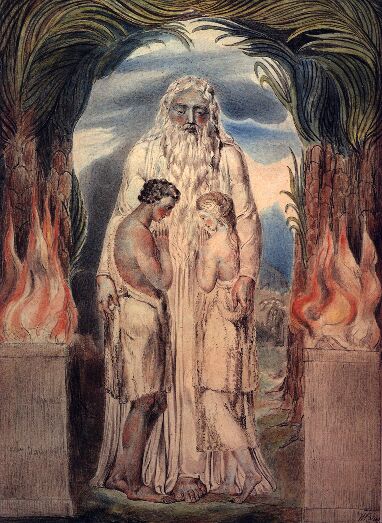 God hung that animal up and stripped the skin from its lifeless body as blood stained the ground. And God wraps that skin around the shameful, sinful bodies of Adam and Eve.
 Pastorsamwise
You must be logged in to post a comment.