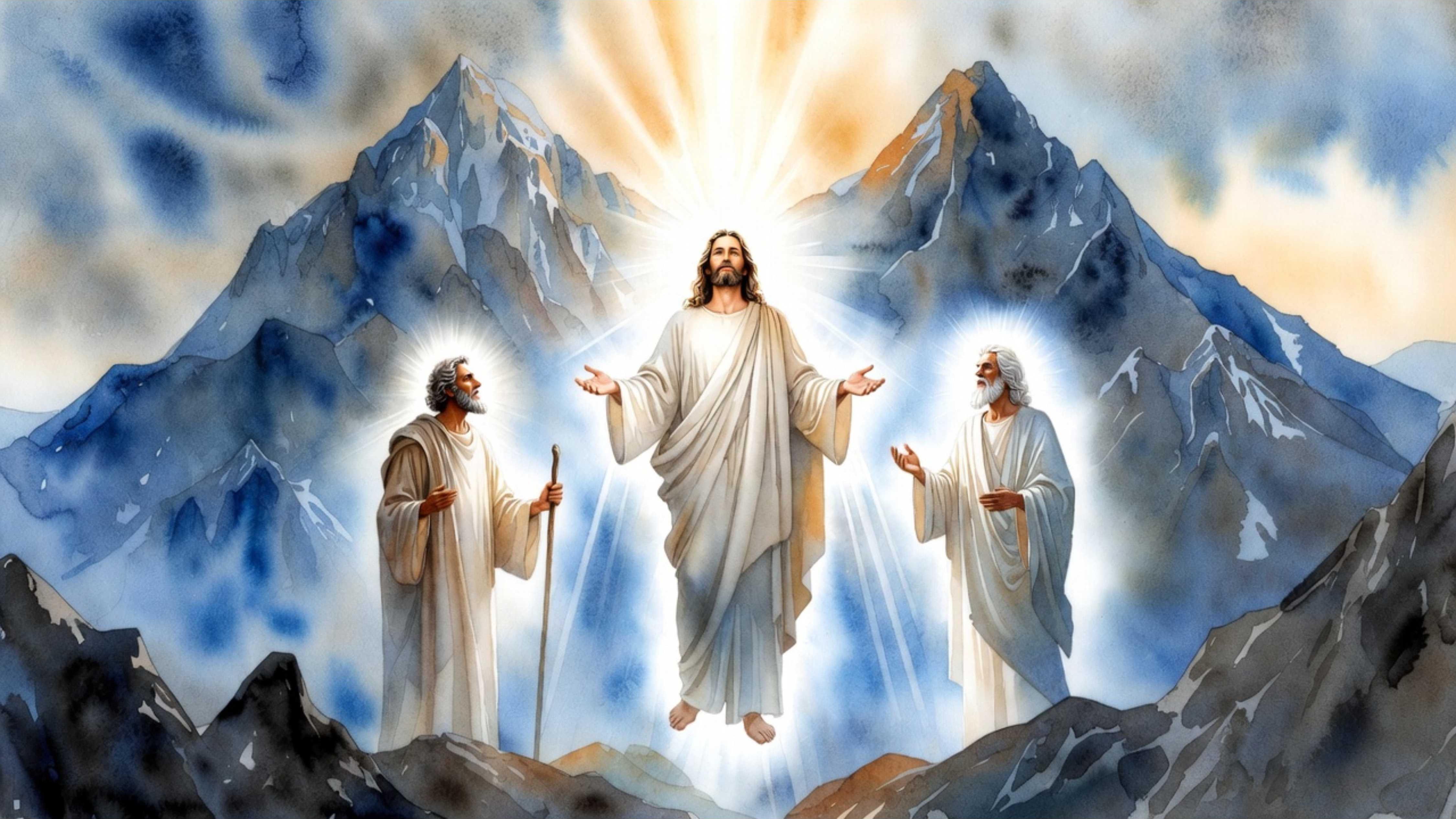
In the name of Jesus. Amen.
The Transfiguration is unique. It is the only time that the curtain gets pulled back and Jesus’ glory, His divine splendor, is allowed to shine through His human nature. Sure, the night Jesus was born, the glory of the Lord shined, but it was in a field outside of Bethlehem to a bunch of shepherds (Lk. 2:8-9). But when the shepherds found newly-born Jesus, the glory of the Lord wasn’t radiating from baby Jesus. Instead, He was surrounded by animals, wrapped in swaddling cloths, and lying in a feeding trough. In last week’s Gospel lesson, Jesus turned water into wine at the wedding at Cana, and John says that miracle is how Jesus manifested His glory (Jn. 2:1-11). But it was with and through the sign. Jesus didn’t start shining like He does here in the Transfiguration. Probably, the bride would’ve been upset by that. Brides don’t want to be one-upped in appearance at their wedding.
The amazing thing about the Transfiguration isn’t that Jesus gets all shiny and glorious. Instead, the amazing thing is that Jesus wasn’t always like that during His time on earth. Jesus is the only-begotten Son of God, God of God, Light of Light, very God of very God, and He was able to conceal His glory when He came to earth. That’s miraculous, and unfortunately, we (myself included) are a little numb to that. The infinite, eternal, glorious God wrapped Himself in human flesh so thoroughly that He looked like a normal 1st century Jewish son of a carpenter (Mt. 13:55).
Jesus only let His glory shine forth once, and it’s here before the small audience of Peter, James, and John. If I were God (and thank God I’m not), I probably would have timed the Transfiguration differently.
Maybe, I would have done it when the 5,000 men plus women and children are surrounding Jesus in the wilderness (Mt. 14:13-21). That’s when Jesus was at the height of popularity and had the most people following Him. There, the day is coming to an end, and the crowds have been listening to Him teach all day. They are hungry and far from home. To me, that seems like a good time for Jesus to get shiny. Pull back the curtain and let everyone in that massive throng see Jesus’ divinity before He feeds them. But Jesus didn’t time His Transfiguration then.
Maybe, I would have had it happen during the trial before all the religious leaders (Mt. 26:58-68). Seventy of the most important priests and leaders, who were all legal experts and oversaw civil matters. It’s like a presidential cabinet meeting; they’re all gathered together. It’s like a presidential cabinet meeting. And the high priest says, “I adjure you by the living God, tell us if you are the Christ, the Son of God.” To me, that seems like good timing for the Transfiguration. That seems like a good time to shine brighter than the sun. But Jesus didn’t time His Transfiguration then.
Maybe, I would have done it when Pilate was asking whom he should release instead of crucify (Mt. 27:15-23). Pilate walks out on the balcony of the palace with Jesus and Barabbas there standing before the crowd, and Pilate asks, “Which of the two do you want me to release for You?” And the crowds keep crying for Barabbas to be released and for Jesus to be crucified. To me that seems like a good time to show the hidden glory and have clothes as white as light. But Jesus didn’t time His Transfiguration then.
Maybe I would have timed the Transfiguration to happen right before the beating and whipping. Or, maybe, while Jesus was laid on the cross and right as the soldier held the nail in one hand and raised the hammer in his other hand. Imagine that for the timing of the Transfiguration. The soldiers would’ve dropped the hammer and nails and run for the hills. But Jesus didn’t time His Transfiguration then. In all of those instances, Jesus keeps His majesty concealed.
Well, I’m not God. You and I can be thankful for that because, if any of those instances were when Jesus was Transfigured, people would have ran away from Him. In God’s infinite wisdom, Jesus’ Transfiguration happens here in Mt. 17. He does it when only three of the twelve disciples are with Him. Jesus chooses this as the timing of His Transfiguration so we sinners can approach Him unafraid.
Let’s get a little more context for the timing. Later today, go back and read the last half of Mt. 16. There, Jesus asks the disciples, “Who do people say that the Son of Man is?” The disciples answer, “Some say John the Baptizer, others say Elijah, and others Jeremiah or one of the prophets.” Then Jesus turns the question, “But who do you say that I am?” Peter makes his great confession, “You are the Christ, the Son of the living God.” And Jesus goes on to promise that upon Peter’s confession He will build His Church, which the gates of hell will never overcome (Mt. 16:13-20).
Right after that, Jesus starts telling the disciples that He must go to Jerusalem to suffer, die, and rise again. Then, Peter takes Jesus aside and rebukes Him saying, “That will never happen to You.” But Jesus rebukes Peter, “Get behind me, Satan! You are a hindrance to Me. For you are not setting your mind on the things of God, but on the things of man”(Mt. 16:21-23). That’s the context for the Transfiguration.
Peter’s just been praised for confessing Christ as the Son of God. Then, Peter is harshly rebuked for saying that Jesus isn’tgoing to die and rise again. So, the disciples are wrestling with these two things that seem to contradict each other. On the one hand, they have heard that Jesus is the Messiah, and on the other hand, they’ve heard that He’s going to die. So, the disciples are probably starting to wonder if all the Old Testament prophecies about the Messiah wasn’t going to be nearly as great as they thought. They’re wondering if all that talk about glory and triumph and thrones and scepters is totally wrong. Well, if that’s what they were thinking, they were wrong.
To be the Christ means to suffer. To be the Christ means that God comes to bear the sins of the world (Jn. 1:29). To be the Christ means that God comes down to be rejected (Jn. 1:9-13). To be the Christ means that God comes down to go to the cross, shed His Own blood, die, and rise again. That is how the Christ enters into His glory (Lk. 24:26) and through that suffering Jesus grants to sinners, who believe in Him, the same glory that He had in the Transfiguration (Jn. 17:22; Ro. 8:17, 29-30; Php. 3:21; 1 Jn. 3:2).
All of this is to say that the timing of the Transfiguration is exactly when it needed to be, and it occurred before the exact audience who needed to see it. Peter, James, and John needed to see it then so they would know that while Jesus suffered all those horrific things in His Passion, God was working to redeem them (Act. 2:36; 3:14-15; 1 Co. 2:8).
This is also why the church has decided to place the Transfiguration on this Sunday to prepare us for Lent and Holy Week. Starting next week, the names of the Sundays orient our hearts and minds toward Easter. Today as we turn our focus toward the Resurrection, we are grounded in the fact that Jesus is God of God, Light of Light, very God of very God who suffers the wrath of God that should have been reserved for us. But Jesus has humbled Himself to be our Friend and Savior.
Dear saints, Jesus hid His glory for most of His ministry, but it was always there. Yes, it was hidden, but it was certainly there. Just because something is hidden doesn’t mean that it doesn’t exist. Remember that. Remember that especially when you face difficult times, when you are suffering, when you feel distant from God. Jesus still has that full glory that is revealed in the Transfiguration – which is the same glory that He had throughout His time here on earth. The day is coming when He will once again put it on full display at the proper time. And that day is the same day when you will share in His glory.
Your glorious Savior is coming again soon. Until then, listen to Him and hold fast to His Word. In 1 Tim. 6:14-16, God encourages you to cling to His Word until the appearing of our Lord Jesus Christ who will be revealed at the proper time. The text goes on to say that Christ is the blessed and only Sovereign, the King of kings and Lord of lords, who alone has immortality and dwells in unapproachable light.
And dear saints, you share that glory. As you wait for Christ’s return, humble yourselves under the mighty hand of God so that at the proper time He may exalt you (1 Pet. 5:6). Know that God’s timing is always good. When it fits God’s purpose, when it will benefit others, and when it will benefit you most, God will pull back the curtain again. Jesus promises that the day is coming when you who are righteous by grace through faith will shine like the sun in the kingdom of your Father (Mt. 13:43). May that day come soon. Amen.
The peace of God, which surpasses all understanding, will guard your hearts and minds in Christ Jesus (Php. 4:7). Amen.

 He lifts up His hands and blesses them. And while He is blessing them, He is carried up into heaven. The last time Jesus was seen on earth, He is lifting up His hands in blessing. And Jesus continues to lift up His nail-pierced hands in blessing over you, dear saints.
 A lord is not simply someone who has the final say or ultimate authority over a situation. A lord is anyone who exercises power over someone at any time. For example, you are a lord when you get into your car and drive 32 mph instead of the posted 30 mph because your time is more important than the safety of others. By the way, you are also a lord when you slow down to 27 mph in a 30 mph in order to teach a lesson to that guy driving 40 mph behind you. You are a lord when you sit down after a long day and your spouse or kids ask you for something, but you don’t feel like giving them the time or attention they desire. You are a lord when you go to the store or click your mouse to spend your money on yourself or family while ignoring the hungry and needy. Kids, you are a lord when you decide that your sibling has done something you don’t like, so you turn around and do something to them that they don’t like. Yes, there are too many lords today.
 Jesus, the Son of God, emptied Himself by taking the form of a servant. He was formed and woven together in His mother’s womb, just like you were. Jesus was born just as you were born, but in a stable. The shepherds and wise men saw Him as an infant. As a helpless infant, Jesus entrusted Himself to the care of His parents who had to flee the violent, wicked hands of Herod, the lord of Jesus’ land. Jesus learned to walk, talk, and eat in Egypt. He was even potty trained there. He learned His letters and how to read after His parents moved Him to their hometown of Nazareth. Jesus grew up learning carpentry, the trade of His (earthly) father, Joseph. Lord Jesus made friends with the neighborhood kids, and He had siblings who didn’t always treat Him with kindness (Mk. 3:31-32, Jn. 7:1-5).
 Pastorsamwise
You must be logged in to post a comment.