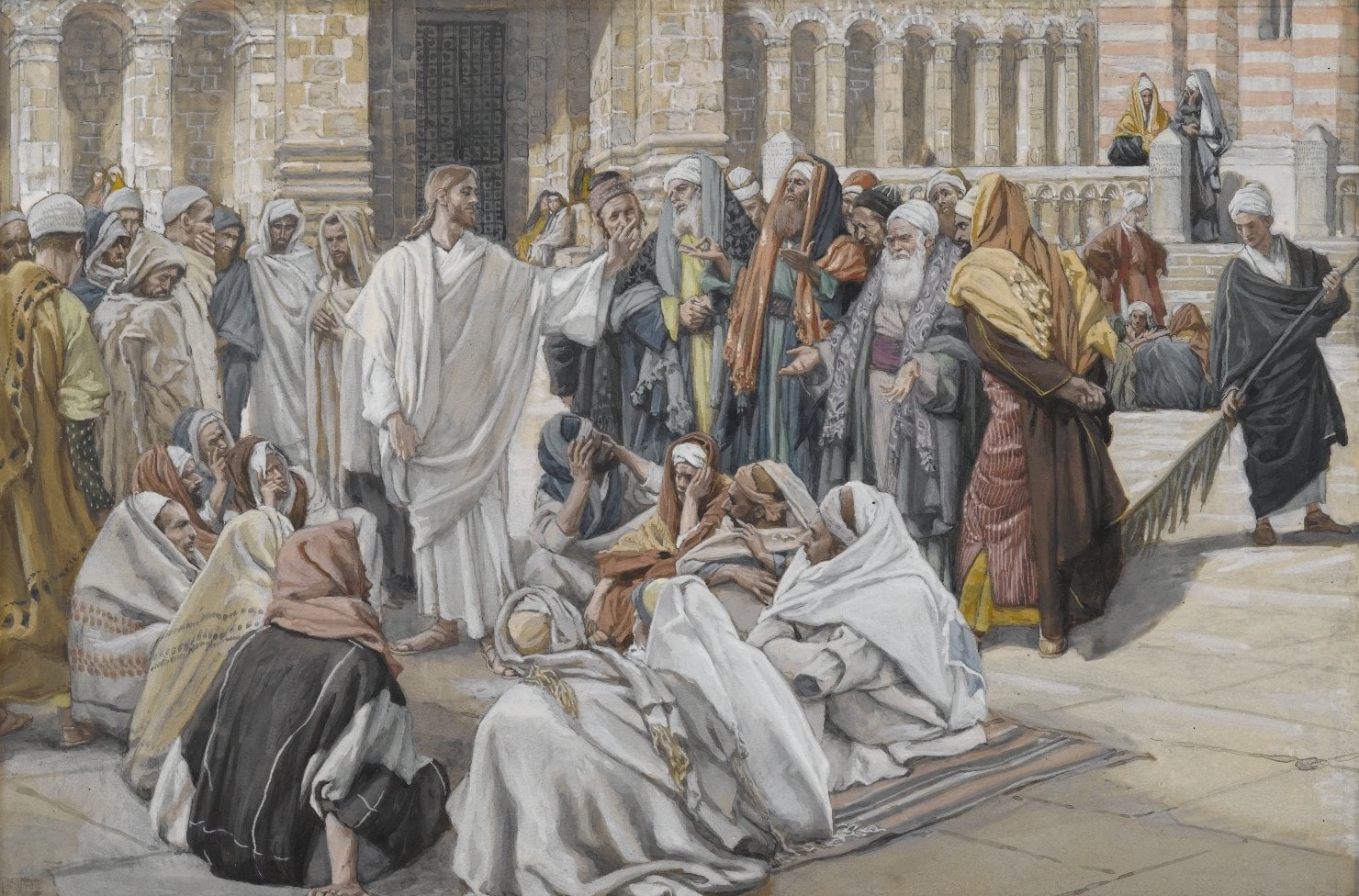
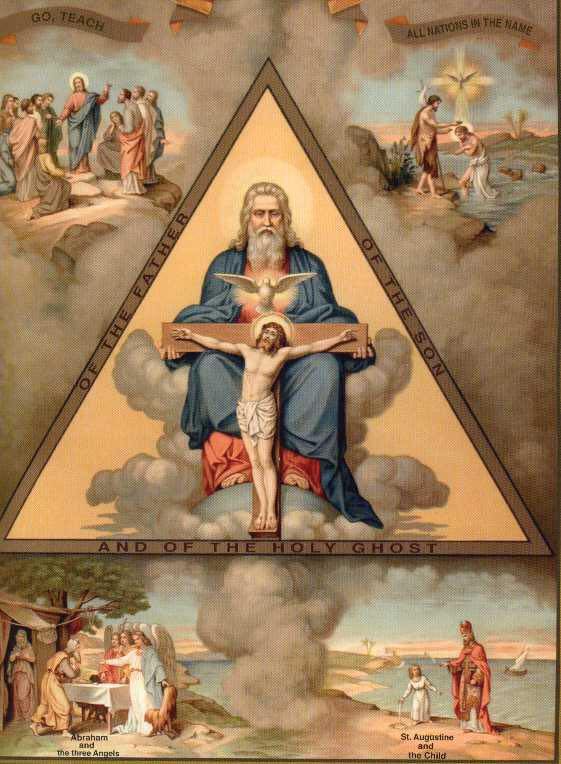
Holy Conversation – Sermon for Holy Trinity Sunday on the Athanasian Creed with Isaiah 6:1-8 as the Starting Point

Isaiah 6:1-8

In the name of Jesus. Amen.

We will get into this text from Isaiah a bit, but right off the bat, two things need to be addressed. The first is that second-to-last line of the Athanasian Creed we just confessed. In your bulletin, it’s on p. 6. It’s the line that reads: “Those who have done good will enter eternal life, and those who have done evil will go into everlasting fire.” That can sound like we’re confessing that salvation is based on works. But that line (as well as the line before it) is basically quoting what Jesus says in John 5. Jesus says that the hour is coming when all who are in the tombs will hear His voice. Then, our Lord says, “Those who have done good to the resurrection of life, and those who have done evil to the resurrection of judgment” (Jn. 5:28-29). So, we should ask ourselves, “Since this is what we confess in the Athanasian Creed, are we wrong when we say that we are saved by grace alone through faith alone?” The answer is a resounding, “No!”

The tension arises because of how we define ‘good.’ Because we are sinners, we grade goodness on a curve. When a one-year-old child takes her first tedious, wobbly steps, her parents praise her. They don’t expect her to glide across the room like at 27.78 mph like Usain Bolt. Scripture tells us that God’s standard for goodness is perfection and holiness (Mt. 5:481 Pet. 1:15-16). So, how do we get this perfection? The Bible is clear that it is only through faith.

The Bible defines what works aren’t good. Romans 14:23 says, “Whatever does not proceed from faith is sin.” And Hebrews 11:6 says, “Without faith it is impossible to please [God].” By faith you are pleasing to God because God counts that faith as righteousness (Gen. 15:6Hab. 2:4Ro. 4:3ff). By faith, God takes away all your sin and adds to you the perfect obedience and every good work of Jesus. By faith, you have done good and will enter eternal life. Romans 4:5says, “To the one who does not work but believes in Him who justifies the ungodly, his faith is counted as righteousness” (cf. Ro. 9:30-321 Co. 1:30Php. 3:9Gal. 2:16).

So, that’s the first thing. Yes, the Bible speaks about a judgment of those who have done good and those who have done evil. And the Bible teaches that goodness only comes through faith in the crucified and risen Jesus Christ.

The second thing I want to address is the history of Trinity Sunday. Holy Trinity Sunday exists because the laity—the average Christians in Alexandria, Greece, Rome, and England—wanted to have a festival to celebrate the Trinity. The clergy resisted, arguing that every Sunday was already dedicated to the worship of God the Father, Son, and Holy Spirit. But the laity were right. Let me just throw out one caveat before I go further. I’m summarizing several hundred years of Church history here. Don’t picture this as something that happened at a congregational annual meeting or at the AFLC Annual Conference.

The clergy only saw the Trinity as a doctrine, and the Church didn’t have feasts for doctrine. The Church doesn’t have an “Original Sin Sunday.” But the laity rightly kept pushing because the Trinity isn’t just a doctrine. It’s a Person (or Persons, plural). If we only see the Trinity as a doctrine to be learned, we’re missing something very important. The Trinity is who God is—Father, Son, and Holy Spirit. Today, we celebrate that we worship one God in three Persons and three Persons in one God.

Now, to this Isaiah text. I’ve preached on it in the past, and if you want, I can give you those sermons later. Just to quickly summarize, Isaiah has this vision of the holy, holy, holy God sitting on the throne. Isaiah is terrified because he knows he’s a sinner. God sends a seraph to deliver forgiveness exactly to the location that Isaiah felt his sin—to his lips. There are weeks’, if not months’, worth of sermons on those first seven verses. But I want to limit our focus today on Isaiah 6:8.

This is a text you might have memorized. But don’t let your familiarity with it make you miss the wonder here. Listen carefully. Isaiah writes, “I heard the voice,” singular, one voice. “I heard the voice of the Lord,” again, singular, one Lord. “I heard the voice of the Lord saying, ‘Whom shall I send,’” singular, one Sender. But that voice of the Lord rephrases the question, “Who will go for Us?”—plural. Multiple. More than one.

Do you hear what is happening there? The Lord is having a conversation, but this conversation isn’t with the seraphim. They’re too busy worshipping and calling out, “Holy, holy, holy.” God is speaking within Himself. The One God in three Persons—Father, Son, and Holy Spirit—is having fellowship and communicating within the Trinity. And this text from Isaiah isn’t the first time this happens.

On the sixth day of creation God said, “Let Us make man in Our image, after Our likeness” (Gen. 1:26f). After the Fall, God says, “Behold, the man has become like one of Us in knowing good and evil” (Gen. 3:22). At the Tower of Babel, God says, “Let Us go down and there confuse their language” (Gen. 11:7). Scripture also clearly teaches that God is one: “Hear, O Israel: The Lord our God, the Lord is one” (Dt. 6:4). In the first Commandment, God says, “You shall have no other gods before Me,” singular (Ex. 20:3). 

The Old Testament makes clear that there is a plurality and singularity in God. The key to unlocking this mystery is found best in the New Testament. God is one in essence, but also three distinct Persons—Father, Son, and Holy Spirit. Those three Persons have always existed in perfect relationship with one another. You know this from Sunday School and Confirmation, but let it play out in your mind today.

Before the world existed, before the Fall into sin, before God created mankind—in fact before anything was created—your triune God was already planning your salvation. Scripture says that Jesus is the Lamb who was slain before the foundation of the world (1 Pet. 1:19-20). Jesus teaches that you who believe will inherit the kingdom that was prepared for you from before the foundation of the world (Mt. 25:34). The book of Revelation says that your name was written in the Book of Life before anything was created (Rev. 13:817:8). Ephesians says that your Triune God chose you to be holy and blameless in Christ from before the foundation of the world (Eph. 1:4). So, let this be clear in your mind: All three Persons of the Trinity—Father, Son, and Holy Spirit—have eternally been conversing about you and your salvation.

Dear saints, this is the wonder of the God we worship. He is not just an idea or some principle. He is personal. In the Scriptures, in the Absolution, in your Baptism, at His Table, the Triune God says “I” to you. He says, “I have loved you with an everlasting love” (Jer. 31:3). He comforts you, “I, I am He who blots out your transgressions for My own sake” (Is. 43:25). He promises, “I am with you always, to the end of the age”(Mt. 28:20). And because He is personal, you get to answer. You get to pray, “You are my God” (Jn. 20:28Ps. 31:1463:188:1). You get to say, “You have redeemed me” (Ps. 31:5). You get to cry out, “You are my Refuge and my Strength” (Ps. 18:246:1) Salvation is God’s work, but is notjust a one-way transaction. It is real fellowship with the living God who has always been in conversation within Himself and who now invites you into that conversation.

In that conversation, God calls you to have a part and input through prayer. Here in Isaiah, the Trinity speaks about the mission of bringing salvation to the lost by asking, “Whom shall I send, and who will go for Us?” (Is. 6:8). And Isaiah was brought into that conversation, so he can respond, “Here am I! Send me.”

Dear saints, you do not go about in this world as a nameless servant. You go out as one who is known by God Himself. The Father who has always spoken to the Son now speaks to you as His own dear child. The Son who has always answered the Father unites you to Himself so that you belong to Him. The Spirit who has always shared in their fellowship now dwells in you and teaches you to cry out, “Abba, Father” (Ro. 8:15). This is personal. This is the God who thinks of you, who acts for you, and who feels compassion toward you. He is not far off. He speaks, and you can answer.

You have all of this because of my favorite line in the Athanasian Creed. It’s near the bottom of p. 5 of your bulletin and the last non-bold. It rightly confesses that Jesus is both God and Man but still One Christ, “one, that is to say, not by changing the Godhead into flesh but by taking on the humanity into God.” Ponder that today and every day.

In the incarnation of the eternal Son of God, God took on humanity into God. Part of who God is now is that He has a human body just like yours. The holy, eternal, all-knowing, omnipresent God lifted humanity unto Himself by becoming flesh and dying, rising, and ascending into heaven.

Dear saints, this is why we have Trinity Sunday. We are not celebrating an abstract doctrine. We are celebrating the living, personal God—who is Father, Son, and Holy Spirit—who loved you enough to send the Son for your redemption, and who now speaks to you so that you can answer Him.

Do not settle for knowing about the Trinity. Know the Triune God who speaks. The Father who sent the Son is your Father. The Son who was sent for you has made you His own. The Spirit who proceeds from them both (Jn. 14:2616:7Gal. 4:6) dwells in you and teaches you to speak with God in prayer. This is not just some doctrine that we talk about on Trinity Sunday. This is the daily wonder of your life in Christ.

Cleansed by His Blood and sent by His Spirit, you belong to the personal God who has always been in conversation—and who has now included you in it. Amen.

The peace of God, which surpasses all understanding, will guard your hearts and minds in Christ Jesus (Php. 4:7). Amen.

Eternal Wind, New Fire – Sermon on Acts 2:1-21 for the Day of Pentecost

Acts 2:1-21

In the name of Jesus. Amen.

Today we celebrate Pentecost, the day the Holy Spirit came with wind and fire. The Holy Spirit came in a special way to enable those believers in Christ—back in Acts 1:15, we read there were about 120 of them—the Holy Spirit enabled those believers to speak in languages from every nation under heaven (Act. 2:58-11) that they didn’t previously know. In those languages, they preached about Jesus to the crowds. And 3,000 souls were added to the Christian Church.

This sermon is going to focus on the Holy Spirit, but I do want to point out that the Holy Spirit doesn’t get mentioned much in this text. You’d think Pentecost would be all about the Holy Spirit, but He’s only mentioned twice in v. 4, and two more times in the passage Peter quotes from the prophet Joel (Act. 2:17-18; see Joel 2:28-32). When you go home today, read the rest of Acts 2, which will give you all of Peter’s sermon and the response of the crowd who hears that preaching. The majority of the text is pointing to Jesus and His death, resurrection, and ascension. That is the work of the Holy Spirit. The Holy Spirit points people to Jesus as He calls, gathers, enlightens, sanctifies, and preserves the entire Christian Church in the true faith.

Dear saints, what that means is that if you want to know if the Holy Spirit is present and working, you simply need to ask, “Am I being pointed to Jesus? Is Jesus is being proclaimed as the crucified, risen, and ascended Savior?” According to Jesus’ clear teaching, when He is being proclaimed, that is how you can know without a doubt that the Holy Spirit is at work (Jn. 15:2614:26). More on that later.

There are three things I want to highlight about the Holy Spirit, and they build on each other.

First, the Holy Spirit is a Person. He is not some force, electrical current, or emotion that bubbles up from inside us. He is a person. It can be easy to forget this about the Third Person of the Trinity. We know persons who are fathers. We know persons who are sons. The Holy Spirit is also a person of the one true God. He is not simply the Father or the Son at work in a new way. The Holy Spirit shares the same divine being with the Father and the Son. Scripture shows us this in clear ways.

At the baptism of Jesus, the Holy Spirit descended on Jesus in the form of a dove while the Father spoke from heaven (Mt. 3:16). Later in Acts, Ananias and his wife, Sapphira, get asked, “Why are you lying to the Holy Spirit?” (Act. 5:1-11). You don’t lie to a force. You can only lie to a person. Scripture clearly teaches that the Holy Spirit is the third Person who is distinguishable from the Father and the Son. Jesus Himself calls Him the “Comforter” (Jn. 14:16), and He says the Spirit “proceeds from the Father” and is sent by the Son (Jn. 15:26Gal. 4:6). All of this shows us that the Holy Spirit is not just stirring of our heart or a power or force. He is the Third Person of the one true God, and He works according to His own divine will (1 Co. 2:10-12).

We must also be careful to distinguish the Person of the Holy Spirit from the gifts He gives. Paul writes, “There are varieties of gifts, but the same Spirit” (1 Cor. 12:4). The Spirit Himself is not the same as the gifts He distributes. He is the Giver, not the gift. Knowing this preserves us from chasing after dramatic experiences or thinking the Spirit is only present when something unusual happens. The Holy Spirit is always the same, whether He works quietly or with visible signs.

The first point is the Holy Spirit is a person. The second point is this: the Person of the Holy Spirit has always been at work. It isn’t as though He was twiddling His thumbs from eternity past and only got going at Pentecost.

The Holy Spirit who appeared at Pentecost was already active long before. He was hovering over the waters at creation (Gen. 1:2). He led Moses and the people through the desert (Is. 63:11-14Neh. 9:19-21). He was in the prophets, moving them to speak God’s Word (2 Pet. 1:21). Isaiah promises that the Spirit who is upon the prophet will remain upon the Church forever (Is. 59:21). The Spirit has always been at work to make believers holy. That’s why David prayed, “Take not Your Holy Spirit from me” (Ps. 51:11). The Spirit who gives faith and new life has never been absent from God’s people.

Scripture even talks about the Holy Spirit’s work in and through people who aren’t believers. The evil prophet Balaam prophesied by the Spirit, though he was an unholy man (Num 24:2ff). King Saul and his men prophesied under the Spirit’s power. In 1 Samuel 19, Saul was hunting David. He sent out a band of men to find David, but they find Samuel instead. The Holy Spirit comes upon them and they start to prophesy. Saul sends a second and third wave of men and they begin to prophesy too. So, King Saul goes himself, and the same thing happens to him. But listen to what Scripture says, “[Saul] stripped off his clothes and prophesied… and lay naked all that day and all that night” (1 Sam. 19:18-24). That’s crazy! That’s not a good way to prophesy. But what that shows is that the Holy Spirit can work through a deranged Saul as a mark of the Spirit’s judgment upon Israel’s first king.

Before Jesus was crucified, Scripture tells us that the high priest, Caiaphas, spoke a true prophecy by the Spirit, even though he opposed Jesus (Jn. 11:47-53). The Spirit can work where and how He wills. But this is the point: the Holy Spirit has always been at work in the world and in the Church. Pentecost was not the beginning of His activity. Instead, it was a new and visible outpouring of the same eternal Spirit for the sake of spreading the Gospel to all people.

So, first: the Holy Spirit is a person. Second, the Holy Spirit has always been at work. Now, third: the Holy Spirit’s main work is to point you to Jesus, your Savior.

Everything the Spirit does serves this one purpose. At Pentecost, the signs—the sound of the eternal wind and the tongues of new fire—served to draw attention to and gather people for the preaching that followed. Peter stood up and preached an ordinary Christian sermon about the death, resurrection, and ascension of Jesus. Through that preaching the Holy Spirit worked repentance and faith in 3,000 hearts. The signs pointed people to the Word, and the Word pointed to Jesus.

That is still how the Holy Spirit works today. He does not point us to ourselves, to our feelings, or to dramatic experiences. He points us to Jesus. Jesus said, “When the Helper comes, whom I will send to you from the Father, the Spirit of truth, who proceeds from the Father, He will bear witness about Me” (Jn. 15:26). Jesus teaches that the Holy Spirit “will teach you all things and bring to your remembrance all that I have said to you” (Jn. 14:26). The test is simple: if Jesus is being proclaimed as the crucified, risen, and ascended Savior, the Holy Spirit is at work. If the focus has shifted somewhere else, the Spirit is not the one driving it.

The Holy Spirit reorients us so that we see Jesus more clearly, but He does not erase who we are. The apostles were still the same men after Pentecost. Peter was still Peter and those fishermen were still fishermen. But now their understanding, their gifts, and their direction in life were reoriented around Christ and His mission. In just fifty-three days, Peter went from being someone who wouldn’t even admit that he knew Jesus before a servant girl by a campfire (Jn. 18:17-18) to someone who openly declared to a massive crowd that they had killed the Lord and Christ (Act. 2:36).

Dear saints, the same Spirit works in you. He takes your personality, your background, your gifts, and even your weaknesses, and He reorients them so that you serve the mission of proclaiming Jesus to a lost world. That intentional proclamation of the Gospel is the fruit of the Holy Spirit. The fruit of the Spirit is love, joy, peace, patience, kindness, goodness, faithfulness, gentleness, and what? Self-control (Gal. 5:22-23). Dear saints, don’t forget that self-control is the result and visible fruit of the Spirit’s work. A sort of chaotic spontaneity is not evidence of the Holy Spirit. Self-control is. The Spirit produces the self-control in you to use who you in an ordered, faithful way for the good of others and the glory of Christ.

The Holy Spirit still comes to us today through the ordinary means He has given—through Word and Sacrament. In Baptism He pours out the washing of regeneration and renewal (Titus 3:5). He gives new birth (Jn. 3:5) and true faith in the heart. The Holy Spirit continually points you to Jesus for the forgiveness of your sins. In the Lord’s Supper He strengthens that faith and keeps you in the one true faith. Through these gifts the same personal Holy Spirit who has always been at work continues to call, gather, enlighten, sanctify, and preserve you in Jesus Christ.

Dear saints, on this Day of Pentecost give thanks to God for the Holy Spirit. He is the Third Person of the one true God, sharing the same divine being with the Father and the Son. He has always been at work in the Church and in the world. His main work is to point you to Jesus, your crucified, risen, and ascended Savior. And He does that work still today right here, as He reorients you with self-control so that your life serves the mission of Christ.

The eternal wind still blows. That new fire still burns. If you want to know if the Holy Spirit is present and working, do not look for any wind and fire. Look to Jesus. Is He being proclaimed as the Savior who died for your sins, rose for your justification, and ascended to rule over creation for your benefit? If that is what you are hearing, then you can be certain the Holy Spirit is at work. He is pointing you to Jesus, and in Jesus you have forgiveness, life, and salvation.

Come, Holy Spirit, fill the hearts of Your faithful people and kindle in us the fire of Your love. Amen.

The peace of God, which surpasses all understanding, will guard your hearts and minds in Christ Jesus (Php. 4:7). Amen.

The Word & Children of God – Sermon on John 1:6-13 for Midweek Advent 2

John 1:6-13

In the name of Jesus. Amen.

These verses make the Advent and Christmas seasons feel like the coming of Spring. And I know we just had our first major snowstorm. We’re currently in meteorological Winter, but astronomical Winter is still eleven days away. Daylight keeps getting shorter. I get it. But even though the coldest days of winter are, probably, still ahead of us, this text fills our sanctuary with a hint of Spring. Can you smell it?

Jesus, the Eternal Word, was there at the beginning of creation with God and as God. All things were created through Christ. In Jesus was Life, and the Life was the Light of men. That Light shines in the darkness, and the darkness has not overcome it. Jesus, the true Light has arrived, not as a conqueror from a far, distant country, but to rescue you from the darkness of death. The winter of sin is passing. Jesus, the Word made flesh, has come. And the Life that Christ brings is budding all around you even now. Dear saints, because Jesus has come, you now live in the never-ending Spring of the new creation (2 Co. 5:7).

John the Baptizer came as a herald to point to Christ, the Light. John was there calling everyone into Jesus’ Light. But then, when the Light burst through the darkness to shine on everyone, many sank further into the shadows (Jn. 1:10-11). And sadly, this is still too often the case. The Light can be rejected. In Jn. 3:19-20, we learn why it is rejected, “Light has come into the world, and people loved the darkness rather than the Light because their works were evil. For everyone who does wicked things hates the Light and does not come to the Light, lest his works should be exposed.”

Light reveals the things hidden in darkness. That’s why, when Jesus came as Light, it seemed to many as though judgment had come. But Jesus was not sent into the world to judge the world. No. He came in order that the world would be saved through Him (Jn. 3:17). Jesus came to give Light to the world, to take away sin, and to give eternal life. But His coming felt like judgment because His presence exposes the darkness and filthiness of sinners. In the Light of Christ, there is no hiding. So, the Light is a threat to the will and the way of every sinner. That’s why sinners hate and reject the Light. Even though the darkness cannot overcome the Light (Jn. 1:5), people can love and choose the darkness instead of receiving the Light (Jn. 1:11).

But to all who did receive the Light, to all who believed in His Name, He gave the right and the authority to become children of God (Jn. 1:12). That’s you, dear saints. You, believer. You are rightfully children of God through faith in Christ. And this idea of being God’s child here in Jn. 1 is so rich and unique. But first, we need to recognize what that phrase ‘children of God’ doesn’t mean – at least not in these verses.

The Bible does talk about all humanity being children of God by virtue of our creation. Because Adam was created in God’s image (Gen. 1:27), he is called the son of God – lowercase ‘s’ (Lk. 3:38). Since your first ancestor is God’s son, you also are a child of God. Malachi 2:10 says that since God created us, He is everyone’s Father. In Act. 17:28-29, Paul says that all people are God’s offspring. So, yes, we are God’s children by virtue of creation. The Bible does teach that. But we have a severe problem if that’s the only kind of childhood we have because our sin has totally and completely alienated us from God. It isn’t a stretch to say that we divorced ourselves from Him by our sin. So, being God’s child by virtue of creation is not the childhood John has in mind here.

Better than the childhood that comes by virtue of your creation is the fact that the eternal Son of God took on flesh and became one of you. So, Moses in our Old Testament reading (Dt. 18:15-19) could rightly prophesy that God would raise up a prophet like him “from among you, from your brothers.” By virtue of Jesus’ incarnation, He has become your Brother. Since Jesus is your brother, you share a Father with Him, which means that you are a child of God. And this is amazing news that we will be pondering for all eternity. But even as wonderful as that is, it still isn’t the kind of childhood that John talks about here.

Dear saints, here John says that you are a child of God by virtue of a birth. None of us here can say that we chose to be born. You didn’t cause your birth or make it happen. In the same way, it isn’t your will, or the will of any other human, that causes you to be born of God. James 1:18 says this plainly, “Of [God’s] own will He brought us forth by the Word of Truth, that we should be a kind of firstfruits of His creatures” (also 1 Pet. 1:23).

So, John is not talking here about a physical birth. It wasn’t anything that nature can accomplish. It’s a miraculous birth that God Himself brings about by the means that He has established. And Jesus teaches about this birth in Jn. 3 when He sheds His Light as He talks with Nicodemus at night. It is a birth that comes from above (Jn. 3:3). It is a birth of water and the Spirit (Jn. 3:5). It is your birth that God has given you through your Baptism. That kind of birth from and of God is solid and sure. God Himself caused it. It’s His action, His working, His doing (Jn. 15:1619) that has made you His child.

The Light, which gives light to everyone was coming into the world, and because of what Jesus has done by His death and resurrection, you are born as God’s own child.

Dear saints, again, can you smell it? The winter of sin and death is passing away. The never-ending Spring of the new creation has dawned in Christ. As His Light shines on you now, receive it again. Let it expose and scatter the shadows in and around you. Always cling to the sonship that you have been given. You are God’s child. And in the Spring of Light that He has brought, you will bloom forever in His unending grace and mercy. Amen.

The peace of God, which surpasses all understanding, will guard your hearts and minds in Christ Jesus (Php. 4:7). Amen.

Far More – Sermon on John 20:19-31 for the Second Sunday of Easter

John 20:19-31

19 On the evening of that day, the first day of the week, the doors being locked where the disciples were for fear of the Jews, Jesus came and stood among them and said to them, “Peace be with you.” 20 When he had said this, he showed them his hands and his side. Then the disciples were glad when they saw the Lord. 21 Jesus said to them again, “Peace be with you. As the Father has sent me, even so I am sending you.” 22 And when he had said this, he breathed on them and said to them, “Receive the Holy Spirit. 23 If you forgive the sins of any, they are forgiven them; if you withhold forgiveness from any, it is withheld.”

24 Now Thomas, one of the twelve, called the Twin, was not with them when Jesus came. 25 So the other disciples told him, “We have seen the Lord.” But he said to them, “Unless I see in his hands the mark of the nails, and place my finger into the mark of the nails, and place my hand into his side, I will never believe.” 

26 Eight days later, his disciples were inside again, and Thomas was with them. Although the doors were locked, Jesus came and stood among them and said, “Peace be with you.” 27 Then he said to Thomas, “Put your finger here, and see my hands; and put out your hand, and place it in my side. Do not disbelieve, but believe.” 28 Thomas answered him, “My Lord and my God!” 29 Jesus said to him, “Have you believed because you have seen me? Blessed are those who have not seen and yet have believed.”

30 Now Jesus did many other signs in the presence of the disciples, which are not written in this book; 31 but these are written so that you may believe that Jesus is the Christ, the Son of God, and that by believing you may have life in his name.

Alleluia! Christ is risen! 
He is risen indeed! Alleluia!

In the name of Jesus. Amen.

Imagine you were building a house. You wouldn’t start by arranging the furniture or painting interior walls because there aren’t any rooms or walls to paint. You’d begin with the foundation – a foundation that is solid and will stand firm in the midst of wind, rain, snow, and all the other things our northern climate could throw at it because the prettiest walls and nicest furniture won’t save a house from collapsing.

Our faith has a foundation that can withstand all the things that the devil, the world, and our own sinful flesh can and will throw at it. John wrote to give that foundation. He clearly states that he doesn’t record all the signs Jesus did – there were far more. In fact, John says that even if he tried to write everything Jesus did, the whole world wouldn’t be able to contain the books that would be written (Jn. 21:25). But the signs John does record provide a solid foundation for eternal life (Jn. 20:30-31). John says that he chose his signs to reveal Jesus’ identity as the Christ and Son of God. But each of those signs are rightly read and understood only when we consider the ultimate sign – the eighth sign – which is Jesus’ crucifixion and resurrection.

As I was considering what to preach from this text, I thought it would be fun to preach on the last two verses because preaching on them meant skimming through and summarizing the entire Gospel of John with all the signs that it contains. So, here we go.

The first sign John records is Jesus turning water into wine at the wedding in Cana (Jn. 2:1-12), which reveals that Jesus has authority over creation. Jesus uses His authority to provide not just what is good, but what is extravagant and delightful. The sign invites us to see that, In an empty world, Jesus fills our lives with His abundant joy.

The second sign John recorded was Jesus healing the royal official’s son (Jn. 4:46-54). Jesus simply speaks a word while He’s about sixteen miles away from where that boy lay dying, and the child was healed in the same moment. This sign shows Jesus’ boundless authority over both distance and death.

The third sign is when Jesus heals a crippled man who lay by a pool in Jerusalem (Jn. 5:1-14). Because Jesus does this sign on the Sabbath, it reveals that Jesus is the One who brings true rest by making the broken whole. That sign shows that in a world paralyzed by sin and pain, Jesus restores.

We heard the fourth sign a few weeks ago – the feeding of the 5,000 men, plus women and children with five loaves and two fish (Jn. 6:1-13). That sign recalled how God had fed His people in the wilderness with manna, but Jesus says He has come to do far more. The sign shows that He is the very Bread of Life from heaven (Jn. 6:35) who nourishes us for eternity.

The fifth sign immediately follows that when Jesus walks on water (Jn. 6:16-24). As the disciples battle a storm, Jesus walks to them on the sea, and when He gets into the boat, they immediately arrive at their destination. This sign also reveals Jesus’ dominion and authority over creation. But here, Jesus also invokes the divine name – Yahweh, “I am” – on Himself (Jn. 6:20). This sign shows that Jesus is the God who safely brings the troubled to their desired haven (Ps. 107:28-30).

The sixth sign is when Jesus heals a man who had been blind from birth (Jn. 9). This sign confirms Jesus’ claim that He is the Light of the World (John 9:5). Jesus has come to give us more than simple sight. In a dark world, Jesus opens our eyes to the light of His truth.

The seventh sign is Jesus raising Lazarus from the dead (Jn. 11:1-45). Lazarus had been dead four days, but Jesus simply calls him out the grave. This sign reveals that Jesus is the Resurrection and the Life (Jn. 11:25). This sign shows that Jesus is the Author of Life (Act. 3:15).

These seven signs show Jesus is the gracious Creator, the mighty Healer, the generous Provider, and the Lord over death. John chose these seven signs, and again, he admits that he could have written far more. Those seven signs point to the fact that Jesus was sent by God. And yet, do they really prove that Jesus is God’s Son? Other prophets who had been sent by God had done similar signs. Moses had turned water into blood (Ex. 7:14-25). Elijah and Elisha had healed and raised people from the dead (1 Kgs. 17:17-242 Kgs. 4:18-37). Elisha also miraculously fed a crowd with a tiny amount of food and had some left over (2 Kgs. 4:42-44).

However, Jesus is more than a prophet. He’s the Christ and Son of God who brings life to all who believe in Him. When John wrote this Gospel, he wasn’t out to prove that Jesus was a powerful individual. John wants far more than that. He wants you to believe that Jesus is the Christ, the Son of God, and Savior so that you would have life in His name (Jn. 20:31).

That’s why John doesn’t say what all the signs are pointing to until after Jesus’ death and resurrection. Those seven signs point to the most important, eighth sign – Jesus’ dying and rising. On the cross, Jesus’ glory shines brightest (Jn. 12:23-24). He takes your sin and your shame. And the empty tomb is what seals the deal. Christ died and raised Himself to life (Jn. 10:17-18) so you can know that all sickness, sin, death, and fear; all pain, sorrow, and sadness; all trouble, toil, and tribulation will be done away with forever. That’s the solid foundation.

Mary Magdalene sees the risen Jesus and worships (Jn. 20:11-18). The fearful disciples see and rejoice (Jn. 20:19-20). Unbelieving Thomas has his disbelief melt into the declaration, “My Lord and my God!” (Jn. 20:28). Christ’s resurrection proves more than every other sign because it shows that Jesus is where you find far more than temporary blessings. Jesus is where God gives you grace upon grace (Jn. 1:16) and manifests God’s saving love for you (Jn. 1:18).

The signs John writes down to strengthen and encourage your faith weren’t tricks. They aren’t fables or nice stories. They’re evidence. Faith in Christ isn’t a blind leap. John’s signs are rooted in history, witnessed by real people. Their initial doubts actually bolster our faith. Most of the eyewitnesses of Jesus chose to die rather than denying Him and the things He did because Jesus proved that He is the Son of God.

Believe, and have life in Jesus’ name (Jn. 20:31). Jesus has defeated sin, death, and the devil. He is the sure, sturdy foundation on which you can build your entire life. Jesus is the Christ. In a crumbling world, you have a Savior who has come to restore all things and make them new (Rev. 21:5).

You can build your entire life on the foundation of Christ. The cross and resurrection are the sure cornerstone. A life built on that is no flimsy shed. It’s a fortress. Trust Jesus because, in Him and in Him alone, you have life – eternal, abundant life in His almighty name. Amen.

Alleluia! Christ is risen! 
He is risen indeed! Alleluia!

The peace of God, which surpasses all understanding, will guard your hearts and minds in Christ Jesus. Amen.

The Righteous Live by Faith – Sermon on Habakkuk 2:1-4 for Reformation Sunday

Habakkuk 2:1–4

1 I will take my stand at my watchpost 
and station myself on the tower, 
and look out to see what he will say to me, 
and what I will answer concerning my complaint. 

2 And the Lord answered me: 
“Write the vision; 
make it plain on tablets, 
so he may run who reads it. 
3 For still the vision awaits its appointed time; 
it hastens to the end—it will not lie. 
If it seems slow, wait for it; 
it will surely come; it will not delay. 
4 “Behold, his soul is puffed up; it is not upright within him, 
but the righteous shall live by his faith.

Ingredients of Great Faith – Sermon on Matthew 15:21-28 for the Second Sunday of Lent

Matthew 15:21–28

21 And Jesus went away from there and withdrew to the district of Tyre and Sidon. 22 And behold, a Canaanite woman from that region came out and was crying, “Have mercy on me, O Lord, Son of David; my daughter is severely oppressed by a demon.” 23 But he did not answer her a word. And his disciples came and begged him, saying, “Send her away, for she is crying out after us.” 24 He answered, “I was sent only to the lost sheep of the house of Israel.” 25 But she came and knelt before him, saying, “Lord, help me.” 26 And he answered, “It is not right to take the children’s bread and throw it to the dogs.” 27 She said, “Yes, Lord, yet even the dogs eat the crumbs that fall from their masters’ table.” 28 Then Jesus answered her, “O woman, great is your faith! Be it done for you as you desire.” And her daughter was healed instantly.

In the name of Jesus. Amen.

I want to start with an analogy that gets regularly used. Imagine two men who want to cross a frozen river with thick ice. One man doesn’t hesitate at all because he believes the ice is strong and stable. So, he gets in his ¾ ton pickup truck and drives straight across no sweat. The other man is terrified and trembling because he doesn’t trust the ice. He lays out as flat as possible to distribute his weight and crawls on his belly inch by inch and makes it to the other side. Both men had faith. The guy in the truck had a strong faith, and the guy wriggling on his belly had a weak faith. Was their success in crossing based on their faith? No. Obviously, one had an easier time than the other but they both succeeded in the goal of crossing.

Now imagine those same two men needing to cross the frozen river, but the ice is less than an inch thick. Again, the first man doesn’t hesitate at all because he believes the ice is fine, but he and his pickup plunge into the frigid river and are swept away. The other man is crawling because he’s worried about the thickness of the ice. But it doesn’t matter how careful he is. That thin ice cracks, and he’s swept away too. Now again, was their failure in crossing based on their faith? No. It was based on the thickness of the ice.

Here’s the point: Faith has an object; faith is in something. You can have a lot of faith, but if that faith is in the wrong thing it doesn’t matter how strong that faith is because the thing you believe isn’t right. The opposite is true too. You can have a tiny, little, weak faith in the right thing and that’s what matters because that thing can support that faith even though it’s weak.

For a long time now, you’ll hear people talk about being a “believer.” Ok, but a believer in what? That term is fine. The Bible uses it, but it needs more context. What is it that you believe? A newer term that seems to be gaining popularity is “a person of faith.” That one drives me nuts – as though faith is the thing that matters. Everyone has faith in something. A “person of faith” has faith in what? Honestly, an atheist is a person of faith. They are. An atheist believes that everything that exists came from nothing or believes that matter is eternal. An atheist believes, contrary to every observable fact, that the order and beauty we see in creation happened by mere chance. An atheist believes he knows enough to conclude that there is no designer or creator. Now that takes a lot of faith, but that faith is based on complete foolishness.

Christian, you can define your faith. The Creeds are excellent summaries of what you believe. The strength of your faith or the amount of your faith doesn’t matter as much because what you believe is solid, right, and true. The stronger your faith is, the better your life will be. Think back to the analogy of the two guys crossing the river: They both get across. The guy who has great faith gets across quickly and easily, but the guy who crawls still gets across.

We do want to grow in and strengthen our faith. Sometimes people will think that when Jesus calls us to have the faith of a child (Mk. 10:14-15) that He’s saying that a weak faith is fine. A child’s faith is not weak. Think about it. An infant can’t do anything on her own. But that infant has faith that simply crying will get her parents to spring into action to fix her problem – her hunger, need for a nap, or messy diaper. Infants actually have a strong faith that trusts the adults will take care of whatever needs that infant has.

Ok. All of that brings us to the text about the Canaanite woman. She is one of only two people in the Gospels who has a faith that gets praised by Jesus, “O woman, great is your faith!” (the other is in Mt. 8:10; Lk. 7:9). So, it’s good for us to consider what is it about this woman’s faith that makes it great enough that Jesus would praise it. Well, let’s consider the text.

The first ingredient of great faith is that it trusts that Jesus is the Savior of all mankind. This woman is an outsider – a Canaanite. She was part of the people that should have been eliminated because of their demonic worship. Psalm 106 talks about the failure of the Israelites to drive out the Canaanites and how that failure led to tolerating the pagan religious practices of the Canaanites. Because of that failure, the people were sacrificing their sons and daughters to the demons (Ps. 106:34-39).

It is no stretch to assume the reason this woman’s daughter was so severely possessed by a demon was because of her own actions and due to her pagan worship. If I’m wrong about that, I’ll apologize to this woman in heaven because we’ll meet her there. Now, despite all of that, this woman trusts that Jesus is herSavior and can help her and her daughter. So, she goes to Him and prays, which leads us to the second ingredient.

The second ingredient of great faith is that it is bold and persistent in prayer. This woman is unflinching. I know that it’s hard to hear how our Lord treats this woman. She cries out, and He ignores her. Jesus dismisses her and acts as though He doesn’t have anything for her. And, finally, Christ insults her by calling her a dog.

By the way, don’t let the way Jesus acts toward her make you think that Jesus is a misogynist or is racist. Look at the end of the account. Because He praises her faith, we know what He thought of all those prayers that came before. He loves this woman and her daughter. But in the middle of it the woman doesn’t know what Jesus thinks of her or her prayer. And despite the way she is treated, she keeps praying. She doesn’t let up. She keeps asking for relief and trusts that Jesus will deal with her according to His grace and mercy.

How many times have you prayed about something and it seems as though God is ignoring you or the situation gets even worse? That is not the time to stop praying. Great faith stays bold and steadfast even when it appears that God doesn’t care. Know that He does care and loves you.

The third and final ingredient of great faith is that it recognizes that God’s crumbs are more than enough. Now, getting rid of that demon was huge for the woman. It’s something she can’t do on her own. But her faith has such a high opinion of Jesus and His power that she recognizes that it’s no big deal for Him to conqueror that demon and expel it from her daughter. This woman recognizes that it is just a crumb for Jesus to completely defeat this demon who has crushed her soul, who has plunged her entire world into chaos and grief and suffering, and who has brought her all this pain and torment. It’s just a crumb. It’s no big deal for Jesus.

Dear saints, it’s nothing for Jesus to take away all your sins. He’s already done all the heavy lifting. So, it’s a simple task for Him now to forgive you, bless you, and grant you eternal life. He gives you better than crumbs. He gives you Himself to cure your soul and bring you unto eternal life with Him. Amen.

The peace of God, which surpasses all understanding, will guard your hearts and minds in Christ Jesus. Amen.

The Sidewalk of Faith – Sermon on John 20:19-31 for the Second Sunday of Easter

John 20:19–31

19 On the evening of that day, the first day of the week, the doors being locked where the disciples were for fear of the Jews, Jesus came and stood among them and said to them, “Peace be with you.” 20 When he had said this, he showed them his hands and his side. Then the disciples were glad when they saw the Lord. 21 Jesus said to them again, “Peace be with you. As the Father has sent me, even so I am sending you.” 22 And when he had said this, he breathed on them and said to them, “Receive the Holy Spirit. 23 If you forgive the sins of any, they are forgiven them; if you withhold forgiveness from any, it is withheld.”

24 Now Thomas, one of the twelve, called the Twin, was not with them when Jesus came. 25 So the other disciples told him, “We have seen the Lord.” But he said to them, “Unless I see in his hands the mark of the nails, and place my finger into the mark of the nails, and place my hand into his side, I will never believe.” 

26 Eight days later, his disciples were inside again, and Thomas was with them. Although the doors were locked, Jesus came and stood among them and said, “Peace be with you.” 27 Then he said to Thomas, “Put your finger here, and see my hands; and put out your hand, and place it in my side. Do not disbelieve, but believe.” 28 Thomas answered him, “My Lord and my God!” 29 Jesus said to him, “Have you believed because you have seen me? Blessed are those who have not seen and yet have believed.”

30 Now Jesus did many other signs in the presence of the disciples, which are not written in this book; 31 but these are written so that you may believe that Jesus is the Christ, the Son of God, and that by believing you may have life in his name.

Alleluia! Christ is risen!
He is risen indeed! Alleluia!

In the name of Jesus. Amen.

The Bible says our faith depends on Jesus’ resurrection. If it was proven that Jesus did not rise from the dead, Scripture says that you can forget everything else in the Bible. In 1 Cor. 15:14, Paul writes, “If Christ has not been raised, then our preaching is in vain and your faith is in vain.”

The work of the Holy Spirit is not to convert reasonable, sensible people to believe wild stories. Instead, the Holy Spirit converts stubborn, obstinate hearts to believe reasonable things. The resurrection of Jesus is completely reasonable and historical. If you find it reasonable that Shakespeare wrote Romeo and Juliet – even though you didn’t see him write it with your own eyes – there is just as much evidence that Jesus rose from the dead. If Jesus rose from the dead, which He did, then you have to take Him seriously. And if you take Jesus seriously, you have to take the entire Bible seriously because Jesus took the Bible seriously.

To demonstrate that the Holy Spirit works on stubborn hearts to believe reasonable things, consider Thomas here. Our text starts the evening of Jesus’ resurrection. The ten disciples (minus Thomas) are sitting in a locked room in Jerusalem because they were afraid (Jn. 20:19), and Jesus appears to them. He forgives them of their sinful fear by saying, “Peace be with you.” And Christ restores them by sending them out with the authority to forgive sins. Then, Jesus leaves. Thomas arrives and hears the ten tell him about seeing Jesus, but he refuses to believe. There is no reason whatsoever for the ten to lie about this, and yet Thomas refuses to believe what they tell him. Unless he can thrust his fingers and hand in Jesus’ hands and side, he’s not going to believe. Thomas was being stubborn – sinfully, hard-heartedly stubborn. He doesn’t believe what is perfectly reasonable to believe.

The same can be said about those who refuse to believe in Jesus’ resurrection today. Christ’s resurrection is one of the most verifiable historical facts. Still, some make excuses to not believe. They will say the disciples just wanted to become rich and famous. Sure, they’re famous today, but they weren’t during their lives. The disciples had nothing to gain from lying about the resurrection. In fact, their lives would have been better if they had gone back to their fishing businesses or tax collecting. Through their entire lives, they were poor, arrested, persecuted, beaten, and all of them, except John, died for preaching that Jesus had risen. You don’t die for something you know is a lie. A modern atheist philosopher has said that when you consider the disciples’ lives after the resurrection, something must have happened for them to live the way they did. I don’t know what his conclusion ultimately is, but he admits there is no doubt that they had nothing to gain for what they preached.

Some doubters will say that the Gospel accounts are too different to be reliable. One gospel says two angels are at the tomb, another only has one, another doesn’t mention any. The number and names of the women vary between the Gospels. Well, the response to that is that each Gospel was written by different individuals to different audiences for different reasons. Certain details are more important to each writer, and each author doesn’t have to mention every detail. When you consider the resurrection accounts of the four Gospels, the details all fit together. And the differences are, actually, further evidence that the accounts are not made up or fabricated. A doctor of law, who teaches lawyers how to evaluate witness testimony, says that slight differences between the four Gospels are actually further evidence to their reliability. Perfectly harmonized testimony indicates that witnesses are trying to hide or distort something. But that is not what we have in the Gospels. We have varied but consistent, compatible testimony to the resurrection.

Beyond all that, there is evidence outside the Bible that points to the resurrection. A Roman emperor talks about how surprised he is that the first Christians all testified to Jesus’ resurrection and would rather die than deny it. A reliable Jewish historian, who wasn’t a Christian that lived shortly after Christ’s resurrection, says the same. All of this is to say that believing in the resurrection of Jesus is perfectly reasonable and sensible. Again, Christianity is not believing in myths or fairy tales. Christianity is believing that the Son of God came into human history to save and forgive sinners. If someone doesn’t believe that, it is only because of their own stubborn hard-heartedness, and the Holy Spirit must come and remove that heart of stone.

Faith in Jesus is always a work of the Holy Spirit. But what we believe is completely reasonable. The Christian faith isn’t a thoughtless dependence on something unknowable. Faith is grounded in Jesus’ death and resurrection. Another thing about this is that the Holy Spirit uses the fact of Christ’s resurrection to help us fight against sin because sin is nothing more than unbelief. Romans 14:23 says, “whatever does not proceed from faith is sin.”

Let’s use an analogy to get this across. When was the last time you had to concentrate to walk on a sidewalk? A normal sidewalk – clear, clean, flat, straight, no cracks or bumps. It’s three feet across – maybe wider – so it isn’t like walking on a tightrope. You’ve probably never had to think about it. You just walk straight. Almost everyone can do that successfully. Congratulations, you can all pat yourselves on the back. 

 Now, let’s change one thing. What if that sidewalk was suspended between two skyscrapers hundreds of feet in the air.[1] Everything else about that sidewalk is exactly the same. Completely firm, straight, and level. There’s no wind. (I know that’s hard to imagine living here in the Red River Valley, but the air is perfectly still.) There are still no guardrails, and you don’t have a harness that connects you to anything. If you fall off that sidewalk, you will plummet to your death. In that situation, you’d probably be stressed about taking that stroll. Your pace might be cut in half. You might be crawling on your belly. You might not be willing to take one step out on that sidewalk – even though you know you’re perfectly capable of doing it. You can walk straight, but being way up in the air like that is going to make it a completely different, terrifying experience. You would have to fight your doubts to believe you can do it because the consequences of not doing it right are fatal.

This is how it is living the Christian faith. The Holy Spirit persuades you about the truth of Jesus’ resurrection, and because Jesus is risen from the dead, everything He says is true – both Law and Gospel. What He says is sinful is sinful and separates you from God. What He promises is also true – that His death delivers you from sin, that He forgives you, that He is coming back for you. And because Jesus’ resurrection is so historically verifiable, none of that hard to believe intellectually. It’s as simple as walking on a normal sidewalk on the ground. But some still refuse to do it because the stakes are high. There are times when believing in Jesus is like walking on that sidewalk hung hundreds of feet in the air. There’s no question we can do it, but we have to fight against our fears and actually do it.

For example, you are tempted to twist the truth so your reputation isn’t ruined. You are tempted to get something without working for it and earning it. You are tempted to have an inappropriate relationship with someone who isn’t your spouse. Whatever sin it is, it doesn’t matter. In each of those moments, it’s like the sidewalk has been suspended between those skyscrapers and faith begins to waver and falter. In those moments of temptation, you realize that what the Bible says is inconvenient to what your sinful nature wants to do. You just need to keep walking straight and stay on the sidewalk. And it is precisely in those moments you need to remember that Jesus is risen, and everything He has said and done matters. And your faith needs to fight against those sinful urges and desires.

It isn’t that you need to be stronger in your own discipline and strength. Instead, you need to be stronger in your faith that Christ is risen, and the fact that Christ is risen changes everything. When you face temptations, ask yourself, “Is Jesus risen?” Because the answer is, “Yes,” you need to fight against those temptations and continue to believe that Jesus forgives you even though it is difficult. That’s when the Holy Spirit will come and continue to strengthen and encourage you to resist falling into those sins, whatever they are.

Like Thomas in this text, you have no good reason to disbelieve. Yet, our faith is often weak and shallow. To you, Jesus says what He said to Thomas, “Do not be unbelieving, but believe.” Get over yourself and believe what is obviously true. Jesus is risen from the dead and loves you. He has forgiven you of your sins and will return to bring you to Himself. And be encouraged because Jesus was thinking of you when He blessed you and spoke of you one week after His resurrection. You are in the Bible from Jesus’ own lips. Jesus says of you, “Blessed are those who have not seen,” and that’s you, “Blessed are those who have not seen and yet have believed.”

You have everything you need to fight against the temptations that you face (1 Cor. 10:13). The Holy Spirit continues to work on you, strengthening your faith about the facts of Jesus’ resurrection. And when you sin and fail and falter, Jesus’ death and resurrection has you covered. Because of what Jesus has done, you are forgiven, redeemed, and equipped to live in a fallen, broken world. And, dear saints, through that Holy Spirit-wrought faith, you overcome the world (1 Jn. 5:4).

Alleluia! Christ is risen!
He is risen indeed! Alleluia!

Amen.

The peace of God, which surpasses all understanding, will guard your hearts and minds in Christ Jesus. Amen.


[1] This analogy is borrowed and adapted from Pr. Jared Melius from Denver, CO.

See No Death, Taste No Death – Sermon on John 8:42-59 for the Fifth Sunday of Lent

John 8:42–59

42 Jesus said to them, “If God were your Father, you would love me, for I came from God and I am here. I came not of my own accord, but he sent me. 43 Why do you not understand what I say? It is because you cannot bear to hear my word. 44You are of your father the devil, and your will is to do your father’s desires. He was a murderer from the beginning, and does not stand in the truth, because there is no truth in him. When he lies, he speaks out of his own character, for he is a liar and the father of lies. 45 But because I tell the truth, you do not believe me. 46 Which one of you convicts me of sin? If I tell the truth, why do you not believe me? 47 Whoever is of God hears the words of God. The reason why you do not hear them is that you are not of God.”

48 The Jews answered him, “Are we not right in saying that you are a Samaritan and have a demon?” 49 Jesus answered, “I do not have a demon, but I honor my Father, and you dishonor me. 50 Yet I do not seek my own glory; there is One who seeks it, and he is the judge. 51 Truly, truly, I say to you, if anyone keeps my word, he will never see death.”52 The Jews said to him, “Now we know that you have a demon! Abraham died, as did the prophets, yet you say, ‘If anyone keeps my word, he will never taste death.’ 53 Are you greater than our father Abraham, who died? And the prophets died! Who do you make yourself out to be?” 54 Jesus answered, “If I glorify myself, my glory is nothing. It is my Father who glorifies me, of whom you say, ‘He is our God.’ 55 But you have not known him. I know him. If I were to say that I do not know him, I would be a liar like you, but I do know him and I keep his word. 56 Your father Abraham rejoiced that he would see my day. He saw it and was glad.” 57 So the Jews said to him, “You are not yet fifty years old, and have you seen Abraham?” 58 Jesus said to them, “Truly, truly, I say to you, before Abraham was, I am.” 59 So they picked up stones to throw at him, but Jesus hid himself and went out of the temple.

In the name of Jesus. Amen.

Today we hear Jesus give one of the clearest, most comforting promises He ever spoke. “Truly, truly I say to you, if anyone keeps My Word, he will never see death.” As comforting as this already is, it is even more comforting when we consider the context of when Jesus says this. Jesus is having an argument with some of the Jews in the Temple (Jn. 8:20, 24), and this argument is heated.

Earlier, in part of the argument that isn’t in our text, Jesus told them, “You will die in your sin.” He calls them slaves to sin (Jn. 8:31-34). In this reading, you heard Jesus call these hostile people children of the devil (Jn. 8:44) who do not listen to the voice of God (Jn. 8:47).

Now, these are not tactics you will hear in an evangelism class, but it is all true. Of course, Jesus is telling them the truth. Everything He says is absolutely true, clear, and direct. Jesus isn’t beating around the bush or sugarcoating anything. He isn’t worried about tiptoeing around touchy topics in order to maintain His relationship with them just in case they eventually come around to see things His way. Christ tells them what they need to hear even though it is offensive.

Dear saints, there are times when you simply tell someone the truth, and they will get mad. But the truth remains the truth no matter how people respond to it. Yes, speak the truth in love (Eph. 4:15), but remember that the truth is always loving. And know that there are times people will get angry when they hear the truth. And it isn’t a matter of you needing to speak the truth in a better way or be more loving. You are not smarter, gentler, or more loving than Jesus. Even though He speaks the hard truth to them, Jesus loves these people. About six months after this argument, Jesus will go the cross and be their substitute under God’s wrath, but here they get angry with Him. And if people got angry with Jesus for telling the truth, then, Christian, there are times when people will be angry with you for telling the truth. Sometimes, showing love will get people angry with you.

That’s all important to know, but we are trying to see how great a promise Jesus makes to these people who are arguing with Him when He tells them that if they keep His Word they will never see or taste death. He starts with the hard but loving truth, but listen to how they respond. They throw two accusations at Jesus, “Are we not right is saying that You are a Samaritan and have a demon?” Now, calling Jesus a Samaritan was, at least, a racial slur. Today, people’s lives get ruined if they use this type of language. But this might have been more than just a racial slur.

Remember, Jesus had just called them children of the devil (Jn. 8:42), and when they call Jesus a Samaritan, it appears that they are responding to Jesus calling them Satan’s spawn. They are saying that Jesus’ mom was adulterous and promiscuous. They are calling Jesus is an illegitimate child.

They also accuse Jesus of having a demon. Here is God in the flesh warning people and calling them to repentance and faith, and they accuse Him of trying to pull them down into hell. If I were in Jesus’ sandals and had to listen to people saying awful things like this, the best I could hope to do is walk away from them. But Jesus doesn’t walk away. Instead, this is the context where He gives them the promise, “Truly, truly, I say to you, if anyone keeps My Word, He will never see death.” He is calling them to faith and life. Despite their horrific statements, Jesus still loves them and wants to rescue them from death. That Jesus would give this promise to these people – in fact, that He is even speaking to them at all – is tremendous, remarkable mercy. Jesus had come to rescue them.

But, again, they respond to this promise, “Now we know you have a demon!” They are hearing are the very words of God, but they think it is the voice of Satan. Jesus had come to His own, but they did not receive Him (Jn. 1:11); they loved the darkness rather than the light (Jn. 3:19).

So, what does Jesus mean when He says, “Truly, truly, I say to you, if anyone keeps My Word, He will never see death”? First, what does it mean to keep His Word?

To keep Jesus’ Word is to believe what He says. Keeping Jesus’ Word does mean to do the things He commands, but it also means that when you fail to obey what He says, you also keep Jesus’ promises. It means believing that because of what God has done for you in Christ, you are forgiven (Jn. 6:28-29). Keeping Jesus’ Word means to believe what He says when He calls you a sinner, and keeping Jesus’ Word means believing what He says when He declares that you are forgiven.

Anyone who keeps Jesus’ Word will never see death. And what does that mean? Well, most of you have heard me preach at a funeral, so this is something you have heard before. But even if we heard this a thousand times, we still need to be reminded of it – even if it isn’t at a funeral.

To the one who keeps Jesus’ Word, to anyone who believes the Gospel, in other words you, Christian, you will never see death. You won’t die. And this isn’t the only time Jesus says something like this. In John 10:28, Jesus says that His sheep will never perish. In John 11:26, Jesus plainly says, “Everyone who lives and believes in Me shall never die.”

It is true that one day you will breathe your last and your heart will stop beating – unless Jesus comes first. Christ might return before that happens (1 Thess. 4:15). Let’s imagine that Jesus does come back before you die, you are simply given your new body and are eternally with the Lord. If you went and found your loved ones who did die and asked them, “What was that like? What happened when you died?”

Their response would be, “I don’t know. I didn’t die. Jesus was simply with me the entire time.”

“Even though I walk through the valley of the shadow of death, I will fear no evil, for You are with me” (Ps. 23:4) – all the way through. Jesus has died for you. Christ has taken away your sin, your guilt, your shame, and even your death.

That is why Scripture will regularly use different terms when a believer dies. Abraham didn’t die, he was “gathered to his people (Gen. 25:8). Simeon, after he sees forty-day-old Jesus in the Temple says that now he can depart in peace (Lk. 2:29). The Bible talks about death being sleep (Mt. 9:24; Jn. 11:11, 13-14; 1 Thess. 4:13) from which Jesus will simply wake us. Paul talks about death as “departing and being with Christ” (Php. 1:23), being “delivered from evil” (2 Tim. 4:18), and even death being gain (Php. 1:21).

Dear saints, Jesus is the God of the living (Lk. 20:38) and He promises that, “neither death nor life, nor angels nor rulers, nor things present nor things to come, nor powers, nor height nor depth, nor anything else in all creation, will be able to separate [you] from the love of God in Christ Jesus [your] Lord” (Ro. 8:38-39). Dear saints, keep Jesus’ Word, believe, and you will never see and never taste death. Amen.

The peace of God, which surpasses all understanding, will guard your hearts and minds in Christ Jesus. Amen.

See and Rejoice – Sermon on John 8:42-59 for the Fifth Sunday in Lent

John 8:42-59

42 Jesus said to them, “If God were your Father, you would love me, for I came from God and I am here. I came not of my own accord, but he sent me. 43 Why do you not understand what I say? It is because you cannot bear to hear my word. 44 You are of your father the devil, and your will is to do your father’s desires. He was a murderer from the beginning, and does not stand in the truth, because there is no truth in him. When he lies, he speaks out of his own character, for he is a liar and the father of lies. 45 But because I tell the truth, you do not believe me. 46 Which one of you convicts me of sin? If I tell the truth, why do you not believe me? 47Whoever is of God hears the words of God. The reason why you do not hear them is that you are not of God.”

48 The Jews answered him, “Are we not right in saying that you are a Samaritan and have a demon?” 49Jesus answered, “I do not have a demon, but I honor my Father, and you dishonor me. 50 Yet I do not seek my own glory; there is One who seeks it, and he is the judge. 51 Truly, truly, I say to you, if anyone keeps my word, he will never see death.” 52 The Jews said to him, “Now we know that you have a demon! Abraham died, as did the prophets, yet you say, ‘If anyone keeps my word, he will never taste death.’ 53 Are you greater than our father Abraham, who died? And the prophets died! Who do you make yourself out to be?” 54 Jesus answered, “If I glorify myself, my glory is nothing. It is my Father who glorifies me, of whom you say, ‘He is our God.’ 55But you have not known him. I know him. If I were to say that I do not know him, I would be a liar like you, but I do know him and I keep his word. 56 Your father Abraham rejoiced that he would see my day. He saw it and was glad.” 57 So the Jews said to him, “You are not yet fifty years old, and have you seen Abraham?” 58 Jesus said to them, “Truly, truly, I say to you, before Abraham was, I am.” 59 So they picked up stones to throw at him, but Jesus hid himself and went out of the temple.

In the name of Jesus. Amen.

This portion of John is one of the high points of the four Gospels because, here, Jesus pulls back the veil and reveals Himself to be God saying, “Truly, truly, I say to you, before Abraham was, I am.” There is a whole sermon there, but it will have to wait until the next time this text rolls around. Today, we’re going to consider just two sentences from our Lord. The first reveals just how stubborn mankind is in our sin and how desperate we are to believe lies, and the second sets us up for the Scripture readings we are going to be hearing next Sunday and through Holy Week.

In the last half of v. 46, Jesus asks, “If I tell the truth, why do you not believe Me?” That question should startle us – especially because it comes from the lips of our Savior. In our fallen, sinful state, we are willing to reject the truth even when it stares us in the face. When the truth is difficult and hurts us, we would rather live by lies than change course. We have this false idea in our minds where we think that if people are presented with the facts so that the truth is crystal clear, then everybody will agree and everything will be right in the world. But that is false.

Here, Jesus, who is the Truth (Jn. 14:6), speaks the truth to the people in the Temple, but they refuse to believe and are ready to stone Him. No matter how clearly the truth is spoken or how authoritative the speaker of truth is, there are some who will simply reject it and refuse to live in reality.

Sometimes, we think that problems we face are caused by the news channels, social media suppression, or other sources of misinformation. Those things certainly don’t help. But don’t imagine that if someone waived a magic wand and made all those things disappear that, suddenly, everything would be right in the world and everyone would automatically believe the truth. People didn’t believe Jesus when He spoke the truth. And even worse, Jesus was persecuted when He spoke the truth. Dear saints, we should expect the same. In fact, that is exactly what we see today.

The reason people reject truth, especially the truth about God, is that we are by nature children of wrath (Eph. 2:3). Because of our sin, we do not and cannot love God. We cannot come to Him or understand Him. Instead, we naturally run away from Him. But God still desires to bring you back unto Himself. So, God goes out to battle and fights for you. And – it is so important to understand this – when God fights for you, yes, He is fighting against Satan and the demons, against sin and death. But even more importantly, when God fights for you, He is even fighting against you, against your sinful nature and mine.

The texts through Lent have all been about this fight. The first Sunday of Lent, we saw how Jesus fought against the devil in His temptation (Mt. 4:1-11). The second and third Sundays of Lent, we saw how Jesus fought against the demons (Mt. 15:21-28, Lk. 11:14-28). Last week, we saw how Jesus fought against the crowds who wanted Jesus to satisfy all their fleshly desires and make Him a bread king (Jn. 6:1-15). Today, there is an obvious fight between and the crowds as Jesus simply speaks truth and is rejected. The crowds were so adamant in their rejection they are ready to stone Him (Jn. 8:59). And those crowds would have killed Jesus if it had been His time to die, but it wasn’t His time – not yet. But in next week’s Gospel lesson, which will be Matthew’s account of Jesus’ passion (Mt. 26:1-27:66) and then again in the texts for Good Friday, it will be Jesus’ time to die. The same crowds will call for Jesus to be crucified. And there, on the cross, Jesus will fight the final, decisive battle against all the forces of evil.

Lent is about God fighting against evil. When we get to Easter and the Resurrection, we will celebrate Jesus’ victory. With the resurrection, Jesus reveals His victory over all evil, even the evil within you and me. Because of the resurrection, you can know that Christ has snatched you away from the kingdom of darkness and transferred you to His kingdom of light (Eph. 1:13, 1 Pet. 2:9). And as His people, we will celebrate His victory. On Easter, we will rejoice and sing, and our hearts will be glad when we celebrate the resurrection. But what will we do, and how will we react, as we hear Jesus fighting that battle? What will be our response as we see Jesus going to the cross and suffering God’s eternal wrath against our sin?

Some of you have mentioned to me how you don’t like Good Friday and Christ’s crucifixion and would much rather jump straight to Easter and the resurrection. Now, I understand the sentiment. I do. But there is no Easter joy, no resurrection gladness, apart from Good Friday. Easter cannot happen unless Jesus dies first. One of the Sunday school teachers (and I apologize, but don’t remember who it was) mentioned to me in the past couple weeks how one of their students asked why call the day of Jesus’ death ‘Good Friday.’ What is good about that? Well, today Jesus tells us.

Jesus makes a comment in v. 56 of today’s text that helps us know how to approach the texts of Holy Week and how to see His crucifixion. Jesus says, “Your father Abraham rejoiced that he would see My day. He saw it and was glad.” What is Jesus talking about there? Notice, Jesus doesn’t say that Abraham ‘believed in My day and was glad.’ No. Abraham saw it and was glad. Well, Abraham saw Jesus’ day in our Old Testament text (Gen. 22:1-14).

There, when Isaac was spared from being sacrificed, Abraham sees the ram caught in a thicket by its horns. And Abraham doesn’t have to be told anything. Immediately, Abraham takes Isaac off the wood and places the ram in Isaac’s place. Abraham sacrifices the ram instead of Isaac, Abraham’s beloved son. Through that sacrifice, God is visibly showing Abraham what He will do through Jesus, His only-begotten Son. In that text, Abraham saw what God would do in and through Jesus as He goes to the cross in your place. Abraham saw, rejoiced, and was glad.

Dear saints, as we approach the crucifixion and see Jesus’ day of victory over sin, death, the devil, and our own sinful flesh, let us see and rejoice as well. Jesus willingly goes to the cross in your place. There on Mt. Calvary, Christ wins the victory and battle for you. As we approach Holy Week, let us look to Jesus, the founder and perfector of our faith and remember that Scripture says it was “for the joy,” the joy, “that was set before Him, He endured the cross” (Heb. 12:2) for Abraham, for Isaac, for you, and for all sinners.

Dear saints, on the cross your Savior has won the battle. Christ has shed His blood and with that blood, He now cleanses your conscience from dead works to serve the living God. Come now and receive the Body and Blood of your Savior who brings you into the new covenant and to your promised, eternal inheritance (Heb. 9:14-15). Amen.

The peace of God, which surpasses all understanding, will guard your hearts and minds in Christ Jesus. Amen.

The Milk of Peace – Sermon on John 20:19-31 for the Second Sunday of Easter

Listen here.

John 20:19-31

19 On the evening of that day, the first day of the week, the doors being locked where the disciples were for fear of the Jews, Jesus came and stood among them and said to them, “Peace be with you.” 20 When he had said this, Thomas Sees Jesushe showed them his hands and his side. Then the disciples were glad when they saw the Lord. 21 Jesus said to them again, “Peace be with you. As the Father has sent me, even so I am sending you.” 22 And when he had said this, he breathed on them and said to them, “Receive the Holy Spirit. 23 If you forgive the sins of any, they are forgiven them; if you withhold forgiveness from any, it is withheld.”

24 Now Thomas, one of the twelve, called the Twin, was not with them when Jesus came. 25 So the other disciples told him, “We have seen the Lord.” But he said to them, “Unless I see in his hands the mark of the nails, and place my finger into the mark of the nails, and place my hand into his side, I will never believe.”

26 Eight days later, his disciples were inside again, and Thomas was with them. Although the doors were locked, Jesus came and stood among them and said, “Peace be with you.” 27 Then he said to Thomas, “Put your finger here, and see my hands; and put out your hand, and place it in my side. Do not disbelieve, but believe.” 28 Thomas answered him, “My Lord and my God!” 29 Jesus said to him, “Have you believed because you have seen me? Blessed are those who have not seen and yet have believed.”

30 Now Jesus did many other signs in the presence of the disciples, which are not written in this book; 31 but these are written so that you may believe that Jesus is the Christ, the Son of God, and that by believing you may have life in his name.

Alleluia! Christ is risen!
He is risen indeed! Alleluia!

In the name of Jesus. Amen.

The first words of Scripture you heard in today’s service came from 1 Pet. 2:2, “Like newborn infants, long for the pure spiritual milk [of the Word].” Hear that again, “Like newborn infants, long for the pure spiritual milk [of the Word].” A newborn child, when placed on her mother’s abdomen, will push herself up to nurse from her mother’s breast. This is such a beautiful testimony to the fact that God has created and designed us so that even from the moment we are born, we know what we need and where to get it.

And then, we grow up… and think we know better.

As kids get older, their sinful nature becomes more and more evident. Kids don’t know what they need and they chafe under the direction and discipline of their parents. When I was a teenager, I would beg my parents to give me more freedom and let me stay out late. God be praised that they knew better than I did and loved me enough to not allow it. When I moved away for college and had the freedom to make my own decisions about when to be home, I quickly realized that freedoms came with responsibility. Just because I could stay out until all hours of the night didn’t mean actually doing it was a good idea. The need to study, pay attention during lectures, and function at work didn’t go away just because I exercised my freedom to start another round of Mahjong with my friends at 2:00 AM.

Christian, God knows better than you do. God has begun a good work in you, and He will complete it. But it isn’t complete yet. God knows that you need to be nurtured and fed, and God knows exactly what food you need – the pure spiritual milk of His Word and specifically the Gospel. Which is why Scripture tells us to continue longing for the pure spiritual milk of the Word as a newborn infant.

1 Peter 2_2 Pure Spiritual MilkListen carefully: You don’t outgrow your need for the Gospel. Ever. There are many things that Scripture teaches that are important about how to live and function in this world, and all of us need to heed that instruction from the Word. But you don’t graduate from the pure spiritual milk of the Gospel. You never mature past the point of needing to hear about the peace that Jesus has won for you on the cross and which He preaches to His disciples in this text.

That is why Jesus preaches the same little sermon three times in this text, “Peace be with you.”He proclaims it to them twice the on evening of His resurrection, and again one week later.

The day of Christ’s resurrection was a day of both joy and fear all mixed together. Jesus appears first to Mary Magdalene (Mk. 16:9; Jn. 20:11-17). Then, Jesus appears to all the women who had gone to the tomb (Mt. 28:8-10). Jesus appears to the two disciples who were on their way to Emmaus (Lk. 24:14-32). Shortly after that, Jesus appears to Peter (Lk. 24:34; 1 Cor. 15:5). And now, all the disciples are gathered together in Jerusalem minus Thomas. They are wondering what might happen to them because they knew that the chief priests were concerned about them stealing Jesus’ body which is why the stone had been sealed and the Roman soldiers kept watch at the grave (Mt. 27:62-66; 28:11-15).

So, imagine the ten disciples (again minus Judas and Thomas) gathered in that room terrified of any sounds outside. At any moment, soldiers could arrive to arrest or kill them. But instead of soldiers banging on the locked door, Jesus suddenly appears in the room. It is possible that they were even more afraid of Jesus than of the soldiers. Jesus could have shown up angry and mad. Jesus might ask them, “Where were you guys? Why did you all abandon Me?” Or they might have been afraid of Jesus because it was, after all, their sins (and ours) that He died for.

But Jesus doesn’t do any of that. Instead, Jesus is almost giddy (if you’ll allow that description of our risen Lord). He stills and removes their fears with His word, “Peace. Peace be with you.”And He shows them His wounds. In other words, Jesus is saying, “All of My suffering, My being forsaken by My Father, My death, and My burial is all so that you can have the peace which I have secured for you.”And He preaches to them once again comforting them with the same sermon, “Peace be with you.”

Jesus tells them that He is sending them out into the world with the Holy Spirit to forgive sins in His name. Keep this in mind for a minute: Jesus breathes on them, giving them the Holy Spirit, and commissioning them with the message of forgiveness.

Eventually, Thomas meets up with the disciples, and Thomas doesn’t just doubt, he is disbelieving. We have inherited the bad habit of calling him ‘doubting Thomas,’ but Jesus will call him ‘disbelieving Thomas.’ He refuses to believe until he sees what the other disciples have seen.

Now, fast forward to the following Sunday (Easter 2, if you will). Remember, the disciples have been given the Holy Spirit. They have been sent by Jesus with His authority to forgive sin. But where are they? Not out forgiving sins in Jesus’ name! They are in the same room, behind the same locked doors. If I was their pastor, I’d be irate. Time to give them some Law. Time to preach a new strategy – Four Steps to Being a Better Apostle. But what does Jesus preach? Literally, the exact sermon: “Peace be with you.”Jesus gives them the same pure spiritual milk of the Word – the same milk of peace. Jesus knows how to preach better than I or anyone else.

Christian, according to Scripture, you need this constant milk of peace. Paul writes, (1 Cor. 1:22-24), “For Jews demand signs and Greeks seek wisdom, but we preach Christ crucified, a stumbling block to Jews and folly to Gentiles, but to those who are called, both Jews and Greeks, Christ the power of God and the wisdom of God.”

Jesus, with His same preaching of peace, also removes Thomas’ disbelief and calls him to faith,“Do not disbelieve, but believe.”And, of course, Thomas does.

Now, I could spend a lot of time on Thomas, his disbelief, and his conversion, but I have in the past. Instead, I want to close with Jesus’ response to Thomas’ conversion. “Have you believed because you have seen Me? Blessed are those who have not seen and yet have believed.”

Blood and Water from JohnJesus is speaking about you. Christian, Jesus had you in mind when He spoke those words. You have not seen Your resurrected Savior in the flesh. You don’t see the marks in Jesus’ hands and side. Instead, you see crosses that remind you of the death that Christ died for you. You see the font where Jesus delivers to you His mercy and forgiveness and washes away your sins. You see an altar on which nothing has ever been sacrificed but which Jesus uses as His table to feed you His risen Body and Blood.

You do not see, but you hear the same proclamation of Jesus, “Peace be with you.”That peace is yours because Jesus Christ, true God, begotten of the Father from all eternity was crucified, died, and was buried. He is risen again to give you the milk of peace, the forgiveness of your sins now and for all eternity. And, according to Jesus, because of what He has done, you are blessed. Christian, nurse on that, now and forever.

Alleluia! Christ is risen!
He is risen indeed! Alleluia!

Amen.

The peace of God, which surpasses all understanding, will guard your hearts and minds in Christ Jesus. Amen.