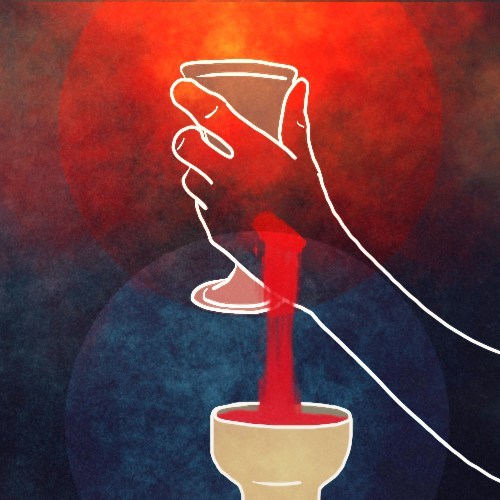
The Scripture readings for tonight’s service are Psalm 111; Exodus 12:43-51; and Mark 14:22-25.
I. What Is the Sacrament of the Altar?
It is the true Body and Blood of our Lord Jesus Christ, under the bread and wine, given unto us Christians to eat and to drink, as it was instituted by Christ Himself.
Where is it so written?
The holy Evangelists, Matthew, Mark, and Luke, together with St. Paul, write:
“Our Lord Jesus Christ, in the night in which He was betrayed, took bread; and when He had given thanks, He broke it and gave it to His disciples saying, ‘Take, eat; this is My Body, which is given for you; this do in remembrance of Me.’
“In the same manner, also, when He had eaten, He took the cup, and when He had given thanks, He gave it to them saying, ‘Drink of it, all of you; this cup is the New Testament in My Blood, which is shed for you, and for many, for the forgiveness of sins; this do, as often as you drink, in remembrance of Me.’”
Luther’s Small Catechism
In the name of Jesus. Amen.
Imagine being in Egypt for the initial Passover (Ex. 12:1-13). Your entire family is gathered for a special meal because God is about to deliver you from slavery, and being a slave is all you have ever known. God is coming to deliver, release, and rescue you, so everyone is filled with excitement. Your enemies are about to be defeated as the angel of death passes through the land. God promises that you will be protected from the angel of death because the blood of the Passover lamb will cover you.
So, you find that perfect, year-old lamb. You kill it and take the blood of the lamb and put on the posts and over the door of your house. Then, you start cooking. You roast the lamb, set the table, and have the meal. You eat it dressed and ready to travel to the Promised Land. And the next day, you walk out of Egypt through the Red Sea with a wall of water on your right and on your left. All your enemies are being defeated behind you. You are finally delivered from bondage and slavery.
Dear saints, that is, essentially, what happens each and every time you come to the Lord’s Supper. At this altar, you are delivered out of your slavery to sin. Jesus, the lamb without blemish or spot (1 Pet. 1:18-19), has been sacrificed. His Blood marks your door, and the angel of death passes over you. You eat His Body and drink His Blood which have been given and shed for the forgiveness of your sins. All your enemies are defeated. You are rescued from your slavery to sin and death. And God ushers you into the Promised Land of the kingdom of heaven.
Whenever you have the Lord’s Supper, as you return to your seat, it is completely and utterly appropriate for you to imagine walls of water on your right and left because in the Lord’s Supper you are being delivered from slavery and ushered into God’s kingdom.
Last week, we considered the first part of the question, “What is the Sacrament of the Altar?” and how Holy Communion is Jesus’ Body and Blood given to Christians to eat and drink for the forgiveness of sins. Tonight, we are going to consider the words Jesus used to institute the Lord’s Supper a bit more.
The words in your bulletin are a conflation of the four places in Scripture that record Jesus instituting the Lord’s Supper. By ‘conflation,’ I mean this: The four places where Scripture gives us the words of institution have slight, minor differences. The four passages are all in agreement in the essentials, and what you have printed there in the bulletin is all the actions and words of Jesus as He instituted His Supper which are taken from those four texts. If you are interested, I put together a table of the four passages and divided them into the parallel sections so you can see the similarities and differences. Through these midweek services, you will hear all four accounts. Last week, you heard Matthew; tonight, Mark; next week, Luke; and the week after, Paul in 1 Corinthians 11.
Again, even though there are minor differences, the essentials are the same. Jesus takes bread, blesses it, and gives it to the disciples to eat saying, “This is My Body.” Jesus takes the cup, blesses it, and gives it to the disciples to drink saying, “This is My Blood of the New Testament which is shed for you.”
So, what is this New Testament? When a person makes out a will or testament, he spells out who gets what after he dies. There might be times when a person will make changes to the will and what is to be done with the inheritance, but that is rare. And once he dies, that will is set in stone and cannot be changed.
Jesus’ will and testament is where and how Jesus swears to give His children everything that is His after He dies. In Holy Communion, Jesus gives you everything He has – His entire self His Body and Blood and His divine life. In other words, by Jesus’ crucifixion and death, you are made inheritors of His life which is a resurrection life. And because He made this Testament with you and has died for you, this Testament cannot be altered or changed – not even by God Himself.
God spoke about this new testament in Jeremiah 31:33-34 where He promised to put His Word in you and write it on your hearts. He will be Your God, and you will be His people. God will forgive your iniquity and remember your sin no more.
In the Lord’s Supper, you are given your inheritance as a child of God. You are delivered, forgiven, and have the right to enter the kingdom of God because Christ Himself has given you that right.
Remember that Jesus wants to give you this gift regularly, as often as you eat and drink it. And this does something for you and for others. Whenever you partake in the Lord’s Supper, you are doing two things simultaneously. First, you are receiving this Testament where Jesus promises the forgiveness of sins. And second, you are proclaiming Jesus’ death until He comes.
1 Corinthians 11:28, which should be familiar to you, says, “As often as you eat this Bread and drink the Cup, you proclaim the Lord’s death until He comes.” In a very real way, receiving the Lord’s Supper is how you proclaim, preach, and confess Jesus’ death and resurrection to a fallen and darkened world.
As you receive His meal of forgiveness, you are strengthened in faith toward God and love toward your neighbor. Psalm 116:12 asks, “What shall I render to the Lord for all His benefits to me?” Psalm 116:13 gives the answer, “I shall lift up the cup of salvation and call on the name of the Lord.” By you receiving the Lord’s Supper, God draws others to Himself to become His people, His children. For that, God be praised. Amen.
The peace of God, which surpasses all understanding, will guard your hearts and minds in Christ Jesus. Amen.
 Pastorsamwise
You must be logged in to post a comment.