Beautiful Time – Sermon on Ecclesiastes 3:1-15, 22 for Midweek Lent 3

The Scripture readings for tonight’s service are Psalm 31:14-15145:17-1916:7-8Ecclesiastes 3:1-15221 Timothy 6:6-11; and Mark 12:41-44.

In the name of Jesus. Amen.

Last week, we heard how God gives us Christians joy in this life in two simple things. He gives us joy in our leisure or in our eating and drinking; and He gives us joy in our work – not from our work but in our work (Ecc. 2:24). Scripture is clear, you won’t to find enjoyment in the fruit of your work by getting money that buys you things. That won’t work. Instead, you are to find enjoyment in the work God gives you to do. Your work and the effort you expend on all your God-given tasks is a gift from God’s hand. There is goodness and joy in you doing that work. If you didn’t hear that sermon from last week, I’d encourage you to go back and listen to it.

Tonight, as we consider this portion of Ecc. 3I’d like to pick up our thinking with some words that you heard last week, but you need to hear them again because they set up these verses which, probably, are more familiar to you – even if it’s only because of the song “Turn, Turn, Turn” by The Byrds.

Ecclesiastes 2 closed with these words, “[T]o the one who pleases him God has given wisdom and knowledge and joy, but to the sinner he has given the business of gathering and collecting, only to give to one who pleases God” (Ecc. 2:26). This is an amazing thing for God to say, and you have to have this clear in your mind. You, Christian, are one who pleases God. You please God because Christ has forgiven you and made you His child and because the Holy Spirit has made you holy. But to the sinner (and, yes, we are all sinners in a general sense, but ‘the sinner’ here refers to who is one who does not have faith in Christ’s forgiveness) to the sinner God has given the business of gathering and collecting, only to give what’s been gathered and collected to one who pleases God.

In short, people who aren’t Christians only gather and collect, but they don’t get to keep anything. People who aren’t Christians are always working to try and get some future joy that they will never achieve or attain because they try to find joy apart from God. So, they can’t enjoy either their work or their leisure.

There are really wealthy unbelievers who have a lot more than any of us here have. Dear saints, you are far better off than the richest people you can think of if they aren’t a Christian. Just because they have all that stuff doesn’t mean they are able to enjoy it. They might have a house with way more rooms than your house has, but they – just like you – can only be in one room at a time.

That’s where Ecc. 3 comes in. The simple fact is that we creatures of God are only given one moment at a time. Time comes to us moment by moment. Just as you can’t cling to those moments and make them stay, you also cannot reach out and grab future moments to make them come sooner. They only come in God’s timing.

Solomon summarizes this in v. 11 saying, “[God] has made everything beautiful (or ‘pleasant, right, fitting’) in its time.” Each moment is beautiful in the time that God gives it. And notice, that also means when something is outside of that time, it’s no longer beautiful, pleasant, enjoyable.

In that little poem that opens Ecc. 3, Solomon gives sixteen pairs of opposites: a time to be born, and a time to die; a time to plant, and a time to pluck what is planted; and so forth. Those pairs encompass everything in life, but to make sure that point gets across, the Holy Spirit inspired Solomon to preface all those pairs with, “For everything there is a season, and a time for every matter (or ‘activity’) under heaven.” So, you could add anything to this list.

There’s a time to drive a car, and a time to be chauffeured everywhere. There’s a time to be active and play sports, and a time to sit and watch sports. There’s a time to make a grocery list, a time to go fill up your shopping cart, a time to prepare food, a time to enjoy the food, and a time to clean everything up. Everything you do has a time to do it, and the time to do it is when that thing is before you to do.

Again, this sounds so simple, but think of how many people do not realize this and hijack and sabotage their joy by trying to live in moments that aren’t given to them. God gives a season to be a child and play with dolls or Lego’s and be joyful as a child. But children want to be older, get their driver’s license, and be independent. The young want to be older instead of enjoying the joy of childhood. You’ve heard the saying, “Youth is wasted on the young”? There is some truth to that. But what might be even sadder is when adults try to clutch and hang on to their youth and long-gone ‘glory’ days. We all easily fall into the trap of not having joy in the season of life that God has given.

Parents long for the days when their children can cut their own food and clean themselves and do some chores. Then, when the kids become teenagers and let their parents know how much they hate doing the chores, a parent longs for the former days of diapers, baths, and mushed peas.

Again, the problem is, when you try to find your joy in the future or in the past, you rob yourself of the beauty and joy of the present moment. But God makes everything beautiful (or ‘fitting’) in its time and in the season in which God gives it.

Imagine you’re on a camping trip in late August. The sun has set; you’re zipping up your tent and climbing into your sleeping bag. Suddenly, a massive fireworks show starts. You’d probably be fairly perturbed. It’s not the time for fireworks. But if you’re camping on the 4th of July, you’d disappointed if there wasn’t fireworks. You see? The fireworks aren’t the problem in August, it’s the timing. Or try this, if one of you right now started pitching a tent here in the sanctuary and rolling out a sleeping bag, we’d all look at you like you’re a crazy person because you would be. Same thing – it isn’t the tent that’s the problem, it’s the timing. Firework shows, tents, and sleeping bags are all fine and good and right and enjoyable – in their proper time. Which leads me to this…

Right now, dear saints, God has given us the moments that are mentioned in Ecc. 3:4. A time to weep, and a time to laugh. A time to mourn, and a time to dance. And we’re going to be bouncing back and forth in those. With Jesus (Jn. 11:35), we weep because of the passing of our sister, Ros. We miss her. Rightly so. And as we weep, we share memories and laugh and mourn and weep again. And in the midst of that, we can dance because we know that she is with Jesus and we will see her again.

All of that leads me to the other part of v. 11. Hear it again, “[God] has put eternity into man’s heart.” This phrase is difficult to understand, but try this: We humans have a capacity that other creatures don’t have. 1) We can remember the past, and 2) we can anticipate the future. But those abilities can be dangerous if we use them for the wrong reasons. God allows us to remember the past so we can give thanks to Him for it. And God allows us to anticipate the future so we can have hope for what lies ahead.

Even though you can’t hold on to a moment. It’s here one second and gone the next. But God has given you memory. What the Holy Spirit wants you to do with that gift of memory is to use it to thank God for what He has done and given. Even though you can’t reach into the future and force those moments to come sooner, God has given you the capacity to anticipate the future. And the Holy Spirit wants you to use that gift so you can have hope, which is a good thing.

In other words, you can remember the past and be thankful. You can anticipate the future so you can have hope. But Ecclesiastes is clear. You can’t have joy either in the past or in the future. Joy is only given in each present moment, and God makes those moments beautiful in their times.

So, dear saints, receive the beauty and joy in every moment God gives you. When you have past joys, thank God for that gift, but don’t try to go back because you can’t, and you’ll miss the beautiful moment now. Don’t try to pull the future into the present. Don’t do that first, because you can’t. But also, don’t do it because that moment hasn’t ripened yet. Leave the future in God’s good and generous hands so He can deliver those gifts to you in the right, beautiful time.

Finally, dear saints, let the beauty and the joy that God gives in each moment give you a hunger and a hope for the eternal joy that God has promised to give you. What a joy that will be. Amen.

The peace of God, which surpasses all understanding, will guard your hearts and minds in Christ Jesus. Amen.

A Peaceful, Quiet Life of Prayer – Sermon on 1 Timothy 2:1-6 for the Sixth Sunday of Easter

1 Timothy 2:1–6

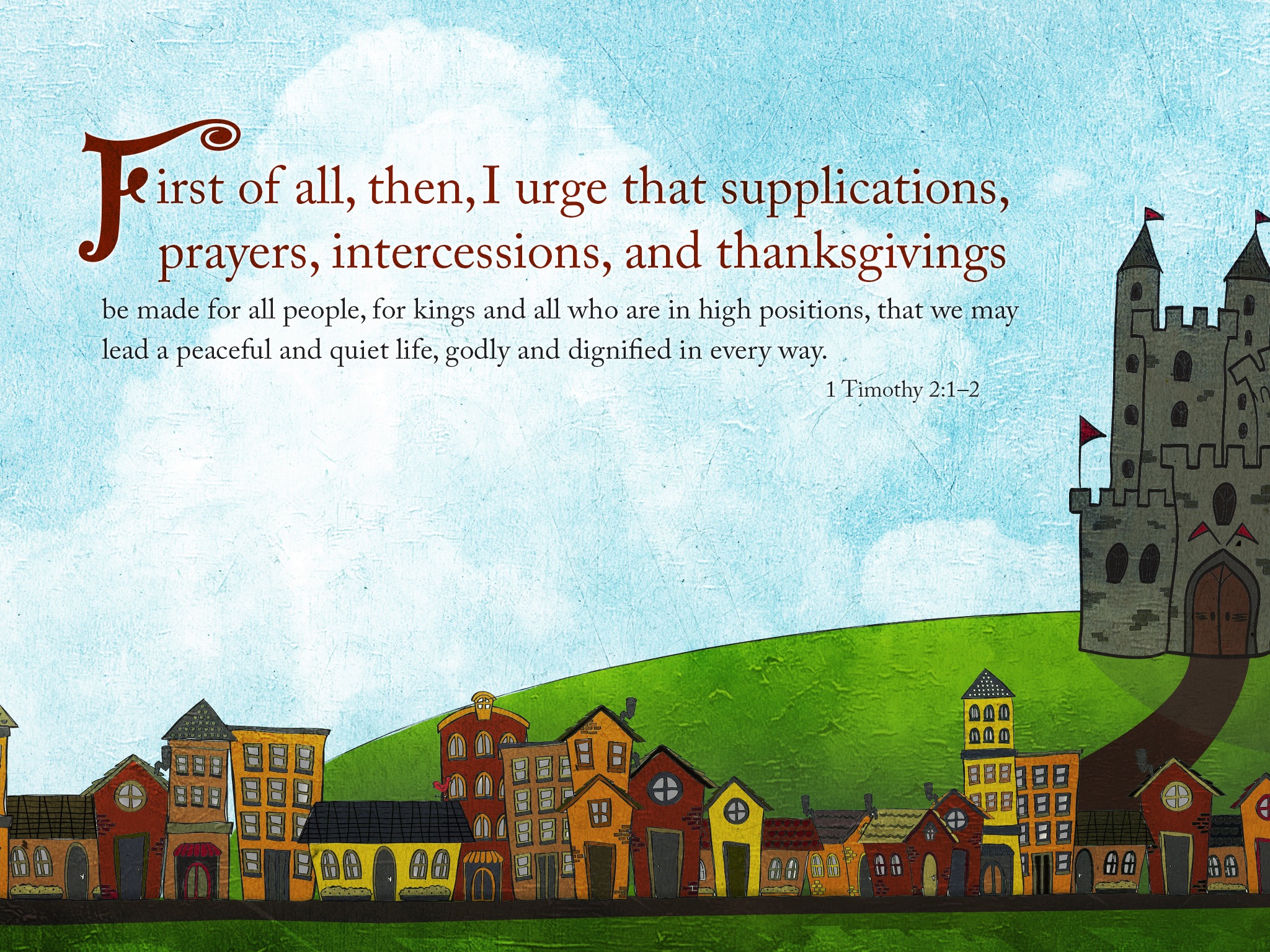
1 First of all, then, I urge that supplications, prayers, intercessions, and thanksgivings be made for all people, 2 for kings and all who are in high positions, that we may lead a peaceful and quiet life, godly and dignified in every way. 3 This is good, and it is pleasing in the sight of God our Savior, 4 who desires all people to be saved and to come to the knowledge of the truth. 5 For there is one God, and there is one mediator between God and men, the man Christ Jesus, 6 who gave himself as a ransom for all, which is the testimony given at the proper time.

Alleluia! Christ is risen!
He is risen indeed! Alleluia!

In the name of Jesus. Amen.

This should come as no surprise, but the Apostle Paul, who was inspired by the Holy Spirit to write 1 Timothy, was not an American. Here, Paul gives instructions about how a peaceful, quiet, godly, and dignified life will come about, and it isn’t through the separation of church and state. This peaceful life comes about by praying for all people, for kings, and for all who are in positions of authority. That means that Paul is instructs pastor Timothy to encourage his congregation to pray for Nero the emperor, the family and descendants of Herod, the different Roman governors who came after Pontius Pilate, and many others. In the context of our day, that means, Christian, you need to pray for your mayor; your city council and school board members; your state and national senators and representatives; the president; the judges at all levels; police and parole officers. We could go on and on and include all the bureaucrats who are appointed to positions of authority, but that would take too long.

We are to pray for those people in authority because God desires all to be saved and come to a knowledge of the truth. And just to be clear on this, Paul is, without question, saying there is a link between Christian prayers for civil authorities and the spread of the Gospel. The two go together according to this text. This really undermines the common understanding of the relationship between the church and the state, at least as it is talked about today.

In our country, it is good that the governing authorities don’t get to mandate or dictate that you be a Roman Catholic, Baptist, Methodist, or even Lutheran. Our founding fathers were wise when they wrote the Bill of Rights and decreed, “Congress shall make no law respecting an establishment of religion, or prohibiting the free exercise thereof.” But this does not mean that the Church and the State should stay in their separate corners and never have anything to do with each other. A lot more could be said about this, but the context for that would be better for a study on politics, culture, and religion – not a sermon.

For a sermon, which this is, it is better to get a Biblical perspective of how God has ordered this world for the benefit of us, His creatures. So, that’s what we are going to do.

To preserve and maintain order in creation, God has instituted the Three Estates – the Church, the Family, and the State. Through these Three Estates, God provides for His people and all creation. Now, many of you have heard me preach and teach about the Three Estates before, but it is good to be reminded of what these estates are and what they are to do.

Both the estate of the Church and the estate of the Family were established by God before the Fall into sin. God established the estate of the Church so there would be spiritual life, and spiritual life always comes through faith in God’s Word (Hab. 2:4; Ro. 1:17; Gal. 3:11; Heb. 10:38). The Church began when God told Adam to not eat of the Tree of the Knowledge of Good and Evil. As long as Adam didn’t eat that fruit, he had spiritual life through trusting God that evil was bad and if Adam gained knowledge of evil, he would surely die (Gen. 2:16-17). After the Fall, God gave the estate of the Church a new promise which was that He would send Jesus to forgive and save sinners and crush the devil’s head (Gen. 3:15). Today, the Church continues to proclaim the Gospel so more would believe in Christ, be saved, and have eternal life.

Also, before the Fall, God established the estate of the Family. The purpose of the Family is physical life. God created Adam and Eve and commanded them fill the earth and have dominion over it (Gen. 1:28-30). God loves people, He wants there to be more people, and He has given a husband and wife an important role in enlarging the number of people. God wants husbands and wives to have children and faithfully raise those children so they will grow up and have more children. The estates of the Church and Family were all that was needed before the Fall because they provided all what was necessary – spiritual life and physical life.

But we don’t live in the original goodness and perfection of creation anymore. All mankind fell into sin. Sinners will only look out for themselves. Left unchecked, sinners do whatever is right in their own eyes (Dt. 12:8; Jdg. 17:6, 21:25) and the world quickly falls into chaos and anarchy. So, after the Fall, God established the estate of the State, and just to be clear, the State is the governing authorities. Scripture is clear that every authority that exists is put in that position of authority by God (Ro. 13:1-2). Since the Fall, every emperor, every monarch, every president, prime minister, governor, legislator, judge, police officer, etc., has been put into his or her office by God Himself.

The State cannot give life, but giving life isn’t God’s purpose for the State. God gave the State to protect and preserve life in a world of sinners. In fact, we rightly recognize that the State only exists to protect and serve the estates of the Church and the Family. There will be no estate of the State in heaven. But the only way for the State to maintain order in a world of sinners is through punishment and the threat of punishment. So, it is good and right for the State to do things like setting speed limits, collecting taxes to maintain a strong police and military to protect the citizens, and have laws that allow for businesses to grow and thrive so people can have jobs that provide a living for families. The State is there to maintain peace, stability, and predictability in a world full of sinners.

The unfortunate thing about the State, and we repeatedly see this throughout history, is that the people in authority quickly let that authority go to their head. They often make life more difficult for those under their authority in all sorts of ways. That is why Paul here tells pastor Timothy to teach his congregation to pray for the authorities in the State with supplications, prayers, intercessions, and thanksgivings.

Now, with these four different words for prayer, you don’t need to get too worked up about them. They just summarize what you normally do in prayers. Supplications are prayers that you offer for others as though their problems are your problems. Prayers is the generic term that simply refers to petitioning or appealing to God. Intercessions are asking God to forgive the sins of others as though they are your own sins. Thanksgivings here doesn’t only mean that we are thankful for the authorities, though we should be; these thanksgivings are on behalf of others. We thank God for the mercies He has given to others as though He has given all those blessings to us. When things are good for others, they are good for us. In Jeremiah 29, God tells His people to seek the welfare of the city where they will be captive and exiled because it result in the welfare for God’s people in while they are in exile (Jer. 29:7). The same is true today. When those in authority are governing well and serving those under their authority, life is good.

Praying for the authorities in this way blesses us. God hears those prayers and answers them. Too often we might think that our prayers don’t actually do anything, but we are wrong. I’ve used this analogy before, but think of it this way: When a president or king is fighting a war, he has advisors. They sit around a table and strategize, consult, and plan together. Those advisors are important, and the person in charge values their input and alters his plans based on that discussion. Scripture teaches that you, Christian, you, child of God, are at that table. When God commands you to pray, He is inviting you into His war room to give your input as to how things should be handled on the battlefield. God wants your thoughts and ideas on how situations should be handled. God turns to you and asks, “My beloved child, what do you think we should do?” Your prayers are your response.

Another blessing that comes when we pray for authorities often gets overlooked. Our prayers give us a better perspective on God’s involvement in the world. God is not some divine clockmaker who just wound the gears and stepped back to let creation run on its own. No, He is deeply involved in all aspects of creation. Praying for the authorities helps remind you of that. Yes, God has given them power and control over many aspects of society and life, but who has power and control over those authorities? God Himself does.

This is why it especially important to pray for the authorities when they are governing in a way that contradicts how God would have them govern. Remember when Paul wrote these verses, Nero was the emperor. Paul says Christians should be praying for Nero, who was burning Christians to light his garden parties and would order Paul’s execution. Through your prayers for the authorities, God reminds you that they are not the ones who are ultimately in control. God is. Proverbs 21:1 says, “The king’s heart is a stream of water in the hand of the Lord; [the Lord] turns it wherever He will.” And if the authorities do evil, God Himself will hold them accountable. Remember that and your life will be a lot more peaceful and quiet, godly and dignified in every way.

Now, we’re going to abruptly change gears here. Vivian, this all brings me to you. Vivian, today you are Baptized. Today, Jesus has joined you to Himself by placing His name upon you (Mt. 28:19) and clothed you with Himself (Gal. 3:27). Vivian, in your Baptism, Jesus joined you to His death so that you have a Jesus-kind of death – in other words, a death that doesn’t last long and ends in resurrection (Ro. 6:3-11). Vivian, the God who desires all people to be saved has come and saved you. And, Vivian, as a congregation, we promise that we will pray for you that you will lead a peaceful and quiet life, godly and dignified in every way. 

Vivian, and all you saints, that life comes only because of Christ Jesus. He is the mediator between God and all mankind. The mediation He did was to give Himself on the cross, to shed His blood, and to lay down His life as a ransom for all and for you.

Dear saints, when you are surrounded by chaos and confusion on every side, call out to the Lord in prayer. He will listen and not reject your prayers (Ps. 66:19-20). And even though you will have tribulation in this world, Jesus, your Savior, has overcome the world (Jn. 16:33). May that fact give you eternal peace.

Alleluia! Christ is risen!
He is risen indeed! Alleluia!

Amen.

The peace of God, which surpasses all understanding, will guard your hearts and minds in Christ Jesus. Amen.

Rise & Go – Sermon on Luke 17:11-19 for the Fourteenth Sunday after Trinity

Luke 17:11-19

11 On the way to Jerusalem [Jesus] was passing along between Samaria and Galilee. 12 And as he entered a village, he was met by ten lepers, who stood at a distance 13 and lifted up their voices, saying, “Jesus, Master, have mercy on us.” 14 When he saw them he said to them, “Go and show yourselves to the priests.” And as they went they were cleansed. 15 Then one of them, when he saw that he was healed, turned back, praising God with a loud voice; 16 and he fell on his face at Jesus’ feet, giving him thanks. Now he was a Samaritan. 17 Then Jesus answered, “Were not ten cleansed? Where are the nine? 18 Was no one found to return and give praise to God except this foreigner?” 19 And he said to him, “Rise and go your way; your faith has made you well.”

In the name of Jesus. Amen.

Leprosy wasn’t simply a skin disease. Scripture repeatedly equates leprosy with punishment for sin and a sign of God’s wrath. In Dt. 28(:15, 27) Moses says, “If you will not obey the voice of the Lord your God,… [He] will strike you with the boils of Egypt, with tumors, with scales and [leprosy] of which you cannot be healed.” We see this happen several times in the Scriptures.

When Moses’ sister Miriam spoke against Moses (Num. 12:1-10), she became a leper. David’s general, Joab (and later Joab’s descendants), were struck with leprosy after he unjustly killed Abner (2 Sam. 3:29). After Naaman was healed from his leprosy, Elisha’s servant, Gehazi, took a bribe from Naaman and became leprous (2 Kgs. 5:20-27). King Uzziah of Judah contracted leprosy when he offered incense in the Temple even though he was not a priest (2 Chr. 26:16-21). The rabbis in Jesus’ day taught that leprosy was never contracted by people who lived moral lives. (I don’t think we can or should go that far, though.) There is little doubt that these ten lepers concluded that their condition meant they were being punished by God.

In desperation, they cry out, “Jesus, Master, have mercy upon us.” What were they asking for? Did they know that Jesus had cleansed lepers before, so they were crying out to Him for healing? Did they want food or money? Honestly, we don’t know, and it’s possible that the lepers didn’t know themselves. Notice, they don’t call Jesus ‘Lord’ as many other people do when they call out to Jesus in faith. Instead, they call our Lord, ‘master,’ which opens the door to all sorts of possibilities. Jesus simply responds, “Go and show yourselves to the priests.”

Now, this statement from Jesus was probably not received well by the lepers. They already knew that the priests were supposed to examine people with skin diseases and declare them to be clean or unclean, and, since these ten have leprosy, they are unclean. Going to the priests would be a pointless exorcise for lepers. The best-case scenario for a leper being examined by a priest would be for them to be declared unclean again. Because we know the end of the story, we know that Jesus has a hidden word of promise here. We know that their leprosy would be gone by the time they got to the priests. But some have argued, and I think convincingly, that these lepers heard the opposite. Instead of hearing the hidden promise, they heard a hard, “No, I won’t help you,” from Jesus.

Let me explain. I frequently and regularly get phone calls and people coming in to the church asking for help. I listen to their story and ask questions to discern how we as a congregation can best help them. Nine times out of ten, the individual is simply looking for one more excuse to continue some type of sinful, destructive behavior.

A few years ago, a man came here telling me that he was homeless and wanted money to buy food. I listened to his story, prayed with him, offered him some godly advice, and told him, “We have some food I can give you in the basement.” (And just so you know it was perfectly good food that I ate a couple days after he came.) But he didn’t want what we had, so I told him that he could go to Northlands Rescue Mission or to the Food Shelf because we support those ministries monthly, but he wasn’t interested in that either. He wanted money to get something from the store. I simply told him, “Listen, we are happy and willing to help you. You can have this food here, you can get a meal at Northland, or you can get something from the Food Shelf.” He became very upset, and as he left he yelled at me, “[Bleep] off.”

I’m very glad that we, as a congregation, send monthly support to different ministries in our community that can assist probably 95% of the people who come to our congregation asking for help. Those ministries serve as a clearing house to make sure people aren’t abusing the generosity of Christians and can come along side of people to help teach them to make better decisions. And I want to be clear, we still help many who need assistance through our Deacons’ Fund, but some people refuse to receive the help they actually need.

I think the nine lepers were like that man. He was offered three ways to get food, which is what he said he wanted. But he only heard the refusal to give him money as a refusal to help him. These lepers probably heard Jesus’ statement, “Go and show yourselves to the priests,” in a similar way. It was as if Jesus was saying, “I’ll only help you if you are declared to be clean by the priests.”

The other thing we have to consider is the timing of all this. When were these lepers healed, and when did they discover that they were cleansed? I’ve typically imagined that the ten lepers start marching off to Jerusalem, and after they had walked for a couple hours, discover that they were healed. Nine of them continue journeying to the Temple, but the Samaritan hikes his way back to the village, back through the streets, back to Jesus’ feet where he falls down and gives Him thanks. The thing about this is that the text doesn’t actually supply any of those details. It’s certainly possible that it happened that way, but the grammar that Luke uses actually seems to imply something different.

The way the verbs work seems to suggest that the healing happened more or less immediately, or at least while the ten are still within earshot of Jesus. Imagine if their cleansing happened immediately, basically just as they turned away. The Samaritan, unlike the nine, turns back and praises Jesus with a loud voice. He recognizes both his healing and the source of his healing – which came from the Word of Jesus. In faith, given by the Holy Spirit, the Samaritan believes that Jesus is the good God who has good things for him. He receives the gift of healing, but even better, he believes in the healing Savior, who also gives salvation and eternal life, which is exactly what he gets. Those last words of Jesus in our text are better translated, “Your faith has saved you.”

In the end, the nine ungrateful lepers didn’t expect God to be good to them. And Jesus’ statement, “Were not ten cleansed? Where are the nine?” would be a direct rebuke of them – something along the lines of, “Are you nine going to ignore when I have just done? I’ve given better than the mercy you asked for, and I have even more to give you.” But even if that isn’t the case, when the nine are healed, they refuse to recognize their Healer. The fact that they are cleansed is a wonderful thing, but it is only temporary. Their skin is restored, but their souls were still leprous in sin. They are the embodiment of the un-thankfulness that Jesus talks about in Mt. 5:45 where He says, “[God] makes the sun rise on the evil and on and on the good, and sends rain on the just and on the unjust.” Dear saints, how often does our merciful God gives good things to draw us to Himself, but we fail to recognize it?

But the Samaritan sees God’s goodness and comes back for more. He returned to Christ from whom all blessings flow.

It’s one thing to be grateful, but it is a different thing to be thankful. There is little doubt that the nine lepers were grateful that they were better, but they didn’t recognize how they had been healed. But the one, the Samaritan, the doubly outcast, was thankful. He was not only happy for the gift of healing; he was also thankful for and to the Giver of the gift. That is why he returns to Jesus and gives Him thanks and praise.

I’m going to abruptly change gears here, so bear with me. The church has commonly used Psalm 116:12-13 as a prayer before receiving the cup during Holy Communion. Here’s that prayer: “What shall I render to the Lord for all his benefits to me? I will lift up the cup of salvation and call on the name of the Lord,” which fits perfectly with what this Samaritan leper does. Jesus is good to him by healing him. So, what thanks and service does he offer to God? He goes back and receives more. He receives the salvation of his soul which is even better than being cleansed from leprosy.

So, let’s bring this to us today. Too often, we are like the nine. We see and feel our suffering and think that God has forsaken us. We pray and ask God to remove whatever crosses we bear, but in our impatience, we think that any delay of relief is a hard, “No,” from God which makes us doubt God’s goodness. As that sinful doubt creeps in, we grow less and less thankful, and even when God does remove that suffering, we do not recognize His goodness and mercy. May we repent.

Dear saints, even in our most difficult times, we can wait on the mercy of God. Yes, we suffer in this life, and “Our sufferings are not trivial, but neither are they eternal” (Rev. Petersen). We can wait on and trust in God. We can praise Him even in times of sorrow because He has bought us with His blood and will never leave nor forsake us.

And from this Samaritan, let us learn to always return to Jesus. When Jesus tells him, “Rise and go,” He doesn’t give him any direction. The man can go wherever he wants. But notice where he did go after being healed, he went back to Jesus, back to the goodness of God for more. And the interesting thing about Jesus’ command to ‘go’ is that the Greek word is a little ambiguous. At its root, it means ‘journey’ which means that It doesn’t necessarily mean, ‘go away,’ it could also mean ‘come with me.’ And it doesn’t make much sense if Jesus praises the man’s faith and tells him to go away. Faith always returns to Jesus in thanks to receive more of what Jesus has to offer. That is why Ps. 116 answers the question, “What shall I render to the Lord for all his benefits to me?” with, “I will lift up the cup of salvation and call on the name of the Lord.”

Dear saints, we can expect God to be good wherever we journey. And we always desire to come back to Christ because He has more good things to give to us. Faith wants to be with Jesus and continue to receive His gifts. He is our Temple. He is our Priest. And He is here now to cleanse us and freely give us His forgiveness.

God has given you every good thing. So, what will you do to repay Him? Come and get more. Come now to His table and lift up the cup of salvation. Come, eat and drink the Body and Blood of Christ for the salvation of your soul. Amen.

The peace of God, which surpasses all understanding, will guard your hearts and minds in Christ Jesus. Amen.

Thanks – Sermon on Luke 17:11-19 for the Fourteenth Sunday after Trinity

Listen here.

Luke 17:11-19

11 On the way to Jerusalem he was passing along between Samaria and Galilee. 12 And as he entered a village, he was met by ten lepers, who stood at a distance 13 and lifted up their voices, saying, “Jesus, Master, have mercy on us.” 14 When he saw them he said to them, “Go and show yourselves to the priests.”And as they went they were cleansed. 15 Then one of them, when he saw that he was healed, turned back, praising God with a loud voice; 16 and he fell on his face at Jesus’ feet, giving him thanks. Now he was a Samaritan. 17 Then Jesus answered, “Were not ten cleansed? Where are the nine? 18 Was no one found to return and give praise to God except this foreigner?” 19 And he said to him, “Rise and go your way; your faith has made you well.”

In the name of Jesus. Amen.

Last week, we heard the parable of the Good Samaritan (Lk. 10:25-37). Jesus is the One who gets down in the dirt and has mercy upon you. Today, we again hear about a good Samaritan who was one of the ten lepers healed by Jesus. Today’s good Samaritan receives mercy from Jesus, the Good Samaritan, and gets down in the dirt to give Christ thanks.

These ten lepers were socially distancing themselves, as the Law of God demanded (Lev. 13:45-46). The lepers are suffering, but they are also dangerous to others, so they were to be separate from the rest of society. Yet, they form a little community. We know that at least some (if not nine) of these lepers were Jewish, but at least one of them was a Samaritan. Normally, Jews have no dealings with Samaritans (Jn. 4:9) because Samaritans were considered unclean. But since all ten of these lepers were already unclean, they are united together in their suffering, similar to what happened in the months after 9/11, when our country was suffering. We bonded together as a nation. May God grant that type of unity again!

Anyway, these suffering lepers have gathered together and this little congregation lifts up its voice, “Jesus, Master, have mercy upon us.” When they cry out for mercy, what were they asking for? Did they want some food or money? Did they know that Jesus had cleansed lepers before and were crying out for healing? We don’t know, and it’s possible that the lepers didn’t even know themselves. Notice, they don’t call Jesus ‘Lord’ as many other people do when they call out to Jesus in faith. Instead, they call our Lord, ‘master.’

What is important is that they were asking the right one – Jesus – for the right thing – mercy. God in His mercy answers imperfect and imprecise prayers in exactly the right way. In fact, “Lord, have mercy,” is a great prayer that distills everything you need down to a single petition. Mercy is always what you need.

Now, we need to consider the attitude toward lepers back then. In Jesus’ day, the rabbis typically taught that leprosy was a manifestation of an inner uncleanness. In other words, the common thought was that leprosy didn’t just happen to people. Instead, leprosy was seen as a Divine judgment against the sins of those who had it, and people had the general attitude that lepers were simply getting what they deserved from God.

Unfortunately, we Christians often have a similar attitude toward those who are suffering: the poor, the homeless, etc. May God forgive us for the times that we are like the priest and Levite in the parable of the Good Samaritan, looking past those who need mercy and passing by on the other side of the road. So, please know, that while the normal attitude toward lepers in Jesus’ day was to think of it as God’s just judgment on those who had it, I’m not defending that attitude. But I think that fact is important to possibly understanding the actions of the nine who don’t return to Jesus.

Jesus hears their plea for mercy and says, “Go and show yourselves to the priests.” Because we know the whole story, we know that when Jesus said that they would be healed, the priests would look them over, and they would be admitted back into regular society. In that moment, the lepers didn’t know that. They already knew about the priests, and they knew that because of their leprosy, there was no place for them in the Temple because they are unclean.

So, some have speculated (and I think it is a likely explanation) that the lepers might have understood Jesus’ words in a negative and offensive way. So often in the Gospels, we read that even the disciples do not understand Jesus, and that may have been what is going on here. Even though Jesus didn’t mean it this way, the lepers might have understood Christ to be saying something like, “Why should I have mercy on you when you are unclean? Get out of here. Show yourselves to the priests. If they declare you to be clean, then I will help you.”

Again, it’s speculation. But if this is accurate, it would mean that they interpreted Jesus as saying, “No.” So they are disappointed and their refusal to rejoice even when they are healed might be reasonable in their minds because Jesus hasn’t done anything for them. However, this Samaritan sees things differently, and because he has faith, he returns to Jesus, praises Him with a loud voice, and gives thanks. According to Jesus, this good Samaritan wasn’t just healed from his leprosy; instead, Jesus says to him, “Rise and go your way; your faith has (lit.) saved you.”

Now, there are a lot of things we can glean from this text. For one, we see the saving power of Jesus’ Word – even from a distance. Or, as we have in the past, we could consider how Jesus is the true, great High Priest who makes atonement for us. We could also focus on how Jesus claims to be God (even though so many people claim that He never did). With this good Samaritan at His own feet, Jesus says, “Was no one found to return and give praise to God except this foreigner?” But today, we are going set all of that aside, and instead focus on the Christian act of giving thanks.

Jesus sees the evidence of this good Samaritan’s faith in the fact he came back to give thanks. Christians give thanks. Christians are thankful people. We heard the fruits of the Spirit in our Epistle text (Gal. 5:16-24), and one of the fruits of faith is thanksgiving. I want to put before you four thoughts about thanksgiving.

The first thought is that thanksgiving comes first. Over and over in Paul’s letters, he begins by giving thanks. All of Paul’s letters except Galatians and Titus begin with thanksgiving. And this is amazing when you realize to whom Paul was writing. Paul wrote two letters to the Thessalonians who thought they had missed Jesus’ return and the Resurrection. They were tempted to think that Paul was a fraud apostle. But Paul begins both of his letters to the Thessalonians with thanksgiving.

The church in Corinth was even worse. There was a man who had gotten married to his mother-in-law and was bragging about it. Families were breaking apart and people were abandoning their spouses because they thought the Resurrection was coming soon. Some members of the church didn’t even believe in the Resurrection. They were not letting poor people come to the Lord’s Supper, and some were getting drunk during Communion. They were fighting about who to follow – Paul, Peter, Apollos, or Christ (1 Cor. 1:11-13). The church in Corinth was, by all accounts, a colossal disaster. We would think Paul would begin his letters to them by saying, “I’m ripping my hair out every time I think of you.” But no! Paul begins his letter, “I give thanks to my God always for you” (1 Cor. 1:4).

There is something to be said about starting with thanksgiving. When you start each day with thanking God for protecting you through the night from all harm and danger, you’re starting your day off right. It’s easy to start your day with worrying, panicking, fretting, and thinking of all the things you have to do, but doing that only wears you down and is offering the false worship of worry instead of the true worship of thanks. Thanksgiving starts us off on the right foot.

This leads to the second thought about thanksgiving. Thanksgiving requires a turning back. The good Samaritan had to turn back and return to Jesus to give thanks. While this is what literally, physically happened, there is also something very profound to contemplate here.

If we’re always focused on what is coming next, if we are always oriented toward what lies ahead, we cannot give thanks. There’s nothing in the future to be thankful for. There are reasons to be hopeful, but nothing to give thanks for. Remember that Jesus says that tomorrow is always full of worry but let tomorrow worry for itself (Mt. 6:34). As long as we think about tomorrow, we can only have worry – or, at best, worry mixed with hope. But we cannot have thanksgiving.

If we are going to give thanks, we must look backwards to what has been or to the present and to what is. So often, Scripture pictures thankfulness as the opposite to worry. Philippians 4:6 says, “Do not be anxious about anything, but in everything by prayer and supplication with thanksgiving let your requests be made known to God.” When we remember how God has forgiven us, provided for us, and protected us, we give thanks for He is good, and His mercy endures forever.

The third thought about thanksgiving is that thankfulness and faith go together because thankfulness looks to God as the Giver of all good things. And here, it might be good to make a distinction between thanksgiving and gratefulness. Gratefulness looks at the goodness of the gift while thanksgiving tends to look at the goodness of the giver or source of the gift. If you brought me a milk chocolate mocha with no whip and an extra shot of espresso, I would be grateful for the coffee in my hand and thankful to you because you gave it to me.

Don’t get me wrong, gratitude is important. We should be grateful and recognize the goodness of the gifts that we have – family, health, food, clothing, house, home, etc. But Christians should go past gratefulness and be thankful. I don’t doubt that the nine lepers were grateful that they were cleansed, but they didn’t return and give thanks to Jesus, their Cleanser.

By faith, we look past the gift and even past the individual who has given the gift and recognize that everything we have comes from God. As James 1:17 says, “Every good and every perfect gift is from above, coming down from the Father of lights.”

The good Samaritan leper saw and was grateful for his healing, but he looked past that and gave praise to God at the feet of the Son of God. And we Christians, when we have a table full of food, we look past the person who earns the paycheck, past the grocers, truck drivers, and farmers (it is right to give them thanks too). But ultimately, we give thanks to God who has provided the good gift of food.

Which leads us to the fourth thought: Christians give thanks even in times of suffering. After, ‘mama’ and ‘papa,’ there are two words that parents work to teach their children – ‘please’ and ‘thank you.’ It isn’t just Christians who teach this. Part of living in this world is to be polite and thankful for good things. But Christians can even give thanks in bad times because God remains good. Even when God hands us over to suffering, He does so out of His goodness. 

Natural, worldly thanks has to do with the goodness of the gift. But Christian thankfulness has to do with the goodness of the Giver – the goodness of God. As Christians we recognize that everything we have comes from God. In Philippians 4:11, Paul says, “I have learned in whatever situation I am to be content.” Or think of Job who had been protected and blessed by God. Even when God removes His protection, Job still rightly thanks God even in his suffering and says, “Though He slay me, I will hope in Him” (Job 13:15).

So, whether we are full or hungry, whether we have friends or are lonely, whether we have peace or are in the midst of chaos, in life and even in death, we give thanks to God because He has already graciously given us Jesus. Remember Romans 8:32, “He who did not spare His own Son but gave Him up for us all, how will He not also with Him graciously give us all things?” In other words, God has already given you Jesus, and there is no good thing He will ever hold back from you.

Everything in this life comes from God the Father. In health and in pandemic, in good times and in bad, in order and in chaos, in joy and in sorrow, still we give thanks and bless God’s name. 

This good Samaritan leper had reason to give thanks for being healed, but there was even more reason to give thanks that Jesus had looked upon him in kindness and forgiven his sin. The same is true for you. God has given you His only begotten Son so that you can receive His eternal love and kindness.

May the Holy Spirit grant that we always be filled with this thankfulness. Amen.

The peace of God, which surpasses all understanding, will guard your hearts and minds in Christ Jesus. Amen.

Thankful & Waiting – Sermon on Matthew 25:1-13 for the Last Sunday of the Church Year

Listen here.

Matthew 25:1-13

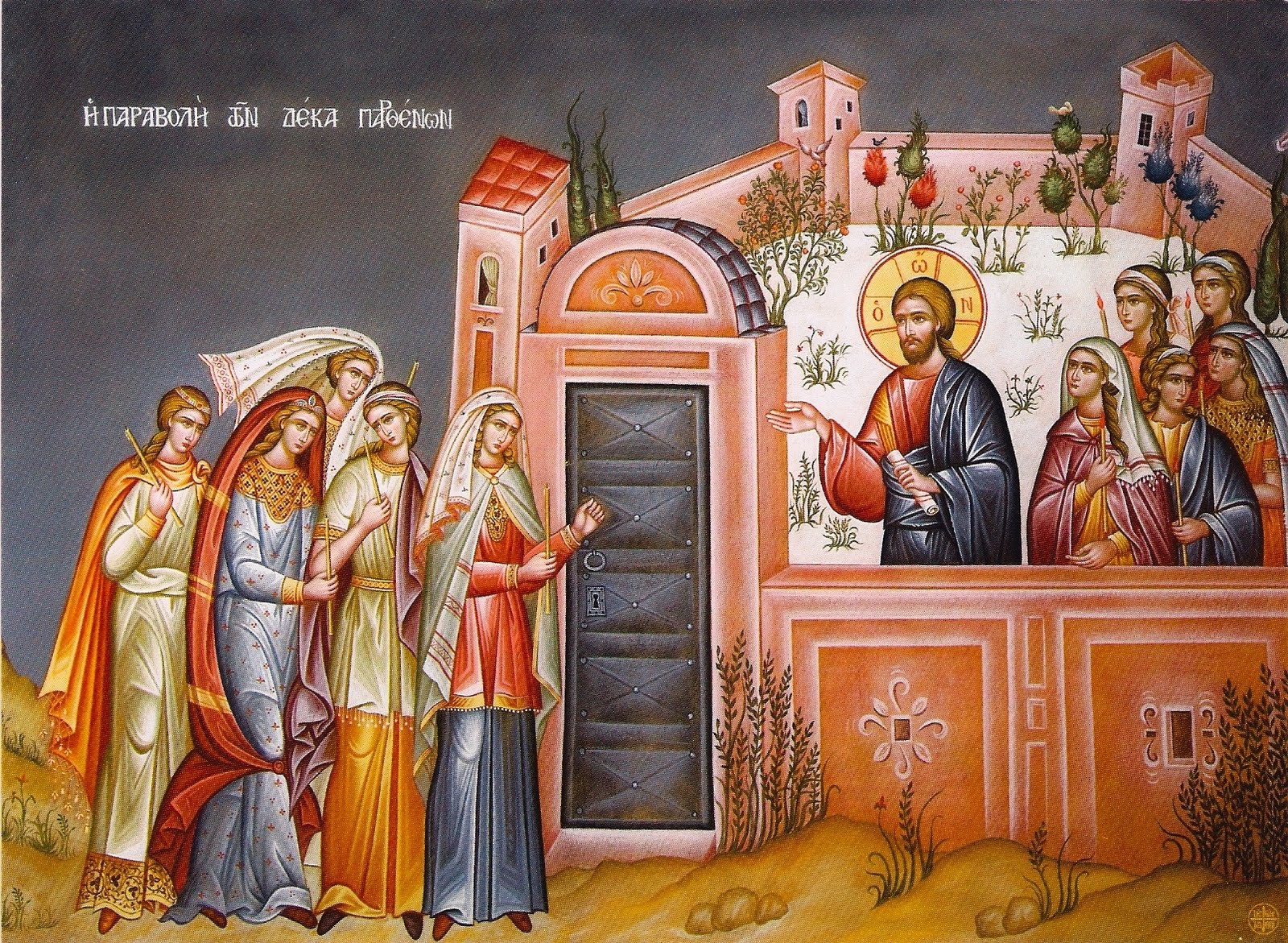
1 “Then the kingdom of heaven will be like ten virgins who took their lamps and went to meet the bridegroom. 2 Five of them were foolish, and five were wise. 3 For when the foolish took their lamps, they took no oil with them, 4 but the wise took flasks of oil with their lamps. 5 As the bridegroom was delayed, they all became drowsy and slept. The Ten Virgins Riojas6 But at midnight there was a cry, ‘Here is the bridegroom! Come out to meet him.’ 7Then all those virgins rose and trimmed their lamps. 8 And the foolish said to the wise, ‘Give us some of your oil, for our lamps are going out.’ 9 But the wise answered, saying, ‘Since there will not be enough for us and for you, go rather to the dealers and buy for yourselves.’ 10 And while they were going to buy, the bridegroom came, and those who were ready went in with him to the marriage feast, and the door was shut. 11 Afterward the other virgins came also, saying, ‘Lord, lord, open to us.’ 12 But he answered, ‘Truly, I say to you, I do not know you.’ 13 Watch therefore, for you know neither the day nor the hour.”

In the name of Jesus. Amen.

I promise we’ll get to the parable; it’ll be in a roundabout way. But first…

Four days from now, our nation will pause and dedicate a day to giving thanks. Friends and families will gather. Tables will be set. Turkeys will be cooked. (By the way, if you’re in charge of the turkey, make sure you brine it first – use kosher salt, 24 hours. Talk to me after the service.) Potatoes will be mashed. Stuffing will be fluffed. Pies will be baked. Cream will be whipped. Football will be watched. And couches and recliners will be tested for structural integrity.

Having a day for Thanksgiving is good, right, and important – probably more important than we could ever realize. Even though it is in the name – “Thanksgiving” – most people probably miss the whole meaning of the day. Thanksgiving is a day to give thanks, and that means there must be a recipient of our thanks – someone to whom we give thanks. And, dear Christian, I hope Thanksgiving Day is different for you than it is for many in our country because you know to Whom you give thanks. Let me parse that out.

Many people today will talk about gratitude. Some people finish each day by crawling into bed and thinking of five things for which they can be grateful. That is a good exercise, but it only goes so far. While there are similarities between the two, gratitude is not always the same as thanksgiving.

Let me try this on you, and you can tell me what you think. Gratitude tends to look at the goodness of the thing received. 1 Thessalonians 5 18But thanksgiving, yes it recognizes the goodness of the thing, but it looks past that and sees the goodness of the giver of the thing. This is why Christians can give thanks in all circumstances (1 Th. 5:18). Even in the tough stuff, even in difficult times, in sorrow, and in afflictions that come to us in this broken world, you can know that everything comes to you from the very same hands that were nailed to the cross for you.
Christians give thanks. Scripture even goes so far as to say that not giving thanks is one of the marks of the unbeliever. Romans 1:21-23 says of idolators, “Although they knew God, they did not honor Him as God or give thanks to Him, but they became futile in their thinking and their foolish hearts were darkened. Claiming to be wise, they became fools,” (see there a connection to the parable), “and exchanged the glory of the immortal God for images resembling mortal man and birds and creeping things.” In other words, people fall into idolatry because they foolishly do not give thanks to God.

Think back to Eden and the Fall when sin was being born: Eve rightly told the serpent that they could eat of any tree in the garden except the Tree of the Knowledge of Good and Evil. Nothing was forbidden to Adam and Eve except learning what evil is. But the devil awakened the desire to become more. Remember, the devil lied, “You will not surely die. God knows when you eat of it your eyes will be opened, and you will be like God, knowing good and evil.”

Instead of being content and thankful for everything God had given, the desire for something more was awakened. Then, those fateful words, “When the woman saw that the tree was good for food, and that it was a delight to the eyes, and that the tree was to be desired to make one wise, she took of its fruit and ate, and she gave some to her husband who was with her, and he ate” (Gen. 3:6).

In the account of the Fall, we can see how thanklessness is the root of every sin. When we aren’t giving thanks, we are lured and enticed by misguided and false desires. The Epistle of James warns us about this (1:14-15), “Each person is tempted when he is lured and enticed by his own desire. Then desire when it has conceived gives birth to sin, and sin when it is fully grown brings forth death.”

All of this is to say that one of the most important things for us to do to fight against sin is to give thanks. When we are giving thanks, we are looking at the goodness of our God and fighting against the false desires that lead to sin which grows and matures into death. So, again, as Scripture says, “Give thanks in all circumstances” (1 Th. 5:18). For many in our community – you farmers especially – this is important. Many of you have to leave your crops in the ground, and not only that you have to pay to do so. Lord, have mercy. It is awful and horrible.

Yet, in the midst of this suffering, God is giving you a chance to grow in your faith. Remember when Job had his oxen, donkeys, sheep, camels, children, and his health taken away? His wife tells him to curse God and die. But Job responds, “You speak as one of the foolish women. Shall we receive good from God, and shall we not receive evil?” (Job 2:9-10).

You farmers who are suffering now, everyone else who is suffering in other ways, and those of you who will suffer in the future, remember that God is your Heavenly Father. He will never withhold anything good from you. Psalm 84:11, “The Lord bestows favor and honor. No good thing does he withhold from those who walk uprightly.” Psalm 34:9–10, “Oh, fear the Lord, you his saints, for those who fear him have no lack! Those who seek the Lord lack no good thing.” Any suffering you experience is an opportunity for your faith in God’s goodness to grow and mature (1 Pet. 1:7, 4:12-16). He will not fail you.

Parable of the Ten VirginsNow, to the parable. Honestly, it is very difficult, and the difficulty mainly lies in the fact that we don’t know enough about Jewish wedding customs in Jesus’ day to know why it was so important that these virgins have lit lamps when the groom arrived.

I would love to be able to tell you exactly what the oil represents, but Jesus doesn’t tell us. Is it the fear of the Lord which is the beginning of wisdom (Ps. 111:10; Prov. 1:7)? Since the fear of the Lord is the beginning of wisdom do we need to also add God’s Word, faith, grace, the Holy Spirit, the Sacraments, or thanksgiving? The safest answer is that it is probably all of them, because they are all tied together to make a sinner ready for the Day of the Lord. There are two things we can say for sure – the first is about the oil and the second about the lamps.

First, the oil is not something that can be shared. When the foolish ask the wise to share their oil, they say, “No,” because, even though the groom is around the corner, they will not have enough for both themselves and the foolish. The second thing we can say is about the lamps that no one can walk by the light of another’s lamp, each must have their own.

Also, we know for sure that all of these girls are failures. They all sleep. They all need to be awakened. They all need to quickly trim their lamps to be ready to meet the groom, but not all are able. Five are wise and get into the feast. And five are foolish and are left outside like strangers. We also know the purpose of the parable. Jesus wants us to be wise as we watch for His return. We need to have faith that God’s promises are sure and certain. He will return. He will come back. And He wants you at the feast.

Dear saints, the One who was born for you; the One who lived a life of perfect obedience for you; the One who suffered, bled, and died for you is the same One who is coming for you. Jesus will return and take you to be with Himself.

So, be wise. Continue even now to be where your Lord has promised to be. Be in His Word. Be here where He gives you His mercy and grace in the Supper. Be in the fellowship of your fellow believers. Be fed by His promises because those promises will never fail you. And be fighting against the foolishness of sin. Your Lord and Savior is coming. Amen.

The peace of God, which surpasses all understanding, will guard your hearts and minds in Christ Jesus. Amen.