A Peaceful, Quiet Life of Prayer – Sermon on 1 Timothy 2:1-6 for the Sixth Sunday of Easter

1 Timothy 2:1–6

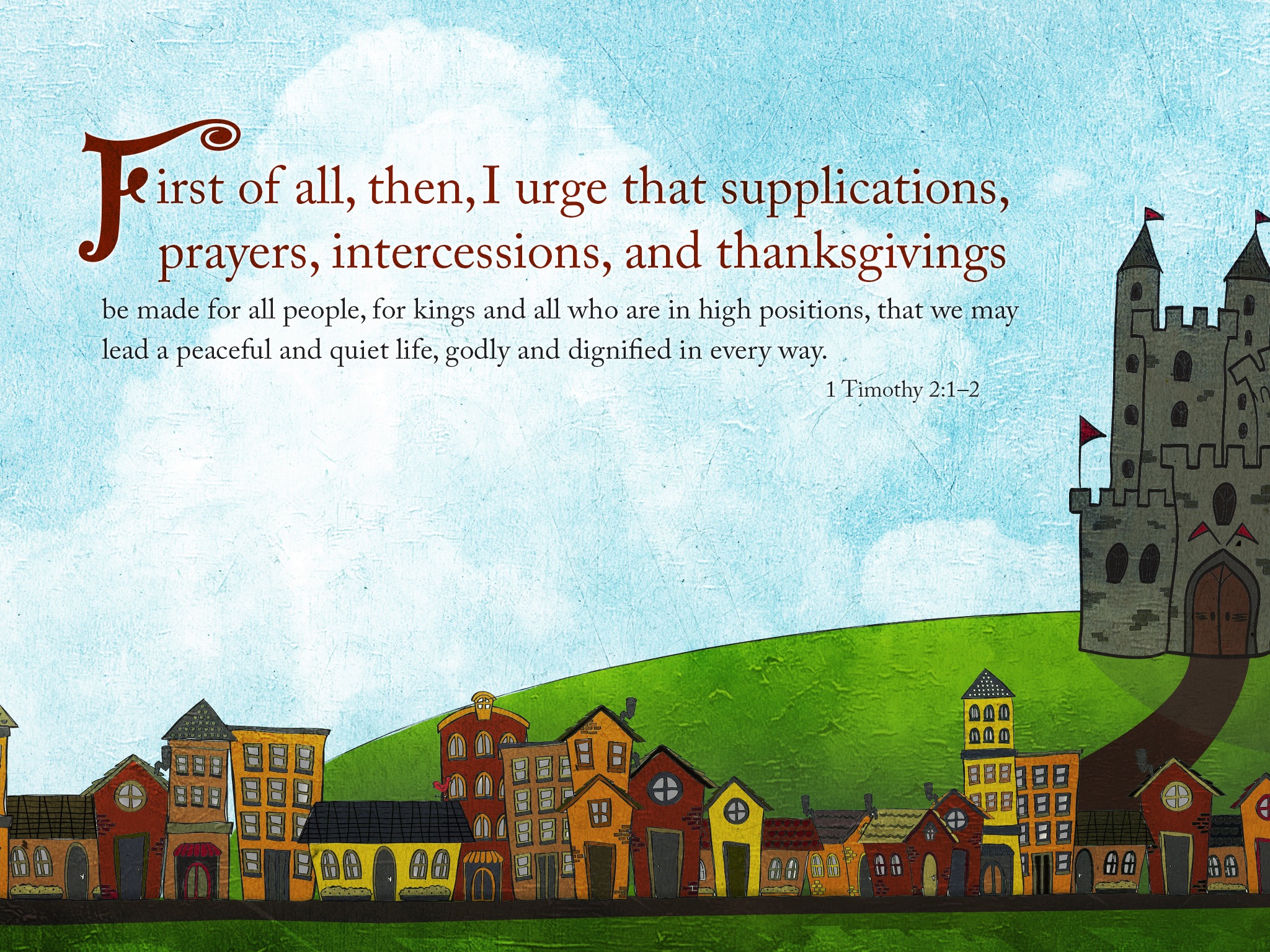
1 First of all, then, I urge that supplications, prayers, intercessions, and thanksgivings be made for all people, 2 for kings and all who are in high positions, that we may lead a peaceful and quiet life, godly and dignified in every way. 3 This is good, and it is pleasing in the sight of God our Savior, 4 who desires all people to be saved and to come to the knowledge of the truth. 5 For there is one God, and there is one mediator between God and men, the man Christ Jesus, 6 who gave himself as a ransom for all, which is the testimony given at the proper time.

Alleluia! Christ is risen!
He is risen indeed! Alleluia!

In the name of Jesus. Amen.

This should come as no surprise, but the Apostle Paul, who was inspired by the Holy Spirit to write 1 Timothy, was not an American. Here, Paul gives instructions about how a peaceful, quiet, godly, and dignified life will come about, and it isn’t through the separation of church and state. This peaceful life comes about by praying for all people, for kings, and for all who are in positions of authority. That means that Paul is instructs pastor Timothy to encourage his congregation to pray for Nero the emperor, the family and descendants of Herod, the different Roman governors who came after Pontius Pilate, and many others. In the context of our day, that means, Christian, you need to pray for your mayor; your city council and school board members; your state and national senators and representatives; the president; the judges at all levels; police and parole officers. We could go on and on and include all the bureaucrats who are appointed to positions of authority, but that would take too long.

We are to pray for those people in authority because God desires all to be saved and come to a knowledge of the truth. And just to be clear on this, Paul is, without question, saying there is a link between Christian prayers for civil authorities and the spread of the Gospel. The two go together according to this text. This really undermines the common understanding of the relationship between the church and the state, at least as it is talked about today.

In our country, it is good that the governing authorities don’t get to mandate or dictate that you be a Roman Catholic, Baptist, Methodist, or even Lutheran. Our founding fathers were wise when they wrote the Bill of Rights and decreed, “Congress shall make no law respecting an establishment of religion, or prohibiting the free exercise thereof.” But this does not mean that the Church and the State should stay in their separate corners and never have anything to do with each other. A lot more could be said about this, but the context for that would be better for a study on politics, culture, and religion – not a sermon.

For a sermon, which this is, it is better to get a Biblical perspective of how God has ordered this world for the benefit of us, His creatures. So, that’s what we are going to do.

To preserve and maintain order in creation, God has instituted the Three Estates – the Church, the Family, and the State. Through these Three Estates, God provides for His people and all creation. Now, many of you have heard me preach and teach about the Three Estates before, but it is good to be reminded of what these estates are and what they are to do.

Both the estate of the Church and the estate of the Family were established by God before the Fall into sin. God established the estate of the Church so there would be spiritual life, and spiritual life always comes through faith in God’s Word (Hab. 2:4; Ro. 1:17; Gal. 3:11; Heb. 10:38). The Church began when God told Adam to not eat of the Tree of the Knowledge of Good and Evil. As long as Adam didn’t eat that fruit, he had spiritual life through trusting God that evil was bad and if Adam gained knowledge of evil, he would surely die (Gen. 2:16-17). After the Fall, God gave the estate of the Church a new promise which was that He would send Jesus to forgive and save sinners and crush the devil’s head (Gen. 3:15). Today, the Church continues to proclaim the Gospel so more would believe in Christ, be saved, and have eternal life.

Also, before the Fall, God established the estate of the Family. The purpose of the Family is physical life. God created Adam and Eve and commanded them fill the earth and have dominion over it (Gen. 1:28-30). God loves people, He wants there to be more people, and He has given a husband and wife an important role in enlarging the number of people. God wants husbands and wives to have children and faithfully raise those children so they will grow up and have more children. The estates of the Church and Family were all that was needed before the Fall because they provided all what was necessary – spiritual life and physical life.

But we don’t live in the original goodness and perfection of creation anymore. All mankind fell into sin. Sinners will only look out for themselves. Left unchecked, sinners do whatever is right in their own eyes (Dt. 12:8; Jdg. 17:6, 21:25) and the world quickly falls into chaos and anarchy. So, after the Fall, God established the estate of the State, and just to be clear, the State is the governing authorities. Scripture is clear that every authority that exists is put in that position of authority by God (Ro. 13:1-2). Since the Fall, every emperor, every monarch, every president, prime minister, governor, legislator, judge, police officer, etc., has been put into his or her office by God Himself.

The State cannot give life, but giving life isn’t God’s purpose for the State. God gave the State to protect and preserve life in a world of sinners. In fact, we rightly recognize that the State only exists to protect and serve the estates of the Church and the Family. There will be no estate of the State in heaven. But the only way for the State to maintain order in a world of sinners is through punishment and the threat of punishment. So, it is good and right for the State to do things like setting speed limits, collecting taxes to maintain a strong police and military to protect the citizens, and have laws that allow for businesses to grow and thrive so people can have jobs that provide a living for families. The State is there to maintain peace, stability, and predictability in a world full of sinners.

The unfortunate thing about the State, and we repeatedly see this throughout history, is that the people in authority quickly let that authority go to their head. They often make life more difficult for those under their authority in all sorts of ways. That is why Paul here tells pastor Timothy to teach his congregation to pray for the authorities in the State with supplications, prayers, intercessions, and thanksgivings.

Now, with these four different words for prayer, you don’t need to get too worked up about them. They just summarize what you normally do in prayers. Supplications are prayers that you offer for others as though their problems are your problems. Prayers is the generic term that simply refers to petitioning or appealing to God. Intercessions are asking God to forgive the sins of others as though they are your own sins. Thanksgivings here doesn’t only mean that we are thankful for the authorities, though we should be; these thanksgivings are on behalf of others. We thank God for the mercies He has given to others as though He has given all those blessings to us. When things are good for others, they are good for us. In Jeremiah 29, God tells His people to seek the welfare of the city where they will be captive and exiled because it result in the welfare for God’s people in while they are in exile (Jer. 29:7). The same is true today. When those in authority are governing well and serving those under their authority, life is good.

Praying for the authorities in this way blesses us. God hears those prayers and answers them. Too often we might think that our prayers don’t actually do anything, but we are wrong. I’ve used this analogy before, but think of it this way: When a president or king is fighting a war, he has advisors. They sit around a table and strategize, consult, and plan together. Those advisors are important, and the person in charge values their input and alters his plans based on that discussion. Scripture teaches that you, Christian, you, child of God, are at that table. When God commands you to pray, He is inviting you into His war room to give your input as to how things should be handled on the battlefield. God wants your thoughts and ideas on how situations should be handled. God turns to you and asks, “My beloved child, what do you think we should do?” Your prayers are your response.

Another blessing that comes when we pray for authorities often gets overlooked. Our prayers give us a better perspective on God’s involvement in the world. God is not some divine clockmaker who just wound the gears and stepped back to let creation run on its own. No, He is deeply involved in all aspects of creation. Praying for the authorities helps remind you of that. Yes, God has given them power and control over many aspects of society and life, but who has power and control over those authorities? God Himself does.

This is why it especially important to pray for the authorities when they are governing in a way that contradicts how God would have them govern. Remember when Paul wrote these verses, Nero was the emperor. Paul says Christians should be praying for Nero, who was burning Christians to light his garden parties and would order Paul’s execution. Through your prayers for the authorities, God reminds you that they are not the ones who are ultimately in control. God is. Proverbs 21:1 says, “The king’s heart is a stream of water in the hand of the Lord; [the Lord] turns it wherever He will.” And if the authorities do evil, God Himself will hold them accountable. Remember that and your life will be a lot more peaceful and quiet, godly and dignified in every way.

Now, we’re going to abruptly change gears here. Vivian, this all brings me to you. Vivian, today you are Baptized. Today, Jesus has joined you to Himself by placing His name upon you (Mt. 28:19) and clothed you with Himself (Gal. 3:27). Vivian, in your Baptism, Jesus joined you to His death so that you have a Jesus-kind of death – in other words, a death that doesn’t last long and ends in resurrection (Ro. 6:3-11). Vivian, the God who desires all people to be saved has come and saved you. And, Vivian, as a congregation, we promise that we will pray for you that you will lead a peaceful and quiet life, godly and dignified in every way. 

Vivian, and all you saints, that life comes only because of Christ Jesus. He is the mediator between God and all mankind. The mediation He did was to give Himself on the cross, to shed His blood, and to lay down His life as a ransom for all and for you.

Dear saints, when you are surrounded by chaos and confusion on every side, call out to the Lord in prayer. He will listen and not reject your prayers (Ps. 66:19-20). And even though you will have tribulation in this world, Jesus, your Savior, has overcome the world (Jn. 16:33). May that fact give you eternal peace.

Alleluia! Christ is risen!
He is risen indeed! Alleluia!

Amen.

The peace of God, which surpasses all understanding, will guard your hearts and minds in Christ Jesus. Amen.
Paradise, Provision, & Protection – Sermon on Genesis 2:7-25 for the Seventh Sunday after Trinity

Genesis 2:7-25

7 Then the Lord God formed the man of dust from the ground and breathed into his nostrils the breath of life, and the man became a living creature. 8 And the Lord God planted a garden in Eden, in the east, and there he put the man whom he had formed. 9 And out of the ground the Lord God made to spring up every tree that is pleasant to the sight and good for food. The tree of life was in the midst of the garden, and the tree of the knowledge of good and evil.

10 A river flowed out of Eden to water the garden, and there it divided and became four rivers. 11 The name of the first is the Pishon. It is the one that flowed around the whole land of Havilah, where there is gold. 12 And the gold of that land is good; bdellium and onyx stone are there. 13 The name of the second river is the Gihon. It is the one that flowed around the whole land of Cush. 14 And the name of the third river is the Tigris, which flows east of Assyria. And the fourth river is the Euphrates.

15 The Lord God took the man and put him in the garden of Eden to work it and keep it. 16 And the Lord God commanded the man, saying, “You may surely eat of every tree of the garden, 17 but of the tree of the knowledge of good and evil you shall not eat, for in the day that you eat of it you shall surely die.”

18 Then the Lord God said, “It is not good that the man should be alone; I will make him a helper fit for him.” 19 Now out of the ground the Lord God had formed every beast of the field and every bird of the heavens and brought them to the man to see what he would call them. And whatever the man called every living creature, that was its name. 20 The man gave names to all livestock and to the birds of the heavens and to every beast of the field. But for Adam there was not found a helper fit for him. 21 So the Lord God caused a deep sleep to fall upon the man, and while he slept took one of his ribs and closed up its place with flesh. 22 And the rib that the Lord God had taken from the man he made into a woman and brought her to the man. 23 Then the man said,

“This at last is bone of my bones
and flesh of my flesh;

she shall be called Woman,
because she was taken out of Man.”

24 Therefore a man shall leave his father and his mother and hold fast to his wife, and they shall become one flesh. 25 And the man and his wife were both naked and were not ashamed.

In the name of Jesus. Amen.

In our Gospel lesson today (Mk. 8:1-9), we heard how Jesus fed 4,000 men plus women and children (see Mt. 15:38). In that desolate place, Jesus provided a little taste of the paradise He had created mankind to enjoy. Those crowds had been listening to Jesus teach for three days and now had nothing to eat. So, Jesus temporarily removes the curse of sin. Without having to sweat and toil for their food (Gen. 3:19), Jesus provided bread and fish so the people could eat and be satisfied. Now, this text from Genesis 2 shows how God created Adam and Eve to enjoy life before they brought the curse of sin to every aspect of our lives.

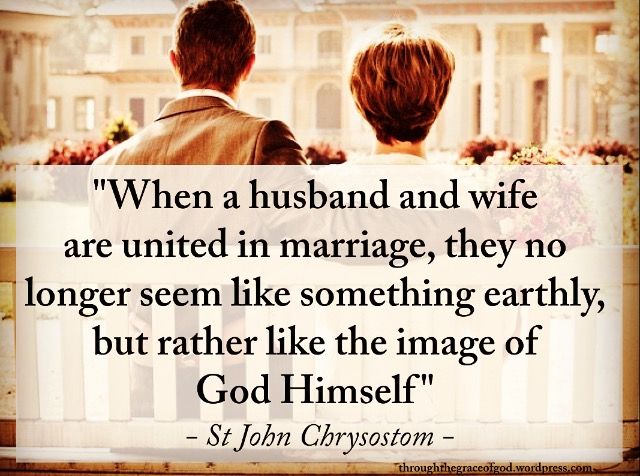
In full disclosure, I extended this lesson (originally it stops at Gen. 2:17) so we can see how God ordered creation in paradise to include two of the Three Estates. First is the Estate of the Church, second is the Estate of the Family (both of those are instituted before the Fall), and the third Estate is the Estate of the State (which was instituted after the Fall). I’ve preached on the Three Estates in the past and, if you’re interested, I can point you to some resources on this topic. But I wanted to take a little time today to focus on the second Estate, the Estate of the Family, and specifically consider the center of the family which is husband and wife living together in holy marriage.

To just briefly recall what the Three Estates are: In this lesson, we heard how God instituted the Estate of the Church when He told Adam to not eat of the Tree of the Knowledge of Good and Evil or he would die. This statement from God established the Church because you cannot be righteous without faith. Scripture repeatedly says, “the righteous shall live by faith” (Hab. 2:4; Ro. 1:17; Gal. 3:11).

Before they sinned, Adam and Eve had everything good from God because of the perfection of creation, so, to be righteous, they needed a promise of God to believe. That promise was implied when God gave the command to not eat from the Tree of the Knowledge of Good and Evil. In other words, God’s command there also included a promise which was, “Evil is bad. Trust Me on this.” So, with this command and promise, Adam and Eve could have by faith what God never intended them to have by experience. God didn’t want humanity to experience evil and death by sight, only by faith. Through the Estate of the Church, God provides eternal life. And even now, after the Fall, God provides eternal life through the Estate of the Church through faith in Christ.

The second Estate, the Estate of the Family, was also instituted by God before the Fall when God took Adam’s rib and formed Eve. God told Adam and Eve, “Be fruitful and multiply and fill the earth and subdue it” (Gen. 1:28). Even after we became sinners through the Fall, we know that God blesses and wants the Estate of the Family to continue because God repeats this command to Noah and his descendants after the Flood (Gen. 9:1). Through the Estate of the Family, God provides physical life as husbands and wives have children.

Just very briefly, the third Estate, the Estate of the State, was instituted only because of and after the Fall. There isn’t a direct passage of Scripture where God establishes the State; however, Scripture does plainly teach that the State is a good gift from God in both Romans 13:1-7 and 1 Peter 2:13-17. In those passages, Scripture teaches that the State is not a terror to good conduct but to bad and that the State carries out God’s wrath on the wrongdoer. The Estate of the State is limited in what it can do. The State cannot give life; it can only preserve and protect life through the threat of punishment.

And this means that the Estate of the State is the only one of the three that is temporary. When Christ returns, there will be no more need of the State because there will be no more sin. So much of our time today is, frankly, wasted focusing on politics and what is going on in our government. Don’t get me wrong, the State is important. The State and the authorities God has placed over us matter, and they are good gifts from God to protect life in a fallen world. But what is going on in your Family is vastly more important than anything that happens in the State. So, let’s put more of our focus and attention there.

With all of that in mind, we’ll focus now on the center of the Estate of the Family – marriage.

In Genesis 1, Scripture gives an overview of the entire creation. We see how, in six days, God created the heavens and earth – sun, moon, stars, galaxies, planets, oceans, continents, plants, birds, fish, animals, and humanity. The conclusion of each day of creation notes that there was evening and morning. Then, God rests on the seventh day, blessing and sanctifying it. The interesting thing about the seventh day is that there is no mention of evening and morning. In a very real way, the picture is that the day of blessing and rest doesn’t end. Now, in Gen. 2, the clock rewinds, and the focus shifts. Here in our text, we move from the big picture of all creation to the little world that we experience – human life. And we see that human life is centered around marriage.

Now, I want to be clear at the outset here. When I say that all human life is centered around marriage, that doesn’t mean that all people grow up in a home where a perfect husband and perfect wife have perfect kids. To be sure, sin has brought a brokenness to the Estate of the Family. God be praised if you grew up in a family with a father and mother and siblings. But even when that isn’t the case, marriage is still the center of human life. If you aren’t married or never will be married, you are here because of a marriage. Yes, some of you have been adopted into a family and are blessed through God’s invention of marriage with a father and mother. But even when that isn’t the case and you grew up without a father or a mother, your parents engaged in sex which an act of marriage. And even when someone is conceived through rape – in other words, someone has committed a grievous sin and stolen an act intended for marriage – that child is a blessing from God (Ps. 127:3). And, please, if you would like a fuller explanation on that statement or need any pastoral or professional psychiatric care if, please, please, please let me know. The many ways that family exists apart from God’s design for marriage just shows how sin has utterly broken what God designed for us.

The second half of this text (v. 18-25) is where God establishes the Estate of the Family and holy marriage. Again, in Gen. 1 we get the big picture of creation, God creates man and woman in His image (Gen. 1:26-30). But in Gen. 2:18, we get the detailed creation of man and woman and family, God creates the man first. Then, God says something totally unexpected. Over and over in the larger picture of creation, God sees what He has made and says, “It is good.” But in v. 18, God says, “It is not good that the man should be alone.” God created Adam first, and knew that Adam needed a helper compatible, complementary, and harmonizing for him.

Man alone is not good. So, God brings all the animals to Adam, and Adam gives them names. But still no suitable helper is found. God puts Adam to sleep and takes part of Adam’s side. Our translation which reads ‘rib’ is a bit polite and sterile. The Hebrew word there means ‘side’ or ‘rib cage.’ The teaching of Jewish rabbis can help explain the significance of this. God didn’t take Adam’s hair to create Eve. Then, she would have been over him. God didn’t use Adam’s feet or toes to create Eve. Then, she would have been below him. Instead, God took Adam’s side, or rib cage, so she would be next to him, beside him, and near his heart.

Take special note, please, of v. 19. God formed every beast of the field and bird of the heavens out of the ground. But Adam was created differently. Look back at Gen. 2:7. Adam, like the animals, was formed out of the dust of the ground, but God added to that dust the breath, or spirit, of life. Now, when God creates the woman, He doesn’t just gather up another bit of earth, form the woman, and breathe life into her. Instead, God takes a part of Adam and forms the woman.

So, follow me here. I know this sounds like repetition, but it isn’t, it’s building: Man alone is not good. That doesn’t mean that man alone is bad, he just isn’t good. To make mankind good, God creates a woman from man’s side to be man’s helper. By the creation of the woman, Adam is less than he was before God put him to sleep. But when Adam wakes up, he is more than he was before. After the creation of the woman, man is good. And this goodness comes about because as a married man, Adam is more than he was before. Now, he is complete, but this complementary, completeness comes from outside of himself. Only after this marriage is creation “very good” (Gen. 1:31).

All this action of God is why Jesus says that every marriage is a union that God arranges. When Jesus is asked about divorce by the Pharisees, He quotes Gen. 2:24 and says, “What God has joined together, let not man separate” (Mt. 19:6). And here is why this is important for you. To those of you who are married, and to those of you who will, one day (God willing) be married, you don’t ever have to wonder if you made a mistake along the way. When you are married and look at your spouse, you can always know that your marriage is God’s will for you. God is the One who joined you together as husband and wife. And this is also why being widowed is so painful. When a spouse dies, part of the living spouse is gone. So, God be praised that Christ has come to undo the curse of sin and death.

Also, because God joins husband and wife together, you can know that your marriage is good in the eyes of God. He joined you together, and everything that God does is good. Even when things are hard, this is a sign that your marriage is good because the devil attacks all good things that God has given. In our day, marriage is viewed cynically as some sort of outdated, antiquated institution. Sadly, a lot of people think marriage is restrictive, boring, and painful.

But study after study after study shows that marriage is much more likely to lead to fulfillment and happiness than any other alternative. All the surveys indicate that the number of couples who are happy in their marriage is extremely high. Studies also show that, even of those who are not happy in their marriage, two-thirds of them will become happy if they stay together. There’s a lot of talk today about believing science. Well, the science clearly shows that marriage is much more fulfilling, rewarding, and joy-bringing than what most people think.

Marriage is hard work, but even that is good. Any married couple can tell you this. Sometimes people think that the best marriages happen without any work or effort and when the couple is perfect and completely compatible with each other. And this leads people to think that the best marriages allow each person in that marriage be simply be themself and never change. But love, true love, doesn’t come naturally or easily. Love is work. Love is effort.

If we were perfect, sure, love would be easy. But every husband is an imperfect man, and every wife is an imperfect woman. Everyone here, including myself, we are all imperfect. Each of us is self-centered and self-absorbed. And this isn’t good. Our selfish nature hurts ourselves and those around us, and our self-centeredness never leads to more happiness for ourselves. It leads only to more pain and misery.

But know this: we are most fulfilled when we are emptied of ourselves and pour ourselves out in love and service to another person. People are happiest when they are serving and giving. And God has given no better setting to serve someone else than in marriage.

Yes, marriage is hard. The sinful self revolts against the changes and sacrifices that marriage requires. No two sinners are compatible. Any parent knows that when you put two kids together in a room, it only takes a while for the self-centeredness of each to take over. So, don’t despair if your marriage gets hard. Instead, rejoice because God loves you and has put you into the institution of marriage so you can have Him working on you through your marriage.

Finally, no consideration of marriage would be complete without the truest picture of marriage – Christ and the Church. At the end of Ephesians 5, Paul quotes v. 24 of our text, “Therefore a man shall leave his father and his mother and hold fast to his wife, and they shall become one flesh.” Then, Paul says something absolutely wonderful. He writes, “This mystery is profound, and I am saying that it refers to Christ and the Church” (Eph 5:32).

Dear saints, you are the Bride of Christ. You were formed from what Christ did on the cross. God put Jesus, your Savior, into the sleep of death. And from His pierced side, came water and blood. From that water, you are given the new birth from above, and from that innocent, forgiving blood, you are saved. God has made you to be bone of Christ’s bone, and flesh of Jesus’ flesh. Because of what Jesus has done, you can and do stand before the holy God unashamed, righteous, holy, blameless, and innocent. God be praised! Amen.

The peace of God, which surpasses all understanding, will guard your hearts and minds in Christ Jesus. Amen.

Preview – Sermon on Luke 7:11-17 for the Sixteenth Sunday after Trinity

Listen here.

Luke 7:11-17

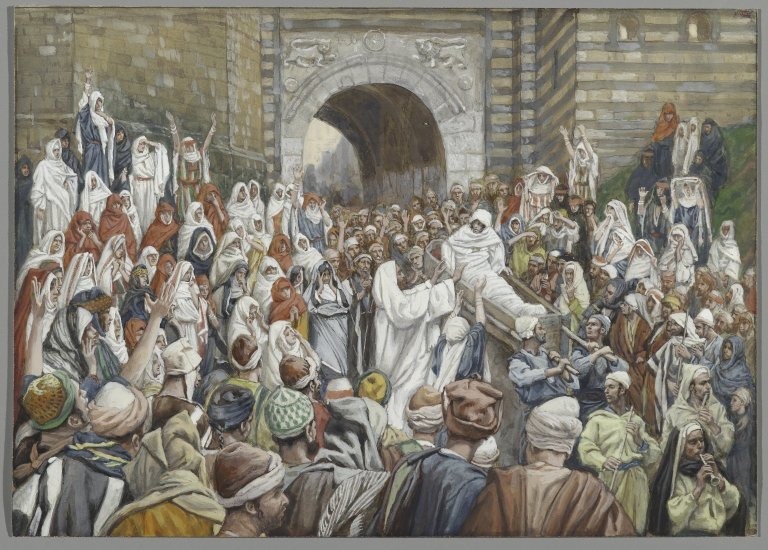
11 Soon afterward [Jesus] went to a town called Nain, and his disciples and a great crowd went with him. 12 As he drew near to the gate of the town, behold, a man who had died was being carried out, the only son of his mother, and she was a widow, and a considerable crowd from the town was with her. 13 And when the Lord saw her, he had compassion on her and said to her, “Do not weep.” 14 Then he came up and touched the bier, and the bearers stood still. And he said, “Young man, I say to you, arise.” 15 And the dead man sat up and began to speak, and Jesus gave him to his mother. 16 Fear seized them all, and they glorified God, saying, “A great prophet has arisen among us!” and “God has visited his people!” 17 And this report about him spread through the whole of Judea and all the surrounding country.

We didn’t get to do it enough (at least in person) this past Easter Season. So, since we live in the Easter Age, and since every Sunday is a celebration of the Resurrection…

Alleluia! Christ is risen!
He is risen indeed! Alleluia!

In the name of Jesus. Amen.

This whole text is a wonderful preview of what will happen later in Luke’s Gospel. Everything recorded for us in this text actually happened and is part of actual history, but this text is a beautiful preview.

Jesus approaches the little town of Nain which is in Galilee. Nain is about six miles south of Nazareth where Jesus grew up. Nain, the name of the town, means ‘pleasantness’ or ‘beautiful.’ Nain is on the slopes of a mountain. For those of you who have lived here in the Red River Valley your whole life, a mountain is like a dyke, but it isn’t there to prevent floods. A mountain is where the ground naturally goes up and up really high. It’s bigger than a dyke but isn’t man-made. Nain is on the lower slopes of Mt. Moreh, the same mountain where Gideon and his 300 men defeated the army of Midian with nothing but trumpets and torches in jars (Judges 7).

As Jesus and His entourage approach the gate of this beautiful town, our Lord encounters an ugly scene. Another large crowd is exiting the gate of the city. They follow a corpse carried by pallbearers on a bier which is an open coffin. Just behind the corpse, a widow is joined by most of the citizens of the town, and the corpse on that bier is the lifeless body of her ‘only begotten’ son (the same word used of Jesus in Jn. 3:16). The crowd is following her because the death of one member in the city is mourned by everyone in the city. And this death is particularly sad.

This poor woman is now absolutely alone with no one to provide for her. Her husband had already died, and in those days, she couldn’t just go out and get a job to provide for herself. After the death of his father, this son would have become the main source of hope and income for himself and his mother. But now, the son is dead, her hope is gone, and this woman is, according to Scripture, truly a widow (1 Tim. 5:3-5).

Proper etiquette would mean that Jesus and everyone following Him would move aside, get out of the way, and let this somber march of death pass by without interruption. But Christ, the Lord of Life, doesn’t yield. He doesn’t step aside for death. And so, these two crowds get mixed up and entangled there at the gate. It must have been quite a scene.

We need to pause here a minute. We talked last week about the Three Estates – the Church, the Family, and the State. If you didn’t hear that sermon, I’d encourage you to go back and listen to it because it is a helpful lens through which we can consider the world, what is going on around us, and how we are to serve God in Church, family, and state. And it is an idea I plan on pointing you back to regularly.

The gate where these two crowds meet was on the outer wall which surrounded the town of Nain. One of the ways we can imagine the Three Estates is as a set of three walls of protection around you. In medieval times, the seats of kingdoms would have three walls to protect the center of the city where the palace, the military base, and the stock of supplies were safe from enemies. So, when an enemy attacked a city, the first two walls could be breached, but the people could still defend themselves and what was most important.

That idea of three protective walls is one of the ways theologians picture the Three Estates of Church, Family, and State, and we can see how God protects our lives by providing order and peace in society through the first wall of the Estate of the State. We can see how God gives physical life and provides a safe environment for families to grow and learn and go about their business through the second wall of the Estate of the Family. And we can see how God gives spiritual life and sustains that life through the teaching of God’s Word through the third wall of the Estate of the Church.

But the devil is always attacking these walls and estates, and Satan is most effective in his attacks when he attacks from inside each of these estates. The best way for the devil to attack the Church is through false teachers within the Church. The best way for the devil to attack the Family is by going after parents and tempting them away from their family. The best way for Satan to attack the State is through politicians and leaders who make unjust laws.

Now, I need to address something before we move on here. Kids, listen up. Going off to college and moving away from your family is a dangerous time and you can expect the devil to attack you and your faith. Normally, the State isn’t going to punish you when you break God’s Commandments, so there is already a breech, or a weakness, in the wall of the State. When you move away from your family and live on your own, that wall of protection isn’t there in the same way as when you are living with your parents. And if you are living in a new town and don’t find a Church to attend every week that correctly teaches all of God’s Word, the devil has access to your conscience and will try to lure you away from the faith. In one fell swoop, the walls of protection can crumble around you. Too many kids end up denouncing Christianity shortly after they move away from home. So kids, when the time comes for you to move away from home, I would be delighted and more than happy to help you find a good church wherever you move. Ok?

Back to this poor woman. She has quickly had the wall of her family completely decimated. Her husband and her only son have died. She is vulnerable. She is weeping – and rightly so. Death is unnatural. God never intended that we should die. When someone you love dies, weeping and crying is a right response. Even Jesus, the Son of God in the flesh, weeps at the death of His friend Lazarus (Jn. 11:35). So, why does Jesus tell her, “Stop weeping”?

Christ interrupts the funeral procession and gives her this command because He is about to act. Jesus could have reversed the order. Christ could have raised her son to life then told her to stop weeping, but He doesn’t. Instead, with this command, Jesus gives her an implied promise that her son will live again. These words from Jesus give a little preview into what He is about to do. Then, only after giving that promise, Jesus touches the bier and commands the young man to get up. The life-giving Word of Christ awakens the dead young man from the slumber of death.

Dear saints, I said at the beginning that this account is completely true. But it is also a preview. Christ, who raises the dead as easily as waking them from a nap, this very same Jesus went to His death. He hung on the cross. And as His holy and precious blood flowed out of His hands, feet, and head, He spoke to His widowed mother. Christ gave His mother into the care of John the disciple to provide a new family for her and rebuild that wall of protection. Then, Jesus died and His lifeless body was carried to a tomb.

But also, just like in this text, the march of death was stopped short. Death had to give way to the Word of Jesus at the gate of Nain, and death had to give way to Jesus on the third day when Christ burst from the grip of death. Death tried to swallow up the Lord of Life, but it bit off more than it could chew. In fact, death choked and died when it tried to consume Jesus. And on Easter morning, Christ rose victorious from the grave.

And yet, dear saints, even that is just a preview of what will happen when your Lord returns. Your sorrow, your loneliness, and your death will all be brought to an end. With a simple word, Christ will call you out of your graves. He will raise you and all believers to live forever with Him in perfection and bliss. In that day, we will confess just as the people of Nain did, “God has visited His people!” 

Dear saints, while we look forward to that day, let us confess the same thing now. God has visited you bringing life and salvation to a dark, dying world. May He visit us again soon. Come, Lord Jesus.

Alleluia! Christ is risen!
He is risen indeed! Alleluia!

Amen.

The peace of God, which surpasses all understanding, will guard your hearts and minds in Christ Jesus. Amen.

Three Circles of Protection – Sermon on Matthew 6:24-34 for the Fifteenth Sunday after Trinity

Listen here.

Matthew 6:24-34

24 “No one can serve two masters, for either he will hate the one and love the other, or he will be devoted to the one and despise the other. You cannot serve God and money.

25 “Therefore I tell you, do not be anxious about your life, what you will eat or what you will drink, nor about your body, what you will put on. Is not life more than food, and the body more than clothing? 26 Look at the birds of the air: they neither sow nor reap nor gather into barns, and yet your heavenly Father feeds them. Are you not of more value than they? 27 And which of you by being anxious can add a single hour to his span of life? 28 And why are you anxious about clothing? Consider the lilies of the field, how they grow: they neither toil nor spin, 29 yet I tell you, even Solomon in all his glory was not arrayed like one of these. 30 But if God so clothes the grass of the field, which today is alive and tomorrow is thrown into the oven, will he not much more clothe you, O you of little faith? 31 Therefore do not be anxious, saying, ‘What shall we eat?’ or ‘What shall we drink?’ or ‘What shall we wear?’ 32 For the Gentiles seek after all these things, and your heavenly Father knows that you need them all. 33 But seek first the kingdom of God and his righteousness, and all these things will be added to you.

34 “Therefore do not be anxious about tomorrow, for tomorrow will be anxious for itself. Sufficient for the day is its own trouble.”

In the name of Jesus. Amen.

Today, Jesus preaches to us against worry by making fun of it. Jesus asks, “Which of you by being anxious can add a single hour to his span of life?” (v. 27). Christ is making a joke. Literally, Jesus says, “Which of you by worrying can add a cubit,” a measurement of length, “to your life?” which is, of course, measured in time. I don’t know a lot of tall, elderly people, but my grandfather, who died in his 80’s, was 6’ 2”. When I saw him never thought, “Wow. Grandpa must have worried a lot.” Jesus even makes fun of us worriers. When our translation quotes Jesus asking, “Will He not much more clothe you, O you of little faith?” He is actually calling us a name – “you little faiths” or “little faithers.”

In His preaching, Jesus invites us wise and noble humans to slow down and hear the preaching of birds and flowers. When birds need food, they don’t go to the little bird grocery store where all the food grown by farmer birds is sold. It’s almost as if Jesus was inviting you to imagine certain types of birds working in each role. (Finches would be at the grocery tills – fight me.) Birds don’t keep their food in cupboards and pantries in their nests. Flowers don’t look for best sales of the season for clothes, but they are splendidly clothed. In His wisdom, God has ordered creation in such a way that He takes care of feeding birds and clothing the grass. The birds and grass trust Him, and Jesus says we should as well.

Kids, whenever you are studying science – botany, biology, anatomy, astronomy, physics, etc. – you get a small peek into all the ways we have observed how God has ordered creation. And the more scientists discover, the more we see about the complexity, intricacy, and beauty of God our Father and Creator. God put thought and wisdom and detail into every part of creation as He spoke it into existence. All of creation was designed by God to both continue and sustain life. He does it for birds and plants and animals and planets and stars and galaxies. And He does it for you.

And it is with that thought, I want to take a step back and consider how God gives order to provide for us and protect us, the pinnacle of His creation. As we see this wonderful and beautiful order, Jesus invites us to not worry when we are tempted to do so.

In His wisdom, God has given order to our lives by creating and instituting, what theologians call, “the Three Estates”: The Three Estates are the Church, the Family, and the State (or government), in that order are the three circles of protection that God has graciously given. Science cannot observe and study this, but from God’s Word we can see how God has woven these Three Estates into the fabric of creation to provide for you and protect you. When we consider what is going on in the world through the lens of the Three Estates, it helps shape and guide our thinking in a biblical way so that we do not worry. And even though things can get bad (and, even, currently are bad) in these estates, these estates cannot be completely overthrown or destroyed.

Each of the Three Estates has a “source” or when it was instituted. A “form” or what it consists of. And an “end” or goal. So, let’s talk about each of these:

First, the estate of the Church. The estate of the Church was instituted and has its source at the Tree of the Knowledge of Good and Evil. And this will take a bit of explaining. We are always and only righteous and holy through faith. Scripture repeatedly says, “the righteous shall live by faith” (Hab. 2:4; Ro. 1:17; Gal. 3:11).

Before they fell into sin, Adam and Eve had everything good from God because of the perfection of creation, so they needed a promise of God to believe. That promise was implied when God gave the command to not eat the fruit of the Tree of the Knowledge of Good and Evil (Gen. 2:16-17). In other words, God’s command included a promise which was, “Evil is bad. Trust Me on this. When you find out what evil is, it won’t go well for you. In fact, you’ll die.” So, with this command and promise, Adam and Eve could have by faith what God never intended them to have. God didn’t want humanity to experience evil or death by sight, only by faith.

The estate of the church takes the form and consists of the Word of God preached and believed. As long as Adam and Eve believed God’s Word, they had the pure Church. God be praised that now, even after the Fall, we still have the Church which continued when God promised that the Seed of the woman, Jesus, would deliver and rescue us from death (Gen. 3:15).

Finally, the end or goal of the Estate of the Church is for us to have eternal life with God. So, we have, first, the Church: instituted by God’s promise before the Fall (and sustained after the Fall), with the goal and end of eternal life.

The second estate instituted by God to protect and provide for humanity is the Estate of the Family. The Estate of the Family has its source and was instituted also before the Fall when God took Adam’s rib and formed Eve. Then, God told Adam and Eve, “Be fruitful and multiply and fill the earth and subdue it” (Gen. 1:28). Even after the Fall, we know that God wants the Estate of the Family to continue because God repeats this command to Noah and his descendants after the Flood (Gen. 9:1).

The Estate of the Family takes the form of and us made up by husband, wife, and children.

And the end or goal of the Estate of the Family is also life, but, unlike the Estate of Church, the Family provides temporal, physical life. So, we have the Family: again, instituted by God before the Fall (and sustained after the Fall), with the goal and end physical life.

The Estate of the State is a little more complex because it was instituted only after the Fall. And there isn’t a direct passage of Scripture where God clearly establishes the Estate of the State. However, Scripture does clearly teach us that the Estate of the State is a good institution of God in both Romans 13:1-7 and 1 Peter 2:13-17 where Scripture teaches that the State is not a terror to good conduct but to bad and that the State carries out God’s wrath on the wrongdoer.

A couple possibilities of when God establishes the Estate of the State could be: When God sent the cherubim to guard the way to the Tree of Life (Gen. 3:22-24). By prohibiting Adam and Eve from eating from the Tree of Life, God was protecting them from living forever in sin. Some suggest that the Estate of the State was instituted after the murder of Abel, and there are some good arguments for that, but for the sake of time I’m not going to get into that now.

The Estate of the State takes the form of and uses the instrument of the sword and punishment. In other words, the State uses either punishment or the threat of punishment to protect and preserve life. Think of it this way, God established the State to bring about ‘little death.’ To the State God has given the tools of rules, punishments, jail, even execution and war to prevent more or bigger death.

Try this as an example: your car can probably go over 100 mph. But the authorities that God has established in the State have brought about a ‘little death’ for your car through speed limits. You have to drive down Columbia at or under 40 mph. because driving 100 mph. would endanger the lives of others. And if you refuse to obey the law, there is the threat of punishment through a speeding ticket, or, if you actually do drive 100 mph. down Columbia, you should be thrown in jail for reckless endangerment.

The goal of the Estate of the State is to preserve life. Because it is impossible for the state to give life, it’s only function is to preserve life through the means of that ‘little death.’ An analogy for this would be when a surgeon cuts open a person to do surgery on their heart or to remove a tumor. This brings about pain and death, but in an effort to preserve life. So, we have the State: instituted by God after the Fall, with the goal and end preserving life through punishment or “little death.”

Now, this ordering of creation has very important ramifications. When we worry about what is going on around us, the Three Estates let us see how God has provided these three circles of protection. The Three Estates also helps shape what we are to do. We are to be faithful citizens of the State by voting and following the laws that the State gives to protect life. We are to be faithful to our Family by being good parents and obedient children. And we are to be faithful members of Christ’s Church by trusting Him and growing in God’s Word and faith.

We are constantly bombarded with news, and it is easy to get caught up with what is going on in Washington D.C. or St. Paul or Bismarck. We tend to get so focused on the coming election and what is happening in the government – both at the federal and state level. With the economy in a bad place, an open seat on the Supreme Court, and pandemic, we start to think that the State has to do something, and the State does have a place to make rules and laws to protect life. But then – when you throw in riots, fires, hurricanes, masks, and social distancing – it is easy for us to look to the State for things that God hasn’t given the State to do. There certainly may be a place for the State to have care and direction when it comes to those things as well. And there is also a place for polite discussion and disagreement on what level and to what degree the State should or shouldn’t make those decisions.

But in all of this, we should recognize that the State exists only to protect life by minimizing death. It also means that the Estate of the State has nothing to do and has no purpose apart from the Estate of the Church and the Estate of the Family. Since life does not exist apart from the Church and the Family, there is nothing for the State to do without the Church or Family. So, the State is the most temporary and the least important of the Three Estates because it only exists to serve and protect the life that comes only through the Church and the Family.

Also, it is important for each of the Three Estates to “stay in their own lane.” Pastors should not shepherd their flock like a president or king. Families should not look to the State or the Church to provide for them. Politicians should not guide on what is right and moral. We could go on and on, but I hope you get the point. (And we can talk about all this later too.)

The end of all this, dear saints, is this: A lot of our worry (at least for me and what I see on social media) comes from what is going on in the State. Repent! It shouldn’t be this way. Yes, the State is important. The State and the authorities God has placed over us matter and are there to protect life. But what is going on in your Family much more important than what happens in the State. Put more of your focus and attention there.

Remember that Jesus promises to provide for your family. Jesus hasn’t given you permission to worry about anything. If Jesus wants to give you permission to worry about something, He’ll be sure to let you know. But until then, go about your work. And worrying is not work – even though it often feels like it. Worrying takes a lot of time and energy, but worrying isn’t productive. Remember, God has promised, and He will provide – even if it means sending ravens or a miraculous provision of flour and oil like He did in our Old Testament text (1 Kgs. 17:8-16). While you remember that what happens in your family is more important than what is going on in the State, even more important than what is going on in your family is what is going on at here at Church.

Here God provides everything you need for eternal life. He has given Christ to go to the cross, shed His blood, die, and rise again for your justification. He continues to pour out His mercy upon you from this very altar with this holy Supper. Sure, things are currently bad in the state. Maybe, things are even not so great in your family. But both could certainly be worse. Remember, God still protects and provides everything you need for eternal life through the Estate of the Church. And no matter what happens in this world, the gates of hell will never overcome Christ’s Church (Mt. 16:18). Don’t be anxious. Don’t worry, little faithers.

I want to close here with what Jesus says when He preaches almost the exact same sermon in Luke 12:29–31. Your Savior says, “Do not seek what you are to eat and what you are to drink, nor be worried. For all the nations of the world seek after these things, and your Father knows that you need them. Instead, seek His kingdom, and these things will be added to you. Fear not, little flock, for it is your Father’s good pleasure to give you the kingdom.” Amen.

The peace of God, which surpasses all understanding, will guard your hearts and minds in Christ Jesus. Amen.