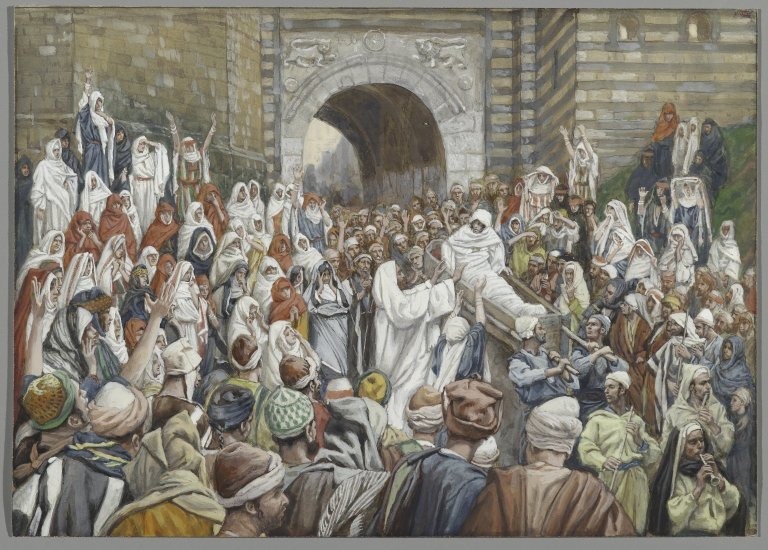
At the Gate – Sermon on Luke 7:11-17 for the Sixteenth Sunday after Trinity

Luke 7:11-17

11 Soon afterward he went to a town called Nain, and his disciples and a great crowd went with him. 12 As he drew near to the gate of the town, behold, a man who had died was being carried out, the only son of his mother, and she was a widow, and a considerable crowd from the town was with her. 13 And when the Lord saw her, he had compassion on her and said to her, “Do not weep.” 14 Then he came up and touched the bier, and the bearers stood still. And he said, “Young man, I say to you, arise.” 15 And the dead man sat up and began to speak, and Jesus gave him to his mother. 16 Fear seized them all, and they glorified God, saying, “A great prophet has arisen among us!” and “God has visited his people!” 17 And this report about him spread through the whole of Judea and all the surrounding country.

In the name of Jesus. Amen.

One of the great mysteries of Scripture is that Jesus is fully God and fully Man. Saying that isn’t hard; you’ve probably grown up saying it. But believing that Jesus is both 100% God and Man is hard to believe – especially when it comes to Jesus’ life here on earth. As the Son of God, Jesus is eternal, all-powerful, and all-knowing, but as a Man, Jesus didn’t always fully use His divine rights and attributes. As God, Jesus all-powerful, but as a man, He still had to eat (Lk. 4:2), His body got tired and needed sit after a long walk (Jn. 4:6), and He had to sleep (Lk. 8:23). Because Jesus is God, He is all-knowing. He had known from all eternity that He would meet this funeral procession at the gate of Nain. But as a man, it wasn’t as though Jesus woke up that morning thinking, “Oh, today’s the day I’ll raise that boy in Nain.”

The way Luke records this event, he makes it clear that Jesus didn’t intentionally go to Nain for the purpose of raising this boy from the dead. Instead, Luke gives us the impression that Christ just happened to be going by the city at the precise moment this boy, widow, and funeral procession was exiting the city gate. This resurrection is very different from what we see in John 11, when Jesus raises Lazarus.

In John 11, Christ does use His divine omniscience. Jesus is a long way from where Lazarus lived when He gets a message that Lazarus is sick, but He doesn’t move an inch. He stays put. He says that Lazarus’ sickness would not end in death and that it was for the glory of God (Jn. 11:4). Then, Jesus waits two more days before He finally decides to go to Lazarus’ house because He knows that Lazarus has died, but our Lord says that He is going to wake Lazarus from the sleep of death (Jn. 11:1411). By those statements before Lazarus’ resurrection, we know that Jesus did plan on going to Lazarus’ grave for the purpose of raising him even though no one told Jesus that Lazarus had died.

But this resurrection miracle is different. No one had summoned Jesus to come and help like they would for some of the other miracles (Lk. 7:1-108:40-56). His presence wasn’t requested at the gate of Nain. He just happens to be at the gate at that very moment. But even though Jesus intended to pass by the city, His compassion for the mother means that He has to stop and raise her son.

Dear saints, your Savior is no priest or Levite who passes by and leaves someone for dead in the ditch (Lk. 10:30-32). No. Your Savior is the Good Samaritan. He sees the widow and her dead son coming out of the gate, and He has compassion. He interrupts that march toward the grave. He pours on the medicine of His Word by telling that mother to stop weeping, and He raises her son. In that moment, the gate of Nain was more than just a way to enter or exit the city. It was much more significant than that. The gate was the threshold between life and death, and it was the place where the citizens of Nain encountered and recognized the God who had come in the flesh to visit His people (Lk. 7:16).

Throughout the Bible, gates were always incredibly important places. Generally, when we think about a gate, we only think about its purpose. A gate exists to be either a barrier to block entrance or a doorway to grant it. Gates separate insiders from outsiders, allies from enemies, friend and family from foe. That’s probably all we imagine when we think about gates. But in the ancient world, gates were much more significant than that. In the Bible, gates were important places for commerce, politics, and justice.

The city gate was where citizens would typically meet (Pr. 1:21). The gate is where business deals and transactions were made (Ru. 4:11). Leaders would have people assemble at the gate so they could make important announcements (2 Ch. 32:6Neh. 8:13), which is why prophets and priests would proclaim God’s Word at the gates (Is. 29:21Am. 5:10Jer. 17:19-20). Instead of courthouses like we have today, trials took place at the city gate (2 Sam. 15:2). The gate was where you would learn about everything that was going on in the city (Gen. 19:1Ps. 69:12Est. 2:21).

So, in this reading, it’s likely that almost the entire town of Nain was there, at the gate. The gate would have already been busy and crowded just because of the normal, day-to-day things that took place at the gate. And it would have been even busier than normal because this boy’s funeral. The mother and the mourners were carrying her son through the gate to lay him to rest outside of the city, away from the living. So, again, that gate was the threshold between life and death. But there, at the gate stood the Author of Life (Act. 3:15), and Jesus does not let death cast this boy outside.

Now, before I go on here, I need to say that this miracle is an actual, historical event that really happened. Because it happened, it reveals that Jesus is the long-promised prophet (Dt. 18:15) and that God has visited His people (Lk. 7:16). But even more than that, the Holy Spirit inspired Luke to record this event for your comfort because this resurrection miracle is a glimpse into your story.

When God created all things, He gave Adam and Eve a home in the Garden of Eden. But when they chose to sin and rebel against God by eating the forbidden fruit, they were cast out of Eden. Now, Eden is never described as having a gate, but it is described as having borders made by four rivers. And when Adam and Eve are expelled from Eden, God, in His mercy, sent a cherub with a flaming sword to protect the way to the Tree of Life to prevent mankind from living forever because we would have lived forever in sin (Gen. 3:23-24). So, even though Eden is never mentioned as having a gate, the idea of a gate is certainly there. It is right to say that the cherub shut the gate to Eden and to an eternal life in sin and death.

God did not want the path to life to be forever blocked by a gate, but He had to do something before the gate could be reopened. God had to send Jesus to pay the penalty for your sin, my sin, and the sin of all mankind (1 Jn. 2:2). By Jesus’ death and resurrection, the gates to Eden, to paradise, and to eternal life free from sin are now open for you.

And even better, now that Christ is raised and ascended, He always and fully uses His divine attributes. He sees your sorrow and has compassion on you. He sees you when you are lost and outside of the gates. He runs to embrace you and bring you unto Himself as His child (Lk. 15:20-24). Christ uses all of His divine power to bring you back to Himself through the gates that He has opened for you.

One of the most beautiful scenes in all Scripture is the new heavens and earth in Rev. 21. The New Jerusalem is described as having twelve gates, three gates on each side of the city, and all twelve gates are made out of a single pearl (Rev. 21:12-1321). And the most wonderful thing about those gates is that they stand wide open – never to be shut (Rev. 21:25). They can remain open without any danger because when Christ returns, all your enemies are utterly defeated and cast out forever.

In that blessed, eternal city, every tear is wiped away. Mourning is turned into dancing (Ps. 30:11Jn. 16:20). There will be no more pain because this fallen world will have passed away (Rev. 21:4). In that city, all the children of God dwell together because they are raised, never to die again (Ro. 6:7-11).

So, you who are dead in sin, know that God is able to do far, far, far more abundantly than all you ask or think (Eph. 3:20). Hear your Savior’s call. Rise from your deadness. Christ, who is the Resurrection and the Life, has given you to the rest creation to be a blessing.

Dear saints, you have been raised to new life. So, enter His gates with thanksgiving and His courts with praise. To Christ Jesus be glory in the Church throughout all generations, forever and ever (Eph. 3:21). Amen.

The peace of God, which surpasses all understanding, will guard your hearts and minds in Christ Jesus (Php. 4:7). Amen.

Given, Taken, Blessed – Sermon on Job 1:1-22 for the Sixteenth Sunday after Trinity

Job 1:1–22

In the name of Jesus. Amen.

In a sinful and broken world, no one escapes suffering (Jn. 16:33), and no one can make themself right before God. We clearly see that in the book of Job. But another thing that we see in Job is that God accomplishes His purpose, even in the midst of suffering.

Job was very blessed by God. Job had 7,000 sheep, 3,000 camels, 500 yoke of oxen, 500 female donkeys, and many servants. Job was the greatest of all the people of the east. Beyond that, Job had seven sons and three daughters. One of the things that makes Job great is all of these children. Our culture tries to make it seem like children a burden. It’s sad that today people will see parents with a lot of children and joke with them. “Oh, you must be so tired,” or, “Don’t you know about the birds and the bees?”

We need to stop that. If we are doing it ourselves or hear others doing it, we need to put an end to it. Children are a blessing; they are a heritage from God (Ps. 127:3-5). Don’t fall for the lies of Margaret Sanger and Planned Parenthood. A blessed life does not mean that you’re free of obligation to children. Children are a blessing from God and are to be embraced.

Job was the also the spiritual leader of his family. He was careful to make sure his children were raised well. The fact that Job offered sacrifices for his children points to him being a father who is raising his children in the Christian faith. There is a good reason to see that all of Job’s children are following their father in the faith, but I’ll wait until the end of the sermon to say more about that.

So, Job was very blessed in every temporal way by God. And Job was also spiritually blessed by God. Three times in the first two chapters, we are told that Job is blameless, upright, one who fears God, and turns away from evil. Two of those times, that description comes from the lips of God Himself. And let’s consider each of those briefly.

First, Job is blameless. In Hebrew, that word can also mean ‘perfect’ or ‘pure.’ This does not mean that Job is sinless. Sinless and blameless are similar words, but they aren’t identical in meaning. Job himself will say that he’s sinful (e.g. Job 13:23). So how can God say that Job is perfect, that he’s blameless? Well, this is something that God Himself gives to Job. When God says something about you, it is true. When God says that you are blameless, that makes you blameless. This blamelessness, this purity, this perfection that Job has is a gift from God.

Second, Job is upright. This isn’t talking about Job’s posture. It’s not like he went to the chiropractor regularly. Job is upright. Most of the time this word gets used in Scripture, it’s referring to God. God Himself is upright. There’s no twisted or crooked way about him. God is without fault and without error. Job is too. Again, this characteristic is something that God gives to Job. Whatever sins Job had committed, God had forgiven.

Third, Job fears God. Throughout the Bible, fearing God is linked to trusting God. The 1stCommandment in the Small Catechism is explained, “We should fear, love, and trust in God above all things.” Usually, when we think of being afraid, it means we don’t trust someone or something because it’s unsafe. But when the Bible talks about the fear of God, it is not to think that God is unsafe. It means if you turned away from God, then God becomes unsafe. When you turn to Him, then He is your Refuge and Strength (Ps. 28:8; 46:1). C.S. Lewis captures this really well in the Chronicles of Narnia. There’s a question about the character that corresponds to Jesus and if he is ‘safe,’ and the reply is, “Of course he isn’t safe, but he’s good.”

Fourth and finally, we’re told that Job turns away from evil. By the power of the Holy Spirit, Job turns away from evil things. Again, that’s what a Christian does. A Christian does not run headlong into doing sinful, evil things. Instead, a Christian turns away from them. Yes, we sin, and we sin often. But by God’s help, we strive to turn away from evil.

So, when God describes Job as blameless, upright, fearing God, and turning away from evil, God is saying that Job is a Christian. God says this about any of you who believe in Christ.

After this description of Job, we see him begin to suffer. And the cause of Job’s suffering is important. Satan is in heaven, and God starts to brag about Job to the devil. It’s almost like if a jewelry store was being robbed and the owner came out and said to the thief, “Hey, have you seen my rarest, most expensive diamond?” We don’t know why God draws attention to Job, but He does. And the devil doesn’t even bother arguing with God. The devil doesn’t push back or try to “fact-check” God, not at all. God is right. The devil and the demons have to agree with God when God says something. Make sure you recognize that. 

Instead, the devil pushes back on Job’s faith. Satan says that the only reason Job is blameless and upright is that God is nice to him. The devil says that if God takes those things away that Job will curse God to His face. Notice how arrogant the devil is. He’s basically saying, “Let me have at him and I’ll make sure that he ends up the way that I want him to be.” For reasons that I don’t understand, God lets the devil do it. Through the rest of the ch. 1, we hear what the devil does. The devil sends different calamities that take away all the blessings God had given Job.

And how does Job respond to all this loss? It’s remarkable, “Naked I came from my mother’s womb and naked I shall return. The Lord gave, and the Lord has taken away. Blessed be the name of the Lord.” Who was it that destroyed all those things? We have to say that it was the devil, and yet who allowed the devil to do that? God did. God gave the devil a long enough leash to take all those things away. And who does Job credit? He credits God. The Lord gave. The Lord has taken away. Blessed be the name of the Lord.

In ch. 2, which we didn’t read, the devil is allowed to go farther. Job hasn’t cursed God, so the devil asks God to let him go after Job’s body. And Job gets afflicted with sores all over his body. But still, Job does not curse God. You have to imagine how frustrated this made the devil. Satan figured he’d be triumphantly standing over Job while Job was groveling at his feet, but Job doesn’t even acknowledge Satan in any of his suffering. It’s absolutely remarkable. Job’s eyes, mind, and heart are fixed squarely on God even in the midst of suffering.

Job doesn’t go down the black hole of trying to figure out why he’s suffering. He simply recognizes that he is suffering, and in his suffering, Job places himself squarely in God’s gracious hands.

Christian, take note of this. Whenever you’re presented with trials, tribulations, and suffering, don’t bother with the why of your suffering. Instead, focus on Christ. 1 Pet. 4:12-13 says, “Beloved, do not be surprised at the fiery trial when it comes upon you to test you, as though something strange were happening to you. But rejoice insofar as you share Christ’s sufferings, that you may also rejoice and be glad when His glory is revealed.”

Suffering and evil are definitely related to each other, but that does not mean that suffering itself is evil. In fact, suffering is good. If you didn’t suffer when you touched a hot stove, you wouldn’t remove your hand from it. If criminals and murderers didn’t suffer with time in prison, then there’d be a lot more theft and murder.

Suffering is meant to bring about repentance and faith in Christ. Suffering isn’t evil, but that doesn’t mean that God demands that you enjoy your suffering. You are right to hope for the end of your suffering. God sent Jesus to relieve you from suffering. Christ entered into our suffering in order to bring us into His kingdom where there will be no more suffering.

Comfort in suffering comes from seeing that God has come into our world to suffer alongside of us and for us. That’s the real comfort for anyone who suffers in any way. The world sees suffering and it tries to eliminate it. So much of our world today is focused on death as the only solution to suffering. They’ll see a poor, single woman who is pregnant and say, “That baby has no chance of being happy, healthy, or successful. So, abort the baby.” The world sees a person going through horrible medical problems and says, “It’ll just be better to end that life now with a doctor assisted suicide.” The world’s only answers to suffering are barbaric.

God’s answer to suffering is that He sends Jesus, not to bring an end to the sufferer, but to defeat suffering through His suffering (1 Co. 15:54). Jesus is the “Man of Sorrows.” In your suffering you find your Savior, who has died and risen again for you, to deliver you.

What we heard today isn’t the end of Job’s story. Job gets everything back. In Job 42, we see God gave Job twice as much as he had before. There, Job has double the sheep, camels, oxen, and donkeys. But then we’re told that Job also had seven more sons and three more daughters. I told you I’d come back to it.

Now, wait a minute. Seven sons and three daughters? That’s what Job had before, isn’t it? Shouldn’t Job have had fourteen sons and six daughters? No. Job’s first ten children aren’t lost to him. This points to Job’s first ten children being saved. Job still has them, even though they died. They’ll be united with Job in the resurrection, because Job knows that his Redeemer lives. Christian, your Redeemer lives too. And like Job, your eyes shall see him and not another (Job 19:25-27). Come quickly, Lord Jesus (Rev. 22:20). Amen.

The peace of God, which surpasses all understanding, will guard your hearts and minds in Christ Jesus. Amen.

Funeral Etiquette – Sermon on Luke 7:11-17 for the Sixteenth Sunday after Trinity

Luke 7:11–17

11 Soon afterward he went to a town called Nain, and his disciples and a great crowd went with him. 12 As he drew near to the gate of the town, behold, a man who had died was being carried out, the only son of his mother, and she was a widow, and a considerable crowd from the town was with her. 13 And when the Lord saw her, he had compassion on her and said to her, “Do not weep.” 14 Then he came up and touched the bier, and the bearers stood still. And he said, “Young man, I say to you, arise.” 15 And the dead man sat up and began to speak, and Jesus gave him to his mother. 16 Fear seized them all, and they glorified God, saying, “A great prophet has arisen among us!” and “God has visited his people!” 17 And this report about him spread through the whole of Judea and all the surrounding country.

In the name of Jesus. Amen.

I want to start by giving you a simple exercise to do when you read Scripture that can be very helpful. First, you identify the different characters and then, you pay attention to what those characters do and say.

In this text, the characters, in order of appearance, are Jesus, His disciples, a great crowd following Jesus, a dead man, the man’s mother who is a widow, a considerable crowd following her, and people carrying the dead man’s casket, i.e. the pallbearers. The first step of the exercise is done. Great work! Now, notice what the different characters do and say.

So, first, Jesus: He has compassion. He speaks to the widowed mother. He touches the bier (or coffin). He speaks to the dead man. And finally, Jesus gives the man to his mother.

Next, the disciples: They are silent and don’t do a thing. By the way, that’s not an indictment here. We’re just observing.

The crowd that follows Jesus: They are silent like the disciples until the end when they are rightly fearful because they glorify God by saying, “God has visited His people.” And then, they bear witness because the report about this event spreads.

The dead man: He’s silent when he is introduced, for obvious reasons. But he sits up and begins to speak – even though we aren’t told what he says.

The mother: She’s silent except her weeping which we only know about because Jesus tells her, “Do not weep.” The only other thing she does in the text is also implied. She receives her son when Jesus gives him to her.

The crowd following the mother: They are the same as the crowd that follows Jesus. They are rightfully fearful, glorify God, and tell the event to others.

Finally, the pallbearers: They carry the coffin. They stand still. And they are silent – unless they also fear God and spread the report.

Doing that exercise helps us see that even in a short text like this, there’s a lot going on, but it also helps us see that the text focuses on and is centered around Jesus. Our Lord does almost all the talking. Every other character shares one line of recorded speech, and their words give glory to Him – “God has visited His people!”

That exercise helps us see the main theme of the text: Jesus leads the living and defeats the march of death. Jesus, the Lord of Life, is leading this crowd of people, and when He meets a funeral procession, our Lord doesn’t defer. He doesn’t just stand back out of respect for the widow and these mourners. He brings life out of death like it’s no big deal. He raises this man by doing little more than you would do to wake up a sleeping child.

Today, I want to go one step further and offer you some suggestions on how you should act and behave as a Christian at a funeral. No one likes to go to funerals. Funerals can – and probably should – make us at least a bit uncomfortable. Every funeral is a reminder of the wages of sin (Ro. 6:23) that each of us will be paid unless Christ returns first. But there are a few things in this text that shed some light on how we, as Christians can offer comfort, light, and life even and especially at a funeral because we have passed from death to life (Jn. 5:24).

The focus of the whole text is on Jesus, but also notice where Jesus’ focus is. He’s not very focused on the dead man. He’s focused on the mother. He sees this widow who has already lost her husband, and now she has lost her only-begotten son. Yes, the word there is the same as describes Jesus in John 3:16. Jesus sees this scene and has compassion on her and goes to her first. It is only after Jesus talks to her that He does anything for the dead son.

So, here’s your first funeral etiquette lesson. When you attend a funeral, focus your time and attention on the surviving family and friends. Sure, go ahead and pay your respects at the coffin and share your memories and stories. Doing that can be comforting for the bereaved. But in doing all of that, be more focused on offering comfort to the family than focusing on the person who has died. You can’t give any comfort to the dead. When you are at a funeral, the mourners are the ones that God is calling you to serve. So, serve them with compassion.

That brings us to the second etiquette lesson which is how to comfort, serve, and have compassion on them. Notice what Jesus says to the mother, “Do not weep.” Now, this might sound harsh from Jesus. It isn’t. Remember, we are told specifically that Jesus has compassion on her (v. 13). While our translation uses the word ‘weep’ there, the Greek word for what the widow is doing (κλαίω) is actually stronger than that. The word there means wail, like a hopeless, uncontrollable sobbing.

I want to be clear here. Jesus does weep in Jn. 11:35, when He is at the grave of His friend, Lazarus, but it’s a different word there (δακρύω), and it is clear that Jesus weeps, not because of Lazarus’ death. Our Lord knew that He was soon going to call Lazarus out of death and the grave (Jn. 11:11-15). Jesus doesn’t weep because Lazarus died; instead, He weeps because He sees the great sorrow that death brings to mankind.

Here, Jesus isn’t forbidding that widow from being sad and grieving. What He’s doing is calling her to faith. He wants her to pay attention and see what He’s about to do. He wants her to see that He is the One brings life out of death so she can believe in Him because Jesus Himself is the Resurrection and the Life (Jn. 11:25).

So, my suggestion of how to show love and compassion isn’t to tell people, “Stop crying,” at a funeral. That isn’t going to go over well. Instead, use your words to point people to Jesus. And the best way to do that is to use Jesus’ own words that He uses to comfort people in the face of death. Again, just before He goes to Lazarus’ grave, Jesus tells Martha, Lazarus’ sister, “Your brother will rise again.” Well, change the word for the relationship as needed. “Your mother, your husband/wife, your child, your friend will rise again.” Of course, say this when the deceased is a Christian. But also know that that is true for people who have died as unbelievers. Doing that points the grieving to Jesus who has defeated death because He is the Resurrection and the Life.

That brings us to the final funeral etiquette lesson for today, and this one is maybe the most important. It’s important when you feel the pain of the death of a loved one and it’s important when you are called to comfort others who feel that pain. Grief can be a good work offered to God and neighbor.

The best way to get this across is to consider our love for our neighbor as taking different shapes, and those shapes are defined by the needs of your neighbor and your relationship to that neighbor. Consider the parable of the Good Samaritan (Lk. 10:30-37) as an example. The good Samaritan’s love for the robbed, stripped, beaten, half-dead guy was shaped by the needs of that poor soul lying in the ditch. The Samaritan applied first aid by pouring on oil and wine. He lifted the guy up onto his donkey. He set him up at the inn, prepaid for the guy’s needs, and offered to come back to pay any outstanding debts the guy incurs. The good Samaritan didn’t need to do that for every person he saw along the road that day. If he had poured on oil and wine to every person passing by and hoisted them on his donkey, he would have been arrested. His love for other travelers was simply being friendly, giving them a kind, “Hello,” or an up-nod. His love for others was shaped by their needs and his relationship to them.

In the same way, your love for your parents when you were a child (or if you are still a child) is shaped in such a way that you let them take you to the doctor and behave well. When your parents get to a certain age, your love for them might be shaped by you taking them to the doctor. Again, our love for others is shaped by our relationship to them and their needs.

So, how is your love shaped when your family and friends have died and are gone? Can you still show love to them? Yes, absolutely. Your love for those who are close to you and have died is to grieve their absence. In 1 Thess. 4:13, Paul tells the congregation there that he doesn’t want them to grieve death the same way as those who have no hope. It’s very clear there that grieving is not the problem. It’s grieving without hope that is a problem, which is, in fact, sinful. So, yes grieve knowing that Jesus is the Resurrection and the Life.

Dear saints, Jesus, your Savior, has come to give life and give it to the full (Jn. 10:10). Jesus knows how to get out of death and the grave. He is your Good Shepherd who leads you through the valley of the shadow of death even now. And He is the one who will lead you out of death on the Last Day when He returns. Your God who has, does, and will conquer death has visited you. To Him belongs all glory, now and forever. Amen.

The peace of God, which surpasses all understanding, will guard your hearts and minds in Christ Jesus. Amen.

Doxology – Sermon on Ephesians 3:13-21 for the Sixteenth Sunday after Trinity

Ephesians 3:13-21

13 So I ask you not to lose heart over what I am suffering for you, which is your glory. 

14 For this reason I bow my knees before the Father, 15 from whom every family in heaven and on earth is named, 16 that according to the riches of his glory he may grant you to be strengthened with power through his Spirit in your inner being, 17 so that Christ may dwell in your hearts through faith—that you, being rooted and grounded in love, 18 may have strength to comprehend with all the saints what is the breadth and length and height and depth, 19 and to know the love of Christ that surpasses knowledge, that you may be filled with all the fullness of God. 

20 Now to him who is able to do far more abundantly than all that we ask or think, according to the power at work within us, 21 to him be glory in the church and in Christ Jesus throughout all generations, forever and ever. Amen.

In the name of Jesus. Amen.

This text is a prayer that you would be strengthened, rooted, and grounded in faith so that you would know the love of Christ. Whether you know it or not, that is why you are here today. You are here so that you would know the love of Jesus. Now, beware. The prayer in this text is very humbling for us. But if you are willing to be humbled, you will receive a gift greater than you can imagine. So, let’s walk through the text.

In v. 14-15, Paul is basically getting to his knees to pray. Then, in v. 16, the prayer begins. Paul asks that God would strengthen our inner being so we would know the love of Christ that surpasses knowledge. Now, Paul wouldn’t pray that we be strengthened if our inner being were already strong enough to hold on to and grasp Christ’s love. And we can’t make ourselves strong enough by working harder than others or being smarter than others. Of course, it’s good to be smart and work hard, but this text isn’t about that. This strength comes from outside of us.

As we come to v. 17, we need to remember that Paul is writing this text to and praying this prayer for Christians. If you go back to the opening verses of this letter, you see that Paul is writing to the saints who are faithful and have already been blessed in Christ and have been given every spiritual blessing in the heavenly places (Eph. 1:1-3). So, it is good and right to imagine that Paul is praying this for you. But his prayer asks for something you would expect to have already happened. He prays that you, Christian, would be strengthened with power through the Holy Spirit so that Christ would dwell in your hearts through faith. Isn’t that interesting? Doesn’t Christ already dwell in the hearts of Christians? Yes. And don’t you already know this? Yes!

But this prayer shows that even you, God’s people, His saints, you who are chosen by God, you need to be rooted and grounded so that you have strength to comprehend the love of Christ. Let’s consider this idea of being rooted and grounded because it helps us understand why Paul can pray that we would have something we already have and know something we already know.

A lot of our learning moves from one thing to another. In school, you are taught numbers then, when you master that, you move on to addition. When you master addition, you move to subtraction then multiplication then division, etc. Sometimes, we are tempted to think we don’t need to learn something anymore because it’s simplistic. If you showed up for calculus your senior year and the lesson was learning how to count, you’d drop the class! But the Christian life is about learning, and learning again, and again, and again the love of Jesus.

How young were you when you learned the lesson, “Jesus loves me this I know”? Isn’t that teaching for baby Christians? Yes, it is. But Christian, you don’t move beyond those lessons. The teaching of Christ’s love is as elementary as learning that 2 comes after 1, and 3 after 2. But that teaching is also more advanced than differential equations.

Christian, be humbled to learn that simple lesson again. You need to be strengthened to be rooted and grounded in Christ’s love. Rooted and grounded means that you don’t move. You don’t go anywhere. You stay put. You roots go down deeper and deeper where you already are. In other words, there are incredible things to know, but it is the same. Same soil. Same location.

Here’s where those roots dig down – look at v. 18-19. Those roots dig down into the breadth and length and height and depth of the love of Christ that surpasses knowledge. You already know this love, but Paul is praying that you would know more fully the love of Christ.

Now, we know that the place we learn of Christ’s love is always through the Scriptures. But for that message to take deeper root, there needs to be some breaking up of hardened soil. In other words, for your inner being to become stronger, God will come to you through His Word to break you up a bit first. You will hear the Law and learn about your needs, your weaknesses, your limitations, and your sin. And God uses that Law to break you up and expose your failure and sin. Then, the soil is prepared for your roots to go deeper as you hear God say, “You knew before that I loved you, but you didn’t know that I would love you here and in this situation.”

Just briefly consider our Old Testament lesson (1 Kgs. 17:17-24) which is a continuation of the story from last week. The widow of Zarephath learned that God loved her and cared for her during a drought that left her with only enough flour and oil for she and her son to have one more bite before they died. But in the midst of her plight, God loved her and provided so that her little bit of ingredients wouldn’t run out. In today’s text, she learns that God still loved her even when her son died.

Remember what she said. This widow figured that her son’s death was God simply reminding her that she was a sinner (1 Kgs. 17:18). She thinks that God’s love was only enough to provide for her next meal. But God had more blessings and love to pour out on her. Her son was raised. God loved her and did far more abundantly than she could ask or think. God had more love to give that widow even in midst of the death of her son. Her son was raised, and, God be praised, her roots went deeper into the love of God.

Now, that’s her story, how she was broken, strengthened, and more deeply rooted in Christ’s love. I can’t say how this will specifically happen for you. But you will face a time of suffering or weakness. You will encounter something that simply knocks you down so all you can see and feel is how weak and powerless you are. Then, God’s love will come to you in that weakness and place of inability. That love isn’t new, but His love will come into that place, and you will know again and more fully than before the love of Jesus which you already know.

Dear Beau, that brings me to you. Beau, today you are Baptized. Today, God has made you a Christian and saved you (1 Pet. 3:21). God has made you His disciple by placing His name – Father, Son, and Holy Spirit – upon you (Mt. 28:). He has claimed you as His own. God has joined you to the death and resurrection of Christ (Ro. 6:3-10). God has clothed you with Christ (Gal. 3:27). But, Beau, today is just the beginning of God’s love for you in Christ. There’s more. More gifts. More blessings. More love that God will continue to pour out on you. Beau, may God give you the strength to let your roots sink deeper and stronger in the love of Christ as you grow and mature in the faith. May each day of your life be filled with lessons of Christ’s infinite love for you.

And all you saints, may this be the same for you. May God give all of you the strength to sink your roots further and deeper into the knowledge of God’s love so you may know His love which surpasses knowledge. And may you unite your voice with the entire church in a doxology, in praise to God.

Dear saints, your God is able to do far more abundantly than all you ask or think. And His power is at work within you. To Him be glory in the church and in Christ Jesus throughout all generations, forever and ever. Amen.[1]

The peace of God, which surpasses all understanding, will guard your hearts and minds in Christ Jesus. Amen.


[1] Portions of this sermon were adapted from a sermon by Rev. Dr. Jeff Gibbs on this text.

Preview – Sermon on Luke 7:11-17 for the Sixteenth Sunday after Trinity

Listen here.

Luke 7:11-17

11 Soon afterward [Jesus] went to a town called Nain, and his disciples and a great crowd went with him. 12 As he drew near to the gate of the town, behold, a man who had died was being carried out, the only son of his mother, and she was a widow, and a considerable crowd from the town was with her. 13 And when the Lord saw her, he had compassion on her and said to her, “Do not weep.” 14 Then he came up and touched the bier, and the bearers stood still. And he said, “Young man, I say to you, arise.” 15 And the dead man sat up and began to speak, and Jesus gave him to his mother. 16 Fear seized them all, and they glorified God, saying, “A great prophet has arisen among us!” and “God has visited his people!” 17 And this report about him spread through the whole of Judea and all the surrounding country.

We didn’t get to do it enough (at least in person) this past Easter Season. So, since we live in the Easter Age, and since every Sunday is a celebration of the Resurrection…

Alleluia! Christ is risen!
He is risen indeed! Alleluia!

In the name of Jesus. Amen.

This whole text is a wonderful preview of what will happen later in Luke’s Gospel. Everything recorded for us in this text actually happened and is part of actual history, but this text is a beautiful preview.

Jesus approaches the little town of Nain which is in Galilee. Nain is about six miles south of Nazareth where Jesus grew up. Nain, the name of the town, means ‘pleasantness’ or ‘beautiful.’ Nain is on the slopes of a mountain. For those of you who have lived here in the Red River Valley your whole life, a mountain is like a dyke, but it isn’t there to prevent floods. A mountain is where the ground naturally goes up and up really high. It’s bigger than a dyke but isn’t man-made. Nain is on the lower slopes of Mt. Moreh, the same mountain where Gideon and his 300 men defeated the army of Midian with nothing but trumpets and torches in jars (Judges 7).

As Jesus and His entourage approach the gate of this beautiful town, our Lord encounters an ugly scene. Another large crowd is exiting the gate of the city. They follow a corpse carried by pallbearers on a bier which is an open coffin. Just behind the corpse, a widow is joined by most of the citizens of the town, and the corpse on that bier is the lifeless body of her ‘only begotten’ son (the same word used of Jesus in Jn. 3:16). The crowd is following her because the death of one member in the city is mourned by everyone in the city. And this death is particularly sad.

This poor woman is now absolutely alone with no one to provide for her. Her husband had already died, and in those days, she couldn’t just go out and get a job to provide for herself. After the death of his father, this son would have become the main source of hope and income for himself and his mother. But now, the son is dead, her hope is gone, and this woman is, according to Scripture, truly a widow (1 Tim. 5:3-5).

Proper etiquette would mean that Jesus and everyone following Him would move aside, get out of the way, and let this somber march of death pass by without interruption. But Christ, the Lord of Life, doesn’t yield. He doesn’t step aside for death. And so, these two crowds get mixed up and entangled there at the gate. It must have been quite a scene.

We need to pause here a minute. We talked last week about the Three Estates – the Church, the Family, and the State. If you didn’t hear that sermon, I’d encourage you to go back and listen to it because it is a helpful lens through which we can consider the world, what is going on around us, and how we are to serve God in Church, family, and state. And it is an idea I plan on pointing you back to regularly.

The gate where these two crowds meet was on the outer wall which surrounded the town of Nain. One of the ways we can imagine the Three Estates is as a set of three walls of protection around you. In medieval times, the seats of kingdoms would have three walls to protect the center of the city where the palace, the military base, and the stock of supplies were safe from enemies. So, when an enemy attacked a city, the first two walls could be breached, but the people could still defend themselves and what was most important.

That idea of three protective walls is one of the ways theologians picture the Three Estates of Church, Family, and State, and we can see how God protects our lives by providing order and peace in society through the first wall of the Estate of the State. We can see how God gives physical life and provides a safe environment for families to grow and learn and go about their business through the second wall of the Estate of the Family. And we can see how God gives spiritual life and sustains that life through the teaching of God’s Word through the third wall of the Estate of the Church.

But the devil is always attacking these walls and estates, and Satan is most effective in his attacks when he attacks from inside each of these estates. The best way for the devil to attack the Church is through false teachers within the Church. The best way for the devil to attack the Family is by going after parents and tempting them away from their family. The best way for Satan to attack the State is through politicians and leaders who make unjust laws.

Now, I need to address something before we move on here. Kids, listen up. Going off to college and moving away from your family is a dangerous time and you can expect the devil to attack you and your faith. Normally, the State isn’t going to punish you when you break God’s Commandments, so there is already a breech, or a weakness, in the wall of the State. When you move away from your family and live on your own, that wall of protection isn’t there in the same way as when you are living with your parents. And if you are living in a new town and don’t find a Church to attend every week that correctly teaches all of God’s Word, the devil has access to your conscience and will try to lure you away from the faith. In one fell swoop, the walls of protection can crumble around you. Too many kids end up denouncing Christianity shortly after they move away from home. So kids, when the time comes for you to move away from home, I would be delighted and more than happy to help you find a good church wherever you move. Ok?

Back to this poor woman. She has quickly had the wall of her family completely decimated. Her husband and her only son have died. She is vulnerable. She is weeping – and rightly so. Death is unnatural. God never intended that we should die. When someone you love dies, weeping and crying is a right response. Even Jesus, the Son of God in the flesh, weeps at the death of His friend Lazarus (Jn. 11:35). So, why does Jesus tell her, “Stop weeping”?

Christ interrupts the funeral procession and gives her this command because He is about to act. Jesus could have reversed the order. Christ could have raised her son to life then told her to stop weeping, but He doesn’t. Instead, with this command, Jesus gives her an implied promise that her son will live again. These words from Jesus give a little preview into what He is about to do. Then, only after giving that promise, Jesus touches the bier and commands the young man to get up. The life-giving Word of Christ awakens the dead young man from the slumber of death.

Dear saints, I said at the beginning that this account is completely true. But it is also a preview. Christ, who raises the dead as easily as waking them from a nap, this very same Jesus went to His death. He hung on the cross. And as His holy and precious blood flowed out of His hands, feet, and head, He spoke to His widowed mother. Christ gave His mother into the care of John the disciple to provide a new family for her and rebuild that wall of protection. Then, Jesus died and His lifeless body was carried to a tomb.

But also, just like in this text, the march of death was stopped short. Death had to give way to the Word of Jesus at the gate of Nain, and death had to give way to Jesus on the third day when Christ burst from the grip of death. Death tried to swallow up the Lord of Life, but it bit off more than it could chew. In fact, death choked and died when it tried to consume Jesus. And on Easter morning, Christ rose victorious from the grave.

And yet, dear saints, even that is just a preview of what will happen when your Lord returns. Your sorrow, your loneliness, and your death will all be brought to an end. With a simple word, Christ will call you out of your graves. He will raise you and all believers to live forever with Him in perfection and bliss. In that day, we will confess just as the people of Nain did, “God has visited His people!” 

Dear saints, while we look forward to that day, let us confess the same thing now. God has visited you bringing life and salvation to a dark, dying world. May He visit us again soon. Come, Lord Jesus.

Alleluia! Christ is risen!
He is risen indeed! Alleluia!

Amen.

The peace of God, which surpasses all understanding, will guard your hearts and minds in Christ Jesus. Amen.

Easter in October – Sermon on Luke 7:11-17 for the Sixteenth Sunday after Trinity

Listen here.

Luke 7:11-17

11 Soon afterward he went to a town called Nain, and his disciples and a great crowd went with him. 12 As he drew near to the gate of the town, behold, a man who had died was being carried out, the only son of his mother, and she was a widow, and a considerable crowd from the town was with her. 13 And when the Lord saw her, he had compassion on her and said to her, “Do not weep.” 14 Then he came up and touched the bier, and the bearers stood still. And he said, “Young man, I say to you, arise.” 15 And the dead man sat up and began to speak, and Jesus gave him to his mother. 16 Fear seized them all, and they glorified God, saying, “A great prophet has arisen among us!” and “God has visited his people!” 17 And this report about him spread through the whole of Judea and all the surrounding country.

Alleluia! Christ is risen!
He is risen indeed. Alleluia!

In the name of Jesus. Amen.

The Resurrection of the Widow's Son at NainIf Menards can have Christmas decorations out already and if the Hallmark Channel can do nonstop Christmas movies in July, then the Church can certainly have Easter in October. In fact, we have to celebrate Easter because this text screams Easter – loud and clear. But always before Easter, there is Good Friday. Before resurrection, there must be death. Good Friday sadness is a prerequisite to Easter joy. We have to see that first.
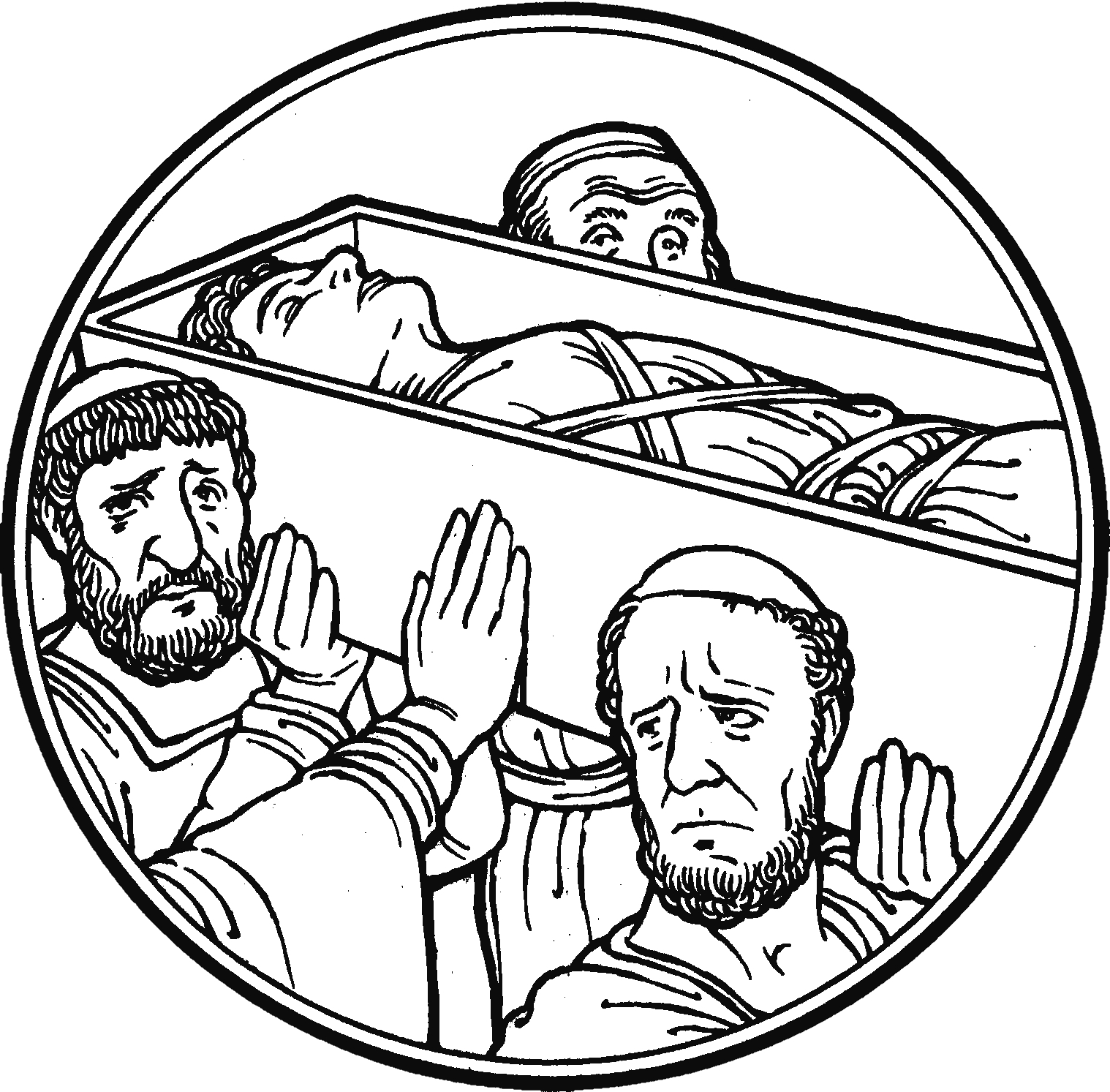
Yes, Easter joy is the climax of this text, but Good Friday sadness gets more words. Yes, the young son of this woman is raised, but Luke spends much more time telling us about the sad estate of his mother. She was a widow, but now she is really alone. This son of hers that has died is her only-begotten (μονογενής same word used in Jn. 3:16) son. A great crowd follows her sharing in her grief. Jesus sees her and speaks to her first. This woman is drowning in Good Friday grief. But Jesus He won’t allow it.

Jesus isn’t very good at funerals. He always ruins them. Remember when Jairus’ little girl died (Mt. 9:18-26; Mk. 5:22-43; Lk. 8:41-56), Jesus sees all the mourners weeping and wailing and tells them, “Go away, for the girl is not dead but sleeping,” and everyone laughs at Him. But then Jesus goes into the house, takes the girl by the hand, and says, “Little girl, get up” (Mk. 541:). And she does. Or, remember when Lazarus died. Jesus came when Lazarus’ corpse would have been ripe and stinky. Then, Christ tells them to roll the stone away from the entrance of the tomb and says, “Lazarus, come out” (Jn. 11:43). And out He comes. Finally, remember Jesus’ own funeral. Our Lord didn’t behave properly then either. Jesus leaves before His funeral is finished. He didn’t stick around in the grave long enough to have a proper burial.

Well, here in this text, Jesus ruins another funeral. Jesus is leading a great crowd. And as they reach the city of Nain, they meet another crowd who were going out of the city to bury the boy. These two throngs of people meet at the gate. Imagine this. One crowd is leaving the city and following death, and another crowd is entering the city lead by the Life of the world (Jn. 11:25, 14:6). And these two crowds get mixed up together in this bottle neck.

Proper etiquette and manners would dictate that Jesus and His crowd would step aside and allow the funeral procession to pass by. But, remember, Jesus is no good at funerals. Instead, Jesus marches right up to the front of the funeral procession. He does this, Luke tells us, because when He saw the mother He had compassion on her. Literally, Jesus’ guts were being wrenched and all twisted up inside.

He walks up to the woman and says, “Do not weep.” This sounds absolutely callous. Weeping is the right thing for this woman to be doing – her son has died. When you are saddened by the death of someone and find yourself weeping, you are doing what is right. Your actions line up with how God feels about death. Jesus, who never sinned, Himself cried when He was at the tomb of Lazarus (Jn. 11:35). Now, the text doesn’t tell us this, but I wouldn’t be surprised if Jesus had tears in His eyes as He approached the widow. Remember His guts are wrenched. But He tells her to stop crying because He is about to intervene. Jesus could have reversed the order. He could have raised the young man first, then told the mother to stop crying. But He doesn’t. He tells her to stop crying because it isn’t going to be necessary in a moment. This command to stop crying is a call for her to trust in Him.

H-70 Trinity 16 (Lu 7.11-17)Then, Jesus walks past the pallbearers, straight up to the bier, touches it, and says, “Young man, I say to you, arise,” as though He was waking up a sleepy teenager late on a Saturday morning. The boy gets up and begins to speak. I wonder what he said.

Jesus gives the boy back to his mother and everyone glorifies God saying, “A great prophet has arisen among us!” And, “God has visited His people!” They were right. God had visited His people. God had taken on flesh to deliver His people from death and sin, the sting of death (1 Cor. 15:54-56).

Dear saints, today is October 6th, but today we celebrate Easter; we celebrate the resurrection. Yes, we await the resurrection on the final day when Christ returns and raises up the dead and grants eternal life to all who believe in Him. But the resurrection has already begun. Jesus, your Savior died, but He lives. He is the first fruits of those who have fallen asleep (1 Cor. 15:20). Whenever Jesus contends with death, death looses.

And that is what you need because this morning, you were part of a funeral procession. Because you are a sinner, the stink of death hangs around you. Young and old – man, woman, and child – we all dragged some dead thing here with us today.

Is it your relationship with your spouse that is slowly dying? Is it the skeleton of disobedience to parents? What dead thing have you brought with you?

Is it the rotting remains of your finances that cause you to worry and doubt, or simply discontentment with what God has given you? Is it the cadaver of lust that flames within you? Is it the carcass of pride that is so inwardly focused that you do not notice the needs of others? What dead thing have you brought here with you?

Maybe it isn’t even your fault. Maybe it is just the fear of what might happen in the future. Maybe it is anger for how you have been wronged in the past. Maybe your dead thing is your own sick, crumbling body. What dead thing have you brought here with you?

Body of Christ CommunionJesus marches toward your funeral procession, and He does not stop or yield. Jesus does not give way or defer to death. Instead, Jesus defeats death with His death and resurrection, each and every time He meets it. Jesus meets you here today as you plod along in your personal funeral procession and gives you life. Jesus meets you at this altar to give you His living Body and His life-giving Blood.

Alleluia! Christ is risen!
He is risen indeed. Alleluia!

Amen.

The peace of God, which surpasses all understanding, will guard your hearts and minds in Christ Jesus. Amen.

Death & Beauty – Sermon on Luke 7:11-17 for the Sixteenth Sunday after Trinity

Listen here.

Luke 7:11-17

11 Soon afterward he went to a town called Nain, and his disciples and a great crowd went with him. The Resurrection of the Widow's Son at Nain12 As he drew near to the gate of the town, behold, a man who had died was being carried out, the only son of his mother, and she was a widow, and a considerable crowd from the town was with her. 13 And when the Lord saw her, he had compassion on her and said to her, “Do not weep.” 14 Then he came up and touched the bier, and the bearers stood still. And he said, “Young man, I say to you, arise.” 15 And the dead man sat up and began to speak, and Jesus gave him to his mother. 16 Fear seized them all, and they glorified God, saying, “A great prophet has arisen among us!” and “God has visited his people!” 17 And this report about him spread through the whole of Judea and all the surrounding country.

In the name of the Father, Son, and Holy Spirit. Amen.

Funeral processions – you see them from time to time. A hearse drives down the road followed by a line of cars driving from a church or funeral home on their way to a cemetery. Car after car follows the dead body of the husband or wife, brother or sister, father or mother, child or friend. You see death, and out of respect you pause for the mourners. You yield the right-of-way and let death pass.

Contrast a funeral procession with a parade.

Parades are also long lines of people and vehicles. Parades are also given the right-of-way. Out of respect for the people in the parade you smile and wave no matter how silly the costume no matter how poorly the band is marching and playing, no matter how vehemently you disagree with the political candidate. It is a parade. Parades are happy.

Well, what happens when a parade – a line of celebration, happiness, and glee –  meets a funeral procession – a line of despair, mourning, and death? That is precisely what happens in our text today, and Luke gives beautiful details.

Jesus is at the height of His popularity; a great crowd follows Him – people who have been healed or were witnesses of Jesus giving sight to the blind, hearing to the deaf, cleansing to the diseased, and good news to all. Jesus is bringing the reign of God to earth, and a parade follows Him.

But as this parade following Jesus reaches the gate of Nain (which means ‘Beautiful’), they meet something ugly – the funeral procession for a young man. Luke tells us that this young man was the only begotten son of his mother. Death has reared its ugly head to the town called ‘Beautiful.’

This mother is familiar with funeral processions. She had walked out of that same gate following the same path to the same cemetery to bury her husband. Even though the road was familiar, the procession has lost none of its bite or pain. In fact, this procession is more bitter, more final because, now, this widow is truly alone (1 Tim. 5:3-5).

You would think that, out of compassion for this widow, Jesus would respectfully turn His parade aside in quiet respect for the dead. You would think that happiness and joy would pause and defer to mourning and death. But you would be wrong. Jesus and His parade simply will not yield. And what Jesus does is so foreign to our thinking.

If you saw a hearse leading a line of cars to a cemetery, you would not swerve in front of the hearse blocking the road. You would not demand that the driver get out of the vehicle and throw the keys into the ditch. You would not go to the back of the hearse and pull out the casket. And you certainly wouldn’t open the casket revealing the body and start speaking to it. But that is what Jesus does.

There’s no question that Jesus has compassion on this woman, but it doesn’t pass for what we would call compassion. Jesus speaks only two words to this woman, “Weep not.”Imagine telling a parent who is mourning the death of a child, “Quit crying.” But as shocking as that is, Jesus goes even further – He stops the procession, touches the bier, and speaks to that dead flesh, “Young man, I say to you, arise.”

The dead boy sits up and is given back to his mother. He is put back where he belonged.

Jesus does not yield to death. Instead, death yielded to Jesus. This account reminds us of another time when Jesus and death marched toward each other.

Then, the funeral procession began long before death stuck its blow. Jesus Carries His Own CrossThe funeral procession began at the sentencing as crowds shouted out, “Crucify, crucify Him.” In that funeral procession, Jesus carried His own bier, His own cross, until He could carry it no more. A great crowd of people followed Jesus mourning and lamenting for Him. But even in the midst of that funeral procession, Jesus’ words are the same, “Weep not”(Lk. 23:26-28).

At that confrontation between Jesus and death, Jesus’ own widowed mother mourned the loss of her Son. In that epic meeting between Jesus and death, by all appearances, death had won. The Man who had raised the dead was now dead. His corpse buried, and for three days it rested in the ground from which it was taken.

But, once again, death gave way to Jesus.

Funeral processions can get ugly. The weeping and mourning and wailing can make us uncomfortable. Even though death is in your future, you deny or ignore it. Be honest, you see everything around you rotting, decaying, and dying. You have grown so accustomed to sin and being around death that you don’t notice it very often.

This morning, you were part of a funeral procession. You are guilty of sin, so the stink of death hangs around you. You are part of your own, constant funeral procession. Young and old – man, woman, and child – you all dragged some dead thing here with you today.

Is it your relationship with your spouse that is slowly dying, and yet you stand idly by?

Is it the cadaver of disobedience to parents or others in authority over you? You only do what you need to get by, even though you know you could do more.

What dead thing have you brought with you?

Is it the dying remains of your finances that cause you to worry and doubt, or simply discontentment with what God has given you?

Is it the carcass of lust that flames within you?

Is it the rottenness of pride that is so focused inward that you do not see the needs of others? A pride that boasts in your own accomplishments and belittles others?

What dead thing have you brought here with you?

Maybe, it is not even your fault. Maybe, it is just the fear of what will happen in the future. Maybe, it Is the worry and concern you have for others. Maybe it is anger for how your neighbor has wronged you. Maybe, your dead thing is your own sick, crumbling body. What dead thing have you brought here with you?

You are in your own funeral procession. Yes, maybe it will be months, years, or decades before you are finally lowered into the ground, but from the time you were born you have been marching toward your grave. Just admit it.

Jesus approaches your funeral procession, and He does not stop; Jesus does not yield.  Jesus does not give way or defer to death; He doesn’t have time for it.

Cross and CommunionInstead, Jesus defeats death, each and every time He meets it.

Jesus is here today. Jesus meets you as you plod along in your personal funeral procession and gives you life. Jesus meets you at this altar, this beautiful gate, to give you His living Body and His life-giving Blood. Amen.

The peace of God, which surpasses all understanding, will guard your hearts and minds in Christ Jesus. Amen.

This sermon was reworked from 2014.