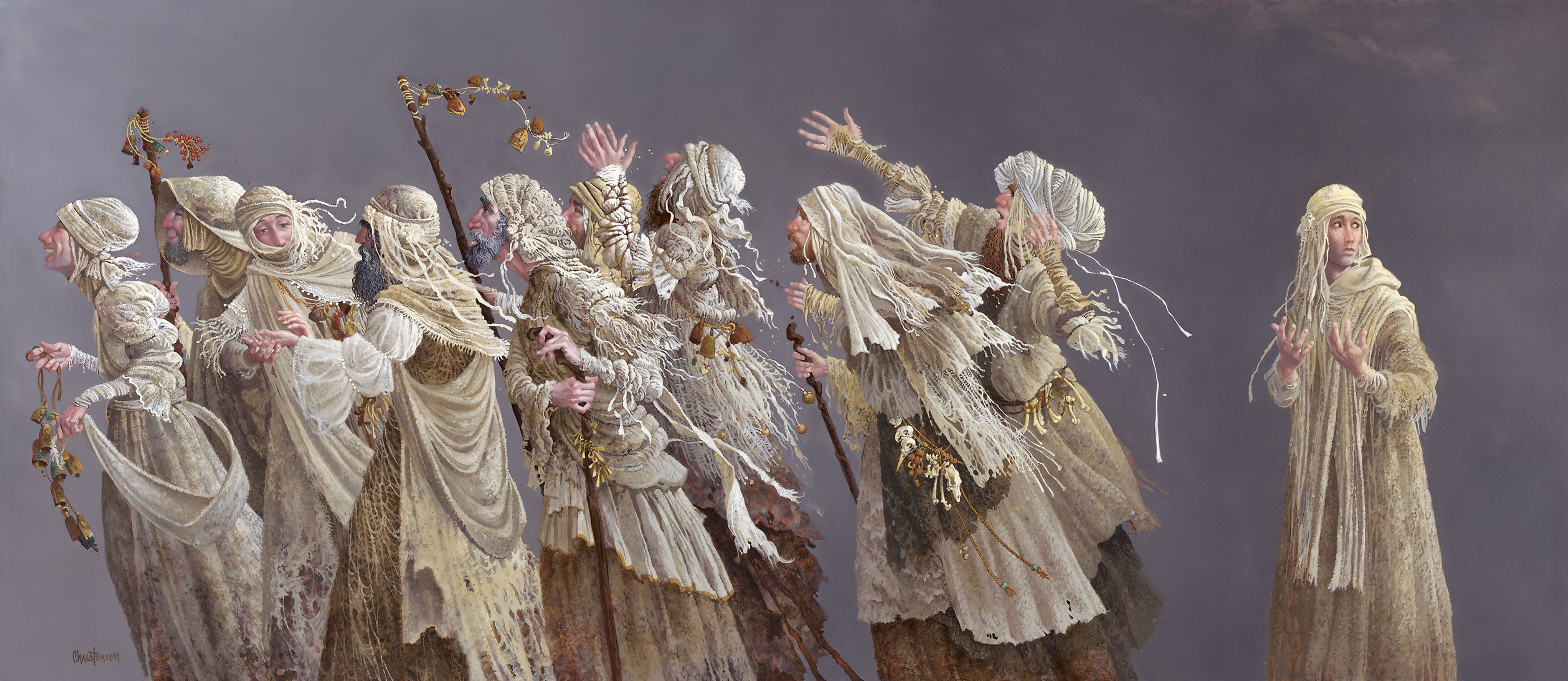
Cleansed & Thankful – Sermon on Luke 17:11-19 for the Fourteenth Sunday after Trinity

Luke 17:11-19

11 On the way to Jerusalem he was passing along between Samaria and Galilee. 12 And as he entered a village, he was met by ten lepers, who stood at a distance 13 and lifted up their voices, saying, “Jesus, Master, have mercy on us.” 14When he saw them he said to them, “Go and show yourselves to the priests.” And as they went they were cleansed. 15Then one of them, when he saw that he was healed, turned back, praising God with a loud voice; 16 and he fell on his face at Jesus’ feet, giving him thanks. Now he was a Samaritan. 17 Then Jesus answered, “Were not ten cleansed? Where are the nine? 18 Was no one found to return and give praise to God except this foreigner?” 19 And he said to him, “Rise and go your way; your faith has made you well.”

In the name of Jesus. Amen.

Trouble will often create fellowship. After the terrorist attacks on 9/11 our country had a strong sense of unity – at least for a bit. Those of you who lived here during the ’97 flood still have that fellowship. Maybe you’ve noticed having better fellowship with your family when a loved one has gone through lengthy medical treatments or died. Everyone bands together to get stuff done.

One of the reasons Alcoholics Anonymous or other support groups are so helpful is that struggling people can meet others have gone through similar situations. People gain strength and encouragement from others who have had similar experiences and struggles. All those are good examples of trouble creating fellowship. That kind of fellowship produces unity and focus, a renewed sense of purpose and drive, and hope in the midst of sorrow. Fellowship created by and through trouble can have a powerful positive effect. 

But trouble can also create bad fellowship – really bad fellowship. I’ve heard of support groups that morph into a kind of contest where some will try to show how much more pain they have endured than the rest of the individuals in that group. Or, when a group like that only focuses on their pain and struggle, some might start to think they’ll lose their connections if they begin to heal from the pain. So, everyone gets fixated on either being or, even worse, remaining a victim in an effort to not lose that camaraderie.

It seems like that fixation on victimhood is one of the tactics the devil is using to divide our culture today. There is so much conversation about privileged and the underprivileged. The super-rich and those who aren’t. The oppressors and the oppressed. Even if you aren’t initiating those conversations, the natural, knee-jerk reaction to that kind of talk is to view people who are introducing that kind of vocabulary as the enemy, so you put up walls and barriers. Dear saints, you must fight against that urge.

As a Christian, you know that all of humanity is much more united than we are divided. Whenever you have the urge to shove others away – and it doesn’t matter who the ‘others’ are – remember two things: First, you are united with every person you meet by the trouble of sin. We are all under the curse of sin and the sentence of death because of that sin. Second, you are united with every person you meet by the mercy of God that is only found in Christ. You know from the Word of God that every person you meet is someone from whom Christ died (Jn. 1:291 Tim. 2:6). Those two points of unity are desperately needed in our society and culture today.

In this text, the ten lepers were united by the trouble of their disease. Leprosy was a chronic skin disease caused sores, numbness, and the eventual loss of limbs. Because it was so contagious, leprosy also caused isolation from family and friends. Lepers had to live apart from others. But these ten found fellowship with each other because of their common trouble. The leprosy created a tight-knit community of ten that is more remarkable than we might realize. Apparently, most of these lepers were Jewish, but at least one was a Samaritan.

This is remarkable because this community of ten wouldn’t have formed unless they shared this disease. It wasn’t even conceivable. The disdain and divide between Jews and Samaritans was even bigger than between Vikings and Packers or Red Sox and Yankees fans. Or any other divide you want to insert here. But here they are in this little community of the suffering. And they are so united they do something very interesting.

When lepers encountered people who weren’t lepers, they would cry out, “Unclean, unclean” (Lev. 13:45). But that isn’t what these ten holler when they see Jesus. Instead, with a united voice (by the way, the Gk. for ‘voice’ there is singular not plural), these ten lepers cry out, “Jesus, Master, have mercy on us!” Jesus tells them to present themselves to the priests, and the only reason a leper would do that is if they had recovered from their leprosy. It’s only as they walk away from Jesus that they are healed from their leprosy. But only one, only the Samaritan, does an about-face and returns to give thanks to Jesus.

Once the leprosy that united them was miraculously healed by Christ, the unity they had was gone, so the group splits up. The Samaritan is now united through faith to Jesus. So, of course, this cleansed Samaritan returns to the One who cleaned him. The saved returns to his Savior. What happened to the nine? Were they just too excited to get back to their families that they forgot to thank the Son of God? Who knows?

We can ask this Samaritan in the Resurrection because, dear saints, you will meet him there. You will meet him because you have also been cleansed from the leprosy of your sin, just as he was. One day, you will join him in giving thanks and worshiping at the feet of your God and Savior, Jesus Christ. Maybe that Samaritan will tell us how he went and witnessed to the other nine and will introduce us to them.

From this Samaritan, we should learn that one of the characteristics of faith is thanksgiving and being a person of thankfulness. It’s interesting when Paul listed the fruit of the Spirit in our Epistle reading (Gal. 5:16-24) that he didn’tinclude thankfulness. But based on this account of the thankful Samaritan, we do see that thankfulness is one of the ways that faith is manifest.

As the Samaritan lies with his face on the ground giving thanks at Jesus’ feet, our Lord says to him, “Rise and go your way; your faith has (lit.) saved you” (not just ‘made you well’). In other words, the Samaritan’s thankfulness is the visible manifestation of faith because giving thanks is how he recognizes and acknowledges the Source of his cleansing.

Dear saints, be people of thanks, not just people of gratitude. There’s a lot of talk about gratitude today, and gratitude is good, but thankfulness is better. The distinction between the two is this (you’ve heard me say this before): Gratitude recognizes the goodness of the thing that has been given. But thankfulness goes a step further. Thankfulness recognizes the goodness of the giver. If a daughter asks her mom for a snack and is given a bowl of ice cream, the girl can be grateful, but if mom gives her a few sticks of celery, the kid won’t be grateful because celery is gross. But that same child can be thankful with either a bowl of ice cream or disgusting celery because it comes from her mom who loves her and knows what her daughter needs.

This distinction between gratitude and thankfulness helps us understand 1 Th. 5:18 which says, “Give thanks in all circumstances.” Not all circumstances are good, so how can you give thanks? Well, because thankfulness is not gratitude. Through faith you can give thanks whether God sends you joy or sorrow, pleasure or pain, goodness or even evil. Remember Job. After all his property and children were taken from him, Job said, “Naked I came from my mother’s womb, and naked shall I return. The Lord gave, and the Lord has taken away; blessed be the name of the Lord” (Job 1:21). Even after Job’s health was taken from him and his wife told him to curse God and die, Job said, “You speak as one of the foolish women would speak. Shall we receive good from God, and shall we not receive evil?” (Job 2:10). In both instances, Scripture says, “In all this Job did not sin with his lips” (Job 1:222:10).

In moments of loss and pain, you might not be able to be grateful, but you can be thankful. If nothing else, you can give thanks to God for what He has given, even if He takes it away. Through faith, you can give thanks – even when God takes His gifts from you because you know the goodness of the God who gave and removed those gifts. Through faith, you know that His goodness doesn’t fade or change. Only through faith can you give thanks in all circumstances (1 Th. 5:18).

Dear saints, in this world you have lots of trouble (Jn. 16:33), but even in and through that trouble, God unites you into the community of His Church. Christ has delivered you from your sin by the forgiveness He won and purchased with His blood on the cross. Because of that, you aren’t just united with others by trouble. You are united by something much, much stronger. You are united by His Blood, which cleanses you from all your sin.

Live now as God’s forgiven people, united in giving Him thanks. Your gracious, cleansing God and Savior, Jesus Christ, now invites you to His table to receive that cleansing through His Body and Blood. Come. Receive. And leave here with His thanks and praise on your lips. Let that thankfulness be on your tongue as you go about your business this week and every week because that thankfulness will point others to your Savior, who has cleansed you. Amen.

The peace of God, which surpasses all understanding, will guard your hearts and minds in Christ Jesus (Php. 4:7). Amen.

One – Sermon on Ephesians 4:1-6 for the Seventeenth Sunday after Trinity

Ephesians 4:1-6

1 I therefore, a prisoner for the Lord, urge you to walk in a manner worthy of the calling to which you have been called, 2 with all humility and gentleness, with patience, bearing with one another in love, 3 eager to maintain the unity of the Spirit in the bond of peace. 4 There is one body and one Spirit—just as you were called to the one hope that belongs to your call— 5 one Lord, one faith, one baptism, 6 one God and Father of all, who is over all and through all and in all.

In the name of Jesus. Amen.

What is your impression of or reaction to the following words: unity; inclusion; oneness; togetherness?

They are all good words and concepts, but those words probably throw up some red flags for you. Who doesn’t want unity? Wouldn’t it be great if our country was really the United States of America? No one wants to be excluded and left on the outside. It’s true that the team that plays together wins together. But would you say that we live in a time of unity? Probably not. We’ve gotten used to hearing that we are more divided now than at almost any other point in our nation’s brief history. Some even speculate that we may be on the verge of another civil war. Who knows?

But the more divided, fractured, and fragmented we become, the higher the desire there is for unity. The biggest obstacle to unity in this world, though, just might be the desire and calls for unity. For there to be unity, there needs to be something people are united on. And because the world is full of sinners who all want our own way, we are going to have a difficult time finding a point of unity. The selfishness, pride, and greed around and within us – yes, even in us Christians who still wrestle with our old Adam – will continue to cause division.

Well, this text doesn’t give us any suggestions for bringing unity to our culture or nation. There is nothing here to help us mend the political, economic, racial, and other divisions that we face in our society and culture today. Sorry. There are other passages of Scripture deal with that. Hebrews 12:14 says, “Strive for peace with everyone.” Romans 12:18 says, “If possible, so far as it depends on you, live peaceably with all.” And Philippians 2:4 probably gives us the best advice in achieving peace in our culture when it says to not look only to your own interest but to the interest of others.

Our text today, when it talks about unity and being one, refers to the unity that exists between Christians, and this unity between Christians is twofold.

First, there is a unity that all Christians simply have. We could call this a ‘vertical unity,’ and this unity consists of how sinners are made one with God. All Christians are sinners who by nature were children of wrath (Eph. 2:3). Christians of all time and in all places are united by the one faith in Jesus who is our Savior, the only Savior. Because Jesus is the only Savior, we are united in Christ who is the Way, the Truth, the Life, and the only access we have to God the Father (Jn. 14:6). When the Holy Spirit works faith in us, this unity simply exists.

All Christians believe that Jesus is the Lamb of God who takes away the sin of the world (Jn. 1:29). Through Him, every Christian of every tribe, language, race, and even denomination is united on the confession that Jesus is the Christ, the Son of the living God (Mt. 16:16). Through that Holy Spirit-wrought faith, every Christian is joined to the one holy Christian Church confessing the one hope of forgiveness and eternal life. That means that every Christian is part of the one body with Christ as the head (Eph. 4:15). This unity exists, but we also recognize that this unity is invisible.

This brings us to the second unity, and that is the unity that all Christians are to strive for. We can call this a ‘horizontal unity’ of how we as Christians are united with one another. This unity is of conviction and true confession. We rejoice in the unity we have here in our congregation, and we have been rejoicing in the unity we have with our sister congregation on the other side of the river as we gather together on Wednesdays. But we also rejoice in the unity we have with Christians of other denominations: Lutheran Brethren, AALC, Missouri Synod, ELS, ELCA, Evangelical Free, Covenant, Baptist, Methodist, Presbyterian, Assembly of God, Catholic, and I could go on and on.

Now, even as I mention all those different church bodies, you are probably thinking, “Pastor, aren’t all the different denominations a sign that we Christians are not united?” To a degree, yes. But there is also something counterintuitive about all the different denominations is actually a sign of our unity. 

Now, please bear with me as I flesh this out. Go back to the first unity, our vertical unity. All Christians have one Lord, one faith, one Baptism. But one of the things that divides the various Christian denominations and disrupts that horizontal unity is what the different church bodies believe and teach about Baptism. Here at Christ the King, we teach that Baptism is God’s work where He forgives sins (Act. 2:38), joins us to Jesus’ death and resurrection (Ro. 6:3-11), gives us the new birth (Jn. 3:5), and saves us (1 Pet. 3:21). Many Christians (and please note that I am calling them ‘Christians’) who attend other churches do not believe that is what the Bible teaches about Baptism. They will say that Baptism is something a believer does for God as an outward expression of an inward change.

The Bible does not teach both of those things. Those two doctrines cannot both be true. One is right, and the other is wrong. And it would be wrong and even sinful for either us or other Christians who believe differently to say, “Well, it doesn’t really matter what we believe about Baptism.” It does matter. What we believe about Baptism matters because Scriptures teach us about Baptism. And Jesus tells Christians to keep and observe all that He has said to us in and through the Scriptures (Mt. 28:20). Just a few verses after our text, Paul tells us to “not be tossed to and fro by the waves and carried about by every wind of doctrine” (Eph. 4:14). God wants us to be rooted and grounded so that we rightly handle His Word of truth (2 Tim. 2:15).

Christians want to stay true to what the Scriptures teach. The only way we can stay true to what the Scriptures teach is to continue to grow in our knowledge of the Scriptures. That is why it is important for you, Christian, to keep learning and diving into the Scriptures that are inspired by God and profitable for teaching, for reproof, for correction, and for training in righteousness that the man of God may be complete, equipped for every good work (2 Tim. 3:16). So, dear saints, be in the Scriptures. Read and meditate on them daily. Come to Bible study and Sunday School to continue being equipped by and through God’s Word. The best way to maintain and strengthen the horizontal unity between Christians is to be grounded in the Bible.

This brings us back around to the differences between Christian church bodies: The silver lining in the doctrinal differences that exist between the various denominations is that we are all trying to be true to what the Bible teaches. In other words, we are taking what Jesus teaches in the Bible seriously. We take it seriously enough that we recognize when those differences exist and when we are not united in doctrine. We don’t rejoice in that horizontal disunity, but we love each other enough to be honest about it because what the Bible teaches is important. That is why we – with humility, gentleness, and patience – point those who believe differently than we do to what Jesus has said. We don’t pridefully lambast them saying, “You aren’t a Christian if you don’t believe just like I do.” No!

Instead, we do what our text calls us to do. We work to maintain the unity of the Spirit in the bond of peace. We can’t maintain or keep the unity of the Spirit unless that unity already exists, and it does. The unity of the one holy Christian Church is a gift given by God Himself through faith in Christ.

The unity of the Spirit in the bond of peace, the oneness that God has given all Christians, is a precious thing. We hold on to this unity as we hold onto Christ and His Word in humility. Jesus was glorified after He humbled Himself by being obedient to His death on the cross (Php. 2:8). That act of humiliation was rewarded by God the Father. And because of Christ’s obedience, the entire Christian Church is washed clean of sin. Christ’s humiliation is the glory of every Christian. So, let us imitate His humility by bearing with our brothers and sisters in Christ in love and forgiving as we have been forgiven. And we rejoice in God’s promise that we are now, right now, united in Him and are one with all our fellow Christians in a unity that is real whether or not we see of feel it.

And we patiently await the day when Christ will return and bring His one holy Christian and apostolic Church to live forever with Him as one. Amen.

The peace of God, which surpasses all understanding, will guard your hearts and minds in Christ Jesus. Amen.

The Holy Spirit’s Work – Sermon on Genesis 11:1-9; Acts 2:1-21; and John 14:23-31 for the Day of Pentecost

Genesis 11:1-9; Acts 2:1-21; & John 14:23-31

23 Jesus answered him, “If anyone loves me, he will keep my word, and my Father will love him, and we will come to him and make our home with him. 24 Whoever does not love me does not keep my words. And the word that you hear is not mine but the Father’s who sent me.

25 “These things I have spoken to you while I am still with you. 26 But the Helper, the Holy Spirit, whom the Father will send in my name, he will teach you all things and bring to your remembrance all that I have said to you.

27 “Peace I leave with you; my peace I give to you. Not as the world gives do I give to you. Let not your hearts be troubled, neither let them be afraid. 28 You heard me say to you, ‘I am going away, and I will come to you.’ If you loved me, you would have rejoiced, because I am going to the Father, for the Father is greater than I. 29 And now I have told you before it takes place, so that when it does take place you may believe. 30 I will no longer talk much with you, for the ruler of this world is coming. He has no claim on me, 31 but I do as the Father has commanded me, so that the world may know that I love the Father. Rise, let us go from here.”

Before I officially begin the sermon, I’d just like to ‘let you in’ a little bit on sermon preparation. There are times when preaching is similar to athletic events. For example, in competitive diving, your final score is dependent on two factors: degree of difficulty and execution. Certain dives that score only 7’s and 8’s on execution but have a high degree of difficulty will get that competitor a higher score than another competitor who scores 9’s and 10’s on a dive with a lower degree of difficulty. What I’m attempting to do in today’s sermon is, in my estimation, a high degree of difficulty. I know my execution of today’s sermon will probably only score 7’s, but I hope and pray the payoff will be worth it. I’ll need your assistance though with an attentive ear, so help a preacher out.

In the name of Jesus. Amen.

To help us get a better handle on Jesus’ remarkable teaching about the Holy Spirit in this Gospel lesson, we need to make some observations from our Old Testament (Gen. 11:1-9) and Epistle lessons (Act. 2:1-21). First, from the Old Testament lesson:

There is a theory about what the people of Babel were doing that dates back to several centuries before Jesus was born. Please know that this isn’t drawn directly from Scripture, but it does help us understand what was going on a little better. Babel wasn’t just a bunch of people who decided to live together in a big tower. Instead, the mighty man, Nimrod (Gen. 10:8-10), has gathered people and said that together they could make a name for themselves and be greater than God who had judged the world with the flood just two generations prior. In other words, they want to be their own little ‘g’ god. They figured they could build a tower so high that the true God could not drown them again. God had already promised that He would never repeat that kind of judgment, but they didn’t trust God’s promise. Instead, they are going to try and make themselves safe from God’s wrath.

Again, the Holy Spirit didn’t inspire this theory, but it is still a very good theory. First, it clearly explains what the people were trying to accomplish. They weren’t trying to build a tower to get closer to God; rather, they were trying to establish an earthly, man-made peace by shielding themselves from God and His anger over their sin. This theory also explains why God saw their plan with such hostility and put a swift end to their work. But notice how God put an end to their work. He didn’t destroy the tower with a tornado or earthquake. Instead, God came down (I love how that phrase is used twice [v. 5, 7]). God had to come down to see this great tower which was going to have its top in the heavens. And God confused their languages so that they dispersed over the face of the earth. Now, God did this as a curse, but He also did it so they wouldn’t continue to live in their sin. Even God’s punishment turns into a blessing.

Now, when we come to the day of Pentecost and giving of the Holy Spirit in the Epistle lesson, God doesn’t quite undo the curse of Babel. He doesn’t reunite all the languages of the earth and make all mankind into one nation again. Instead, God had gathered His people together to celebrate the feast of Pentecost which is also called the Feast of Weeks. God’s people had come to Jerusalem, our text says, from every nation under heaven (Act. 2:5). They would have been daily listening to God’s Word in the Temple, and the Temple had strict rules that the Bible was only read in Hebrew. It didn’t matter if some, or even, most of the people didn’t even understand Hebrew, that’s just how it was.

But then on the day of Pentecost, the Holy Spirit was poured out on the disciples. Back in Act. 1:15, we are told that the number of faithful believers was only about 120. The Holy Spirit arrived with the sound of a mighty, rushing wind, and the people from all over the world who were visiting Jerusalem for the feast were brought even closer together. They heard that sound which made them gather in one place. But the sound of the wind was not the most important thing they heard that day. The most important thing they heard is the disciples speaking the mighty works of God in their own languages (Act. 2:11).

Here’s the interesting part: for these visitors to be able to get around in Jerusalem, they would have had to be able to communicate in at least one of four languages: Hebrew, Greek, Aramaic, or Latin. But here’s the beautiful thing, the Holy Spirit didn’t limit the number of languages that proclaimed those mighty works of God. Those 120 believers were filled by the Holy Spirit in such a way that they were able to speak in every language that existed even though it would only have been necessary for Him to have the Gospel preached in only four languages. In other words, the Holy Spirit sanctifies and makes holy every language on earth to carry the Gospel of Jesus’ death and resurrection to every nation on the day of Pentecost. Now, keep all of that tucked in the back of your mind as we move to this Gospel lesson.

The night Jesus was betrayed and arrested He taught His disciples a lot of things about the Holy Spirit; chapters 14-16 of John’s Gospel is probably the fullest, clearest teaching we have about the Holy Spirit. But, basically, all of this teaching boils down to the fact that the Holy Spirit’s work is to point us sinners to Jesus (Jn. 15:26). Whenever you hear Jesus proclaimed as the Savior of sinners, you can know without a doubt that the Holy Spirit is actively working in your life.

Specifically in this text, Jesus says that the Holy Spirit will teach the disciples all things and bring to their remembrance all that Jesus has said to them (Jn. 14:26). Then, notice the first word Jesus says after that is ‘peace.’ “Peace I leave with you; my peace I give to you.” And please notice that Jesus, the eternal Son of God, gives His own peace. This means your situation, Christian, is that there is nothing to disturb your relation to God. On the cross, Jesus has won and established this peace between you and God by His death and resurrection.

The only way for this peace to be undone, you would have to do two things. First, you would need to create a time machine and travel 2,000 years back in history and go to Mt. Calvary when Jesus hung on the cross. And that would be the easy part. Second, you would have to somehow pry Jesus off of the cross and undo God’s plan of salvation that He had prepared before the foundation of the world (1 Pet. 1:19-20). So, according to Jesus, the Holy Spirit’s job is to continually proclaim to you the message of the peace that Christ has won.

Jesus goes on to say, “Not as the world gives do I give to you.” The question I have there is this: Is Jesus talking about the motivation of giving (the ‘how’ the world gives), or is He talking about the content of what He gives verses the content of what the world gives? In other words, when we sinful people give something, we always have wrong motivations. We often give and have some expectation of getting something in return. Think of the phrase, “I’ll scratch your back and you scratch mine.” The false notions of karma and luck are also related to this. Deep down, that’s always the motivation behind the world’s giving.

Or is Jesus saying that the peace He gives is different than the peace the world gives. So many times, the world will offer all sorts of ideas that they think will bring peace to this fallen, broken world. Politicians, celebrities, beauty pageant contestants, musicians, etc. all do this. But none of their policies or ideas will bring peace because they are not able to bring true peace. The only thing that can bring true peace is the atoning blood of Jesus. Now, the Holy Spirit is the one who reminds and points you to Christ’s peace which surpasses all understanding (Php. 4:7).

Over the last week, we have heard a lot of talk about how to solve the evil of mass shootings in our country. I’m not going to preach on that because mass shootings are not the problem – they are only a symptom of a spiritual and moral problem. Even if you got a giant gun magnet and got rid of every gun in the world, evil people would figure out a way to kill and harm others. A lot of politicians are saying things like, “We need to come together and fix this.” The problem is that when sinners work together, it is generally in service to evil. Babel in our Old Testament lesson is just one example, but Scripture is filled with more. Any attempt to bring about a unity that isn’t centered around the forgiveness of sins in Christ is going to turn evil quickly.

The Holy Spirit brings something better. He unites people from every tribe under heaven in the faith. He brings us together to hear the Gospel, receive forgiveness for all our sins, and places us in the Church. And that same Holy Spirit leads you to this altar, to this table, to receive the true Body and Blood of your Savior Jesus Christ. Through this meal, the Holy Spirit strengthens and empowers you to be His instrument in this dark, evil world.

Again, Jesus says, “Not as the world gives do I give to you.” All the world has to offer you is trouble and tribulation. Jesus says, “I have said these things to you, that in me you may have peace. In the world you will have tribulation. But take heart; I have overcome the world” (Jn. 16:33).

So come; receive what Christ freely gives. Let the Holy Spirit do His work in you so that He may also do His work through you as you go back out into a world full of evil. And you can do that work and navigate all that evil with confidence because the Holy Spirit will continually point you to your true peace which Christ has won for you. Amen.

The peace of God, which surpasses all understanding, will guard your hearts and minds in Christ Jesus. Amen.