
Luke 16:19-31
19 “There was a rich man who was clothed in purple and fine linen and who feasted sumptuously every day. 20 And at his gate was laid a poor man named Lazarus, covered with sores, 21 who desired to be fed with what fell from the rich man’s table. Moreover, even the dogs came and licked his sores. 22 The poor man died and was carried by the angels to Abraham’s side. The rich man also died and was buried, 23 and in Hades, being in torment, he lifted up his eyes and saw Abraham far off and Lazarus at his side. 24 And he called out, ‘Father Abraham, have mercy on me, and send Lazarus to dip the end of his finger in water and cool my tongue, for I am in anguish in this flame.’ 25 But Abraham said, ‘Child, remember that you in your lifetime received your good things, and Lazarus in like manner bad things; but now he is comforted here, and you are in anguish. 26 And besides all this, between us and you a great chasm has been fixed, in order that those who would pass from here to you may not be able, and none may cross from there to us.’ 27 And he said, ‘Then I beg you, father, to send him to my father’s house— 28 for I have five brothers—so that he may warn them, lest they also come into this place of torment.’ 29 But Abraham said, ‘They have Moses and the Prophets; let them hear them.’ 30 And he said, ‘No, father Abraham, but if someone goes to them from the dead, they will repent.’ 31 He said to him, ‘If they do not hear Moses and the Prophets, neither will they be convinced if someone should rise from the dead.’”
In the name of Jesus. Amen.
Right off the bat, this text confirms that there are things much worse than being poor, hungry, covered with sores, and having dogs as your only friends and caretakers. There is eternal life after this life, and after you die, there are only two destinations. Heaven and hell are real. You will spend eternity either in bliss with God your Creator, Redeemer, and Sanctifier, or in eternal damnation and torment.
Because that truth stares you in the face when hearing this text, I want us to focus for a moment on a rich man in this text.
There was a rich man who was adorned with the finest garb. This man daily feasted on the best food. Wherever he went, he was chauffeured around in decadence. This rich man had the most precious things in all creation and was truly blessed. And this rich man’s name was… Lazarus.
Now, I can hear what you’re thinking: “Pastor, Lazarus didn’t have anything good in this life. Abraham even said that Lazarus received bad things in his lifetime.” Absolutely, I’ll concede that point. But with this parable, Jesus is trying to fix our hearts where true joys are found. Both in this life and the next, true joy is to be found in the promises of God’s Word.
Too often, we Christians are tempted to think that if things aren’t going a certain way that God is mad at us. I often hear testimonies of Christians who will say things like, “I thought I was saved, but…” Then, they’ll recount some difficulty or hardship they have gone through. Then they will continue, “But then, I truly gave my life to Jesus, and everything got so much better. And now I’m really saved.” Honestly, that is sad to hear.
Dear saints, beware that kind of thinking and mentality. The devil wants us to tie our assurance of salvation to how things are going in this life. Honestly, that type of thinking is precisely what the book of Job is teaching against. God says that Job is righteous and upright (Job 1:8, 2:3), but the devil says, “Hey God, let me have a crack at him. Let me take everything from him – his wealth, family, possessions, and health. And Job will curse You to Your face, God” (Job 1:9-11, 2:4-5). And even when Job’s friends try to get Job to confess that he must have done something sinful to cause all the evil he endured, Job clung to faith in God’s promises.
Considering our life and judging what God thinks of us based on our blessings or lack of blessings is a dangerous place to be. Jesus Himself says that the life of faith is going to be difficult. Remember, Jesus promises that if the world persecuted Him, believers will be persecuted too (Jn. 15:20). Jesus calls Christians to follow Him which means picking up a cross – not a lazy boy (Lk. 9:23). If we are always stuck looking at how our lives are going, we’ll never be at rest as Christians. In fact, we will easily fall away. All the devil will have to do is keep bouncing us between highs and lows, and eventually, we will break.
Now, there are all sorts of ways we can go wrong when we consider this parable about Lazarus and the rich man unless we understand Jesus when He says, “Blessed are those who hear the Word of God and keep it” (Lk. 11:28). Those who hear God’s Word and believe it live blessed lives despite all appearances to the contrary. And that is the main difference between Lazarus and the rich man.
So, back to the idea that Lazarus was the truly rich man in this parable: Yes, absolutely. Lazarus was poor in this life, but when we consider what God’s Word says, we see that Lazarus was rich. In the parable, Jesus doesn’t say what kind of rags Lazarus wore, but Scripture does say that all believers are clothed with Christ (Gal. 3:27). In fact, Ephesians 5:25-27 says that Christ loved the Church and gave Himself up for her, that He might sanctify her and cleanse her by the washing of water with the Word, so that He might present the Church to Himself in splendor, without spot or wrinkle or any such thing, holy and without blemish. Because Lazarus was a Christian, that is how he was clothed – despite the appearance of his beggarly clothes.
In the parable, Jesus says that Lazarus was hungry and desired to be fed with what fell from the rich man’s table. But because Lazarus was a Christian, he did not live on bread alone, but on every Word that proceeds from the mouth of God (Mt. 4:4). Lazarus knew the mercy of Christ, the Word made flesh (Jn. 1:14), who is the living bread that comes down from heaven (Jn. 6:50-51). That Word of God was sweet to Lazarus’ taste, sweeter than honey (Ps. 119:103).
And Lazarus had the finest chauffeurs who, when he died, carried him to Abraham’s side. The angels took care of all his transportation needs. Yes, despite all the suffering Lazarus had in this life, he was truly blessed.
And when we consider the rich man in the parable, we see the opposite. For all the temporal blessings the rich man had in this life, he did not have the most important thing – faith in God’s Word. Even as he is tormented in hell, the rich man continues to reject God’s Word. In damnation, he has the audacity to tell Abraham that God’s Word isn’t enough to warn his five living brothers about the peril of their sins. He demands that Lazarus be raised from the dead and warn them. But Abraham responds, “If they do not hear Moses and the Prophets (in other words, the Scriptures), neither will they be convinced if someone should rise from the dead.” In other words, to hold fast to God’s Word is to be truly rich through faith in Christ. Blessed are those who hear the Work of God and keep it.
Don’t trip up on v. 25 where Abraham says, “Child, remember that you in your lifetime received your good things, and Lazarus in like manner bad things.” Some will say that statement teaches that the poor in this life go to heaven and the rich in this life go hell. That can’t be the case. Instead that again teaches us to not look at our blessings in this life, whether they be many or few.
Just think about the other rich man you heard about today in our Old Testament lesson (Gen. 15:1-6) – Abraham himself. In his day, Abraham was one of the wealthiest men in the world. One night, the Lord promised Abraham that His reward would be very great. But when Abraham looked at himself, he saw an old, wrinkled man. When Abraham looked at his wife, he saw an old woman who was past the age of bearing children. Abraham looked over at his servant Eliezer who was going to get all Abraham’s stuff when he died because Abraham had no heir. So God took Abraham outside, told him to look at the stars and try to number them. And God promised, “So shall your offspring be.” And Abraham stopped looking at his temporal blessings, and he looked past the limitations that seemed to contradict God’s promise. Instead, Abraham believed the Lord, and God counted it to him as righteousness.
Lazarus had that same faith. The name “Lazarus” means “one whom God helps.” Even with his beggarly status in life, Lazarus rested on the promises of God for forgiveness, life, and salvation despite all appearances to the contrary. Those promises carried Lazarus throughout his life, so when he died, the angels carried Lazarus to paradise. Yes, the rich man had earthly treasures in this life, but once he died, those treasures were gone forever. Because he didn’t have faith in God’s Word, he had nothing and was truly poor.
So, parents, this is mainly directed at you, but it is also for all of us Christians: We need to reconsider how we encourage our children and young people. Too often, we urge kids to grow up to be like the unnamed rich man in the parable. Obviously, he was wildly successful financially. He was a family man who cared about his siblings. He was probably a very generous man. Why else would Lazarus be begging at this man’s gate each day? The unnamed rich man was independent, successful, and a model, upstanding citizen. But he lacked the faith and fear of God. And without that, he had nothing.
And don’t get me wrong here. It is good to teach, instruct, and encourage our children to work hard, be independent, earn an honest living, and take pride in their accomplishments. It is important to do that. But never to the neglect of faith in God’s Word. Above all else, let us train our children and encourage one another to be dependent upon God and rest in His promises.
Those promises of God’s love, mercy, and forgiveness carry us through this life. And when our time comes, may we be found faithful to Christ and like Lazarus be carried by the angels to the side of our crucified, risen, and ascended Savior, Jesus Christ. Amen.
The peace of God, which surpasses all understanding, will guard your hearts and minds in Christ Jesus. Amen.
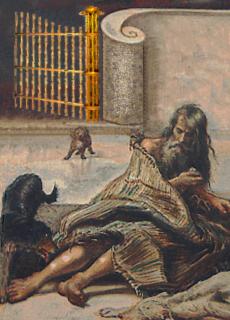 Now in the parable, Jesus does say that Lazarus is there at the man’s gate begging and desiring to be fed with what fell from the rich man’s table. Absolutely, I’ll give you that. Maybe, the rich man should be helping more and being more generous. But, why do you think Lazarus chooses to beg at this man’s gate? Could it be that Lazarus knows he has a better chance to receive something at that gate than if he went to a different gate? And let’s be brutally honest here. If you had a Lazarus camped outside your house begging day after day wouldn’t you find a way to make them move on? How long before you’d be embarrassed about that poor person asking for money when visitors came to your house?
 So, put two and two together and that means everyone is a slave to sin. But you and every person that you will ever meet, every person that has been or ever will be, every individual has been bought from slavery to sin. Every individual has been deemed and valued by God to be worth the blood of His own Son, Jesus. So, whether someone is rich or poor; whether someone is white, black, yellow, or brown; whether someone is a police officer or a rioter; whether someone is a capitalist or a Marxist; whether someone is conservative, liberal, Republican, or Democrat, remember God has paid the blood of Jesus to redeem that person from his or her slavery to sin. Amen?
 Striving means that you work hard because you aren’t sure if you are going to make it. That’s why you strive. And rest? Well, rest is rest. It’s the opposite of striving. Typically, striving and rest only go together when the later follows the former. People strive so they can go home and rest for the evening or the weekend, or they work for decades so that eventually they can retire and rest. But that is only how things are in this fallen world.
 Christian, you have entered into the rest of God. You find your rest as you simply allow God’s Word to do its work in your heart as it pierces to the division of soul and spirit and discerns the thoughts and intentions of your heart. That Word of God convicts you of your sin revealing that your thoughts, words, and deeds are sinful in God’s sight. And that same Word invites you to faith in Christ who says, “Come to Me, all who labor and are heavy laden, and I will give you rest,” or better translated, “I will rest you” Mt. 11:28).
 And on a Friday, the sixth day from the cross, Jesus cried out as He died, “It is finished” (Jn. 19:30). His striving for your salvation was done. Jesus was laid to rest in a tomb on the Sabbath, the seventh day because all His work to redeem you was complete. And Christ rises on the first day of the week, the first day of the new creation.
 Bella, and all you saints, because you and I are always tempted to think there is something left for us to do to be saved, God desires that you continue to be pointed to the holy, eternal rest that Christ has given you. Here, assembled in God’s presence with your brothers and sisters in Christ, God reminds you of the holy rest you have now. There is nothing left for you to do. Every time you come here, you receive that rest by listening to God’s life-giving Word and letting that Word do God’s work in you.
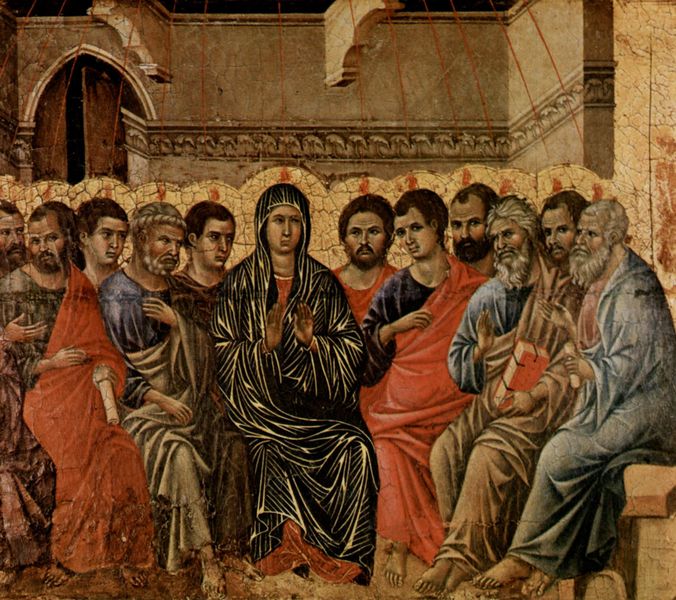 1 When the day of Pentecost arrived, they were all together in one place. 2 And suddenly there came from heaven a sound like a mighty rushing wind, and it filled the entire house where they were sitting. 3 And divided tongues as of fire appeared to them and rested on each one of them. 4 And they were all filled with the Holy Spirit and began to speak in other tongues as the Spirit gave them utterance.
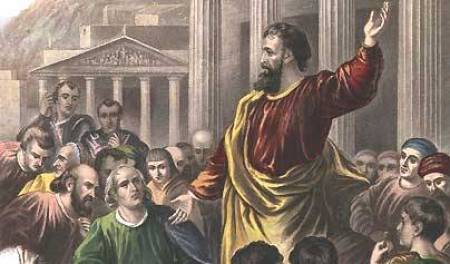 We didn’t hear Peter’s whole sermon. It goes on for another fifteen verses, but I want you to hear the highlights of the whole thing. In the part of Peter’s sermon that we did hear, Peter tells the people that, if they had read their Bible, wouldn’t have been surprised at what they are hearing because it had been foretold in the prophet Joel. Then, Peter goes on to proclaim Jesus to the people.
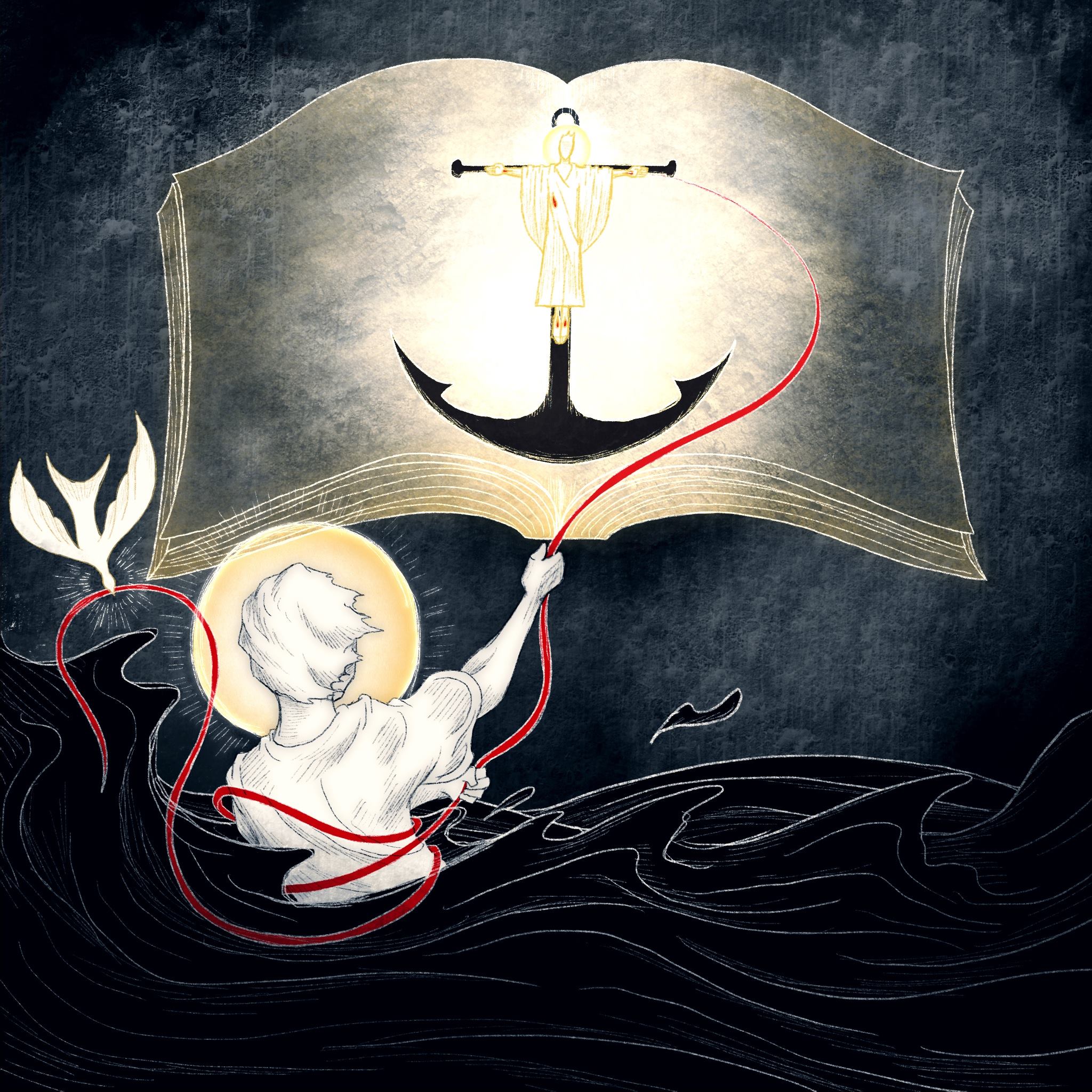 So you, when the Law comes and points its finger at you and declares you to be a sinner, don’t make excuses. Don’t try to turn the accusations away. Don’t try to put your own spin on it and say that at least you aren’t as bad as so-and-so. Instead, repent. Repent because the Holy Spirit wants you to know that Jesus came to save you who are lost in sin. That means that Jesus has come to save you and me.
 3 When Herod the king heard this, he was troubled, and all Jerusalem with him; 4 and assembling all the chief priests and scribes of the people, he inquired of them where the Christ was to be born. 5 They told him, “In Bethlehem of Judea, for so it is written by the prophet:
 Ouija boards, etc. – all things that the Scriptures consistently forbid because they are all demonic, satanic practices. So, again v. 1, “Now after Jesus was born in Bethlehem of Judea in the days of Herod the king, check this out, magi from the east came to Jerusalem.” It’s absolutely shocking. These are the first Gentile (non-Jewish) people in all the Gospels to seek Jesus, the Son of God.
 The magi take leave of Herod. The star appears again to lead them (Had it disappeared for a time?). They see it and “rejoice with exceedingly great joy.” And they find what they’ve been looking for, what they have been traveling for months to find. There, in a house, is the infant Jesus Christ, God in the flesh. And they worship the Child who will grow up and die on the cross for them. But then, notice, they have to be warned in a dream to not return to Herod. And they return to their country by another way.
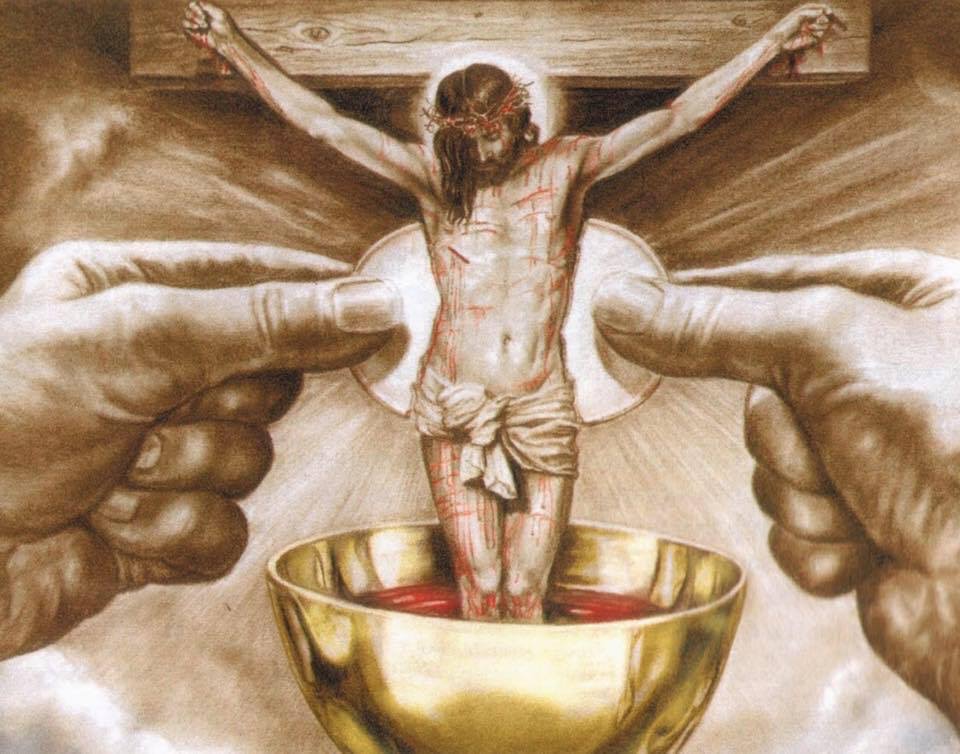 And always remember, that God doesn’t give up on you either. Through the same Scriptures, God has led you here to Himself. He hasn’t used a something as uncertain as star or a dream. He has led you with something more certain (2 Pet. 1:19) – His Word. He has led here to receive His mercy, grace, and forgiveness. He leads you now to His altar to receive His very Body and Blood given and shed for the forgiveness of your sins. Leave your sins behind. Come, taste, and see that your God is merciful and gracious, full of steadfast love and righteousness. Amen.
 And he came in the Spirit into the temple, and when the parents brought in the child Jesus, to do for him according to the custom of the Law, 28 he took him up in his arms and blessed God and said,
 This forty-day-old Jesus is going to bring a division between believers and unbelievers. Simeon, inspired by the Holy Spirit, says this division comes because what a person does with Jesus will reveal the thoughts of their heart. The division falls in one of two ways: many will oppose and reject Jesus to their fall, to their ruin, and to their damnation, and many will trust in Him to their resurrection and eternal life.
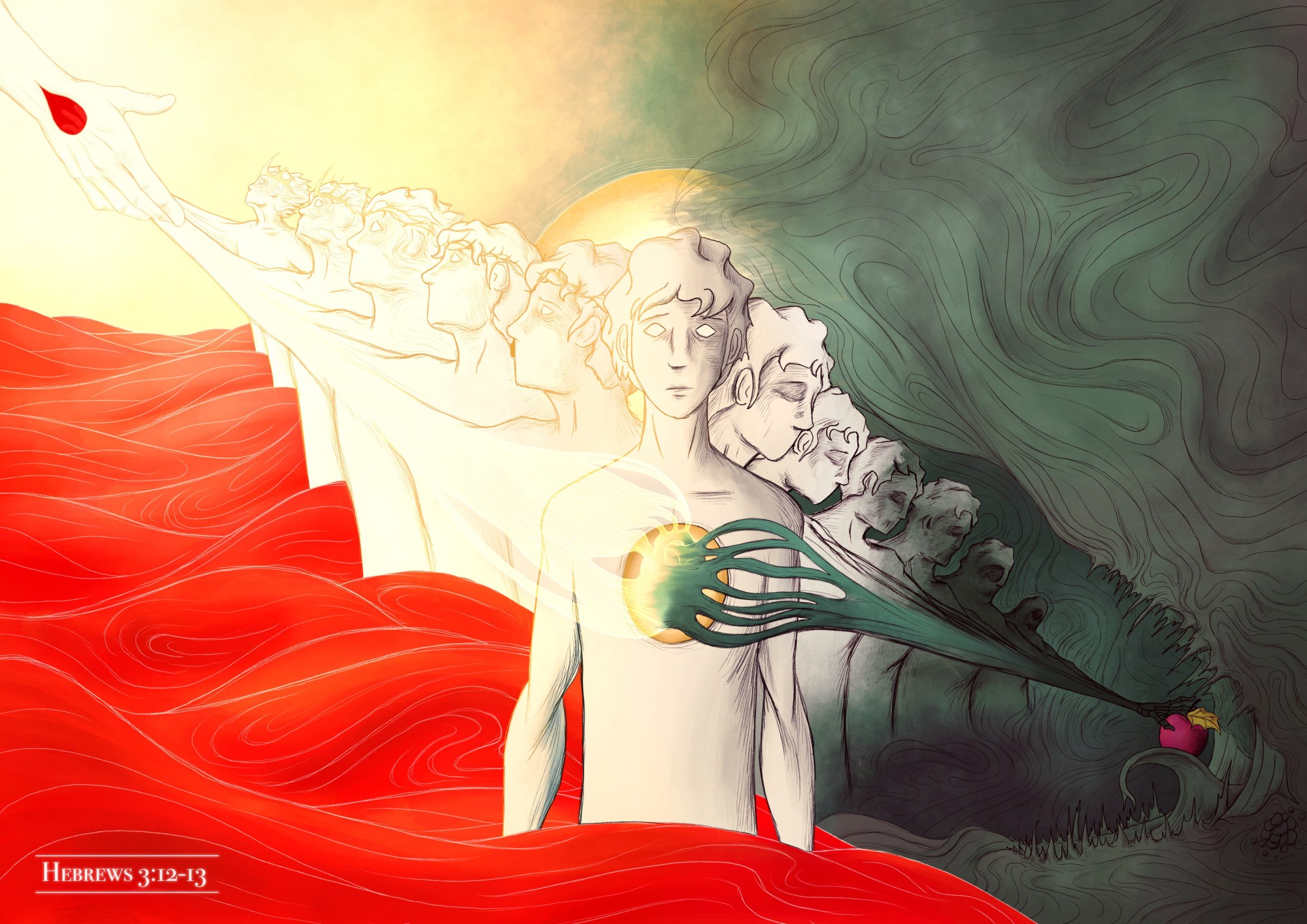 There can be, and often is, a conflict between how God sees you in your reborn spirit and how you see yourself in your soul – your thoughts, and emotions. You have probably experienced this. Part of you, your spirit, wants to live a certain way. You want to keep God’s commands, you want to live a God-pleasing life, you want to love your neighbor, etc. But part of you, your soul, doesn’t. Your soul would rather make sure you are comfortable and doesn’t really care about what God has commanded or what would benefit others. Paul talks about this conflict in Ro. 7(:7-25)where he wants to do good, but instead he keeps doing the sinful thing that he hates.
 The artist Michelangelo (not the Ninja Turtle) used to say that when he looked at a hunk of marble, he didn’t see big rock. Instead, he saw the sculpture that he was going to free from the rest of the rock that he would eventually chip away. He would say that he wasn’t creating a sculpture, he was just getting rid of all the rock that wasn’t part of the sculpture. That is somewhat the idea in the verse from Hebrews about the Word of God doing the work of dividing soul and spirit.
 Pastorsamwise
You must be logged in to post a comment.