Luke 17:11-19
11 On the way to Jerusalem he was passing along between Samaria and Galilee. 12 And as he entered a village, he was met by ten lepers, who stood at a distance 13 and lifted up their voices, saying, “Jesus, Master, have mercy on us.” 14 When he saw them he said to  them, “Go and show yourselves to the priests.”And as they went they were cleansed. 15 Then one of them, when he saw that he was healed, turned back, praising God with a loud voice; 16 and he fell on his face at Jesus’ feet, giving him thanks. Now he was a Samaritan. 17 Then Jesus answered, “Were not ten cleansed? Where are the nine? 18 Was no one found to return and give praise to God except this foreigner?” 19 And he said to him, “Rise and go your way; your faith has made you well.”
In the name of Jesus. Amen.
This text is so full of movement, it’s like a carousel. Jesus is traveling on His way to Jerusalem between Samaria and Galilee. Jesus tells the ten lepers to hit the road and travel to the priests and the Temple. The Samaritan leper turns back interrupting his trip to the priest to make his way back to Jesus. And Jesus tells the thankful Samaritan to go his way in health and salvation (more on that later). This is a moving text in more than one way.
Now, the first verse of our text is what the commentators will call a “travel notice.” We tend to skip over these travel notices when we read because we aren’t that familiar with the geography of Israel in Jesus’ day, but they are important. However, describing where places are on a map doesn’t work well in a sermon. The important thing is this: Back at the end of Luke 9, Jesus foretells His death and resurrection (9:44-45) then Luke gives us an important turning point in his Gospel. Luke says, “When the days drew near for Him to be taken up, [Jesus] set His face to go to Jerusalem” (9:51). In other words, this miracle takes place while Jesus is on His way to the cross.
The interesting thing is that Jesus isn’t taking the direct route. Instead, Luke mentions is that Jesus is traveling between the regions of Samaria and Galilee which mainly east-west instead of from Galilee in the north directly south toward Jerusalem. Instead, He is taking His time to preach, heal, and minister to the needs of as many people as possible with His mercy and grace.
As Jesus enters a village, He is met by ten lepers. Now, leprosy still exists today, though it is commonly called ‘Hansen’s disease.’ There are actually cases of it in the US today, but it is treatable by modern medicine and not easily transferred anymore. But in Jesus day, leprosy was a terrible problem. The disease makes your skin rot away while you are still alive. Leprosy would make the nerve endings of the effected areas grow numb. A leper could have oozing blisters all over their feet, cut their arm, or burn their hand and they wouldn’t even now it. This is why, so often throughout the history of the church, sin is described as leprosy. Our sin makes us so sick, we don’t even realize how wounded we are.
Now, in Jesus’ day, leprosy was highly contagious. So, lepers had to live apart from everyone else. If you had leprosy and somebody got near you, you would have to yell out, “Unclean! Unclean!” so they wouldn’t get near you. Because of this, lepers would form their own communities to help take care of each other, and that is what we see in this text. These ten lepers have formed a little community and, because of their common disease, it was a very inclusive community. Most of these lepers are Jews, but at least one of them is a Samaritan. Normally, the Jews and Samaritans didn’t deal with each other at all (Jn. 4:9). For a Jew to eat with a Samaritan made the Jew unclean. But these ten lepers formed a little community of the desperate.
They cry out to Jesus, but instead of yelling, “Unclean! Unclean!” they cry out, “Jesus, Master, have mercy on us.” They pray the Kyrie just like do each week. But Jesus’ response to their cry for mercy isn’t to wave His hand over their bodies and speak them clean. He doesn’t make mud with His spit and put it on their diseased skin to heal them. Jesus simply tells them to go show themselves to the priest.
Now, as lepers, this is something they would have done when they first contracted their leprosy. Through Moses (Lev. 13:2ff), God commanded that people who had a problem with their skin to go to the priest. The priest would examine the effected area, and, if it was indeed leprosy, the priest would declare them to be unclean. Then, if the area would clear up, the person was to go back for a second appointment with the priest and be declared clean (Lev. 14:1-32) so they could go back and live with their family and return to work. But here, Jesus simply tells them to go show themselves to the priest.
Think of that for a minute. Before anything has changed, while their skin is still rotting, Jesus tells them to go to the priest. Now, they wouldn’t be let into the streets of Jerusalem let alone be allowed into the Temple. But in this command of Jesus, there is an implicit promise. And by leaving Jesus, they act in faith.
There is a little lesson here for us about prayer. Probably most of our lives as Christians, we are waiting for an answer to a prayer. How often do we pray for something and are left to wait? But, Christian, take heart, God will answer. As these lepers journey to the Temple, they are cleansed.
Now, presumably, the nine lepers do continue to Jerusalem. They make their way through the streets to the Temple. They find the priest and are declared to be cleansed of their disease and allowed back into their families and community once gain. But only one of them actually obeys Jesus.
 This Samaritan who returns to the true Temple and true High Priest. He returns to Jesus to give thanks. Did you catch what Jesus said there, “Was no one found to return and give praise to God except this foreigner?” In other words, the nine went onto the Temple and God’s house, but God wasn’t there. He was walking in the flesh between Samaria and Galilee where the Samaritan falls at His human feet giving Him thanks. Some people will read the Gospels and say that Jesus never claimed to be God. Well, sorry, they are wrong. He does right here.
And this Samaritan receives from God, from Jesus, not just a declaration of cleanliness from his flesh-eating disease, but from his leprosy of sin. Jesus’ final recorded words to this man are, “Rise and go your way, your faith has saved (σῴζω) you,” (not just ‘made you well’), “your faith has saved you.”
The Samaritan is more than just a cleansed man, he is now our Christian brother. In fact, he shows the fruits of the Spirit that we heard about in our Epistle lesson (Gal. 5:16-24). He has love for God, joy in his healing, and peace that only comes through faith in Christ. He exhibited patience as he walked away from Jesus with the promise of healing. We can imagine his kindness toward the other nine who might have thought he was silly to go back to Jesus instead of going to the Temple in Jerusalem. His goodness is visible. Jesus encourages his faith. His has gentleness and self-control can be seen in his thankfulness to God; let me quickly explain that.
The word that gets translated ‘gentleness’ is a noun and has the idea of being humble or meek. Jesus uses the same word as an adjective in the Beatitudes, “Blessed are the meek, for they shall inherit the earth” (Mt. 5:5). The Samaritan humbles himself in meekness before Jesus falling at His feet. And instead of running off to his restored life, the man exercises self-control to turn back and first give thanks to God, to Jesus.
As we, like this Samaritan, rise from here and go on our way, let us turn back to give thanks to Jesus. Thankfulness requires a turning back. If we are thinking of what is going to happen next, we can’t give thanks. If we are always thinking about the future, we cannot give thanks because there is nothing there to give thanks for – at least not yet. We don’t know what is going to happen tomorrow. Jesus could return before we get to our cars to leave. As long as we’re thinking about tomorrow, we can’t give thanks.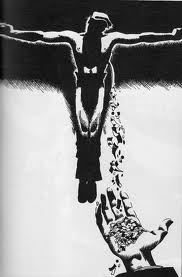
Instead, turn back. Turn back to what Jesus has done for you. Most importantly, He has died and risen for you. Because of His blood shed for you, He has declared you free and forgiven of all your sins here and now. Dear saints, rise and go your way. Get on the road again in thankfulness for what Christ has done, your faith has saved you. Amen.
The peace of God, which surpasses all understanding, will guard your hearts and minds in Christ Jesus. Amen.
 Pastorsamwise
You must be logged in to post a comment.