Matthew 25:1-13
1 “Then the kingdom of heaven will be like ten virgins who took their lamps and went to meet the bridegroom. 2 Five of them were foolish, and five were wise. 3 For when the foolish took their lamps, they took no oil with them, 4 but the wise took flasks of oil with their lamps. 5 As the bridegroom was delayed, they all became drowsy and slept.  6 But at midnight there was a cry, ‘Here is the bridegroom! Come out to meet him.’ 7Then all those virgins rose and trimmed their lamps. 8 And the foolish said to the wise, ‘Give us some of your oil, for our lamps are going out.’ 9 But the wise answered, saying, ‘Since there will not be enough for us and for you, go rather to the dealers and buy for yourselves.’ 10 And while they were going to buy, the bridegroom came, and those who were ready went in with him to the marriage feast, and the door was shut. 11 Afterward the other virgins came also, saying, ‘Lord, lord, open to us.’ 12 But he answered, ‘Truly, I say to you, I do not know you.’ 13 Watch therefore, for you know neither the day nor the hour.”
In the name of Jesus. Amen.
I promise we’ll get to the parable; it’ll be in a roundabout way. But first…
Four days from now, our nation will pause and dedicate a day to giving thanks. Friends and families will gather. Tables will be set. Turkeys will be cooked. (By the way, if you’re in charge of the turkey, make sure you brine it first – use kosher salt, 24 hours. Talk to me after the service.) Potatoes will be mashed. Stuffing will be fluffed. Pies will be baked. Cream will be whipped. Football will be watched. And couches and recliners will be tested for structural integrity.
Having a day for Thanksgiving is good, right, and important – probably more important than we could ever realize. Even though it is in the name – “Thanksgiving” – most people probably miss the whole meaning of the day. Thanksgiving is a day to give thanks, and that means there must be a recipient of our thanks – someone to whom we give thanks. And, dear Christian, I hope Thanksgiving Day is different for you than it is for many in our country because you know to Whom you give thanks. Let me parse that out.
Many people today will talk about gratitude. Some people finish each day by crawling into bed and thinking of five things for which they can be grateful. That is a good exercise, but it only goes so far. While there are similarities between the two, gratitude is not always the same as thanksgiving.
Let me try this on you, and you can tell me what you think. Gratitude tends to look at the goodness of the thing received.  But thanksgiving, yes it recognizes the goodness of the thing, but it looks past that and sees the goodness of the giver of the thing. This is why Christians can give thanks in all circumstances (1 Th. 5:18). Even in the tough stuff, even in difficult times, in sorrow, and in afflictions that come to us in this broken world, you can know that everything comes to you from the very same hands that were nailed to the cross for you.
Christians give thanks. Scripture even goes so far as to say that not giving thanks is one of the marks of the unbeliever. Romans 1:21-23 says of idolators, “Although they knew God, they did not honor Him as God or give thanks to Him, but they became futile in their thinking and their foolish hearts were darkened. Claiming to be wise, they became fools,” (see there a connection to the parable), “and exchanged the glory of the immortal God for images resembling mortal man and birds and creeping things.” In other words, people fall into idolatry because they foolishly do not give thanks to God.
Think back to Eden and the Fall when sin was being born: Eve rightly told the serpent that they could eat of any tree in the garden except the Tree of the Knowledge of Good and Evil. Nothing was forbidden to Adam and Eve except learning what evil is. But the devil awakened the desire to become more. Remember, the devil lied, “You will not surely die. God knows when you eat of it your eyes will be opened, and you will be like God, knowing good and evil.”
Instead of being content and thankful for everything God had given, the desire for something more was awakened. Then, those fateful words, “When the woman saw that the tree was good for food, and that it was a delight to the eyes, and that the tree was to be desired to make one wise, she took of its fruit and ate, and she gave some to her husband who was with her, and he ate” (Gen. 3:6).
In the account of the Fall, we can see how thanklessness is the root of every sin. When we aren’t giving thanks, we are lured and enticed by misguided and false desires. The Epistle of James warns us about this (1:14-15), “Each person is tempted when he is lured and enticed by his own desire. Then desire when it has conceived gives birth to sin, and sin when it is fully grown brings forth death.”
All of this is to say that one of the most important things for us to do to fight against sin is to give thanks. When we are giving thanks, we are looking at the goodness of our God and fighting against the false desires that lead to sin which grows and matures into death. So, again, as Scripture says, “Give thanks in all circumstances” (1 Th. 5:18). For many in our community – you farmers especially – this is important. Many of you have to leave your crops in the ground, and not only that you have to pay to do so. Lord, have mercy. It is awful and horrible.
Yet, in the midst of this suffering, God is giving you a chance to grow in your faith. Remember when Job had his oxen, donkeys, sheep, camels, children, and his health taken away? His wife tells him to curse God and die. But Job responds, “You speak as one of the foolish women. Shall we receive good from God, and shall we not receive evil?” (Job 2:9-10).
You farmers who are suffering now, everyone else who is suffering in other ways, and those of you who will suffer in the future, remember that God is your Heavenly Father. He will never withhold anything good from you. Psalm 84:11, “The Lord bestows favor and honor. No good thing does he withhold from those who walk uprightly.” Psalm 34:9–10, “Oh, fear the Lord, you his saints, for those who fear him have no lack! Those who seek the Lord lack no good thing.” Any suffering you experience is an opportunity for your faith in God’s goodness to grow and mature (1 Pet. 1:7, 4:12-16). He will not fail you.
 Now, to the parable. Honestly, it is very difficult, and the difficulty mainly lies in the fact that we don’t know enough about Jewish wedding customs in Jesus’ day to know why it was so important that these virgins have lit lamps when the groom arrived.
I would love to be able to tell you exactly what the oil represents, but Jesus doesn’t tell us. Is it the fear of the Lord which is the beginning of wisdom (Ps. 111:10; Prov. 1:7)? Since the fear of the Lord is the beginning of wisdom do we need to also add God’s Word, faith, grace, the Holy Spirit, the Sacraments, or thanksgiving? The safest answer is that it is probably all of them, because they are all tied together to make a sinner ready for the Day of the Lord. There are two things we can say for sure – the first is about the oil and the second about the lamps.
First, the oil is not something that can be shared. When the foolish ask the wise to share their oil, they say, “No,” because, even though the groom is around the corner, they will not have enough for both themselves and the foolish. The second thing we can say is about the lamps that no one can walk by the light of another’s lamp, each must have their own.
Also, we know for sure that all of these girls are failures. They all sleep. They all need to be awakened. They all need to quickly trim their lamps to be ready to meet the groom, but not all are able. Five are wise and get into the feast. And five are foolish and are left outside like strangers. We also know the purpose of the parable. Jesus wants us to be wise as we watch for His return. We need to have faith that God’s promises are sure and certain. He will return. He will come back. And He wants you at the feast.
Dear saints, the One who was born for you; the One who lived a life of perfect obedience for you; the One who suffered, bled, and died for you is the same One who is coming for you. Jesus will return and take you to be with Himself.
So, be wise. Continue even now to be where your Lord has promised to be. Be in His Word. Be here where He gives you His mercy and grace in the Supper. Be in the fellowship of your fellow believers. Be fed by His promises because those promises will never fail you. And be fighting against the foolishness of sin. Your Lord and Savior is coming. Amen.
The peace of God, which surpasses all understanding, will guard your hearts and minds in Christ Jesus. Amen.
 28 But when that same servant went out, he found one of his fellow servants who owed him a hundred denarii, and seizing him, he began to choke him, saying, ‘Pay what you owe.’ 29 So his fellow servant fell down and pleaded with him, ‘Have patience with me, and I will pay you.’ 30 He refused and went and put him in prison until he should pay the debt. 31 When his fellow servants saw what had taken place, they were greatly distressed, and they went and reported to their master all that had taken place. 32 Then his master summoned him and said to him, ‘You wicked servant! I forgave you all that debt because you pleaded with me. 33 And should not you have had mercy on your fellow servant, as I had mercy on you?’ 34 And in anger his master delivered him to the jailers, until he should pay all his debt. 35 So also my heavenly Father will do to every one of you, if you do not forgive your brother from your heart.”
 Think about the other night. You were watching that show. Men, that woman wasn’t your wife; she was sitting next to you. But God knew your lusts. Women, that handsome, considerate, compassionate character wasn’t your husband. You know what? That’s lust too.
 Let your ears be attentive to the voice of my pleas for mercy! [W]ith the Lord there is steadfast love, and with him is plentiful redemption. And he will redeem Israel from all his iniquities.”
 However, because we are sinful and corrupt to our core, we have a tendency to turn God’s good gifts into idols. This happens all over in the Scriptures. God has given beautiful trees and precious metals and stones, but people would take those things and make images out of them into false gods and bow down and worship them. In Isaiah 44[:9-20], God mocks the people for the foolishness of idols. God says, “You foolish people will cut down a tree and take some of the wood and make a bonfire to warm yourself and bake bread. Then, you take other parts of that same tree and carve it into an idol, bow down to it, and worship it saying, ‘Deliver me, for you are my god!’” What folly to say to a hunk of wood, “You are my god.”
 There is a quote from C. S. Lewis in your Scripture insert from his book The Problem of Pain, which I’d encourage you to read. Here’s the quote, “God whispers to us in our pleasures, speaks in our conscience, but shouts in our pain; [pain] is His megaphone to rouse a deaf world.” In other words, in His mercy, God gets our attention by allowing pain to bring us back to Him for mercy and grace.
 Second, God will not leave you alone with your idols. Know that, even when you make an idol of God’s good gifts, God wants you to have what He has given you in a way that is better than you deserve or know. Even in those moments when your pain is acute and severe, God is good and is working all things together for good for those who love and trust Him. So, trust Him because He is completely worthy of your trust.
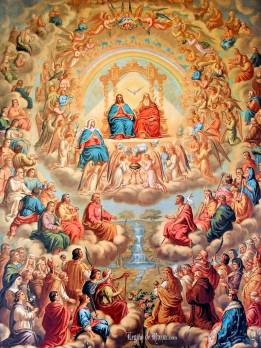 9 After this I looked, and behold, a great multitude that no one could number, from every nation, from all tribes and peoples and languages, standing before the throne and before the Lamb, clothed in white robes, with palm branches in their hands, 10 and crying out with a loud voice,
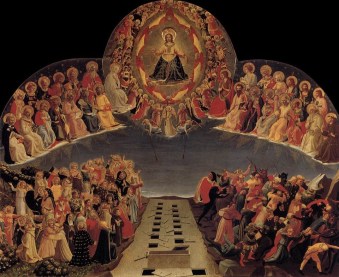 While death may come suddenly and abruptly here, those who die in the faith are not surprise arrivals in heaven. The company in heaven is not startled or shocked by those who show up at the doors of glory. The gates are open, and the believers who arrive there have been anticipated and are welcomed into the great multitude to be with the Lamb who shepherds them. Their arrival into glory is no shock to the residents of heaven. It is perfectly ordinary and on time.
 Because of this, we can have joy in the midst of sorrow. Here and now, as we are gathered together in God’s house and are invited to God’s table, we come to what is described in Hebrews 12(:22-24). This very morning in a small church on the north end of East Grand Forks, MN, we have come, “to Mount Zion and to the city of the living God, the heavenly Jerusalem, and to innumerable angels in festal gathering, and to the assembly of the firstborn who are enrolled in heaven, and to God, the judge of all, and to the spirits of the righteous made perfect, and to Jesus, the mediator of a new covenant.”
 Pastorsamwise
You must be logged in to post a comment.