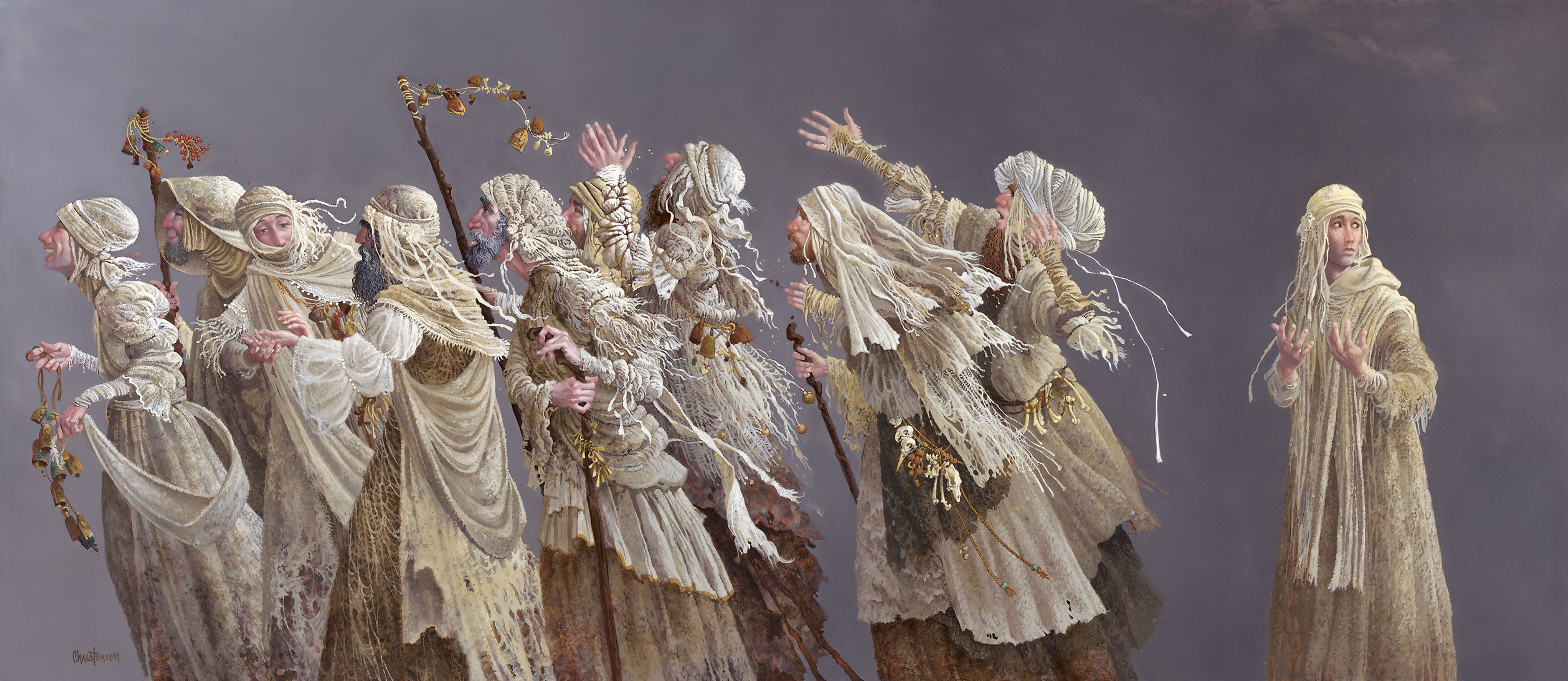
Luke 17:11-19
11 On the way to Jerusalem [Jesus] was passing along between Samaria and Galilee. 12 And as he entered a village, he was met by ten lepers, who stood at a distance 13 and lifted up their voices, saying, “Jesus, Master, have mercy on us.” 14 When he saw them he said to them, “Go and show yourselves to the priests.” And as they went they were cleansed. 15 Then one of them, when he saw that he was healed, turned back, praising God with a loud voice; 16 and he fell on his face at Jesus’ feet, giving him thanks. Now he was a Samaritan. 17 Then Jesus answered, “Were not ten cleansed? Where are the nine? 18 Was no one found to return and give praise to God except this foreigner?” 19 And he said to him, “Rise and go your way; your faith has made you well.”
In the name of Jesus. Amen.
In my opinion, this is the third weirdest miracle Jesus does. If you want to know which two top it, you’ll have to ask me after the service.[1] This miracle is weird because of how Jesus heals with a hidden promise, “Go and show yourselves to the priests.” In saying this, Jesus instructs the lepers to do what the Law required after being cleansed from leprosy (Lev. 14:2-32), but when Christ tells them to do that, they are still leprous.
I don’t know what it is with this text, but I have a lot of questions about it. Maybe I have these questions because Jesus Himself asks a lot of questions in it. One of my questions is when the ten lepers ask Jesus to have mercy on them, what exactly are they asking for? They have the obvious need of being healed from their leprosy, and Jesus had healed lepers before (Lk. 5:12-16). So, maybe they knew Jesus could cure their disease and wanted Him to do that. It could be that the lepers were asking for something different than healing. Maybe they wanted food or some other form of charity.
Another question I have is why does Jesus heal the lepers this way? Back in Luke 5, a leper came to Jesus saying, “If you are willing, you can make me clean.” And Jesus says, “I am willing; be clean,” then Jesus says, “Go and show yourself to the priest and make an offering for your cleansing as Moses commanded, for a proof to them.” Why wouldn’t Jesus do that again? Why not say, “Sure I’ll give you mercy. Be cleansed and go, show yourselves to the priest”? Why does He skip the first part?
Another question I have is how far did the ten go before they were cleansed? Was it after they walked for a couple hours, or was it ten or fifteen minutes and after they got outside the village? Or, possibly, was it as soon as they pivoted away from Jesus and toward Jerusalem? It’s unclear in English, but the Greek verbs can legitimately be interpreted to suggest that it happened more or less immediately. Jesus’ question, “Were not ten cleansed? Where are the nine?” could be a direct rebuke of the unthankfulness of the nine that they heard with their own ears. Something along the lines of, “Hey, are you nine going to ignore what I have just done for you?”
Now, we don’t know if the lepers were healed immediately or not. And we don’t know for sure what happened to the nine. Maybe they went to the Temple, were declared clean by the priest, offered the sacrifices, and went back to normal life. I’m sure the nine lepers were grateful for their restored skin and the fact they were able to be regular members of society again. But they were not thankful.
Whatever happened to them, it is a reminder of what Jesus says in the Sermon on the Mount, that God “makes His sun rise on the evil and on the good, and sends rain on the just and the unjust” (Mt. 5:45). God is good to all mankind. Anyone can be grateful for a sunny day or a rain shower that provides what we need to eat. Unbelievers can be grateful for all the blessings God gives through creation, but they can’t be thankful because they don’t know whom to thank. Only believers can be thankful to the God who gives good gifts.
There is a difference between being grateful and being thankful, between gratitude and thanksgiving. The two are, certainly, related. But to use a distinction by a pastor friend of mine,[2] gratitude looks at the goodness of the gift while thankfulness looks back behind the gift to the goodness of the giver. Let me give an example:
My first year of Bible College, I was on a choir that went on a tour in Eastern Europe. One church that hosted us was in the Czech Republic, and the church ladies prepared a meal for the entire choir and the chaperones (around 40 people). For them, this was a monumental task and huge cost. We all sat down at the tables as we waited for the ladies to serve us, and out they came with plates loaded with steamed sauerkraut and dumplings. That was the meal. Now, don’t get me wrong. I like sauerkraut, but I like it as a side – not the main dish. But we could tell that those ladies were proud of the meal they had set before us. So, we all did our best to eat as much as possible. Some, of course, ate more than others. I don’t think anyone was grateful for a meal of sauerkraut, but everyone, even those who only choked down a few bites, was thankful to the ladies. After our concert that night, I went to my host family and had a massive spread of food put before me that included several different baked goodies, sliced meat and cheese, fruit, and vegetables. There was more than I could eat. There, I was both grateful and thankful for the food. But, in both instances, those who served the food were good and generous and deserved thanks.
Back to the healed Samaritan leper. I’m sure he was grateful for the healing, but only he was thankful to Jesus, the Giver of the healing. Notice, he “turned back, praising God with a loud voice; and he fell on his face at Jesus’ feet, giving Him thanks” (Lk. 17:15-16). Now, there is something important here. There are some pagans who say Jesus never claimed to be God. It’s complete nonsense and ignores the totality of Jesus’ sayings and what the Scriptures teach.[3] But look at what Jesus says while this Samaritan is worshipping at His feet, “Was no one found to return and give praise to God except this foreigner?” Right there, Jesus is identifying Himself as God. Dear saints, God has feet – human feet that were pierced for you.
Yes, this text is about thankfulness, but more broadly, this text is about the worship of thanks. Worship is always about turning back. Psalm 51:17 says, “The sacrifices of God are a broken spirit; a broken and contrite heart, O God, You will not despise.” So, one act of worship is repentance. Repentance is nothing more than turning back, turning back from a life filled with sin and the consequences of sin and turning toward God. Another act of worship is thankfulness. Thankfulness is receiving God’s gifts and not just going on to the next thing but turning back to give thanks to the God who gave the gift.
To be thankful, this healed Samaritan leper has to literally turn back to Jesus. And it is the same for us. To offer God the worship of thanksgiving is to first receive God’s gifts and turn back in thanks. Now, I’m using this sermon to prepare us for what we will hear Jesus say in next week’s Gospel lesson (Mt. 6:24-34) about worry and anxiety. This text puts us in the right orientation to hear what Jesus has to say about the future and worry. We can face the unknown future with confidence when we first look back and give God the worship of thanks. You can’t thank God for things in the future because God hasn’t given them yet. Yes, we can look to the future with hope, but even that hope comes through faith, and faith is another form of worship that requires looking back to the promises God has already given us. With those promises in our pocket, we can face the future without fear. Worry and anxiety come by looking at the unknown, bad things in the future. The worship of thankfulness turns back to God who has been faithful to us in the past and given us good things.
Dear saints, you have a giving God. God’s love language is gift-giving. So, the best way to worship a giving God is to come back and receive more of His gifts like this Samaritan does. He receives healing from Jesus, comes back, and receives salvation. The last words of Jesus in this text are literally, “Your faith has saved you.” God is like a grandma. You know how grandma invites you over for a huge meal and stuffs you full of her excellent cooking. The best way to praise and thank your grandma after such a meal is not to help with the dishes. No, the best way to praise grandma is to take another helping of her special green-bean casserole.
Dear saints, God gives you every good thing. He has given you a new day to live and receive His gifts of parents, children, siblings, friends, food, clothing, house, etc. And here, in God’s house, you have received God’s gifts of forgiveness, absolution, His Word, faith, eternal life, and fellowship with your blood-bought brothers and sisters in Christ. Jesus has won all of this for you through His death and resurrection and freely gives it all to you. And He has more for you.
We will continue to worship. We worship our Savior by receiving all these gifts He has already given and we will turn back to fall at the feet of our crucified and risen Savior. And Jesus raises up from His feet to sit at His table where He continues to give us more gifts. The gift of His life-giving Body and Blood in His Supper. Amen.
The peace of God, which surpasses all understanding, will guard your hearts and minds in Christ Jesus. Amen.
[1] The two stranger miracles are the healing of the deaf and mute man in Mk. 7:31-37 and the two-part healing of the blind man in Mk. 8:22-26
[2] Pr. Bryan Wolfmueller.
[3] Many of Jesus’ own statements are clear about Him being the Son of God, but those statements can only be understood in light of the Old Testament.
 Pastorsamwise
You must be logged in to post a comment.