Luke 18:31–43
31 And taking the twelve, he said to them, “See, we are going up to Jerusalem, and everything that is written about the Son of Man by the prophets will be accomplished. 32 For he will be delivered over to the Gentiles and will be mocked and shamefully treated and spit upon. 33 And after flogging him, they will kill him, and on the third day he will rise.” 34 But they understood none of these things. This saying was hidden from them, and they did not grasp what was said.
35 As he drew near to Jericho, a blind man was sitting by the roadside begging. 36 And hearing a crowd going by, he inquired what this meant. 37 They told him, “Jesus of Nazareth is passing by.” 38 And he cried out, “Jesus, Son of David, have mercy on me!” 39 And those who were in front rebuked him, telling him to be silent. But he cried out all the more, “Son of David, have mercy on me!” 40 And Jesus stopped and commanded him to be brought to him. And when he came near, he asked him, 41 “What do you want me to do for you?” He said, “Lord, let me recover my sight.” 42 And Jesus said to him, “Recover your sight; your faith has made you well.” 43 And immediately he recovered his sight and followed him, glorifying God. And all the people, when they saw it, gave praise to God.
In the name of the Father and of the Son and of the Holy Spirit. Amen.
The disciples are blind. Not physically but spiritually. Jesus plainly tells them where they are going – Jerusalem. Jesus plainly tells them why they are going to Jerusalem. So that everything written about Him in the Scriptures would be fulfilled. He will be mocked, shamefully treated, and spat upon. Jesus will be flogged, whipped, and beaten. He will be crucified, and He will die. But He will, He absolutely will, rise again on the third day.
Jesus gives turn-by-turn directions to His destination. But the disciples are blind, and Luke wants us to know this, and tells us three times. The disciples understood none of these things. This saying was hidden from them. And they did not grasp what was said.
 The road to the cross passes through Jericho. In the city where the walls had come-a-tumblin’ down, lived a blind man. Mark tells us that his name is Bartimeaus (Mk. 10:46). Bartimeaus heard all sorts of commotion and asked what it was all about. He is told nothing more than that Jesus of Nazareth is passing through. As blind as he is, Bartimeaus sees his opportunity and cries out, “Jesus, Son of David, have mercy on me.” And don’t miss this.
By recognizing that Jesus is the “Son of David,” blind Bartimeaus recognizes that Jesus is his King and Lord. And Bartimeaus requests mercy. In Greek, it would be, “Kyrie eleison.”
Each week, part of our normal service to sing the Kyrie after the Confession of Sins. We ask God the Father, God the Son, and God the Holy Spirit to have mercy upon us. Maybe, you have done it so often that you don’t really think about it. Well, today, do think about it.
Think through our whole service. What would you say is the highest praise, the most worshipful thing we do? Is it when we sing songs and hymns or when we place our tithes on the Altar? Now, those things are good, and it is right to do them. But I would argue above them, and maybe the greatest worship we offer, is singing that God would have mercy upon us.
For one thing, asking God for mercy is one of the most common prayers in all of Scripture, trusting people who count such things. It also puts us alongside other people in the Gospels – two blind men (Mt. 9:27), the Canaanite woman whose daughter is possessed by a demon (Mt. 15:22), and the ten lepers (Lk. 17:12-13). We take their cries for mercy and put them on our lips.
Now, maybe you think the Kyrie isn’t too worshipful and more like begging. You have a point because we are. But also realize that this is high praise. When we ask God to have mercy, we are recognizing God as He wants to be recognized. He wants to be known as the God who is merciful. His truest character is that He has steadfast love and compassion (Ex. 34:6-7). He desires mercy and not sacrifice (Hos. 6:6; Mt. 9:13). God’s mercy, His steadfast love, endures forever (Ps. 136).
When we cry out, “Kyrie eleison. Lord, have mercy.” We stand with the blind men, with the unclean lepers, and with those who are oppressed by the devil and the demons. We are saying, “Lord, we want You to be our Savior too. We want you to be Jesus for us. We want to receive what You gave to them. We want You to be what all the Scriptures reveal You to be. We want You to come to us in Your truest character.”
And Jesus delights in that prayer. He answers that prayer and is merciful. He gives sight, healing, deliverance, cleansing, life, and salvation. And because of that, we follow Him and give praise to God.
 Dear Charlie. Today, you are Baptized. Today, your God and Lord has had mercy upon you. Today, God joined all His promises of forgiveness, life, and salvation to water and poured out all His love upon you. The perfect, Divine love we heard in our Epistle lesson (1 Cor. 13) has been given to you and to all your brothers and sisters in Christ.
All you saints, hear this. The love of Christ you have received is not simply empty words that echo like noisy gongs or clanging cymbals. In His great love and mercy, Jesus gave away all He had – every last ounce of strength, every drop of His blood, and His final breath.
To you, Christ has been patient and kind. Though Jesus was mocked, shamefully treated, and spit upon, He was not arrogant or rude. Even in the midst of all this He was thinking of you praying, “Father forgive them.” Jesus did not rejoice in the wrongdoing but rejoiced in the truth that God, in His mercy, would use all of this for your eternal good. On the cross, your Savior in love and mercy bore all things, believed all things, hoped all things, and endured all things. His merciful love for you will never fail and never end.
And so, we sing in worship with Bartimeaus, “Kyrie eleison.” Lord have mercy. And He does. Amen.
The peace of God, which surpasses all understanding, will guard your hearts and minds in Christ Jesus. Amen.
 9 And when his disciples asked him what this parable meant, 10 he said, “To you it has been given to know the secrets of the kingdom of God, but for others they are in parables, so that ‘seeing they may not see, and hearing they may not understand.’ 11 Now the parable is this: The seed is the word of God. 12 The ones along the path are those who have heard; then the devil comes and takes away the word from their hearts, so that they may not believe and be saved. 13 And the ones on the rock are those who, when they hear the word, receive it with joy. But these have no root; they believe for a while, and in time of testing fall away. 14 And as for what fell among the thorns, they are those who hear, but as they go on their way they are choked by the cares and riches and pleasures of life, and their fruit does not mature. 15 As for that in the good soil, they are those who, hearing the word, hold it fast in an honest and good heart, and bear fruit with patience.”
 Third, Jesus blows away any misconceptions we may have that if the devil left us alone and the seed gets the nourishment that it needs, then everything would be hunky dory. The seed that falls among the thorns – that is the riches and pleasures of this life – it dies too. Even good things in this life are a threat to your faith. Thorns don’t just prick you like a needle leaving a little pain behind. They entangle and trap. Enjoy the good gifts God gives you in this life, but also recognize how easily they choke out your faith.
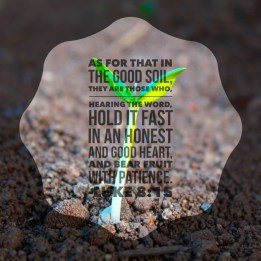 And hear again what Jesus says in the last verse of our text: “As for that in the good soil, they are those who, hearing the word, hold it fast in an honest and good heart, and bear fruit with patience.”
 In the name of the Father and of the Son and of the Holy Spirit. Amen.
 The point of this parable at the twenty-eight-year-old’s funeral was that this famous rabbi had done enough good works to go to heaven early. In other words, be good, do good, and get rewarded. Santa Claus anyone?
 And, with the Gospel, there is no room for despair. God’s love has been poured out for you to save you. In Christ, God has won your salvation on the cross. On the cross, Jesus bore the heat of the day, the heat of God’s wrath. And you, believer, get His wages.
 In the name of Jesus. Amen.
 In the Transfiguration, Jesus is truly beautiful, divinely beautiful. But in there is another beauty that is better than the Transfiguration. The beauty of Jesus is what you see on the cross where God in the flesh dies for the disciples and for you to save you from your sin.
 5 His mother said to the servants, “Do whatever he tells you.” 6 Now there were six stone water jars there for the Jewish rites of purification, each holding twenty or thirty gallons. 7 Jesus said to the servants, “Fill the jars with water.” And they filled them up to the brim. 8 And he said to them, “Now draw some out and take it to the master of the feast.” So they took it. 9 When the master of the feast tasted the water now become wine, and did not know where it came from (though the servants who had drawn the water knew), the master of the feast called the bridegroom 10 and said to him, “Everyone serves the good wine first, and when people have become drunk, then the poor wine. But you have kept the good wine until now.” 11 This, the first of his signs, Jesus did at Cana in Galilee, and manifested his glory. And his disciples believed in him.
 When you or a loved one is plagued with sickness and disease you pray for healing. You pray for a clean scan. You pray that the next doctor appointment will show that everything is normal. You pray for a miracle. These are all good things to pray for.
 sin of this world. He has answered them by sending His Own, beloved Son to die and rise again. He has glory for you that is unspeakable and unimaginable.
 46 After three days they found him in the temple, sitting among the teachers, listening to them and asking them questions. 47 And all who heard him were amazed at his understanding and his answers. 48 And when his parents saw him, they were astonished. And his mother said to him, “Son, why have you treated us so? Behold, your father and I have been searching for you in great distress.” 49 And he said to them, “Why were you looking for me? Did you not know that I must be in my Father’s house?” 50 And they did not understand the saying that he spoke to them. 51 And he went down with them and came to Nazareth and was submissive to them. And his mother treasured up all these things in her heart. 52 And Jesus increased in wisdom and in stature and in favor with God and man.
 But as sinners, we never want to own our sin. Instead, we offer excuses and expect others to justify us in our sin. That is why, when someone offends you, you are more likely to tell someone else how mad you are rather than speak to the person you are angry with. Sometimes, we do get approval for our sinful actions from others. But we do ourselves no favors finding approval from others because when we do, we start to think that we can play the same game with God.
 If you’ve ever played hide and seek with a little child, you don’t have difficulty finding her. She will hide in the same three or four spots every time. Behind a door. Under a lumpy, moving blanket on the floor with her legs sticking out. Or lying face-down on the couch with her eyes shut because if she can’t see you then you can’t see her, obviously.
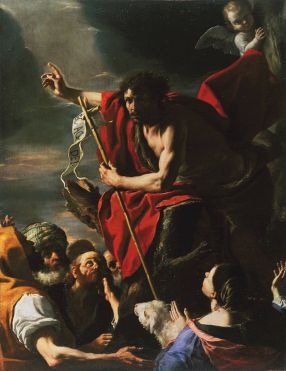 “What then? Are you Elijah?” He said, “I am not.” “Are you the Prophet?” And he answered, “No.” 22 So they said to him, “Who are you? We need to give an answer to those who sent us. What do you say about yourself?” 23 He said,
 And they ask this because of what we heard in our Old Testament lesson (Dt. 18:15-19). In that text, Moses told the people that God would raise up a prophet for His people from among them. And Moses made it very clear, “To Him you shall listen.”
 Finally, take a page out of John’s playbook and point people to Jesus. John has a laser-like focus on Jesus and isn’t interested in talking to people unless he is pointing them to Christ. Point others to the One who delivers them from sin. Point them to Jesus, the Lamb of God who takes away the sin of the world. Tell them that they don’t need to save themselves. Jesus saves them.
 The only people who can be comforted are those who are troubled, afflicted, and uncomfortable. And God says, “Give them a double dose. Give them two shots of comfort.”
 God’s anger is but for a moment, and His favor is for a lifetime. Weeping may tarry for the night, but joy comes with the morning (Ps. 30:5). And even before the suffering begins God preaches comfort to His people.
 Here is your hope, Christian. You have God’s comfort in all things. Heaven is on your side. Your warfare is ended. Your iniquity pardoned. And no one, not even God Himself, can charge you for your sins because His Word of comfort stands forever.
 Remember also that this world is not all that there is. There is more. There is still the eternal wedding feast of the Lamb in His kingdom. That is why Jesus tells us to not be afraid when these things draw near. He says, “When these things begin to take place, straighten up and raise your heads, because your redemption is drawing near.”
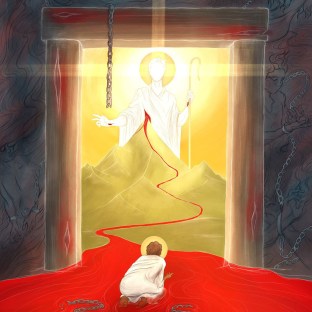 So, the castle of this world crumbles, but your redemption draws near. Though the earth gives way, though the mountains tremble and are moved into the heart of the sea (Ps. 46:2-3), according to His promise you are waiting for the new heavens and new earth in which righteousness dwells (2 Pet. 3:13).
 securely. And this is the name by which he will be called: ‘The Lord is our righteousness.’
 for us by the saints who have come before us. Today, this first Sunday in Advent, is the beginning of a new Church year.
 Pastorsamwise
You must be logged in to post a comment.