Luke 14:1-14
1 One Sabbath, when he went to dine at the house of a ruler of the Pharisees, they were watching him carefully.
2 And behold, there was a man before him who had dropsy. 3 And Jesus responded to the lawyers and Pharisees, saying, “Is it lawful to heal on the Sabbath, or not?” 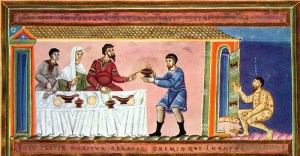 4 But they remained silent. Then he took him and healed him and sent him away. 5 And he said to them, “Which of you, having a son or an ox that has fallen into a well on a Sabbath day, will not immediately pull him out?” 6 And they could not reply to these things.
7 Now he told a parable to those who were invited, when he noticed how they chose the places of honor, saying to them, 8 “When you are invited by someone to a wedding feast, do not sit down in a place of honor, lest someone more distinguished than you be invited by him, 9 and he who invited you both will come and say to you, ‘Give your place to this person,’ and then you will begin with shame to take the lowest place. 10 But when you are invited, go and sit in the lowest place, so that when your host comes he may say to you, ‘Friend, move up higher.’ Then you will be honored in the presence of all who sit at table with you. 11 For everyone who exalts himself will be humbled, and he who humbles himself will be exalted.”
12 He said also to the man who had invited him, “When you give a dinner or a banquet, do not invite your friends or your brothers or your relatives or rich neighbors, lest they also invite you in return and you be repaid. 13 But when you give a feast, invite the poor, the crippled, the lame, the blind, 14 and you will be blessed, because they cannot repay you. For you will be repaid at the resurrection of the just.”
Grace, mercy, and peace to you from God our Father and from our Lord and Savior Jesus Christ. Amen.
Some dinner party this was. Did you feel it in the text? Awkward! Eyes are darting around the room.  Everybody is watching each other, and every look is critical. It isn’t just to see who foolishly uses the dinner fork to eat their salad. No! The Pharisees are carefully watching Jesus, just waiting to catch Him doing something wrong. And Jesus has His eyes on them, watching as they stumble over each other for seats of honor. So much for Sabbath rest at this dinner party – it’s exhausting.
The Pharisees are watching for good reason because it appears that they have set up this whole scenario. Somewhere in the crowd is a man with dropsy. Pockets of fluid are collecting in his body tissue, and he has swelling all over. Jesus sees this grotesque-looking man, and knowing the Pharisees are watching His every move, He asks, “Is it lawful to heal on the Sabbath, or not?”
They refuse to answer the question, but Jesus doesn’t care what answer they might have given. Jesus looks at this swollen man just as He looks at all sinners – like a mother looks at her child in the cancer ward. Or, even better, Jesus looks upon sinners like a mother looks at her child who has been rightly convicted of murder and is hours from execution on death row (Pedersen). Jesus sees this man’s need, and He has mercy.
The dining room turns into a doctor’s office and the buffet becomes an exam table. “Move the turkey legs out of the way. Slide those potatoes across. You might want to cover the salad bowl. Time to get this bloated, swollen man healed. Ok. Now that that’s done, let Me ask you – which of you, would leave your son or even your ox in a well if it fell in on the Sabbath?”
Now, instead of refusing to reply, the other dinner guests can’t reply. There they sit, dumber than oxen who don’t even realize they have fallen into a well. The question convicts them, and they are like dead men. Despite their deadness and hatred of Him, Jesus still loves them. His desire is to save them too.
So Jesus tells this parable which is a retelling of Proverbs 25:6-7. Now, we could take this parable as an etiquette lesson: Sit low and get honor by being paraded through the party to a higher seat. But that flies in the face of what Jesus is actually doing. Jesus wants to show them true humility. And pretending to be humble in order to get everyone’s attention isn’t true humility.
This parable is all about Jesus. It tells of His path from glory down to earth and even hell and back again. Jesus was removed from the place of honor at His Father’s right hand in order to make room for you. Jesus was humiliated (Php. 2:5-11). He took the form of a servant. God was found in human form. When we sinners saw God in the flesh, we pinned Him to a cross.
But, then, God does the strangest thing. He takes you who are sitting in the muck and mire of your sin. Because God sees that Jesus’ seat is open, He invites you to move up. You are invited to sit at the table He prepares for you. He anoints your head with oil and makes sure your cup is never set down empty.
 Then, from the lowest place, Jesus is raised up. At His name, every knee shall bow and every tongue confess that He is King of kings and Lord of lords.
Notice what Jesus says is the lesson of the parable, “Everyone who exalts himself will be humbled, and he who humbles himself will be exalted.” He doesn’t give you something to do by saying, “Be humble.” Pride is your problem, but you can’t overcome pride by humility. To think that you can fix your pride is, by definition, prideful. The anecdote for your pride is not you being humble – it is grace. Grace which is never merited or earned. Grace that is pure gift, pure mercy, pure love.
You have been honored by Jesus’ grace. And as you sit in that seat of honor, you are humbled because of what Christ has done, for you
That is why Jesus, your Savior, still invites you, “Come up higher. Sit here. Yes here! Come and receive what you could not earn or buy. Come and receive what you aren’t even clever enough to ask for. Come and receive My grace, My forgiveness, My mercy.” Amen.
The peace of God, which surpasses all understanding, will guard your hearts and minds in Christ Jesus. Amen.
 52 For from now on in one house there will be five divided, three against two and two against three. 53 They will be divided, father against son and son against father, mother against daughter and daughter against mother, mother-in-law against her daughter-in-law and daughter-in-law against mother-in-law.”
 Jesus doesn’t let us answer His question, “Do you think I have come to give peace on earth?” He jumps right in and says, “No, I tell you, but rather division.” In the same context in Matthew, Jesus answers His own question more violently, “I have not come not to bring peace but a sword” (Mt. 10:34).
 “Wretched man that I am! Who will deliver me from this body of death? Thanks be to God through Jesus Christ our Lord! So then, I myself serve the law of God with my mind, but with my flesh I serve the law of sin” (Ro. 7:24-25). All the while God says, “There is therefore now no condemnation for those who are in Christ Jesus” (Ro. 8:1).
 Of how much more value are you than the birds! 25 And which of you by being anxious can add a single hour to his span of life? 26 If then you are not able to do as small a thing as that, why are you anxious about the rest? 27 Consider the lilies, how they grow: they neither toil nor spin, yet I tell you, even Solomon in all his glory was not arrayed like one of these. 28 But if God so clothes the grass, which is alive in the field today, and tomorrow is thrown into the oven, how much more will he clothe you, O you of little faith! 29 And do not seek what you are to eat and what you are to drink, nor be worried. 30 For all the nations of the world seek after these things, and your Father knows that you need them. 31 Instead, seek his kingdom, and these things will be added to you.
 He does it with tenderness. Jesus diagnoses your idolatry very acutely, but very gently. The voice of your Shepherd calls you away from danger, away from idolatry to Himself. Jesus gives you several questions to ask yourself. Each of these questions is an argument against your idolatry and drives you to put your trust in God.
 God comes to you today, and He is not here to destroy you. He says, “Fear not. I am your shield; your reward shall be very great” (Gen. 15:1). He comes not to judge you. Jesus is here to give you His Body and Blood in His supper. It is His good pleasure to give you the kingdom in the Bread and Wine. Fear not, you of little faith because you don’t have an inconsistent God who forgets His promises to care for you and all of your needs. Your God and His love for you in Christ will never change, never fade, and never diminish. Amen.
 16 And he told them a parable, saying, “The land of a rich man produced plentifully, 17 and he thought to himself, ‘What shall I do, for I have nowhere to store my crops?’ 18 And he said, ‘I will do this: I will tear down my barns and build larger ones, and there I will store all my grain and my goods. 19 And I will say to my soul, “Soul, you have ample goods laid up for many years; relax, eat, drink, be merry.”’ 20 But God said to him, ‘Fool! This night your soul is required of you, and the things you have prepared, whose will they be?’ 21 So is the one who lays up treasure for himself and is not rich toward God.”
 “Take care, and be on your guard against all covetousness, for one’s life does not consist in the abundance of his possessions.” Coveting is the beginning of all sin. Sin, all sin, starts from the bottom, “You shall not covet.” And it works its way up through the rest of the Commandments until, finally, it breaks the First, “Thou shalt have no other gods before Me.” In our Epistle lesson (Col. 3:1-11), Paul says that covetousness is idolatry (v. 5). Think about it. When you covet, you make yourself to be God. That thing over there should be over here. You know better than God what you should or shouldn’t have. Right?
 The student should learn from the teacher. So when this disciple sees Jesus praying, it is good, right, and proper to ask Jesus to teach them how to pray. What Jesus teaches them is likely what He had just finished praying. To you who believe but still struggle with doubt, fear, and anxiety, Jesus teaches you to pray to His Father saying these very words:
 How often, parents, has your child told you, “I’m hungry”? You know what they want, but you make them ask, “Can I have some food?” Jesus teaches us to pray this petition so that we acknowledge God’s gifts to us and receive them with thanksgiving. Food, clothing, house, home, money, goods, parents, children, godly and faithful rulers, good government, seasonable weather, peace and health, order and honor, true friends, good neighbors, and anything else – all of it is God’s gift to us.
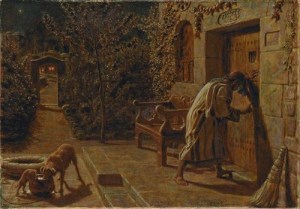 Jesus tells this parable about the man who goes knocking on his friend’s door at midnight because he was totally unprepared for his guest. There is no chance that the man who is in bed will send his neighbor away empty-handed. The guy in bed is ‘shameless’ in a good sense, he has a perfect reputation. And to keep his shameless reputation, he will give the neighbor not just the three loaves, but whatever else his neighbor needs.
 Grace, mercy, and peace to you from God our Father and from our Lord and Savior Jesus Christ. Amen.
 esus does all this for you. He rescues you who were going the wrong way – away from God. He rescues you who have been robbed, beaten, stripped, and left half dead. He binds you up with His Word, Baptism, Absolution, and the Lord’s Supper. He puts you in the inn of His Holy Christian Church promising to return and pay for your no-limit account. Jesus desires mercy and not sacrifice. Jesus desires to be merciful to you. Nice little parable, huh?
 In Paul’s day, you didn’t utter the word ‘cross’ in polite circles, but now it is the cause of boasting. The cross is, arguably, the most brutal form of execution, the most horrific instrument of death, that has ever been devised. Designed to make death as slow as possible, the cross is symbolic of defeat and humiliation. But for Paul and for you, the cross reveals God’s power.
 Aesop tells a fable about a dog who was given a bone from the butcher. As the dog went home, he had to cross a bridge over a calm, clear pond. The water was so still it’s reflection was like a mirror. As the dog crossed the bridge, he happened to look down and thought he saw another dog with a bone that was bigger than the one in his mouth. In his greed, the dog dropped his bone as he lunged and snapped at his own reflection to get the bigger bone only to find himself swimming for his life to reach the shore. Finally, he managed to scramble out and realized what a foolish dog he had been.
 To keep us from falling from either of these two fake bones, Luther takes these verses and offers us two statements that are very helpful: “A Christian is a perfectly free lord of all, subject to none. A Christian is a perfectly dutiful servant of all, subject to all.”
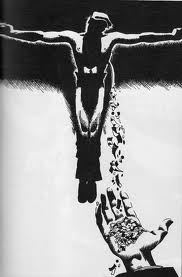 And you will fail to bear this fruit. But that is when you return to Christ’s mercy which never fails. When you fail to bear the fruit of the Spirit, and you will, return to Jesus. Your love, joy, and peace, your patience, kindness, and goodness, your faithfulness, gentleness and self-control will all fail. When those fail, hear God’s word of forgiveness, remember your Baptism, and come to the Lord’s Supper. There, your God will forgive you, refresh and restore you. God will pour out His love, joy, peace, patience, kindness, goodness, faithfulness, gentleness, and self-control upon you so that you can go back into the world and bear those good fruits. Amen.
 25 But now that faith has come, we are no longer under a guardian, 26 for in Christ Jesus you are all sons of God, through faith. 27 For as many of you as were baptized into Christ have put on Christ. 28 There is neither Jew nor Greek, there is neither slave nor free, there is no male and female, for you are all one in Christ Jesus. 29 And if you are Christ’s, then you are Abraham’s offspring, heirs according to promise.
 You are now sons of God through faith, “for as many of you as were baptized into Christ have put on Christ.” When God looks at you He doesn’t see your sins past, present, or future. When God looks at you, He sees Jesus covering you. He doesn’t see your disobedience because He sees Christ’s perfect obedience. He doesn’t see your sin; He sees Christ’s holiness. All of this is because God made a promise to Abraham and to Abraham’s offspring.
 You feel it. You feel it in your body every night when you grow weary and need to sleep, when you get sick, when your stomach is empty enough that it growls, or even when you stub your toe. You feel it in your emotions when you become angry with your spouse, or when the sorrow and angst of a broken relationship keeps you up at night. You see it. You see it on the news when people and nations war against each other, when the weather destroys people’s homes and livelihoods and brings back memories of when it happened to you. You see it when your loved one is lowered into their grave, and you are reminded that same fate is somewhere in your future.
 Jesus took those sins of David, the sins of the woman, the sins of Paul, the sins of the Galatians, and your sins. God made Jesus, who knew no sin, to be sin (2 Cor. 5:21). Jesus Christ redeemed you from the curse of God’s Law by becoming a curse for you. There on that cross Jesus became the only object of God’s wrath. God poured all of His wrath against all your sin upon Jesus, and hell’s flames were drowned with His holy blood.
 Pastorsamwise
You must be logged in to post a comment.