Matthew 3:13-17
13 Then Jesus came from Galilee to the Jordan to John, to be baptized by him. 14 John would have prevented him, saying, “I need to be baptized by you, and do you come to me?” 15 But Jesus answered him, “Let it be so now, for thus it is fitting for us to fulfill all righteousness.” Then he consented. 16 And when Jesus was baptized, immediately he went up from the water, and behold, the heavens were opened to him, and he saw the Spirit of God descending like a dove and coming to rest on him; 17 and behold, a voice from heaven said, “This is my beloved Son, with whom I am well pleased.”
Grace, mercy, peace be to you from God our Father and from our Lord and Savior Jesus Christ. Amen.
No question about it. John the Baptizer was a bold man. He preached, “Repent,” and that takes guts. John preached the Law in such a way that Jerusalem and all Judea and all the region about the Jordan were coming to him, confessing their sins, and being baptized (Mt. 3:5-6).
John, the last of God’s prophets, lived out in the wilderness wearing camel skins and eating locusts and honey. Yet he had the boldness to call even the Pharisees and Sadducees, the religious elite, to repentance calling them a brood of vipers.
Jesus called John the Baptizer the greatest of those born of women (Mt. 11:11). Yet, John knew his place. John rightly confessed, “The one coming after me is greater than I am. I am not even worthy to carry His sandals.”
But when Jesus came to John to be baptized, well, John flinched. “Excuse me? You want me to do what? Look, this isn’t right, Jesus. I need to be baptized by You! How can I with my dirty thoughts, my filthy hands, and my unclean heart, how can I baptize You? You should just baptize Yourself.”
 In John’s hesitation to baptize Jesus, we see John’s sinful pride rearing its ugly head. If John truly believed that he wasn’t worthy to carry Jesus’ sandals (and he wasn’t), then who does John think he is to question his Lord when Jesus tells John to baptize Him? How dare John say, “Look, Jesus, You’ve got it all wrong”?
We can all sympathize with John because we all shirk and attempt to evade our responsibilities. Too often, we parents don’t want to do the work of raising our children. It is too exhausting. Instead of giving our children discipline, attention, and love, we buy them off with devices to distract them so they will leave us alone and we can amuse ourselves.
As spouses, we do the same. We find all sorts of excuses to get out of serving one another – washing the dishes, changing the bed sheets, and scrubbing around the toilet.
As Christians, we fill our lives with things that are good in and of themselves. But our lives get stuffed by commitments, the tournaments, and the traveling. Something must give, and sadly the easiest thing to put off is being at church, gathering with one another, and hear and rejoicing in God’s Word.
And I can tell you, on good authority, that your pastor does this too. It is all too easy to put off calling someone who is hurting and ministering the Gospel to them under the guise of having too many other things to do. Forgive me.
For all of us, there are ample reasons to repent. Repent, and hear what Jesus says to John. “Let it be so now, for thus it is fitting for us to fulfill all righteousness.”
God had called John to baptize Jesus, to anoint Jesus for His work of being the Lamb of God who takes away the sin of the world. Anyone could have baptized Jesus. The act didn’t require a lot of skill, training, or experience. But God had called John to do it in order to fulfill all righteousness.
In the same way, God gives us tasks, duties, and vocations in His kingdom. It was fitting for Jesus and John together to fulfill all righteousness. And it is fitting for you to do the good works that God has called you to in your vocations.
Now, you have probably heard me use that word ‘vocation’ before, but to define it again is probably helpful. Your vocations are the many different functions you have and are defined by your relationships to others. Parent, spouse, child, neighbor, citizen, student, employee, employer – all of these are vocations. In all your vocations, God gives you good works to do.
If you are a parent, God has given you the good work of feeding, clothing, protecting, and providing for your child(ren). As a citizen, God has given you good works like paying taxes, voting, and coming to a complete stop at stop signs. If you are a customer at a grocery store, God has given you the good work of buying food and not shoplifting by tasting the grapes before you purchase them. Wherever you are, God has called you to a particular vocation where you can be His light shining in this dark world by doing good works.
And God gives you great freedom in these good works. At the risk of sounding sexist: mothers, God commands that you feed your children. But you have the freedom to decide whether to cook a lavish meal of salad, pot roast with potatoes, carrots, and onions finished off with homemade cheesecake or to simply grab some corn dogs out of the freezer and throw them in the oven. Either way, you have been a faithful mother by providing for your children.
In all our vocations, we remember that we are not worthy to do these good works, but God has called us to them. And in doing them, we join with God to do good in an evil world. Also, in doing them, God gives us the greatest joys.
When you have fed, bathed, swaddled, and finally gotten your infant to sleep, you stand over the crib in joy and peace that God has entrusted that little life to you. When you celebrate with your co-workers after that grueling, month-long project, God is blessing you and them with that happiness and sense of accomplishment. When you lay next to your spouse and fall asleep in their arms, you have comfort and peace of knowing that God has joined to you the bone of our bone and flesh of your flesh.
Will you fail in these vocations? Yes. You will sin and fall short of the calling that God has given you. But always remember, of all the vocations, all the callings which God has given you, the first, the primary, the most unchanging vocation God gives to you is your Baptism.
 Abby, on this day of your Baptism, and all of you baptized believers here, remember this. Before anything you are a Baptized child of God. You belong to Him. He has placed His Name upon you. Jesus has joined you to Himself – joined to His death, buried you in His tomb, and raised you in His resurrection.
Where you lack, Jesus provides. Where you fail, Jesus fulfills. God will provide what you need as you carry your cross and follow after Him. You are His child. You belong to Him, and He is well-pleased with you. Amen.
The peace of God which surpasses all understanding will guard your hearts and minds in Christ Jesus. Amen.
*This sermon was preached on the occasion of the Baptism of Abigail McClintic.
 The opening to John’s Gospel tells us the nativity story as a cosmic battle. John doesn’t tell us about Joseph or Mary. He doesn’t mention the shepherds and angels. He doesn’t even set the scene in Bethlehem. Instead, John tells us, “In the beginning was the Word and the Word was with God and the Word was God.”
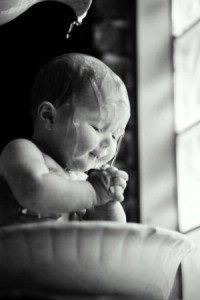 And so, dear Harper, today on the day of your Baptism, through the washing of water with the Word, you became a child of God. Harper, you became a child of God because He became a child of a woman. Harper, Jesus, your God and Savior, became Flesh and dwelt among us so that you and all your brothers and sisters in Christ could be His own, dear children.
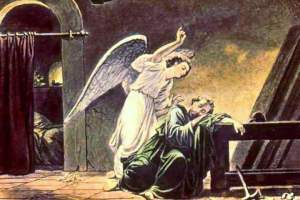 Joseph is in a mess. His legally-bound fiancé is pregnant, and Joseph knows that he is not the father. Joseph is a just man, a respectable man, an honorable man. It is very possible that Joseph had paid several years’ savings to become engaged to Mary. Legally, Joseph could have taken Mary into court and gotten his money back. Instead, Joseph resolves to quietly divorce her so she doesn’t get stoned for her apparent adultery. Joseph knows that this will bring him public shame and disgrace, but he is willing to do it anyway. Joseph is not willing to put Mary to shame.
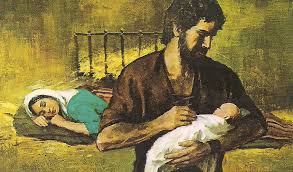 Yet Joseph endured all of that suffering and shame because of God’s promise. And Joseph clung to that promise that this Child, entrusted into his care, would save him from his sins.
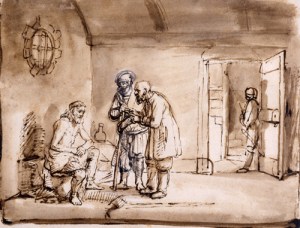 This is more unique than the Cubs winning the World Series or the Vikings winning the Super Bowl. Start dancing in the streets. Throw a parade. But, hang on, we’d better wait. Before we start blowing the confetti and popping the champagne corks, look – there in prison, in Herod’s dungeon – there sits John the Baptizer. We should probably wait for him.
 What do you do when you cannot pray because Jesus has seemed to fail you? What do you do when Jesus doesn’t bust you out of the prison of suffering and doubt, and it looks like He has left you there to rot? What do you do when Jesus becomes offensive?
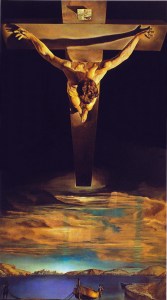 When you are offended by Jesus, remember, that in the cross and the empty tomb, He has defeated all your doubts, all your afflictions, and all your diseases.
 10 Even now the axe is laid to the root of the trees. Every tree therefore that does not bear good fruit is cut down and thrown into the fire.
 They say, “You are what you eat.” John’s diet of locusts has a locust effect, but John’s diet of honey also has a sweet effect too. John preaches, “Repent. Repent for the reign of heaven is at hand.”
 This is the second, and most important part of repentance. Repentance, turning away from trust in yourself and your own works and efforts leads you to trust in what Jesus has done for you.
 Jesus didn’t tell His disciples to find a chariot and a mighty war horse to chauffeur Him into Jerusalem. He could have, but He didn’t. Jesus’ entrance into Jerusalem was not a red-carpet event. He didn’t make His way on top of a long runner of fine, royal fabric. Again, He could have, but He didn’t. Instead, Jesus told the disciples to find a donkey and a colt – common beasts for common, poor people. And your Savior entered Jerusalem passing over the cloaks of the people who welcomed Him and over the palm branches they found nearby.
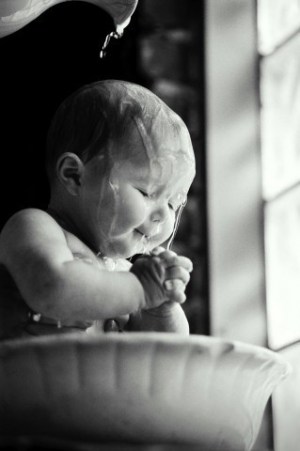 Today is a day to celebrate and be glad. You have been adopted into a loving, caring family. Your parents have chosen you to be their children. You have the unique privilege of never having to wonder if your parents wanted you or not. You will always know that your parents have intentionally brought you into your family and have promised to care for you and love you.
 Dear saints, though you have nothing to offer God, though you are unimportant in the eyes of the world, and even though the world looks at you and thinks that you could be replaced by any other body, this is not what your God thinks about you. The God who entered Jerusalem that Palm Sunday does not think about you that way.
 Be careful as you consider this text. This text requires faith – faith to see what is really happening. At the crucifixion, only Jesus and His Father know what is happening.
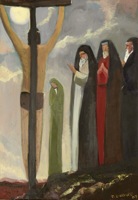 Our text reads, “Jesus said, ‘Father, forgive them, for they know not what they do.’” But the Greek there should be translated either “Jesus was saying,” or “Jesus began to say.” “Father, forgive them.” The point is that this was not just a one-time prayer. This was Jesus’ constant plea to His Heavenly Father.
 Christ the King promises, “Truly, I say to you, today you will be with Me in Paradise.”
 29 And he told them a parable: “Look at the fig tree, and all the trees. 30 As soon as they come out in leaf, you see for yourselves and know that the summer is already near. 31 So also, when you see these things taking place, you know that the kingdom of God is near. 32 Truly, I say to you, this generation will not pass away until all has taken place. 33 Heaven and earth will pass away, but my words will not pass away.
 The first reaction is fear. For those who do not have faith in Christ, for those who do not know God’s mercy, love, and forgiveness, these signs cause distress. Unbelievers are weighed down with fear, dissipation, and drunkenness. And how else should they respond? Fear is proper and appropriate for those who think that this world is all there is. As they see the creation falling apart and people fighting against each other, they know that everything they hold dear is coming undone. They fear.
 Instead, Jesus says, “When these things begin to take place, straighten up and raise your heads, because your redemption is drawing near.”
 In the vision that John saw in our first reading (Rev. 7:2-17), John saw you. John saw you who have come out of the great tribulation of this world which Jesus has overcome (Jn. 16:33). John saw you who have been baptized, absolved, have had your hunger and thirst for righteousness quenched by Communion, and have washed your robe white in the blood of the Lamb. You have Jesus, the lamb of God who takes away the sin of the world, as your Shepherd.
 When you are weary of the fight, when the war seems unwinnable, when you reach the end of yourself, hear the victorious battle song. Remember that the battle has been won. On the cross Christ, your Savior, defeated all your enemies. Be encouraged. Stand again. Fight with a heart made brave and arms made strong by Jesus’ body and blood. Alleluia! Alleluia!
 entered Jericho and was passing through. 2 And behold, there was a man named Zacchaeus. He was a chief tax collector and was rich. 3 And he was seeking to see who Jesus was, but on account of the crowd he could not, because he was small in stature. 4 So he ran on ahead and climbed up into a sycamore tree to see him, for he was about to pass that way. 5 And when Jesus came to the place, he looked up and said to him, “Zacchaeus, hurry and come down, for I must stay at your house today.” 6 So he hurried and came down and received him joyfully. 7 And when they saw it, they all grumbled, “He has gone in to be the guest of a man who is a sinner.” 8 And Zacchaeus stood and said to the Lord, “Behold, Lord, the half of my goods I give to the poor. And if I have defrauded anyone of anything, I restore it fourfold.” 9 And Jesus said to him, “Today salvation has come to this house, since he also is a son of Abraham. 10 For the Son of Man came to seek and to save the lost.”
 Today, our congregation is focusing on missions. But today the church also celebrates the Reformation. The Reformation was certainly a rediscovery of the Gospel. But it was more than that too.
 Look up into that tree because on that tree, Jesus will bear Zacchaeus’ sins and your sins. On the tree of the cross, Jesus died for all the thieving and conniving of Zacchaeus as well as for all your sins.

You must be logged in to post a comment.