John 20:19-31 – Through Locked Doors

Listen here.

John 20:19-31

19 On the evening of that day, the first day of the week, the doors being locked where the disciples were for fear of the Jews, Jesus came and stood among them and said to them, “Peace be with you.” 20 When he had said this, he showed them his hands and his side. Then the disciples were glad when they saw the Lord. 21 Jesus said to them again, “Peace be with you. As the Father has sent me, even so I am sending you.” 22 And when he had said this, he breathed on them and said to them, “Receive the Holy Spirit. 23 If you forgive the sins of any, they are forgiven them; if you withhold forgiveness from any, it is withheld.”

24 Now Thomas, one of the Twelve, called the Twin, was not with them when Jesus came. 25 So the other disciples told him, “We have seen the Lord.” But he said to them, “Unless I see in his hands the mark of the nails, and place my finger into the mark of the nails, and place my hand into his side, I will never believe.”
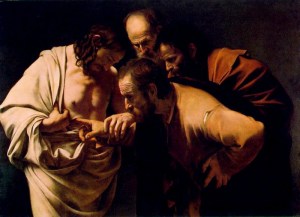
Thomas Sees Jesus26 Eight days later, his disciples were inside again, and Thomas was with them. Although the doors were locked, Jesus came and stood among them and said, “Peace be with you.” 27 Then he said to Thomas, “Put your finger here, and see my hands; and put out your hand, and place it in my side. Do not disbelieve, but believe.” 28 Thomas answered him, “My Lord and my God!” 29 Jesus said to him, “Have you believed because you have seen me? Blessed are those who have not seen and yet have believed.”

30 Now Jesus did many other signs in the presence of the disciples, which are not written in this book; 31 but these are written so that you may believe that Jesus is the Christ, the Son of God, and that by believing you may have life in his name.

In the name of Jesus. Amen.

Christ is risen!
He is risen indeed! Alleluia!

Death died when Jesus rose. The stone is rolled away. Jesus escaped. The grave’s strength is spent. The guards could not keep Him. Death could not hold Him.

Thomas gets a bad rap. Was he doubting? Yes, of course, but no more doubting than the other disciples.

Our text starts on the evening Jesus rose from the dead. Peter and John had seen the empty tomb, and John believes (Jn. 20:8). Mary Magdalene and some of the other women see Jesus (Mt. 28:9-10). Two other disciples, who are not part of the Twelve, see Jesus on the road to Emmaus. And, at some point, Jesus appears to Peter privately (Lk. 24:34). Jesus is popping up all over the place, but the disciples are scared. Why were they scared?

On the day Jesus died, the Pharisees had gathered before Pilate. They remembered that Jesus had said that He would rise after three days. They figured that the disciples would steal Jesus’ body and fake a resurrection. So Pilate tells the Pharisees to set a guard and seal the tomb (Mt. 27:62-66). So the disciples know that there is an empty tomb. They know the Pharisees were afraid that the disciples might steal Jesus’ body and fabricate a resurrection. The ten disciples are afraid. So they go to the upper room, lock the door, and sit there terrified. They figure, at any moment, the guards were going to come and smash the door and do to them what they had done to Jesus.

Small Catechism - Confession IconBut the door doesn’t come crashing down; it isn’t unlocked; it doesn’t even open. Jesus simply appears there in the room with them to say, “Peace to you.” Jesus shows the disciples His hands and side, and the disciples were filled with joy. And Jesus repeats Himself, “Peace to you. As the Father has sent Me, even so I am sending you.” Then, Jesus breathes on them and says, “Receive the Holy Spirit. If you forgive the sins of any, they are forgiven them; if you withhold forgiveness from any it is withheld.” (More on that a little later.)

Now, Thomas wasn’t with them, and we don’t know where he was. The ten were gathered together with the doors locked because they were afraid. But Thomas isn’t there. Maybe he was out checking to make sure the other disciples were safe. Maybe he wanted to see if they had been arrested. Maybe Thomas was just out running errands. Eventually, Thomas does find the others. They tell him that they have seen Jesus. But Thomas says with some vulgarity, “Unless I see in His hands the mark of the nails and thrust (not just ‘place’ – lit. ‘throw’) my finger into the mark of the nails, and thrust my hand into His side, I will never believe.”

Now, our text jumps to one week later. The Sunday after the Resurrection, Thomas is with the disciples. Even though the ten had seen Jesus, even though Jesus had sent the disciples with His peace to forgive sins, the doors are locked again. Thomas has an excuse to be there but not the others. The ten should have been out speaking about the Resurrection and forgiving sins. But there they are, locked inside. It’s not just doubting Thomas – it’s doubting disciples.

They doubt just like you and I doubt. If you are like me – and I would be willing to guess you are – when you hear the words, “You are forgiven,” your mind goes back to that one sin or those several sins that you have committed. Sins that haunt and guilt and convict and remind you that you deserve hell. Sins that you would do anything to make sure no one ever learns about them. We doubt that Jesus’ forgiveness really covers those sins.

That’s why, dear saints, we need absolution – over and over and over again. That is what Jesus has called us to do. That is what Jesus has called me to do as your pastor.

I wouldn’t dare stand up here and say, “I forgive you of your sins,” unless Jesus had said that is what should be done when sins are confessed.

Boyd Gets Released from PrisonAnother pastor (Rev. Bryan Wolfmueller) uses this analogy: Imagine you are found guilty of a crime and locked in prison. As you sit there in prison, a judge looks over your case and rules that you are innocent. He sends an order to the guard of your prison to set you free. The guard comes with the keys, unlocks your cell, and releases you back into society. Now, who set you free, the judge or the guard? Honestly, the answer is both.

If the judge declares you innocent, but the guard doesn’t go to where you are and unlock your cell – you are stuck in prison. But if the guard, with no order from the judge, lets you go, you will live the rest of your life expecting to be arrested again because you haven’t been justly declared innocent.

Christ is your Judge, and because of what He has done, He declares you innocent. God then orders pastors – the people who have been given the keys (Mt. 16:19) – to go to where you are locked up and open your cell. That is why the absolution is given only “by Christ’s command and authority.”

But this authority isn’t just given to pastors to announce over congregations on Sunday mornings. Jesus gives all believers this authority too. You can announce this forgiveness. If someone comes to you and tells you about their sin and guilt and shame, you can tell them of Jesus death. Tell them that Jesus is the Lamb of God who takes away the sins of the world. Tell them that Jesus’ death takes away their sins, and His resurrection shows that God accepted Jesus’ sacrifice. And tell them, “I forgive you of your sins because of what Jesus has done.”

That is the Gospel message. That is the authority Jesus has given to the Church. That is the message Jesus has sent us into the world to announce. That is the peace that Jesus gives when He says, “Peace to you.” It is the peace that, because He died and rose again, sins are forgiven. They are gone. As far as the east is from the west, so far has Jesus removed our transgressions from us.

No locked door can hold Jesus back. No “secret” sin can match Jesus’ ability to forgive. Jesus is way better at forgiving than you are at sinning. Don’t be afraid anymore. Boldly go. Boldly forgive because:

Christ is risen!
He is risen indeed! Alleluia! Amen.

The peace of God, which surpasses all understanding, will guard your hearts and minds in Christ Jesus. Amen.
Mark 16:1-8 – The Death of Death

Listen here.

Mark 16:1–8

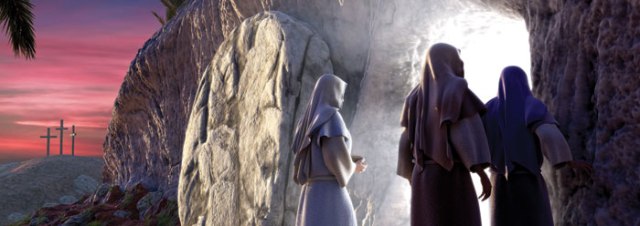
1 When the Sabbath was past, Mary Magdalene, Mary the mother of James, and Salome bought spices, so that they might go and anoint him. 2 And very early on the first day of the week, when the sun had risen, they went to the tomb. 3 And they were saying to one another, “Who will roll away the stone for us from the entrance of the tomb?” 4 And looking up, they saw that the stone had been rolled back—it was very large.

5 And entering the tomb, they saw a young man sitting on the right side, dressed in a white robe, and they were alarmed. 6 And he said to them, “Do not be alarmed. You seek Jesus of Nazareth, who was crucified. He has risen; he is not here. See the place where they laid him. 7 But go, tell his disciples and Peter that he is going before you to Galilee. There you will see him, just as he told you.”

8 And they went out and fled from the tomb, for trembling and astonishment had seized them, and they said nothing to anyone, for they were afraid.

Empty Tomb 1In the name of Jesus. Amen.

Christ is risen!
He is risen indeed! Alleluia!

Jesus Laid in the Tomb 1Death swallowed up the Son of God. The grave took Jesus’ lifeless body into its jaws. Jesus was brought so low that His breath was stopped. He was cut off from the land of the living. The full brunt of the God’s wrath against your sin fell upon the perfect, sinless Son of God.

Was that death’s victory? Had hell won?

Absolutely not. The stone is rolled away. Jesus escaped. The grave’s strength is spent. Death could not hold Him. The guards could not keep Him.

Death died when Jesus rose.

But doesn’t death still rule over the battlefield, the cancer center, the hospital, and even the womb? Aren’t we reminded of death in every skinned knee, mosquito bite, and every time we fall asleep? Isn’t death still the master that will take every one of us and our loved ones whenever it wants? Doesn’t death still make our bodies weak, grow stiff and old, and contract diseases? Yes, it still does.

The ResurrectionBut death has died. The grave cannot hold you. Jesus lives. He has risen out of death and back to us. He came out as a king to meet His people. He is a victorious general returned from war. Jesus burst down the prison walls of death from the inside. Death could not hold Him, and it cannot hold you.

On the last day, the dead will rise. No one will stay in the grave. Death has died.

There will still be a division. The goats will be separated from the sheep, unbelievers from believers. God will not force Himself on you. He will not steal you. If you do not want Him, you can chose to remain in hell. Your body will rise, but you will forever return to the grave, even though the grave is defeated. You will get what is yours. You will be paid the deathly wages of your sin.

But everyone who believes in Jesus, the Risen One, you will rise to eternal life. It doesn’t matter whether you are good or bad, whether you are full of virtue or full of scandal. Through faith, you have eternal life and a place in God’s kingdom. God will happily give you what you did not earn and definitely didn’t deserve. God will freely give what Jesus has won for you. Christ will give you His perfect life.

Now, even when we lower our loved ones into the grave, we do it in mockery of death. Even though they are dead, they live. They are with Jesus who is the Resurrection and the Life. Their bodies only await the resurrection and the life of the world to come.

My kids teach me a lot, but about eight months ago, Annalise gave me a lesson I’ll never forget. On August 4th, she was at the cemetery as we buried Roy Link. I could tell that being there and watching the casket lowered into the ground had got her to thinking. When we arrived home, she said that she was very sad for Sonia. But then she asked the perfect question. “Papa, when is Easter?”

Well, Easter is today. The Resurrection is now. The grave is defeated. Death has died.

Christ is risen!
He is risen indeed! Alleluia!

Christ is risen!
He is risen indeed! Alleluia!

Christ is risen!
He is risen indeed! Alleluia! Amen.[1]

The peace of God, which surpasses all understanding, will guard your hearts and minds in Christ Jesus. Amen.

[1] I am thankful to Rev. David Petersen’s sermon on this text as inspiration for this sermon. http://emmanuelpress.us/books/thy-kingdom-come/

Isaiah 52:13 – 53:12 – You No Longer Own Your Sin, a Good Friday Sermon

Isaiah 52:13–53:12

13 Behold, my servant shall act wisely;
he shall be high and lifted up,
and shall be exalted.

14 As many were astonished at you—
his appearance was so marred, beyond human semblance,
and his form beyond that of the children of mankind—

15 so shall he sprinkle many nations;
kings shall shut their mouths because of him;

for that which has not been told them they see,
and that which they have not heard they understand.

1   Who has believed what he has heard from us?
And to whom has the arm of the Lord been revealed?

2   For he grew up before him like a young plant,
and like a root out of dry ground;

he had no form or majesty that we should look at him,
and no beauty that we should desire him.

3   He was despised and rejected by men;
a man of sorrows, and acquainted with grief;

and as one from whom men hide their faces
he was despised, and we esteemed him not.

4   Surely he has borne our griefs
and carried our sorrows;

yet we esteemed him stricken,
smitten by God, and afflicted.

5   But he was pierced for our transgressions;
he was crushed for our iniquities;

upon him was the chastisement that brought us peace,
and with his wounds we are healed.

6   All we like sheep have gone astray;
we have turned—every one—to his own way;

and the Lord has laid on him
the iniquity of us all.

7   He was oppressed, and he was afflicted,
yet he opened not his mouth;

like a lamb that is led to the slaughter, Lamb of God who takes away the sins of the wolrd
and like a sheep that before its shearers is silent,
so he opened not his mouth.

8   By oppression and judgment he was taken away;
and as for his generation, who considered

that he was cut off out of the land of the living,
stricken for the transgression of my people?

9   And they made his grave with the wicked
and with a rich man in his death,

although he had done no violence,
and there was no deceit in his mouth.

10 Yet it was the will of the Lord to crush him;
he has put him to grief;

when his soul makes an offering for guilt,
he shall see his offspring; he shall prolong his days;

the will of the Lord shall prosper in his hand.

11 Out of the anguish of his soul he shall see and be satisfied;

by his knowledge shall the righteous one, my servant,
make many to be accounted righteous,
and he shall bear their iniquities.

12 Therefore I will divide him a portion with the many,
and he shall divide the spoil with the strong,

because he poured out his soul to death
and was numbered with the transgressors;

yet he bore the sin of many,
and makes intercession for the transgressors.

In the name of Jesus. Amen.

What should sinners expect when the holy, righteous God shows up? We expect judgment, punishment, condemnation, destruction.

That is why Adam and Eve hid themselves when they heard the sound of God walking in the Garden. They knew what they deserved – their eyes had been opened. They knew they were naked. They knew shame. God showed up and they were terrified.

The same goes for Isaiah when he saw the Lord, seated on a throne, high and lifted up. He heard the cries of the seraphim, “Holy, holy, holy is the Lord of hosts. The whole earth is full of His glory.” Isaiah’s only response was, “Woe is me for I am unmade. For I am a man of unclean lips and dwell among a people of unclean lips.”

Adam, Eve, Isaiah, you, and me – our reason and our experience says that each person must bear their own sin. Anything else is “unfair.”

Yet, what actually happens? What do Adam, Eve, Isaiah, you, me, and every other sinner experience? Contrary to all reason and logic, when God shows up, He offers pardon and forgiveness.

God told Adam and Eve that on the day they ate of the tree, they would surely die. But what happens? God slaughters a flock of animals, covers their nakedness, removes their shame, and they live another 900 years.

Isaiah figured He would be unmade because he, a sinner, stood in the presence of God. But what happens? God sends a seraph with a burning coal to touch his lips. His guilt was taken away, and his sins atoned for.

How can God do this? Adam and Eve had the fruit in their stomachs. They were picking the peel from between their teeth. Isaiah had his uncleanness on his lips. All the fingerprint and DNA evidence pointed toward their guilt. So how can God pardon the guilty?

God can forgive because our text says that the sins of Adam, Eve, and Isaiah were somewhere else. Scripture also says that your sins are no longer yours – they are gone. They now belong to God’s Servant, Jesus. God placed on Jesus the iniquity of us all. Jesus bore your griefs. Jesus carried your sorrows. Jesus was pierced for your transgressions and crushed for your iniquities. Your sin, all your sin, even the sins that you will commit years from now, they have all been placed and punished upon Jesus.

Jesus takes and becomes sinThe Gospel tells us that, contrary to everything that is right and “fair,” Jesus is judged guilty for your sin. Jesus bore your sin in His body on the tree that you might die to sin (1 Pet. 2:24). God made Jesus who knew no sin to be sin that you might become the righteousness of God (2 Cor. 5:21). As John the Baptizer said, Jesus is the Lamb of God who takes away the sin of the world (Jn. 1:29). In other words, Jesus has stolen your sins from you. He took possession of them, they are His.

Where are those sins now? They are forever lost in the emptiness of the Easter tomb.

Faith is the constant struggle about who owns sin. Your sin can only be in one of two places. Either your sin is upon you and you are damned, or your sin is on Jesus.

Faith is a struggle because Satan, the world, and you yourself will throw all sorts of accusations against you. The devil, the world, and you will see your sin and say, “Look at that terrible thing you did. You deserve death and condemnation.”

Faith is learning to say what the Scriptures say, what God says about your sin. When you feel the guilt and load of your sin, when you are accused, you can respond, “That sin you see on me is not mine anymore. That sin belongs to Jesus. Jesus has taken away the sins of the world. That includes me. If you want to talk to anybody about that sin, you go talk to Jesus.”

Jesus, God’s suffering Servant, has given you a wonderful exchange. You sin, but Jesus pays the penalty. Jesus deserves lives a life completely obedient to God and deserves peace, but He gets God’s wrath. And you are given, you receive God’s peace.

Some people ask, “How can I know I’m saved?” The answer is, “Jesus is crucified. He has taken the shame of my past. He owns the failures of my present. And He removes the guilt of my future.”

Jesus makes you to be accounted righteous. He has borne your iniquities, and with His stripes you are healed. Amen.

The peace of God, which surpasses all understanding, will guard your hearts and minds in Christ Jesus. Amen.

Mark 14:1 – 15:47 The Path of Life Leads You through the Valley of the Shadow of Death

Listen here.

In the name of Jesus. Amen.

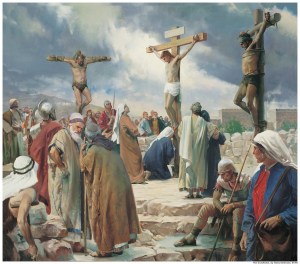
Jesus Crucified 1Three men are tried and condemned as criminals. They are sentenced to be hung until they die. Two of them, the two on the outside, are getting what they deserve. But not the man in the center. He is innocent. But all three share the same execution together. They are brothers in death.

We have followed Jesus’ life through the first half of the church year. We witnessed His birth, just like one of us. We heard as He grew to be a man, a carpenter by trade. Jesus shared His whole life with us. He was our brother in everything, except He did not sin. Jesus’ life was in total harmony with God. Jesus had no life apart from God. He was obedient to God in all things.

So why did He die? Jesus came to go through your whole life with you, and this was completed by His sharing physical death with you. He is with you even when your body dies. As these three men on their crosses were made brothers in death, you are too. Jesus put Himself not only next to the two criminals there on Calvary, but also next to you and next to all rebels against God. Jesus goes through it with you.

Jesus really died. Scripture emphasizes this by telling of His burial. In the Creed we say not only that Jesus was crucified and died, but also that He was buried. His corpse was taken down from the cross by Joseph of Arimathea and Nicodemus, wrapped in a piece of linen, and put in a grave. Jesus was buried. And so whenever you put the body of a loved one down into a grave, you know Jesus has been there too. That makes all the difference. In Jesus you see how God does things.

In John 12:23-25, Jesus says, “The hour has come for the Son of Man to be glorified. Truly, truly, I say to you, unless a grain of wheat falls into the earth and dies, it remains alone; but if it dies, it bears much fruit. Whoever loves his life loses it, and whoever hates his life in this world will keep it for eternal life.”

When Jesus said His hour had come to be glorified, He referred to His death. As a seed only bears fruit by dying first, so it was with Jesus. So it is with you. God brings you to that death, to that participation with Jesus in crucifixion (Ro. 6:3-5). As you stand beneath the cross this morning you can say, “As Jesus dies, I die too. From here on out, I will know no life but that which comes from our dying together.”

Jesus dies the big death for you. He carries the awful load of your sin for you. You are spared from your sin by His death for you. Jesus answers for your sin and breaks it’s domination over you. But all this becomes yours only as you die with Him. At the cross, you part company with both your sin and the miserable life that you would make for yourself apart from Him.

The path of life lies only through dying. Jesus’ death was the climax, the crowning glory. It did not appear so, but He committed Himself to the God who brings life out of death.

Baptism 2So your death, your parting company with sin, will seem a loss to you, but it is not so. For when you die, you are cast on God. The God who brings life out of death – only out of Jesus’ death. He died the big death for the sin that separates you from God. With your sin He suffered, with your sin He was rejected and abandoned by God. Sin cannot condemn you again. For the death Jesus died he died to sin, once for all, but the life he lives he lives to God. So you also must consider yourselves dead to sin and alive to God in Christ Jesus (Ro. 6:10-11). Amen.[1]
The peace of God, which surpasses all understanding, will guard your hearts and minds in Christ Jesus. Amen.

[1] This sermon is based on a sermon by Rev. Donavon Riley https://thefirstpremise.wordpress.com/2014/04/19/homily-for-good-friday-on-mark-1533-47-the-path-of-life-lies-only-through-dying/

Mark 10:32-45 – What Do You Want from Jesus?

Listen here.

Mark 10:32-45

32 And they were on the road, going up to Jerusalem, and Jesus was walking ahead of them. And they were amazed, and those who followed were afraid. And taking the twelve again, he began to tell them what was to happen to him, 33 saying, “See, we are going up to Jerusalem, and the Son of Man will be delivered over to the chief priests and the scribes, and they will condemn him to death and deliver him over to the Gentiles. 34 And they will mock him and spit on him, and flog him and kill him. And after three days he will rise.”

35 And James and John, the sons of Zebedee, came up to him and said to him, “Teacher, we want you to do for us whatever we ask of you.” 36 And he said to them, “What do you want me to do for you?” 37 And they said to him, “Grant us to sit, one at your right hand and one at your left, in your glory.” 38 Jesus said to them, “You do not know what you are asking. Are you able to drink the cup that I drink, or to be baptized with the baptism with which I am baptized?” 39 And they said to him, “We are able.” And Jesus said to them, “The cup that I drink you will drink, and with the baptism with which I am baptized, you will be baptized, 40 but to sit at my right hand or at my left is not mine to grant, but it is for those for whom it has been prepared.”

41 And when the ten heard it, they began to be indignant at James and John. 42 And Jesus called them to him and said to them, “You know that those who are considered rulers of the Gentiles lord it over them, and their great ones exercise authority over them. 43 But it shall not be so among you. But whoever would be great among you must be your servant, 44 and whoever would be first among you must be slave of all. 45 For even the Son of Man came not to be served but to serve, and to give his life as a ransom for many.”

In the name of Jesus. Amen.

Jesus had called the disciples to follow Him, and here they literally are following. Jesus is ahead of them. moving at a fast clip walking to Jerusalem, and the disciples are behind, amazed and afraid. They sense that something dire is down the road in Jerusalem. Things are coming to a head.

Christ Crucified 1So what does Jesus do? He takes the twelve aside and turns up the heat. “We’re going to Jerusalem, and the Son of Man will be delivered over to the chief priests and scribes, and they will condemn Him to death and deliver Him over to the Gentiles. They will mock Him, spit on Him, flog Him, and kill Him. And after three days He will rise.” Jesus doesn’t sugar-coat what is about to happen.

James and John don’t like all this death talk, so they try to change the subject to something more comfortable – for them at least. “Let’s talk about heavenly seat arrangements, Jesus. When You sit in Your glory, how’s about You let us sit on either side of You – one at Your right and one at Your left.”

This request is so breathtakingly bizarre. In all the Gospels but especially in Mark, the disciples come across as numbskulls who repeatedly don’t get it. But brutally honest moments like these, where the disciples come across as imbeciles, show that the Gospel accounts are honest. If the apostles were making up some new, fake religion, they would certainly make themselves look better in the stories they told.

Jesus bluntly tells James and John that they are out of their minds and don’t have a clue what they are asking. So Jesus asks them, “Are you able to drink the cup that I drink, or to be baptized with the baptism with which I am baptized?”

The cup that Jesus will drink is the cup of God’s wrath against our sin. In the Garden of Gethsemane, Jesus prays that this cup will pass from Him. But He finishes that prayer with, “But not what I will, but what You will” (Mk. 14:36).

Predictably, James and John answer Jesus’ question, “Sure, we are able.”

Jesus Crucified 1Can you imagine the look on Jesus’ face as He pauses and says, “Oooookay. I’m in the death and resurrection business, and that’s all I’m into. You will certainly have that. But the issue of who gets to sit where, well, that’s not in My job description. The seats at My right and left when I am in My glory have already been assigned.”

But then the other disciples, showing that they are just as imbecilic as James and John, get mad at the sons of thunder (Mk. 3:17). So Jesus calls a closed-door team meeting.

“Ok guys, listen up. All this talk of power and glory, it’s Gentile talk. You’re working the way the world works. A CEO will call in his vice-president of production and chew him out. The VP will take it on the chin, apologize, and leave the CEO’s office. But once he’s out of there, he’ll turn around and rip apart the first manager he sees. The manager will turn around and get after the shift supervisor and so on and so forth. But that’s not how it goes in My kingdom. If you want to be great, you must be servant of all. Even I came not to be served but to serve. I’ve come to give My life as a ransom payment for many.”

That’s the key to understanding this whole text. When God shows up on earth, it is to serve and not to be served. You see, we’re no different than the disciples; we are just like James and John.

If you think your presence here at church is fulfilling your weekly duty for God, or if you think coming here is about you offering something to God – well, you’re wrong. When God shows up, He shows up to serve. He came to serve you and give His life as a ransom for you.

This is the last Sunday of Lent. Next week, we will watch the fulfillment of Jesus’ ominous talk about going to Jerusalem to be tried, convicted, crucified, killed, and buried. We will see that the only place where Jesus is labeled as “King of the Jews” is when a sign is hung above Him on the cross (Mk. 15:26). We will learn the identities of those who have the honor of sitting on Jesus’ right and left (the same language that James and John use here) – and they are two robbers (Mk. 15:27). And we will see Jesus serving all humanity, giving His life as a ransom.

But go back to Jesus’ initial question to James and John, “What do you want Me to do for you?” and turn it around. What do you want from Jesus? Like James and John, do you want honor and prestige and power? Or do you want Jesus to serve you by giving His life as a ransom for you?

Before you answer that question, ask yourself: What is the greater honor, sitting chummy with the Son of God at a glorious banquet? Or being served by God in the flesh as He gives His life for yours?

Petersen QuoteI was intentionally overly harsh with James and John and all the disciples in this sermon. Calling them ‘numbskulls’ and ‘imbeciles’ is hardly charitable. For all their faults, the disciples are to be admired. Being able to walk with Jesus for those three and a half years was not an advantage over us. Instead, we have a huge advantage over the disciples. We live after Easter, after the resurrection. We can admire the disciples’ honesty. We should be thankful for how unapologetically they portray themselves as foolish and downright evil. But they can do that precisely because Jesus gave His life as a ransom for them. The apostles were confident of the forgiveness and grace of Christ (Rev. David Petersen).

You can be confident of that same forgiveness and grace. Jesus has come to serve you. He has given His life as a ransom for you. The story of Christianity is not about the best and most holy moving up to God. Instead, it is about God moving down to the worst of sinners, about God moving down to you. Amen.

The peace of God, which surpasses all understanding, will guard your hearts and minds in Christ Jesus. Amen.

John 3:14-21 – Serpents & Crucifixes

Listen here.

John 3:14-21

14 “And as Moses lifted up the serpent in the wilderness, so must the Son of Man be lifted up, 15 that whoever believes in him may have eternal life.

16 “For God so loved the world, that he gave his only Son, that whoever believes in him should not perish but have eternal life. 17 For God did not send his Son into the world to condemn the world, but in order that the world might be saved through him. 18 Whoever believes in him is not condemned, but whoever does not believe is condemned already, because he has not believed in the name of the only Son of God. 19 And this is the judgment: the light has come into the world, and people loved the darkness rather than the light because their works were evil. 20 For everyone who does wicked things hates the light and does not come to the light, lest his works should be exposed. 21 But whoever does what is true comes to the light, so that it may be clearly seen that his works have been carried out in God.”

In the name of Jesus. Amen.

Thursday morning before I left for work, Naomi made a loving gesture. She handed me a little plastic, pink ring with the shape of a heart. As she gave it to me, she said, “Here Papa. Take this so you can remember that I love you when I don’t see you today.” The ring just barely fits on my pinkie, and it probably looked a little ridiculous to the handful of people who saw it on my finger. I’m sure they wondered why 33 year-old man with a beard was wearing it. But it was a good reminder throughout the day. A quick glance at my pinkie reminded me that my little daughter loved me.

To prove He loves us, God has given us a sign, a gesture of love – Jesus on the cross. Whatever situation we find ourselves in, we can look to this sign and know God loves us. God in the flesh crucified, hanging on a tree, and lifted up for you is greatest gesture of love ever given.

As precious as Jesus lifted up on the cross is to us, we tend to forget how strange, mysterious, and downright offensive it is. This text, a familiar text, is a good occasion to remember how odd and wonderful and precious the cross is. John 3:16 has become cliché – we hear it so often – but we rarely hear the context.

The full context, of course, goes back to the beginning of John’s Gospel. The Word who was in the beginning with God and was God, this Word became flesh and dwells, tabernacles, among us. The Word of God in the flesh says in v. 14, “As Moses lifted up the serpent in the wilderness, so must the Son of Man be lifted up.”

Jesus is, of course referring back to our Old Testament text (Nu. 21:4-9). God’s people were complaining for what seems like the eighteenth time about being out in the wilderness with no water and nothing to eat except that loathsome, worthless food. They seem to forget the fact that God repeatedly, miraculously provided water and that God was daily providing them with manna and quail. But the people still whine and moan and complain.

So God sends serpents among the people. Those serpents bite and injecting their fiery venom of death. This venom causes many of the people of Israel die, but they realize what they have done. So they come to Moses and say, “We have sinned, for we have spoken against the Lord and against you. Pray to the Lord, that He take away the serpents from us.” So Moses prays and God tells him to make, of all things, a bronze serpent and set it on a pole. If anyone is bitten, he can look at the serpent raised up on that pole and live.

Now, doesn’t it seem a little rude of God to make the people look at an image of the curse to be healed from their bites? Imagine feeling the poison coursing through your veins, the last thing you would want to look at is an image of the very thing that has caused you this pain.

When something hurts you, you naturally try to avoid it. You have watched your friends and relatives get bitten by these snakes and die in pain as the fiery venom courses through their veins. Now you are bitten. But all God has given you is a bronze image of one of those serpents to look at. Moses says, “Here’s your remedy. If you get bitten, look at this bronze serpent that looks just like the ones that are biting you. Look here and live.”

You would be thinking, “Moses, are you insane? How could that help us? Why would we want to look at an image of the very thing that is killing us and terrifying us?”

But as ridiculous as it sounds, God gave this bronze serpent as a sign of His love and care for His people. Odd? Yes. Strange? Indeed.

But it was God’s sign, God’s remedy. God gave it and attached His promise of life to it. What other cure was there? Nothing. No matter how foolish it seemed, it brought healing and life.

Now, Jesus takes this story and broadens it. Jesus says that God has given one sign of God’s love to all humanity. There is one place to look for healing from the poison of sin coursing through our veins. There is one sign of God’s love. And that is Jesus on the cross.

Just as the people of Israel were bitten with the fiery, poisonous venom of death, you and I and all humanity has the venom of sin coursing through our veins. Only one cure exists – the Son of Man dying on a cross. The only cure for us is to look at Jesus beaten, bloodied, and dying on the cross. Only there do we find forgiveness, life, and healing.

What does God’s love look like? What is the sign of His love? Jesus lifted up on the cross, and nothing else.

John 3:16, maybe the most recognizable verse in the Bible, is one of those verses that can get neglected. We hear it so often that we don’t realize what a beautiful verse it is.

On Friday, Sarah and I went to the jewelry store where we got our wedding rings and had them both cleaned. Our rings are always on our fingers, and they naturally lose their original shine and beauty just because they are always there. But you get them cleaned and they look like new. The same thing can happen with familiar Bible verses.

Today, look at John 3:16 with fresh eyes. Look at fresh and clean. See it from a little different angle to notice the beauty there. Let me tweak the translation a little bit. The little word, ‘so’ can mislead us somewhat. Often, ‘so’ is taken in the sense of “God loved the world soooo much.” But that isn’t what this word means. The Greek word means “in this way.” “For God in this way loved the world, that He gave His only begotten Son.”

God gave His Son to the world, to you, lifted up on the cross. This sign of God’s love is universal. Jesus crucified is given to all the world, to you. No one falls outside of this gift of God’s love. God loved the world so He gave His only begotten Son for the world to see lifted up on the cross as the remedy for sin. Jesus, lifted up, suspended between heaven and earth, held by three nails is God’s eternal sign of love for you.

Jesus crucified is God’s eternal sign of love to show you that God is not out to condemn the world but to save the world through Jesus.

Whatever you are going through, this is God’s one and only sign that His love for you does not change based on how you are doing at any given moment.

When times are good, look to Jesus crucified for you. When you are upset with God, look to Jesus crucified for you. When you feel the pains of sin and death, look to Jesus crucified for you. Look to the Son of God lifted up on the cross as the remedy, the salve, for all your woes, all your pains. Look to Him dying on the cross so that you not die but have everlasting life. This is God’s eternal sign of His love for you. Amen.

The peace of God, which surpasses all understanding, will guard your hearts and minds in Christ Jesus. Amen.

John 2:13-22 – Protect This House

Listen here.

John 2:13-22

13 The Passover of the Jews was at hand, and Jesus went up to Jerusalem. 14 In the temple he found those who were selling oxen and sheep and pigeons, and the money-changers sitting there. 15 And making a whip of cords, he drove them all out of the temple, with the sheep and oxen. And he poured out the coins of the money-changers and overturned their tables. 16 And he told those who sold the pigeons, “Take these things away; do not make my Father’s house a house of trade.” 17 His disciples remembered that it was written, “Zeal for your house will consume me.”

18 So the Jews said to him, “What sign do you show us for doing these things?” 19 Jesus answered them, “Destroy this temple, and in three days I will raise it up.” 20 The Jews then said, “It has taken forty-six years to build this temple, and will you raise it up in three days?” 21 But he was speaking about the temple of his body. 22 When therefore he was raised from the dead, his disciples remembered that he had said this, and they believed the Scripture and the word that Jesus had spoken.

In the name of Jesus. Amen.

“His disciples remembered that it was written, ‘Zeal for your house will consume me.’”

Jesus has a mean side. “Gentle Jesus, meek and mild” – not so much here. This is more like, “Aggressive Jesus, scrappy and contentious.”

Jesus Clears the TempleAfter seeing the merchants selling their oxen, sheep, and pigeons and the money-changers, Jesus assembled His homemade whip. And out He drove them – the sellers, the animals, and the money-changers. Imagine the sounds – animals howling, people yelling, whip cracking, tables flipping, coins clanging to the concrete. A scene like this is more akin to a child throwing a temper tantrum than a religious teacher restoring reverence to a place of worship.

But Jesus didn’t have a choice in the matter. Zeal consumed Him. God’s Temple, God’s house was being destroyed. This was something that had to be done. Jesus had to protect His Father’s house.

But why did it have to be done? Prayers were being made, sacrifices offered. How was what they were destroying the Temple? After all, the merchants and money-changers were offering a service.

God had instituted the sacrifices, and sure it was reasonable for someone from Bethlehem, Nazareth, or Capernaum to bring their own sheep or ox to Jerusalem for a sacrifice. But what about the faithful who lived in Turkey or Rome? Getting to the Temple was difficult enough. Bringing an ox or a sheep or even a pigeon was a burden. It’s much easier to bring money with you, buy the animal at the destination, and sacrifice it. The priests recognized this. And they, as stewards of God’s house, had sanctioned it.

The merchants and money-changers just made everything more convenient. And, quite frankly, there wasn’t anything wrong with them making a profit as they did it. The merchants were simply running a business. No sin in that. Everyone has to make a living. They were simplifying worship. But just because something makes worship more simple, doesn’t make it right.

The problem wasn’t what they were doing – it was where they were doing it. The sale of sacrifices had been going on for a long time, but it had occurred outside the Temple on the slopes of Mount of Olives. Apparently, Caiaphas, who was high priest in Jesus’ day (Lk. 3:2; Jn. 18:24), was the first to allow the merchants to set up shop inside the Temple.

The vulgarity of what they were doing was that, through their indifference and complacency, they turned the house where God freely gave forgiveness into a house of business, a house of transactions. God’s forgiveness should never be connected with making a transaction. The place where God extends mercy to His people gratis should never be a house of business, trade, and enterprise. Through complacency, God’s people were destroying God’s house. Their indifference was the catalyst for the decay and destruction of the Temple that had taken forty-six years to build.

But they didn’t see it that way. They were still offended at Jesus’ action, Jesus’ zeal. So they ask Jesus for a sign. But notice that John doesn’t say that the religious leaders, the Pharisees and Sadducees, demand Jesus give a sign to authenticate His authority. It was all the people. “The Jews said to Him, ‘What sign do You show us for doing these things?’”

Passion of Christ on the CrossJesus replies, “Destroy this temple, and in three days I will raise it up.” But, in saying that, Jesus had moved the metaphor. He was speaking about the temple of His body.

As important as the Temple building was to Jesus, the Temple was pointing to something even more important – Jesus Himself. Jesus is the place where God’s glory dwells. “The Word became flesh and dwelt among us” (Jn. 1:14). Jesus is the place where the perfect Sacrifice for all sin, for your sin, was offered to God. The Jews will get the sign they demand, but only in Jesus’ death and resurrection. Jesus had authority to drive the merchants and money-changers out because He is the resurrected One.

Jesus’ zeal for God’s house consumes Him – in fact, it destroys Him. Jesus’ zeal for God’s house came at a great price.

What about today? Well, the metaphor moves again. The Temple pointed to Jesus’ body, and now the Church – that’s you, believer – the Church is the temple of God. 1 Cor. 3:16-17 says, “Do you not know that you are God’s temple and that God’s Spirit dwells in you? If anyone destroys God’s temple, God will destroy him. For God’s temple is holy, and you are that temple.”

Jesus’ zeal for God’s house consumed Him. Jesus’ zeal for you consumed Him. He was destroyed for you. The Jews did destroy the temple of Jesus’ body, and Jesus raised that temple. Jesus protected that house, and Jesus will protect this house. He will protect you, His church, His temple. Amen.

The peace of God, which surpasses all understanding, will guard your hearts and minds in Christ Jesus. Amen.

Romans 5:1-11 – Peace

Listen here.

Romans 5:1-11

1 Therefore, since we have been justified by faith, we have peace with God through our Lord Jesus Christ. 2 Through him we have also obtained access by faith into this grace in which we stand, and we boast in hope of the glory of God. 3 Not only that, but we boast in our sufferings, knowing that suffering produces endurance, 4 and endurance produces character, and character produces hope, 5 and hope does not put us to shame, because God’s love has been poured into our hearts through the Holy Spirit who has been given to us. 6 For while we were still weak, at the right time Christ died for the ungodly. 7 For one will scarcely die for a righteous person—though perhaps for a good person one would dare even to die— 8 but God shows his love for us in that while we were still sinners, Christ died for us. 9 Since, therefore, we have now been justified by his blood, much more shall we be saved by him from the wrath of God. 10 For if while we were enemies we were reconciled to God by the death of his Son, much more, now that we are reconciled, shall we be saved by his life. 11 More than that, we also boast in God through our Lord Jesus Christ, through whom we have now received reconciliation.

In the name of Jesus. Amen.

This text is simply laying out what Jesus has done for you. While you were weak, while you were ungodly, while you were still a sinner, while you were an enemy of God – Christ died for you. Jesus didn’t die for anyone righteous; He didn’t suffer for anyone who is good.

Jesus died for you who are fighting against God. Jesus died for rebels raging against their Creator. That is me and that is you.

We imagine our problems are one of a thousand earthly problems. Scripture says that we are not even capable of knowing or diagnosing our real problem (Ro. 7:15). We invent other problems then call them all our real problems. That is why we need God’s Word to tell us again and again that our real problem is hatred of God. And not just that, you need God’s Word to constantly tell you that Jesus’ blood and death rescued you from your hatred of God.

Jesus has rescued you from the real problem that you didn’t even know was your problem. And it worked!

How do you know it worked? The evidence that it worked is not seen when you are somehow more moral, or a little better each day. You don’t see that it worked because you are happier or you ‘experience’ Jesus more and more – whatever that means.

You know the cross actually did what Jesus said it did by the fact that the Father raised Him out of the grave three days after we killed Him on that dark Friday afternoon.

In our Gospel text (Mk. 8:27-38), we see Jesus saying He is on His way to Jerusalem, on His way to rejection, on His way to suffering, on His way to death. In all four Gospels, we see a Jesus who is determined to go to the cross. I forget who, but someone has said, the Gospels are accounts of Jesus’ Passion with really long introductions. True, true.

There is no Jesus, the good teacher. There is no Jesus, the miracle worker (even though Jesus actually did those miracles). There is no Jesus, our example. There is only crucified Jesus. If you do not know Jesus as God-in-the-flesh crucified for you, you don’t know the Jesus of the Gospels. And any sermon or teaching about Jesus that isn’t about crucified, dead, and risen Jesus is no Christian sermon.

My problem and your problem isn’t that we feel guilty before God. Our problem is that we are guilty before God – whether we feel it or not. You and I, all of us, we stand justly condemned before God.

The verdict is in. “Guilty.”

The sentence has been pronounced. “Death.” There is no possibility of appeal. We sit on death row waiting for the judgment to fall.

But then, Scripture steps in and declares that judgment fell already. Two-thousand years ago, your death sentence was carried out. Jesus stepped in between you and your enemy. Jesus, the Son of God, stepped between you and God, your enemy. Jesus shoved you out of the way to safety. He bore your sins in His body. Jesus, who knew no sin, became sin for you.

Jesus didn’t die for those who needed a little convincing that God really loved them. Jesus didn’t die for those who want to improve their life, career, marriage, or work habits. Jesus died only for God’s enemies. Sin makes you a God-hater. Jesus died only for those who hated God. Jesus says “The light has come into the world, and people (that’s you and me) loved the darkness rather than the light because their works were evil” (Jn. 3:19).

Only those who are sick need a physician. Only sinners need forgiveness. Only those who are dead need a resurrection. If you don’t need forgiveness or resurrection, if you don’t need peace with God, than Jesus has nothing to offer you that you don’t already have.

But Jesus has come for you whether you like it or not. God has demonstrated His love for you God-haters. Jesus has brought God’s love to you. Jesus has washed you in His life. He feeds you His love. He has made you His own child. Therefore, you now have peace – peace with God. The peace you have with God is all because of Jesus’ action, Jesus’ doing, Jesus’ dying for you.

You have peace with God and access to God because you stand in grace. You stand in Jesus. You stand where God pours His love into your hearts. Here, at this altar, in this bread, in this wine is Jesus. Here, God’s love is poured on you. Be at peace. Amen.

The peace of God, which surpasses all understanding, will guard your hearts and minds in Christ Jesus. Amen.

Genesis 22:1-18 – The Son is Slaughtered

Listen here.

Genesis 22:1-18

1 After these things God tested Abraham and said to him, “Abraham!” And he said, “Here I am.” 2 He said, “Take your son, your only son Isaac, whom you love, and go to the land of Moriah, and offer him there as a burnt offering on one of the mountains of which I shall tell you.” 3 So Abraham rose early in the morning, saddled his donkey, and took two of his young men with him, and his son Isaac. And he cut the wood for the burnt offering and arose and went to the place of which God had told him. 4 On the third day Abraham lifted up his eyes and saw the place from afar. 5 Then Abraham said to his young men, “Stay here with the donkey; I and the boy will go over there and worship and come again to you.” 6 And Abraham took the wood of the burnt offering and laid it on Isaac his son. And he took in his hand the fire and the knife. So they went both of them together. 7 And Isaac said to his father Abraham, “My father!” And he said, “Here I am, my son.” He said, “Behold, the fire and the wood, but where is the lamb for a burnt offering?” 8 Abraham said, “God will provide for himself the lamb for a burnt offering, my son.” So they went both of them together.

9 When they came to the place of which God had told him, Abraham built the altar there and laid the wood in order and bound Isaac his son and laid him on the altar, on top of the wood. abraham sacrificing isaac 210 Then Abraham reached out his hand and took the knife to slaughter his son. 11 But the angel of the Lord called to him from heaven and said, “Abraham, Abraham!” And he said, “Here I am.” 12 He said, “Do not lay your hand on the boy or do anything to him, for now I know that you fear God, seeing you have not withheld your son, your only son, from me.” 13 And Abraham lifted up his eyes and looked, and behold, behind him was a ram, caught in a thicket by his horns. And Abraham went and took the ram and offered it up as a burnt offering instead of his son. 14 So Abraham called the name of that place, “The Lord will provide”; as it is said to this day, “On the mount of the Lord it shall be provided.”

15 And the angel of the Lord called to Abraham a second time from heaven 16 and said, “By myself I have sworn, declares the Lord, because you have done this and have not withheld your son, your only son, 17 I will surely bless you, and I will surely multiply your offspring as the stars of heaven and as the sand that is on the seashore. And your offspring shall possess the gate of his enemies, 18 and in your offspring shall all the nations of the earth be blessed, because you have obeyed my voice.”

In the name of Jesus. Amen.

This text draws you in. The details paint a vivid picture that makes you wonder what it was like for the characters in the story. I wonder what Abraham’s wife, Isaac’s mother, Sarah, thought of this father-son trip. Did she know why they were leaving? Or was it the shock of hearing what happened that killed her? (She dies six verses after this text). What about the servants who accompany Abraham and Isaac? What kind of conversations did they have with their master and his son on the three-day journey? Or were the daily marches and nightly campfires morbidly quiet? And how did Isaac get on top of the wood; did Abraham have to wrestle with him? Probably not, but the text doesn’t say; or how did Abraham go about explaining to Isaac what the plan was?

But what is usually the biggest question, how could Abraham go through all of this? That question is what makes this story so mesmerizing and etches it into our minds.

Listen to how God starts this whole circus – He says, “Take your son, your only son Isaac, whom you love, and go to the land of Moriah, and offer him there as a burnt offering.” God Himself pours on the sentimental words and phrases then says, “Slit his throat and burn him to a charred crisp – reduce him to ashes.”

And Abraham rises early in the morning, saddles his donkey, takes his two servants and his son, and cuts the wood for the offering.

On the third day – those words are so precious wherever they come up in Scripture – on the third day, Abraham saw the place from afar. Abraham tells his servants to stay with the donkey, but then listen carefully to what Abraham says. One subject governs all the verbs, but I’m going to supply the subject before every verb, “I and the boy will go over there. I and the boy will worship. And I and the boy will come again to you.”

Isaac Carries the WoodAbraham takes the wood and lays it on his son, and Isaac carries his own location of death.

Abruptly, Isaac speaks up, “My father!”

“Here I am, my son.”

“Behold, the fire and the wood, but where is the lamb for a burnt offering?” A poignant, touching question.

But we need to interrupt the text. We need to slow down and gaze at Abraham’s answer and ponder it. The Hebrew word here in v. 8 which gets translated ‘provide’ is a really bad translation. The Hebrew word actually means ‘to see’ But basically every English version you can get your hands on will translate it as ‘provide.’ They say that the verb ‘to see’ here has the sense of ‘will see to it’ as in, “God will see to it Himself that there is a lamb.” But to translate it that way makes us miss something big.

Because there is one other part of Abraham’s words here that we miss in English. The most literal, wooden translation of Abraham’s response to Isaac is, “God will see Himself – a lamb” (Dr. John Saleska) God will see Himself – a lamb. Are you beginning to see?

Now, the story slows way down giving every excruciating detail. They come to the place. Abraham built the altar. He laid the wood in order. He bound his son. He laid him on top of the wood. Abraham reaches out his hand. He takes the knife to slaughter his son.

And the angel of Yahweh steps in. You can ask me about this sometime, I’m not going to take the time to fully explain it in this sermon, but the “angel of Yahweh” in the Old Testament is Jesus. For now, the only proof I’ll offer is that the angel of Yahweh speaks as God Himself with God’s same words earlier. Notice He says, “You have not withheld your son, your only son, from Me.”

Abraham lifts up his eyes and “looked” (same word that means ‘see’ but gets translated ‘provide’ earlier) and there is a ram crowned with thorns in a thicket.

Passover LambAbraham offers up the ram as a burnt offering instead of his son. And Abraham names that place, “Yahweh will see.” And it became a saying, “On the mount of Yahweh it will be seen.”

Again, do you see? The Son is slaughtered, but not in this text. Jesus stops this sacrifice because He will be the sacrifice. Isaac could not bear the sins of the world. But Jesus could. In Jesus, God did see Himself – the Lamb, the Lamb of God who takes away the sins of the world.

Jesus, the son of God, the only begotten Son of God, the Son in whom the Father is well pleased came. Jesus, the Son, was offered by the Father as a burnt offering for your sins. Jesus carried His own wood, His own place of death. Jesus was caught in a crown of thorns. Jesus willingly let Himself be slaughtered. And God did not stop Himself.

What does that mean for you? Romans 8:32 says, “He who did not spare his own Son but gave him up for us all, how will he not also with him graciously give us all things?”

Lamb of God who takes away the sins of the wolrdOn Mount Calvary, God saw Himself – the lamb. On the mount of Yahweh, God saw. And now, when He looks at you, all He sees is Jesus. Amen.

The peace of God, which surpasses all understanding, will guard your hearts and minds in Christ Jesus. Amen.