Luke 13:1-9
1 There were some present at that very time who told him about the Galileans whose blood Pilate had mingled with their sacrifices. 2 And he answered them, “Do you think that these Galileans were worse sinners than all the other Galileans, because they suffered in this way? 3 No, I tell you; but unless you repent, you will all likewise perish. 4 Or those eighteen on whom the tower in Siloam fell and killed them: do you think that they were worse offenders than all the others who lived in Jerusalem? 5 No, I tell you; but unless you repent, you will all likewise perish.”
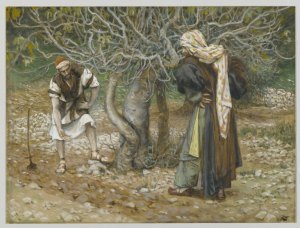 6 And he told this parable: “A man had a fig tree planted in his vineyard, and he came seeking fruit on it and found none. 7 And he said to the vinedresser, ‘Look, for three years now I have come seeking fruit on this fig tree, and I find none. Cut it down. Why should it use up the ground?’ 8 And he answered him, ‘Sir, let it alone this year also, until I dig around it and put on manure. 9 Then if it should bear fruit next year, well and good; but if not, you can cut it down.’”
Grace, mercy, and peace to you from God our Father and from our Lord and Savior Jesus Christ. Amen.
So. Did you have a good week? Everything go well for you or, at least, mostly well? Did your house keep you warm and sheltered? Did your kids stay mostly healthy? Did you get enough to eat? Did you keep your job? Good!
How are you going to spend your afternoon? A little nap? Maybe relax a little and read a few more chapters in your book? Do a little cleaning up around the house and pay some bills? Go and buy your groceries for the week? Get that last bit of homework done before your Monday morning class? Sure.
What do you have planned for this coming week? Same old, same old? Keep the house fairly clean? Grind out another week of work? Get the kids to their activities? Visit some friends or family? Sounds nice.
Life goes on, and it is fairly comfortable. Some rough patches pop up here and there, but nothing out of the ordinary. We sit down to eat and drink and rise up to play (1 Cor. 10:7). We come each week to church, go through the liturgy, hear the Word, listen to the sermon, and think God that is mostly pleased with us. “What has been is what will be, and what has been done is what will be done” (Ecc. 1:9). We just continue on with our normal, mundane routine.
But beware. “Let anyone who thinks that he stands take heed lest he fall” (1 Cor. 10:12). You do not know what this week will bring. You could get diagnosed with pancreatic cancer. You do not know what tomorrow will bring. Maybe, you will be hit by a drunk driver. You do not know what will happen even while I am speaking this sentence. A gunman could come in here and shoot us all dead. This fallen world is a lethally dangerous place for sinners, that means you and me. Because of our sin, our life is dangerous, our existence perilous. Your lives should be filled with constant repentance.
Some people come up to Jesus and speak about a national outrage. “Hey, Jesus. While some Galileans were offering their Passover sacrifices, Pilate sent soldiers into the Temple where they were not allowed, and they slaughtered those poor souls.” To get a sense of how outrageous this: Imagine approaching this altar to receive Holy Communion, and the National Guard comes in here by order of the governor, and guns a bunch of us down. Despicable! Ghastly! Horrid!
“Hey, Jesus. Have You heard about how evil Pilate is? We need to take action. We need to protest! We need to occupy Pilate’s residence! We need to start a group – Galilean Lives Matter!”
But Jesus doesn’t condemn Pilate. He doesn’t say, “Yes, it is tragic. Pray for survivors. This violence has to end.” He says nothing of the sort. Neither does Jesus say something trite, “Where God closes a door, He opens a window.” Or, “Some things we don’t understand now, but we will later.” No!
Instead, Jesus says, “Do you think that those who were killed were worse sinners than everyone else because they died like this?”
No, they were not worse sinners. But when you see evil, when you see injustice, when you see ruthlessness, don’t seek revenge. Don’t take things into your own hands. Don’t even ask, “Why did this happen?” Instead, Jesus uses this wicked deed by a ruthless governor to remind us all to repent. “Unless you repent, you will all likewise perish.”
And Jesus takes it a step further. “Hey, remember those eighteen people who were crushed when the tower fell in Siloam? Do you think they were more sinful than the people who weren’t crushed and buried by the rubble? Did karma catch up with them? Nope, no sir. But unless you repent, you will all likewise perish.”
 Jesus uses both of these things – the wickedness of a political authority and a tragic “act of God” – to remind us to live as repentant people. All tragedies and all acts of violence should remind us that we are sinners who deserve nothing good. God doesn’t owe us peace or long, healthy lives. God’s anger against our sin is real. And just because we are God’s forgiven, adopted children does not mean that we will have a wonderful life. We deserve to be slaughtered. We deserve to have towers pushed over on us. God’s anger is real, and death is what our sin has earned us. We, all of us, need to repent.
We have angered God by the evil we have done. We deserve His wrath for the good we have left undone. We need to repent of our good works because they don’t cut it. Even our righteous deeds are as filthy rags (lit. used toilet paper). Do you think that your attendance at church, giving your offering, and living a generally good life means that God owes you? Does any of that mean you are less likely to be crushed by a tower or martyred by a wicked ruler?
Repent. Your life isn’t quiet and comfortable because you have pleased God with the fruit of your good works. God isn’t nice to you based on how you are living at any given moment. In fact, God isn’t nice at all. He does not tolerate your sin. He condemns it and punishes it. “Unless you repent, you will all likewise perish.”
God isn’t nice, but He is good. Jesus uses this little parable about the barren fig tree to show you the goodness and patience of God. Imagine this barren fig tree. According to God’s command (Lev. 19:23-25), when a tree was planted, you gave the tree three years to grow. Then, the first three years of fruit from that tree were forbidden. The seventh year after the tree is planted (which should also be the fourth year that it produces fruit), all the fruit is to be given as an offering to God. So, the vineyard owner in this parable has been waiting for three years for that first crop to bring as an offering to God. This is a nine-year-old tree hasn’t produced anything – worthless thing that it is.
The vineyard owner calls his vinedresser to sharpen the axe and chop down that parasitic tree. But the vinedresser intercedes. “Sir, let it alone this year also.” Let it alone. Jesus literally says, “Forgive the tree this year also. Give Me have some time with it. Let Me dig around it. Let Me fertilize it. Let’s see what I can do with this worthless tree.”
In this little parable, Jesus is giving us a beautiful picture of what we read in Romans 8:34, “Who is to condemn? Christ Jesus is the one who died – more than that, who was raised – who is at the right hand of God who indeed is interceding for us.”
You see, the God who is angry with your sin, the God who pushes over towers, the God who puts rulers in authority who sentence Christians to death, 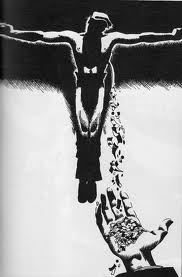 He is the very God who digs, prunes, and fertilizes. And He is not done with you. He refuses to stand by and watch as you grow fruitless and wild. He will not chop you down without first caring for you with His love. Jesus pours out His blood for you and showers his constant forgiveness upon you.
Always remember that. You live only by His mercy. Learn to number your days because God is not nice, but He is good. His mercy endures forever and ever. Amen.
The peace of God, which surpasses all understanding, will guard your hearts and minds in Christ Jesus. Amen.
 34 O Jerusalem, Jerusalem, the city that kills the prophets and stones those who are sent to it! How often would I have gathered your children together as a hen gathers her brood under her wings, and you were not willing! 35 Behold, your house is forsaken. And I tell you, you will not see me until you say, ‘Blessed is he who comes in the name of the Lord!’”
 We are just like those chicks. Rather than seeing Jesus’ wings as our place of refuge, we see them as smothering and confining. We don’t want to be stifled and cramped under His wings. Because of our sinful nature, our wills are hell-bent on remaining free and unfettered to run around rather than being protected in repentance under the wings of Jesus. We see the fire, and we are scared. But rather than trusting Jesus to protect us, we keep running around kicking up sparks, spreading the fire, and making things worse.
 Thankfully, Jesus’ will is stronger than yours. Jesus knows what it will cost for Him to spread His wings over you. And Jesus still resolves to go to Jerusalem. Jesus will continue to run His course. He will cast out demons and perform cures today and tomorrow, and on the third day will be finished. This is exactly what Jesus says on the cross. He cries out, “It is finished,” (Jn. 19:30 same word as in v. 32), and He gives up His spirit.
 3 The devil said to him, “If you are the Son of God, command this stone to become bread.” 4 And Jesus answered him, “It is written, ‘Man shall not live by bread alone.’”
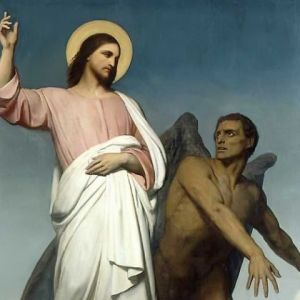 Finally, the devil takes Jesus to the top of the Temple, and the he goes back to questioning Jesus’ son-ship. “If You are the Son of God, throw Yourself down from here because God will not let you get hurt.” The devil even quotes from our Psalm this morning. Satan is being really tricksy here. He is saying, “God has said that He will protect You. Prove that you trust God’s promises to You.”
 What they saw must have woken them up quickly. Before them, the Son of God shines in open, unmistakable glory. Moses and Elijah are there speaking with Jesus about the departure (lit. ‘exodus’) of His cross and resurrection. This is a tremendous moment that Peter, James, and John want to hold on to. They love this shiny Jesus more than the Jesus who speaks so openly about dying. And Peter has a bright idea (pun intended) of his own. “Master, it is good that we are here. Let us make three tents, one for You and one for Moses and one for Elijah.”
 To strengthen us on our journey to the mount of His crucifixion, this morning, we are invited to Jesus’ table. You are invited by your Savior to behold another glorious thing. Your Savior comes to you, body and blood, in bread and wine. He comes to you to forgive you of your sins and to be your Savior. He comes to absolve you of your sins and to fix your eyes upon Him.
 The Gospel says that Jesus is the Lamb of God who takes away the sins of the world. In other words, there is not one person for whom Christ did not die. His crucifixion appeases the wrath of God for all sin of all time. But imagine walking up to a total, complete stranger at the grocery store and telling them, “You are forgiven.” Now, some of them might be Christians and say, “Praise God!” Be I bet that most people and even some Christians would say something like, “Forgiven for what? I haven’t done anything wrong.” For someone who does not have a sense of their sin and guilt, the Gospel is offensive. This is the first way that the Gospel is offensive; it is out of an ignorance of sin and guilt.
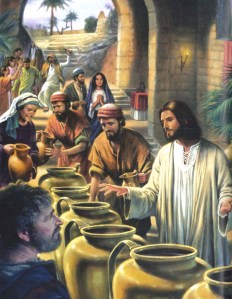 6 Now there were six stone water jars there for the Jewish rites of purification, each holding twenty or thirty gallons. 7 Jesus said to the servants, “Fill the jars with water.” And they filled them up to the brim. 8 And he said to them, “Now draw some out and take it to the master of the feast.” So they took it. 9 When the master of the feast tasted the water now become wine, and did not know where it came from (though the servants who had drawn the water knew), the master of the feast called the bridegroom 10 and said to him, “Everyone serves the good wine first, and when people have drunk freely, then the poor wine. But you have kept the good wine until now.” 11 This, the first of his signs, Jesus did at Cana in Galilee, and manifested his glory. And his disciples believed in him.
 Really, Mary? You are bringing the Son of God into this situation, and you’re doing it like this? Mary, you sound like a whiny child. Parents, you know what I’m talking about. Your kid lethargically walks up to you and says in their whiney little voice, “There’s nothing to eat.” You know that they are in a very ungrateful, impolite way they are asking you for food. It is very easy to get upset when our children approach us like this. I get upset. But notice the faith of your children in this. They feel a need, and where do they go? They go to you. They know that you provide food and so they present their need to you trusting that you will translate their statement into a request. And lovingly or, maybe, not so lovingly, you give them what they haven’t asked for simply because you are gracious.
 This most clearly seen on the cross. To the lost, rebellious, drunk-with-sin, unthankful human race, Jesus gives what is most precious and what should make all our hearts burst with gladness. Jesus gives His very blood and His perfect obedience to the Father.
 46 After three days they found him in the temple, sitting among the teachers, listening to them and asking them questions. 47 And all who heard him were amazed at his understanding and his answers. 48 And when his parents saw him, they were astonished. And his mother said to him, “Son, why have you treated us so? Behold, your father and I have been searching for you in great distress.” 49 And he said to them, “Why were you looking for me? Did you not know that I must be in my Father’s house?” 50 And they did not understand the saying that he spoke to them. 51 And he went down with them and came to Nazareth and was submissive to them. And his mother treasured up all these things in her heart. 52 And Jesus increased in wisdom and in stature and in favor with God and man.
 No one makes us angry. Rather, we give in to our anger and let it have the best of us. In our fight or flight instinct, we usually choose to fight, and we blame others for our overreactions.
 In those waters of my baptism, the all-consuming Flood of God condemned all that was unbelieving in me while God safely placed me in the ark of His catholic Church.



You must be logged in to post a comment.