Mark 9:2-9 – To the Top of the Mountain! (Warning: This is not a pleasant sermon)

Listen here.

Mark 9:2-9

2 And after six days Jesus took with him Peter and James and John, and led them up a high mountain by themselves. And he was transfigured before them, 3 and his clothes became radiant, intensely white, as no one on earth could bleach them. 4 And there appeared to them Elijah with Moses, and they were talking with Jesus. 5 And Peter said to Jesus, “Rabbi, it is good that we are here. Let us make three tents, one for you and one for Moses and one for Elijah.” 6 For he did not know what to say, for they were terrified. 7 And a cloud overshadowed them, and a voice came out of the cloud, “This is my beloved Son; listen to him.” 8 And suddenly, looking around, they no longer saw anyone with them but Jesus only.

9 And as they were coming down the mountain, he charged them to tell no one what they had seen, until the Son of Man had risen from the dead.

In the name of Jesus. Amen.
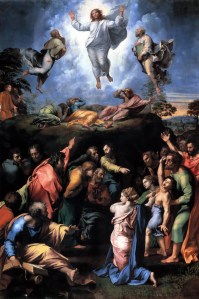
Transfiguration by RaphaelToday, it is important for us to go to the top of the mountain. Today, it is important for us to see this event in Christ’s life, to see Jesus transfigured, metamorphosized. Today, it is important for us to see His clothes turn radiantly white – brighter than the sun glaring off of freshly fallen snow. Today, it is important for us to see Jesus’ face shining more brightly than if He had swallowed the sun. As Peter said, “It is good that we are here.”

The Transfiguration is full of the imagery of the Resurrection. In fact, one liberal theologian, who denies that Mark is divinely inspired, has said that this text is a misplaced Resurrection scene. He says that Mark made a mistake when he wrote the Gospel and put a scene of the resurrected Jesus right smack in the middle of the Gospel. Oops. Well, he is wrong, but this text is a preview of the resurrection glory of Jesus.

It is good for us to see this vision of Jesus today, the last Sunday before Lent because the next six weeks will be focused on the cross. The glory of Jesus will fade, and we will follow Jesus down the mountain and into the valley of the shadow of death. Over the next six weeks, the glory radiating from Jesus on the mountain will disappear from our sight as we watch Him be beaten, whipped, stripped, crucified, dead, and laid in the grave. The glory revealed here will be hidden behind suffering. But the glory of the Transfiguration will once again be visible on Easter after Jesus is raised, and that glory will never fade.

But we cannot put the cart before the horse. There is no resurrection unless death comes first.

The Transfiguration occurs six days after Jesus told the disciples that He must suffer, be rejected, killed, and rise again (Mk. 8:31). Peter didn’t want to hear this. He didn’t want this to happen to Jesus – understandably so. Peter rebuked Jesus for saying that this would happen to Him, and Jesus rebuked Peter for setting his mind on the things of man and not on the things of God.

The glory that is revealed here in the Transfiguration is the glory that Christ receives because He is God’s Suffering Servant. Christ is glorious because He bears your sins. The Transfiguration serves as a preview of what is coming. The glory that shines forth on this mountain before Peter, James, and John is a glimpse of what will come. It is how Jesus will appear after He has risen from the dead. But Jesus can’t stay on the mountain. Jesus can’t dwell in Peter’s tent because He hasn’t yet done His glorious work. Jesus has not yet died for the sins of the world (Php. 2:6-9). Defeat must come before victory. Death must come before resurrection. Suffering must come before glory. This is God’s way, and it is not completely foreign to us.

Take the story of Cinderella for example: You can tell the story in a way that makes it completely forgettable. “Once upon a time, there was a girl who married a prince, and they lived happily ever after.” Boring.

CinderellaOnly when you hear the whole story does the happily ever after mean something. “Once upon a time, there was a girl named Cinderella. After her mother died, her dad married a wicked woman who had two nasty, ugly daughters. Then Cinderella’s dad died too. Her step-mother and step-sisters made Cinderella their slave. But then Cinderella gets a taste of the good life – she is given beautiful coach with magnificent horses. She gets beautiful shoes, mascara, and a stunning evening gown. She dances all night with the prince. But then – bong, bong, bong, bong. Back down she goes. But the prince eventually finds her, marries her, and she lives happily ever after.

Your story follows the same pattern. You are born dead in sin. You are brought to the waters of baptism where God puts His name upon you. You are forgiven and declared innocent before God. You have been raised up with Christ and seated with Him in the heavenly places (Eph. 2:5-6). But you now live in the time of suffering. You live in the time after the clock has struck twelve, and you wait for Jesus to bring you to the palace and live happily ever after.

But suffering currently hides that glory. We need to be ok with that because it is reality. We do ourselves no favors if we deny this fact. Do you want to follow after Christ? Listen to what He says right before the Transfiguration, “If anyone would come after Me, let him deny himself and take up his cross and follow Me” (Mk. 8:34).

In this world, as a sinner saved by Jesus, you have tribulation (Jn. 16:33). Your husband, father, or friend will have a stroke and not be able to talk. You will have back issues that cause you pain and discomfort for months. Crying to GodYour loved ones will die. Your kids will make bad choices and cause you all sorts of heartache. And you can shake your fist at God and be angry with Him. Or you can endure the suffering. And you can even rejoice in your suffering. Rejoice in suffering? Yes. Rejoice in suffering, knowing that suffering produces endurance, and endurance produces character, and character produces hope, and hope does not put us to shame, because God’s love has been poured into your hearts through the Holy Spirit who has been given to you (Ro. 5:3-5).

This Lenten season, you will watch your Savior go to the cross. You will behold Him as He suffers, bleeds, and dies. But you will watch all of that pain and suffering knowing what lies at the end – the resurrection.

The resurrection also awaits you. But for now, you suffer. You suffer until your own transfiguration is complete. “We all, with unveiled face, beholding the glory of the Lord, are being transformed (transfigured, metamorphosized just as Christ was on the mountain) into the same image” (2 Cor. 3:18).

O wondrous type! O vision fair
of glory that the Church may share,
which Christ upon the mountain shows,
where brighter than the sun He glows!

With Moses and Elijah nigh
th’incarnate Lord holds converse high;
and from the cloud the Holy One
bears record to the only Son.

With shining face and bright array
Christ deigns to manifest today
what glory shall be theirs above
who joy in God with perfect love.

O Father, with the’eternal Son
and Holy Spirit ever one,
We pray Thee, bring us by Thy grace
to see Thy glory face to face.[1] Amen.

The peace of God, which surpasses all understanding, will guard your hearts and minds in Christ Jesus. Amen.

[1] “O Wondrous Type! O Vision Fair” LSB #413

Mark 1:29-39 – Bringing the Reign of God – To You (A Frantic Sermon)

Listen here.

Mark 1:29-39

29 And immediately he left the synagogue and entered the house of Simon and Andrew, with James and John. 30 Now Simon’s mother-in-law lay ill with a fever, and immediately they told him about her. 31 And he came and took her by the hand and lifted her up, and the fever left her, and she began to serve them.

32 That evening at sundown they brought to him all who were sick or oppressed by demons. 33 And the whole city was gathered together at the door. 34 And he healed many who were sick with various diseases, and cast out many demons. And he would not permit the demons to speak, because they knew him.

35 And rising very early in the morning, while it was still dark, he departed and went out to a desolate place, and there he prayed. 36 And Simon and those who were with him searched for him, 37 and they found him and said to him, “Everyone is looking for you.” 38 And he said to them, “Let us go on to the next towns, that I may preach there also, for that is why I came out.” 39 And he went throughout all Galilee, preaching in their synagogues and casting out demons.

In the name of Jesus. Amen.

FranticThe Gospel of Mark moves along at a frantic pace. No time to stop and look at the scenery in Mark. No time to take a selfie. In last week’s text, Jesus preached in Capernaum’s synagogue and immediately a demon shows up. Jesus silenced the demon and cast it out of the man. The people were left astonished and wondering who this Jesus is.
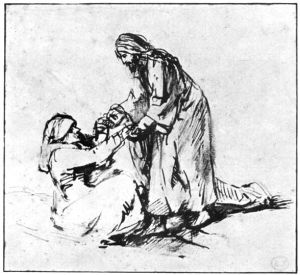
But there is no slowing down. With the loud cries of the demon still echoing in the synagogue, Mark is already herding us to the next thing. “Immediately He left the synagogue and entered the house of Simon (Peter) and Andrew, with James and John.” Into that unremarkable house Jesus enters.

You can imagine the reaction of Peter’s family, “If there aren’t enough chairs, we can sit on the floor. If only we had known You were coming, Jesus – everything is such a mess. We’ve had our hands full taking of mother-in-law, You know what a bother she can be, and our men have been no help at all, off listening to some new Preacher – that is You” (Nagel).

“Immediately” on hearing about mother-in-law, Jesus marches to her. Jesus doesn’t knock on the door to make sure if mother-in-law is decent or presentable enough for Him to enter the room. Jesus doesn’t pause. He simply goes to her. He enters the woman’s room and sits next to her bed – not really a place for a man to be. Jesus heals Peter's Mother-in-law 1Here is the Messiah, the Holy One of God, who is preaching about the reign of God – whose presence is the reign of God. Straight to the bed and to the feverish, flustered women He comes. “There is nothing more important in all the world than for Jesus to be there for the sick woman” (Nagel). Sent with the task of redeeming the whole world, Jesus is there just for her.
Jesus takes her by the hand. Jesus lifts her up, and the fever leaves her. Last week, the demon asked Jesus, “Have You come to destroy us?” But now, the Man whose presence puts the fear of fire into demons removes the fire of fever from Peter’s mother-in-law.

She doesn’t begin to worship Jesus. She doesn’t leave her family to dedicate herself to some spiritual service to God. She does what is right for her to do. She serves. She puts on the coffee and cooks her favorite recipe.

You know how weak you can be when you are sick and even when you get better it still takes days for your strength to return? Yeah, none of that here. Mother-in-law moves from coughing, feverish, and bed-ridden to serving. The restoration that Jesus brings is full and complete. No trace of the fever remains. The fever “left” her. Just so you know, that’s the same word that gets translated often as “forgive.”

From that day on she was never the same. She knew to whom she was precious – to Jesus, the Man whom the boys had brought home. That old woman knew that the reign of God had come to her.

Just as Jesus was for Peter’s mother-in-law so He is for you. He doesn’t look for people who are worthy. He doesn’t seek the pure and holy. He walks straight to those who are unworthy. He approaches those who are in need. Only His worthiness matters. He walks to you, not you to Him. He takes you by the hand, you don’t take His. “He gives power to the faint, and to him who has no might He increases strength” (Is. 40:29).

Jesus lifted Peter’s mother-in-law up. He lifts you up too. “Lifts you up” – that’s the word for “resurrection.” He resurrects you who are dead in sin. He forgives you, removing your sin and restoring you. He does all this so that “at the last day, [He] will raise up [you] and all the dead and will grant everlasting life to [you] and to all who believe in Christ. This is most certainly true.”

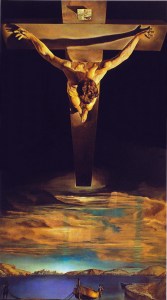
As important as it was for Jesus to do all of this for Peter’s mother-in-law, Jesus wasn’t content just raising her up. He wasn’t satisfied healing all the sick and demonized in Capernaum. He insists on moving on. Christ of St John on the Cross Salvador DaliHe has one goal in mind. He has come to do His Father’s will. He has come to die. Jesus dies for the same reason you will die – because of sin. Jesus raises you up because He was raised up from the earth on the cross with the sins of the world on Himself. Because of His death, your sins have left you. Because He rose again from the dead, you can know that you too will rise from the dead. In your baptism you were united with Jesus’ death so you too can rise again (Ro. 6:4-5).
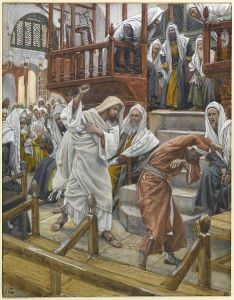
Jesus brings the reign of God to you so that He can fill you. You can go from this house raised up by Jesus with your sins gone. Jesus is present here, bringing the reign of God to you. There is nothing more important in all the world to Jesus than to be here for you. He sees your helplessness. He knows your unworthiness. But He is not deterred. He comes to you. Takes you by the hand. Raises you up. He serves you. And all your evil, all your sin, all your badness leaves you.

And your life is forever changed. You know to whom you are important. You know to whom you belong. You know that Jesus has brought the reign of God to you. Amen.[1]

The peace of God, which surpasses all understanding, will guard your hearts and minds in Christ Jesus. Amen.


[1] I am thankful to a sermon by Rev. Dr. Norman Nagel as inspiration for this sermon.

Mark 1:21-28 – Unclean? No Problem!

Listen here.

Mark 1:21–28

21 And they went into Capernaum, and immediately on the Sabbath he entered the synagogue and was teaching. 22 And they were astonished at his teaching, for he taught them as one who had authority, and not as the scribes. 23 And immediately there was in their synagogue a man with an unclean spirit. And he cried out, 24 “What have you to do with us, Jesus of Nazareth? Have you come to destroy us? I know who you are—the Holy One of God.” 25 But Jesus rebuked him, saying, “Be silent, and come out of him!” 26 And the unclean spirit, convulsing him and crying out with a loud voice, came out of him. 27 And they were all amazed, so that they questioned among themselves, saying, “What is this? A new teaching with authority! He commands even the unclean spirits, and they obey him.” 28 And at once his fame spread everywhere throughout all the surrounding region of Galilee.

In the name of Jesus. Amen.

This Sabbath probably began like every other Sabbath in Capernaum. Families were scrambling to get ready and out the door so they could to go to synagogue. Fathers hounding their kids to finish breakfast and get their teeth brushed because they already running late. Mothers arguing with daughters about what was and what was not appropriate to wear to synagogue. Sons complaining that the services were too long. Elderly people trying to prepare themselves for another boring sermon. Boring sermons are nothing new.

People entered the synagogue and nestled themselves into the benches that served as pews (pews aren’t new either). The liturgy began. Opening prayers taken from the Psalms were prayed. The hymns were sung. The creed confessed. The Scripture lessons read. With the Scriptures still ringing in their ears, it was time for the sermon. Normally, the preacher would cite rabbi after rabbi. “Rabbi so-and-so learned from rabbi so-and-so who learned from rabbi so-and-so who learned from rabbi so-and-so that this text means….” Scintillating, isn’t it?

But this seemingly normal Sabbath would take a turn. Things would never be the same for the faithful of Capernaum. Today, they would hear a message from God unlike any other. They would hear God speak. They would hear God’s word from the lips of the Prophet that Moses spoke of (Dt. 18:15-19). But this Prophet was more than a prophet. His words were the words of God spoken by the Word of God made flesh.

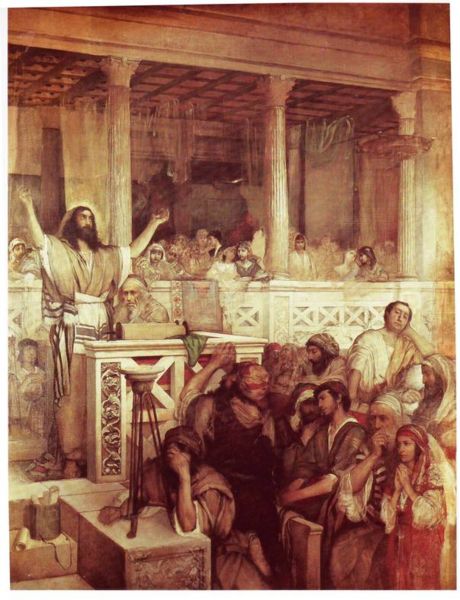
Jesus Teaching at CapernaumThis particular Sabbath, Jesus preaches. But Jesus doesn’t preach like anyone else. Jesus preaches with authority, “You have heard it said of old… but I say to you (Mt. 5:21ff). Oh, and by the way, the time is fulfilled and reign of God is here. Get rid of your sin. Confess it. I’ll take it. I’ll deal with it, and it will be gone forever. Repent and believe the Gospel.”

The people are sitting there in their pews and thinking, “Whoa. This is different.” Some find it refreshing; others find it disturbing. The best way to get people riled up is to change something at church. But as disturbed as the people sitting in the pews were. Satan and the demons were even more upset.

Right in the middle of Jesus’ sermon, all hell breaks loose – literally. A man with an unclean spirit – a demon – was present in the synagogue that day. In the middle of holy worship, a demon cries out, “What have You to do with us, Jesus of Nazareth? Have you come to destroy us? I know who you are – the Holy One of God.”

Jesus heals a Demonic at CapernaumBut Jesus keeps right on preaching. He preaches directly to the demon. He doesn’t use swift spiritual ninja moves to shut the demon up. He simply uses words, “Be silent, and come out of Him.” And the evil, unclean spirit obeys. The demon threw the man into convulsions. And the screaming – can you imagine how violent this would have looked? And all of this is happening right in the middle of church! But the evil spirit leaves and the man is unharmed (Lk. 4:35).

The normal reverence of the service was gone. People erupted in astonishment. “What is going on here? We hear this new teaching – these Gospel-filled words – and now we see evil spirits obeying this Guy? This is crazy!” It was the talk of the town. The news spread. Twitter lit up. People throughout the region were hearing about this Jesus who uses words with authority.

Today, we tend to hear stories like this and think of some bygone era when miracles took place. We wonder where the epic battles between God and the forces of hell are taking place today. Maybe we wish something like this would happen here at Christ the King. If we could see this happen, then we would have a story for our friends and neighbors, “Hey, you’ll never guessed what happened at church this week…” Maybe then more people would come and we’d have to add those extra spaces to our parking lot. Maybe we’d even have to add a second service or build a larger sanctuary. But here we are with nothing but our same old liturgy, the same old sermons, the same old words.

But hold on now; just a second. The same Jesus who teaches with authority and commands evil spirits is the same God who is speaking through the liturgy, through the sermons, through the same words.

The demon asked Jesus, “Have you come to destroy us?” The answer is, “Yes.” Jesus came to destroy the power that Satan, the demons, death, sin, and all evil has over His creation. These few verses from Mark are a microcosm of what Jesus, the Holy One of God, does here and now.

You see, there are only two kingdoms – a kingdom of darkness and a kingdom of light. A kingdom of evil and a kingdom of holiness. You are either under the lordship of Satan or under the lordship of God. There’s no such thing as dual citizenship.

Assailed by DemonsThe forces of hell assail our worship today. Demons are here. You have brought them with you into this holy place. Your demons of drunkenness, your demons of gossip, your demons of adultery, your demons of hatred, your demons of laziness, your demons of despising the Word of God. Don’t just give them little pet names. Call them what they are! They are evil, wicked, damnable sins. They too need to be silenced and ripped out of you. And that is precisely why Christ is here – to remove your demons with His words.

And that is precisely what Jesus has done. He has conquered sin, death, the devil, and all of hell’s strength through His death and resurrection. And Jesus still wages war on evil through His Words. He’s been doing it all through our service. Through the Absolution, Jesus speaks His words to you that you are forgiven, freed, and made holy. Through this simple sermon, Jesus speaks to you that you are delivered by His prefect life, His atoning death, and His glorious resurrection. And, soon, the climax of it all, when you will come to this altar, when you will be fed the body of your Savior. Where your thirst for righteousness will be quenched by the blood of your Redeemer.

Are you unclean? Absolutely. But that’s no problem because here’s Jesus – for you. Amen.

The peace of God, which surpasses all understanding, will guard your hearts and minds in Christ Jesus. Amen.

Mark 1:14-20 – Repent & Believe

Listen here.

Mark 1:14-20

14 Now after John was arrested, Jesus came into Galilee, proclaiming the gospel of God, 15 and saying, “The time is fulfilled, and the reign of God is at hand; repent and believe in the gospel.”

Jesus calls the disciples by the sea16 Passing alongside the Sea of Galilee, He saw Simon and Andrew the brother of Simon casting a net into the sea, for they were fishermen. 17 And Jesus said to them, “Follow Me, and I will make you become fishers of men.” 18 And immediately they left their nets and followed Him. 19 And going on a little farther, He saw James the son of Zebedee and John His brother, who were in their boat mending the nets. 20 And immediately He called them, and they left their father Zebedee in the boat with the hired servants and followed Him.

In the name of Jesus. Amen.

You have heard two of the shortest sermons recorded in Scripture this morning. From Jonah’s cry, “Yet forty days, and Nineveh shall be overthrown!” (3:4) to Jesus’ proclamation, “The time is fulfilled, and the reign of God is at hand; repent and believe in the gospel.”

Jonah’s audience, the evil pagans of Nineveh, had an urgent timeline. Forty days is not a long time before annihilation. But Jesus’ call is even more urgent, “The time is fulfilled – the time is even now – and the reign of God is at hand. Repent and believe the gospel.”

Jonah’s sermon is very incomplete. He gives no Gospel, delivers no forgiveness. He doesn’t proclaim God’s mercy, only God’s judgment. If the time ever comes when you hear me preaching sermon after sermon proclaiming only God’s coming judgment on sin, run me out of here! Remove me from being your pastor because your only getting half the story – less than half. That is not how a shepherd should treat his flock.

However, even though Jonah proclaims nothing but Law, judgment, and destruction, God speaks His Word through Jonah’s mouth to miraculously bring about repentance and faith in the Ninevites. That is how powerful God’s Word is. God works through His Word to do His work of bringing people to repentance and faith.

The king of Nineveh took a shot in the dark when it came to repentance. He said (Jon. 3:9), “Who knows? God may turn and relent and turn from His fierce anger, so that we may not perish.” For all they knew, God would still destroy their city even if they repented. The people of Nineveh could have simply taken on the slogan, “Let us eat, drink, and be merry for in 39 days we die.” They didn’t know God’s nature or character because Jonah didn’t tell them. Jonah didn’t mention that God is slow to anger and abounding in steadfast love and mercy. But the Ninevites rolled the dice, and they did learn that God is merciful.

Jesus’ sermon is complete. Today, through my voice, Jesus says to you, “The time is fulfilled, and the reign of God is at hand. Repent and believe in the Gospel.”

Small Catechism - Confession IconToday, God brings His kingdom, His rule, His reign in this place, in this city, this state, this world. Repent. Turn from your sin. Confess your sin. Do you know what that word confess means? It literally means ‘to say the same thing as.’ Every week, you come here and together we all say the same thing about ourselves and our sin as God says about us and our sin. We are poor sinners. We are, by nature, down to our core, sinful and unclean, unfit to be in God’s presence. Throughout the week, we have sinned against God in thought, word, and deed. You are damnable. I am damnable.

“Repent,” this is the command of your Lord and Savior, Jesus Christ. But this very command is not something we are able to do. We cannot repent. But this word, “Repent,” from Jesus creates exactly what it calls for. Don’t look at your repentance or confession as the part you have to do to be saved. Repentance is not your work (Act. 5:31; 11:18; 2 Tim. 2:25). That’s a good thing. How could you ever know if you have really repented enough? Your sin is so bad that you are dead. Last I checked, dead people don’t do anything.

Think back to creation. When God said, “Let there be light,” light obeyed the word of God. God spoke into the void, and that which did not exist obeyed. When God said, “Let the earth sprout vegetation,” it just happened. Plants, grass, and trees simply grew and produced fruit and seed. The very nature of God’s Word is that it creates, and it always creates what it calls for.

Jesus’ call to repent is the same. Spoken by the lips of Jesus, the command, “Repent,” creates the very repentance demanded. But it can and does, sadly, happen that some resist and defy God’s Word. “In between repentance and defiance is the mystery of the Holy Spirit’s work” (Rev. Timothy Winterstein).

The same goes for Jesus’ command, “Believe the gospel.” By our own reason and strength, we cannot believe in Jesus Christ as Lord or come to Him. But the power of Jesus’ word creates belief and faith as the Spirit works. A simple word from Jesus moves the dead to life. The living Gospel brings life to the dead.

The people of Nineveh didn’t know what would happen if they repented; Jonah didn’t even tell them to repent. But you know. Jesus gives the Gospel because He is the Gospel. He is the one who miraculously took away your sins through His death on the cross.

You are here because of Jesus. Jesus’ call to Andrew and Simon and James and John has left the shores of the sea of Galilee and echoes through the millennia to you here today. Jesus calls you just as He called them, “Follow Me.” Though I do have to say that translation is too clean. Literally, Jesus says, “Com’ere [sic], behind Me.” And, now, here you are – behind Jesus.

Small Catechism - Jesus on Trial IconLiving in repentance and faith and being behind Jesus means you are different. The time is short, and the present form of this world is passing away (1 Cor. 7:29, 31). Jesus has called you out of this world to be behind Him wherever He goes. Where He goes proclaiming the Gospel, you also go. You go freed from having to live as though the things of this world matter. You can walk through the things of this world knowing that nothing matters except that you are repentant, believing, and behind Jesus.

You know that Jesus has placed you behind Him living with your spouse, your children, your jobs, and your stuff as salt and light. You are in this world now as God’s own child, repentant and forgiven. Living in the present reign of God, and being His voice calling others into His reign. Amen.

The peace of God, which surpasses all understanding, will guard your hearts and minds in Christ Jesus. Amen.

John 1:43-51 – Greater Things

Listen here.

John 1:43-51

43 The next day Jesus decided to go to Galilee. He found Philip and said to him, “Follow me.” 44 Now Philip was from Bethsaida, the city of Andrew and Peter. 45 Philip found Nathanael and said to him, “We have found him of whom Moses in the Law and also the prophets wrote, Jesus of Nazareth, the son of Joseph.” 46 Nathanael said to him, “Can anything good come out of Nazareth?” Philip said to him, “Come and see.” 47 Jesus saw Nathanael coming toward him and said of him, “Behold, an Israelite indeed, in whom there is no deceit!” 48 Nathanael said to him, “How do you know me?” Jesus answered him, “Before Philip called you, when you were under the fig tree, I saw you.” 49 Nathanael answered him, “Rabbi, you are the Son of God! You are the King of Israel!” 50 Jesus answered him, “Because I said to you, ‘I saw you under the fig tree,’ do you believe? You will see greater things than these.” 51 And he said to him, “Truly, truly, I say to you, you will see heaven opened, and the angels of God ascending and descending on the Son of Man.”

In the name of Jesus. Amen.

Again, these words of Jesus, “Because I said to you, ‘I saw you under the fig tree,’ do you believe? You will see greater things than these. Truly, truly, I say to you, you will see heaven opened, and the angels of God ascending and descending on the Son of Man.”

I want to tell you a nasty story. It is about a whole family that was sneaking around and backstabbing each other. Isaac and Rebekah had twin sons – Esau and Jacob. Isaac loved Esau, but Rebekah loved Jacob (Gen. 25:28). Esau and Jacob had been fighting since they were in Rebekah’s womb. Two brothers fighting is hardly a new phenomenon, but this was bigger than a typical sibling rivalry. Jacob and his mother Rebekah had plotted to lie to Isaac in order to steal Esau’s blessing. They planned every last detail. Rebekah would cook Isaac’s favorite meal, like Esau would have prepared. Isaac had become blind in his old age, so Rebekah told Jacob to wear animal skins so that he would feel hairy like his brother Esau. Rebekah even had Jacob put on some of Esau’s cloths so that Jacob would smell like Esau.

When Jacob came into Isaac’s room to steal the blessing, Isaac was unsure at first. He recognized the voice as Jacob’s. But twice Jacob lied, insisting that he was Esau. When Isaac felt the hairy animal skins, which felt like Esau, and when he smelled Esau’s cloths, he took the bait and blessed Jacob.

When Esau found out, he was so enraged that he decided he would kill his brother. But Rebekah heard about Esau’s plot. She told Jacob to flee to her relatives who lived far north.

With his life in danger, Jacob flees alone with only the cloths on his back. When the sun set, Jacob stopped. He lied down to sleep with a rock for his pillow. His own actions had brought him to this lonely place. His head is filled with regrets, and his future is one of fear. Finally, he falls asleep and has a dream – a strange dream.
In this dream, JaJacob's Laddercob sees a ladder touching the earth and reaching up to heaven. On that ladder, angels ascend and descend – up and down, down and up. From earth to heaven, from heaven to earth. Jacob sees the bridge between Creator and creature. He hears God speak to him.

God had watched as Jacob maliciously plotted with his mother, stole from his brother, lied to his father, and ran away. So what would you expect God would say to little, wretched Jacob? Something like, “You little twerp, you’ve really done it now. You’re alone, alienated from your family. You have a rock for a pillow. But you sure do deserve it.” But God doesn’t say anything like that.

Listen to what God actually says, “I am the Lord, the God of Abraham your grandfather and the God of Isaac your father. I am your God too. I am with you. I will keep you wherever you go. I will give you so many offspring that they will be like the dust of the earth. And in you and your offspring shall all the families of the earth be blessed. I will not leave you until I have done all that I have promised you.”

After this, Jacob woke up. He set up that stone that he used as a pillow as a pillar, and named that place Bethel – “house of God.” That very spot became a place of worship for the people of Israel when they were taking possession of the Promised Land. The Israelites knew that when you worshiped at Bethel, at the “house of God,” God was present there.

Jacob’s dream is what Jesus is referring to when He tells Nathaniel and the other disciples (the ‘you’ here is plural) ”Truly, truly, I say to you, you will see heaven opened, and the angels of God ascending and descending on the Son of Man.”

Nathaniel was impressed when Jesus knew about him before they even met – so impressed that he confesses that Jesus is the Son of God and King of Israel. But that’s just the beginning of what Nathaniel and the other disciples will see. They will see that Jesus is what Jacob’s ladder was pointing to. They will see the reality of what Jacob saw in a dream. They will see what it actually looks like when God makes His house on earth. They will see that Jesus, the Son of God and Son of Man, is the link between heaven and earth, between God and man. They will see that Jesus has fused heaven and earth together in His very body (Rev. Chad Bird).

Nathaniel and the disciples saw many miracles: Jesus turning water into wine, feeding the hungry, cleansing lepers, making the lame to walk, giving sight to the blind, and raising the dead. But they saw and heard even greater things than these. They heard God Himself forgiving sins. They ate Jesus’ very body and blood. They saw God delivering Himself into the hands of evil, wicked men. They saw God die. They saw God’s corpse placed into the ground. They saw Jesus raised from the dead. They saw the physical body of Christ ascend into heaven.

Jesus Cross Heaven & EarthJesus has come and heaven is opened to you. Heaven is just a short ladder away. A ladder with one rung – the ladder of the cross. Through the cross, Jesus has united heaven and earth. Even if you may not see it with your eyes, you see it through faith. When you were baptized, when you eat and drink Communion, when you receive the absolution, or listen to a sermon, heaven is open. You hear the voice of your heavenly Father.

Just as God knew what Jacob had done – all his deceit, all his trickery, all this thieving – God knows what you have done too. He knows your treachery. He knows your hatred toward your neighbor and brothers and sisters. He knows all your malicious thoughts and intents. And yet, He still died for you. He still forgives you. He promises to be with you wherever you go and bless you. He promises to be your God, and He will never leave you or forsake you. Amen.

The peace of God, which surpasses all understanding, will guard your hearts and minds in Christ Jesus. Amen.

Mark 1:4-11 – God, Water, Death, & Life

Listen here.

Mark 1:4-11

4 John appeared, baptizing in the wilderness and proclaiming a baptism of repentance for the forgiveness of sins. 5 And all the country of Judea and all Jerusalem were going out to him and were being baptized by him in the river Jordan, confessing their sins. 6 Now John was clothed with camel’s hair and wore a leather belt around his waist and ate locusts and wild honey.

7 And he preached, saying, “After me comes he who is mightier than I, the strap of whose sandals I am not worthy to stoop down and untie. 8 I have baptized you with water, but he will baptize you with the Holy Spirit.”

Baptism of Christ - Theophany9 In those days Jesus came from Nazareth of Galilee and was baptized by John in the Jordan. 10 And when he came up out of the water, immediately he saw the heavens being torn open and the Spirit descending on him like a dove. 11 And a voice came from heaven, “You are my beloved Son; with you I am well pleased.”
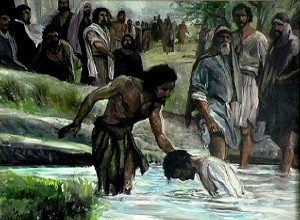
In the name of Jesus. Amen.

I’m not a person who enjoys taking a bath. Maybe once every other year, I’ll take a bath to relax, but not to get clean. For one thing, I’m too tall to fit nicely in a bathtub. But mostly, I don’t feel clean after a bath. Showers, now, showers are great – the water washes the dirt right down the drain. With a bath, you just sit in your own filth.

Imagine though, taking a bath in someone else’s used bathwater. It’s not really a nice thought, is it? We are blessed with plenty of clean water in our country so we don’t have to even consider doing that in an attempt to make ourselves clean.

In our Gospel text, John the Baptizer is doing his thing – baptizing and preaching. John came on the scene preaching a baptism which led to and resulted in repentance. Sometimes this gets turned around by people with a theological agenda. John was not baptizing people because they were repentant. Instead, the baptism they received brought the people to repentance (the grammar here makes it very clear, so does Mt. 3:11). Jesus' BaptismPeople heard John’s preaching, got baptized, and became repentant people. A lot of people did. “All the country of Judea and all Jerusalem were going out to him and were being baptized by him in the river Jordan, confessing their sins.” That’s a lot of people.
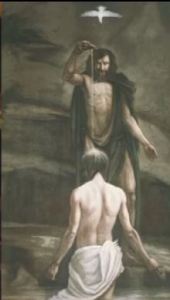
Men, women, children, and even infants (unless there were no infants in all of Judea and Jerusalem) were all going out to be baptized by John and going home repentant people. They came and their sins were washed away in the waters of the Jordan.

Now, imagine having the eyes of God and seeing all the sins of all the people of Judea and Jerusalem mucking up the Jordan River. It would be a cesspool. The Parks & Rec. Department should shut down the beach and send everyone home. They would call in teams wearing hazmat suits to get the clean-up effort started. The headlines would read, “Jordan River Becomes Toxic with Sin.”

Now, here comes Jesus to the Jordan River, and He is here to be baptized. John tried to prevent Jesus from being baptized. Mark doesn’t record it this, but Matthew does. John said (Mt. 3:14), “I have need to be baptized by You, and do You come to me? This isn’t right, Jesus. What do You think You’re doing?”

John is thinking like we do. We think that God must stay separate from sinners. Sinners should have to move to God – not the other way around. But Jesus is not going to hear of it. Jesus is here to be with sinners, to stand next to us, to identify with us. Jesus will be baptized. He will go down to those sin infested waters and be washed.

But unlike the sinners coming to John, Jesus has nothing to be repentant of. Jesus is not washed to remove His sins and make Him repentant – just the opposite. Like a filter, Jesus sucks all the sin, all of the filth, all of the muck out of the water into Himself. Jesus takes on all that has gone wrong with us, all our sins. God made Jesus, who knew no sin, to be sin for your sake.

We often think of Jesus bearing our sin on the cross, and He did. But His baptism is where He began to be the sin-bearing Messiah. John says as much later. When he tells people about the time he baptized Jesus, he says, “Behold the Lamb of God who takes away the sin of the world” (Jn. 1:29).

In His baptism, Jesus fulfills Isaiah’s prophecy in Is. 53:11 that God’s Servant, God’s righteous One, shall bear their iniquities. In His baptism, Jesus takes your sin and the sin of the whole world so He could bear that sin to the cross and to the grave.

And now you who are baptized into Christ Jesus are baptized into His death. That’s right. In your baptism, you have already died the only death that will have any lasting significance for you. God uses the waters of your baptism to put you to death with Jesus – but no so He can leave you there. Because remember what happened to dead Jesus. He rose again. If you die with Jesus, you certainly will rise with Jesus.

Jesus' Baptism Spirit DescendsSo there is Jesus, in those sin-filled waters, receiving a sinner’s baptism. He comes out of the waters and God shows up, and God shows up violently. Immediately the heavens were torn open. But it doesn’t stay violent. Normally, when God shows up like this, people are falling to the ground in fear. But instead of fear and trembling in the presence of God, a dove, a sign of peace, descends. The Holy Spirit comes in peace and descends, literally, “into” Jesus. And the voice of God says, “You are my beloved Son; with you I am well pleased.”
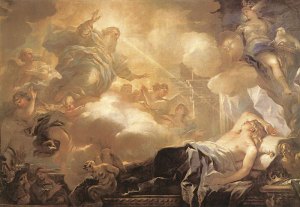
God’s pleasure and delight is in His Son, Jesus. And that is where you are. “As many of you who have been baptized into Christ have put on Christ” (Gal. 3:27).

God is not far off. He is not aloof. He is not separate. In fact, God has come straight to you. He walked right up to you and took your sin. Jesus was baptized to become your sin-bearer. Where your sins are is where Jesus is. And where Jesus’ righteousness is, is where you are (Nagel).

Jesus has taken every last thing that is wrong with you. He has taken it away and, in return, He has given you His righteousness. Amen.

The peace of God, which surpasses all understanding, will guard your hearts and minds in Christ Jesus. Amen.

1 Kings 3:1-15 – The Folly of Wisdom

Listen here.

1 Kings 3:1-15

1 Solomon made a marriage alliance with Pharaoh king of Egypt. He took Pharaoh’s daughter and brought her into the city of David until he had finished building his own house and the house of the Lord and the wall around Jerusalem. 2 The people were sacrificing at the high places, however, because no house had yet been built for the name of the Lord.

3 Solomon loved the Lord, walking in the statutes of David his father, only he sacrificed and made offerings at the high places. 4 And the king went to Gibeon to sacrifice there, for that was the great high place. Solomon used to offer a thousand burnt offerings on that altar. 5 At Gibeon the Lord appeared to Solomon in a dream by night, and God said, “Ask what I shall give you.” 6 And Solomon said, “You have shown great and steadfast love to your servant David my father, when he walked before you in faithfulness, in righteousness, and in uprightness of heart toward you. And you have kept for him this great and steadfast love and have given him a son to sit on his throne this day. 7 And now, O Lord my God, you have made your servant king in place of David my father, although I am but a little child. I do not know how to go out or come in. 8 And your servant is in the midst of your people whom you have chosen, a great people, too many to be numbered or counted for multitude. 9 Give your servant therefore an understanding mind to govern your people, that I may discern between good and evil, for who is able to govern this your great people?”

10 It pleased the Lord that Solomon had asked this. 11 And God said to him, “Because you have asked this, and have not asked for yourself long life or riches or the life of your enemies, but have asked for yourself understanding to discern what is right, 12 behold, I now do according to your word. Behold, I give you a wise and discerning mind, so that none like you has been before you and none like you shall arise after you. 13 I give you also what you have not asked, both riches and honor, so that no other king shall compare with you, all your days. 14 And if you will walk in my ways, keeping my statutes and my commandments, as your father David walked, then I will lengthen your days.”

15 And Solomon awoke, and behold, it was a dream. Then he came to Jerusalem and stood before the ark of the covenant of the Lord, and offered up burnt offerings and peace offerings, and made a feast for all his servants.

In the name of Jesus. Amen.

I remember watching the movie Aladdin as a kid. You know the story of the street rat stumbling upon a magic lamp and being granted three wishes by Robin Williams – I mean a genie. I remember daydreaming about what I would do if I was ever granted three wishes. Visions of piles of money, a huge mansion, and a peaceful life distracted my grade-school mind from long division; participles, infinitives, and gerunds; and plant science. In the movie, Aladdin decides that two wishes are enough for himself, and he promises to use his third wish to free the genie. You can certainly get a lot with two wishes. Most people would even be happy with one wish. One wish, rightly used, could solve most, if not all, your problems.

Solomon has just taken over as king. He blows out the candles on his coronation cake, and God tells him to ask for anything. “At Gibeon Yahweh appeared to Solomon in a dream by night, and God said, ‘Ask what I shall give you.’”

Solomon Asks God for WisdomNow, Solomon could have used a lot of things. Solomon was not David’s oldest son. Several of his brothers were in line before him to sit on the throne of David. But David chose Solomon to be king after him. The previous chapter, 1 Kings 2, is filled with Solomon wading through the mess of killing people who opposed him and David. It’s not easy becoming king. Solomon could have really used wealth and power to his advantage, as any new, young king could. But Solomon puts power and wealth to the side.

To our worldly minds, it looks like a mistake. It looks like Solomon wastes the biggest opportunity of his life. The all-powerful God of the universe says that He will give Solomon anything, but Solomon throws all worldly things away. He doesn’t ask for riches or power or fame. Solomon lets all those things go.

Instead, Solomon remembers how God had dealt with his father, David. Remember who Solomon’s mother was and how she became the king’s wife? David had lusted after Solomon’s mother, Bathsheba, while she was another man’s wife. David got Bathsheba pregnant, and to cover up his sin, he murdered her husband. But God was merciful and gracious toward David forgiving him of these terrible sins. And God showered David with great and steadfast love and mercy. And Solomon remembers all of that first and foremost.

Now when God tells Solomon to ask Him for anything, Solomon doesn’t treat God as just a magic genie who will grant one wish and go back into his lamp to sleep for a thousand years. Instead, he knows that his God is merciful and gracious. That’s a good kind of God to have around. So Solomon asks for an understanding mind.

Solomon recognizes that he is king only because of God’s great and steadfast love. He recognizes his inadequacies to be king and humbles himself. He asks God to give him discernment to govern God’s great people. By itself, this request shows wisdom, and it pleased God.

God grants Solomon’s request, and God says He will add even more. As icing on the cake, God says that He will, willy-nilly, throw in the riches and honor that Solomon didn’t ask for.

Now, I’d be a terrible preacher if I ended the sermon here and said, “Now, go be like Solomon.” You know what happens to Solomon. He is blessed with wisdom, and his wisdom makes him world-famous (1 Kgs. 10:24), but he recognizes the emptiness of wisdom and fame (Ecc. 1:12-18). Solomon is blessed with riches, but he wrote later that he was never satisfied with the wealth that God gave him (Ecc. 4:8, 6:1-2). Even a long life was not a blessing to Solomon. He said that, since he found no satisfaction in the good things God gave him, a stillborn child is better off than he was (Ecc. 6:3).

Wisdom is a gift from God, but wisdom itself is not the doorway to peace with God. Wealth is a gift from God, but all the riches in the world will not buy your way into eternal life. Solomon’s wisdom, wealth, fame, honor, and power distracted him. Through his life, Solomon forgot that God was the source of those blessings. As his grew older, Solomon saw the emptiness and vanity of all these good gifts from God.

So where should the sermon go from here?

Scripture speaks of another wisdom in 1 Cor. 2:7, a secret and hidden wisdom from God that looks foolish to the world. “In the wisdom of God, the world did not know God through wisdom, [therefore] it pleased God through the folly of what we preach to save those who believe” (1 Cor. 1:21). This wisdom is Jesus Christ and Him crucified. It is the wisdom that looks past the foolishness of God saving humanity through the death of a Man on a cross.

Passion of Christ on the CrossReal wisdom finds God where He has said He is – even when it sounds foolish. Wisdom sees the King of kings born not in a capitol city but in the little town of Bethlehem. Wisdom finds the Good Shepherd not hunting wolves and bears but hidden in the manger. Wisdom sees a helpless infant as the Creator of the universe. Wisdom sees the death of a carpenter’s Son on a cross as the way God punishes of the sin of the world. Wisdom sees the emptiness of a tomb and believes that guilt is gone.

Anyone can see God’s power by looking around at creation. But only through faith can anyone see God delivering His grace through something as simple as the Word and Sacraments. Only by faith, can we find God working through bread and wine to forgive sins. Amen.

May the peace of God which surpasses all understanding guard your hearts and minds in Christ Jesus. Amen.

Luke 1:26-38 – Call Him Jesus

Listen here.

Luke 1:26-38

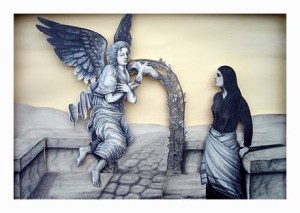
26 In the sixth month the angel Gabriel was sent from God to a city of Galilee named Nazareth, 27 to a virgin betrothed to a man whose name was Joseph, of the house of David. And the virgin’s name was Mary. 28 And he came to her and said, “Greetings, O favored one, the Lord is with you!” 29 But she was greatly troubled at the saying, and tried to discern what sort of greeting this might be. 30 And the angel said to her,Gabriel Visits Mary

“Do not be afraid, Mary, for you have found favor with God.

31 And behold, you will conceive in your womb and bear a son,
and you shall call his name Jesus.

32 He will be great and will be called the Son of the Most High.
And the Lord God will give to him the throne of his father David,

33 and he will reign over the house of Jacob forever,
and of his kingdom there will be no end.”

34 And Mary said to the angel, “How will this be, since I am a virgin?”

35 And the angel answered her,

“The Holy Spirit will come upon you,
and the power of the Most High will overshadow you;

therefore the child to be born will be called holy—
the Son of God.

36 And behold, your relative Elizabeth in her old age has also conceived a son, and this is the sixth month with her who was called barren. 37 For nothing will be impossible with God.”

38 And Mary said, “Behold, I am the servant of the Lord; let it be to me according to your word.” And the angel departed from her.

In the name of Jesus. Amen.

“Behold, you will conceive in your womb and bear a Son, and you shall call His name Jesus.”

These twelve verses are packed with salvation, they are filled with deliverance, they are stuffed with wonder and power and mystery and Gospel.

In these verses, we hear the basis for what we confess in the Nicene Creed: Jesus Christ, the Son of God “for us and for our salvation, came down from heaven, and was incarnate by the Holy Spirit of the Virgin Mary.”

In these verses, we hear the details of that mysterious beginning of John’s Gospel: “In the beginning was the Word, and the Word was with God and the Word was God…. And the Word became flesh and tabernacled among us” (Jn. 1:1, 14).

Small Catechism - Creed IconThis text tells us about the first new thing since the beginning of creation – a virgin becomes pregnant with a Son. This had never happened before, and it will never happen again. In a completely new and unique way God did what He had been doing since the beginning. He comes to dwell – to tabernacle – with His people.

When God led His people out of slavery in Egypt, God was present with them in a pillar of cloud by day and a pillar of fire by night. As Israel wandered in the wilderness, God instructed them to build the Tabernacle. After it was completed, Exodus 40:34-38 says that the cloud covered – it ‘overshadowed’ – the Tabernacle and the glory of Yahweh filled it.

For several hundred years, the Tabernacle continued to be the place where God dwelt among His people. Then, in our Old Testament text (2 Samuel 7:1-16), David realizes something – he is living in a nice, warm, comfortable house, but God is dwelling in a tent. Tents are for camping. Someone has said, “Camping is fun, if you like to pretend to be homeless.” So David decided to build God a house. But God told David that He had something much better in store. Through Nathan, God told David, “No, David. You’re not going to build a house for Me. I’m going to build a house for you. Your house and your kingdom shall be established forever.”

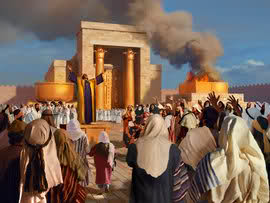
Solomon Dedicates the TempleAfter David died, Solomon built the Temple. 1 Kings 8 tells how the priests took the ark of the covenant and placed it in the Temple. Again, the cloud descended on the Temple – think ‘overshadowed’ again – and the glory of Yahweh filled the Temple.
As more centuries passed, the people of Israel began to sacrifice to pagan gods. Because of this, God sent the people into exile and allowed Babylon to destroy His Temple. Then when King Cyrus let the people of Israel return to their land, he told them to rebuild the Temple. But when this second Temple was dedicated, the cloud did not overshadow it. God’s glory did not return. This was very troubling for the people of Israel. God’s glory had departed, and it hadn’t come back.

However, through the prophets, God repeatedly promised that His glory would return to His Temple (Hag. 2:19, Zech. 8-9). Centuries passed, but God’s glory still did not return. Fast-forward several hundred years, King Herod began a large building project improving the second Temple and the grounds around it. But still, the glory did not return.

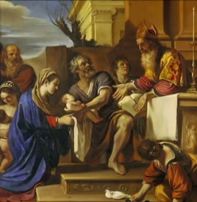
Then, suddenly, right here in our text, Gabriel tells Mary, “The Holy Spirit will come upon you, and the power of the Most High will overshadow you.” God’s messenger, Gabriel, tells Mary, “The glory and the cloud is going to descend upon you, Mary. God is coming again to dwell with His people.” Jesus presented in the Temple SimeonFor the nine months of her pregnancy, Mary was literally the temple, the place where God’s glory dwelt. And finally, when Jesus was 40 days old, God returned to His Temple.

There are three miracles are in this text: First, God and man are joined together in the Child conceived in Mary’s womb. The second is that Mary, a virgin, would conceive a Child. But third, and most miraculously, that Mary believed God’s word that this would actually happen.

Now, Mary is not the first believer. Adam and Eve, Noah, Abraham, Isaac, Jacob, Joseph, Moses, Joshua, David, Isaiah, Jeremiah, and all the godly Old Testament believers had faith in God’s promised Messiah, the Christ. But Mary is the first to learn the identity of God’s Messiah. The Child conceived in her womb is the Savior of the world. Mary is first in the line of faith in the person of Jesus.

The church of Rome goes too far in exalting Mary, and they are wrong to do so. However, we Christians outside of the Roman church have made the opposite error. We lower Mary too much. Mary truly is the mother of God. God was with Mary in a way that He will never be with another human. If you believe the creeds, then this is what you believe.

God entered the womb of only one woman, Mary. But through that union, God enters you. Gabriel’s greeting to Mary (literally translated), “Rejoice, favored woman, the Lord is with you,” is also true for you. God was with Mary, so He can be your Emmanuel – God with you.

The glory of God that overshadowed the Tabernacle and the Temple and the glory of God that overshadowed Mary, also overshadows you. Yes, it is a miracle that a virgin conceives, but that is child’s play for the Lord and Giver of life. It is a miracle that God joined Himself to human flesh, but nothing is impossible with God.

The real miracle here is faith. That Mary believed these words of God is a miracle. However, God is doing that same miracle here and now. God speaks to you, now, through His Word. You have already confessed that you believe these words of God in the Creed. You have confessed that you believe that Jesus, this Son of Mary, died and rose again for your sins. Just like Mary, but with different words, you have said, “Behold, I am the slave of God. Let it be to me as you have said.” Amen.

The peace of God, which surpasses all understanding, will guard your hearts and minds in Christ Jesus. Amen.

Isaiah 61:1-4, 8-11

Listen here.

Isaiah 61:1-4, 8-11

1   The Spirit of the Lord God is upon me,
because the Lord has anointed me

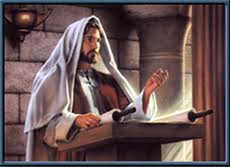
to bring good news to the poor; Jesus Reading Isaiah
he has sent me to bind up the brokenhearted,

to proclaim liberty to the captives,
and the opening of the prison to those who are bound;

2   to proclaim the year of the Lord’s favor,
and the day of vengeance of our God;
to comfort all who mourn;

3   to grant to those who mourn in Zion—
to give them a beautiful headdress instead of ashes,

the oil of gladness instead of mourning,
the garment of praise instead of a faint spirit;

that they may be called oaks of righteousness,
the planting of the Lord, that he may be glorified.

4   They shall build up the ancient ruins;
they shall raise up the former devastations;

they shall repair the ruined cities,
the devastations of many generations.

8   For I the Lord love justice;
I hate robbery and wrong;

I will faithfully give them their recompense,
and I will make an everlasting covenant with them.

9   Their offspring shall be known among the nations,
and their descendants in the midst of the peoples;

all who see them shall acknowledge them,
that they are an offspring the Lord has blessed.

10 I will greatly rejoice in the Lord;
my soul shall exult in my God,

for he has clothed me with the garments of salvation;
he has covered me with the robe of righteousness,

as a bridegroom decks himself like a priest with a beautiful headdress,
and as a bride adorns herself with her jewels.

11 For as the earth brings forth its sprouts,
and as a garden causes what is sown in it to sprout up,

so the Lord God will cause righteousness and praise
to sprout up before all the nations.

In the name of Jesus. Amen.

Rocky & DragoWe love Cinderella stories. We want the down-and-out rise from the dust. We want characters move from rags to riches, orphans to become kings. We want Rocky to beat Drago. We love these stories because we want to be like them. We want to move up, climb the ladder, reach the top. We want to better ourselves, rise up, and thrive. But we’ve tried it and found that too often, it doesn’t work.

We tried to better ourselves in the Garden of Eden. God told us that we were good. We were whole and needed nothing more to be complete. Then, Satan presented Adam and Eve with the possibility of becoming more than they were. “When you eat of the tree, your eyes will be opened, and you will be like God, knowing good and evil. You can improve yourself. You will be better than you are now.”

Adam and Eve attempted to climb the ladder. They took from the tree and ate. Their eyes were opened. They became something more. Now, they knew evil – but it was not better.

The root of sin is seeking to improve ourselves. We want to take control of our own lives. We want to be the master of our own destiny. We keep looking up, striving to be more. We want to be our own god. But the more we try, the more we fail, the more we sin, and the worse we become.

Christ of St John on the Cross Salvador DaliGod is not like us. God does not look up – there is nothing above Him. God doesn’t even look side-to-side – there is no one like Him. God only looks down. God looks down to those who are beneath Him. Luther even says, “The farther one is beneath God, the better doss God see him.” God is far-sighted.

God has always acted this way. God brings good news to the poor. Even before God cursed poor Adam and Eve, He promised that He would crush Satan’s head.

God binds up the brokenhearted. After Cain killed Abel, God gave Adam and Eve another son, Seth.

God proclaims liberty to the captives. He delivered His people from slavery under Pharaoh.

God opens the prison to those who are bound. Whether it was the apostles Peter, John, or Paul. God opens any and all iron bars to release His people.

God gives a beautiful headdress instead of ashes. Abraham’s son Isaac was not reduced to ashes, instead God provided.

God gives the oil of gladness instead of mourning. Jesus forgave the sins of the woman who washed His feet with her tears.

God does all of this because it brings Him glory.

God sees our pathetic attempts to rise up and improve, and He has pity on us. So He came down. He came down in the most dramatic, humble way.

Your God came down and placed Himself in the womb of a poor peasant girl. Your God came down to be born at night in a cold barn. Your God let Himself be carried by His parents to another country to escape being slaughtered as an infant. Your God grew up in a little podunk town learning the trade of a carpenter. Your God was despised and rejected by His peers and relatives. Your God touched lepers. Your God ate with the tax collectors and prostitutes. Your God suffered. Your God bled. Your God died. He did all of this for you.

God’s glory isn’t to become something more than He already is. God can’t become anything more. God is glorified through what He does for you. He was anointed to bring good news to you who are poor. His glory is to bind up you, the brokenhearted, to proclaim liberty to you who are captive in sin, and releasing you even from the prison of death. Christ’s glory is to proclaim to you the year of Yahweh’s favor and to comfort you who mourn. He is glorified by giving you a beautiful headdress instead of ashes and oil of gladness and garments of praise.

Baptism 2In your baptism, He clothed you in the garments of salvation. Through His Word, He covers you with the robe of righteousness.

Christ was anointed to do all of this for you. You, and the faithful believers who have come before you and who will come after you, you all are His garden, His planting. You produce the fruit of righteousness and praise. God has made His covenant with you, and He is always faithful to His promises. Amen.

The peace of God, which surpasses all understanding, will guard your hearts and minds in Christ Jesus. Amen.