Humbled for Your Redemption -Sermon on the 2nd Article of the Apostles’ Creed for Midweek Lent 2

The Scripture readings used during tonight’s service were Psalm 71; Isaiah 52:13-53:12; and Philippians 2:1-11.

Listen here.

And in Jesus Christ, His only Son, our Lord; Who was conceived by the Holy Spirit; born of the virgin Mary; suffered under Pontius Pilate; was crucified, dead and buried; He descended into hell; the third day He rose again from the dead;  He ascended into heaven; and is seated on the right hand of God the Father Almighty; from where He shall come to judge the living and the dead.

What does this mean?

I believe that Jesus Christ, true God, begotten of the Father from eternity, and also true Man, born of the virgin Mary, is my Lord; Who has redeemed me, a lost and condemned creature, bought me and freed me from all sins, from death, and from the power of the devil; not with silver and gold, but with His holy and precious blood and with His innocent sufferings and death; in order that I might be His own, live under Him in His kingdom, and serve Him in everlasting righteousness, innocence, and blessedness; even as He is risen from the dead and lives and reigns to all eternity.  This is most certainly true.

In the name of Jesus. Amen.

There are too many lords in here tonight. I’m a lord. You are a lord. You are a lord. Everyone sitting on this side of the sanctuary is a lord. Maybe you don’t feel like much of a lord. You don’t have a castle. You don’t have lands or titles or pedigree. You can’t control the economy. You can’t even control if your house has toilet paper because all the other lords have gone and purchased it all before you could get to the store.

Probably most of us don’t think we are guilty of seeing ourselves as lords. Each of us usually thinks that we are the low man on the totem pole while there is somebody else up there – in the school office, in Washington D.C., or wherever ‘there’ is. But guess again. You are a lord, and there are too many lords here and too many lords out there.

Haughty PrideA lord is not simply someone who has the final say or ultimate authority over a situation. A lord is anyone who exercises power over someone at any time. For example, you are a lord when you get into your car and drive 32 mph instead of the posted 30 mph because your time is more important than the safety of others. By the way, you are also a lord when you slow down to 27 mph in a 30 mph in order to teach a lesson to that guy driving 40 mph behind you. You are a lord when you sit down after a long day and your spouse or kids ask you for something, but you don’t feel like giving them the time or attention they desire. You are a lord when you go to the store or click your mouse to spend your money on yourself or family while ignoring the hungry and needy. Kids, you are a lord when you decide that your sibling has done something you don’t like, so you turn around and do something to them that they don’t like. Yes, there are too many lords today.

The question tonight is this: “What kind of lord are you?” In the Epistle text you heard earlier (Php. 2:1-11), Paul doesn’t ask the question directly, but the Holy Spirit would like that text to have us each answer the question, “What kind of lord am I?” And that Scripture text would have us consider ourselves in light of the Lordship of Jesus who is King of kings and Lord of lords.

As we consider the 2nd Article of the Apostles’ Creed this week and next, we are going to divide it in two parts – Jesus’ humiliation tonight and Jesus’ exaltation next week. Tonight, know this: because Jesus is Lord, the kind of Lord you have is a humble Lord.

Here is the first thing we have to understand about our Lord Jesus’ humiliation. To be humiliated or humbled, you have to start with some status. The higher you start, the more you can be humbled. So, consider Jesus. Jesus is the eternal, all-knowing, all-powerful, everywhere-present Son of God. You can’t start higher or more lord-like than that. But Jesus didn’t count equality with God a thing to be grasped or held on to.

Jesus’ lordship stands opposite to what Adam and Eve did. Remember in the Garden, Satan aroused Adam and Eve (who were given dominion [i.e. ‘lordship’] over all creation) to eat of the tree which God commanded them not to eat so that they would be like God. They took the bait and fell. Even though Jesus didn’t need to be like God (because He already was God), Jesus is patient and waits to be given that glorification, that lordship, until it pleases God to give it to Him. So, Christ chose to humble Himself.

Even though Jesus was true God and equal to God in all respects, as a man, Christ did not fully make use of His divine powers and attributes. If Jesus wanted to go somewhere, He didn’t teleport. Jesus didn’t sustain Himself by His divine power; instead, He ate food. Jesus took naps, and His feet got dirty. Yes, there are times where Jesus uses His divine power, but almost always it is for the benefit of others by healing them.

good-friday-jesus-comes-to-rescueJesus, the Son of God, emptied Himself by taking the form of a servant. He was formed and woven together in His mother’s womb, just like you were. Jesus was born just as you were born, but in a stable. The shepherds and wise men saw Him as an infant. As a helpless infant, Jesus entrusted Himself to the care of His parents who had to flee the violent, wicked hands of Herod, the lord of Jesus’ land. Jesus learned to walk, talk, and eat in Egypt. He was even potty trained there. He learned His letters and how to read after His parents moved Him to their hometown of Nazareth. Jesus grew up learning carpentry, the trade of His (earthly) father, Joseph. Lord Jesus made friends with the neighborhood kids, and He had siblings who didn’t always treat Him with kindness (Mk. 3:31-32, Jn. 7:1-5).

Jesus knew tiredness after a long day of travel (Jn. 4:6). He got hungry (Mt. 4:2). Jesus experienced disappointment of friends who betrayed Him (Lk. 22:47-48). He felt the pain of friends and family dying (Jn. 11:32-34). Jesus experienced the lure and enticement of every temptation that you face. Yet, Jesus still did not count equality with God a thing to be grasped. He did not use His divine power to remove Himself from any of those situations.

Instead, your Lord Jesus humbled Himself to the point of death, and not just any death. He humbled Himself to a cross-type death – the most painful and humiliating death ever devised for the lowest of criminals. To illustrate how humiliating Jesus’ death was, it is interesting to note that Muslims believe that Jesus was a prophet, but they don’t believe Jesus died on the cross because dying on a cross is below the dignity of a prophet. And finally, Jesus was buried in a borrowed tomb.

Dear saints, your Lord Jesus humbled Himself. You have a truly humble Lord, and Jesus, your Lord did all of this for your redemption. Yet, Christ is most God-like when He is on the cross. With all power and authority at His disposal, He lays it all aside to shed His blood for you, to die for you, to redeem you, to give you His grace and mercy, and to become your Lord.

Christian, that is the kind of Lord you have. Because you have been redeemed by your humble Lord, you are children of God and lords – with a little ‘l’ (1 Cor. 9:19, Ro. 13:8). And this world desperately needs little lords that have the humble mind of Christ. Amen.

The peace of God, which surpasses all understanding, will guard your hearts and minds in Christ Jesus. Amen.

Created by the Father to Love and Serve – Sermon on the 1st Article of the Apostles’ Creed for Midweek Lent 1

The Scripture readings used during tonight’s service were Psalm 104; Genesis 1:1-2:3; and Matthew 6:22-34.

Listen here.

I believe in God the Father Almighty, Maker of heaven and earth.

What does this mean?

I believe that God has created me and all that exists; that He has given and still preserves to me my body and soul, my eyes and ears, and all my members, my reason and all the powers of my soul, together with food and clothing, home and family, and all my property; that He daily provides abundantly for all the needs of my life, protects me from all danger, and guards and keeps me from all evil; and that He does this purely and out of fatherly and divine goodness and mercy, without any merit or worthiness in me; for all of which I am in duty bound to thank, praise, serve, and obey Him. This is most certainly true.

In the name of the Father and of the Son and of the Holy Spirit. Amen.

Tonight, we begin this little adventure of considering the Apostles’ Creed and the God who has created, redeemed, and sanctified us. From the moment I began thinking about this series, I knew that preaching the 1st Article would be the most difficult sermon to write because there are so many possibilities. I thought about preaching against evolution and atheism. Or preaching about the wisdom of God and the wonderful care and detail He used when He situated all the parts of creation for us to live on this little speck of dirt traveling through the universe. I thought about preaching how God our Father and Creator graciously continues to sustain and preserve creation even after the Fall into sin. There were too many possibilities. But my main concern about preaching the 1st Article was to make sure that as we consider the fact that God created us that it also fit with preaching Christ. So tonight, you are going to get a little of all that.

The poisonous theory of evolution that says the entire universe happened by a chance, chaotic explosion, that caused life to accidentally form in a violent world, and that life continues to exist only because of death and Galexysurvival of the fittest. But the more scientists discover and learn, the more it becomes impossible to believe that we are the product of a series of random events.

We live on a big earth, but when you compare our solar system to the size of the universe, our entire solar system is incredibly small. Yet, our solar system is placed in the perfect spot in the Milky Way Galaxy that protects us from radiation. The number and size of other planets in our solar system protect us from asteroids hurtling through space that would destroy Earth. Our planet is just the right distance from the Sun – move us much closer and everything would be too hot, much further and everything would be too cold. The axis of Earth is tilted just the right number of degrees to regulate heat on the planet. The size of our planet means it has enough gravity to hold on to the gasses of our atmosphere, but it is not so large that we become a gaseous giant like Jupiter. The chemistry of our planet is in perfect balance to sustain life. Our moon is just the right size to regulate tides that sustain life in the oceans. And the magnetic field surrounding us is perfect to shield us from the sun’s radiation. Each of these details show that you believe in an Almighty Creator.

That’s just the big picture, macro stuff. Let’s get tiny and consider the micro stuff. Your body is made up of somewhere around 35 trillion individual cells that serve various functions. If the DNA strands in those cells were laid out end to end, it would travel from here to the sun and back 100 times. DNAFrom the moment you were conceived, the information in your DNA would fill 600,000 pages with information. And right now, in each of the 35 trillion cells of your body, biological “machines” are copying the volumes of information in your DNA into amino acids which are taken by other machines and folded in specific and precise ways into proteins. (So, don’t let anyone tell you that you are lazy.) But with all those minute details, you believe in an intricate, sophisticated, wise Maker.

Yes, you believe in God Almighty, Maker of heaven and earth. And we could continue to consider all sorts of other facts about the universe and the size of the sun and the necessity of solar flares on the large scale. Or, we could consider the miracle of trillions of bacteria that line your intestines so you can digest the wonderful soup, sandwich, and desserts traveling through your gut right now on the small scale. And that would be time well spent marveling at the wonders of creation. But we would be missing what might be the most important word in the 1st Article – the word ‘Father.’

Every detail – both large and small scale – shows that you have a Creator who cares about everything large and small. Your God is the Father Almighty, Maker of heaven and earth. He cares for you and governs all creation to make sure that you have everything you need for life. Matthew 6_26 Birds Father ProvidesYour heavenly Father created and gives you everything. Your body and soul, your eyes and ears, all your members, your reason and senses – everything you have is a good gift from God your Father who daily provides for all the needs of your life. And He promises to continue to provide those things for you without any merit or worthiness in you. So, you don’t have to go running around worrying about what you will eat or drink or wear. God makes the sun to shine on the evil and the good, and He sends rain to the just and the unjust (Mt. 5:45). Everything that God provides for your life in His creation continues to be given as His good gift. The theological shorthand for all these things needed for life in God’s creation is called “1st Article gifts.” So, if you don’t mind, I’ll use that term again in a bit.

Now, the church has been fighting against atheism and the false theory of evolution for so long that we have forgotten to think about two important questions related to the 1st Article: How do we, as God’s creatures, view our neighbor? And what is our relationship and responsibility to creation? The answers to these questions are bound up together.

First of all, everyone you meet is one of God’s creatures intricately created and lovingly preserved by God. Every child from the moment of conception to the oldest person alive is a precious creature of God the Father. Every individual – no matter their skin color, their culture, their political views, or their ability – is valued and prized by the God who created them. So, treat them as such.

Your relationship and responsibility to them is to use all the 1st Article gifts God has given you to love them, to care for them, and to help and assist them. Sometimes, that means changing diapers, feeding, and cleaning up after them. Sometimes, that means holding a door, shoveling a sidewalk, or letting them merge into your lane. Sometimes, that means listening, assuring, encouraging, warning, or protecting them.

So, protect the blessings of creation. Care for this world and protect the blessings God has given both to you and to others. When you look at others, remember that they too are created by God, and He loves them as His creatures.

Rest in the knowledge that God your Father continues to protect you from all danger and guards and keeps you from all evil. He does this because He is your Heavenly Father. He knows what you need. He knows that you need to eat and drink. He knows every last one of your needs, and He will provide every one of these 1st Article gifts because He is your Father.

How can you know this? Because He sent what was most important in Him to provide for your deepest lack.Hebrews 4_12 - Word of God Sharp Sword

God the Father Almighty who made you has sent Jesus, His beloved Son, into creation, into this 1stArticle world, to redeem you. And to that redemption, we turn next week. Amen.

The peace of God, which surpasses all understanding, will guard your hearts and minds in Christ Jesus. Amen.

Faithful & Just – Sermon on 1 John 1:5-10 for Ash Wednesday

Listen here.

The Scripture readings for tonight were Jonah 3:1-10; 1 John 1:5-10; and Matthew 6:16-21.

In the name of Jesus. Amen.

I don’t remember exactly how old I was, but I was definitely old enough to know better. It was a cold, wet, Spring day. A friend from church, my sister, and myself were probably driving our parents crazy, so our parents dropped us off at the Williston Recreational Center to burn off some energy. The Rec. Center had two basketball courts, a few racquetball courts, and a hockey arena that still had the boards up but no ice. When we paid the fee and signed our names in, the employee told us that the empty hockey rink was off limits to the public that particular day, so we went to the basketball courts to play horse and lightning. But it didn’t take long before we got bored and decided we needed a little more excitement. So, of course, we went to the forbidden hockey arena.

I don’t remember exactly how we got past the front desk unnoticed, but we did. And we proceeded to have a grand time playing inside the boards. But not for long. I remember seeing the employee approaching the glass windows and door that separated the hockey arena from the lobby, and he didn’t look happy. I warned my friend and sister that we had been caught and were about to get in trouble. But my sister had a plan. She insisted that if we closed our eyes, the employee couldn’t see us. She said that it worked once for her friend. Now, I’m three years older than she is, so, again, I should have known better. But I did it. I closed my eyes as tight as I could and assumed the fetal position against the boards. I can only imagine how foolish we looked to that employee. Even as he hollered at us for being in there, I didn’t open my eyes until he tapped my shoulder.

Dear people of God, “If we say we have no sin,” (Notice that this is present tense. No matter how long you’ve been a Christian, not matter how much you’ve improved, no matter how much good you do, you still have sin.) “if we say we have no sin we deceive only ourselves,” and we look like a foolish child cowering with our eyes closed. We cannot flee from or escape the watchful eye of the God who created us. He knows your actions. He knows the words that come out of your mouth. He knows the thoughts of your mind. And He knows the hypocrisy of your heart. If we say we have no sin, the truth is not in us.

Repent because there is another way. Repent because that is the only way!

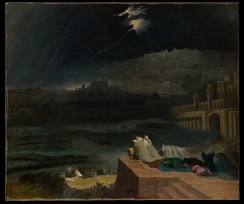
Scripture is clear that our God is merciful and gracious, slow to anger and abounding in steadfast love and faithfulness. This is one of if not the most common descriptions of God. In fact, this is how God Himself defines who He is (Ex. 34:6). Repentance of Ninevah by John Martin c 1840When Jonah preached to the sinners of Nineveh in our Old Testament lesson (Jon. 3:1-10), they repented from their evil, violent ways. And for them, it was as crazy an idea as closing their eyes to enable invisibility mode. The king says in his proclamation, “Who knows? God may turn aside from His fierce anger, so that we may not perish.” In other words, “Let’s try repenting. It might work.” Dear saints, we do not have to wonder how God will respond to humble, contrite sinners. Our Epistle Lesson (1 Jn. 1:5-10) says, “If we confess our sins, God is faithful and just to forgive our sins and to cleanse us from all unrighteousness.”

Make sure you catch all of the words there in v. 9. The text doesn’t just say “If you confess your sins, God will forgive and cleanse.” No. The text says that God is faithful and just to forgive. We would expect to hear different words there – words like merciful, gracious, kind, generous, or even lenient. But that is not what Scripture says. God is faithful and just to forgive you of your sins and cleanse you from all unrighteousness.

Dear saints, God’s forgiveness delivered to you is right and just. That’s saying it in a positive way. And it is true in a negative way (or the opposite way): God would be unjust to withhold forgiveness from you who confess your sins. Your sin, your shame, your unrighteousness, your guilt was all laid upon Jesus on the cross. He has taken all of it and endured the punishment that you deserve. For God to give you any of His anger or displeasure because of your sin would not be right or just. He would be removed from the bench, disbarred, and thrown into prison if He didn’t forgive you.

Dear Christian, be comforted. God faithfully and justly and willingly and delightfully forgives you all your sins because of what Jesus has done for you. Amen.

The peace of God, which surpasses all understanding, will guard your hearts and minds in Christ Jesus. Amen.

Living in Holy Light & Being Holy Light – Sermon for Midweek Advent 3 2019

Listen here. (The first 30 seconds of tonight’s sermon were not recorded. The missed portion was simply a summary of the previous weeks’ messages.)

The texts for tonight’s service were Isaiah 60:1-5; 2 Corinthians 4:6-12; and John 1:1-14.

In the name of Jesus. Amen.

Tonight, we are continuing the theme from 1 Timothy 4:4-5, “Everything is made holy by the Word of God and prayer.” In the first of these Advent sermons, we considered how God, the Holy One, makes us holy through His Word which cleanses and sanctifies us (Jn. 15:1-5; 17:17). Last week, we saw how God initially created all things good, but nothing created was holy by itself – nothing is inherently or intrinsically holy. So, God places His holy name upon us in our Baptism which makes us holy so we can be in His presence. This not only gives us access to God’s presence, it actually makes us a temple of the Holy Spirit who dwells in us (1 Cor. 6:19). This means, Christian, that you are no longer common. Now, you are sacred.

Tonight’s sermon will give us the picture of what our sacred life looks like according to Scripture especially from the Epistle lesson (2 Cor. 4:6-12). Paul is using imagery that was very common in his day, lamps. In the verses leading up to that text, he says that the Gospel – the good news that our sins are forgiven because of Jesus’ birth, life, death, and resurrection – is a light (2 Cor. 4:1-5). Then our text picks up that image. Look at those verses while I read and comment on them:

The God who said, ‘Let light shine out of darkness,’ has shone (Where?) in our hearts. (Why?) To give the light of the knowledge of the glory of God. We have this treasure – the treasure of God’s glory – in jars of clay.

These jars of clay are the lamps people used in New Testament times. Back then, houses were lit up, not by flipping on a switch but by little clay lamps filled with olive oil. Those clay lamps (or jars) had a small hole for a wick that floated in the oil and fed the flame.

So, God’s holy presence is in us. We have the treasure of His glory and power, but that holiness, that sacredness, that power, and that glory is hidden. You can’t see it just like you couldn’t see the oil inside of that clay lamp. But you know that oil is there as long as the wick continues to burn. If you lit a wick that didn’t have any fuel feeding it, that wick would burn up quickly. But when that wick has fuel, it will burn for hours and hours. Imagine that you didn’t know about the oil in the lamp, you would be surprised at how long the wick can burn.

Back to v. 7, we have this treasure hidden in jars of clay (Why?) to show that the surpassing power belongs to God and not to us. To close out this picture, Paul says that the life we have in Christ is reveled and shown in our suffering. Listen to v. 8-9, “We are afflicted but not crushed. Perplexed, but not driven to despair. Persecuted, but not forsaken. Struck down, but not destroyed.” When we endure suffering, others are able to see this surpassing power of God because of how it is manifested.

Afflictions do not crush us. Instead, they cause us to run to God (Ps. 129:2). Things that are perplexing and confusing do not cause us to despair (Ps. 37:32-33). When we have trials, we don’t need to wonder if God loves us – He does! When we are persecuted, we can know that we are suffering the very same things that Christ did. Jesus said, “If they persecuted Me, they will persecute you” (Jn. 15:20). When we are struck down, we turn the other cheek (Mt. 5:39) because we know that our enemies cannot destroy us – Christ has promised (Mt. 10:28). We have died and our life is hidden with Christ in God (Col. 3:1-4).

You see, dear saints who have been made sacred, God’s glory and power given to you is manifested to this world in your weakness for when you are weak, then you are made strong by God’s power (2 Cor. 12:9-10). Our problem is that this is the opposite of what we normally think. In every other aspect of our lives, growing up means that we move from depending on others to becoming independent. When a child can feed herself, walk, is potty trained, able to dress herself, tie her shoes, etc., we see that she is growing up into an independent woman.

The exact opposite is true of spiritual growth. Growing up spiritually means that we become more dependent upon Christ for everything in every situation. As we mature in faith, we learn to borrow all that we need from Christ which means that we grow in holiness.

As God shines the light of the Gospel into you, that light shines out of you so that you are a light to others. Jesus puts it this way Mt. 5:14–16, “You are the light of the world. A city set on a hill cannot be hidden. Nor do people light a lamp and put it under a basket, but on a stand, and it gives light to all in the house. In the same way, let your light shine before others, so that they may see your good works and give glory to your Father who is in heaven.”

God put the light of His Gospel into you so that you would give light to the dark house of this world. Jesus commands that light within you to shine. English cannot do justice to what the Greek does there. Jesus commands the light He has placed within you to shine so that the people of this world would see your good works and give glory to your heavenly Father.

I want to conclude tonight with one more image of what living in this light looks like by considering. Proverbs 3:5-6 (and I’m going to use a translation that might be different from what you are used to[1]), “Trust in the Lord with all your heart, and do not lean on your own understanding. In all your ways know Him, so that He will straighten your paths.”

These verses picture traveling, but it isn’t the normal traveling from one place to another. It is traveling through life. Throughout your life, you travel on many different roads and paths that seem to have little or nothing to do with each other and it can feel like you aren’t getting anywhere. You go from one thing to another, but it feels like you have no destination.

But these verses invite to you to know the Lord in all your ways. What does that mean? It means that He is present with you in everything. Wherever you go, He is there with you. He is your invisible partner and companion. When you woke up this morning, He was there. When you traveled to work or school, as you ate lunch, while you drove here, He didn’t abandon you. He was right there beside you. You have had lots of little journeys today, and the Lord was with you the whole time.

All the paths of today and yesterday and six months ago, and all the paths of tomorrow and every day of your future are all one journey because God is with you every step of the way. In all your ways, know Him, see Him, expect Him. He is there walking with you leading you along the way. You don’t have to map out your own journey, you can simply trust Him because He is there making your path straight.

The biggest problem you have and that I have is that we think we are traveling by ourselves. We don’t even bother to look for Him because we don’t expect Him to be there. But there He is giving us His light, leading us, guiding us, directing us along our paths. This means that all our paths are sacred because of God’s presence.

All the little paths and bits and tasks of your life are not the story of your journey but the story of Jesus’ journey with you. Live your life in His holy light as you radiate that holy light. Amen.

The peace of God, which surpasses all understanding, will guard your hearts and minds in Christ Jesus. Amen.

[1] Translation from Rev. Dr. John Klienig.

The Name That Makes Us Holy – Sermon for Midweek Advent 2 2019

Listen here.

The texts for tonight’s service were Numbers 6:22-27; Ephesians 1:3-14; and Matthew 28:16-20.

In the name of Jesus. Amen.

Last week, we considered how God, the Holy One, makes us holy through His Holy Word which cleanses and sanctifies us (Jn. 15:1-5; Jn. 17:17). Tonight, we are going to look at Scripture and see what this notion of holiness is all about. So, in order to try get an idea what is holy, we are going to look at Leviticus 10:10 to see how God views everything when it comes to holiness.

But before we can do that, we have to remember that when God finished creation, He stepped back and declared everything to be “very good” (Gen. 1:31). Everything created by God is, by God’s declaration, good as the theme verses (1 Tim. 4:4-5) for these services say. Notice that Scripture doesn’t say that God created things and called them ‘holy.’ Nothing created is inherently or intrinsically holy or unclean; instead created things were all created ‘good.’ However, now that we have brought sin into the world, there are various degrees of holiness and impurity. So, Aaron, the high priest and all the priests after him (Ezek. 44:23), were called by God to make distinctions. Look at Lev. 10:10, “You are to distinguish between the holy and the common, and between the unclean and the clean.”

Holiness SpheresGod’s holiness creates three interlocking spheres which I’ve tried to show with this figure.[1] Because God’s holy presence dwelled in the Tabernacle and later in the Temple, those places became the place where the holy God dwelt with fallen mankind (2 Chron. 6:14-21). They served as a bridge between heaven and earth, and specifically the Holy of Holies was where heaven and earth overlapped. So, in this figure, on the one hand, you have God’s holy presence and on the opposite side, there is the state of impurity which is utterly incompatible with holiness. What is unclean and defiled has been corrupted by sin and the devil. But you will notice there is all sorts of space between God’s holy presence on the one side and Satan and the demons on the other side. That is where we dwell.

Here’s the picture: What is holy is clean, but it is possible for something to be clean yet not holy which means it normal or common, which most things are. And something can be common but also unclean or abnormal.

In this ordering, things that are common must be cleansed of impurity before they can come into contact with God and share in His holiness or else, they are destroyed and consumed by God’s holiness. Last week we briefly considered Isaiah’s call (Is. 6:1-7). That event is helpful in understanding this concept.

When Isaiah was in God’s holy presence, he recognized his uncleanness. Isaiah’s lips were death-dealing, disordering, cursing, and made things around him sick. But the angel came with that coal from the altar (Is. 6:6) – which is an important fact because God had said that anything that touches the altar becomes holy (Ex. 29:37). With that holy coal, the angel touched Isaiah’s lips to purify him from his sins. Made holy by God’s declaration, that coal was life-giving, ordering, blessing, and healing so that Isaiah was made clean. After this encounter with God, Isaiah continued to receive God’s holiness as He received God’s Word, and Isaiah even emanated and transferred God’s holiness to others when He preached God’s Word. Even still today you receive God’s holiness that He dispersed through Isaiah as you hear God’s Word when you read the book of Isaiah. Get the picture?

Let’s fill this out a little more. The closer something comes to God, the holier it becomes. Think of it this way: The high priest was more holy than a normal Israelite, even though God had declared His people to be holy and sanctified them (Lev. 19:2; 21:8), because only the high priest could go into the Holy of Holies while the Israelite could only enter as far as the outer part of the Temple. The same thing was true for different sacrifices. Certain sacrifices and offerings, like peace offerings, were holy, but they were less holy than other sacrifices because they were offered outside of the Temple and didn’t ever come into the Temple.

The opposite is true for things or people that were unclean. Some things were desecrated and defiled – like a person who was a medium (Lev. 20:27) or someone who sacrificed a child to Molech (Lev. 20:2). These were so defiled and unclean that God required the death sentence. But other people who were defiled – like someone who touched a corpse (Lev. 11:31-32) or who had a skin disease (see Lev. 14) – were easily fixed and made clean. That person could be purified of the uncleanness and sanctified.

Now, I can hear some of you saying, “Sure, pastor. But that is all Old Testament stuff. Jesus did away with that kind of thinking.” To which I say, “Not so fast!”

In Mark 7[:1-23] Jesus, our great High Priest, continued to teach about what makes a person clean or defiled.[2] It is true that the incarnation of Jesus meant that the location of God’s holiness moved from the Temple building to Jesus’ body (Jn. 2:21-22). And now, Jesus’ death has ripped open the curtain that guarded the Holy of Holies (Lk. 25:45-46), so the focus of defilement is no longer the physical body, but the human heart.

And Hebrews (9:13-14) addresses this as well: “For if the blood of goats and bulls, and the sprinkling of defiled persons with the ashes of a heifer, sanctify for the purification of the flesh, how much more will the blood of Christ, who through the eternal Spirit Hebrews 9_14 - Christ offered Himself without blemish to Godoffered himself without blemish to God, purify our conscience from dead works to serve the living God.”

In Jesus, God’s holiness entered our common realm so that He could cleanse unclean sinners and expel the demons that brought defilement. And the demons recognized Jesus as the holy one of God who had come into the flesh to undo and cast out the uncleanness they brought with them (Mk. 1:21-27). All of this means that God’s holiness isn’t limited to the Temple building anymore.

Jesus’ incarnation, death, resurrection, and ascension has brought about such a cleansing that now you, believer, are the temple of the Holy Spirit who abides in you (1 Cor. 6:19). So, continue to receive God’s holiness.

One more analogy to help get this across: Today was a bright, sunshiny day. There were no clouds on the sky and the sun’s light wasn’t blocked; it came clearly through the sky and bounced off the snow making everything outside bright. If you braved the cold and went outside you were receiving amazing amounts of light from the sun. It isn’t possible to capture that light – bottle it up or something – and have it to use it later in these short, dark days. To keep receiving the sun’s light, you have to be where the sun is. The same is true with God’s holiness. You have to be where God has promised to deliver His holiness to continue in it.

Hebrews 10_19-23 Jesus our High PriestIn Jesus, God has come into this common world and brought His holiness to you. Because of what Christ has done, God has claimed you as His own so that you can live with Him in His kingdom and serve Him in everlasting righteousness. He placed His holy name upon you when you were Baptized. In your Baptism, you were marked with the name of the Father, Son, and Holy Spirit (Mt. 28:18-20). That holiness, given to you in your Baptism, is now continually delivered to you when you hear and believe God’s holy Word. As you hear the word of truth, the gospel of your salvation, you are sealed with the promised Holy Spirit (Eph. 1:13). God continues to place His name on you as He blesses you, keeps you, makes His face shine upon you, and be gracious to you (Num. 6:22-27). Bearing His holy name, you are brought into His holy presence, and radiate His holiness to those around you.

Christian, you are no longer common. Now, you are sacred. You bear the holy name of God throughout creation as you go about your common life in the midst of common people. Made holy by that name, you bring God’s sacred space to those who need purification and sanctification through Jesus’ blood. Rejoice and proclaim that name so that God’s sacred space continues to spread. Amen.

The peace of God, which surpasses all understanding, will guard your hearts and minds in Christ Jesus. Amen.

[1] The idea for this figure came from this paper by Rev. Dr. John Kleinig.

[2] See also what Jesus says when He washes His disciples’ feet in John 13:8-11. And when Jesus, our High Priest, came to wash His disciples’ feet, Peter objected. Jesus responded, “If I do not wash you, you have no share with me.” So, Peter went all in, “Lord, not my feet only but also my hands and my head!” And Jesus responded, “The one who has bathed does not need to wash, except for his feet, but is completely clean.” (See also Jn. 15:3, 17:17-19.)

The Holy One Makes Us Holy – Sermon for Midweek Advent 1 2019

Listen here.

The texts for tonight’s service were Exodus 3:1-5; 1 Timothy 4:1-10; and John 15:1-5.

In the name of Jesus. Amen.

For a little over two years, I have been mulling over those words we heard from 1 Timothy 4[:4-5], “Everything created by God is good, and nothing is to be rejected if it is received with thanksgiving, for it is made holy by the Word of God and prayer.” These words have a profound impact on how we, as God’s holy people, go about our daily lives and interact with the world.

Every home, every marriage, every relationship, every gift, every possession, every day, every night, all our work, all our sleep, all our joys, and all our sorrows: everything is made holy and sacred by God’s Word.

Tonight, we are going to begin a year-long journey considering God’s holiness: how that holiness comes to us, and the implications of what it means to live as God’s sacred people. Now, I know that a year sounds like a long time. It probably is. But when I was at a conference in the beginning of October, one of the pastors who was presenting mentioned that people have to hear something eight times before they begin to latch on to it. (For me, it is probably more like sixteen times.)

So, these mid-week Advent services will serve as an introduction to that theme: Sacred. And through this Church year I will repeatedly draw on this idea. Hopefully, by the end of it all, I will have touched on this theme often enough that we will have a better understanding of how God’s holiness is given to us in our Baptism, maintained by His Word, sustained in us through ongoing faith, and changes the way we interact with everyone and everything around us.

Now, it’s tempting for me to throw everything at you all at once, but I’m going to try to resist that temptation and remind myself that I have a whole year. So, tonight, we will begin by briefly considering how our holy God makes us holy.

God alone is holy, and, apart from Him, nothing is ever holy. We fallen, sinful humans can only be holy if we receive God’s holiness. Just as a flashlight has no energy to shine unless it has batteries, our holiness is completely dependent to being connected with the holiness of God. Our holiness is never our achievement; it is always a gift from God. And, yes, God wants to give us this holiness.

Exodus 3_14 - Burning BushIn our Old Testament lesson tonight (Ex. 3:1-5), Moses found himself standing on holy ground when God appeared in a bush. That bush was burning because of God’s holy presence, and Moses’ curiosity was piqued when he noticed that though the bush was aflame it was not consumed; it didn’t burn up. In the same way, when God’s holiness comes to us, it burns but God does not want us to be consumed by the fire of His holiness. Instead, He wants us to be changed by it.

Consider when Isaiah found himself in God’s presence (Is. 6:1-7). Isaiah saw the Lord high and lifted up, seated on the throne, the train of His robe filled the Temple, and the seraphim called out, “Holy, holy, holy is the Lord of hosts.” Isaiah knew this put him in a bad place. He cried out, “Woe is me! For I am undone; for I am a man of unclean lips, and I dwell in the midst of a people of unclean lips; for my eyes have seen the King, the Lord of hosts.” God’s holiness does two things to Isaiah.

First, God’s holiness revealed and unmasked Isaiah’s sin, and it wasn’t only Isaiah’s defilement that troubled him. Isaiah knew that because he lived among other sinners, their sinfulness and defilement had rubbed off on him making him more unclean and unholy. And God’s holiness was a fire that would reduce Isaiah to ashes. But God would not have it be this way.

Isaiah 6 - Holy Holy Holy Lips CoalSo, the second thing God’s holiness does to Isaiah is rub off on him. God sent one of the seraphs to fetch a burning coal, take it to Isaiah, and touch his lips with it and give a word of promise, “Behold, this has touched your lips; your guilt is taken away, and your sin atoned for.”

God didn’t appear in His holiness to undo Isaiah and destroy him. Instead, God brings Isaiah into fellowship with Him as He forgave and reconciled Isaiah to Himself making Isaiah holy and sacred to go and proclaim God’s Word.

Like Isaiah, we do not ever possess God’s holiness as our own. It isn’t something we can bottle up and store for later. We continually receive and borrow holiness from God, and God isn’t stingy in sharing His holiness with us. He happily and readily gives us His holiness through His Word making us sacred.

We heard this in the Gospel lesson (Jn. 15:1-5) where Jesus tells us that He is the Vine and we are the branches. There, Jesus gives us a beautiful picture of the holy lives we lead. As we abide in Him, who is the Vine, we bear sacred fruit. And God the Father prunes us so what we may bear more of that fruit. But Jesus doesn’t stop there. He tells us that already we are clean (it’s the same word Jesus used which was translated ‘pruned’). And what is the instrument that prunes us and makes us clean? It is His Word.

This means that Jesus doesn’t make us holy and then leave us to continue being holy on our own. Instead, He meets us where we are, calls us through His Word, and by that Word He joins us to Himself. As we abide in Jesus’ Word, He does everything for us and gives everything to us. Jesus invites us to safely approach our holy heavenly Father in faith with Him. Apart from Him, we cannot accomplish anything spiritually. But with Jesus, we stand on holy ground before God the Father in the heavenly sanctuary. Jesus brings heaven to earth for us so that we can live heavenly lives with Him here on earth.

God’s will for us as His children is to be holy as He Himself is holy (1 Pet. 1:14-16). The good news is that God doesn’t expect us to generate our own holiness. Jesus continually doles out His holiness upon us through His Word which makes us and all we do sacred.

More on that in the weeks to come. Amen.

The peace of God, which surpasses all understanding, will guard your hearts and minds in Christ Jesus. Amen.

Death Be Not Proud – Sermon on Matthew 28:1-7 for the Vigil of Easter

Listen here.

Matthew 28:1-7

Now after the Sabbath, toward the dawn of the first day of the week, Mary Magdalene and the other Mary went to see the tomb. And behold, there was a great earthquake, for an angel of the Lord descended from heaven and came and rolled back the stone and sat on it. His appearance was like lightning, and his clothing white as snow. And for fear of him the guards trembled and became like dead men. But the angel said to the women, “Do not be afraid, for I know that you seek Jesus who was crucified. He is not here, for he has risen, as he said. Come, see the place where he lay. Then go quickly and tell his disciples that he has risen from the dead, and behold, he is going before you to Galilee; there you will see him. See, I have told you.”

In the name of the Father and of the Son and of the Holy Spirit. Amen.

Alleluia! Christ is risen!
He is risen indeed! Alleluia!

In 1609 the English pastor and poet John Donne nearly died after being a pastor for eight years. After he recovered, he wrote a poem titled “Death Be Not Proud.” You would think that after nearly escaping death, you would be relieved and grateful. But Donne wrote his sonnet mocking death.

You would think death has a good reason to be proud. To our eyes, it appears that death never loses. Eventually, death gets all of us and our loved ones. We try to fight death with cancer screenings, seat belts, air bags, eating healthy, and a good fitness routine. Some fight death by coloring gray hairs and anti-aging serums. But, in the end, nothing works. And as much as you try to escape his grasp, death is happy and willing to be patient. If he doesn’t get you at sixty, he’ll wait around until seventy or eighty or ninety.

We try to ignore death. Sometimes, death is given more reverence than God Himself. In the Old Testament, people would avoid speaking God’s name because it was so sacred and holy. The same happens with death today. People don’t like to talk about death. Instead, they talk about their loved ones ‘passing away,’ or ‘going to a better place.’ Some insist that their loved ones not have a funeral but a ‘celebration of life.’

Death is lord in our culture and is seen as the answer to many problems in society today. The suicide rate continues to rise. States continue to pass “right to die” laws. And abortion – the murder and death of children in the womb – is viewed as a fundamental right by some.

Death casts a wide shadow, and we live in its shadow every day of our lives. But death has no reason to be proud because of what happened this day.

Death’s pride was death’s undoing. In his pride, death opened his jaws too wide and went too far. Death swallowed up the One who is Life (Jn. 11:24; 14:6) and it was death’s undoing. Our risen Lord and Savior Jesus Christ shows that death has been defeated forever.

Life and death fought against each other, and the Prince of Life came out of that contest victorious. Death stuck his stinger right into Jesus’ hands, feet, and side. And because of that, death has lost his sting (1 Cor. 15:54-56).

King Jesus rode into Jerusalem on a royal donkey to face death. Christ carried His cross to answer for all your faithlessness and sin. Jesus has drowned death in His blood which cleanses you from all your sin.

Death is defeated – now and forever. Even if death takes you, Jesus, the death Destroyer, says that you are not dead. Instead, Christ says, “I am the Resurrection and the Life. Whoever believes in Me, though he die, yet shall he live. And everyone who lives and believes in Me shall never die” (Jn. 11:25-26).

Dear Christian, even in death you are not dead. Instead you are Christ’s. In your Baptism, you have already been joined to Christ’s death, which means that your death will not and cannot last (Ro. 6:3-5). In this Holy Sacrament, Jesus feeds you with His living Body and gives you to drink of His living, life-giving Blood.

Death has no reason to be proud. Not anymore. Jesus has conquered the bitter tyrant of death. And He has connected you to that victory. Amen.[1]

Alleluia! Christ is risen!
He is risen indeed! Alleluia!

The peace of God, which surpasses all understanding, will guard your hearts and minds inChrist Jesus. Amen.

[1]The idea for this sermon comes from a sermon by Pr. Ralph Tausz which can be found here (http://www.apostlesmelrosepark.org/index.php?page=Sermons&sid=380).

It Is Finished – Sermon on John 19:30 for Good Friday

Listen here.

John 19:30

30 When Jesus had received the sour wine, he said, “It is finished.”

In the name of the Father and of the Son and of the Holy Spirit. Amen.

Dear saints, Jesus says, “It is finished.”

Jesus isn’t talking about His suffering. He doesn’t mean His agony or pain. These words do not refer to the darkness over the whole land while Jesus hung on the cross between noon and three. Yes, those things are coming to an end when Jesus says,“It is finished.”But Jesus is talking about something much bigger.

He is saying that the war between God and man is over. “It is finished.”

All of creation was plunged into sin and rebellion when Adam and the woman ate from the tree of which God commanded them not to eat. In that moment, all of humanity declared war against God. But God would not let mankind, the crown of His creation, be at war against Him. God would not fight against us though we fight against Him. Instead, He would fight for us.

Right after we fell into sin, God came down to the Garden and said that He would put enmity between Himself and the devil promising that the Seed of the woman would come and crush Satan’s head even as the devil crushed His heel. Then and there, God declared war – not against us – but against the devil, against death, and against your sin.

The Scriptures are the record of that war. Throughout the Bible, you read of the devil claiming people as his own, putting his name on them, making them his servants and followers, and dragging them with him into destruction.

But all the while God was fighting back. He kept rescuing His people from the devil and his armies. He rescued Adam and Eve. He delivered Abel, Noah, Abraham, and Moses. God ransomed His people from slavery in Egypt. He saved Joshua, Samuel, Samson, David, Elijah, Isaiah, Ezekiel, and countless others – both named and unnamed. God was fighting back, calling His people back to Himself. Promising that one day the battles would cease. The war would end. And there on the Cross, Jesus proclaims the victory when He says, “It is finished.”

The victory was costly – more costly than we can ever fathom. And the victory did not appear to be glorious. The victory, in fact, looked like defeat as the eternal Son of God hung there, dead on the cross. It is much easier for us to see Jesus’ heel being crushed than to see the devil’s head being crushed because that heel crushing is overwhelming.

But, dear saints, if the crushing of Jesus’ heel appears to be that devastating, how much more annihilating is the crushing of the devil’s head?

Today especially, but whenever you consider Jesus’ suffering, see what God is doing. He is ending the war. The war is ended not with a ceasefire or a peace treaty, but with total and complete victory. “It is finished.”

Consider what God says the crucifixion of our Lord means. It means that everything that was ever demanded of you in the Law (Col. 2:14), Jesus says, “It is finished.”

All the prophecies about Christ’s suffering that were recorded for us in the books of Moses, the prophets, and the Psalms (Lk. 18, 24), Jesus says, “It is finished.”

Everything that was necessary for the Christ to suffer so you could be forgiven and adopted as God’s child (Php. 2:5-15), Jesus says, “It is finished.”

Everything that was necessary for you to be saved and have eternal life (1 Pet. 1:10-12), Jesus says, “It is finished.”

Remember that God calls Jesus “the Lamb slain from the foundation of the world” (1 Pet. 1:19-20). It is God’s loving and gracious will for you to believe in Him. Everything that weighs on your soul, every sin that troubles your conscience, every burden of doubt, every fear, every worry, and every guilt is taken off of you and placed on Jesus. And Christ bears it away and buries it in the depths of the sea (Pr. Preus). “It is finished.”

Today is not bad Friday or sad Friday or black Friday. Today is Good Friday, the day that our Lord restored the original goodness to His creation, and that is most certainly good for us (Petersen).

The death of Christ is your redemption, your victory. Jesus is the Lamb who was slain, but now lives forever and ever. Christ has suffered and died in order that you might be His own, live under Him in His kingdom, and serve Him in everlasting righteousness, innocence, and blessedness. Christian, just as Christ is risen from the dead and lives and reigns to all eternity, you will too. Amen.

The peace of God, which surpasses all understanding, will guard your hearts and minds in Christ Jesus. Amen.

Clean and Cleansed – Sermon on John 13:1-15 for Maundy Thursday

Listen here.

John 13:1-15

Now before the Feast of the Passover, when Jesus knew that his hour had come to depart out of this world to the Father, having loved his own who were in the world, he loved them to the end. During supper, when the devil had already put it into the heart of Judas Iscariot, Simon’s son, to betray him, Jesus, knowing that the Father had given all things into his hands, and that he had come from God and was going back to God, rose from supper. He laid aside his outer garments, and taking a towel, tied it around his waist. Then he poured water into a basin and began to wash the disciples’ feet and to wipe them with the towel that was wrapped around him. He came to Simon Peter, who said to him, “Lord, do you wash my feet?” Jesus answered him, “What I am doing you do not understand now, but afterward you will understand.” Peter said to him, “You shall never wash my feet.” Jesus answered him, “If I do not wash you, you have no share with me.” Simon Peter said to him, “Lord, not my feet only but also my hands and my head!” 10 Jesus said to him, “The one who has bathed does not need to wash, except for his feet, but is completely clean. And you are clean, but not every one of you.” 11 For he knew who was to betray him; that was why he said, “Not all of you are clean.”

12 When he had washed their feet and put on his outer garments and resumed his place, he said to them, “Do you understand what I have done to you? 13 You call me Teacher and Lord, and you are right, for so I am.14 If I then, your Lord and Teacher, have washed your feet, you also ought to wash one another’s feet. 15 For I have given you an example, that you also should do just as I have done to you.”

In the name of the Father and of the Son and of the Holy Spirit. Amen.

Peter gets uncomfortable when Jesus laid aside His outer garments, tied a towel around His waist, got down on His hands and knees, and began to wash the disciples’ feet. Jesus washes the Disciples' feetThe Man whom Peter had confessed to be the Son of the living God (Mt. 16:16), the Man who had healed the sick, fed the masses, and raised the dead, the Head of all creation (Col. 1:15) kneels to wash Peter’s dirty, smelly feet.

Foot washing was a common thing in those days. Anyone who was going to be a guest at a banquet would have their feet washed even if they had just bathed. The walk from one house to another would make a person’s feet dirty and dusty enough to need another washing. But the task of foot washing was always reserved for the lowest of servants. Disciples would do many different chores for the rabbi they were following, but foot washing was never one of them. But here, Jesus, the Rabbi, the Teacher sent from God, and in fact God Himself in the flesh, humbles Himself to do the lowest of tasks for His disciples.

To understand how shocking this is, you have to imagine having some guests over for a fancy dinner. You have cleaned the parts of the house you expect they will go, but not the whole house – especially not that one bathroom. But imagine your horror if you found one of your well-dressed guests on their hands and knees on that hard, tiled floor with a sponge scrubbing the scum and stains around that neglected toilet.

We aren’t told how the other disciples react to this; however, they were probably uncomfortable with the arrangement as well. But Peter is, of course, the one to speak up and object, “You shall never wash my feet.”

But Jesus turns this event into a new lesson, “If I do not wash you, you have no share( or “no part”) with Me.”Jesus isn’t simply talking about washing feet anymore. He doesn’t say “If I do not wash your feet…,” He says, “If I do not wash you, you have no share with Me.”This is about Peter’s heart and his general need for the cleansing and forgiveness that Jesus has come to give. And Peter understands so he says, “Then don’t just wash my feet, but wash my hands and my head too.” In other words, “Jesus, I need You to thoroughly wash me and make all of me clean because I am so sinful.”

But Jesus responds, “The one who has bathed does not need to wash, except for his feet, but is completely clean. And you are clean, but not every one of you.”

Not everyone who is in that upper room is clean because Judas was still there and was about to betray Jesus. Judas is not clean because he is not a Christian; Judas does not trust in Jesus’ promises of mercy and forgiveness. The other eleven disciples do trust in Christ, so Jesus says that they are completely clean. Their whole being is clean. Jesus is referring to not their bodies, but their souls. Even the dirtiest, most sinful parts of the disciples are completely clean. Their sins have been washed away and cleansed.

So, what is this that Jesus says they need to have their feet cleaned? Well, they keep falling into sin. They keep fighting with each other about who is the greatest. They keep making promises that they can’t keep. They are clean, but they keep sinning. They keep stepping in the same old sins, but their whole being is already clean.

We can’t get our minds around this reality that Jesus presents unless it is about sin, and even then, it is hard to grasp.

Christian, Jesus has died on the cross and absorbed the entire wrath of God against your sin. As Jesus said, “It is finished.”God isn’t holding a charge, a sin, or an accusation against you to judge you on the Last Day. There is no dirt or anything left to do for you to be cleansed by Christ. You are already clean.

Baptism 2In your Baptism, Jesus has sprinkled clean water on you thus cleansing you from all your uncleannesses (Ezk. 36:25). In your Baptism, God has given you the new birth (Jn. 3:5), He has connected you to Jesus’ death and resurrection (Ro. 6:3-5), He has given you the washing of regeneration and the renewal of the Holy Spirit (Tit. 3:5).

And yet, though you have been cleaned by God in this way, you still get dirty feet all the time. Even since this service started, you have had evil and bitter thoughts, you have let your mind wander from the Word of God, etc. You are clean, but you need to be cleaned again.

That is why you are here tonight. You are a saint and a sinner at the same time. You are holy and righteous in God’s sight, yet you have sinned. And you need mercy and cleansing again.

Well, sinner and saint, Jesus has the answer. After He washed His disciples’ feet, Jesus served the disciples again. Christ took bread and gave it to the disciples saying, “Take, eat. This is My Body.”Then, He took the cup and gave it to them saying, “Take, drink. This is My Blood given and shed for you for the forgiveness of sin.”

Christ gives this cleaning to Christians who are clean and pleasing to God but need cleaning again.

Dear saint, you are declared by Jesus to be clean. Your Lord and Savior is here to be your servant and clean you again. Come and receive what He gives you for your comfort, for your strengthening, for your cleaning. Amen.

The peace of God, which surpasses all understanding, will guard your hearts and minds in Christ Jesus. Amen.

The Eighth, Ninth, and Tenth Commandments: Truth & Contentment

Listen here.

In the name of the Father and of the Son and of the Holy Spirit. Amen.

Just a heads up: Tonight, we will not consider these Commandments in order. I’ll start with the 9th and 10th Commandments since they go together and are only slightly different (I’ll explain why they are different later). Then, we’ll close with the 8th Commandment.

Though it has been corrupted by sin, your conscience is an important gift from God. Imagine your conscience like a radar that picks up all sorts of sins. Blip, there’s anger violating the 5th Commandment. Blip, there’s laziness violating the 7th. Blip, there’s lust violating the 6th. Blip, there’s disrespecting authority violating the 4th. But your conscience probably doesn’t even register sins against the 9th and 10th Commandments about coveting. Coveting is, in a sense, the stealth bomber of sin. Paul mentions this in Romans 7[:7-8] where he says, “I wouldn’t even have known what it was to covet if the Law had not said, ‘You shall not covet.’”

I preached on training and softening your conscience a couple of weeks ago, and if you missed that sermon, I would encourage you to go back and read or listen to it (March 24th on Luke 11:14-28 titled “The Last State”). Tonight’s sermon will, hopefully, help to soften your conscience when it comes to the 9th and 10th Commandments. And softening your conscience to violations of the 9th and 10th Commandments will, I promise you, help you battle against your sins with regard to all the other Commandments.

Now, as we have gone through this series, I have tried to show you how God is giving and protecting His good gifts to you in each of the Commandments. If is helpful for you to see the whole Commandment, turn to p. 23 of the hymnal for the whole list.

In the 1st Command, “Have no other gods,” God gives you the gift of Himself. In the 2nd, “Don’t misuse God’s name,” God gives you the gift of prayer. In the 3rd, “Keep the Sabbath holy,” God gives you the gift of His Word. In the 4th, “Honor your parents,” God gives you the gift of order. In the 5th, “Don’t kill,” God gives you the gift of life. In the 6th, “Don’t commit adultery,” God gives you the gift of marriage. In the 7th, “Don’t steal,” God gives you the gift of stuff. In the 8th, “Don’t lie,” God gives you the gift of truth and a good name. You get the idea.

So, in the 9th and 10th Commandments about coveting, what gift is God giving you? Any guesses? I’ll give you a clue, it isn’t something that we usually recognize or rest in. Contentment. God is giving you and protecting His gift of contentment.

Everything around us screams at us that we shouldn’t be content. Open a paper, see a billboard, scroll through social media, surf the internet, turn on the radio or television and everything there will tempt you to break these Commandments of coveting. All marketing campaigns and advertisements are built around getting us to break these last two Commandments. Now, we can’t blame advertisers for our sins of coveting. And even if you cut out all media from your life, you would still break these Commands.

Now, I’ve said it before, but it bears repeating. You never break only one Commandment. We’ve already seen how breaking the 6th Commandment about adultery is often followed by breaking the 5th Commandment about murder. But you never break Commandments 2-8 without first breaking the 9th or 10th Commandment. Sin, all sin, starts down in the 9th or 10th Commandment with coveting or, another way to put it, false desire. Scripture teaches this. James 1:13-15 says that God tempts no one. But each person is tempted when he is lured and enticed by his own desire, referring 9th and 10th Commandments. “Then desire when it has conceived gives birth to sin, and sin when it is fully grown brings forth death.”

In tonight’s Old Testament lesson (1 Kings 21:1-29), we heard how King Ahab broke the 9th Commandment and then broke the 5th, 4th, 8th, and 7thCommandments.

Now, this is why the 9th and 10th Commandments are so important. In these Commands, God gives us the gift of contentment and protects us from false desire. Colossians 3:5 says that coveting is idolatry. Hear that again: Coveting is idolatry. At its core, coveting is idolizing yourself and making yourself a (little ‘g’) god by saying, “God, You messed up. That thing my neighbor has over there should be mine over here.”

So, when you are struggling with sin, notice where it starts – coveting. If you are full of lust (which is adultery [Mt. 5:28]), you have the false desire to have a spouse that is attractive in a different way than your spouse. If you are angry (which is the same as murder [Mt. 5:21-22], you have a false desire for someone to act differently than they act. If you are lazy (which is thievery), you have a false desire there too.

Repent. Recognize that false desire and cut it off at the roots. Fight against the sin of coveting. Now, listen to these Commandments and see if you can tell the difference between the two…

The 9th Commandment
Thou shalt not covet thy neighbor’s house.

What does this mean?
We should fear and love God so that we do not seek by craftiness to gain possession of our neighbor’s inheritance or home, nor obtain them under pretense of a legal right, but assist and serve him in keeping the same.

The 10th Commandment
Thou shalt not covet thy neighbor’s wife, nor his manservant, nor his maidservant, nor his cattle, nor anything that is thy neighbor’s.

What does this mean?
We should fear and love God so that we do not estrange or entice away our neighbor’s wife, servants, or cattle, but seek to have them remain and fulfill their duty to him.

Did you catch the difference? It’s so simple, it’s silly. It has to do with whether the thing you covet has legs or not. The spouse, servants, and animals outlined in the 10th Commandment could conceivably end up in your possession in a way that would appear to be righteous. You could make your neighbor’s dog love you more than your neighbor by giving it treats or something and steal it. Don’t covet it and steal it. Don’t falsely desire what your neighbor has that can’t move, and don’t falsely desire what your neighbor has that can move.

Finally,

The 8th Commandment
Thou shalt not bear false witness against thy neighbor.

What does this mean?
We should fear and love God so that we do not deceitfully lie about, betray, backbite, nor slander our neighbor, but defend him, speak well of him, and put the most charitable construction on all that he does.

I’ll be brief here because I know I’ve gone long on the 9th and 10th Commandments.

We break this Commandment when we desire the truth to be different and lie. But we also break this Commandment when we desire the truth to make our neighbor look bad and spread gossip. I remember when I was in Confirmation and memorized this Commandment and meaning. That last phrase, “put the most charitable construction on all that he does,” that phrase cut me down.

Yes, lying is bad, and we often have our conscience pricked when we lie. But gossip and tearing others down is just as bad. Even when you are telling the truth about someone else’s sin, you are violating this Commandment. Don’t tell someone else about another’s sin if the person you are speaking to doesn’t need to know about it. You don’t like it when it happens to you. Repent. In this Commandment, God protects His gift of the truth.

And recognize that this is the truth. Christ has come. He has kept the Law, all of the Law, perfectly on your behalf. He never fell short of perfectly loving God or loving His neighbor. He perfectly loved you by laying down His life for you. And because of what He has done on the cross, He takes all of your sin against God’s Law and in exchange gives you His perfect obedience. Christ has removed your heart of stone and given you a heart of flesh. Yes, fight against your sin, but live in Christ’s grace now and forever. Amen.

The peace of God, which surpasses all understanding, will guard your hearts and minds in Christ Jesus. Amen.