John 16:16-22
16 “A little while, and you will see me no longer; and again a little while, and you will see me.” 17 So some of his disciples said to one another, “What is this that he says to us, ‘A little while, and you will not see me, and again a little while, and you will see me’;and, ‘because I am going to the Father’?” 18 So they were saying, “What does he mean by ‘a little while’? We do not know what he is talking about.”
19 Jesus knew that they wanted to ask him, so he said to them, “Is this what you are asking yourselves, what I meant by saying, ‘A little while and you will not see me, and again a little while and you will see me’? 20 Truly, truly, I say to you, you will weep and lament, but the world will rejoice. You will be sorrowful, but your sorrow will turn into joy. 21 When a woman is giving birth, she has sorrow because her hour has come, but when she has delivered the baby, she no longer remembers the anguish, for joy that a human being has been born into the world. 22 So also you have sorrow now, but I will see you again, and your hearts will rejoice, and no one will take your joy from you.”
Alleluia! Christ is risen!
He is risen indeed! Alleluia!
In the name of Jesus. Amen.
Jesus says, “I’m here, but in a little while I won’t be here. Then, a little while later I’ll come back.”And the disciples are confused. They whisper to each other about this and none of them knows what this ‘a little while’ means. So, Jesus explains it to them.
First and foremost, this ‘little while’ refers to what would happen in a couple of hours. Jesus is soon to be betrayed and arrested. He will be tried, crucified, killed, and buried. Somewhere in that sequence, all of the disciples will no longer see Jesus. For most of them, it is when Jesus is arrested. For Peter, it is during Jesus’ trial while he is out by a bonfire denying he knows Jesus the third time (Lk. 22:61). And for John, it is either at the cross or at the burial. The disciples don’t see Him anymore, and they weep and lament because Jesus is dead, buried, and sealed behind the stone in the tomb.
But it is only for a little while – Friday evening and night, all day Saturday, Saturday night through Sunday afternoon before they see the resurrected Jesus once again. Again, first and foremost, this is the ‘little while’ Jesus is referring to.
But Jesus also alludes to something more. He is also speaking about His ascension, which is what Jesus was referring to when He said He was “going to the Father.” Don’t miss that part of our text. The morning of the Resurrection, Jesus appears first to Mary Magdalene. When she recognizes Jesus, Mary falls at His feet and embraces Him (Mt. 28:9), but Jesus says to her, “Do not cling to me, for I have not yet ascended to the Father; but go to my brothers and say to them, ‘I am ascending to my Father and your Father, to my God and your God.’”
So, yes, He is referring to the time that the disciples weep and lament and have sorrow between His burial and resurrection. But here, in this text with this ‘little while,’ Jesus is also referring to the time while you have sorrow between His ascension and return in glory on the last day, which means, you, dear saint, are even now living in the ‘little while’ Jesus refers to.
 This ‘little while’ has lasted nearly two thousand years and counting. Yet, two thousand years is nothing when you compare it to everything that lies ahead for you in eternity. And it is even more miniscule when you realize that it will only be a few short years before you meet Jesus face-to-face – even if you live to be one-hundred-twenty. But we still have a problem. During our pain and anguish, our difficulties and seasons of tribulation, time seems to stand still while we suffer. But we can take heart and be encouraged. Jesus says it will only be ‘a little while.’
This little phrase from Jesus – ‘a little while’ – is meant to be comforting in the midst of sorrow, pain, anguish, trials, and tribulations. First, it lets us call that trouble what it is – it is suffering and not something that God ever intended you to experience. When you suffer, you don’t have to put on a brave face and say things like, “I know other people have it worse than I do.” No. No matter how great or small, call suffering what it is – suffering. The second reason this is comforting is that you can know that your God and Savior promises that your suffering can only last ‘a little while.’
Mothers, you understand Jesus better than anyone else which is why He uses you as an example here. As a man who has never and will never give birth, and as a father who has been present at the births of all four children, I hesitate to speak too much about this – especially on Mothers’ Day. But as a pastor who has been called to preach God’s Word, I must echo what Jesus says.
Kids, your mom suffered to bring you into this world. The pain and anguish of a woman in labor is real – there is no denying it. And, mothers, Jesus knows the pain you have been through, not because He ever gave birth, but because He is the one who said that a woman’s pain in childbirth would be greatly increased after the Fall (Gen. 3:16). But when a mother has delivered the baby – and remember this is according to Jesus – she no longer remembers the anguish because of her joy that a child has been born into the world.
It is not as though her memory is erased and she forgets the pain of labor – that is not what Jesus says. Instead, her anguish is swallowed up by joy that she now has a child to love and cherish. This is the main thing Jesus is teaching us in this text. Sorrow and suffering is temporary for you, Christian. It can only last ‘a little while’ and no more.
 Now, there is no denying that your suffering is real. Some of you are currently enduring that suffering in severe ways right now. We pray that your relief will be soon and swift. But know this: God is working through those sorrows. He is using your trials to keep you close to Himself, to work virtue in you, to teach you to trust in Him. This does not mean that you should rejoice because of trials and tribulations. Instead, it is a reminder that you can rejoice in spite of and in the midst of that suffering. Like buds on a tree indicate that full blossom is coming, those troubles, trials, sorrows, and crosses are harbingers of the joy that is to come.
And if you aren’t currently going through trials right now, you will. Jesus says that you will weep and lament, and you will be sorrowful. Jesus has called you to take up your cross and follow Him. Good Friday always comes before Easter, but Easter joy always overcomes Good Friday sorrow. Resurrection always defeats death.
Christian, the crosses you have borne in the past, the crosses you bear now, and the crosses you will bear in the future will and must give way to Resurrection joy because – already and now – Christ is risen.
Pain, sorrow, trial, and tribulation is real and there is no getting around it. A slave is not above his master. If Jesus is persecuted and suffers, you will be persecuted and suffer (Jn. 15:20). And Jesus promises, “You will weep and lament, and you be sorrowful, but your sorrow will turn into joy. And no one will take your joy from you,”because Jesus has promised it will only be ‘a little while.’
Alleluia! Christ is risen!
He is risen indeed! Alleluia!
Amen.
The peace of God, which surpasses all understanding, will guard your hearts and minds in Christ Jesus. Amen.
 For our great comfort, Scripture gives many images of God shepherding His people. Psalm 23, of course, comes to mind. We have a picture in the entry of our church of Jesus walking through green pastures and still waters leading a flock of good-looking sheep. Jesus tells the parable of the shepherd who goes out seeking his one lost sheep, hefts it on his shoulders, and brings it home. All of that imagery is Scriptural and comforting and good.
 Yes, it does mean ‘good’ but not in a subjective sense, not in a way that is open to anyone’s interpretation. Jesus is uniquely qualified to be the Shepherd of sinful sheep. Christ is the ‘good for you’ Shepherd. Kalos also means ‘right, fitting, true, beautiful, and competent.’ And Jesus Himself defines exactly what makes Him the kalos Shepherd. His the kalos Shepherd because of the fact that He lays down His life for the sheep.
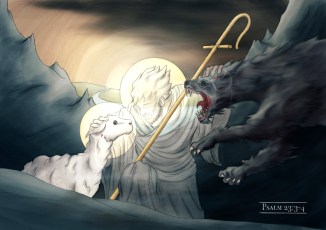 My dear fellow sheep: Jesus is the kalos Shepherd; you are the sheep. You are not called to stand toe-to-toe with the devil. Satan, sin, and death are the wolves, and you are the sheep. Hide behind Jesus. Christ, your kalos Shepherd, places Himself in danger to rescue you from every threat. But even as you hide behind your kalos Shepherd, you do not cower in fear. Hide behind Jesus confidently knowing that He has overcome the wolf, won the victory, and His victory is your victory because you are His.
 he showed them his hands and his side. Then the disciples were glad when they saw the Lord. 21 Jesus said to them again, “Peace be with you. As the Father has sent me, even so I am sending you.” 22 And when he had said this, he breathed on them and said to them, “Receive the Holy Spirit. 23 If you forgive the sins of any, they are forgiven them; if you withhold forgiveness from any, it is withheld.”
 Listen carefully: You don’t outgrow your need for the Gospel. Ever. There are many things that Scripture teaches that are important about how to live and function in this world, and all of us need to heed that instruction from the Word. But you don’t graduate from the pure spiritual milk of the Gospel. You never mature past the point of needing to hear about the peace that Jesus has won for you on the cross and which He preaches to His disciples in this text.
 Jesus is speaking about you. Christian, Jesus had you in mind when He spoke those words. You have not seen Your resurrected Savior in the flesh. You don’t see the marks in Jesus’ hands and side. Instead, you see crosses that remind you of the death that Christ died for you. You see the font where Jesus delivers to you His mercy and forgiveness and washes away your sins. You see an altar on which nothing has ever been sacrificed but which Jesus uses as His table to feed you His risen Body and Blood.
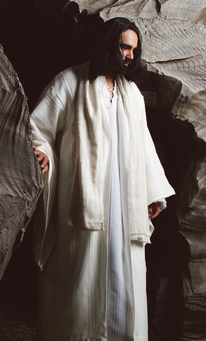 And you can smile in his face, “Yes, death, you used your sting, didn’t you? You should have used your sting on me. The sting would have stuck on me. But you didn’t. Instead, death, you used your sting on my Savior, my God, and my Lord. You used your sting on Jesus, didn’t you? You had Jesus pinned tightly on the cross, and you stuck Him with your stinger and buried it into Him. Death, you were a fool that day. You stung God Himself. You stung Jesus who is the Resurrection and the Life (Jn. 11:25). But when you went to the tomb to find your stinger and get it back, Jesus wasn’t there. And guess what, death, Christ has taken my sin as He hung on the cross. And, death, you will not ever get your sting back. Never. That empty tomb means that your sting is lost forever. Death, I don’t fear you any longer.”
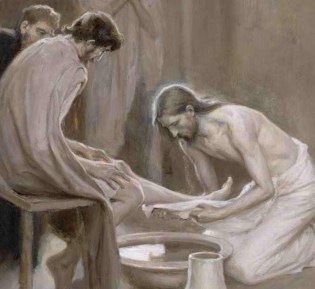 The Man whom Peter had confessed to be the Son of the living God (Mt. 16:16), the Man who had healed the sick, fed the masses, and raised the dead, the Head of all creation (Col. 1:15) kneels to wash Peter’s dirty, smelly feet.
 In your Baptism, Jesus has sprinkled clean water on you thus cleansing you from all your uncleannesses (Ezk. 36:25). In your Baptism, God has given you the new birth (Jn. 3:5), He has connected you to Jesus’ death and resurrection (Ro. 6:3-5), He has given you the washing of regeneration and the renewal of the Holy Spirit (Tit. 3:5).
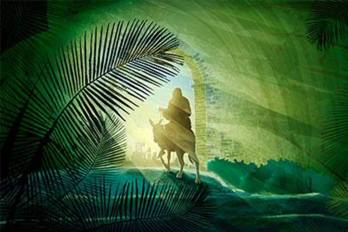 The main focus of Matthew’s Passion account we just heard is the royalty of Jesus. Christ rode into Jerusalem on a royal donkey just like King David and King Solomon (1 Kgs. 1:38) had done. But Matthew doesn’t focus on Jesus’ royal greatness or magnificence. Instead, Matthew focuses on King Jesus’ innocence. Matthew points us to King Jesus “the Innocent.”
 Jesus has arrived in Jerusalem. The Priest has come to the Temple. The Prophet has come to Mt. Zion. The King has come to His city. But most importantly the Lamb of God has come to His altar, where He would in five days breathe His last and pour out His blood for you (Pr. Wolfmueller). This is your Lord’s Passion, done and completed for you. Amen.
 Or my favorite, the boy standing in the middle of the room with his eyes closed tight. (To my great shame, I learned closing your eyes doesn’t make you invisible when I was in fourth grade.) Silly kids.
 Jesus stood in the middle of people who have been looking for a reason to kill Him for almost His entire ministry (Mk. 3:6). Today, Christ declares Himself to be no less than Almighty God. When He declares Himself to be the great I Am, Jesus announces that He is the One who is Lord over all things, and the One who always was, always is, and always will be, the One who spoke to Moses from the burning bush, the One who led their ancestors through the Red Sea on dry ground, the One whom Isaiah saw in the Temple.
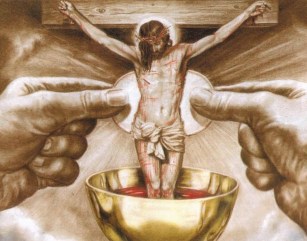 All of that is hidden so that you do not have to face it. It is hidden so that you do not need to hide.
 Pastorsamwise
You must be logged in to post a comment.