Matthew 5:21-37
21 “You have heard that it was said to those of old, ‘You shall not murder; and whoever murders will be liable to judgment.’ 22 But I say to you that everyone who is angry with his brother will be liable to judgment; whoever insults his brother will be liable to the council; and whoever says, ‘You fool!’ will be liable to the hell of fire. 23 So if you are offering your gift at the altar and there remember that your brother has something against you, 24 leave your gift there before the altar and go. First be reconciled to your brother, and then come and offer your gift. 25 Come to terms quickly with your accuser while you are going with him to court, lest your accuser hand you over to the judge, and the judge to the guard, and you be put in prison. 26 Truly, I say to you, you will never get out until you have paid the last penny.
27 “You have heard that it was said, ‘You shall not commit adultery.’ 28 But I say to you that everyone who looks at a woman with lustful intent has already committed adultery with her in his heart. 29 If your right eye causes you to sin, tear it out and throw it away. For it is better that you lose one of your members than that your whole body be thrown into hell. 30 And if your right hand causes you to sin, cut it off and throw it away. For it is better that you lose one of your members than that your whole body go into hell.
31 “It was also said, ‘Whoever divorces his wife, let him give her a certificate of divorce.’ 32 But I say to you that everyone who divorces his wife, except on the ground of sexual immorality, makes her commit adultery, and whoever marries a divorced woman commits adultery.”
33 “Again you have heard that it was said to those of old, ‘You shall not swear falsely, but shall perform to the Lord what you have sworn.’ 34 But I say to you, Do not take an oath at all, either by heaven, for it is the throne of God, 35 or by the earth, for it is his footstool, or by Jerusalem, for it is the city of the great King. 36 And do not take an oath by your head, for you cannot make one hair white or black. 37 Let what you say be simply ‘Yes’ or ‘No’; anything more than this comes from evil.”
Grace, mercy, peace be to you from God our Father and from our Lord and Savior Jesus Christ. Amen.
 Most jokes do not work unless you have certain pieces of information. This past NFL season, DIRECTV had a series of commercials called “Peyton on Sunday Morning.” As I was watching a game early this season one of those ads come on. The commercial opens with Peyton Manning sitting in his pajamas on his couch with his feet on the coffee table. He calls his brother, Eli, to tell him that he has NFL Sunday Ticket which allows him to watch every game in HD. So Eli should come over and Peyton even offers to make nachos. But Eli declines, “I can’t, man. I’m playing.” Peyton sadly shakes his head and says, “Oh yeah…. Alright, I’ll pencil you in for Tuesday.”
Sarah saw this commercial and asked, “How is that funny? Aren’t they both quarterbacks?” I had to inform her that Peyton had retired, a fact that I thought every red-blooded American knew, but apparently, I was wrong. I guess there are more important things than knowing the status of quarterbacks. Anyway, the light went on, and Sarah then understood the humor behind the commercials. She didn’t quite get them before because she didn’t have all the information.
The same thing happens in all sorts of movies, television shows, and suspense stories. There are certain clues that point to this person being the killer. But then, one piece of information comes to light, and everything falls into place and reveals what really happened. Columbo was great at catching criminals in their own words with his notorious line, “Just one more thing.” That “one more thing” was always the final piece of information needed to see the criminal’s guilt.
In this Gospel text today, Jesus is doing exactly that. But to bring our sin to light, Jesus doesn’t say, “Just one more thing.” Instead, Jesus says, “But I say to you.”
 Jesus is preaching about the Commandments – specifically the 5th, 6th, and 8th Commandments. But what Jesus tells us is no joke. His sermon does not give us that important nugget of information to bring us into hysterical laughter. Instead, Jesus’ preaching on the Commandments reveals the horrific murder scenes, the scandalous affairs, and the blatant lies that surround us every day. Like a black light revealing the traces of blood stains in an otherwise clean-looking room, Jesus’ words reveal just how sinful and depraved we are.
Jesus challenges our attempts to justify ourselves in the sight of the Law. In fact, He obliterates any claim we might have to keeping the Commandments.
Jesus says, “You have heard that it was said to those of old, ‘You shall not murder; and whoever murders will be liable to judgment.’ But I say to you that everyone who is angry with his brother will be liable to judgment. When you use angry words to insult your brother, you are liable to the council and the fire of hell.”
Jesus says, “You have heard that it was said, ‘You shall not commit adultery.’ But I say to you that look, that glance, that peek was just as evil as adultery in the eyes of God because you have already committed adultery in your heart.”
Jesus says, “You have heard that it was said to those of old, ‘You shall not swear falsely, but shall perform to the Lord what you have sworn.’ But I say to you, don’t even bother with taking oaths. Anything more than a simple, ‘Yes,’ or, ‘No,’ comes from the evil one.”
And here is the rub. No amount of external discipline can change the hateful and murderous, the lustful and adulterous, the dishonest and deceitful ways of your heart. If you cut off one hand that keeps sinning, the other will make up for it. If you pluck out the eye that focuses on those lusty images, the other eye will compensate.
What Jesus says is true: It is better and preferable to enter the kingdom of heaven with one hand and one eye than to be thrown completely into hell. But self-mutilation doesn’t get you into the kingdom of heaven.
Jesus will not and cannot lessen the Law. The Law stands forever accusing you, sinner. Not the least commandment, not an iota, not a dot will perish from the Law until all is accomplished.
 These words of Law that Jesus preaches in the Sermon on the Mount are true and eternal words. But they are not Jesus’ last word. On another mountain, on Golgatha, Jesus preaches the Gospel that all the Law is accomplished in Him. He takes your sin, your anger, your murder, your lust, your adultery, your lies, and your betrayal. He takes it all and fulfills all the Law for you when He says, “It is finished.”
Sinner, you can’t get out from your punishment on a technicality because your sin has already been punished to the full extent of the Law on Jesus. You see, there are no loopholes in the Law of God because there are no gaps in Jesus’ mercy.
Just as Christ has reconciled you to God, be reconciled to others. Be forgiven. Be free. Love your neighbor even when you think he deserves your hatred. Husbands, love your wives and cherish them. Wives, honor your husbands and be submissive to them. Children, obey your parents for this is right. Be salt. Be light. Be forgiven. Be a beam of mercy in this dark world. Amen.
The peace of God which surpasses all understanding will guard your hearts and minds in Christ Jesus. Amen.

 And what happens when you don’t believe God when He says, “You are the light of the world”? Jesus has an answer for that too. First, things become absurd. It is like trying to hide a huge city set way up high on a hill. Then, it becomes dangerous. It is like putting a dry basket over a flame. What happens when you put a basket, when you put fuel, over a burning lamp? Fire breaks out and burns everything up.
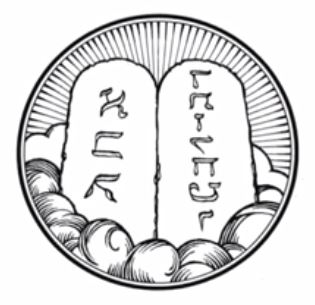 God says, “You will have no other gods before Me.” So do the good work of believing God. Fear, love, and trust in Him above all things. He is saying, “Bet all your chips on Me being a good God to you.”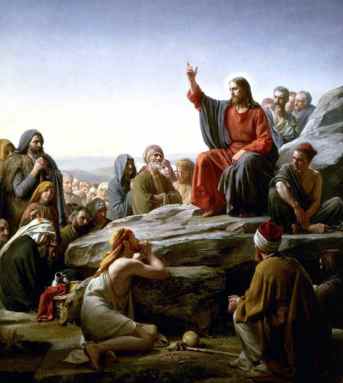
 Today, you are baptized. Today, Jesus has washed you in a saving flood. Today in your Baptism, you were buried with Jesus into His death so that, just as Jesus is risen from the dead, you too would walk in newness of life. Today, you have received the washing of regeneration and the renewal of the Holy Spirit.
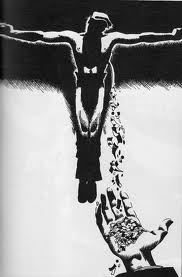 Blessed are you. Hear that again, “Blessed are you.” Blessed are you when people hate you because of what the Word of God says. In each of these Beatitudes, by saying you are blessed, Jesus says you are saved.
 As you grow, your parents, your sponsors, and your church will teach you about a lot of lambs in the Bible.
 Eloise, pay attention to all these stories about lambs because they all point to one Lamb – to Jesus, the Lamb of God who takes away the sin of the world.
 All you believers, behold Jesus. Behold Him who was in the beginning before anything else, the One who was with God and was God. Behold Jesus who made all things, yet became flesh. Behold Jesus who is the light and life of all.
 In John’s hesitation to baptize Jesus, we see John’s sinful pride rearing its ugly head. If John truly believed that he wasn’t worthy to carry Jesus’ sandals (and he wasn’t), then who does John think he is to question his Lord when Jesus tells John to baptize Him? How dare John say, “Look, Jesus, You’ve got it all wrong”?
 Abby, on this day of your Baptism, and all of you baptized believers here, remember this. Before anything you are a Baptized child of God. You belong to Him. He has placed His Name upon you. Jesus has joined you to Himself – joined to His death, buried you in His tomb, and raised you in His resurrection.
 The opening to John’s Gospel tells us the nativity story as a cosmic battle. John doesn’t tell us about Joseph or Mary. He doesn’t mention the shepherds and angels. He doesn’t even set the scene in Bethlehem. Instead, John tells us, “In the beginning was the Word and the Word was with God and the Word was God.”
 And so, dear Harper, today on the day of your Baptism, through the washing of water with the Word, you became a child of God. Harper, you became a child of God because He became a child of a woman. Harper, Jesus, your God and Savior, became Flesh and dwelt among us so that you and all your brothers and sisters in Christ could be His own, dear children.
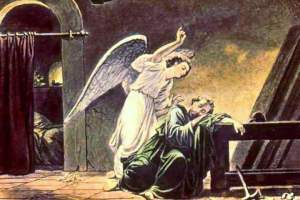 Joseph is in a mess. His legally-bound fiancé is pregnant, and Joseph knows that he is not the father. Joseph is a just man, a respectable man, an honorable man. It is very possible that Joseph had paid several years’ savings to become engaged to Mary. Legally, Joseph could have taken Mary into court and gotten his money back. Instead, Joseph resolves to quietly divorce her so she doesn’t get stoned for her apparent adultery. Joseph knows that this will bring him public shame and disgrace, but he is willing to do it anyway. Joseph is not willing to put Mary to shame.
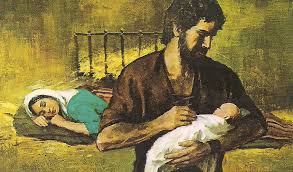 Yet Joseph endured all of that suffering and shame because of God’s promise. And Joseph clung to that promise that this Child, entrusted into his care, would save him from his sins.
 This is more unique than the Cubs winning the World Series or the Vikings winning the Super Bowl. Start dancing in the streets. Throw a parade. But, hang on, we’d better wait. Before we start blowing the confetti and popping the champagne corks, look – there in prison, in Herod’s dungeon – there sits John the Baptizer. We should probably wait for him.
 What do you do when you cannot pray because Jesus has seemed to fail you? What do you do when Jesus doesn’t bust you out of the prison of suffering and doubt, and it looks like He has left you there to rot? What do you do when Jesus becomes offensive?
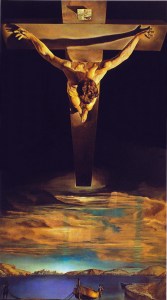 When you are offended by Jesus, remember, that in the cross and the empty tomb, He has defeated all your doubts, all your afflictions, and all your diseases.
 10 Even now the axe is laid to the root of the trees. Every tree therefore that does not bear good fruit is cut down and thrown into the fire.
 They say, “You are what you eat.” John’s diet of locusts has a locust effect, but John’s diet of honey also has a sweet effect too. John preaches, “Repent. Repent for the reign of heaven is at hand.”
 This is the second, and most important part of repentance. Repentance, turning away from trust in yourself and your own works and efforts leads you to trust in what Jesus has done for you.
 Jesus didn’t tell His disciples to find a chariot and a mighty war horse to chauffeur Him into Jerusalem. He could have, but He didn’t. Jesus’ entrance into Jerusalem was not a red-carpet event. He didn’t make His way on top of a long runner of fine, royal fabric. Again, He could have, but He didn’t. Instead, Jesus told the disciples to find a donkey and a colt – common beasts for common, poor people. And your Savior entered Jerusalem passing over the cloaks of the people who welcomed Him and over the palm branches they found nearby.
 Today is a day to celebrate and be glad. You have been adopted into a loving, caring family. Your parents have chosen you to be their children. You have the unique privilege of never having to wonder if your parents wanted you or not. You will always know that your parents have intentionally brought you into your family and have promised to care for you and love you.
 Pastorsamwise
You must be logged in to post a comment.