Matthew 13:44-52—44 “The kingdom of heaven is like treasure hidden in a field, which a man found and covered up. Then in his joy he goes and sells all that he has and buys that field.
45 “Again, the kingdom of heaven is like a merchant in search of fine pearls, 46 who, on finding one pearl of great value, went and sold all that he had and bought it.
47 “Again, the kingdom of heaven is like a net that was thrown into the sea and gathered fish of every kind. 48 When it was full, men drew it on the beach and sat down and sorted the good into containers but threw away the bad. 49 So it will be at the end of the age. The angels will come out and separate the evil from the righteous 50 and throw them into the fiery furnace. In that place there will be weeping and gnashing of teeth.
51 “Have you understood all these things?” They said to him, “Yes.” 52 And he said to them, “Therefore every scribe who has been trained for the kingdom of heaven is like a master of a house, who brings out of his treasure what is new and what is old.”
In the name of Jesus. Amen.
In these final three parables of Matthew 13, Jesus continues to teach what the kingdom of heaven looks like. Remember, please that our word kingdom can sometimes be misleading when we try to understand the kingdom of heaven. The kingdom of heaven is not a country or piece of land defined by boarders. Instead, the kingdom of heaven is the active, saving reign and rule of God in Jesus Christ. Jesus came to earth announcing the reign of heaven was at hand and His every action brought that reign.
Jesus faced opposition as He ministered and brought the reign of heaven. As you look back to the context of Mt. 12 and 13, you see that Jesus is being rejected. The crowds do not believe Him, the Pharisees are seeking to destroy Him, and even Jesus’ own family is trying to get Him to quit teaching because things aren’t going so hot. But this opposition and rejection doesn’t stop Jesus. In fact, Jesus tells seven parables in Matthew 13 to teach that the reign of heaven is still going on despite the obvious adversity.
Jesus begins with the Parable of the Sower and the Seed which teaches that there is nothing wrong with the seed, which He explains is the Word. The problem is that people are rejecting it. Jesus continues with the Parable of the Weeds and the Wheat which shows that Satan is actively trying to disrupt and ruin God’s saving action in Jesus, but the parable teaches that the devil will fail and God will triumph. The Parable of the Mustard Seed shows that the operation of the reign of heaven begins small, but it spreads out – way out. The Parable of the Yeast shows that the reign of heaven will penetrate into the whole world even though it won’t look very impressive most of the time.
Our text today continues with three more parables about the active reign of heaven as it comes in Jesus. Jesus teaches these final three parables to His twelve disciples privately and not to the crowds.
First, the Parable of the Hidden Treasure: Now some take this parable as though we sinners go out into a field and find the reign of heaven, then, once we find it, we should give up everything we have to take possession of the kingdom. But there is a problem with this. In every other parable in this chapter, Jesus Himself is the main character. We should carry this theme into to these parables as well. Jesus is the man who finds a treasure out in a field.
In Jesus’ day, landowners didn’t have mineral rights. If you there was treasure in your field but you don’t know about it, the treasure doesn’t belong to you. Notice also that the man who finds the treasure doesn’t lift the treasure up If the man is employed by the landowner (and he likely is even though the parable doesn’t state that explicitly) he is obligated to tell the owner about the treasure. Instead, the man simply covers the treasure, goes, and sells all that he has in order to buy the field. Since he knows about the treasure, once he buys the field, the treasure is his.
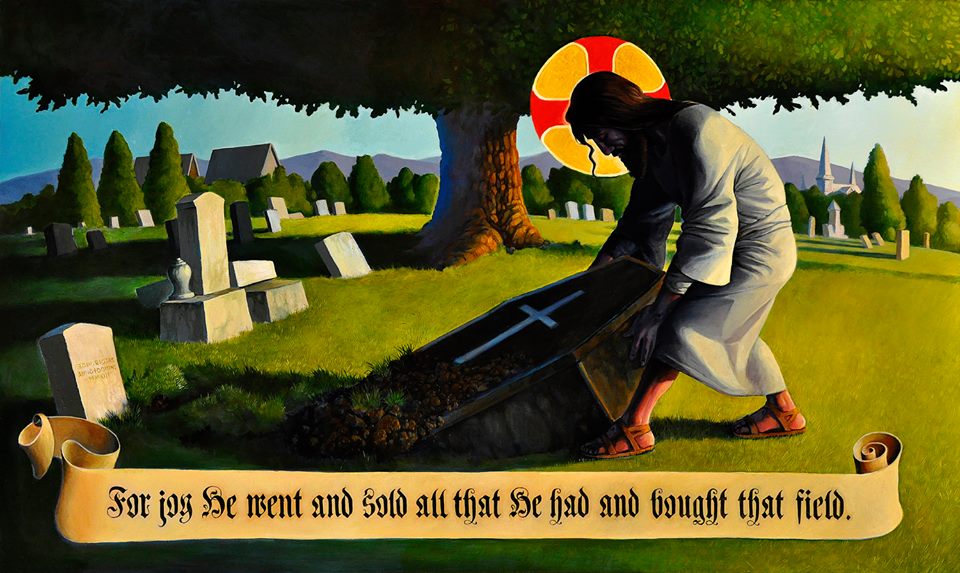
Copyright: Edward Riojas. Used by permission
Now, back when Jesus explained the parable about the weeds and the wheat, Jesus said that the field was the world (lit. the κόσμος). So picture Jesus walking through the field of the world and coming across this treasure. What is this treasure? It is you – you who are dead in sin and caught in a box that you cannot escape from. Remember back in our OT text (Dt. 7:6-9), God said that His people were His treasured possession. They weren’t a treasure because they were so great and so many and so mighty. They were treasured because God loved them.
Jesus puts another parable before the disciples about the reign of heaven being like a merchant who is searching for fine pearls, but He finds one so valuable that He sells all that He has and buys it. Though Jesus was in the form of God, He did not count equality with God a thing to be grasped, but emptied Himself of everything. He did this by taking the form of a servant, being born in the likeness of men. And being found in human form, He humbled Himself by becoming obedient to the point of death, even death on a cross (Php. 2:6-8).
Jesus puts one final parable before the disciples. The reign of heaven is like a net that is thrown into the sea. This net gathers up every kind of thing. Interestingly, Jesus, as He tells the parable, doesn’t even use the word fish; our English translations just insert it. Imagine throwing a net into the Red River. What would you find once you pulled up that net – empty bottles, slimy camping pots, all sorts of garbage, animal corpses, and, to be sure, fish. Once the net is filled up, the angels will draw it up on the beach, sit down, and sort the good stuff into containers but throw away the bad (lit. ‘rotten’).
This parable tells us that the day will come when the evil and the righteous will be separated. Our epistle text (Ro. 8:28-39) makes clear that Jesus, the Son of God who died for the sins of the world and rose again, is the one who condemns. He will direct the angels as they sort out whatever the net catches. He can use a little elbow grease to shine up that slimy camping pot. Who knows what kind of valuable thing He can make with a broken bottle? Jesus will tell the angels who is good, justified, and righteous, and He will tell the angels who is rotten and evil.
This whole world is filled with rotten, evil people. So is this room – this sanctuary. Every last one of us here is rotten and evil. But God in Christ found us all broken, dead, and rotten in sin. He found us, treasured us, and gave everything He had in order to purchase us back by giving His life – His body and His blood – on the cross.
“Everybody, even the worst stinker on earth, is somebody for whom Christ died” (Capon). Just as a hospital is a place for the sick, the church is a place for sinners. We are misrepresenting Christ if we act otherwise. The righteous and just are righteous are righteous and just only because of the free gift of Jesus’ righteousness. This righteousness has been offered to all. But even though Jesus has given this righteousness to everyone some decided they don’t like it and demand to be accepted just as they are, but they won’t be.
After finishing these parables, Jesus asks the disciples, “Have you understood all these things?” That is a scary question for a teacher to ask. The disciples give a quick Yes answer.
Jesus gives a blessing – to them and to you. “Every scribe (not meaning the religious group who sought along with the Pharisees to kill Him, but everyone who learns the Word of God) Every scribe who has been discipled for the reign of heaven is like a master of a house (lit. ‘house despot’), who brings out of his treasure what is new and what is old.”
Did you catch that? Loaded up with the teaching of these parables, which we have only scratched the surface of, believer, you are like the master of a mansion full of treasure. And you can be glad to give these treasures away because there is simply so stinking much of it.
Believer, be at peace knowing that though you were dead in sin, Jesus found you. He treasured you. And He joyfully went and sold all He had to make you His own. Rejoice because He has promised that there is nothing in all creation which will separate you from His love (Ro. 8:38-39). He who has ears, let him hear. Amen.
The peace of God, which surpasses all understanding, will guard your hearts and minds in Christ Jesus. Amen.
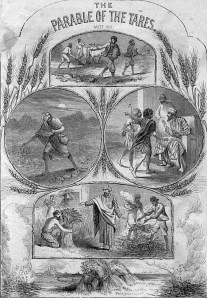 The reign of heaven may be compared to a man who sowed good seed in his field, but in the night an enemy comes and sows weeds. The weeds Jesus speaks about look identical to wheat as they grow, but at harvest time the grains of this weed are a different color than the wheat. The servants of the master ask if they should go and go and gather the weeds, but take careful note of what the master says:
 But Jesus teaches with the parable of the Sower and the Seed, and the disciples don’t like this. They are disappointed. “Why do You speak to them in parables?” they ask (13:10). It is as if the disciples are saying, “Jesus, don’t You see how much trouble You’ve stirred up today. People are rejecting Your message. The Pharisees hate You, and You are separating us from the crowds and even Your own family. Now, You are teaching in parables? Come on, clear things up! Teach them plainly so they can understand.”
 But God did reveal (lit. “apocalypsed”) His salvation to those who had no wisdom of their own – to the “little children.” All sinners, that includes you, are without understanding. Like Paul in our epistle text (Ro. 7:14-25), you too are a slave to sin. You carry the burden of knowing what is right and good, but you don’t do it. Like Paul, you practice the very things you hate and know to be evil. You reject and deny God’s authority over you.
 at might be St. Augustin’s most famous quote he says to God, “Thou hast formed us for Thyself, and our hearts are restless till they find rest in Thee.” The rest that Jesus gives is completely foreign and alien to our normal, everyday existence. The rest Christ delivers is the forgiveness of sins and the end striving against God. That rest is what God wanted us to have so He gave us the third Commandment, “Remember the Sabbath day to keep it holy.” God wanted us to set apart a whole day when we could find rest in being fed with His Word. Jesus is offering the eternal Sabbath rest that only comes from God.
 Matthew 10:34-42—34 “Do not think that I have come to bring peace to the earth. I have not come to bring peace, but a sword. 35 For I have come to set a man against his father, and a daughter against her mother, and a daughter-in-law against her mother-in-law. 36 And a person’s enemies will be those of his own household.
 The Prince of Peace says, “Do not think that I have come to bring peace to the earth. I have not come to bring peace, but a sword.” Strange words from Jesus especially when we remember that, at His birth, the angels sang, “Peace on earth,” (Lk. 2:14). Such an odd saying from Jesus who, the night before He dies proclaims, “Peace I leave with you; My peace I give to you” (Jn. 14:27).
 In Junior High and early High School, my favorite article of clothing was a sweatshirt which had a little logo embroidered over my heart which said, “No fear.” That sweatshirt was my favorite. It was forest green with a plaid hood. I felt super cool wearing it, so I probably wore it more often than I should have. I would don that bold and defiant statement, “No fear.” However, underneath that sweatshirt was the skin and bone frame of a timid, dorky adolescent. In reality, I feared lots of things. I feared the mean kids. I feared being left out and rejected. I feared that no girl would ever like me.
 In the face of persecution and death, Jesus tells His disciples – and you – do not fear, but acknowledge (lit. ‘confess’) Christ. Jesus solemnly urges you to make your confession of salvation through Christ. He has redeemed you and everyone you meet with His holy and precious blood and with His innocent sufferings and death.
 This message is for you here today. God gives an urgency to this message because these are the last days. God’s final attack on sin has occurred in the person of Jesus Christ. Therefore, be united with Him through baptism. Are you already baptized? Good; remember the promise God made to you there. His promise is that He has forgiven your sins, made you His child, and ushered you into His presence now and forever. Amen.
 As your pastor, I covet your prayers, and I know that many of you are very faithful about praying for me and my family. This was an extremely hectic and rough week for me personally. And this sermon, more than any of the 289 others I have preached here in the past four years and five months, is what I need to hear today.
 This world is filled with troubles and sin and death. This world throws all sorts of sufferings and crosses that trouble our hearts. But Jesus’ words in this text show that no matter what comes our way, God is using them to conform us, His chosen, elect children, into the image of His Son. “For neither death nor life, nor angels nor rulers, nor things present nor things to come, nor powers, nor height nor depth, nor anything else in all creation, will be able to separate us from the love of God in Christ Jesus our Lord (Ro. 8:38-39).”
 Pastorsamwise
You must be logged in to post a comment.