Dominion – Sermon on Isaiah 9:2-7; 1 John 2:7-14; & Matthew 4:12-17 for Midweek Advent 2

Isaiah 9:2-7; 1 John 2:7-14; and Matthew 4:12-17

In the name of Jesus. Amen.

When Isaiah tells us that “the people who walked in darkness have seen a great light,” what is the darkness he is referring to? The context of tonight’s passage from Isaiah 9 is the same as last week’s from Isaiah 7. Judah is being attacked by the armies of Syria and Israel, but instead of being firm in faith that God will deliver (Is. 7:9b), King Ahaz is buying help from the evil Assyrian empire (2 Kgs. 16:5-8). In other words, the days were definitely dark because of the enemies they faced.

But because of how the Holy Spirit inspired Matthew to mark the fulfillment of that Isaiah passage in our Gospel reading (Mt. 4:12-17), we know that this darkness is referring to a greater darkness than what covered Judah about 2,700 years ago. The darkness God is promising to deliver His people from is the darkness of sin and death. The light that shines even through that deep darkness is the light Christ brought when He began His ministry calling people to, “Repent for the kingdom of God is at hand” (Mt. 4:17).

Isaiah here was inspired by God to write about something that would happen 700 years later as though the hour of light and redemption had already come. Isaiah spoke as though he was standing before Jesus’ manger, “For to us a Child is born, to us a Son is given.” 

A Child, a Son, who will defeat the blackest darkness, becomes a humble, lowly Infant born and laid in a manger.

We love underdog stories. Whether it’s Rudolph the red-nosed reindeer getting the lead spot on Santa’s sleigh, Cinderella or Ariel marrying the handsome prince, Charlie getting the title to Wonka’s chocolate factory, the Mighty Ducks beating the Hawks, Kevin Malone repeatedly booby-trapping the Wet Bandits, or two hobbits destroying the Ring of Power. Even though those are all very different stories, they have the common theme: the outcast(s) overcome their sorrow, pain, and deficiencies to come out on top. The reason those stories captivate us is that they are echoes of the reality of our redemption and salvation that come through the Child who is born and the Son who is given.

This Child and Son Isaiah foretold is born and given for and to you. The Christ-child belongs to you. You are His, and He is yours. Your life depends on Him.

Unlike other under-dogs, He was powerful even from His birth, though it didn’t look like it. Our translation read, “The government shall be upon His shoulder.” I used to misunderstand this phrase. The summer between 3rd and 4th grade, my family drove out to visit my aunt and uncle who were stationed at an Air Force base near Washington D.C. We got to visit the Capitol, White House, and Supreme Court; we saw the Pentagon and the FBI headquarters. All of them are big, impressive buildings where I knew powerful people were making important decisions. After that trip, I would hear these verses from Isaiah and imagine those buildings actually situated on Jesus’ shoulder. Because of that, Jesus was big in my mind, not an infant.

“The government will be on [this Child’s] shoulder.” Each of us probably has a slightly different opinion of the ‘government.’ According to current polls, the government isn’t viewed favorably. Depending on which branch of government people are asked about, the government only has between a 20-40% favorably rating. (That isn’t intended to offene politicians here; it just is what it is.) Because of those different opinions of ‘government,’ probably a better translation of that word for us today would be ‘authority’ or ‘dominion.’ The authority and dominion of all the earth shall be upon this Child’s shoulder. Imagine that. All the authority and all the dominion of all the world (Mt. 28:18) – past, present, and future – is on the shoulder of the Infant in the manger.

The shoulders of the Christ-Child will also bear the entire weight of the world’s sin. He will bear that load to the cross, replacing the darkness of sin and death with His magnificent light. By His coming, spiritual oppression, slavery to sin, wrath, punishment, and judgment are ended, once and for all bringing a perfect and everlasting salvation.

Who is this Child? Isaiah gives us four names: Wonderful Counselor, Mighty God, Everlasting Father, Prince of Peace. Each of these names is worthy of a library of sermons, but let’s briefly consider each one:

First, Wonderful Counselor. In this Child, the wonder of all wonders has taken place. In the eternal council of God, a Savior for humanity has taken on flesh to be born. This wonderful, unfathomable, wise counsel of God saves us. Even before the infant Jesus can open His lips, He is full of wonders and counsel.

Second, Mighty God. The Child in the manger is none other than God Himself. God became a Child. That is the greatest thing that could ever be said. Because of Jesus, a human being of flesh and blood is where God dwells among you. The Baby is your God, your Strength, and your Might.

Third, Everlasting Father. This might be the strangest name for a child. The fatherly love of God is demonstrated in this Child who desires to bring God’s love earth. Yes, this name demonstrates the unity between the Father and the Son (Jn. 14:9; Col. 1:15; Heb. 1:3), but even better than that is the fact that this name reveals that the Son of God takes all the love of His Father in heaven and delivers that love down to you here on earth.

Fourth, Prince of Peace. When this Child is born and this Son is given, peace is secured between you and God as well as between you and others. When you have conflict and strife with others, remember how God has become your brother out of His love for you. In a world filled with violence, the Prince of Peace brings His perfect peace that surpasses all understanding.

After giving these four names, Isaiah goes on to tell us about what kind of kingdom and dominion Jesus will have. His kingdom and dominion will continually increase until it fills all creation (2 Pet. 3:13). It doesn’t matter how great, mighty, and powerful this world appears. It is nothing compared to the dominion of justice and righteousness that Christ brings to you.

Jesus doesn’t fight and advance His dominion with weapons. He conquers and expands His dominion through words. His preaching is the iron rod which shatters the nations and the double-edged sword (Heb. 4:12) that converts hearts. And His dominion will last forever. He guarantees it. “The zeal of the Lord of hosts will do this.”

Dear saints, God brings His plans to completion either with us or despite us, and He desires for you to be with Him. Children of God, your sins are forgiven for His name’s sake. Because of Him, you know Him who is from the beginning. Through Him, you overcome the darkness of the evil one. In Him, you know the Father and are made strong because His Word abides in you (1 Jn. 2:12-14).

For you, this Child – who is your Wonderful Counselor, your Mighty God, your Everlasting Father, your Prince of Peace – is given and born. Isaiah foretold it, and you live in its fullness. Amen.

The peace of God, which surpasses all understanding, will guard your hearts and minds in Christ Jesus. Amen.
Help – Sermon on Matthew 9:1-8 for the Nineteenth Sunday after Trinity

Matthew 9:1–8

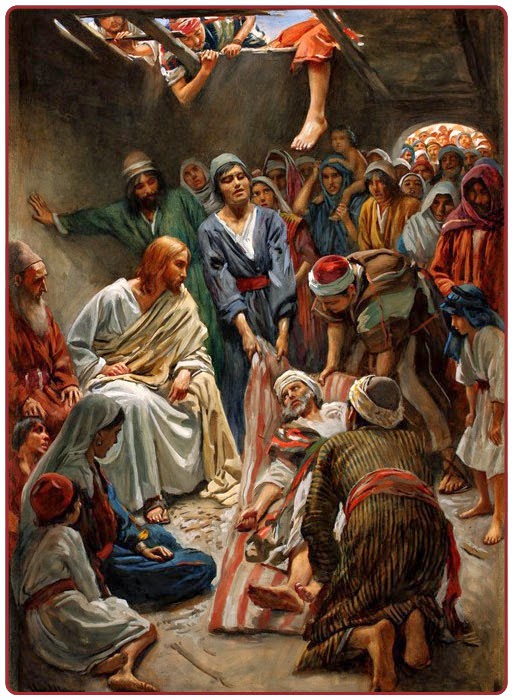
1 And getting into a boat he crossed over and came to his own city. 2 And behold, some people brought to him a paralytic, lying on a bed. And when Jesus saw their faith, he said to the paralytic, “Take heart, my son; your sins are forgiven.” 3And behold, some of the scribes said to themselves, “This man is blaspheming.” 4 But Jesus, knowing their thoughts, said, “Why do you think evil in your hearts? 5 For which is easier, to say, ‘Your sins are forgiven,’ or to say, ‘Rise and walk’? 6But that you may know that the Son of Man has authority on earth to forgive sins”—he then said to the paralytic—“Rise, pick up your bed and go home.” 7 And he rose and went home. 8 When the crowds saw it, they were afraid, and they glorified God, who had given such authority to men.

In the name of Jesus. Amen.

What do you suppose the friends of this paralyzed man thought when they heard Jesus? They had gone to a lot of trouble to bring him to Jesus. They had heard Jesus was at home (Mt. 9:1; Mk. 2:1), and people from all around knew that the power of God was with Jesus to heal (Lk. 5:17). We can imagine these friends going to the paralyzed man’s house and telling him, “Hey, Charles,” (he probably wasn’t named ‘Charles’ but go with me on this), “Hey Charles, Jesus is in town. We’re going to take you to Him and get you healed.”

They lift up Charles’ bed and lug him through the city streets. But when they get to where Jesus was, they find that too many people are there, and they can’t even get to the door (Mk. 2:2; Lk. 5:19). So, they take desperate measures. They lug Charles and his bed to the top of the house, tear open the roof, tie ropes on the corners of Charles’ bed, and lower him so he is before Jesus (Mk. 2:4). Charles’ friends are trying to catch their breath, wiping the sweat off of their foreheads, and giving each other tired fist bumps as they surround that gaping hole, thinking, “We did it. Jesus is going to heal our buddy so he can walk.”

But then, down in the house with dust swirling around them, Jesus looks at Charles, and Charles looks up at Jesus. And Jesus says those words, “Take heart, My son; your sins are forgiven.” I imagine those friends were thinking to themselves, “You’ve gotta be kidding me, Jesus. We brought Charles here so You could fix his body!”

We don’t actually know what the paralytics’ friends thought, but we do know what the scribes and Pharisees thought, “Jesus is a blasphemer. Only God can forgive sins” (Mk. 2:7; Lk. 5:21). They grumble. They scoff. They doubt. But Jesus knows their thoughts and hearts, just as He knew the faith and believing hearts of this man’s friends. And because Jesus knows both the faith of these friends and the grumbling of the scribes, we also know that Jesus knew the paralytic’s thoughts.

Maybe, the paralytic was initially excited at the prospect of being healed and using his limbs. But based on Jesus words to him, there is little doubt that Jesus told him exactly what he needed to hear. The first word Jesus says, “Take heart,” is the same command Jesus will give to the disciples when they are out in a huge storm in the middle of the sea. They are being beaten by the waves and wind. Jesus appears, and they think He’s a ghost. But Jesus calms them, “Take heart; it is I. Do not be afraid” (Mt. 14:27).

This paralytic man hears from Jesus the exact words he needed to hear as he was battered by legs that didn’t work and arms that couldn’t move. “Take heart, My son; your sins are forgiven.” As he was lying there before Jesus, maybe he figured Jesus would tell him how awful he had been and that his paralysis was punishment for his sin. But that’s not what Jesus says. Jesus tells him that in the midst of his suffering and horrible situation that he can be of good courage because his sins are forgiven.

Now, of course, Jesus ends up healing the man too. To silence the grumbling scribes and prove that He actually does have the authority to forgive sins, Christ heals the man.

That’s the main teaching of this text. Jesus proves that He has the authority on earth to forgive sins by healing the paralytic. And the crowds respond with fear and glorified God (notice how the text ends) who had given such authority to men. It’s plural. To men. Not just to the man, Jesus. To men.

That was true here, but it is even more evident on the evening of the Resurrection. Then, Jesus tells the disciples, “If you forgive the sins of any, they are forgiven them” (Jn. 20:23). Jesus, the One who has authority to forgive sins, delegates that authority to His Church, to all Christians. Because you have called me to be your pastor, I get to do that each Sunday morning. God uses my voice to proclaim His forgiveness to you. I get to be ‘the Absolution guy.’ It’s pretty cool. And please, don’t think I’m bragging. Believe me, I wouldn’t have the guts to say that if the Bible didn’t teach it. Forgiveness and absolution is the main point of this text.

But today, I want to draw special attention to this guy’s friends and their tenacity to help him by bringing him to Jesus. They know their friend’s need. They know Jesus is where he can get help. So, they do everything in their power to help him by bringing him to Christ.

Dear saints, you do this too. I know you do. But I’d like to point out three specific, concrete ways you do this because these things are easy to overlook. And when we overlook them, it’s easier to neglect doing them. Here are the three ways you help others by bringing them before Jesus, and they are in no particular order.

First, you help people by inviting them to church. Jesus promises to be here as we gather each and every week when He says, “Where two or three are gathered together in My name, there am I among them”(Mt. 18:20). You are eternally helping others when you bring them here, to God’s house and to the gate of heaven (Gen. 28:17) where Jesus meets them with His Word and forgiveness.

Second, you help people by praying for them. When you have an unbelieving family member or coworker who has some need. Help them by praying for them. As you lift others up in prayer, you are bringing them to and laying them before the feet of Christ. Don’t forget that. When someone is suffering, lift them up to Jesus in your prayers. Maybe Jesus won’t answer your prayers in precisely the way you expect. But He knows best how to help.

James 5:13-16 says that your prayers have great power. You don’t even have to tell the person you are praying for them. (Usually, I think letting them know you are praying for them is a good idea. But there might be times [e.g. if they are really deep in unbelief and hatred of God] you don’t. Use your God-given wisdom.) Even if they don’t share their problems with you, pray for them anyway. They might not share their struggles, but they probably tell you the ways they have been blessed. That same section of James 5 says that when someone is cheerful, you can give a prayer of thanks to God for the blessings He has provided.

Third, you help people by forgiving them. The forgiveness you have received from God frees you to forgive others when they sin against you. Christian, your gracious disposition toward them and toward the world is a way that the light of Christ shines through you (Mt. 5:14-16).

All of that brings me to you, Cooper. Cooper, today you are Baptized. Today, your parents have helped you by bringing you to Jesus who also says to you, “Take heart, My son; your sins are forgiven. I have joined you to My death and resurrection (Ro. 6:3-8). I have clothed you in My righteousness (Gal. 3:27), given you the new birth of water and the Holy Spirit (Jn. 3:3, 5) and made you My child.”

Cooper, and all you saints, you are before Jesus right now. He invites you to His Table where He feeds you with His Body and Blood for the forgiveness of all your sins. As you walk out of here today, remember that you have new life in Christ. Use your freshly given strength to help and serve your neighbor. Amen.

The peace of God, which surpasses all understanding, will guard your hearts and minds in Christ Jesus. Amen.