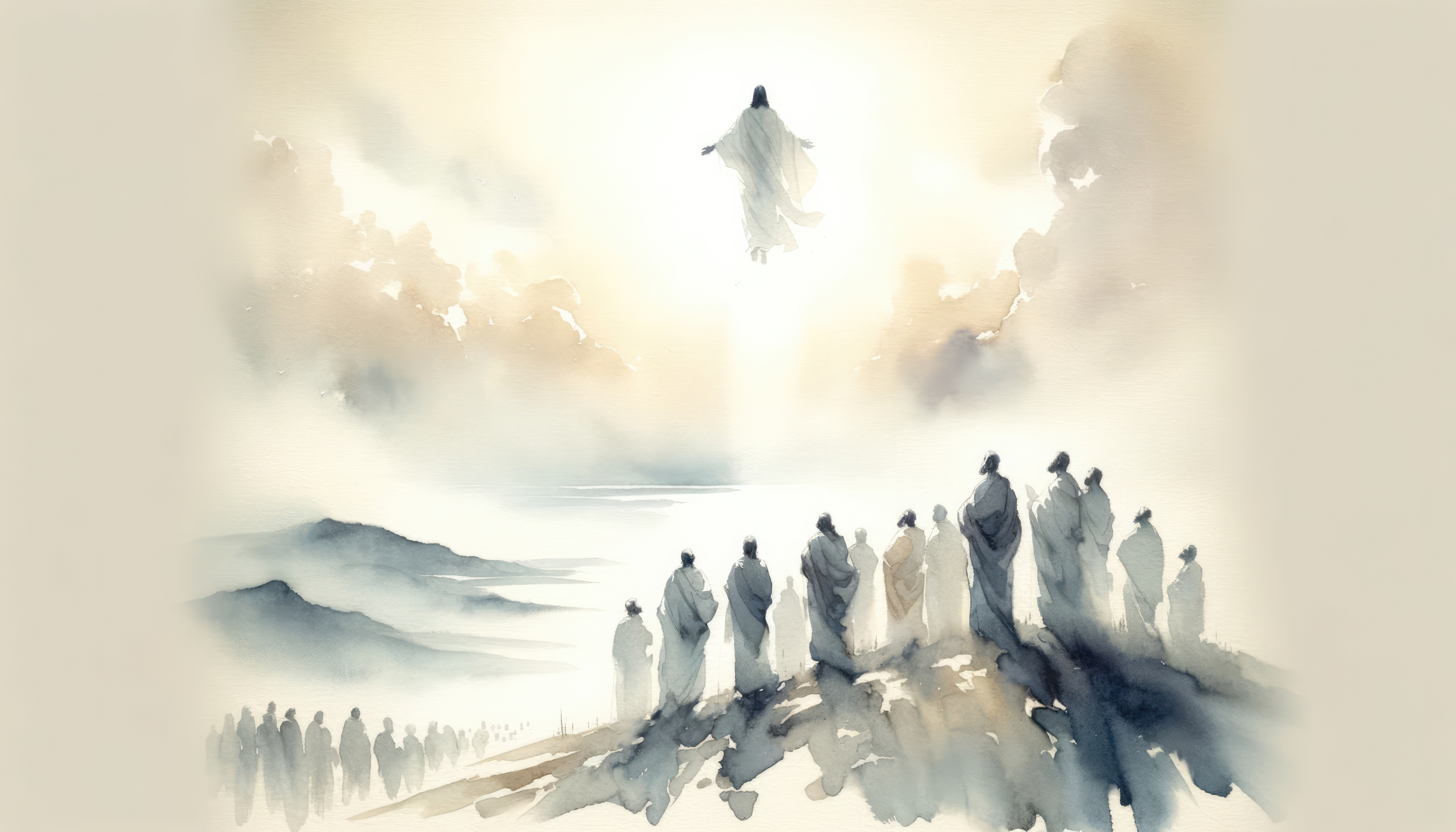
Alleluia! Christ is risen!
He is risen indeed! Alleluia!
In the name of Jesus. Amen.
They say, “Repetition is the mother of learning.” Well, today, you’ve heard the same event, Jesus’ ascension, described three times. You heard it twice from Luke’s two books of the Bible (Act. 1:1-11; Lk. 24:44-53). And you just now heard it from the prophet Daniel. This past Thursday marked the 1,993rd anniversary of Jesus’ ascension to the throne of all creation. The gospel of Luke ends with the disciples seeing Jesus ascend, and Luke makes this comment, “They worshiped Him and returned to Jerusalem with great joy, and were continually in the temple blessing God” (Lk. 24:52-53). The reason they were filled with joy was that they knew what Jesus’ ascension meant.
Jesus had opened the disciples’ minds to understand everything that had been written about Him in the Old Testament (Lk. 24:44-45). So, the disciples got to see Jesus ascend with their own eyes, but they also knew what that meant because Jesus had opened their minds to understand the vision we just heard from Daniel. This text is what happens at Jesus’ ascension—not from the view of earth that Luke records. Daniel records what happens in heaven at Jesus’ ascension. And really, it’s what happens in the entire cosmos.
So today, fellow disciples of Jesus, let’s be filled with the same joy that the disciples had because of Jesus’ ascension by considering this text from Daniel.
Daniel wants us to know about this vision he saw around 552 BC. Daniel had multiple visions that night, but what I just read was the final and greatest vision he saw. He sees God the Father, but Daniel calls Him “the Ancient of Days” (Dan. 7:9). His clothing is white as snow. His hair like pure wool. His throne is ablaze with fire. God is sitting there in judgment. Holy. Majestic. Perfect. Glorious. But the Ancient of Days isn’t alone. There are angels present there. Daniel says there are a thousand thousands angels serving Him (Dan. 7:10). That’s one million angels. How did he count them all? A million seconds is 11.5 days. But then, there’s more. Daniel says there’s 10,000 times 10,000 angels standing before Him. That’s 100 million more angels. How do they all fit in that throne room? They’re all gathered around that fiery throne. Again, think of the beauty and sheer holiness of this place.
Then what does Daniel see? “With the clouds of heaven, there came one like a Son of Man” (Dan. 7:13). Don’t get confused here by the word ‘like.’ This isn’t a being that merely appears like a man. The translation would be better if it said, “There came one as a Son of Man.” Or even, “I saw a Human come up into that scene in heaven.” What business does a human have there?
Remember how Adam fled in his own home that God had made for him in the Garden of Eden because he merely heard the sound of God walking there (Gen. 3:8) Remember how Isaiah saw God on the throne. He saw some angels—some seraphim. But Isaiah doesn’t say he saw 100 million. And he cowered in fear (Is. 6:1-5). Remember how the millions of people God brought out of slavery in Egypt heard God speaking from Mt. Sinai and asked to not even hear His voice (Ex. 20:18-19). Remember all the people in Scripture who are terrified even when they see one angel (Num. 22:31; Jdg. 6:22-23; Lk. 1:11-12, 26-29; Mt. 28:2-4). This Man isn’t acting like any of them.
He doesn’t run. He doesn’t fall down in fear. He isn’t ashamed or afraid. He enters that room. He doesn’t sneak in to find a quiet, obscure corner in the back to simply see everything. He goes higher. He keeps approaching, walking through those millions of angels as they make a path for Him. Closer and closer He walks with His human body and stands there before the Ancient of Days Himself (Dan 7:13).
Pause here for a minute before we get to the rest of the vision because Daniel’s probably thinking, “What is this guy doing? He’s going to be incinerated!” You, of course, know that this is Jesus, so you know that this is the Son of God approaching the Ancient of Days. But don’t forget that this Jesus became man, true man. Christ is Man as we were intended to be. Sadly, it’s easy to forget Jesus’ humanity. Remember Daniel describes Him as “a Son of Man.” And Daniel knows that all humans have been stained by sin, so he probably thinks this Man had been too. And He actually was, but not in the way the rest of us have been stained.
This is Jesus, the One Isaiah says, “the Lord laid on Him the iniquity of us all” (Is. 53:6). Paul tells us that He became sin (2 Co. 5:21). He didn’t commit any sin, but He definitely got tangled up in them. Who is more familiar with sin? You who committed them? Or the One who bears them, suffers God’s wrath against them, and paid for them with His precious blood and death (1 Pet. 2:24)? Jesus knows the weight of your sin. He’s your great High Priest who bears with you in your weaknesses (Heb. 4:15).
Dear saints, this Jesus, this Son of Man that Daniel sees, He doesn’t approach the Ancient of Days because He avoidedsin. He approaches the Ancient of Days because He triumphed over it by His blood (Col. 1:20). He canceled the record of debt that stood against us by nailing it to the cross (Col. 2:14). He left those sins in the grave, which forever stands empty. That’s why He approaches the throne. And what happens?
Daniel sees that this Man is the center of attention in that great throne room. He is there to receive dominion and glory and a kingdom (Dan. 7:14). Jesus doesn’t go to just be there or because His work is done here. He goes to receive what belongs to Him. This isn’t a gift. Jesus takes possession of what He has purchased. He’s earned this.
This Man, Jesus, takes possession of the kingdom of all peoples, nations, and languages. This all-encompassing kingdom and dominion is everlasting. It will not pass away or be destroyed.
Daniel saw kingdoms get destroyed in his days. History is full of kingdoms that have risen to great power, but all of them eventually fall—Egypt, Babylon, Persia, Greece, Rome, the British Empire. Enough time passes and they all fade away. But not this kingdom. Not Jesus’ dominion. It lasts to eternity. It spans any boundary you can imagine, either physical or ethnic. Again, this kingdom is over all peoples, nations, and languages. In other words, this kingdom is also over you.
In Philippians 2, Paul says that Jesus is highly exalted and has the name above every name. And that at the name of Jesus every knee will bow, in heaven and on earth and under the earth, and every tongue will confess that Jesus Christ is Lord (Php. 2:9-11). Christian, for you this is the best news. Your Savior sits on the throne of the eternal kingdom of God. But, sadly, for those who reject or deny Him, for those who don’t believe, well… they’re fighting in a battle they’ve already lost.
That’s the Ascension. But I want to leave you today with a call from Scripture that relates to Jesus’ ascension. It’s from Hebrews 4:16, “Let us then with confidence draw near to the throne of grace, that we may receive mercy and find grace to help in time of need.”
Scripture repeatedly calls us to draw near to God (Jas. 4:8; Is. 55:6; Jer. 29:13). But in Heb. 4:16, it says to draw near to the throne. That’s different. How do we do that? What do we do to draw near to the throne? Do we need to get ourselves into this throne room that Daniel is seeing? Nope!
The throne of grace is here—right here—at church. When you come to church, you are drawing near to the throne of grace because here Jesus is preached. You are drawing near to the place Jesus gives Himself to you, Body and Blood. Jesus is not somewhere far away. He promises that where two or three are gathered in His name, there He is (Mt. 18:20).
Dear saints, you have a place in Daniel’s vision here. As you approach Jesus, the Ruler of all creation smiles and welcomes you as His redeemed child.
Later in Hebrews, you are told that you have come to Mount Zion. You have come to the city of the living God, the heavenly Jerusalem. Here are innumerable angels in festal gathering. This is the assembly of the firstborn who are enrolled in heaven. Right here is God, the judge of all, and the spirits of the righteous made perfect. Here is Jesus, the Mediator of a new covenant (Heb. 12:22-24).
No, you can’t see all of that. But Scripture is clear that you go wherever Jesus goes. He is the Head, and you are His Body (Eph. 5:23). The day will come when He will return, and you will see Him and everything else Daniel saw. But for now, know that He is present here for you, right now, in His Body and Blood. Amen.
Alleluia! Christ is risen!
He is risen indeed! Alleluia!
The peace of God, which surpasses all understanding, will guard your hearts and minds in Christ Jesus (Php. 4:7). Amen.


You must be logged in to post a comment.