Pause – Sermon on Luke 18:31-43 for Quinquagesima Sunday

Luke 18:31–43

31 And taking the twelve, he said to them, “See, we are going up to Jerusalem, and everything that is written about the Son of Man by the prophets will be accomplished. 32 For he will be delivered over to the Gentiles and will be mocked and shamefully treated and spit upon. 33 And after flogging him, they will kill him, and on the third day he will rise.” 34 But they understood none of these things. This saying was hidden from them, and they did not grasp what was said. 

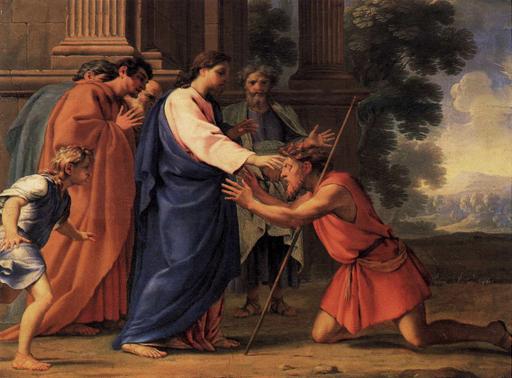
35 As he drew near to Jericho, a blind man was sitting by the roadside begging. 36 And hearing a crowd going by, he inquired what this meant. 37 They told him, “Jesus of Nazareth is passing by.” 38 And he cried out, “Jesus, Son of David, have mercy on me!” 39 And those who were in front rebuked him, telling him to be silent. But he cried out all the more, “Son of David, have mercy on me!” 40 And Jesus stopped and commanded him to be brought to him. And when he came near, he asked him, 41 “What do you want me to do for you?” He said, “Lord, let me recover my sight.” 42 And Jesus said to him, “Recover your sight; your faith has made you well.” 43 And immediately he recovered his sight and followed him, glorifying God. And all the people, when they saw it, gave praise to God.

In the name of Jesus. Amen.

Generally, when we let our imagination go wild, we like to be the heroes. Boys imagine hitting a grand slam in Game 7 bottom of the 9th two outs down by three, or they imagine they are the receiver who dives to catch the hail Mary as time expires to win the Super Bowl. Girls imagine they are Cinderella dancing the night away with Prince Charming, and getting engaged after he returns her glass slipper. Even when it comes to Bible stories, we like to imagine that we are Joshua toppling the walls of Jericho or David slaying Goliath or Elijah defeating the prophets of Baal.

In the two parts of today’s text – the Passion prediction and the healing of the blind man – the only hero is clearly Jesus, and He fully embodies the perfect love that was described in our Epistle reading (1 Co. 13:1-13). This is the third time Jesus explains to the disciples that He is going to Jerusalem to be betrayed, mocked, shamefully treated, spit upon, flogged, crucified, and raised from the dead. But the disciples don’t understand Jesus, the saying is hidden from them, and they could not grasp what Jesus said.

Still, Jesus’ love is on full display. Jesus is patient with and kind toward them. He is not irritated or resentful at their thick skulls. Jesus is going to Jerusalem and will endure all these things because His love does not insist on its own way. Instead, Christ submits to His Father’s will in perfect obedience.

By going to the cross, Jesus will bear all things. All the burdens, all the sins, all the transgressions, all the iniquities, all the wrongdoings, all the evil, all the brokenness of this fallen world – Jesus will bear all of it in His body (1 Pet. 2:24). He does it all for you. Jesus’ journey from His throne in heaven, down into your flesh. His fasting and temptation in the wilderness. His path through the lands of Israel with no place to lay His head (Lk. 9:58). His teaching, healing, casting out demons, forgiving, and restoring. His triumphal entry. His betrayal. His suffering. His death. His burial. His three day rest in the tomb. His resurrection. His ascension. And His continual rule and authority over all things is a journey of love for you.

Jesus’ entire work is directed outward. He didn’t need to do any of that to benefit Himself, and He doesn’t do it for His own, personal gain. He does it because He loves you. And this love of Jesus wasn’t based on your loveliness. It was based on the fact that the God the Father loves you and wanted to rescue you. So, Jesus, God the Son, loved you and did everything necessary to save you.

God hated seeing what sin and death had brought to His creation, so He did something about it by undoing sin and death by the death and resurrection of Jesus. Christ lived the life we were unable to live. He obeyed the whole will and Law of God that we were unable to obey. He took up His cross, endured punishment that you and I deserved, and gave up His dying breath. All of this is done for you.

Jesus does all of this with full knowledge. None of it surprised Him. Christ knew exactly what is going to happen to Him. And still, He goes and does all of this to love you with His perfect, pure love. 

Back in Lk. 9:51, we are told that Jesus had “set His face to go to Jerusalem.” In other words, Jesus is determined to do this loving thing for you. He was focused on redeeming creation, on getting there, and accomplishing it. He goes toward Jerusalem in love.

Day after day, Jesus gets closer to His goal until He arrives in the city of Jericho, which is about fifteen miles from Jerusalem. He’s close – about a day’s journey from the city. But Jesus isn’t in a rush. Sometimes, when you have to do things that you know are going to be unpleasant and painful, you just want to get it over with and put in your rearview mirror. Again, Jesus doesn’t do that. Instead, He paused along His way through Jericho.

Christ hears the blind man’s cry, “Son of David have mercy on me.” Jesus doesn’t say, “I’ve got more important things to do. I’m going to have mercy on you when I get to Jerusalem and go to the cross.” No. Our Lord stops.

The cry for mercy from any corner of His creation gets Jesus’ full attention. He commands that the blind man be brought to Him. Jesus asks him, “What do you want Me to do for you?” “Lord, let me recover my sight.” And in love, Jesus gives the man the mercy he desired. “Recover your sight; your faith has made you well.”

Jesus’ mission to be the Savior of all creation does not stop Him from pausing to give His mercy to the individual He meets along the way. He pauses and heals him.

Dear saints, Lent begins on Wednesday, and Lent is a good time for us to pause and consider all that God has done for us. Today, pause and ponder whom you are most like in this text. Again, we’re not the hero; we’re not Jesus. Instead, sometimes, we’re like the disciples who do not understand or grasp what God is doing for us and saying to us. Sometimes, even though God has plainly and clearly spoken, we are blind and don’t understand what God is doing.

Sometimes, we are broken like the blind man. Even though the blind man could not see with his physical eyes, he understands who Jesus is and what He has come to do. Despite his physical blindness, he has faith that Jesus can and will restore what is broken. So, when Jesus is present, he cries out for mercy. And Jesus gives him the mercy, restoration, and healing that he needed. Maybe, like the blind man, you look foolish to the world how you relentlessly call out to Jesus for His mercy.

Whom are you more like? It probably depends on the day, maybe even the moment.  Whether you don’t have any clue of what God is up to like the disciples or whether all you can do is cry out for mercy, the thing to do is follow Jesus.

Notice that even though the disciples don’t get all the things that God had said through Jesus and through the Scriptures, even though they are blind in their hearts and minds – what do they do? They go with Jesus. They follow Him to Jerusalem and the cross. The blind man, even though he could not see anything until Jesus gave him the sight he desperately wanted, what did he do? He followed too.

Whether you understand what God is up to or not, the conclusion is the same. Follow Jesus. Follow Him to the cross. No matter where you are in your journey through life, no matter how much you understand what God is doing, no matter how much you need from God, no matter how much God has already given you, follow Jesus to the cross.

Stay the course. And as you go with Christ, He will give you ample reasons to glorify God and give Him praise. Amen.

The peace of God, which surpasses all understanding, will guard your hearts and minds in Christ Jesus. Amen.

The Fruit of Liberty – Sermon on Isaiah 11:1-5; Romans 1:1-7; and Luke 4:16-21 for Midweek Advent 3

Isaiah 11:1-5; Romans 1:1-7; and Luke 4:16-21

In the name of Jesus. Amen.

Our text from Isaiah 11 tonight (Is. 11:1-5) refers to a shoot, a root, and fruit that will come from a branch rising from an unexpected place – the stump of Jesse. Then, the verses that come immediately after this text (Is. 11:6-10) talk about predators lying down with things that are normally their prey, but none will be hurt or destroyed. Instead, that root of Jesse will be a glorious resting place for all nations. Now, if that portion of Isaiah makes it sound like creation will be restored, you’re hearing it right. All creation will be restored. A harvest of the fruit of liberty will spring from the stump of Jesse.

Our Epistle reading (Ro. 1:1-7) talks about this same Shoot, Jesus, being descended from David. It says that He was declared to be the Son of God in power by His resurrection (Ro. 1:3-4). So, in our reading from Is. 11, we have a picture of hope rising from barrenness, and in our reading from Ro. 1, we have a picture of power from an ancient, kingly line. Now, it might not seem like it at first, but these two pictures are completely compatible.

Many of you know this, but in case you don’t: the Jesse mentioned here in Isaiah was the father of King David. Jesse only does two things in the Bible. In 1 Sam. 16:1-11, Jesse is there when David is anointed to be king after Saul, and he is briefly mentioned in 1 Sam. 17:17-20 when he sends David to see how the fighting is going against the Philistines. David, Jesse’s son, far eclipses his father in the Bible.

That’s why that reading from Isaiah mentions the stump of Jesse and not the stump of David. Isaiah is prophesying that there will be a new David – One who is like David but who will far surpass even what David did. That One is Jesus, who will come and make all things new. The Spirit of God will rest upon Him. The Spirit of wisdom and understanding, the Spirit of counsel and might, the Spirit of knowledge and fear of Yahweh. This Jesus will be a new and greater King, greater even than David was.

King Jesus will judge the poor “with righteousness” (Is. 11:4a). Normally, when we hear about judging, it means to condemn, but here it means that King Jesus will come to make things right for the poor. King Jesus will, “decide with equity for the meek of the earth” (Is. 11:4b). Unlike the ‘equity’ we hear about today, the kind of equity Isaiah speaks about is a good thing. For the meek and powerless – King Jesus will use His power to make things right.

To summarize what Isaiah is saying in that passage: King Jesus is going to do a whole lot more than simply make the world a little bit better. He is going to defeat death and all violence. He will put an end to suffering. He will restore everything to the way it was in the unshattered bliss of the Garden of Eden.

In Luke 2, we see just how far King Jesus will go to rescue the poor. The Son of God was born not like the son of a powerful general in a mansion, or like a prince in a palace. He was born into the family of a poor carpenter in the tiny village of Bethlehem. He will preach, teach, heal, and die. But from the darkness and gloom of His grave, King Jesus will powerfully rise again (Ro. 1:4).

Now, we’re going to change gears a little bit because we have to consider the Gospel reading (Lk. 4:16-21). One Sabbath, Jesus comes to His hometown of Nazareth, where He had been raised as a Child, and He enters the synagogue. Back in those days, they used a lectionary like we do in church. Certain passages of Scripture were read at different times during the year. That day, the reading was from the prophet Isaiah, and it was Jesus’ turn to read. So, the attendant hands Jesus the scroll.

The way Luke records this, it seems like the attendant had unrolled that scroll to the reading for that day, but Jesus turned the page (I know that’s not how it works with a scroll, but you get the idea), and Jesus reads from a different passage. What He reads is mostly from Isaiah 61:1-2, which was understood to be about the Messiah. The themes of what Jesus reads are very similar to our text from Isaiah 11 tonight, but they are different.

Now, if you read Is. 61:1-2, you’ll see that Jesus does something very interesting. He reads, “The Spirit of Yahweh God is upon Me.” Remember that’s what happened at Jesus’ Baptism. The Holy Spirit descended like a dove and rested upon Him (Mt. 3:16; Jn. 1:33). He continues, “Because [Yahweh] has anointed Me.” The Hebrew word there is the where get our word ‘Messiah,’ and in Greek it would be ‘Christ.’ They both mean ‘anointed one.’ For what purpose did God anoint Jesus?

Jesus keeps reading, “To proclaim good news to the poor. He has sent Me to proclaim liberty to the captives and recovering of sight to the blind.” That part about the blind is actually from Is. 42:7 which is a few inches above what He was already reading. Then, Jesus goes back to Is. 61, “To set at liberty those who are oppressed, to proclaim the year of Yahweh’s favor.”

Then, with the reading finished, Jesus rolls up the scroll, hands it back to the attendant, and sits down, which is how they would preach in those days. (When I get older and more frail, we’ll remember this and get a preaching chair for me.) The eyes of everyone in the synagogue were fixed on Him. They’re holding their breath to hear what He will preach. But before we consider what He preached, we need to realize something.

This likely took place about one year into Jesus’ ministry. The people had heard that He had been Baptized in the Jordan. They knew that He had turned water into wine, cleansed the Temple, and had done many miracles. They hoped that He would do some of those miracles now, here in His hometown (Lk. 4:23). But Jesus doesn’t. He just sits and preaches this message: “Today this Scripture has been fulfilled in your hearing.”

There’s more interaction that takes place between the congregation and Jesus that we didn’t hear tonight. But, when Jesus is done preaching, the people drive Him out of the synagogue, out of the town, out to a cliff, and are ready to toss Him over the edge to kill Him. Now, I know I’ve preached some bad sermons in my fifteen years here, but no one has tried to throw me off a cliff afterward – not yet. Maybe, it’s just because we don’t have cliffs in this part of the world. Why do these people want to kill Jesus for His sermon?

Without a doubt, part of the reason was they recognized that Jesus was claiming to be the Messiah. But I think there was more to it than that. It was more personal. When Luke says that Jesus “began to say to them, ‘Today this Scripture has been fulfilled in your hearing’” (Lk. 4:21), that’s Luke’s shorthand way of saying he’s summarizing Jesus’ sermon. So, if it was true that the Scripture was fulfilled and good news was being proclaimed to the poor, liberty was being proclaimed to the captives, the recovering of sight was being proclaimed to the blind, and liberty being given to those who are oppressed, do you see what Jesus is calling His hearers through His sermon? He’s saying that they are the poor; they are the captive; they are the blind and the oppressed. They don’t like hearing that, so they want to get rid of Jesus.

Let’s take all of this and apply it to us. First, as we share the Gospel with others, we should be ready for the proclamation that Jesus is the Savior for the poor, captive, blind, meek, and oppressed, we should be ready for that to be rejected simply because all sinners, including us, don’t want to hear that they are those things. If you walked up to a stranger and said, “Jesus forgives you all of your sins,” yes, you are sharing the Gospel with them, but they’re probably going to be offended. They’ll probably respond, “Listen, I’m a good person. Why are you calling me a sinner? Get away from me.”

It’s better to let Christ’s light and love shine through you by being kind, gentle, and merciful and be ready to share why you are those things. Tell them, “God has been kind, loving, and forgiving to me.” With people you know better, just be patient. Eventually, they’ll tell you about their sins, even though they probably won’t use the word ‘sin.’ They’ll talk about their failures, shortcomings, or mistakes. And be ready to share how Christ covers all of those for you.

And as we wrap up this Advent series, that leads to the second way this text applies to us. When God advents (i.e. when He comes), He comes to restore you (Gen. 3:9). They day is soon coming when Christ will return to judge the living and the dead. Until then, you be humble. Be quick to repent. Be quick to believe all that God says to you. When God calls you a sinner, believe Him. When God says that He is faithful and just to forgive sinners and to cleanse them from all unrighteousness (1 Jn. 1:9), believe that too.

Dear saints, the abundant fruit of liberty, forgiveness, and life comes from a place where we would not expect it to come. From the stump of Jesse, from that seemingly dead root, God caused Jesus to sprout, grow, blossom, and bear fruit. Through Jesus, and through Him alone, you have good news. You have liberty. And you have the Lord’s favor. All of that is yours because Jesus has come and defeated sin and death by His cross and resurrection. And He is coming again to bring you to the fullness of His salvation and to eternal life. Amen.

The peace of God, which surpasses all understanding, will guard your hearts and minds in Christ Jesus. Amen.

The King in the Wicked City – Sermon on Luke 18:31-43 for Quinauagesima Sunday

Luke 18:31–43

31 And taking the twelve, he said to them, “See, we are going up to Jerusalem, and everything that is written about the Son of Man by the prophets will be accomplished. 32 For he will be delivered over to the Gentiles and will be mocked and shamefully treated and spit upon. 33 And after flogging him, they will kill him, and on the third day he will rise.” 34 But they understood none of these things. This saying was hidden from them, and they did not grasp what was said. 

35 As he drew near to Jericho, a blind man was sitting by the roadside begging. 36 And hearing a crowd going by, he inquired what this meant. 37 They told him, “Jesus of Nazareth is passing by.” 38 And he cried out, “Jesus, Son of David, have mercy on me!” 39 And those who were in front rebuked him, telling him to be silent. But he cried out all the more, “Son of David, have mercy on me!” 40 And Jesus stopped and commanded him to be brought to him. And when he came near, he asked him, 41 “What do you want me to do for you?” He said, “Lord, let me recover my sight.” 42 And Jesus said to him, “Recover your sight; your faith has made you well.” 43 And immediately he recovered his sight and followed him, glorifying God. And all the people, when they saw it, gave praise to God.

In the name of Jesus. Amen.

Today, our text has us focus on two cities – Jerusalem and Jericho. Jerusalem was the city chosen by God to be the place where He would dwell with His people (1 Kgs. 8:10-11, 27-30). If anyone sinned; if God’s people were defeated in battle; if there was drought, famine, pestilence, or plague; they would pray toward God’s house in Jerusalem. God would hear their prayer and forgive (1 Kgs. 8:31-53; 9:3-5). According to Scripture, Jerusalem was a city firmly built together, and God’s people would go there to give thanks to God for all the blessings He had given them (Ps. 122:3-4). It was the city of King David, and God had promised that David’s line would never lack a man to sit on the throne as long as David’s sons walked in God’s ways (1 Kgs. 2:4).

Then, there is Jericho. God commanded His people, “Destroy Jericho. Never rebuild it. If anyone tries to rebuild it, I will consider that to be open idolatry and rebellion against Me. In fact, if someone tries to rebuild Jericho, laying the foundation will come at the cost of his firstborn, and setting up the gates will cost his youngest son,” (Jos. 6:2, 26). What happened? God led His people in battle against Jericho and its walls came tumblin’ down. But about 500 years later, Ahab was king of Israel and led God’s people into idolatry, and during Ahab’s reign, a guy named Hiel rebuilt Jericho. The foundation was laid, and his firstborn died. But Hiel kept going and set up Jericho’s gates at the cost of his youngest son (1 Kgs. 16:34). Whenever you read your Bible and come across Jericho after Joshua 6, think of it as ‘sin city’ because it is a city founded on idolatry and rebellion against God, and its very existence is wicked.

The cities of Jerusalem and Jericho could not be more different. But now, look at our text again. Jesus reminds His disciples, “Hey, we’re going up to Jerusalem. There, I’m going to be delivered to the Gentiles to be mocked, shamefully treated, spit upon, flogged, and killed just as the Scriptures said.” In other words, Jerusalem has joined with Jericho and is in open rebellion against God. But Jesus is purposefully going to Jerusalem to bear the curse of our sin (Gal. 3:3).

And to get to Jerusalem, Jesus must first pass through the wicked, cursed city of Jericho. When God gave Joshua the battle plans on how to defeat Jericho, God instructed that His people were to march around the city in silence once each day for six days then seven times on the seventh day. Then, after circling the city seven times, they shouted, and the walls of Jericho fell down flat (Jos. 6:20). Only then did they enter the city and destroyed everyone in it except Rahab and her household.

Here in Luke, it is almost as if Jesus is doing a similar thing. He is passing by (Lk. 18:36), but there is this blind man crying out, “Jesus, Son of David, have mercy on me!” Instead of quietly marching around Jericho, Jesus stops. It’s like Christ can’t help Himself. Even in the cursed city, Jesus doesn’t ignore cries for mercy because He is mercy embodied. He stops, stands still, and asks for the blind man to be brought to Him. There, in the wicked city, King Jesus, the Son of David, makes a kingly offer, “What do you want me to do for you?” Think of all the times throughout the Scriptures, a king will be pleased with someone and make an offer, “Ask me for anything, up to half my kingdom, and I will give it to you.” Here Jesus doesn’t put any limit on the request, “What do you want me to do for you?” The blind man answers, “Lord, let me recover my sight.” And Jesus says to him, “Recover your sight; your faith has made you well (lit. ‘saved you’).” Not only does the man get the sight he asks for, he gets more. Christ gives this resident of wicked Jericho life and salvation.

Dear saints, this same scene played out today just as it does every Sunday you gather here. Jesus comes into the midst of our wickedness. We beggars find ourselves in the presence of Jesus. We cry to Him for His kingly mercy, and Jesus doesn’t simply march around us and pass through. No. He hears your plea. He stops and stands still, and Christ the King answers your plea by absolving and saving you.

Jesus did that then, and He does that now because of what He is about to do in Jerusalem. Jesus could have, and maybe should have, marched around Jerusalem to destroy it with all their wicked plans for Him. But He doesn’t. Instead, He hangs still as He sheds His blood and pours out His mercy for you upon the cross.

Finally, notice the man’s response after his sight is restored. He can go wherever he wants with his new sight and salvation, but with every option open to him, he follows Jesus. The formerly blind man leaves his home in the wicked city of Jericho and follows Jesus to Jerusalem.

As we begin Lent this Wednesday, let us do the same as we follow Jesus as well. Let us abandon our wickedness and follow King Jesus to Jerusalem this Lent. He leads, and we follow with grateful hearts to Jerusalem, to the cross, and to the empty tomb on Easter.

This same King Jesus invites you now to your seat at His table, where He pours His love and mercy into you by giving you His Body and Blood given and shed for the forgiveness of all your sins. Dear saints, your faith in the crucified and risen Jesus has saved you. Amen.

The peace of God, which surpasses all understanding, will guard your hearts and minds in Christ Jesus. Amen.