
Visible & Invisible – Sermon on Matthew 18:1-11 for St. Michael & All Angels (Observed)

Matthew 18:1-11

In the name of Jesus. Amen.

In April 1961, the Russian cosmonaut, Yuri Gagarin, became the first man to go into outer space and orbit the earth. Sometime later, the leader of the atheist Soviet Union was on an anti-religion campaign. The leader said that they had been to space and hadn’t seen God. The conclusion he wanted people to draw was that this must be proof that God doesn’t exist. C. S. Lewis heard about this and wrote a short essay called “The Seeing Eye.” In that essay, Lewis shreds that argument. He says that looking for God in outer space is like reading every play Shakespeare wrote in the hope of finding Shakespeare as one of the characters.

Shakespeare is in every play he wrote, but he isn’t a character on the stage like Hamlet, Lady Macbeth, Romeo, or Juliet. God created the universe, so creation is the set. You could travel millions of light years and still be no closer to God than you already are sitting in this sanctuary. God is not an item to be found inside the universe He authored. We know Him because He has entered His own creation. The second Person of the Trinity became flesh and shed His blood to save it. Lewis named his essay “The Seeing Eye” because we need to be given one.

In our Old Testament reading (2 Kgs. 6:8-17), Elisha’s servant needed a seeing eye to keep him from despairing. All his eye could see was the human army surrounding him and Elisha. What he couldn’t see was that the mountain was already full of allies—the Lord’s horses and chariots of fire. When God gave the servant a seeing eye, nothing new arrived. The only thing that changed was that the servant could see the whole stage.

The Soviet leader looked at outer space and said God was not there. Elisha’s servant looked at the enemy and said they were finished. Both trusted eyes that cannot see the whole set. We just confessed what an opened eye sees: God the Father almighty, maker of heaven and earth, and of all things visible and invisible. The Nicene Creed names two realms in one creation—visible and invisible. The authors of the creed didn’t make this up. They got that from Colossians 1:16, which puts it this way: “By Him all things were created, in heaven and on earth, visible and invisible.” God gives us that seeing eye through His Word. Some things are real even though our physical eyes don’t see them. The invisible is not a different universe. There are not two creations. There is one. The Lord’s host that surrounded Elisha and his servant was notsomewhere else. It was on that mountain near Dothan.

Even though we aren’t surrounded by the army of Syria, the same angel hosts are present with us right now in this sanctuary. If God gave us seeing eyes, we’d be stunned, amazed, and, maybe, fearful (Dan. 8:16-17; Lk. 1:11-12, 29-30, 2:9; Mt. 28:2-5; etc.) at the number of creatures the Lord has surrounding us. We take attendance here each week. But the numbers on those slips of paper are always wrong. (No offense to you who have taken attendance.) Hebrews 12 says that you have come to Mt. Zion and to “innumerable angels in festal gathering” (Heb. 12:22). In other words, every congregation is a “mega church.” We just can’t perceive it, but just because we can’t perceive it doesn’t make it any less true.

Scripture calls the angels “ministering spirits” sent out to serve Christians (Heb. 1:14). In this Gospel text, Jesus says that the little ones who believe in Him have angels who always see the face of God the Father (Mt. 18:10). The angels are with us wherever we go because God sends them to guard us in all our ways (Ps. 91:11-12). 

These angels also worship God (Is. 6:2-3; Neh. 9:6; Lk. 2:13-14; Heb. 1:6), and fight on our behalf (Rev. 12:7-12). These angels are holy, which is why the Church calls them ‘saints.’ The word ‘saint’ simply means a ‘holy being.’ You are also saints, but in a different way than the angels. Angels have a holiness that is native to their being. God created them good (Gen. 1:31). You have a holiness as well, but you have a holiness that is bestowed, imputed, and given through faith.

Here’s the amazing thing: You are not less holy than the angels. Even though you have sinned, you through faith (Php. 3:9) have the righteousness of Jesus Himself (1 Co. 1:30; 2 Co. 5:21). The angels look at you and are aware of your sins. But when the angels see your righteous and holy status in Christ, Scripture seems to imply that their mouths drop in amazement (1 Pet. 1:12).

So, yes, it’s appropriate to call the angel Michael a ‘saint,’ just as it would be appropriate to call Gabriel or any other angel a ‘saint.’ But, Christian, you have a greater holiness than the angels because you have the righteousness of Christ through faith. They don’t.

That being said, we also know that not all the angels are saints. The devil led many angels in a rebellion against God. Those fallen angels are demons, and they hate us. A compelling argument for why Satan led this rebellion is that he didn’t want to be a ministering spirit. He hated the fact that we are made in God’s image and were given dominion over creation. That jealousy may have led to his rebellion. Scripture doesn’t say that in so many words. But what it does say is clear. Our fight is not against flesh and blood, but against the rulers, the authorities, the cosmic powers over this present darkness, and the spiritual forces of evil in the heavenly places (Eph. 6:12). All of those are titles for the demons.

In the prophet Daniel, the Bible shows that these demons can stand behind kings and nations. Daniel is told that the “prince of the kingdom of Persia”—this refers to a demon—withstood God’s messenger for 21 days until Michael came to help him (Dan. 10:12-13). From that, I think we can infer that the demons can stand behind organizations that promote abortion, groups that try to redefine marriage, many evil and oppressive governments, and all sorts of other groups that seek to destroy and deface humanity.

The demons also start false religions. In Galatians 1:8, Paul says that even if an angel from heaven should preach a gospel contrary to the Gospel of Jesus, let him be accursed. The false religion of Islam claims to originate from a message brought by the angel Gabriel. Mormonism claims an angelic origin as well. Both claim to have angelic origins, but both claim a different salvation. Don’t listen to them.

The same thing goes for worldly spiritualism. Ouija boards, horoscopes, psychics, and the use of crystals are not toys. They are not cute hobbies that try to manage the invisible realm. They are demonic portals. I’m going to give you an example. Just know that I am going to be vague on specifics on purpose to protect the identity of the people involved.

Several years ago, I got a call from someone late at night. This person had recently had a family member die in a tragic way. This person asked, “Pastor, is there a way I can talk to my dead relative?” I said there wasn’t and cited several Scripture passages as proof (Lk. 16:19-31; Lev. 19:31; Dt. 18:10-12; Ecc. 9:5-6, 10; Job 7:9-10; Is. 8:19-20). This person said that their significant other insisted that using crystals was a way to communicate with the dead. But I stopped this person right then. I said, “If you’re hearing voices while using crystals, you’re hearing the voice of demons.” There was silence on the other end of the phone. I asked, “Have you been doing this tonight?” “Yes.” So, I asked, “What did the voice say tonight that troubled you?” After a brief pause, the person responded, “How did you know?” Well, I knew because getting a call like that at 11:00 PM isn’t normal. And I know what Scripture teaches about the demons. They are real, and they will try to lure people into horrible things. I told this person to get away from their significant other. For the next several minutes, I heard this person walk out of the house, run outside, get into a vehicle, and another person pound on the window of that vehicle while screeching in a non-human voice. The entire time, I prayed for God’s protection and that the blood of Jesus would guard this individual.

For the next several weeks, I regularly talked with this person. Sadly, my contact with this person was received less and less. Today, I couldn’t tell you how this person is doing. Pray for this person.

I share this story for two purposes: First, to warn you. The demonic forces are real and they are active. They will do all sorts of things to lure you into their trap and influence. Don’t dabble in the demonic. Second, to prepare you. Even if you aren’t drawn to dabbling in these things, you probably know someone who is. You might be the instrument God uses to draw someone else out of and away from these demonic practices. Yes, the demons are real, but, God be praised, they are already defeated. 

Scripture is clear. The Son of God took on flesh and blood “that through death He might destroy the one who has the power of death, that is, the devil” (Heb. 2:14). Christ disarmed the rulers and authorities and put them to open shame at the cross (Col. 2:15). St. Michael and the angels do throw the dragon down. The brothers conquer him “by the blood of the Lamb and by the word of their testimony” (Rev. 12:11).

The demons do not get the whole stage. Elisha’s servant could only see the Syrian army. But the mountain was not empty then, and it is not empty now.

That is why, in this Gospel reading, Jesus will not let the disciples stare at a greatness they can see. The humble state of a little one who is dependent on another is the greatness Jesus points you to. Do not despise that dependence.

Dear saints, you are the little ones that Jesus talks about in this Gospel reading. Like that little child Jesus put in the midst of the disciples, you are dependent upon another—upon Jesus. God has sent His angels to serve you. They behold the Father’s face, and His face is turned toward you.

Christ has come for you. “The Son of Man came to save the lost” (Mt. 18:11; Lk. 19:10). The Author has walked onto His own set. He became the little Child in the center of all history and grew into the man who is crucified, risen, and returning for the lost.

Today, we thank God for His work through the angels He sends to serve us. And we praise Him because through His Word, your Savior has given you the seeing eye to know about the visible and invisible realities. The mountain is not empty. Amen.

The peace of God, which surpasses all understanding, will guard your hearts and minds in Christ Jesus (Php. 4:7). Amen.
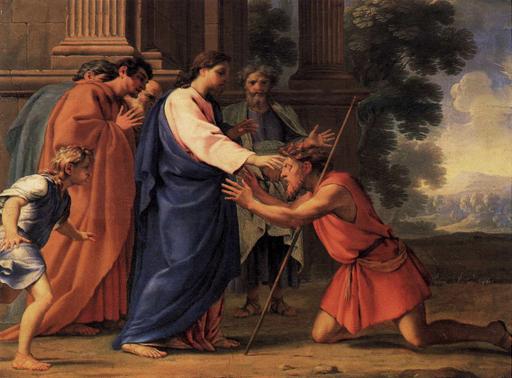
Pause – Sermon on Luke 18:31-43 for Quinquagesima Sunday

Luke 18:31–43

31 And taking the twelve, he said to them, “See, we are going up to Jerusalem, and everything that is written about the Son of Man by the prophets will be accomplished. 32 For he will be delivered over to the Gentiles and will be mocked and shamefully treated and spit upon. 33 And after flogging him, they will kill him, and on the third day he will rise.” 34 But they understood none of these things. This saying was hidden from them, and they did not grasp what was said. 

35 As he drew near to Jericho, a blind man was sitting by the roadside begging. 36 And hearing a crowd going by, he inquired what this meant. 37 They told him, “Jesus of Nazareth is passing by.” 38 And he cried out, “Jesus, Son of David, have mercy on me!” 39 And those who were in front rebuked him, telling him to be silent. But he cried out all the more, “Son of David, have mercy on me!” 40 And Jesus stopped and commanded him to be brought to him. And when he came near, he asked him, 41 “What do you want me to do for you?” He said, “Lord, let me recover my sight.” 42 And Jesus said to him, “Recover your sight; your faith has made you well.” 43 And immediately he recovered his sight and followed him, glorifying God. And all the people, when they saw it, gave praise to God.

In the name of Jesus. Amen.

Generally, when we let our imagination go wild, we like to be the heroes. Boys imagine hitting a grand slam in Game 7 bottom of the 9th two outs down by three, or they imagine they are the receiver who dives to catch the hail Mary as time expires to win the Super Bowl. Girls imagine they are Cinderella dancing the night away with Prince Charming, and getting engaged after he returns her glass slipper. Even when it comes to Bible stories, we like to imagine that we are Joshua toppling the walls of Jericho or David slaying Goliath or Elijah defeating the prophets of Baal.

In the two parts of today’s text – the Passion prediction and the healing of the blind man – the only hero is clearly Jesus, and He fully embodies the perfect love that was described in our Epistle reading (1 Co. 13:1-13). This is the third time Jesus explains to the disciples that He is going to Jerusalem to be betrayed, mocked, shamefully treated, spit upon, flogged, crucified, and raised from the dead. But the disciples don’t understand Jesus, the saying is hidden from them, and they could not grasp what Jesus said.

Still, Jesus’ love is on full display. Jesus is patient with and kind toward them. He is not irritated or resentful at their thick skulls. Jesus is going to Jerusalem and will endure all these things because His love does not insist on its own way. Instead, Christ submits to His Father’s will in perfect obedience.

By going to the cross, Jesus will bear all things. All the burdens, all the sins, all the transgressions, all the iniquities, all the wrongdoings, all the evil, all the brokenness of this fallen world – Jesus will bear all of it in His body (1 Pet. 2:24). He does it all for you. Jesus’ journey from His throne in heaven, down into your flesh. His fasting and temptation in the wilderness. His path through the lands of Israel with no place to lay His head (Lk. 9:58). His teaching, healing, casting out demons, forgiving, and restoring. His triumphal entry. His betrayal. His suffering. His death. His burial. His three day rest in the tomb. His resurrection. His ascension. And His continual rule and authority over all things is a journey of love for you.

Jesus’ entire work is directed outward. He didn’t need to do any of that to benefit Himself, and He doesn’t do it for His own, personal gain. He does it because He loves you. And this love of Jesus wasn’t based on your loveliness. It was based on the fact that the God the Father loves you and wanted to rescue you. So, Jesus, God the Son, loved you and did everything necessary to save you.

God hated seeing what sin and death had brought to His creation, so He did something about it by undoing sin and death by the death and resurrection of Jesus. Christ lived the life we were unable to live. He obeyed the whole will and Law of God that we were unable to obey. He took up His cross, endured punishment that you and I deserved, and gave up His dying breath. All of this is done for you.

Jesus does all of this with full knowledge. None of it surprised Him. Christ knew exactly what is going to happen to Him. And still, He goes and does all of this to love you with His perfect, pure love. 

Back in Lk. 9:51, we are told that Jesus had “set His face to go to Jerusalem.” In other words, Jesus is determined to do this loving thing for you. He was focused on redeeming creation, on getting there, and accomplishing it. He goes toward Jerusalem in love.

Day after day, Jesus gets closer to His goal until He arrives in the city of Jericho, which is about fifteen miles from Jerusalem. He’s close – about a day’s journey from the city. But Jesus isn’t in a rush. Sometimes, when you have to do things that you know are going to be unpleasant and painful, you just want to get it over with and put in your rearview mirror. Again, Jesus doesn’t do that. Instead, He paused along His way through Jericho.

Christ hears the blind man’s cry, “Son of David have mercy on me.” Jesus doesn’t say, “I’ve got more important things to do. I’m going to have mercy on you when I get to Jerusalem and go to the cross.” No. Our Lord stops.

The cry for mercy from any corner of His creation gets Jesus’ full attention. He commands that the blind man be brought to Him. Jesus asks him, “What do you want Me to do for you?” “Lord, let me recover my sight.” And in love, Jesus gives the man the mercy he desired. “Recover your sight; your faith has made you well.”

Jesus’ mission to be the Savior of all creation does not stop Him from pausing to give His mercy to the individual He meets along the way. He pauses and heals him.

Dear saints, Lent begins on Wednesday, and Lent is a good time for us to pause and consider all that God has done for us. Today, pause and ponder whom you are most like in this text. Again, we’re not the hero; we’re not Jesus. Instead, sometimes, we’re like the disciples who do not understand or grasp what God is doing for us and saying to us. Sometimes, even though God has plainly and clearly spoken, we are blind and don’t understand what God is doing.

Sometimes, we are broken like the blind man. Even though the blind man could not see with his physical eyes, he understands who Jesus is and what He has come to do. Despite his physical blindness, he has faith that Jesus can and will restore what is broken. So, when Jesus is present, he cries out for mercy. And Jesus gives him the mercy, restoration, and healing that he needed. Maybe, like the blind man, you look foolish to the world how you relentlessly call out to Jesus for His mercy.

Whom are you more like? It probably depends on the day, maybe even the moment.  Whether you don’t have any clue of what God is up to like the disciples or whether all you can do is cry out for mercy, the thing to do is follow Jesus.

Notice that even though the disciples don’t get all the things that God had said through Jesus and through the Scriptures, even though they are blind in their hearts and minds – what do they do? They go with Jesus. They follow Him to Jerusalem and the cross. The blind man, even though he could not see anything until Jesus gave him the sight he desperately wanted, what did he do? He followed too.

Whether you understand what God is up to or not, the conclusion is the same. Follow Jesus. Follow Him to the cross. No matter where you are in your journey through life, no matter how much you understand what God is doing, no matter how much you need from God, no matter how much God has already given you, follow Jesus to the cross.

Stay the course. And as you go with Christ, He will give you ample reasons to glorify God and give Him praise. Amen.

The peace of God, which surpasses all understanding, will guard your hearts and minds in Christ Jesus. Amen.

The King in the Wicked City – Sermon on Luke 18:31-43 for Quinauagesima Sunday

Luke 18:31–43

31 And taking the twelve, he said to them, “See, we are going up to Jerusalem, and everything that is written about the Son of Man by the prophets will be accomplished. 32 For he will be delivered over to the Gentiles and will be mocked and shamefully treated and spit upon. 33 And after flogging him, they will kill him, and on the third day he will rise.” 34 But they understood none of these things. This saying was hidden from them, and they did not grasp what was said. 

35 As he drew near to Jericho, a blind man was sitting by the roadside begging. 36 And hearing a crowd going by, he inquired what this meant. 37 They told him, “Jesus of Nazareth is passing by.” 38 And he cried out, “Jesus, Son of David, have mercy on me!” 39 And those who were in front rebuked him, telling him to be silent. But he cried out all the more, “Son of David, have mercy on me!” 40 And Jesus stopped and commanded him to be brought to him. And when he came near, he asked him, 41 “What do you want me to do for you?” He said, “Lord, let me recover my sight.” 42 And Jesus said to him, “Recover your sight; your faith has made you well.” 43 And immediately he recovered his sight and followed him, glorifying God. And all the people, when they saw it, gave praise to God.

In the name of Jesus. Amen.

Today, our text has us focus on two cities – Jerusalem and Jericho. Jerusalem was the city chosen by God to be the place where He would dwell with His people (1 Kgs. 8:10-11, 27-30). If anyone sinned; if God’s people were defeated in battle; if there was drought, famine, pestilence, or plague; they would pray toward God’s house in Jerusalem. God would hear their prayer and forgive (1 Kgs. 8:31-53; 9:3-5). According to Scripture, Jerusalem was a city firmly built together, and God’s people would go there to give thanks to God for all the blessings He had given them (Ps. 122:3-4). It was the city of King David, and God had promised that David’s line would never lack a man to sit on the throne as long as David’s sons walked in God’s ways (1 Kgs. 2:4).

Then, there is Jericho. God commanded His people, “Destroy Jericho. Never rebuild it. If anyone tries to rebuild it, I will consider that to be open idolatry and rebellion against Me. In fact, if someone tries to rebuild Jericho, laying the foundation will come at the cost of his firstborn, and setting up the gates will cost his youngest son,” (Jos. 6:2, 26). What happened? God led His people in battle against Jericho and its walls came tumblin’ down. But about 500 years later, Ahab was king of Israel and led God’s people into idolatry, and during Ahab’s reign, a guy named Hiel rebuilt Jericho. The foundation was laid, and his firstborn died. But Hiel kept going and set up Jericho’s gates at the cost of his youngest son (1 Kgs. 16:34). Whenever you read your Bible and come across Jericho after Joshua 6, think of it as ‘sin city’ because it is a city founded on idolatry and rebellion against God, and its very existence is wicked.

The cities of Jerusalem and Jericho could not be more different. But now, look at our text again. Jesus reminds His disciples, “Hey, we’re going up to Jerusalem. There, I’m going to be delivered to the Gentiles to be mocked, shamefully treated, spit upon, flogged, and killed just as the Scriptures said.” In other words, Jerusalem has joined with Jericho and is in open rebellion against God. But Jesus is purposefully going to Jerusalem to bear the curse of our sin (Gal. 3:3).

And to get to Jerusalem, Jesus must first pass through the wicked, cursed city of Jericho. When God gave Joshua the battle plans on how to defeat Jericho, God instructed that His people were to march around the city in silence once each day for six days then seven times on the seventh day. Then, after circling the city seven times, they shouted, and the walls of Jericho fell down flat (Jos. 6:20). Only then did they enter the city and destroyed everyone in it except Rahab and her household.

Here in Luke, it is almost as if Jesus is doing a similar thing. He is passing by (Lk. 18:36), but there is this blind man crying out, “Jesus, Son of David, have mercy on me!” Instead of quietly marching around Jericho, Jesus stops. It’s like Christ can’t help Himself. Even in the cursed city, Jesus doesn’t ignore cries for mercy because He is mercy embodied. He stops, stands still, and asks for the blind man to be brought to Him. There, in the wicked city, King Jesus, the Son of David, makes a kingly offer, “What do you want me to do for you?” Think of all the times throughout the Scriptures, a king will be pleased with someone and make an offer, “Ask me for anything, up to half my kingdom, and I will give it to you.” Here Jesus doesn’t put any limit on the request, “What do you want me to do for you?” The blind man answers, “Lord, let me recover my sight.” And Jesus says to him, “Recover your sight; your faith has made you well (lit. ‘saved you’).” Not only does the man get the sight he asks for, he gets more. Christ gives this resident of wicked Jericho life and salvation.

Dear saints, this same scene played out today just as it does every Sunday you gather here. Jesus comes into the midst of our wickedness. We beggars find ourselves in the presence of Jesus. We cry to Him for His kingly mercy, and Jesus doesn’t simply march around us and pass through. No. He hears your plea. He stops and stands still, and Christ the King answers your plea by absolving and saving you.

Jesus did that then, and He does that now because of what He is about to do in Jerusalem. Jesus could have, and maybe should have, marched around Jerusalem to destroy it with all their wicked plans for Him. But He doesn’t. Instead, He hangs still as He sheds His blood and pours out His mercy for you upon the cross.

Finally, notice the man’s response after his sight is restored. He can go wherever he wants with his new sight and salvation, but with every option open to him, he follows Jesus. The formerly blind man leaves his home in the wicked city of Jericho and follows Jesus to Jerusalem.

As we begin Lent this Wednesday, let us do the same as we follow Jesus as well. Let us abandon our wickedness and follow King Jesus to Jerusalem this Lent. He leads, and we follow with grateful hearts to Jerusalem, to the cross, and to the empty tomb on Easter.

This same King Jesus invites you now to your seat at His table, where He pours His love and mercy into you by giving you His Body and Blood given and shed for the forgiveness of all your sins. Dear saints, your faith in the crucified and risen Jesus has saved you. Amen.

The peace of God, which surpasses all understanding, will guard your hearts and minds in Christ Jesus. Amen.