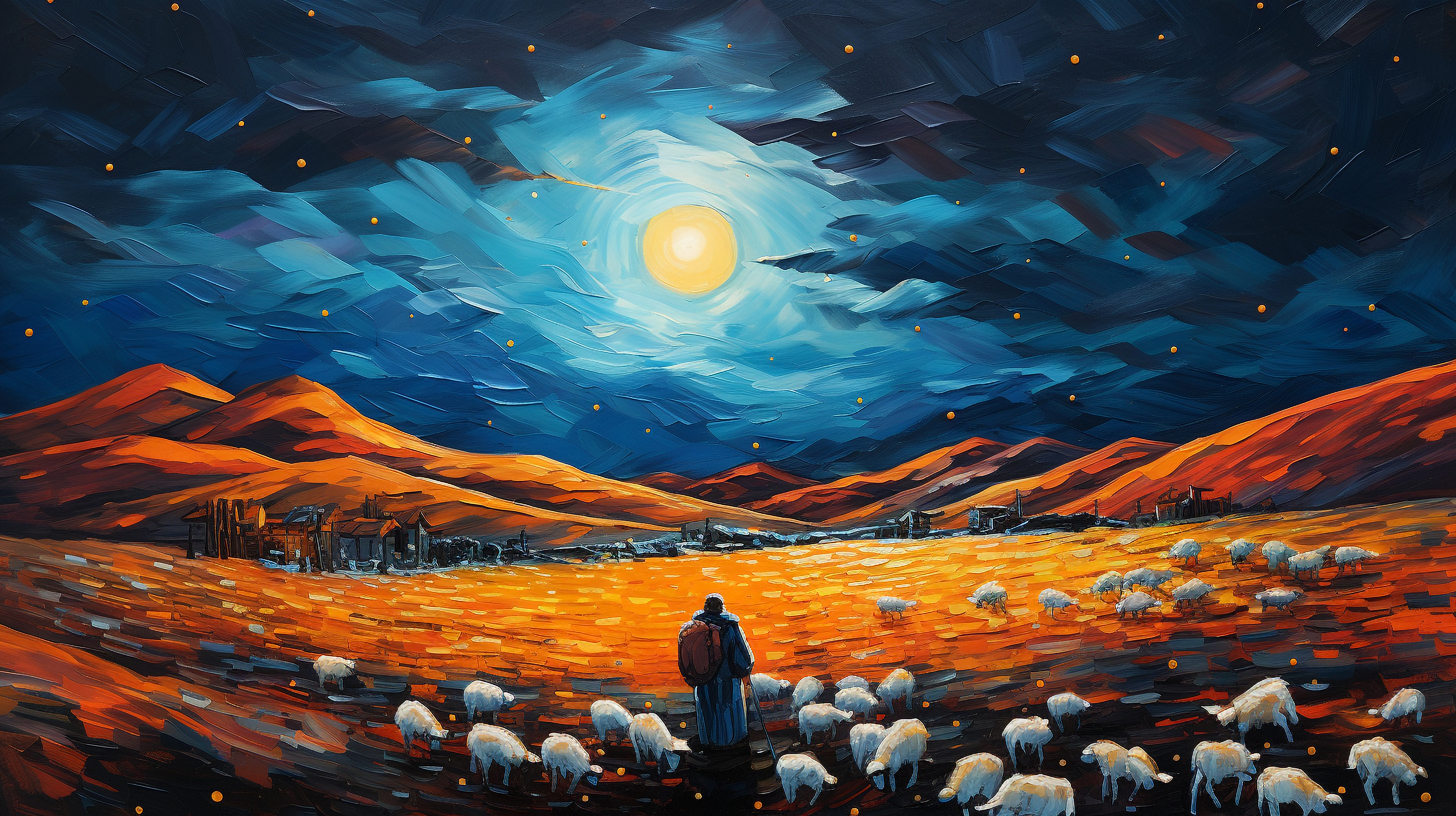
Pleased – Sermon on Luke 2:1-20 for Christmas Eve 2024

Luke 2:1–20

1 In those days a decree went out from Caesar Augustus that all the world should be registered. 2 This was the first registration when Quirinius was governor of Syria. 3 And all went to be registered, each to his own town. 4 And Joseph also went up from Galilee, from the town of Nazareth, to Judea, to the city of David, which is called Bethlehem, because he was of the house and lineage of David, 5 to be registered with Mary, his betrothed, who was with child. 6 And while they were there, the time came for her to give birth. 7 And she gave birth to her firstborn son and wrapped him in swaddling cloths and laid him in a manger, because there was no place for them in the inn. 

8 And in the same region there were shepherds out in the field, keeping watch over their flock by night. 9 And an angel of the Lord appeared to them, and the glory of the Lord shone around them, and they were filled with great fear. 10 And the angel said to them, “Fear not, for behold, I bring you good news of great joy that will be for all the people. 11 For unto you is born this day in the city of David a Savior, who is Christ the Lord. 12 And this will be a sign for you: you will find a baby wrapped in swaddling cloths and lying in a manger.” 13 And suddenly there was with the angel a multitude of the heavenly host praising God and saying, 

14 “Glory to God in the highest, 
and on earth peace among men, with whom he is pleased!” 

15 When the angels went away from them into heaven, the shepherds said to one another, “Let us go over to Bethlehem and see this thing that has happened, which the Lord has made known to us.” 16 And they went with haste and found Mary and Joseph, and the baby lying in a manger. 17 And when they saw it, they made known the saying that had been told them concerning this child. 18 And all who heard it wondered at what the shepherds told them. 19 But Mary treasured up all these things, pondering them in her heart. 20 And the shepherds returned, glorifying and praising God for all they had heard and seen, as it had been told them.

Grace, mercy, and peace is yours this night from God our Father and from our Lord, Jesus Christ. Amen.

The one thing you should learn from Christmas is that God’s greatest, most earnest desire and purpose is to be with you. That’s the “true meaning of Christmas.” Hollywood will give all sorts of other answers about what the “true meaning of Christmas” is – hope, joy, giving, family togetherness, whatever. To one degree or another, those are only related to God’s desire to be with you. Each of those things is only on the fringe of the purpose of Christmas. The birth of Jesus proves that God doesn’t want to be far away or disconnected from you. He wants to be with you. Each day. Every day. God wants to be with you, as close as possible – even within your own heart (2 Co. 1:22).

I say that because of how Luke records the event. The actual birth of Jesus only takes up a tiny fraction of the reading from Luke 2:1-20. In the first five verses, Luke tells us about the census that Caesar Augustus decreed. All the details in those verses – about Augusts, the fact that it was the first registration while Quirinius was governor in Syria, the fact that Joseph was from Nazareth but had to go to Bethlehem, etc. – all of that seems to be there because Luke wants you to know that what he records has been carefully researched. He’s paid attention to the details. He wants you to know that he got all of this exactly right.

Then, Luke simply records Christ’s birth. It is while Joseph and Mary are in Bethlehem that the time came for her to give birth. She gave birth, wrapped the Infant Jesus in swaddling cloths, and laid Him in the only place available – a manger – because there was no other place for them to be, except in that stable.

It’s remarkable, the way God inspired Luke to write this. The most important thing that has ever happened or will ever happen in all of history – the birth of Jesus – is simply stated. “She gave birth.” That’s it. The thing that gets the most focus, and what we will focus on tonight, is the announcement Jesus’ birth, which starts at v. 8.

Some shepherds are nearby watching over their flocks that night. It was an otherwise normal night for these shepherds. We don’t know how many shepherds there are, but we do know the number of angels that appear to them. At first, it’s one. One angel appears, but that angel isn’t the only thing that appears. The “glory of the Lord” also shines around the shepherds. And because of this, the shepherds are afraid. They are filled with a great (the word in Greek is μέγας), a mega fear. Why?

The source of their fear wasn’t that single angel. No, they are afraid because the glory of the Lord was shining around them. That’s the closest reference to their fear. Why would they be so afraid of God’s glory shining around them? Well, they’re afraid because even though God’s glory is a beautiful and wonderful thing, but it is only wonderful if sin isn’t part of the equation. When there is sin, we can’t stand in God’s presence. In Scripture, sinners are always terrified when they find themselves in God’s presence (Ex. 20:18; Jdg. 13:22; Is. 6:5).

Now, I’ll admit that the text doesn’t mention sin. God didn’t inspire Luke to tell us that the shepherds were filled with mega fear because they remembered that they were sinners. Sure enough. But Luke didn’t need to tell us they were afraid on account of their sin because he records what the angel tells them.

“Fear not, for behold, I bring you good news of great (there’s that word μέγας again). Good news of mega joy that will be for all people. For unto you is born this day in the city of David a Savior, who is Christ the Lord” (Lk. 2:10). 

This angel gives two reasons for the shepherds to not be afraid – the two “for” statements. The first because the angel gives to not be afraid is, “Because I bring you good news of great joy that will be for all people.” The source of this great joy is now (present tense) for these shepherds, but it’s not for the shepherds alone.

The angel makes it clear that this great joy that will be (future tense) for all people. That includes you! The good news was given to those five or ten or however many shepherds then, but the good news of mega joy continues to be given throughout the millennia. What the angel said then still echoes to all mankind, even right now, even as you are hearing it.

The second reason the angel tells them to not be afraid is, “Unto you is born this day a Savior, who is Christ the Lord.” Remember that the shepherds fear because God’s glorious presence makes them keenly aware of their sin, but the angel is quick to announce to them that there is a Savior from sin. So, let’s shorten the entire message from the angel. “Don’t be afraid; you have a Savior. He’s just been born.”

That proclamation is the solution to the shepherds’ fear. For the shepherds, the message was that very night that their Savior is born. For you here tonight, you also have nothing to fear because your Savior was born, about 2,021 years ago.

Every one of you here has a Savior. Maybe, you have believed that as long as you can remember. God be praised! Maybe, you used to believe that, but don’t believe it anymore. Maybe, you’ve never believed it. Your belief or unbelief doesn’t change the fact that your Savior is born, and I’m here tonight to tell you to believe it. Believe it because that’s how it benefits you.

Next, this one angel gives the shepherds a sign as proof that their Savior is born. They’ll find a Baby swaddled up and lying in a manger. And at the end of the text (Lk. 2:16-17), the shepherds find exactly that. There, swaddled up in a feeding trough, was the Savior of the whole world. What the angel announced to those shepherds and what that angel is announcing to you now is true. The sign proves it.

We need to go back, though, to what happens just after the shepherds hear this good news of mega joy. Right after the angel’s announcement, there appears with that one angel a huge army of the heavenly host.

The text doesn’t say that they this angel army came, arranged themselves into a choir, and began to sing. Instead, this army of angels appeared to the shepherds. From this, we are to understand that that massive troop of angels was there in that field the whole time. They just weren’t visible to the shepherds for a period, but now they are. This angelic host was present because they wanted to be there and listen to that one angel announce to the shepherds this good news of mega joy.

Angels aren’t like God. God is everywhere all the time. But angels aren’t; they aren’t omnipresent. But it is true that there are angels all around us even though we can’t see them. The Bible has all sorts of examples of angels being around people, but those people can’t see them (Num. 22:31; 1 Kg. 6:17). The night of Jesus’ birth, that angelic army choir wanted to watch as all humanity receives her King.

That angel army sings, “Glory to God in the highest, and on earth peace among men, with whom He is pleased!”

This song reveals that God is pleased with all mankind. The Greek word there for ‘pleased’ is εὐδοκία. It’s two words combined together. The first part is εὐ, which means ‘good,’ and δοκία, which means ‘thinking.’ In other words, the birth of Jesus proves that God is thinking good toward all humanity – every man, every woman, every boy, every girl. You. Everyone. God is pleased with you, and you can know this because He has sent a Savior to become one of you. That is your peace. Your peace is that you have the goodwill, the good-thinking of God in heaven.

Now, I don’t know all of you here tonight. I don’t know if all of you believe this or not. But I’m here tonight to tell you from God’s Word, from the mouth of God Himself, this message: The eternal, almighty, holy, all-powerful, all-knowing God has come to dwell among you in your flesh and blood to save you from your sin. You can believe it without a doubt.

God thinks good things about you. Even though you have sinned against Him and others whom He loves, God isn’t disappointed with you. God should be. Without a doubt He should be, but He isn’t. He isn’t shaking His head and regretting that He created you. No! He is pleased with you. He loves you. That’s why He comes to save you.

Jesus, God in the flesh, your Savior, has come to you, and that is why the angel choir sings.

Again, each one of you here tonight, if you know anything, know this: God doesn’t want to be far away or disconnected from you. He wants to be with you. Each day. Every day.

Your Savior is born. He is born to shed His blood, to redeem, to ransom, and to rescue you from your sin. God is pleased to save you, to remove your sin and my sin. He has come to remove your guilt and my guilt. That is why and how you can know that God is pleased with you. Amen.

The peace of God, which surpasses all understanding, will guard your hearts and minds in Christ Jesus. Amen.

A Great and Mighty Wonder – Sermon on Luke 2:1-20 for Christmas Eve 2023

Luke 2:1–20

1 In those days a decree went out from Caesar Augustus that all the world should be registered. 2 This was the first registration when Quirinius was governor of Syria. 3 And all went to be registered, each to his own town. 4 And Joseph also went up from Galilee, from the town of Nazareth, to Judea, to the city of David, which is called Bethlehem, because he was of the house and lineage of David, 5 to be registered with Mary, his betrothed, who was with child. 6 And while they were there, the time came for her to give birth. 7 And she gave birth to her firstborn son and wrapped him in swaddling cloths and laid him in a manger, because there was no place for them in the inn. 

8 And in the same region there were shepherds out in the field, keeping watch over their flock by night. 9 And an angel of the Lord appeared to them, and the glory of the Lord shone around them, and they were filled with great fear. 10 And the angel said to them, “Fear not, for behold, I bring you good news of great joy that will be for all the people. 11 For unto you is born this day in the city of David a Savior, who is Christ the Lord. 12 And this will be a sign for you: you will find a baby wrapped in swaddling cloths and lying in a manger.” 13 And suddenly there was with the angel a multitude of the heavenly host praising God and saying, 

14 “Glory to God in the highest, 

and on earth peace among those with whom he is pleased!” 

15 When the angels went away from them into heaven, the shepherds said to one another, “Let us go over to Bethlehem and see this thing that has happened, which the Lord has made known to us.” 16 And they went with haste and found Mary and Joseph, and the baby lying in a manger. 17 And when they saw it, they made known the saying that had been told them concerning this child. 18 And all who heard it wondered at what the shepherds told them. 19 But Mary treasured up all these things, pondering them in her heart. 20 And the shepherds returned, glorifying and praising God for all they had heard and seen, as it had been told them.

In the name of Jesus. Amen.

Life is often repetitive and mundane. It fills up with schedules, to-do lists, and errands. You make plans to get everything done as efficiently as possible. You get up, get ready, and get yourself to work or to school or to that appointment. You do what is required of you. Then, you go to bed and sleep only so you can get up tomorrow and do it all over again.

In your efforts to be efficient, organized, and keep it all together, you get into a grove – or, sometimes, a rut. Like a horse pulling a carriage, you put blinders on yourself so you can focus squarely on the next task at work, planning the week’s meals, finishing that big assignment, whatever it is that needs to get done. 

But from time to time, something wonderful happens. Your professor cancels the final. Your adult kid surprises you by coming home. The doctor tells you that the cancer is gone, and you don’t need any further treatments. These wonderful things pull us out of our monotonous lives. And those wonderful things remain wonderful. Five minutes after it happens, it’s still wonderful. If an hour passes, it’s still just as amazing as when it happened. A week, a month, a year, later still has zero effect on the wonder of the thing. Sure, the memory of exactly how it happened might fade, but the wonder stays.

When Sarah and I were dating, I remember meeting her grandma, Hazel. I don’t remember the context of our conversation, but she told me a story of when her kids were young. The family was having serious financial troubles. Hazel didn’t know how she should put supper on the table. There was no food in the house and no money to buy anything. She bumped into one her friends that afternoon who stopped her and asked, “Have you come down from cloud 9 yet?” Hazel didn’t have any idea what her friend was referring to, so her friend told her she had won a drawing at the local grocery store. The prize was a used car that was full of groceries. Suddenly, supper was covered – as well as the next several days of meals. She packed up her kids and picked up the prize. And Hazel told how my father-in-law rode home in the back seat of that car eating cookies and chips that were part of the prize.

When Hazel told that story to me, her voice was excited and filled with wonder. I could see the tears of joy welling up in her eyes. It didn’t matter at all that the food was long gone and the car in the junk yard because it had happened decades before. The wonder of that event hadn’t faded one bit. Hazel would retell that story to me many more times. It wasn’t as though she had forgotten that she had already told the story to me. She just loved telling it, and every time she shared that memory, the joy and wonder the whole thing was still as fresh as though it had happened yesterday because time is irrelevant to the wonder of a thing.

Now, you can probably see where I’m going with this. Jesus was born two-thousand-twenty-some years ago. But the wonder of God entering creation and taking on a human body is still as wonderful and amazing as it was when it happened.

Now, the devil wants to steal that wonder and awe because it was by the birth of Jesus that Satan’s head was crushed (Gen. 3:15). For the Son of God to die and rise again for the forgiveness of your sin, He first had to be born. But Satan thinks you’re stupid. He wants you to adopt an apathetic attitude toward Jesus’ birth and Christmas for the simple reason that it happened a long time ago. He wants to put all sorts of convoluted ideas about the meaning of Christmas into your head so you start to think, “Why should I be happy or joyful about something that happened in the distant past?” If that is the case for you tonight, or any night, you can tell the devil that he’s stupid for thinking you’re that stupid.

Once, a manger had something in it that was bigger than the whole world (C.S. Lewis). The Creator of the universe, who made all things by simply speaking, squeezed Himself into the 8 lb. (give or take) body of an infant boy, and yet He wasn’t cramped. Or more accurately, God became a baby – who couldn’t feed Himself or even lift His own head. And He did this for you.

Tonight, in an effort to regain some sense of the great and mighty wonder of Christmas, put yourself into the account Luke has given us (Lk. 2:1-20). Imagine it from the perspective of Joseph and Mary. Imagine being there among the animals. Jesus has just been born, so they wrap Him up and put Him in the manger because there was simply nowhere else to put Him.

Every parent should have a sense of awe and amazement when a child is born because every birth is a divine gift and miracle. But Joseph and Mary both knew that this particular birth was especially unique. Mary had been told by the angel Gabriel that, though she was a virgin, she would conceive the Son of God (Lk. 1:35). Joseph was also told that the Child in Mary’s womb was the fulfillment of the prophecy we heard from Isaiah 7. Joseph was told that this Child is Immanuel which means “God with us” and that His name was to be Jesus because Yahweh had come to save His people from their sins (Mt. 1:18-25). They knew all of this, so that song, “Mary Did You Know?” the answer to the title of that song is, “Yes.” Maybe she didn’t know all the details about some of the specific questions that song asks, but by and large, the answers to the questions in that song are a resounding, “Yes. Mary knew.”

And yet, the way the Scriptures record the moment of the birth of Jesus, we get left with the impression that it wasn’t any more wondrous than the birth of any other child. In fact, Jesus’ birth was probably a bit of a letdown. Here in Lk. 2, the actual birth of Jesus gets only a verse and a half of ink (v. 6b-7), “the time came for [Mary] to give birth. And she gave birth to her firstborn Son, wrapped Him swaddling cloths, and laid him in a manger.” In Mt. 1:25, Jesus’ birth is even more understated; it’s just, “[Mary] gave birth to a Son.” It’s as though we are to imagine Joseph and Mary looking at this Child, whom they know is God in the flesh, but they look around at the animals and their surroundings and say to each other, “Huh. There’s no glowing. No halo over His head. He’s supposed to be God, but He’s just a baby. So this is it?”

But then, shortly after, some shepherds arrive, and one of them pokes his head from around the corner and asks, “Excuse me. I know this is a barn, but does there happen to be a baby in here?” Joseph or Mary (you can pick which one responds) says, “Well, um, yes there is.” 

The shepherd responds, “I really don’t mean to bother you, but is that baby swaddled?” 

“Yeah. That’s kind of what you do with babies.” 

“Was He just born today?” 

“That’s right, just a few hours ago.” 

“Sorry. I just have one more question. It’s a bit dark in there, and I just have to know – is the baby lying in that manger there?” 

“How did you know?” 

And the shepherds just bow down to the ground and worshipped.

You have probably gotten so used to hearing Lk. 2 on this night each year. It’s good to hear and read it again and again. But it’s so wonderful. Take your time considering all of it. Slow down, look at the details, and meditate on the fact that God became flesh and blood for you.

Imagine it from the angles’ perspective. Imagine how confused the angels must have been that night. They had gotten a break from their regular patrol and angelic duties and sent to this field where the shepherds are. Those angels look up, and there is God on the throne of all creation. So, they sing, “Glory to God in the highest.” But then they look down into that manger and see God is there too. So, they keep singing, “And on earth peace among men with whom He is pleased.”

Luke tells us that those shepherds made known the saying that had been told them concerning this Child and, “all who heard it wondered at what the shepherds told them.” That includes Joseph and Mary. They heard about the angel who announced it, and they heard about the song that the multitude of the heavenly host sang. And they were filled with wonder.

Dear friends, it doesn’t matter how old the story of the birth of God is, Christmas is wonderful. Treasure this great and mighty wonder. Jesus has come, and He has come for you. Tonight and always, ponder in your heart that unto you is born a Savior who is Christ the Lord. Merry Christmas! Amen.

The peace of God, which surpasses all understanding, will guard your hearts and minds in Christ Jesus. Amen.

Come & Behold – Sermon on Luke 2:1-20 for Christmas Eve 2022

Luke 2:1–20

1 In those days a decree went out from Caesar Augustus that all the world should be registered. 2 This was the first registration when Quirinius was governor of Syria. 3 And all went to be registered, each to his own town. 4 And Joseph also went up from Galilee, from the town of Nazareth, to Judea, to the city of David, which is called Bethlehem, because he was of the house and lineage of David, 5 to be registered with Mary, his betrothed, who was with child. 6 And while they were there, the time came for her to give birth. 7 And she gave birth to her firstborn son and wrapped him in swaddling cloths and laid him in a manger, because there was no place for them in the inn. 

8 And in the same region there were shepherds out in the field, keeping watch over their flock by night. 9 And an angel of the Lord appeared to them, and the glory of the Lord shone around them, and they were filled with great fear. 10 And the angel said to them, “Fear not, for behold, I bring you good news of great joy that will be for all the people. 11 For unto you is born this day in the city of David a Savior, who is Christ the Lord. 12 And this will be a sign for you: you will find a baby wrapped in swaddling cloths and lying in a manger.” 13 And suddenly there was with the angel a multitude of the heavenly host praising God and saying, 

14 “Glory to God in the highest, 
and on earth peace among those with whom he is pleased!” 

15 When the angels went away from them into heaven, the shepherds said to one another, “Let us go over to Bethlehem and see this thing that has happened, which the Lord has made known to us.” 16 And they went with haste and found Mary and Joseph, and the baby lying in a manger. 17 And when they saw it, they made known the saying that had been told them concerning this child. 18 And all who heard it wondered at what the shepherds told them. 19 But Mary treasured up all these things, pondering them in her heart. 20 And the shepherds returned, glorifying and praising God for all they had heard and seen, as it had been told them.

In the name of Jesus. Amen.

The birth of Jesus – the very thing we are here to celebrate tonight – doesn’t get much ink in the Scriptures. Don’t get me wrong. The entirety of the Bible is about Jesus coming to save humanity from sin. But His birth comes and goes rather quickly, quietly, and uneventfully.

In the Gospel of Matthew, Jesus’ birth only takes half a verse (Mt. 1:25). John’s Gospel, which we will consider in tomorrow’s sermon, simply says that Jesus, the Word, became flesh and dwelt among us (Jn. 1:14). We could say that John doesn’t record anything about Jesus’ birth because Jesus became flesh the moment He was miraculously conceived. Mark doesn’t include anything about Jesus’ birth; he jumps straight into Jesus’ ministry (Mk. 1:1-11). And even in this familiar reading from Luke 2, Jesus’ birth fills only one verse, v. 7.

The first six verses of this text show how God was working behind the scenes and using Caesar’s census and taxation to get Joseph and Mary to Bethlehem where God promised the Savior would be born (Mic. 5:2-5a). There, we see that God uses even the most powerful people the world to bring about His purpose and plan – even when they don’t intend to. Then, v. 8-20 are about the announcement of Jesus’ birth, which is what we are going to meditate on.

As shepherds are tending their sheep out in the field, an angel of the Lord appears to them and God’s glory shines all around them. The shepherds are terrified, but the agnel says to them, “Fear not, for behold, I bring you good news of great joy…. For unto you is born this day in the city of David a Savior, who is Christ the Lord.”

Notice that the angel is speaking directly to the shepherds. The angel tells them, “Fear not.” This has to be to the shepherds because the other people in and around Bethlehem aren’t terrified; only the shepherds are. Also, notice how the angel directs his speech to them, “I bring you good news… unto you is born this day a Savior.” The angel isn’t speaking over the shepherds’ heads to the entire world. Finally, the angel gives the shepherds instructions how to find this newborn Savior. “You’ll find Him wrapped in swaddling cloths and lying in a manger.” This news and announcement is specifically directed to the shepherds that first Christmas night.

Now, it isn’t the first Christmas anymore, and you have probably noticed that I’ve been skipping over a phrase as I’ve been talking about v. 10-11. I’m not ignoring it. I’ve delayed including it to make a point, and it is time to make that point.

The message of the angel that first Christmas night is good news for those shepherds. A Savior has been born to them. Eventually, that good news will spread over the days, years, and centuries. The first Christmas it was for the shepherds, but this good news of great joy will be for all people, but please know that it is for you specifically and directly, in the same way it was for the shepherds that night.

If that angel was here tonight, he would say directly to you, “I bring you good news of great joy… unto you is born a Savior who is Christ the Lord.” Don’t get lost in the broad scope this announcement. It isn’t as though this Savior is born for all people, and since you’re part of ‘all people,’ I guess, you’re included. No! Unto you is born a Savior who is Christ the Lord. Maybe some Christmas Eve, I’ll preach to each of you individually. But the sermon would be the same for everyone. “Unto you is born a Savior who is Christ the Lord.”

You infants, I’m preaching to you right now. Some might think it’s silly because you can’t understand or comprehend, but this is God’s Word. And the Holy Spirit accompanies that Word to create and sustain the faith God gave you in your Baptism. So, you infants, unto you is born a Savior who is Christ the Lord. Your Savior was once just like you – small and helpless. His father and mother had to carry Him around and do everything for Him. Jesus came to save you. Jesus says that you are the model of our faith and to you belongs the kingdom of God (Lk. 18:18-19).

You children, you’re part of this too. Jesus is your Savior. You aren’t perfect. You sin. But unto you children is born a Savior who is Christ the Lord. Jesus loves you and desires that you come to Him (Mk. 10:13-16). And know this, you are the reason that Jesus grew up as a child.

You adults who have busy, full lives. You have a lot of pressures. Working. Putting food on the table and keeping the house warm. Running kids from one thing to another and helping them with homework. In between all of that, you try to find time to clear your sidewalks and driveway from the ridiculous amount of snow we’ve gotten. You do your best, but you lose your patience. You say and do things to your kids, spouse, friends, and coworkers that you regret. You might have all sorts of things on your mind right now about the rest of the evening’s activities and the credit card bill that is coming to pay for tonight. Well, you adults, give me at least five seconds of your attention: Unto you adults is born a Savior who is Christ the Lord.

You seniors, you’ve seen a lot of changes throughout your life, and very few of those changes have been for the better. Even though Christmas isn’t the same as it was in your childhood, Jesus hasn’t changed. Your Savior is the same yesterday, today, and forever (Heb. 13:8). Unto you is born a Savior who is Christ the Lord. Jesus loves you no less today than the day you were Baptized and brought to faith, and your God will remain faithful to you all your days.

And you who mourn the recent death of a loved one, I know Christmas can be especially difficult. Tonight, you might find yourself looking to an empty chair or wanting to make a comment to someone who is no longer with you. And that absence tonight is just another reminder of the pain and loneliness you feel daily. In the midst of that pain, don’t be ashamed of feeling the joy of the birth of Jesus. You can feel sad tonight, and it’s understandable if you do. Even Jesus wept at the death of His friend, Lazarus (Jn. 11:35). Just know that joy and sadness can mingle together because this good news of great joy is also for you. Unto you is born this day a Savior who is Christ the Lord. And this same Jesus is the Resurrection and the Life (Jn. 11:25).

Again, the angel would say to each of you, “Unto you is born this day a Savior who is Christ the Lord.” The only difference between you and those shepherds is that you cannot go to see Jesus in the manger. He didn’t stay there. Yes, His infant arms were tucked tightly into that manger so those same arms could be stretched out upon the cross. His head was surrounded by hay in a feeding trough to later be crowned with thorns. His body was swaddled and laid in a manger so that same body could eventually be wrapped in linen cloths and laid in a tomb. But just as He did not remain the manger, neither did He remain in the grave.

Even if you went to Bethlehem right now, you wouldn’t behold Jesus there. Instead, you have something better. You have His presence here and now. The Savior born unto you this day says, “Where two or three are gathered in My name, there am I among them” (Mt. 18:20). 

You who have gathered here in Jesus’ name, come and behold Him. You never have to wonder if God loves you. He has demonstrated His great love for you (Ro. 5:8). If you want to know what God thinks of you, first, look down into the manger, then look up to the cross. There is your answer. Merry Christmas! Amen.

The peace of God, which surpasses all understanding, will guard your hearts and minds in Christ Jesus. Amen.

The Child Who Is the Lord – Sermon on Luke 2:1-20 for Christmas Eve 2021

In the name of Jesus. Amen.

Dear saints, merry Christmas!

The first few verses recording Jesus’ birth are nothing spectacular quite honestly. It begins with a government that wanted more taxes. So, Joseph and the very pregnant Mary travel to Bethlehem, Joseph’s hometown, to be numbered and provide a list of their property so Rome would know how much they owed. While they are there, Mary gives birth to her Son and wraps Him is swaddling clothes. Again, nothing extraordinary there.

The only thing that is peculiar is that Mary lays her Newborn in a manger, a feeding trough, because there wasn’t a more hospitable place for the infant Jesus. Quite honestly, if v. 1-7 was all that was recorded concerning Jesus’ birth, there wouldn’t be much to say. Sure, for Joseph and Mary it would have been a very anxious, fretful time, but even today all over the world poor women give birth in unusual and unsanitary conditions.

So, a baby Boy is born and laid in a manger. The only ones to notice in those first seven verses are His father and mother. The people of Bethlehem continue to sleep, and the night would have remained silent and undisturbed, but then comes the rest of the text, and v. 8-20 tell us very clearly that something extraordinary has happened.

The birth of this Child has ushered in a cosmic shift and is the most significant thing that has ever happened. The host of angels suddenly appear to shepherds. The glory of God shines, not in the Most Holy Place in the Temple, but out in the fields surrounding the little town of Bethlehem. All of it reveals that what happened that night was God joining heaven to earth.

The host of holy angels mingle with lowly shepherds. The music of heaven is now heard by men, and they are invited to join in the song. At first, the shepherds are too stunned and afraid to speak. But the angel quiets their fear saying, “Fear not, for behold, I bring you good news of great joy that will be for all the people. For unto you is born this day in the city of David a Savior, who is Christ the Lord.”

In other words, the eternal God who created heaven and earth has been born on earth as a Child to be your Savior. God is powerful enough that His voice breaks the mighty cedar trees (Ps. 29:5), and now He softly coos in His mother’s arms. The Child is the same God who appeared to the shepherd Moses in the burning bush warning Moses to not come close because His presence was too holy (Ex. 3:1-6). But now He invites shepherds to come in as close as possible and see Him lying in a manger as a helpless Child.

The incarnation and birth of Jesus isn’t about God becoming small; instead, it is about mankind becoming big. God made mankind in His own image, but here God becomes what you are – a Child of a woman – in order to make you what He is – a child of the heavenly Father. Even though the people of Bethlehem don’t take notice, heaven itself does. With one foot in heaven and another foot on earth, the company of angels sing, “Glory to God in the highest, and on earth peace among those with whom He is pleased!”

The angels are happy because the Savior of mankind has been born, and we are going to be reconciled to them. There is an interesting verse in 1 Peter 1:12 that says the Gospel, the fact that God comes to save us, is something into which angels long to look. I heard a thought this week about the joy that the angels have because of Christ’s birth that I think is really insightful and deeply rooted in Scripture. The thought is that when the angels see how God forgives, redeems, and saves mankind in Christ’s birth, death, and resurrection, the angels get to witness what love is.

You see, the angels never fell into sin or were corrupted, so they are not redeemed because they don’t need to be. They constantly experience God’s perfect love. So, when the angels see how God loves us in Christ, they see the love God has for them in action. They know how far we have fallen, and in Christ, they see the lengths to which God goes to save us. So the birth of Christ gives the angels a fuller picture of how much God loves them, and it brings them great joy.

Beloved of God, Jesus is born, and He is born to save you. God almighty sucks His thumb. His arms were tucked tightly into that manger as an infant so those same arms could be stretched out upon the cross. His head is surrounded by hay in a feeding trough so it can later be crowned with thorns. His body is swaddled and laid in a manger, so that same body could eventually be wrapped in linen cloths and laid in a tomb. And just as He did not remain the manger, neither did He remain in the grave.

In the birth of Jesus, the grace of God has appeared bringing salvation for all people. That includes you. We sinners cannot be in the presence of a holy God, but God has become a man to welcome and forgive sinners. For those willing to receive it, peace has arrived. The war is over. There is now peace between God and man. Because of what Christ has done, God is well pleased with you.

If you have ever wondered how far God would go to make you His own, first look down into the manger then look up to the cross. There is your answer.

Our next hymn asks, “What Child is this?” Well, we have the answer. This Child is Christ the King. This Child is the Word made flesh. This Child is the Christ. This Child is the Lord God Almighty who comes to forgive you, to save you, to rescue you, to deliver you, and to give you eternal life with Him.

Dear saints, Jesus is born, and He brings you His eternal peace. So, again, merry Christmas. Unto you is born this day a Savior who is Christ the Lord. Amen.

The peace of God, which surpasses all understanding, will guard your hearts and minds in Christ Jesus. Amen.

God Makes Room – Sermon on Luke 2:1-20 for Christmas Eve 2020

Listen here.

Luke 2:1-20

1 In those days a decree went out from Caesar Augustus that all the world should be registered. 2 This was the first registration when Quirinius was governor of Syria. 3 And all went to be registered, each to his own town. 4 And Joseph also went up from Galilee, from the town of Nazareth, to Judea, to the city of David, which is called Bethlehem, because he was of the house and lineage of David, 5 to be registered with Mary, his betrothed, who was with child. 6 And while they were there, the time came for her to give birth. 7 And she gave birth to her firstborn son and wrapped him in swaddling cloths and laid him in a manger, because there was no place for them in the inn.

8 And in the same region there were shepherds out in the field, keeping watch over their flock by night. 9And an angel of the Lord appeared to them, and the glory of the Lord shone around them, and they were filled with great fear. 10 And the angel said to them, “Fear not, for behold, I bring you good news of great joy that will be for all the people. 11 For unto you is born this day in the city of David a Savior, who is Christ the Lord. 12And this will be a sign for you: you will find a baby wrapped in swaddling cloths and lying in a manger.” 13 And suddenly there was with the angel a multitude of the heavenly host praising God and saying, 

14 “Glory to God in the highest, 
and on earth peace among men, with whom he is pleased!”

15 When the angels went away from them into heaven, the shepherds said to one another, “Let us go over to Bethlehem and see this thing that has happened, which the Lord has made known to us.” 16 And they went with haste and found Mary and Joseph, and the baby lying in a manger. 17 And when they saw it, they made known the saying that had been told them concerning this child. 18 And all who heard it wondered at what the shepherds told them.

19 But Mary treasured up all these things, pondering them in her heart. 20 And the shepherds returned, glorifying and praising God for all they had heard and seen, as it had been told them.

In the name of Jesus. Amen.

Merry Christmas!

The first twenty verses of Luke 2 are extremely well-known. Some of you might be able to recite them word for word, and many of you can probably recite them with a little help here and there. Sure, you might need a little help remembering that Quirinius was governor of Syria. (It’s a hard name to remember.) And it is good that you remember this passage. These verses record for us the most significant event in human history. The only other event that would be tied with the birth of Christ would be His death and resurrection.

But one of the problems with our familiarity with this text is just that – we are familiar with it. With that familiarity comes certain ideas that aren’t part of the text. And those things can get ingrained in our minds. Some of the beauty and brilliance of this event fades away when some common misconceptions about the event overshadow the reality. Well, tonight, I’d like to take this magnificent gem of a text and get it cleaned and polished to remove the haze of one of those misconceptions. We’re mainly going to focus on one verse of the text. And I hope and pray that you are blessed. 

The birth of Jesus takes up one verse and is simply recorded for us in v. 7, “And [Mary] gave birth to her firstborn Son and wrapped Him in swaddling cloths and laid him in a manger, because there was no place for them in the inn.”

First let’s lay out the misconception. Unfortunately, we have gotten the idea that Tom Bodett for Motel 6 didn’t leave the light on for Joseph and Mary. (I really hope most of you are old enough to get that reference; if you don’t, you didn’t listen to enough Twins games on the radio in the mid ‘90’s.) All the familiar English translations use the same word there, ‘inn,’ which gives an idea of a hotel. So, we get the idea that, by the time Joseph gets the very pregnant Mary to Bethlehem, it’s late and all the hotels were booked because so many people were there for the census. And it isn’t too hard to imagine that being the case. Anyone who has traveled with a very pregnant lady knows you have to stop for bathroom breaks – a lot of bathroom breaks. The picture in our minds is that Joseph and Mary check at all the hotels, find no rooms available, and end up staying in a stable or barn.

The problem with this is that the word that gets translated as ‘inn’ doesn’t refer to a hotel. In fact, Bethlehem was so small that the little town probably didn’t even have a hotel. Now, the word that gets translated as ‘inn’ here only occurs two other times in the New Testament. The other two times this word gets used are once by Mark and also later at the end of the Gospel of Luke. And both of those times is in the context of Jesus telling His disciples to follow a particular man to his house and say to him, “The Teacher says, ‘Where is My guest room (not ‘inn’ but ‘guest room’ – same word), where I may eat the Passover with My disciples?” (Mk. 14:14Lk. 22:11). And Jesus didn’t institute the Lord’s Supper in a hotel conference room. Also, Luke knows the typical word for an ‘inn’ or ‘hotel’; he uses it in the Parable of the Good Samaritan (Lk. 10:34), but it’s a very different word. If Luke had meant to say there were no rooms in the hotels of Bethlehem, he would have, but he doesn’t.

So, we should understand that Luke isn’t talking about hotels. Instead, when Luke says there was no room for Joseph and Mary in the ‘guest room,’ he’s telling us that the couple had arrived at a home – probably the home of one of Joseph’s relatives – but other members of Joseph’s extended family had lodged there and that there was no longer any place for them in the guest room. In fact, it might be even worse. Maybe, when Joseph and Mary get there, the pious, religious relatives learn that Mary is pregnant out of wedlock and they aren’t willing to make a place in the guest room for her even while she is in labor. So, Joseph and Mary only have one option for the birth of the Child and that was the part of the house where the animals were kept. And, just so you know, it was typical back then for houses to have a place for their animals in a lower part of the house.

Now, don’t go home and throw away your nativity sets. Please don’t. They’re good. But it would be good when you look at a Nativity set to tweak your thinking just a little bit. Add this picture to it: Joseph and Mary aren’t out in a pasture away from everything else. Instead, they are inside a full house where relatives are likely talking, eating, drinking, and laughing – just like at a family reunion. And Mary is off to the side, giving birth, wrapping Jesus in swaddling cloths, and laying Him in a feeding trough.

The Messiah, the One whom all of God’s people were waiting for, is finally born, but there is no place for Him to lay His head except for that manger.

So, play this out a little: When the company of angles come to proclaim the greatest news in all of history, they announce the birth of Jesus to the shepherds. But the shepherds aren’t the first to know about Jesus’ birth. Joseph’s family would have already known. Joseph and Mary probably tried to give an explanation to the family, but they didn’t believe that Mary was miraculously pregnant with Jesus. And, so, they did not make room for the birth and arrival of the Son of God.

Now, this is nothing new. Because of our sin, all humanity is opposed to God’s presence, and in our sin, we have no place for God. That is what we see when Adam and Eve fall into sin. They hear God walking in the garden in the cool of the day but try to hide themselves (Gen. 3:8). It’s what happens after God speaks to His people on Mt. Sinai; they hear His voice and ask Moses to tell God to not talk to them anymore (Ex. 20:18-21Dt. 18:16). It’s why the scribes and Pharisees reject Jesus even though He repeatedly proves that He is God (see esp. Mt. 26:59-66). It still happens today when people use any and every excuse to not be where Jesus is present with His gifts. In his Gospel (and you will hear these verses in a few minutes), John says it more bluntly than Luke. “He came to His own, and His own did not receive Him” (Jn. 1:11).

In the end, we see the sad reality that sinners have no place for the presence of God.

Now, please, don’t finish my sermon for me. This isn’t meant to be a guilt trip. I’m not going to give you a sales pitch appealing to you, “Please, make room for Jesus in your heart.”

Just because God took on flesh and was a helpless Infant, don’t get the impression that Jesus is a fickle, desperate god who is just waiting around for you to make room for Him. Even when He is rejected, when He is pushed out, even when the very people He came to save have no place for Him, He doesn’t twiddle His thumbs and wait for you to make room for Him. Instead, God in His great love for you makes room for Himself.

Don’t let the humility of Jesus’ birth lead you to diminish His power. Even as a little Infant, Jesus is the eternal Son of God, King of kings, Lord of lords. Rather let the humble birth of powerful Jesus lead you to recognize His great love and mercy for you.

Jesus knew what He was coming to and wasn’t surprised that there was no place for Him. But He came anyway. He came to make a room in eternity for those who did not make room for His birth. He knew that the infant hands, feet, and body that Mary swaddled up to keep Him from getting cold would be the same hands, feet, and body that would be nailed to the cross. And He did all of this voluntarily and out of love for you so that He could make an eternal place for you with Him in heaven.

That is the moral of this reading, the whole blessed idea of Christmas, and, in fact, the teaching of all Scripture. God doesn’t wait for you to make room for Him. If you don’t make room for Him, He just nestles in anyway. Whenever He comes, He comes to you to bring you His love, mercy, and forgiveness. Jesus made room in His heart for you. All of your life and salvation is not about how open you are to God rather on how He is open to you. And the the birth of your Savior shows, proves, demonstrates, and manifests how open He is to you.

And Christmas then is the time when we do nothing but watch our God come in the flesh and simply say, “Thank you.”

One more thing and then I’ll stop. Luke is a historian. He is detailed and precise. He mentions all the details about it being the first census when Quirinius was governor, etc. which helps prove the factuality of his Gospel. And Luke does this in all his writings. But notice how Luke is fairly vague in v. 7. He simply and briefly records the fact that Jesus was born and laid in a manger because there was no place in the guest room, and he leaves it at that. Luke doesn’t name names or give addresses. He doesn’t criticize, scorn, or belittle Joseph’s relatives for their rejection of Jesus. He doesn’t throw them under the bus. He simply says, there wasn’t room.

Here’s the point: It isn’t a stretch of the imagination at all to think that the very people who refused to make a place for Jesus when He was born became Christians by the time Luke wrote his Gospel. So, Luke covers their sin and doesn’t call it out. Jesus does the same for you.

Because of what Christ has done by coming to earth, being born in such a humble manner, by giving His life on the cross, and by rising again for you, your sins are removed from you as far as the east is from the west.

And God be praised. You are here tonight. You have rightly made room in your celebration tonight for the birth of the Savior who has made room for you.

People loved by God: Merry Christmas! Amen.[1]

The peace of God, which surpasses all understanding, will guard your hearts and minds in Christ Jesus. Amen.


[1] I am thankful for a sermon by Pr. Jared Melius for the direction of this sermon.

Holy Peace Dwelling with Us – Sermon on Luke 2:1-20 for Christmas Eve 2019

Listen here.

Grace, mercy, and peace be to you from God our Father and from our Lord and Savior, Jesus Christ. Amen.

Dear saints, merry Christmas!Incarnation Icon Tonight, and all the days of your life, you can celebrate the fact that Jesus is born. God has taken on your flesh to save you. He has come in your likeness, born of a woman, in order to deliver you from your sin.

This Gospel text is one of the most familiar passages for Christians. As it was read, you could probably finish most of the phrases from memory, and that is good. But that familiarity can bring with it a loss of the wonder, awe, peace, power, and glory that this text has for us.

Whenever we read the Scriptures, we should be looking for the unexpected. But our familiarity with the text means that almost nothing is unexpected, at least not anymore. We’re so familiar with it that we aren’t surprised even though there are surprises at every turn. It’s surprising that God uses something as normal as a census and taxes to bring Joseph and Mary to Bethlehem to fulfill His promise that the Messiah would be born in the city of David (Mic. 5:2). It is surprising, and saddening, that none of Joseph’s relatives had a place for him and his laboring wife to stay which meant they ended up delivering their Son in a barn. Though those things are familiar to us, they are still shocking, unexpected, and are worthy to have us to pause and consider them more closely. However, tonight we are going to focus on what happens outside of Bethlehem in the fields so that we get a fuller picture of what happened in Bethlehem.

Glory appears to the ShepherdsLuke tells us that those shepherds, who were minding their own business, suddenly found themselves surrounded by the shining, dazzling glory of the Lord. The surprising, unexpected thing is not the existence of God’s glory. God’s glory shining is something that happens throughout the Scriptures.

The glory of God led Israel out of Egypt, but God’s glory was veiled and hidden in a pillar of cloud by day and a pillar of fire by night (Ex. 13:21-22). That same glory, veiled in a cloud, descended on Mt. Sinai when God spoke to the people to give them the Ten Commandments (Ex. 19:9, 16-17). Even though God’s glory was hidden behind the cloud, the people were so afraid of God’s glory that they asked Moses to tell God to not speak directly to them anymore (Dt. 18:15-19). God’s voice along with His glory, even when it was concealed by the cloud, was too much for them to behold.

But God’s glory continued to be with His people. When they built the Tabernacle, that same cloud entered the Tabernacle. And it was this glory of God that led the people through the wilderness during the Exodus. Whenever the cloud would stop, the people would set up their camp and stay there until the cloud was taken up and led them further (Num. 9:17-22).

Every time the people set up their camp, the cloud would enter into the most holy place in the Tabernacle. And God gave strict instructions to Aaron, the high priest, that he wasn’t to enter the holy of holies any time he wanted or else he would die (Lev. 16:2). And even when Aaron, and the high priests after him, were allowed to enter the holy of holies on the Day of Atonement, those high priests were told to burn incense and make a cloud of smoke to serve as an additional barrier between them and the holy presence of God (Lev. 16:12-13).

Glory in Solomon's TempleThis went on for centuries until the King Solomon finished construction of the Temple. When the Ark of the Covenant was brought into the Temple, the cloud descended into the most Holy Place, and the priests had to leave because God’s glory filled the Temple (1 Kgs. 8:10-11; 2 Chron. 5:13-14). God no longer dwelt in the tent of the Tabernacle; now, He dwelled in the house of the Temple which was where heaven and earth intersected. And still, year after year, the high priest would enter the most holy place be the representative of the people and meet with God behind the smoke made by the incense and the cloud that subdued God’s glory (Ex. 25:21-22).

But year after year, God’s people kept serving other pagan gods which defiled them and God’s Temple. And though God repeatedly warned them about their sin, they refused to trust in God alone. So, God sent His people into exile in Babylon. And it was in Babylon that Ezekiel had a vision of the Temple. In that vision, Ezekiel saw the glory of God in that cloud leave the Temple (Ezek. 10:1-19). And shortly after this, Jerusalem was destroyed along with the Temple.

God did bring His people back to their land. They rebuilt Jerusalem and the Temple, but when the second Temple was completed, God’s people had a problem. The cloud of God’s glory didn’t return to dwell there (Ezra 3:10-15; 6:16-18). God did not enter that second, rebuilt Temple. For several hundred years, it went on like this. God’s people had the Temple, but God’s glory wasn’t seen. So, the people didn’t know if God was there for them as He had been with them in the past. Because God’s glory had not entered the Temple, there was confusion and doubt. The people wondered, “Has God forsaken us forever?” And this was a legitimate question.

But now here in Luke 2, outside of the Temple, away from Jerusalem, out in a field, the glory of the Lord reappears. But notice, there is no cloud to veil God’s glory. Why was there no cloud? Well, the cloud was no longer necessary.

The cloud had been there to hide the full glory of God so the people wouldn’t be destroyed by God’s holy presence. Now in the birth of Jesus, the full glory of God is still hidden, but not in a cloud. Now, the glory of God is hidden in the infant Jesus lying in a manger.

Dear saints, tonight we celebrate the fact that God has hidden Himself in your flesh. This is the miracle of Christmas. God hides Himself in your humanity so that He can be with you, dwell with you, and reveal Himself to you. God veils His glory in the body of Jesus so that He can appear as your Savior. God hides Himself so that He can reveal Himself as your Redeemer.

We are sinners. To be found by God in His glory and majesty would be our eternal destruction. But there in Bethlehem is God wrapped in swaddling clothes. Empty Manger With Cross ShadowHe is there so He can grow up and walk among us in the towns and streets of Galilee, Judea, and Jerusalem. He is there so He can be betrayed, arrested, beaten, tried, crucified, loaded up with your sin, die, and rise again.

This is how your God is for you. God does not approach you with His consuming holiness. He hides His holy glory, and He comes in peace so that He can clothe you in His holiness. And clothed in that holiness, you are now the temple of the Holy Spirit who dwells within you (1 Cor. 6:19). God continues to reveal His glory to all creation through you, Christian (Ro. 8:21). Because of what Christ has done for you by making you holy, heaven and earth continue to overlap as God’s glory shines through you (Mt. 5:14-16).

So tonight, we join our voices with the heavenly choir. “Glory to God in the highest, and on earth peace to you.” Behold Christ’s glory which is full of grace and truth. From this Jesus, you receive grace upon grace. For your God is pleased to well with you now and forever. Amen.

The peace of God, which surpasses all understanding, will guard your hearts and minds in Christ Jesus. Amen.

Christmas Emotions – Sermon for Christmas Eve Candlelight Service 2018

Listen here.

Grace, mercy, and peace be to you from God our Father and from our Lord and Savior, Jesus Christ. Amen.

Out of all the nights of the year, Christmas Eve is probably the most emotional and nostalgic. Outside is dark and cold, but inside is bright and warm. You have come to a cozy sanctuary that many of you have been attending for years.

Some of you have been right here, in this sanctuary (maybe even in the same seat), every December 24thof your life. You will probably leave here and have a nice meal and an enjoyable time with family and friends. You will spend the rest of your evening opening well-wrapped presents set under a tree filled with decorations you have had for longer than you can remember.

Everything about this evening feels cozy, quaint, and sentimental.

But, what happens if all the things that you have come to appreciate about this night were gone? What if there are no candles, no lights? What if the furnace here had stopped working and the sanctuary was 40 degrees?

What if, instead of lutefisk, meatballs, and lefse, you went home to peanut butter, jelly, and stale bread? What happens if there is no tree, no ornaments, no tinsel, no wrapping paper? How would this evening feel if your gifts were handed to you in a plastic grocery bag, or – heaven forbid – you had no presents at all?

If everything you associate with a perfect Christmas Eve was gone, would there still be reason to celebrate this night?

Yes. Yes, there would. None of the things we add to this night change the fact that Jesus was born. The fact of Christ’s birth, the fact that God has come in the flesh, is not based upon a mood or emotional feeling we get from the things we normally associate with this night.

Jesus was born at a real time in history, and that night was notfilled with the warmth and ambiance we associate with this evening.

David’s royal line had nearly vanished. The priests were barely more than puppets of the Roman empire. And most people had lost hope in God’s promises.

Mary and Joseph were away from the comforts of their home. An occupying military force was demanding more taxes, and the small-town carpenter had to travel a long distance to pay. Joseph’s extended family didn’t have room for him and his extremely pregnant wife in their homes.

That time in history was filled with uncertainty in the government, uncertainty in economy, uncertainty in health and safety, and even uncertainty in religion.

But there was no uncertainty with God. The time was perfect for Him. In the fullness of time, God sent Jesus, born in the flesh to be Emmanuel – God with us, God with you. God with you to redeem you. God with you to forgive you. God with you to give His everlasting love mercy to you.

For some of you, this will be the most memorable Christmas you have ever had, and you will cherish the memories of this night for the rest of your life. For that, praise God.

For some of you, however, this year the Christmas lights won’t be as bright, and the feelings will be less warm. Things have changed. Loved ones have died. Relationships have broken up. Kids have moved away and aren’t coming home for the holidays. For some of you, the absence of someone tonight will leave an emptiness.

But whether tonight is your best or most difficult Christmas, the fact doesn’t change – Jesus was born. Your Savior now lives as true God and true man forever.

Jesus’ birth was not the culmination of the Old Testament prophecies. It was the beginning. Jesus was born not to remain a baby, but to rescue all people from their sins by His sacrifice for you on the cross.

Jesus was never meant to stay in a manger, and you are not meant to stay in this world. The Light that dawns on you in Christ’s birth will be brought to perfect completion when you know the fullness of His forgiveness and joy in heaven.

Because Jesus was born, because He grew up, suffered, died, and rose again, it doesn’t matter what emotions you have or don’t have tonight. It doesn’t matter what you do or don’t have to adorn your celebrations.

Nothing matters except that you have a Savior. Unto you He is born. For you, He lived. For you, He died. For you, He rose again. For you, He lives evermore and evermore. Amen.

The peace of God, which surpasses all understanding, will guard your hearts and minds in Christ Jesus. Amen.