Nigh-Liver – Sermon on Luke 10:23-37 for the Thirteenth Sunday after Trinity

Luke 10:23–37

23 Then turning to the disciples he said privately, “Blessed are the eyes that see what you see! 24 For I tell you that many prophets and kings desired to see what you see, and did not see it, and to hear what you hear, and did not hear it.”

25 And behold, a lawyer stood up to put him to the test, saying, “Teacher, what shall I do to inherit eternal life?” 26 He said to him, “What is written in the Law? How do you read it?” 27 And he answered, “You shall love the Lord your God with all your heart and with all your soul and with all your strength and with all your mind, and your neighbor as yourself.” 28 And he said to him, “You have answered correctly; do this, and you will live.”

29 But he, desiring to justify himself, said to Jesus, “And who is my neighbor?” 30 Jesus replied, “A man was going down from Jerusalem to Jericho, and he fell among robbers, who stripped him and beat him and departed, leaving him half dead. 31 Now by chance a priest was going down that road, and when he saw him he passed by on the other side. 32So likewise a Levite, when he came to the place and saw him, passed by on the other side. 33 But a Samaritan, as he journeyed, came to where he was, and when he saw him, he had compassion. 34 He went to him and bound up his wounds, pouring on oil and wine. Then he set him on his own animal and brought him to an inn and took care of him. 35And the next day he took out two denarii and gave them to the innkeeper, saying, ‘Take care of him, and whatever more you spend, I will repay you when I come back.’ 36 Which of these three, do you think, proved to be a neighbor to the man who fell among the robbers?” 37 He said, “The one who showed him mercy.” And Jesus said to him, “You go, and do likewise.”

In the name of Jesus. Amen.

You need the right tool for the right job. If you need to fix your glasses, a hammer isn’t going to help you. Sure, you might need to insert a pointy piece of metal hardware into the frame of your glasses, but it’s going to be a screw and not a nail. In fact, when you’re trying to fix a pair of glasses, it isn’t even enough to have a screwdriver. You need the right kind of screwdriver – one that is tiny and difficult for my not-so-dexterous hands to manipulate. That’s why, for me, the right tool for fixing my glasses isn’t a tiny screwdriver; it’s an optician.

The lawyer who comes to Jesus is undertaking a worthy task – desiring to have eternal life, but he is using the wrong tool. Not only does he not have the right tool in his tool chest, he doesn’t even understand of what kind of tool he needs. He thinks salvation is something he can do and achieve for himself. That’s why his question is, “Teacher, what shall I do to inherit eternal life?” Jesus gives him perfect, correct instructions for earning eternal life by pointing him only to the Law. Love God perfectly and love your neighbor perfectly. Do this, and you will live (Lk. 10:26-28; see also Ps. 15).

The lawyer’s response to this is interesting. He doesn’t ask, “Who is God?” That would be ridiculous. He also doesn’t ask, “How do I love God?” Instead, he asks, “Why is my neighbor?” That question reveals something. Apparently, the lawyer thinks that already loves God perfectly. It’s only the second part of the equation that befuddles him. He is looking for an ‘out.’ He wants a limit on the extent of the command to love others. But there is no limit on this command. You cannot love God whom you have not seen if you don’t love your neighbor whom you have seen (1 Jn. 4:20).

In the context of this conversation between Jesus and the lawyer, that question is absurd. The word ‘neighbor’ defines itself. In at least Greek, Hebrew, Latin, German, and English, the word for ‘neighbor’ has more to do with location than anything else. In each of those languages (probably in others too), ‘neighbor’ means the person close to you. The English word neighbor is spelled so weird because it comes from two middle-English words smooshed together: nigh – as in ‘near,’ and gebur which means ‘dweller.’ Your neighbor is anyone who dwells near you. Or, to explain the title of the sermon, your neighbor is the one who lives nigh unto you – a nigh-liver.

Now, the lawyer asks the question because he’s trying to get out from under the command to love his neighbor as himself. He wants a limit to the love that is required of him because, presumably, he wants to keep lying to himself about being worthy of inheriting eternal life. But in general, the question, “Who is my neighbor?” is something we Christians should have in our minds constantly – not because we’re looking for information or identification of our neighbor. Rather, we should be asking that question so we recognize all of the targets of love that God places in front of us. Because we don’t get to pick and choose our neighbors. God gives them to us.

In the parable, God ‘neighbors’ the robbed, stripped, beaten, left-half-dead man to three people. God plops this needy guy in the path of the priest and the Levite. However, both of them intentionally and deliberately try to un-neighbor him. They move to the other side of the road to create distance between them and the wretch in the ditch.

Of course, if the situation had been reversed and either the priest or the Levite had been robbed, beaten, and left for dead, they would have desired help from anyone who passed by. Everyone who gets into trouble or danger is glad to receive help from anyone. That’s the most basic meaning of the command, “Love your neighbor as yourself.”

But the third guy, the Samaritan, is an outsider. Jews and Samaritans hated each other. But this Samaritan recognizes that God has neighbored this man to him, and he uses, what appears to be, unlimited resources to care for him. He binds up the man’s wounds and pours on oil and wine. He bears the burden of lifting the man onto his own animal and walking to town and cares for the man overnight. He pays for two more nights so the man can stay in the inn. And on top of that, he sets up an all-expenses paid account for any charges or costs the man would rack up between the time the Samaritan leaves and comes back. 

We misunderstand this parable if we think it is teaching us who our neighbor is. Sure, the lawyer had asked who his neighbor is, but Jesus uses the parable to show what it is to be a neighbor, a nigh-liver. To be a neighbor is to show mercy. The mercy of the Samaritan had no limits. And that is why the Samaritan is such a clear picture of Christ. Jesus proves to be a neighbor. The eternal Son of God descended from His heavenly throne, took on flesh, and dwelt among us in order to neighbor us and shower His mercy upon us.

Everyone gives you an opportunity to show love. But you aren’t called to love everyone the same way. If you try to feed every single person you come across (whether they need it or not) but that comes at the cost of feeding your own children, that’s a problem. 1 Timothy 5:8 says, “If anyone does not provide for his relatives, and especially for members of his household, he has denied the faith and is worse than an unbeliever.”

Other portions of Scripture are helpful in this as well. Galatians 6:10 says, “So then, as we have opportunity, let us do good to everyone, and especially to those who are of the household of faith.” Yes, you are to love everyone whom God puts along your path, but even in that there is a hierarchy. You are to care for those God puts closest to you first. And your closest neighbors are those in your immediate family – your spouse, your parents, your children. After that is the people in this congregation who have been made your brothers and sisters in Christ. Next come the people who live next to you on your block and your coworkers, boss, and friends. Finally, anyone else that God puts along your path and causes to live nigh to you.

When you think of those two great commands, “Love God with all your heart, soul, mind, and strength, and love your neighbor as yourself,” think of a dart board. What is the bullseye? You might think that God should be there, so you aim all your good works toward God. But that is wrong. God doesn’t need to be the center of your target. He doesn’t need anything from you, and you can’t give Him anything (Job 35:7, 41:11). Instead, it’s the people God places closest to you who are the center of your target. Think of God as being underneath the entire target. Christian, you love God by loving the neighbors that He has given you (1 Jn. 4:20).

Dear Banks, that brings me to you. Banks, in Jesus, God has neighbored you. Today, you are Baptized. Today, Jesus has joined you to Himself by placing His name upon you (Mt. 28:19) and clothed you in His righteousness (Gal. 3:27). Banks, you have been born of God; remain in the faith which overcomes the world (1 Jn. 5:4). Banks, God has neighbored you to us and us to you. As your brothers and sisters in Christ, we will share with you the mercy God has given us so that you can be filled with His mercy and share it with others as well.

Banks and all you saints, receive the mercy of Jesus who has neighbored you. He comes to your rescue. He binds up your wounds. He pours on the medicine of immortality. He sets up an all-expenses paid account for you in the inn of the Church. Everything you need is covered and paid for. So, let the mercy He has given you spill over to other nigh-livers that God places in your life. Amen.

The peace of God, which surpasses all understanding, will guard your hearts and minds in Christ Jesus. Amen.

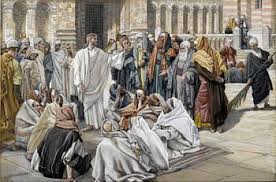
Authority & Service – Sermon on John 13:1-15, 34-35 for Maundy Thursday

John 13:1–15, 34-35

1 Now before the Feast of the Passover, when Jesus knew that his hour had come to depart out of this world to the Father, having loved his own who were in the world, he loved them to the end. 2 During supper, when the devil had already put it into the heart of Judas Iscariot, Simon’s son, to betray him, 3 Jesus, knowing that the Father had given all things into his hands, and that he had come from God and was going back to God, 4 rose from supper. He laid aside his outer garments, and taking a towel, tied it around his waist. 5 Then he poured water into a basin and began to wash the disciples’ feet and to wipe them with the towel that was wrapped around him. 6 He came to Simon Peter, who said to him, “Lord, do you wash my feet?” 7 Jesus answered him, “What I am doing you do not understand now, but afterward you will understand.”8 Peter said to him, “You shall never wash my feet.” Jesus answered him, “If I do not wash you, you have no share with me.” 9 Simon Peter said to him, “Lord, not my feet only but also my hands and my head!” 10 Jesus said to him, “The one who has bathed does not need to wash, except for his feet, but is completely clean. And you are clean, but not every one of you.” 11 For he knew who was to betray him; that was why he said, “Not all of you are clean.”

12 When he had washed their feet and put on his outer garments and resumed his place, he said to them, “Do you understand what I have done to you? 13 You call me Teacher and Lord, and you are right, for so I am. 14 If I then, your Lord and Teacher, have washed your feet, you also ought to wash one another’s feet. 15 For I have given you an example, that you also should do just as I have done to you.

34 A new commandment I give to you, that you love one another: just as I have loved you, you also are to love one another. 35 By this all people will know that you are my disciples, if you have love for one another.”

In the name of Jesus. Amen.[1]

On Sunday, we heard the account of Jesus’ Passion from Mt. 26-27. With all the horrible things that happen to Jesus – the betrayal, the denial, the arrest, trial, beating, mocking, and crucifixion – it is hard to read and listen to. Again, don’t forget that Jesus endured all of that for you because He wanted to. For that joy that was set before Him, Jesus endured the cross, despising the shame (Heb. 12:2). But even knowing that Jesus did it all for the joy of purchasing you, it can seem like everything and everyone in creation conspired against Jesus and that He was a helpless victim. But that is not the case. Jesus was in complete control of everything that happened.

When you consider everything that happens after Jesus entered Jerusalem on Palm Sunday, you can see that He is the one running the show.

Palm Sunday and the following Monday and Tuesday, the Gospels record how Jesus would enter Jerusalem to preach and teach in the Temple. On Tuesday, Judas conspired with the chief priests and put the thirty pieces of silver in his pocket (Mt. 26:14-16). None of the Gospels record Jesus entering Jerusalem on Wednesday of Holy Week. The reason for this was Jesus knew Judas was seeking to betray Him (Jn. 6:70-71). Going into Jerusalem would have given Judas an opportunity to get Jesus arrested too soon. This is also why it appeared as though Jesus didn’t to have a plan on where He and the disciples would celebrate the Passover. But that isn’t the case. His plan was to keep the plan secret. Jesus carefully and deliberately orchestrated everything so that Judas can’t betray Jesus until Jesus is ready.

On Thursday, Jesus sent only Peter and John to find a certain man and follow him to a house, and the owner of that house would show them the upper room where they would prepare the Passover meal (Lk. 22:7-13). So, when Jesus and the twelve disciples get to the upper room, only Jesus, Peter, and John knew where they would be that night. Judas doesn’t betray Jesus until Jesus dismisses him to do it which happens in some of the verses we didn’t read tonight (Jn. 13:21-30). Again, Jesus is in complete control. Even though the events of the Passion seem to be chaotic, Jesus is exercising His authority. 

But look at how Jesus uses that authority. He uses it to serve the disciples by washing their feet. This washing was, in a sense, a parable acted out. By serving His disciples in this way, Jesus is showing how He wants them and us to serve and love one another.

Having someone was your feet was common in Jesus’ day. Anyone who was going to be a guest at a banquet would have their feet washed even if they had just bathed. The walk from one house to another would make a person’s feet dirty enough to need another washing. But the task of foot washing was always reserved for the lowest servants. It was normal for a disciple to do many different chores for the rabbi he was following, but foot washing was never one of them. But here, in a beautiful reversal, Jesus – the Rabbi, the Teacher sent from God, and, in fact, God in the flesh with all authority – humbles Himself to serve His disciples by doing the lowest task for them. This foot washing was an act of vulnerability and intimacy.

When Jesus washes their feet, Judas had not yet left to betray Jesus. Judas was still there. Our Lord washed Judas’ feet and served His betrayer in this way. Judas does not benefit from this, but Jesus still does it for him.

With this foot washing, Jesus gives us an example that teaches us a very important lesson: Love isn’t always easy or clean. Love can often be one-sided and unanswered. Just because you love someone and do selfless acts for them does not mean they will love you in return. Remember, you aren’t greater than Jesus. If His love was rejected and repaid with betrayal, yours will be too.

Yet, still Jesus would have you, His disciples, His Christians, love your enemies just as you have been loved by Him. Bear one another’s burdens. Forgive and serve one another. That is this new commandment, this new mandate, that Jesus gives.

But because you do and will fail in this mandate that Jesus gives, Maundy Thursday is more than Jesus giving a new commandment. It is the night that Jesus also mandates and gives you a meal. Tonight is the night in which Jesus was betrayed, and Judas isn’t the only culprit. Even the disciples who love Jesus fail Him, but He does not fail them. That is why Jesus gives the disciples more than a mandate. He also leaves them the enduring, continual gift and meal of His living Body and Blood.

The two Sacraments Jesus has given us are both precious and give salvation and forgiveness, but they are different. Baptism defines who we are as Christians. In Baptism, we are given God’s name (Mt. 28:19), we are begotten as His children (Jn. 3:3-8), and we are clothed in Christ (Gal 3:27). Baptism defines who we are.

And the Lord’s Supper is what we, the Baptized, do because it is what Jesus has given us to do. We are to eat and drink in remembrance of Jesus (1 Cor. 11:23-25) and whenever we celebrate the Lord’s Supper, according to Scripture, we proclaim His death until He comes (1 Cor. 11:26). In the Lord’s Supper, Jesus promises that we receive the forgiveness of sins. And most Christian thing you can do is receive Christ’s forgiveness.

When Jesus calls us to eat and drink in remembrance of Him, He doesn’t mean, “Do this while you think fondly about Me and what I did for you a long time ago.” Instead, this remembrance is about faith. Faith recalls and clings to what Jesus did and still does with this Bread and Cup. According to what Jesus says, this Bread is His Body which was broken upon the cross for you, and this Cup is His Blood which was shed for you. In faith, we celebrate the Lord’s Supper believing that all of this pertains to us and to our salvation.

Jesus’ death happened nearly 2,000 years ago on a cross outside Jerusalem, but the fruits of His redeeming death are given both before and after. Jesus gives His disciples His Body and Blood even before He makes the sacrifice. And He continues to give the same gifts in every congregation where two or three are gathered. His gift is not bound by time or place.

Both the mandate to love one another and the meal of the Lord’s Supper go together. They are faith and love in action. With the sacrifice of His Body and Blood, Jesus loved the disciples. And when He washed their feet, Christ showed them how to love each other as they place their trust in Him.

So, dear saints, follow Christ’s example and do as He has done to and for you (Jn. 13:15). Your Savior, who has all authority, came to serve you.

And know that when you come to this altar, to this table, you come as royal children of Christ the King and are serving the world. The world benefits from you receiving what Jesus gives in Holy Communion. This Sacrament drives back the forces of darkness because in this meal, Jesus’ death in the place of sinners is proclaimed (1 Cor. 11:26). Jesus puts His Body and Blood into you to crucify you to the world and the world to you (Gal. 6:14). As you receive this meal and do this in remembrance of Him, you celebrate His victory over sin, death, and the devil. Of course, you benefit from this, but so does your neighbor. As you are fed and strengthened in your faith, you will go back into the world knowing that God has forgiven you for the sake of Christ.

And when you fail to be the servant Jesus calls you to be, when you fail to love as you have been loved, run back to Jesus. He is always ready to give you another washing and another serving.

Dear saint, you are declared by Jesus to be clean. Your Lord and Savior is here to be your Servant and cleanse you again. Come and receive what He gives you for your cleaning, for your comfort, for your strengthening. Amen.The peace of God, which surpasses all understanding, will guard your hearts and minds in Christ Jesus. Amen.



[1] Reworked from 2021.

Dependence – Sermon on Matthew 22:34-46 for the Eighteenth Sunday after Trinity

Listen here.

Matthew 22:34-46

34 But when the Pharisees heard that he had silenced the Sadducees, they gathered together. 35 And one of them, a lawyer, asked him a question to test him. 36 “Teacher, which is the great commandment in the Law?” 37 And he said to him, “You shall love the Lord your God with all your heart and with all your soul and with all your mind. 38 This is the great and first commandment. 39 And a second is like it: You shall love your neighbor as yourself. 40 On these two commandments depend all the Law and the Prophets.”

41 Now while the Pharisees were gathered together, Jesus asked them a question, 42 saying, “What do you think about the Christ? Whose son is he?” They said to him, “The son of David.” 43 He said to them, “How is it then that David, in the Spirit, calls him Lord, saying,Jesus and the religious leaders in the Temple

44 “The Lord said to my Lord,
‘Sit at my right hand,
until I put your enemies under your feet’?

45 “If then David calls him Lord, how is he his son?” 46 And no one was able to answer him a word, nor from that day did anyone dare to ask him any more questions.

In the name of Jesus. Amen.

You’ve maybe heard the acronym about the Bible: “Basic Instructions Before Leaving Earth.” Sure, it’s cute, but honestly, it’s horrible because it turns God’s holy and precious Word into a manual of what we must do. If the Bible is about what we need to do and not what God has done for us in Christ Jesus, we’re sunk because we simply cannot do what God commands us to do even if we wanted to, which we don’t.

That is why, when you read the Bible (which I encourage you to do), it is extremely helpful to look for two things – Law and Gospel. Look for God’s commands and His promises. Look for the threats and the blessings. Look for the instruction and for the forgiveness of sins. This Gospel text is a great place to practice this and see how both Law and Gospel depend on each other.

The text has two parts. First, the question the Pharisees ask Jesus along with His answer which is Law. Second, the question or riddle that Jesus gives to the Pharisees which is all Gospel. The text takes place on Holy Tuesday, merely three days before Jesus is crucified. And this day, this Tuesday, was the last day of Jesus’ public teaching. After Jesus silences the Pharisees here, His teaching is only directed to the disciples.

In order to trip Jesus up and get Him in trouble, the religious leaders, the Pharisees and Sadducees, had asked Him several questions. First, He had been asked by the Pharisees about paying taxes to Caesar. Then, the Sadducees asked Him a question about marriage and the resurrection, and He answers it in a way that dumbfounded the Sadducees. And here, in our text, we get the third question.

“Teacher, which is the great commandment in the Law?” And Jesus responds, “You shall love the Lord your God with all your heart and with all your soul and with all your mind. This is the great and first commandment. And a second is like it: You shall love your neighbor as yourself. On these two commandments depend all the Law and the Prophets.”

For centuries, the rabbis had been talking, debating, and arguing about this question. They didn’t know how to answer it. But Jesus rattles off an answer quick as you please. If you want a summary of the all Commandments and condense them down into two statements, it is to love God and love your neighbor – on these two commandments depend (or ‘hang’) all the Law and the prophets. If you want, you can boil the Law down even further to one word, love. Paul says in Ro. 13:10, “Love is the fulfilling of the Law.”

A lot could be said here about the Law, but I’m going to keep it to six simple points.

Holy Spirit open eyes new heartsFirst, love is a beautiful summary of the Law, but that one word, love, does not replace the Law. Many people will say that since we have these two great commandments to love God and love our neighbor that we don’t need the rest of the Law. But that is false. Just because you think you are motivated by love does not mean that you are doing the right thing. We are so fallen that sometimes we try to pit love against the Commandments. Love is never an excuse to sin or an excuse to overlook sin. Instead, the Commandments define the shape of love, which is the second point about the Law.

Love takes shape according to the Commandments. Love is more than a feeling (thank you Boston). Love gives. Love serves. Love dies – greater love has no one than this, that one lays down his life for his friends (Jn. 15:13). If you want to love your neighbor, here is what it looks like: honor your father and mother; don’t murder; don’t commit adultery; don’t steal; don’t bear false witness; don’t covet. If you want to love God, don’t have other gods, keep His name holy, and keep the Sabbath holy. It doesn’t matter if what you do is motivated by love; if it violates or falls outside of these Commands, it is not love. In fact, we could go further and say that, when your actions fall outside of the Ten Commandments, they are motivated by selfishness and hatred toward both God and neighbor.

Third, love is defined by the Commandments, but it also finds and meets your neighbor’s need. What help and service can you give to your neighbor according to the Commandments? If your neighbor is hungry, feed him. If your neighbor is lonely, hang out with him or visit her. If your neighbor is trapped in sin, exhort them and encourage them to repent and ask God for mercy and forgiveness. If your neighbor is not a Christian and suffering spiritually, invite them to church.

Fourth, we love God by loving our neighbor. This is so important. 1 John 4:20 says, “If anyone says, ‘I love God,’ and hates his brother, he is a liar; for he who does not love his brother whom he has seen cannot love God whom he has not seen.” If you want to demonstrate your love for God, you do that by loving your neighbor according to the Commandments and your neighbor’s need. And this starts with those closest to you. Love your spouse first because that is the closest neighbor God has given you. Then, love your children, then your brothers and sisters in Christ, then your friends and coworkers, and so on and so forth.

Fifth, the command to love shows us our sin. There is no time in your life that you can say that you have loved God and neighbor enough. According to the Law, all of us are guilty lawbreakers and sinners. We constantly need to hear the Law tell us that we are sinners so that we are always repentant.

Sixth, and finally on the Law, the Law always shows us our sin, but beware of the temptation to not attempt good works because you are going to fail. When Jesus says, “Be perfect as your heavenly Father is perfect” (Mt. 5:48), don’t just throw up your hands thinking, “Well, that’s impossible so I’m not even going to try.” Get after it. Work. Try. Attempt. And, yes, fail. Then pray. Ask God for forgiveness and mercy. Pray for strength to try again. Pray for wisdom to see your neighbor’s need and how to love them knowing that you are dependent on God’s Law to shape your love for Him and your neighbor.

Now, the Gospel. Jesus silences the Pharisees with His answer, but now He is going to ask them a question. “What do you think about the Christ? Whose son is he?”

They answer correctly. In 2 Sam. 7, God had promised David to raise up one of David’s sons who would sit on his throne forever. There God promised that David’s offspring would be the Messiah, the one to crush the devil’s head, and the one to deliver God’s people. And the Pharisees know it. But Jesus asks a second question based on Ps. 110:1, which is one of the most quoted Old Testament verses in the New Testament, “How is it then that David, in the Spirit, calls him Lord, saying, ‘The Lord said to my Lord, Sit at my right hand, until I put your enemies under your feet’? If then David calls him Lord, how is he his son?”

The Pharisees cannot figure out the riddle from Scripture. How can the Messiah be David’s Son and David’s Lord? The Pharisees were unable to answer this because they didn’t believe that the Messiah would be both God and man. They figured the Messiah would be a man who would get things right and save them.

incarnation of JesusBut, Christian, you know the answer. In fact, you have been taught this and have believed it for so long that you hardly think about it too much. But it is the most amazing thing. Jesus is man, born of His mother. And Jesus is God, begotten of His Father before all worlds. Jesus is man so that He can die, and He is God so that His death can be an atoning sacrifice for our sins.

Because of Christ, the Law has been fulfilled. Yes, it is impossible for you to keep the two great Commandments, but Jesus has done it for you. He has taken on your flesh and blood to deliver you from sin, death, and the devil and give to you everlasting life. This is the Gospel.

Yes, the Law to love God and neighbor is important; on that depend all the Scriptures. But the Gospel is importanter [sic.]. Christian, the Gospel is how and why you will be able to stand before God on the Last Day. Jesus has died for you and put all of your enemies under His feet triumphing over them on the cross (Eph. 1:21-23). On this mercy and grace of God in Christ Jesus you depend. Amen.

The peace of God, which surpasses all understanding, will guard your hearts and minds in Christ Jesus. Amen.

From Commandment to Creed – Sermon on Matthew 22:34-46 for the Eighteenth Sunday after Trinity

Listen here.

Matthew 22:34-46

34 But when the Pharisees heard that he had silenced the Sadducees, they gathered together. 35 And one of them, a lawyer, asked him a question to test him. 36 “Teacher, which is the great commandment in the Law?” 37 And he said to him, “You shall love the Lord your God with all your heart and with all your soul and with all your mind. 38 This is the great and first commandment. 39 And a second is like it: You shall love your neighbor as yourself. 40 On these two commandments depend all the Law and the Prophets.”

41 Now while the Pharisees were gathered together, Jesus asked them a question, 42 saying,“What do you think about the Christ? Whose son is he?”They said to him, “The son of David.” 43 He said to them, “How is it then that David, in the Spirit, calls him Lord, saying,

Psalm 110_1 Footstool44 “The Lord said to my Lord,
‘Sit at my right hand,
until I put your enemies under your feet’?

45 “If then David calls him Lord, how is he his son?” 46 And no one was able to answer him a word, nor from that day did anyone dare to ask him any more questions.

In the name Jesus. Amen.

This Gospel text drops us right into the middle of a conversation that Jesus had in the Temple on the Tuesday of Holy Week with the very people who want to destroy Him. The Pharisees and Sadducees are all trying to trap Jesus and entangle Him in His words. Their purpose is to make either the crowds or the authorities (they don’t care which) turn against Him so they can kill Him and be rid of Him and His preaching.

The first two questions they put to Jesus are about paying taxes and about the resurrection. Both of these questions are designed to take one part of God’s Word and make it contradict another part. And both questions appear to have no good answer. The leaders think that no matter how Jesus answers their question, they will have Him. But they are wrong. Jesus answers both questions leaving them dumbfounded.

Our text begins with the third question. One of the Pharisees, a lawyer, asked Jesus a question, again to test and to trap Jesus in His words.“Teacher, which is the great commandment in the Law?” The purpose of this question is to figure out which Commandment Jesus thinks is most important so that they can find a commandment set against it.

But again, this is absolutely foolish because Jesus knows there is no contradiction in the Law. He is the one who wrote the Law.

Jesus answers, “You shall love the Lord your God with all your heart and with all your soul and with all your mind. This is the great and first commandment.And the second is like it: you shall love your neighbor as yourself. On these two commandments depend all the Law and prophets.”

Now, it is interesting in Mark’s account of this same event, the same questioning, that Jesus says there’s no other commandment (singular) greater than these (plural). Perfect love of God and perfect love of your neighbor go together. It is one commandment. The two are inseparably tied together. Love for God is demonstrated by love for the neighbor.

1 John 4_20-21 Love God and Neighbor


1 John 4:20 
says, “If anyone says, ‘I love God,’ and hates his brother, he is a liar; for he who does not love his brother whom he has seen cannot love God whom he has not seen.”And Jesus says in Matthew 25(:40) that the acts of love that you do toward your neighbor you do toward God. “As you did to the least of these, you did also to Me.”In other words, when you love your neighbor, you are loving God.

So, think about that for a moment. When you are helping, supporting, encouraging your spouse, you are serving both God and your spouse. You are loving both God and neighbor. When you feed your kids, when you obey your parents, when you do your homework, you are serving your neighbor and thereby serving God. Telling the truth, living a caste life, returning a lost wallet or purse instead of stealing, being content with what you have instead of coveting – all of these actions are service to God and your neighbor. Whoever is your neighbor, whoever God puts in your life at any given moment, that is the one whom God wants you to love. And when you love that neighbor, whoever it may be, you are loving God.

While that is so very beautiful, if we stop to think about it, this command to love God and neighbor demands everything of us. And we realize how fallen and sinful we are. This command shows us our desperate need for God to come and rescue us.

With His answer, with His preaching of the Law to love both God and neighbor, Jesus cuts down these people who are trying to trap Him, and He cuts you and I down as well because our sin is exposed. We do not love enough. We never have, and we never will.

But notice Jesus doesn’t take the conversation in that direction. He doesn’t ask them, “How are you doing with loving God and your neighbor?” Jesus doesn’t continue to have a conversation about the Law.

Instead, Jesus moves away from questions about the Law to the Creed. The Law is good and important. It shows us the nature and will of God, but the Law always shows us our sin. The Law tells us what we must do, but it always tells us what we have failed to do.

But the Creed shows us how God is toward us. The Creed isn’t about what we must do, it is the Gospel. It is what God has done for us. In the Creed, we confess that God is the Father who created us sent His Son who redeemed us and gives us the Holy Spirit who sanctifies us and makes us holy.

So, Jesus moves away from the Law to the Creed. He asks them, “The Messiah, whose son is he?”And they were right when they say, “David’s son.”God had promised to send David a son who would sit on David’s throne forever (1 Sam. 7). But David also wrote in Psalm 110:1, which is the verse that Jesus quotes, that this Son is also David’s Lord. So, Jesus’ question is, “How can the Messiah, David’s son, also be David’s Lord?”because a father would never call his descendent, “Lord.”

Now stay with me here: The reason Jesus asks this is that He is teaching the Pharisees, the crowds, and you that the Messiah is both God and man.

Because the Messiah is both God and man, He has kept the Law for you. Jesus perfectly loved God and your neighbor for you. And through faith, Jesus declares that what He has done perfectly, you have done as well (2 Cor. 5:21).

The Law says, “Honor thy father and mother. Love them as yourself.” And you are left saying, “God, I haven’t done that. I need Your help.” If it weren’t for the Creed, if the Messiah weren’t man, God would have to say, “Well, I’m God. I don’t have a father or mother, so I can’t help you. You have to do that yourself.” But God did become a man. Jesus had a mom and a dad. He did love and honor them perfectly. So, He can and does help you. And you can apply this to each and every one of the Commandments.

But most importantly, when you hear the law and know that you have sinned, you know that you deserve death. You deserve the eternal wrath and judgment of God. So, you pray, “God I’m lost. I deserve only death, could You die for me?” Because God has taken up your nature, God says, “Sure. I already have.”

Communion Cross with JesusStop playing games with the Law, there is no contradiction in it. Instead, believe. Believe that Christ has come for you. He has given His life for you. God has purchased you with His own blood (Act. 20:28). He has removed the curse of the Law from you because He has perfectly kept the Law for you. And He gives you His perfection, His righteousness, His holiness.

And, now, He invites you to have your faith strengthened. He invites you to receive His perfect Body and His holy Blood in Bread and Wine. He invites you to come and taste that He is good. Amen.

The peace of God, which surpasses all understanding, will guard your hearts and minds in Christ Jesus. Amen.