
In the name of Jesus. Amen.
You heard it twice today, “You shall love the Lord your God with all your heart and with all your soul and with all your mind” (Mt. 22:37; cf. Dt. 6:5). You might hear “heart, soul, and mind” and think Jesus is giving you a checklist. And you might hear the “all” before each of those as a gauge to measure how much is in each tank. So, you might check the ‘love tank’ of your soul to see if it’s full or if it’s running on fumes. Or, you might think it would be beneficial to siphon some fuel from your ‘heart tank’ to make up for the deficiency in your ‘mind tank.’
That way of thinking can send you down a rabbit trail and end up missing the point Jesus is making. For one thing, when Jesus talks about your heart, soul, and mind, He’s not talking about different ingredients that make up who you are. God didn’t take one part heart, one part soul, and one part mind, mix it together, and poof—there you are. That would leave out your body. When God created Adam, the first part He fashioned was Adam’s body; then, He breathed the breath of life into Adam (Gen. 2:7). God made a body first. The love He commands here is an action that has to be done with a body.
The Bible will regularly use each of these terms—heart, soul, and mind—to talk about you as a whole. Let me walk through each of these, but we’ll spend the most time on the heart.
When we talk about someone’s heart today, it’s usually the center of emotions. But that isn’t the way the Bible talks about the heart. In both the Old and New Testament, the heart is the center of who you are. It’s the place where you understand things. The Scripture does say that the heart has emotion, but there’s also thinking. Proverbs will talk about the heart of a man planning his way (Pr. 16:9). When people grumble after Jesus absolves the man lowered from the roof before healing him, Jesus asks them, “Why do you think evil in your hearts?” (Mt. 9:4). After the shepherds visit newborn Jesus, Mary treasures up all these things, “pondering them in her heart” (Lk. 2:19). You can think of the heart as the center of who you are, the fountain of what you love and what you understand (Heb. 4:12).
Your soul is not a spare part added to your heart. Your soul is your breath and what makes you alive (Ps. 146:4; Gen. 2:7; 35:18; 1 Kgs. 17:21-22; Lk. 8:55; Jn. 19:30; Act. 7:59). Scripturally speaking, your mind doesn’t equal your brain. Your mind is where you think, but your mind also resides in the heart. In a sense, all three—heart, soul, and mind—are all of you. Your whole self.
But also know that your heart, soul, and mind don’t just sort of hang out inside of you. They move your body. Without the body, love can’t act. Don’t let the first and great command be something no one can see. You don’t keep the first and great command by feeling or thinking something about or toward God. That’s why Jesus doesn’t leave things there.
The lawyer asked for one command. Jesus gave him two. “And a second is like it: You shall love your neighbor as yourself” (Mt. 22:39). This isn’t ust a bonus command or additional hobby for people who have finished loving God. The second is like it. The love that loves God with all the heart, all the soul, and all the mind doesn’t stay there. It spills out and loves the neighbor. The mouth speaks. The hands serve. That’s how your love for God becomes something that can actually be seen.
You love God by loving the neighbor God has given you, and you do that loving with a body. The second is like the first because the first was never meant to be invisible. Love of God that never results in love of your neighbor is a false love that does not love God with the whole heart, soul, and mind. A person who withholds love from the neighbor he can see is not loving the God he cannot see (1 Jn. 4:20). The two directions of love—love toward God and love toward neighbor—hang together. On these two, Jesus says, depend all the Law and the Prophets (Mt. 22:40).
That’s why you can’t hear these words without being convicted. You know the shape and direction of this love. If the love of God is something that only stays up in your head and never gets to your hands and out to your neighbor, that’s a problem. That is sin. We have a word for that—half-hearted. The heart never put the body to work. That leads to your neighbor only getting a meager portion of love from you. Half a conversation. Half a patience. Half a mercy.
The Law doesn’t ask you to feel warmly about God in private and then do your best toward people. The Law demands all of you, aimed at God, and landing on the person God puts next to you through what your body does. You haven’t done that, not even on your best day. Repent.
Repent and remember what God does with these two great commands. He doesn’t love you from a distance. He doesn’t just think nice things about you while He sits up in heaven. No, the Son of God became your neighbor. He took on flesh and dwelt among us (Jn. 1:14). He took a body so He could do the love and not only think it. The One who demands, “Love your neighbor,” is the God who left His throne, took a body, and became your Neighbor.
Jesus wasn’t half-hearted when He loved you. He loved you with His whole heart, whole soul, and whole mind. That whole self took a body so He could love. Christ set His face to go to Jerusalem (Lk. 9:51) knowing what was waiting there. He went anyway.
Jesus’ mind was whole. He did not scramble while these lawyers tried to test Him. He pointed them to Himself as David’s Son and David’s Lord. The Messiah stood in the flesh before them. But they refused to believe and had no answer (Mt. 22:42-45).
Jesus’ soul was whole. On the night He is betrayed, He does not desperately cling to His life. He gives it to the disciples and His Church throughout all generations saying, “This is My body. This is My blood.” A half-souled man would have been arranging an exit. Jesus doesn’t.
Christ’s heart was whole, even when He asked in the garden, “My Father, if it be possible, let this cup pass from Me” (Mt. 26:39). And when the Father made it clear that it wasn’t possible, Christ does not waver. He prayed, “Not as I will, but as You will.” Then, Christ, your Neighbor, went all the way to the cross for you and for all who have not loved either Him or each other.
That is the love you could not see, made visible. God’s love for you didn’t remain a mood He had for you up in heaven. Out of His love for you, God came down. His love for you is revealed in a body in the ditch of your sin, hands that touch what is unclean, feet that do not turn aside, a face set to go to Jerusalem and to the cross to save you (Lk. 9:51; Is. 50:7). God loved you by becoming the neighbor His command describes, and He did it with all of Himself in a body.
Because He did that, you are not left to manufacture a sham kind of love out of a divided heart, a love that stays inside and never acts. No, you now draw strength from Him. Christ did not save a slice or portion of you. Jesus took a body, and He still has it. He used His whole body to save your whole body. And He gives His body to you today, so He will raise your whole body on the Last Day.
He saves you—heart, soul, mind, eyes, fingers, knees, elbows. He forgives the eyes that have looked where they should not. He has mercy on the fingers that tried to cling to what they should have given to others. He cleanses the knees that have bowed to other things. He restores the elbows that preferred to rest rather than do the work of love. He redeemed all of that. And He will raise all of that. His plan is to have you, all of you, forever.
Dear saints, now you live a life that is shaped by the love of God who has neighbored you. You love Him because He first loved you by coming near in a body (1 Jn. 4:19).
Loving the Lord your God with your whole heart, soul, and mind and your neighbor as yourself is His will for you. No, you won’t do it perfectly. The Law will still accuse you of what is half-done. But you are not left to try to climb your way back to God. You have been redeemed and saved by His great love for you.
Dear saints, you do not have a half-hearted Savior. When God became your neighbor, He was resolute. Heart, soul, mind, and body, all of it, for you. From that strength, love God. From that strength, love the neighbor He has given you with the body He has redeemed. He will keep the whole of you—eyes, fingers, knees, elbows, heart, soul, and mind—until you arrive at the resurrection and the life of the world to come. Amen.
The peace of God, which surpasses all understanding, will guard your hearts and minds in Christ Jesus (Php. 4:7). Amen.



 5 When he had entered Capernaum, a centurion came forward to him, appealing to him, 6 “Lord, my servant is lying paralyzed at home, suffering terribly.” 7 And he said to him, “I will come and heal him.” 8 But the centurion replied, “Lord, I am not worthy to have you come under my roof, but only say the word, and my servant will be healed. 9 For I too am a man under authority, with soldiers under me. And I say to one, ‘Go,’ and he goes, and to another, ‘Come,’ and he comes, and to my servant, ‘Do this,’ and he does it.” 10 When Jesus heard this, he marveled and said to those who followed him, “Truly, I tell you, with no one in Israel have I found such faith. 11 I tell you, many will come from east and west and recline at table with Abraham, Isaac, and Jacob in the kingdom of heaven, 12 while the sons of the kingdom will be thrown into the outer darkness. In that place there will be weeping and gnashing of teeth.” 13 And to the centurion Jesus said, “Go; let it be done for you as you have believed.” And the servant was healed at that very moment.
 “Centurion” was his title and meant he was a commander over one-hundred soldiers. Centurions wore impressive armor including a helmet with all the feathers sticking out of the top, a shiny breastplate, a metal skirt, and a huge shield. Like a leper, a centurion’s command was also obeyed, but not to avoid becoming one of them. A centurion could say, “Go,” and the soldier would go. “Destroy,” and they would destroy. “Kill,” and they would kill.
 Repent, but do not despair. Jesus, God in the flesh, comes down from the mountain in order to save us. He is a God of mercy and grace. He comes to make the unworthy worthy and the unholy sacred. Jesus willingly approaches the untouchable leper to touch and heal. And Christ has compassion upon a centurion who appeared to have everything, but in reality, had nothing.
 But today, I want to focus on one phrase from this text about love; it is the first phrase from v. 7, “Love bears all things.” Remember, that the second great commandment is to “love your neighbor as yourself” (Mt. 22:39). Paul writes in Gal. 6:2, “Bear one another’s burdens, and so fulfill the law of Christ.” One aspect of love is to bear another’s burdens. And there is no way to make bearing others’ burdens less burdensome.
 Which brings me back to where we started about looking for ways to make life easier. Too often, we try to make our own lives easier by avoiding the Scriptural command to bear one another’s burdens. But this is unloving, and it is, in fact, sinful. I can think of three tricks we commonly use to avoid bearing the burdens of others, but I am sure there are more (if you know more, let me know after the service).
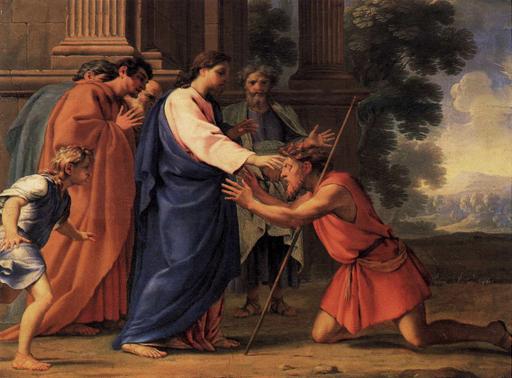 We heard about love in action in our Gospel lesson (Lk. 18:31-43). Jesus encountered blind Bartimeaus (Mk. 10:46). Bartimaeus cries out to Jesus, “Have mercy on me!” Jesus pauses on His important trek up to Jerusalem, where He is going to save the whole world. He stops to listen to Bartimeaus asking him, “What do you want me to do for you?”Bartimeaus says that he wants to receive his sight. And Jesus doesn’t start talking about Himself and the problems He is about to face even though Jesus’ burden is going to be much more than blindness. And Jesus doesn’t give advice – and if anyone is in a position to give advice it’s Jesus. Jesus simply says, “Receive your sight, your faith has made you well.”By doing this, please note, Jesus recognizes that Bartimaeus’ blindness is bad.
 44 “The Lord said to my Lord,
 Stop playing games with the Law, there is no contradiction in it. Instead, believe. Believe that Christ has come for you. He has given His life for you. God has purchased you with His own blood (Act. 20:28). He has removed the curse of the Law from you because He has perfectly kept the Law for you. And He gives you His perfection, His righteousness, His holiness.

You must be logged in to post a comment.