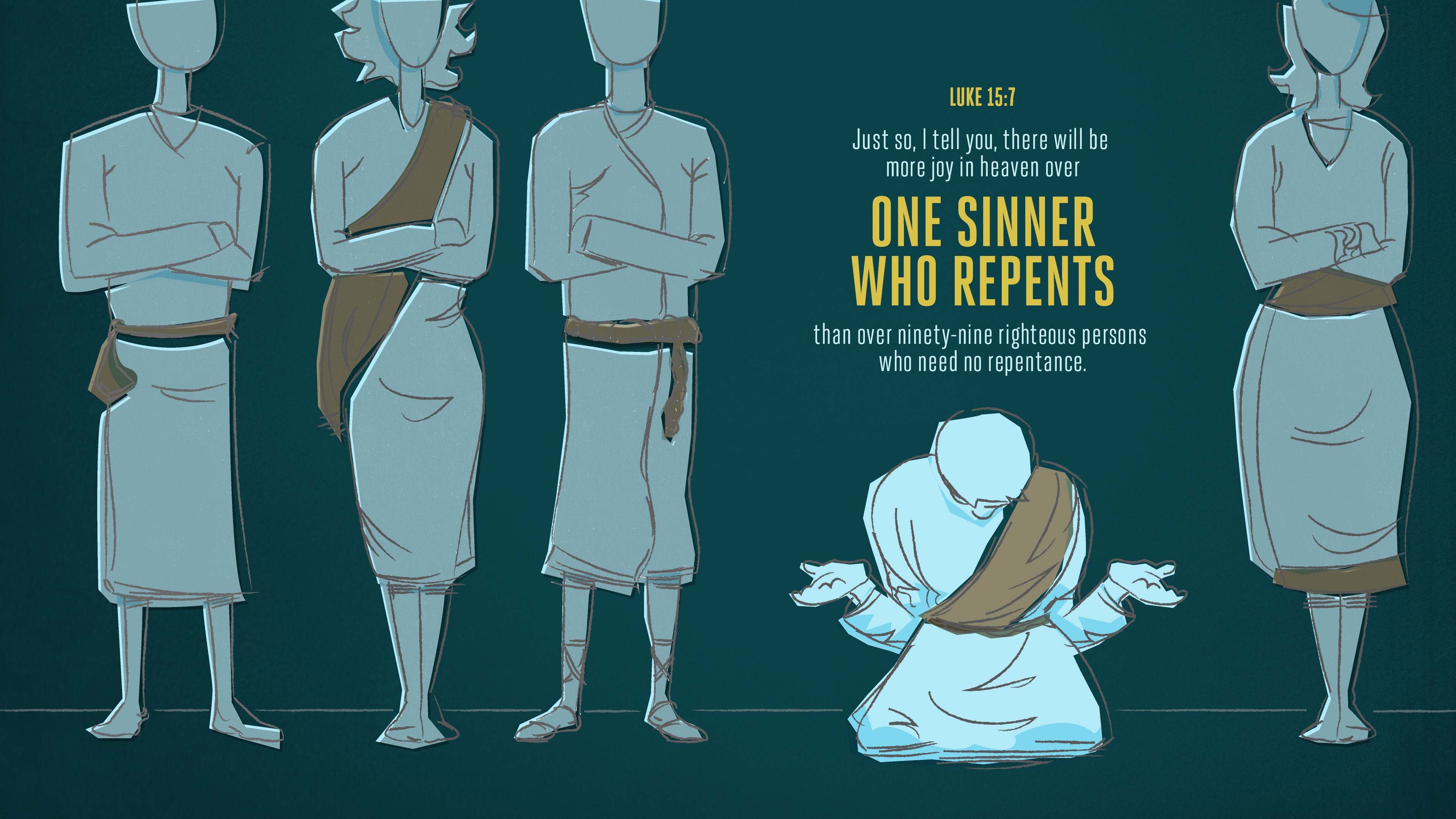
Luke 15:1-32
In the name of Jesus. Amen.
The night Jesus was born, shepherds were out in the field keeping watch over their flocks. A multitude of the heavenly host arrived praising God and saying, “Glory to God in the highest, and on earth peace among those with whom He is pleased.” Heaven was filled with rejoicing the night of Jesus’ birth because your Savior had come to rescue you from sin, death, and the devil. Now, in this Gospel lesson, Jesus says, “There will be more joy in heaven over one winner who repents than over ninety-nine righteous persons who need no repentance” (Lk. 15:7).
Well, there aren’t ninety-nine righteous persons who need no repentance; there has only ever been One righteous person who needed no repentance, Jesus Christ. This is probably a little ridiculous and silly, but should we imagine the joy of those angels the night of Jesus’ birth is multiplied by 99 plus a bit more when one sinner repents? Well, joy isn’t measured in units, so forget about attempting the math problem. But we can know from Jesus’ own lips that heaven rejoices more at the repentance and salvation of one sinner than it rejoiced over Christ’s birth.
Because Jesus brings the topic up in this text, the question for us today is: What is repentance? The word translated ‘repent’ or ‘repentance’ simply means “a change of mind,” but throughout the New Testament, you will find that repentance refers to a complete spiritual change. In fact, many of the times you come across the word ‘repent’ in Scripture it carries the whole idea of conversion.[1] The Bible does not teach that repentance is one step in some twelve-step salvation program. Salvation is instantaneous; just like in creation, God speaks, and it is. And salvation is always an act of God’s grace. “For by grace you have been saved through faith. And this is not your own doing; it is the gift of God, not a result of works, so that no one may boast” (Eph. 2:8-9). The Bible does teach that repentance is necessary for salvation, but if we see repentance as something we do, as our little contribution, then salvation is no longer a free gift. It would be dependent on you.
So, let’s reconsider repentance, what it is and what it looks like from this parable Jesus teaches.
The Pharisees and scribes are complaining that Jesus receives sinners. Luke tells us that Jesus’ response to their grumbling is telling them “this parable” – singular. Luke could have said, “so He told them these three parables,” but he doesn’t. “This parable.” One parable. Three sections, parts, or chapters – it’s fine to think of it that way – but it’s one parable. And I’ve said it before, but I’ll say it again: we typically know these three sections or chapters of this one parable as the lost sheep, the lost coin, and the prodigal son. But it would be better if we referred to them as the seeking shepherd, the seeking woman, and the seeking father because that would help us keep the emphasis on the right syllable when it comes to seeing what Jesus teaches about repentance.
Now, in the first two sections of this parable, it’s a little hard to see where repentance comes into the stories. A sheep gets lost, the sheep gets found, and the shepherd throws a party. A coin gets lost, the coin gets found, and the woman throws a party. Just looking at the stories, we would probably conclude that Jesus isn’t teaching about repentance. He’s just talking about salvation. But Jesus concludes both of those sections by talking about heaven’s joy over repentance, so repentance has to be in there somewhere. According to those two parts of the parable, repentance is nothing more than the lost being found and restored by the owner. Then, the owner celebrates because of the joy of restoration.
Now, you might be saying, “Pastor there’s a lot more to repentance than the lost being found and restored. To repent, you have to feel bad about what you’ve done. You have to recognize the hurt and pain you have caused. You need to be scared because of the punishment that’s coming. You need to want to do better. That’s repentance.” To which I have to say, “Well, not according to this parable.” Guilt, shame, fear of punishment, and resolve to do better are all right responses when it comes to our sin, and all of those things may accompany repentance from time to time. But they aren’t necessary for repentance to be true or genuine.
A lost sheep might be scared. I don’t know enough about sheep to know if they feel remorse, but a lost sheep might wish it had never wandered away from the flock. A lost sheep might try to find its way back to the herd. But in the first section of this parable, the repentance of that sheep is somewhere in the shepherd’s finding and carrying this sheep back to the pen. In the second section of the parable, the coin doesn’t have any feelings or sorrow. A lost coin just sits in the crack gathering dust. And the repentance of that coin is nothing more than the woman picking it up and putting it back in her purse. So, these first two sections picture repentance as something God does to the lost.
Just so you know I’m not making this up: In Acts 10-11, we are told the story about how Peter went to preach at Cornelius’ house. Cornelius was a Gentile, so a lot more could be said about the whole story, but I’m going to keep it short. Peter arrives there and preaches about Jesus’ death and resurrection. Peter’s Pentecost sermon is very similar in it’s content, but unlike that Pentecost sermon, Peter doesn’t hammer everyone with heavy Law. He just says that Jesus died and rose again, and he announces that everyone who believes in Jesus receives the forgiveness of sins. The people who hear that sermon are filled with the Holy Spirit and are Baptized. All of that takes place in Acts 10. When you get into Acts 11, Peter is in Jerusalem and is being accused of hanging out with the wrong crowd (similar to Jesus here in Lk. 15). Peter simply relays the story of what happened. And the response is incredibly interesting. The Jerusalem church leaders respond, “Then to the Gentiles also God has granted repentance that leads to life” (Act. 11:18). Dear saints, repentance is a gift given by God.
Now, when we get to the third section of the parable, things are a little different. In the third chapter of the parable, it sure sounds like the younger son is repentant. But where does his repentance take place? Now, we have to set this up a little bit.
The third section of the parable has three main characters – a father and his two sons. The younger son tells his father to drop dead. That’s how you get an inheritance. Basically, the younger son tells his dad, “I want my share of your stuff, but I want it without you.” And the father gives it to him. Now, this would have meant public shame for the father because it would have involved selling off at least 1/3 of his estate to give the money to his little brat of a son. The son takes the cash and blows it all. He becomes so desperate in his effort to stay alive that he hires himself out to a pig farmer and is jealous of the slop the pigs are eating.
Now, just a quick aside here. This also gives us a picture of what our sin does. Our sin isn’t just us getting lost. Sin is worse than a sheep aimlessly wandering away from the flock or a coin getting dropped. No, our sin makes us lower than and jealous of pigs.
Sitting there in the pigpen, the son starts crafting a speech. And that speech sounds like repentance, but it isn’t. Instead, the younger son realizes his father’s employees have plenty of food, and he’s dying of starvation. He plans to go to his father and say, and listen carefully, “Father, I have sinned against heaven and before you.” So far, completely true and right. “I am no longer worthy to be called your son.” No duh. “Treat me as one of your hired servants.” Now, all of this, again, sounds like repentance. He recognizes the stupidity of his actions and the ramifications of his rebellion. But it’s that last part that shows the brat’s real intention. He wants his dad to give him a job so he can have some food. The interesting thing that I had never noticed is the wording Jesus uses in this part of the parable.
Jesus doesn’t use the normal word for a servant which is doulos. A servant, a doulos, would live on the estate of the master and would even eat meals with the master’s family. But the younger son uses a different word here, misthios. A misthios is someone who would commute to work at the estate. A misthios would have no relationship with the master except when it was time to get paid for work done. His speech just shows how lost and unrepentant he still is. He still wants the benefits his dad can offer, but he doesn’t want anything to do with his dad. In his despair, he’s basically saying, “Dad, I screwed up big time. Can you just help me to stay alive? I won’t bother you and you won’t have to bother with me.” That’s his prepared speech.
He starts his walk home. But as he rounds the corner, his father comes running to him, embraces him, and kisses him. The son begins his speech, “Father, I have sinned against heaven and before you. I am no longer worthy to be called your son.” But the father, the father doesn’t care. He restores him to his rightful place as a son. “Bring the best robe and a ring and shoes; put them all on him. Kill the fattened calf and let’s throw a party. For this my son was dead, and is alive again; he was lost, and is found.” It is in that love and finding and restoration of the father that the son is granted repentance. 2 Corinthians 7:10 says, “Godly grief produces a repentance that leads to salvation without regret, whereas worldly grief produces death.” The son had a worldly grief that would have left him in the death of a lost relationship with his father. But the father here lets the godly grief of his lost son, that true and right realization of what he had done, produce a repentance that leads to salvation and complete restoration. The son doesn’t get to finish his speech. He doesn’t get to be misthios, a hireling. He gets to be a son again – nothing more, nothing less.
Now, I know this sermon is getting long, but I have one more thing, so please bear with me. I made a big deal about this chapter being one parable with three sections. Well, the third section has two parts. There is still the issue of the older son. The older son, who never left, was out working in the field. He comes home, hears the partying, learns what is going on, and is livid. He refuses to join the party. And even though this older son never left his father, he is just as lost as the younger son was back in the pig stye.
And here is why I bring this up. We wrongly think that God is happy when we are doing everything we are supposed to. We think God is happy with us when we are consistent, strong, and can show all the things we’ve accomplished. But that isn’t the case. Your heavenly Father is only happy when His children are forgiven and together with him at the feast. That is why the father leaves his own party and pleads with this older son to come back into the fold.
Dear saints, stop dwelling on your unfaithfulness and sin. Yes, you’ve been the rebellious younger son. But your heavenly Father has sought you out and heaven rejoices at your repentance and salvation. Stop dwelling on your obedience and work for God; don’t be the entitled older brother. Yes, go serve, love, and do your good works diligently, but don’t think that God is going to throw a party for your commandment-keeping.
Heaven rejoices with God when He brings you back into His grace and mercy where nothing is earned or deserved. Instead, it is all freely given for the sake of Jesus, your Savior. Amen.
The peace of God, which surpasses all understanding, will guard your hearts and minds in Christ Jesus. Amen.
[1] Clear examples would include Mt. 4:17; Lk. 5:32; 13:3; 16:30; 24:47; Act. 11:18; 2 Cor. 7:10.
 Pastorsamwise
You must be logged in to post a comment.