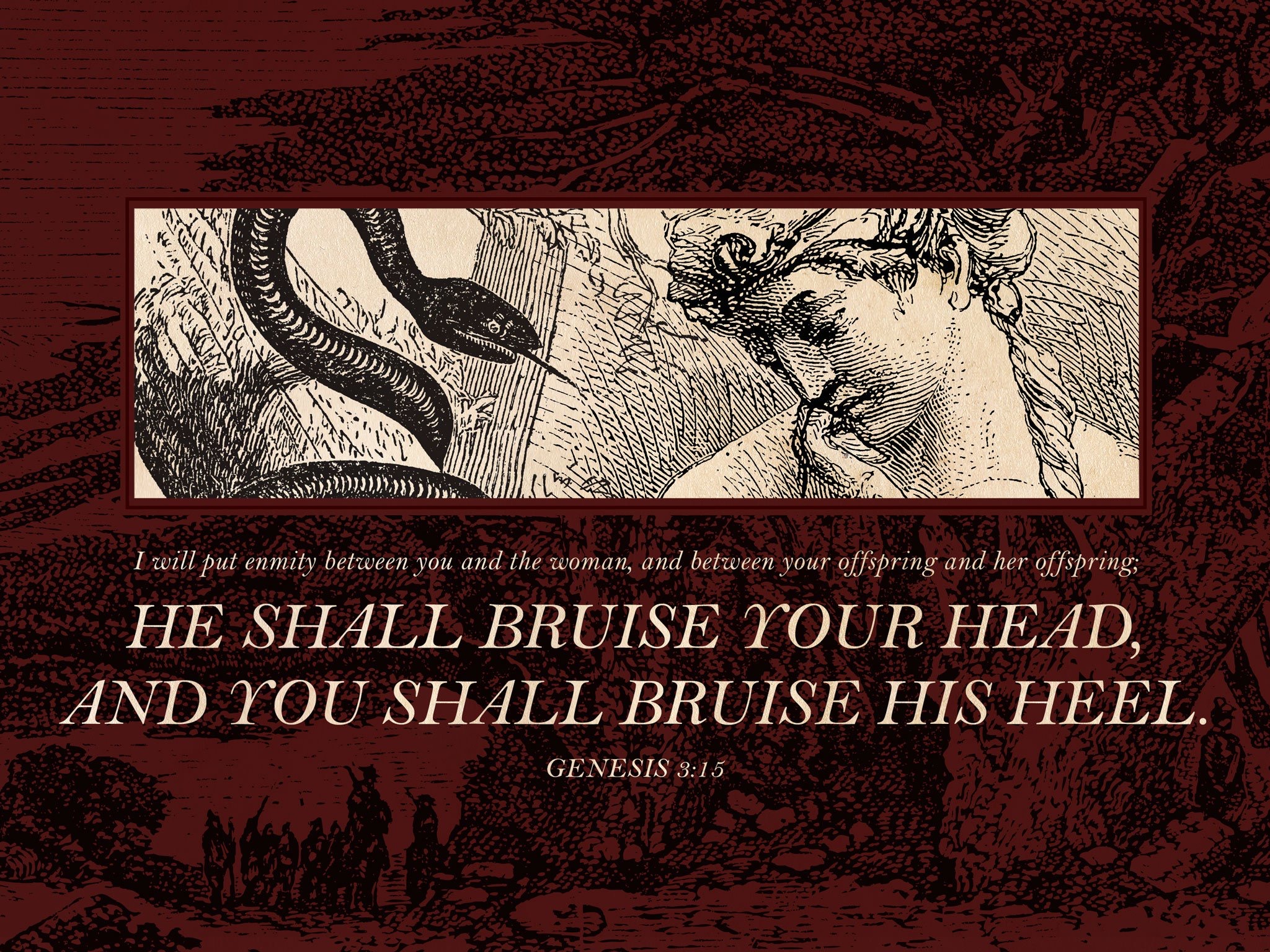
War of Words – Sermon on Genesis 3:1-21 for the First Sunday of Lent

Genesis 3:1-21

In the name of Jesus. Amen.

Genesis 3 is the first battle in the war between the devil on one side versus God and mankind on the other side. Because mankind was the crown of God’s creation, Adam and the woman were Satan’s initial target in his war against God and what He has made. And God knew what He was doing when had Moses record this chapter for us. The Holy Spirit, I suppose, could have inspired Moses to simply write, “But they ate from the forbidden tree, and that’s why everything is messed up,” and move on to Gen. 4. Instead, the Holy Spirit inspired Moses to write a detailed account of what happened. One of the reasons for that is so we can see the way the devil continues to fight against God and us. When you are fighting against someone, it’s helpful to know the weapons, tactics, strategies, and goals of your enemy so you can know how counter those attacks. So, that’s what we’re going to do as we consider this text today.

First, the devil’s weapon: He has only one. The devil couldn’t wage his war against our first parents with stones or clubs or swords or horses or tanks or guns or bombs. He couldn’t use anything physical against them because God’s creation was good – so very good, in fact, that nothing physical could harm them. The devil used the only weapon available to him, and that weapon was words.

The most important thing about us is what we believe because what we believe is the foundation of everything else in our lives. Our belief affects what we do, what we say, what we feel, and how we react. So, the devil came into the center of God’s good creation, into the garden, with words to shatter our belief and to wage his war. And the devil uses the serpent as his tool to hurl those murderous words at our first parents. The devil could’ve used anything to toss his lies at Adam and the woman. Just like an enemy could hurl a stone at a you with his arm, a slingshot, a catapult, or by dropping it from a castle wall, the stone can do harm in any of those instances, but the weapon is the same.

Satan uses the serpent here, but the devil isn’t limited to snakes when he wages war on you. He’s very imaginative and crafty with the different methods he’ll use against you. He might use a book, a video, or the news to throw his weaponized words at you to get you to doubt God and His promises. That worm could use, for example, a doctor who gives you a perfectly accurate diagnosis, “You have this disease, this cancer and you have this long to live.” That doctor might be 100% correct with that diagnosis, but that could be the method that the devil uses to hurl satanic lies at you. Remember, the Son of God, your Savior, promises that death doesn’t get the last word on you, believer. He promises, “Whoever believes in Me shall never die. [The one who believes in Me] has [already] passed from death to life” (Jn. 11:265:24).

So, words are the devil’s weapon. Now, what are his tactics and strategies as he uses that weapon? His tactic is to create space, to open just enough room for you to doubt God. Getting you to doubt God is His goal, so more on that in a minute. His tactic and strategy is to separate and distance you from God and His promises. And it doesn’t take very much space. He can slither his way into the tiniest of cracks.

As that slimy worm talks to the woman here, he presents the possibility that God is holding something back and has denied her something. He wants to open up enough space to make her think that she’s insufficient. The thing you need to notice is that God actually was holding something back from the woman and from Adam. He was withholding the knowledge of evil. God never intended us to know, let alone experience and endure, evil. But God was, as He always is, infinitely good by withholding that knowledge of evil from them.

Consider how small the crack is that the devil used to plant that tiny seed of doubt. That loathsome worm says, “You will be like God, knowing good and evil” (Gen. 3:5), and that statement was true. God Himself agrees. We didn’t read all of Gen. 3, but in the verse right after our reading ended, God says, “Behold the man has become like one of Us in knowing good and evil” (Gen. 3:22). Here’s the thing: Adam and the woman were already created in the image of God (Gen. 1:27). So, do you see how tiny the crack is – like vs. in the image? It’s a tiny difference vocabularically [sic.], but it’s a massive difference theologically.

God did not create us to be exactly like Him. He did create us to bear His image, which is much better for us. We can’t handle being like God. That’s beyond our capacity and ability. It’s too much of a burden for us. Scripture teaches that the best way to combat the devil’s tactic of distancing us from God’s promises, to prevent that space being opened up, is to be content with who we are and content with what God made us to be.

Whenever you sin (no matter what particular commandment you break), you never break only one Commandment. You always break at least two, if not three. Scripture clearly teaches this, but we don’t often think of it this way. Both Col. 3:5and Eph. 5:5 tell us that coveting (9th and 10th Commands) is idolatry (1st Command). When you covet, you are putting yourself in the place of God. Coveting is you saying, “God has messed up. That thing over there,” whatever that thing is, “should be mine over here.”

That is idolatry of self and putting yourself in the place of God. If your sin goes no further, you’ve broken two commands. But if your sin does go further, you break more. Stealing starts with you coveting something someone else owns, which is idolizing yourself, and then you actually take it. Lying starts with you coveting the truth to be something different than it actually is – which, again, is idolizing yourself. Then, you lie to make yourself look better or make your neighbor look worse than he/she is.

Contentment is the counter strategy you have to use against the devil’s tactics. In Php. 4:11-13, Paul urges us toward contentment. He says, “I have learned the secret of facing plenty and hunger, abundance and need.” That secret is contentment. When things are good, be content and don’t seek more. When things are bad, be content. Know that God is in control – even of the evil things you experience, and He promises that He will provide (Mt. 6:331 Tim. 6:6).

Again, the devil’s weapon is words, and his tactic is to create space between you and God’s promises. But that worm’s goal is to get you to doubt God. Don’t! God is no liar. God is faithful. He’s true to His Word.

So, your goal when fighting against temptation should be twofold. First, know God’s Word – more and more, better and better. And second, use that Word. 

You need to know that word extremely well. The woman ended up adding to God’s Word when she says that God didn’t allow them to touch the tree (Gen. 3:3). That wasn’t what God said. God never forbade them to touch the tree (Gen. 2:16-17). But the woman adds to God’s command, which shows that she thought God’s Word was insufficient.

Also, notice how during the temptation, Adam is absolutely silent. He doesn’t respond, interject, or interrupt. Adam doesn’t do or say anything. He just sits there and listens while this all plays out. That’s never the right approach when the devil attacks. When facing temptation, don’t be like Adam. Instead, follow your Savior’s example.

In our Gospel text (Mt. 4:1-11), Jesus counters all three of the devil’s temptations with Scripture. With the temptation to turn stones into bread, Christ quotes God’s Word that focuses on God’s promise of provision (Mt. 4:3-4Dt. 8:3). Your life doesn’t consist in temporal, earthly food. Your life comes from every word that comes from God’s mouth.

When the liar (Jn. 8:44) realizes that Jesus is using Scripture to fight back, Satan tries to use Scripture against Jesus. Think of that. The devil tries to use God’s Word against the Word of God in the Flesh (Jn. 1:14). He says, “God has promised to protect You (Ps. 91:11-12), but have You ever tested that? Jump off this building and see if it’s actually true.”

Dear saints, Satan is still doing this today. Today, he’s using all sorts of voices to pluck Scripture out of context to try to accuse you. The devil will use people who hate God and His Word to quote God’s Word at you and to accuse you of ‘not being very Christ-like.’ Don’t fooled by that. 

Yes, of course, God will protect Jesus from every trouble. But God isn’t a worthless father who will bail his kid out of every trouble that kid gets himself into. To be able to counter the slimy attacks of the worm, you need to know your Bible and know it well so that you won’t be fooled by the satanic twisting of God’s Word. So, Christ counters with Scripture, “You shall not put the Lord your God to the test”(Dt. 6:16). 

Also, notice Jesus’ response to the third temptation. Yes, He quotes Scripture, but even before He does that, our Lord simply says, “Be gone Satan.” And the devil is forced to flee (Mt. 4:11). Sometimes, you simply need to do the same thing. Tell that vile worm, “Get out of here. I’m not falling for your lies, and I don’t want to listen to them anymore.” There’s a time to tell the devil, “Be gone, you little worm.” That’s a good strategy for you to resist Satan’s attacks.

Finally, dear saints, be comforted. You will fall in this war of words. You will fall into sin. But don’t despair. You have a God who seeks you out like He seeks Adam and the woman saying, “Where are you?” (Gen. 3:9). In that moment, know that God isn’t coming after you to punish you. He’s calling you back to Himself. Be quick to acknowledge and repent of whatever sin you have. Your Savior has come. He has crushed the serpent’s head (Gen. 3:15), and He knows the temptations you face because He was tempted in every way as you are, yet without sin (Heb. 4:15). So, He sympathizes with you and your weakness. Even better, He has paid the price for your sins with His own blood (1 Pet. 1:18-19). And He clothes you, not just with animal skins (Gen. 3:21), but with the perfect, spotless robe of His righteousness (Is. 61:10Php. 3:9).

So, fight the good fight (1 Tim. 6:2). Take up the weapons of righteousness and fight against the enemy of your soul. Your Savior is returning with the sound of His war trumpet (Mt. 24:311 Co. 15:52). And in that day, you will be forever changed to be like Him (1 Jn. 3:2) – immortal, at peace, at rest, and altogether alive. Amen.

The peace of God, which surpasses all understanding, will guard your hearts and minds in Christ Jesus (Php. 4:7). Amen.

Escape – Sermon on 1 Corinthians 10:6-13 for the Ninth Sunday after Trinity

1 Corinthians 10:6-13

6 Now these things took place as examples for us, that we might not desire evil as they did. 7 Do not be idolaters as some of them were; as it is written, “The people sat down to eat and drink and rose up to play.” 8We must not indulge in sexual immorality as some of them did, and twenty-three thousand fell in a single day. 9 We must not put Christ to the test, as some of them did and were destroyed by serpents, 10 nor grumble, as some of them did and were destroyed by the Destroyer. 11 Now these things happened to them as an example, but they were written down for our instruction, on whom the end of the ages has come. 12 Therefore let anyone who thinks that he stands take heed lest he fall. 13 No temptation has overtaken you that is not common to man. God is faithful, and he will not let you be tempted beyond your ability, but with the temptation he will also provide the way of escape, that you may be able to endure it.

In the name of Jesus. Amen.

When you’re nearing the end of a task or a project, that’s not the time to get lazy, sloppy, or careless. As you get near to the goal, you need to pay close attention to what you’re doing and finish strong and make sure that you are doing things right. You’ve maybe seen replays from football games where a receiver or kick returner makes an amazing play, outruns the defense, and is about to cross the goal line. But he starts celebrating a few inches too soon and drops the ball right before the endzone. That one, careless act erases everything that he did before.

Well, here, Paul says that the end (τέλος, ‘the completion’) of the ages has come (1 Co. 10:11). And remember, he’s saying this to Christians nearly 2,000 years ago. Since it was true way back then then, it’s even truer now. Paul is encouraging us to finish strong and cross the goal line. He says, “Let anyone who thinks that he stands take heed lest he fall,” (1 Co. 10:12). In other words, don’t fall away, don’t fumble the ball, when you are so close to Christ’s return.

Plain as day, Paul tells us exactly what might drag us down and cause us to fall. In the opening verses of 1 Co. 10, he invites us to think about all the ways God’s people sinned, rebelled, and were judged after God had delivered from slavery in Egypt. He reminds us how they fell into idolatry, sexual immorality, and grumbling, causing them to be destroyed. Paul says that those things took place as examples for us.

Even though they had had God’s protection under the cloud, even though they had God’s miraculous deliverance and passed through the sea, even though they were all baptized in the cloud and in the sea, even though they ate the same spiritual food we eat and drink the same spiritual drink we drink – even though they had all those blessings from God, they were overthrown. So, Paul warns us to not be like them. To not be idolatrous, going after our own golden calves, and to not indulge in sexual immorality. To not put Christ to the test and become destroyed.

We need to learn from their example so that we don’t stumble and fall into temptation and sin right before the end of the ages. Christ is returning, and we need to persevere. If you think that you stand on your own, repent. You’re in big trouble and are about to fall (1 Co. 10:12).

Paul concludes here in v. 13, “No temptation has overtaken you that is not common to man. But God is faithful, and he will not let you be tempted beyond your ability. But with the temptation, he will also provide the way of escape, that you may be able to endure it.”

So according to Scripture, we need to learn from from the failures of others, because we are also prone to fall. We face the same temptations they did, but God is – and always will be– faithful to provide the way of escape. Often in ways that we don’t expect.

Everyone faces the same temptations. Now, being tempted is not a sin. But coveting is a sin. That’s why God gives us the final two Commandments about coveting. Coveting is the stealth bomber of sin. It flies under the radar of your conscience. Your conscience usually detects the sins that you commit in an outward way. But the sin of coveting is committed in an inward way.

You might feel guilty about replying to your spouse or someone else in an angry way that is rude and inconsiderate. But you might not be too troubled about feeling anger if you don’t let that anger out. To be clear, both of those are sins need forgiveness. Both need repentance and faith. But the 9th and 10th Commandments about coveting show that God’s Law governs even our inner thoughts, feelings, and emotions. You’ve heard this before, but it’s worth repeating over and over again. Scripture equates coveting with idolatry (Col. 3:5Eph. 5:5).

Coveting is, basically, saying, “God, You messed up. That thing over there should be mine over here.” When we realize that coveting is idolatry and is how we place ourselves above God, then coveting becomes gross and disgusting. Don’t falsely desire what God hasn’t given you. Let God be God.

So, the devil, the world, and our own sinful flesh always tempt us first to covet. They will put things in front of us that we think should be ours. Coveting is the way in which we begin to break any/all of the commandments.

But look closely at verse 13, and you’ll see three comforting truths:

First, the temptations that you face are not unique. Yes, the devil, the world, and our own flesh will individually tailor certain temptations to each of us. But everyone is tempted by the same things. Maybe in different ways, maybe through different processes, but the things that tempt you are the same things that tempt others as well.

Second, God is faithful and will not allow you to be tempted beyond your ability. God knows precisely how much weight, how much pressure, of temptation you can bear. Imagine temptations as ropes or chains that the devil would use in order to pull you toward sin. Satan cannot use ropes or chains that are too strong for you. God simply doesn’t allow it. Those chains of temptation will completely snap at the exact weight that God Himself has determined. But also, realize what that means: 

Whenever you or I sin, we aren’t pulled into that sin by forces stronger than us. No. We just didn’t fight back long or hard enough for those cords to break. In other words, when we sin, we jump headfirst into those pits. So, fight back. Fighting temptation isn’t just a mortal combat for your physical life. It’s an eternal combat for your soul. If you want to see the chains of temptation snap, just read Mt. 4 or Lk. 4 to see how Jesus resists the devil’s temptations.

The third promise that God gives here in v. 13 is that God will provide the way of escape. You have an escape out of temptation. Sometimes, people will misconstrue v. 13 and say things like, “God won’t give you more than you can handle.” On the one hand that’s true, but it’s only half true. And half-truths are often worse than blatant lies. That phrase places all the weight of fighting temptation on you and your own psychological capabilities. That phrase is basically saying, “You just need to be mentally strong enough to handle it.” Well, God gives something much better than that. He gives a way of escape.

Think of Joseph. Joseph gets attacked by his brothers and thrown into a pit, but Joseph can’t handle staying in the pit the rest of his life. So, God gives an escape, and that escape is that he is sold as a servant to Potiphar in Egypt (Gen. 37:2839:1). Later, Joseph can’t handle Potiphar’s wife asking him day after day to fornicate with her. So, God gives Joseph another escape by putting him safely into an Egyptian prison (Gen. 39:7-20).

In Joseph’s life, we see that God causes all things – even things we think are bad or horrible – to work together for good for those who love Him and are called according to His purpose (Ro. 8:28). 

In every temptation, God gives a way of escape. I know that example of Joseph might not be comforting, so think of Paul himself. In 2 Cor. 12:7-10, he talks about having a thorn in his flesh. He prays three times that God would remove that thorn, but God’s response is simply, “My grace is sufficient for you, for My power is made perfect in weakness.”

It may be that your escape from temptation is only going to come through other trials, like it was for Joseph. Or, it may be that your escape from temptation is God’s promise of His continual grace, like it was for Paul. But ultimately, your way of escape is coming because Christ is returning.

Believer, Christ is returning to bring you to the new creation. The end/completion of the ages and the resurrection of the body is the ultimate escape from temptation. So, press on in your fight against temptation and sin.

Rose, that brings me to you. Rose, today you are baptized, not just into Moses, but into the name of the Father, Son, and Holy Spirit. Now, Rose, you bear His name (Mt. 28:19). Persist. Persevere. Fight against the temptations that the devil, world, and your own flesh will throw at you.

And all you dear saints, you fight too. To strengthen you in that fight, Jesus now invites you to His table. Here, He delivers His Body and Blood, given and shed for the forgiveness of all your sin. Here, you receive God’s grace and mercy. Here, you see God’s faithfulness to you. Resist, fight, flee temptation because the end of all things is at hand. Amen.

The peace of God, which surpasses all understanding, will guard your hearts and minds in Christ Jesus. Amen.

Children of Light – Sermon on Ephesians 5:1-9 for the Third Sunday of Lent

Ephesians 5:1-9

1 Therefore be imitators of God, as beloved children. 2 And walk in love, as Christ loved us and gave himself up for us, a fragrant offering and sacrifice to God. 

3 But sexual immorality and all impurity or covetousness must not even be named among you, as is proper among saints. 4 Let there be no filthiness nor foolish talk nor crude joking, which are out of place, but instead let there be thanksgiving. 5 For you may be sure of this, that everyone who is sexually immoral or impure, or who is covetous (that is, an idolater), has no inheritance in the kingdom of Christ and God. 6 Let no one deceive you with empty words, for because of these things the wrath of God comes upon the sons of disobedience. 7 Therefore do not become partners with them; 8 for at one time you were darkness, but now you are light in the Lord. Walk as children of light 9 (for the fruit of light is found in all that is good and right and true),

In the name of Jesus. Amen.

You’ve probably all heard the phrase, “Nothing good happens after ___ o’clock.” If a news anchor said it, the time might have been midnight or 2 AM. If it was one of your parents, it was probably 10:00. Kids, if you ever hear that phrase from your parents or grandparents, they know what they’re talking about. When darkness falls, it is a lot more likely that evil things are going to happen.

Darkness is the favorite blanket of evil, and we know this instinctively. It’s why kids go into their parents’ room in the middle of the night and cry about monsters under the bed or whatever other impossible things kids imagine. Everyone has a keen sense of vulnerability in the dark. Even adults often have their bleakest thoughts when the world is dark. The thoughts that wake me up at 3 AM are never the best, brightest, or most hopeful ones.

In a wonderful way, Scripture repeatedly gives a picture of the Savior as the bright Morning Star (Is. 60:1-3; Mal. 4:2; 2 Pet. 1:19; Rev. 2:28, 22:16). Or, in a similar vein, Scripture says that, when Jesus comes, a new day dawns (Ps. 84:11; Ro. 13:12). In the first chapter of Luke’s Gospel, the coming of Jesus is described as the “sunrise from on high” that “give[s] light to those who sit in darkness and in the shadow of death,” and His coming, “guide[s] our feet into the way of peace” (Lk. 1:78-79).

Dear saints, the picture Scripture gives us is that all of creation has changed because Christ has come. The darkness has been dispelled, put to flight, and broken up. Jesus hints at this in our Gospel reading (Lk. 11:14-28). Christ says that He casts out demons by the finger of God, and His power to do that is proof that the kingdom of God has come upon us (Lk. 11:20).

Because of Jesus’ resurrection, there is a new day – the day that the Lord has made. Because He has made it, we rejoice and are glad in it (Ps. 118:24). And this new day will never end. Believer, this changes you, and it changes how you think about the world. The fact that today and every other day of your life is the day that the Lord has made, the things in front of you that are ominous, scary, and threatening are all less intimidating. Yes, they are still threats, but you know that they are all defeated threats.

All three of our readings today are about spiritual warfare, about the battle between the kingdom of darkness and Christ’s kingdom of light. It’s obvious in both the Old Testament (Ex. 8:16-24) and Gospel (Lk. 11:14-28). In our Gospel reading, Jesus tells us know how the kingdom of Satan operates, and our Lord comforts us because He tells us how He, our Savior and Champion, has defeated sin, death, and the devil.

And in the Old Testament reading, we heard how Pharaoh’s magicians recognized that the finger of God was at work when they couldn’t replicate the gnats that swarmed throughout Egypt (Ex. 8:18-19). Those evil, demonic sorcerers were able to duplicate the sign God did through Moses of turning his staff into a serpent (Ex. 7:11-12), but they failed to do the smaller thing of reproducing gnats.

The last time these texts came up, I had fully intended to preach about the folly of the kingdom of darkness because that folly is on full display through Pharaoh and his magicians. Their whole country is completely overrun with gnats, but they still try to duplicate the sign done through Moses. That text shows how self-destructive the kingdom of Satan is. “Our whole nation is filled with these gnats.” “I know what we should do; let’s try to make more of them.”

But today, rather than seeing how the kingdom of darkness works or how self-destructive it is, I decided to preach on this Epistle reading because it gives us the strategy of how to fight back against the forces of darkness. Throughout Scripture you are given several ways to fight evil, but this text gives you one simple weapon – thankfulness and thanksgiving.

Notice that v. 3 gives us a list of things we are to not only avoid we aren’t even to name them. That list is sexual immorality, impurity, and covetousness. Then in v. 5, that list is repeated when we’re told that the sexually immoral, the impure, and those who are covetous have no inheritance in the kingdom of Christ and God.

To contrast that twice-repeated list, Paul mentions only one thing here – thanksgiving. The beloved children of God who walk in love as children of light have thanksgiving on their lips, not filthiness or foolish talk or crude joking.

Thanksgiving is one of the fruits of the Spirit (Gal. 5:22-23). And thanksgiving is one of your best weapons against the darkness from which you have been rescued. When thanksgiving is on your lips, the temptations and sins you face are much easier to fight because those things become revolting.

Think back to the Garden of Eden and how the devil tempted our first parents to fall into sin. “Can’t you eat from any tree? If you eat from this one that God told you not to eat from, you will be like God. Don’t you want to be like Him?” (Gen. 3:1, 5). Instead of being thankful that God had given all the other trees for food, instead of being thankful that God had already made created them in His image (Gen. 1:27), Adam and Eve coveted (Gen. 3:6). The fruit of the forbidden tree looked good, and it was desirable. Because of that coveting, because of that wrong desire to be more than God had already made them to be, they took of the fruit and ate and plunged all of creation into the darkness of sin and death.

Coveting is a sin, but it is a sin that rarely registers in our conscience. We pass off coveting as nothing because we think it doesn’t hurt anyone else. That is so wrong. Here coveting is equated with idolatry (Eph. 5:5). Coveting is the first step into sin. To put it another way, every time you sin, you first covet and idolize yourself. Coveting is basically saying, “God, you got it wrong. You messed up. That thing over there,” whatever it is, “should be here. It should be mine.”

Whenever you sin, you break at least three commandments. Every time you sin, you first covet which is nothing less than idolizing yourself. Then you commit adultery, steal, lie, take the Lord’s name in vain, etc. The way to fight against this is to give thanks instead of coveting and having those false desires.

Imagine for just a minute if thankfulness had replaced Adam and Eve’s coveting. They would have realized, “We aren’t hungry; the entire world is our pantry! Thank you, God. We are already created in God’s image and are exactly what God wants us to be. Thank you, God, that we are created in Your image and that you have declared that we are ‘very good’” (Gen. 1:31).

Dear saints, Scripture gives you several ways to fight against the devil and the darkness. But today, you children of light, this text gives you one simple, specific weapon to fight back against the forces of evil, and that is thanksgiving.

You husbands, the next time you are tempted with lust, pause. Take a moment to give thanks to God for your wife. Thank God for uniting the two of you in the bond of holy marriage (Mt. 19:6). You wives, the next time you are tempted to complain to someone about your husband, take a moment to give thanks to God for him and all the ways he cares for you and your family. Children, the next time you are tempted to disobey your parents, take a moment to give thanks to God for all that your parents provide to you and how they protect you.

Dear saints, the light of Christ has shined upon you, and because of that you are now children of the light. You used to be darkness, and notice the way Eph. 5:8 says that. It isn’t just that you were in darkness. No. You were darkness itself. But now that you are God’s children, you are light in the Lord, so now you walk as children of the light. And as children of the light, you produce the fruit of light which is found in all that is good and right and true.

You give thanks to God for all the good He has given you. You give thanks to God, and it is right to do so because He has truly blessed you because He has given Himself up for you as a fragrant offering and sacrifice.

God has forgiven you (Eph 4:32). He has made this new day of light and has shined His light into you. So, rejoice, be glad in this day, and give thanks. And as you give thanks, the darkness flees. Amen.

The peace of God, which surpasses all understanding, will guard your hearts and minds in Christ Jesus. Amen.