Listen here.
Matthew 8:23-27
23 And when [Jesus] got into the boat, his disciples followed him. 24 And behold, there arose a great storm on the sea, so that the boat was being swamped by the waves; but he was asleep. 25 And they went and woke him, saying, “Save us, Lord; we are perishing.” 26 And he said to them, “Why are you afraid, O you of little faith?”Then he rose and rebuked the winds and the sea, and there was a great calm. 27 And the men marveled, saying, “What sort of man is this, that even winds and sea obey him?”
In the name of the Father and of the Son and of the Holy Spirit. Amen.
After hearing this Gospel lesson, I want you to consider again these words from our call to worship because I think it sheds a beautiful light on this text:
“Let them thank the Lord for his steadfast love, for his wondrous works to the children of man! They saw the deeds of the Lord, his wondrous works in the deep. For He commanded and raised the stormy wind, which lifted up the waves of the sea. Then they cried to the Lord in their trouble, and He delivered them from their distress. He made the storm be still, and the waves of the sea were hushed” (Ps. 107:24-25, 28-29).
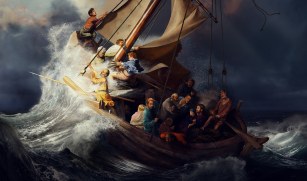 Imagine Matthew in this storm. Remember, Matthew – unlike Andrew and Peter and James and John – Matthew wasn’t a fisherman. He was a tax collector when Jesus called him to be a disciple (Mk. 2:14). Typically, he had hands stained from handling coins all day not clammy, saltwater-drenched hands. Matthew was used to sitting in a tax booth not on the rail of a boat bailing water so that it doesn’t sink. Matthew had seen Jesus rebuke demons, rebuke sickness, and rebuke the Pharisees and religious elite. But now, in the middle of a storm that threatened Matthew’s life, the Man who had called him saying, “Follow Me,”lay peacefully sleeping and undisturbed in the back of the boat on a cushion (Mk. 4:38).
In this text from Matthew, the disciples cry out to Jesus, “Save us, Lord; we are perishing.” But in the Gospel of Mark, the disciples collectively ask Jesus, “Don’t You care that we are perishing?” (Mk 4:38). The folk singer Gordon Lightfoot wrote a song about the sinking of the Edmund Fitzgerald on Lake Superior on November 10, 1975. One of the lines from that song is, “Does anyone know where the love of God goes when the waves turn the minutes to hours?” Those are the types of thoughts going through Matthew’s mind and the minds of the other disciples.
Now, hold on to that thought while I change scenes.
Remember the story of Job? Job was a man who was blameless and upright. Job feared God and turned away from evil. This was what God said about Job (Job. 1:1,8). There was a day when God asked Satan what he thought about Job. And the devil replied, “Does Job fear You for no reason? Haven’t You put a hedge around him and his house and all that he has on every side? Just stretch out Your hand against Job, and he will curse You to Your face.” And God basically says to the devil, “Go for it,” (Job. 1:9-12). Then, one day Job’s servants came one after another to tell him that all his sheep, oxen, donkeys, and camels were all destroyed. Finally, another servant comes and says, “Your seven sons and three daughters were feasting together, and a great wind,” catch that, “a great wind came and struck the corners of the house and killed your children” (Job 1:18-19).
Now, who sent that wind? The devil did. Satan took control of the wind and used it to bring down the house where Job’s children were. But, and you have to remember this, Satan could only do that because God had given the devil permission to do so.
One more scene change. Bear with me.
Think back to our Old Testament lesson (Jon. 1:1-17). Jonah was told to go and preach to Nineveh and call them to repent of their sins. But Jonah turned tail and went the opposite direction. He boards a boat in order to flee from God’s presence. Verse 4 says, “But the Lord hurled a great wind upon the sea, and there was a mighty tempest on the sea, so that the ship threatened to break up.” God sent that wind. God sent the storm. God sent those waves.
So, God can send a wind to come after Jonah, and God can allow the devil to send a wind to do harm. Now, the question is this: who sent the storm in this Gospel text? Was Satan sending this storm to try to drown Jesus or to cause the disciples to doubt Christ? Was God sending this storm to cause the disciples to trust in Jesus more than they had before?
Well, honestly, we don’t know. But that, dear saints, is the point. Either way, whether the devil was behind this storm or God was, God was in control of the whole situation even though it seemed like He didn’t care and was sleeping. At a simple word from Jesus, the winds and waves stopped, and there was a great calm. And this miracle causes the disciples to marvel, “What sort of Man is this, that even the winds and sea obey him?”
In the midst o f that storm, in the middle of the wind and the saves and terror, Jesus asked the disciples, “Why are you afraid, O you of little faith?” This question from our Lord’s lips confronts us today. What are you afraid of? The devil may be behind the things you fear. Satan may want you to enter “emergency mode,” “crisis mode,” “God doesn’t care and is sleeping mode.” The devil wants nothing more than to rob you of the peace and security that comes from being a child of God. So repent. The devil is very cunning and dangerous, but he is also totally and completely predictable.
But what is God doing in allowing you to experience those things that you fear? Why is God permitting Satan to do these things to you? That is an unanswered question in the Bible. If there was an answer in Scripture, I’d be more than happy to tell you, but the Bible seems to be more interested in keeping that answer from us. We know why the devil knocked the house onto Job’s children, but we aren’t told in the whole book of Job why God allowed the devil to do it. We might think that God sent the storm upon Jonah in order to get Jonah to Nineveh to preach and call those people to repent, but there may have been even more reasons that we are completely unaware of as well.
We aren’t told what God is doing when we are in the midst of trials and tribulations. But we can know with confidence, that whenever God sends storms and trials our way or when He allows Satan to send us trouble and tribulation, we know that God has nothing but our best interest in mind. We know because Scripture tells us that God works all things together for good for those who love Him and are called according to His purpose (Ro. 8:28). Scripture says, “Count it all joy when you meet trials of various kinds, for you know that the testing of your faith produces steadfastness. And let steadfastness have its full effect, that you may be perfect and complete, lacking in nothing” (Ja. 1:2-3 see also Heb. 12:6-12, 1 Pet. 1:7, Rev. 3:19).
Here’s the main point. When you are faced with trials, temptations, and crosses you are tempted to think that God is sleeping. You are tempted to think that He doesn’t care and is totally apathetic toward you and your plight. Don’t look at your troubles and try to gauge what God thinks about you.
 If you want to know what God thinks about you, you need look no further than the cross. While you were still weak, at the right time, Christ died for you (Ro. 5:6,8). If you are going through a storm of sickness, a storm of family strife, or whatever it might be, look at it through the lens of Christ crucified and risen for you. And know that God is in control and He will never leave you nor forsake you.
The sailors that Jonah was using to flee from God’s presence had to wake Jonah up and throw him overboard to still the storm. Jesus only has to speak, and the waves are stilled and the storm is hushed. And even though Jesus wasn’t thrown out of the boat in this Gospel text, He was thrown overboard in a much more important way.
On the cross, Jesus was thrown into the place of God’s judgement against your sin and the sins of the whole world. Jesus wasn’t swallowed by a great fish, He was swallowed by death in order that He might defeat death for you. As Jonah was in the belly of that fish for three days, Jesus was in the grave for three days. And He is risen again.
Today, you have different storms, different winds, and different waves tempting you to fear. But you have the same Jesus who slept in the boat, who woke up, who rebuked the wind and the waves and they listened to Him.
Whatever storms you face in this life, bring them to your God. Let those trials teach you to pray. And marvel at the wonderful answer of your God and Savior. Cry to Him in your trouble, and he will deliver you from your distress (Ps. 107:28). Amen.
The peace of God, which surpasses all understanding, will guard your hearts and minds in Christ Jesus. Amen.
 5 When he had entered Capernaum, a centurion came forward to him, appealing to him, 6 “Lord, my servant is lying paralyzed at home, suffering terribly.” 7 And he said to him, “I will come and heal him.” 8 But the centurion replied, “Lord, I am not worthy to have you come under my roof, but only say the word, and my servant will be healed. 9 For I too am a man under authority, with soldiers under me. And I say to one, ‘Go,’ and he goes, and to another, ‘Come,’ and he comes, and to my servant, ‘Do this,’ and he does it.” 10 When Jesus heard this, he marveled and said to those who followed him, “Truly, I tell you, with no one in Israel have I found such faith. 11 I tell you, many will come from east and west and recline at table with Abraham, Isaac, and Jacob in the kingdom of heaven, 12 while the sons of the kingdom will be thrown into the outer darkness. In that place there will be weeping and gnashing of teeth.” 13 And to the centurion Jesus said, “Go; let it be done for you as you have believed.” And the servant was healed at that very moment.
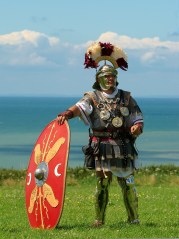 “Centurion” was his title and meant he was a commander over one-hundred soldiers. Centurions wore impressive armor including a helmet with all the feathers sticking out of the top, a shiny breastplate, a metal skirt, and a huge shield. Like a leper, a centurion’s command was also obeyed, but not to avoid becoming one of them. A centurion could say, “Go,” and the soldier would go. “Destroy,” and they would destroy. “Kill,” and they would kill.
 Repent, but do not despair. Jesus, God in the flesh, comes down from the mountain in order to save us. He is a God of mercy and grace. He comes to make the unworthy worthy and the unholy sacred. Jesus willingly approaches the untouchable leper to touch and heal. And Christ has compassion upon a centurion who appeared to have everything, but in reality, had nothing.
 Or my favorite, the boy standing in the middle of the room with his eyes closed tight. (To my great shame, I learned closing your eyes doesn’t make you invisible when I was in fourth grade.) Silly kids.
 Jesus stood in the middle of people who have been looking for a reason to kill Him for almost His entire ministry (Mk. 3:6). Today, Christ declares Himself to be no less than Almighty God. When He declares Himself to be the great I Am, Jesus announces that He is the One who is Lord over all things, and the One who always was, always is, and always will be, the One who spoke to Moses from the burning bush, the One who led their ancestors through the Red Sea on dry ground, the One whom Isaiah saw in the Temple.
 All of that is hidden so that you do not have to face it. It is hidden so that you do not need to hide.
 In the name of Jesus. Amen.
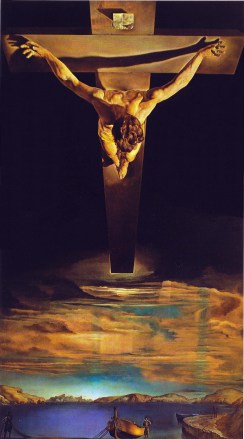 In the Transfiguration, Jesus is truly beautiful, divinely beautiful. But in there is another beauty that is better than the Transfiguration. The beauty of Jesus is what you see on the cross where God in the flesh dies for the disciples and for you to save you from your sin.
 Pastorsamwise
You must be logged in to post a comment.