No Nonsense – Sermon on Luke 24:1-11 for the Vigil of Easter

The bulletin for tonight’s service can be found here.

Luke 24:1-11

1 But on the first day of the week, at early dawn, they went to the tomb, taking the spices they had prepared. 2 And they found the stone rolled away from the tomb, 3 but when they went in they did not find the body of the Lord Jesus. 4 While they were perplexed about this, behold, two men stood by them in dazzling apparel. 5 And as they were frightened and bowed their faces to the ground, the men said to them, “Why do you seek the living among the dead? 6 He is not here, but has risen. Remember how he told you, while he was still in Galilee, 7 that the Son of Man must be delivered into the hands of sinful men and be crucified and on the third day rise.” 8 And they remembered his words, 9 and returning from the tomb they told all these things to the eleven and to all the rest. 10 Now it was Mary Magdalene and Joanna and Mary the mother of James and the other women with them who told these things to the apostles, 11 but these words seemed to them an idle tale, and they did not believe them.

Alleluia! Christ is risen! 
He is risen indeed! Alleluia!

In the name of Jesus. Amen.

With all the reverence and respect that I can give to them, the angels that appear the morning of the resurrection are a bit sassy. These women had left early, even before the sun had started to peek over the horizon. So, they probably hadn’t gotten themselves ready like they would on any other morning. They just tossed on some clothes and grabbed the bundles of spices as they went out the door to walk through that dewy, morning air. They went intending to finish the job of burying Jesus. But when they arrived at the tomb, they find it. The stone – rolled away. The body of Jesus – gone. So, they stand there totally disheveled and utterly perplexed.

These two angels that stand in front of them look completely different. The angels are clothed in dazzling apparel. They look at these tired women with their bundles, and it’s almost like the angels are thinking, “Oh, for cute. These women with their bundles of spices. What do they think they are going to do here?”

And one of those angels asks his sassy question, “Why do you seek the Living One among the dead? He’s not here. He is risen. Remember what He told you while He was still with you in Galilee? The Son of Man had to be delivered into the hands of sinful men, crucified, and on the third day rise. By the way, ladies, that’s today.” It’s like that angel is saying, “This shouldn’t be too difficult for you. He told you all about this.”

And it’s at that point that these women – Mary and Mary and Mary and Mary (there were lots of Marys) and Joanna and Salome – they remember that Jesus had said that He would rise. Only then did they remember those words of Jesus.

So, they ran back to tell these things to the eleven apostles and all the others who were gathered together. Luke doesn’t record the conversation between the women and the rest, but he makes it very clear (it doesn’t come out in our translation) that there was an ongoing conversation. “As they were speaking about these things to the apostles” (Lk. 24:10). 

Luke only leaves us to imagine what this conversation would have sounded like. But the women probably told them all about the angels and their dazzling apparel and about the other sassy angel who had come down to sit on the stone and dance on the grave of death (Mt. 28:2-3). They would have told them how the angel reminded them what Jesus had said about that dying and rising stuff.

But the words of these disheveled, frantic, crazy women sounded delirious. The apostles figured it was nothing more than an idle tale and a bunch of nonsense. What they had seen on Good Friday was too devastating. They figured the women hadn’t gotten enough sleep and should have set their alarm clocks for a little later.

And that reaction to the women’s report is a huge comfort to us today. They should have believed the whole time, even as Christ hung on the cross. But the fact they initially thought it was all nonsense bolsters our faith.

Because as that day rolled on, Jesus would appear to two of them on the road to Emmaus (Lk. 24:13-32). Jesus would appear to Peter (Lk. 24:34). That evening, Jesus would appear to all of them as they sat locked in the upper room (Jn. 20:19-22). Jesus would eat in front of them and show them His pierced hands and side (Lk. 24:38-43).

The women weren’t spewing a bunch of nonsense. It wasn’t an idle tale. As that day wore on, their disbelief melted away into belief. And that belief would strengthen into boldness. And that boldness would mature into courage.

What first had sounded like an idle tale and a bunch of nonsense to the apostles slowly became an undeniable certainty. Jesus died but lives. And now, because He lives, death would have no hold on them because it had no hold on Jesus. Death was no longer their enemy, because their Savior, their Lord, their Jesus, had defeated death.

As the years passed, almost all of those – who, initially, thought that the Resurrection was just a bunch of nonsense, just an idle tale of tired and confused women – they would, one by one, refuse to deny the fact that Jesus had risen. They would not deny that the One who had died is now living. They would rather give up their own lives because it wasn’t nonsense. Jesus is the Living One who gives everlasting life to all who believe in Him.

Dear saints, the day is coming when all the perplexities of this world and of your life will not be perplexing anymore. In that day, this fact will remain certain, firm, and sure – Jesus is risen. It is no nonsense. Amen.

Alleluia! Christ is risen! 
He is risen indeed! Alleluia!

The peace of God, which surpasses all understanding, will guard your hearts and minds in Christ Jesus. Amen.

God of the Living – Sermon for the Vigil of Easter

Click here for the bulletin with the readings for tonight’s service.

Alleluia! Christ is risen!
He is risen indeed! Alleluia!

In the name of Jesus. Amen.

Now and always, our God is the God of the living (Lk. 20:38).

From the very beginning of Scripture (Gen. 1:1-2:3), God creates and gives life to everything that and lives and breathes. God forms Adam from the dust of the ground with His own hand and breathes into his nostrils the breath of life (Gen. 2:7) because He is the God of the living.

In the time of the Flood (Gen. 7:1-5, 11-18; 8:6-18; 9:8-13) when every intention of the thoughts of mankind’s heart was choosing death, God brings destruction to those who rejected Him as the God of life. But He would not make a complete end. He instructed Noah to build an ark to save Noah, his family, and the animals. God did this to preserve the life He had created because He is the God of the living.

When God heard the groaning of His people who were slaves in Egypt, He remembered His covenant with them. God saw their affliction, and God knew (Ex. 2:23-25). God did all those signs and wonders to bring His people out of that land of slavery and death. He opened a way through the waters of the Red Sea so His people could escape Pharaoh’s deadly soldiers, pass through the watery tomb on dry ground, and arrive safely on the other shore (Ex. 14:10-15:1). He did this because He is the God of the living.

When they were scattered and exiled, God promised to bring His people to their own land. He promised to sprinkle clean water on them to wash them from all their uncleanness. He would remove the sinful, dead hearts of stone and give them living hearts of flesh (Ezk. 36:24-28) because He is the God of the living.

When His people were dried up bones (Ezk. 37:1-14), God gave His prophet Ezekiel a promise to proclaim: “I will open your graves and raise you from your graves. I will bring you into the land, and you shall know that I am the Lord. I will put My Spirit within you, and you shall live.” God made that promise because He is the God of the living.

When Job was suffering, he knew that his Redeemer lives (Job 19:20-27). And Job had no doubt that his Redeemer would stand victorious on the earth. Job rightly confessed even after his body died and his flesh was destroyed that his own eyes would see God because Job knew that God is the God of the living.

Faced with a blazing execution, Shadrach, Meshach, and Abednego refused to worship the pagan image that Nebuchadnezzar had set up (Dan. 3:1-30). They knew that God was able to deliver them from the burning fiery furnace and out of the king’s hand. But even if God didn’t deliver them they would not worship that dead, golden image. Even though they were bound and thrown into that inferno, they were not burned or singed because the God of the living walked with them both through and out of that fire.

The God of the living brings life to every corner of creation where we bring sin and, with our sin, death. The God of the living took on flesh and blood to take your place on Golgotha, the Place of the Skull (Mt. 27:33). Out of love for you who choose death, He willingly went to death to utterly defeat it. And when God dies, He doesn’t stay dead. He is the God of the living.

Jesus, your Savior, has and will come into your grave and bring you out. By His death, He has swallowed up death. “O death, where is your victory? O death, where is your sting?” Death’s only answer is, “I lost them. The God of the living has taken them away.”

Dear saints, because of the crucified, dead, buried, resurrected, ascended, and living Jesus, you now look for the resurrection of the dead and for the life of the world to come. Amen.

Alleluia! Christ is risen!
He is risen indeed! Alleluia!

The peace of God, which surpasses all understanding, will guard your hearts and minds in Christ Jesus. Amen.

The Price – Sermon on Matthew 27:62-28:15 for the Vigil of Easter

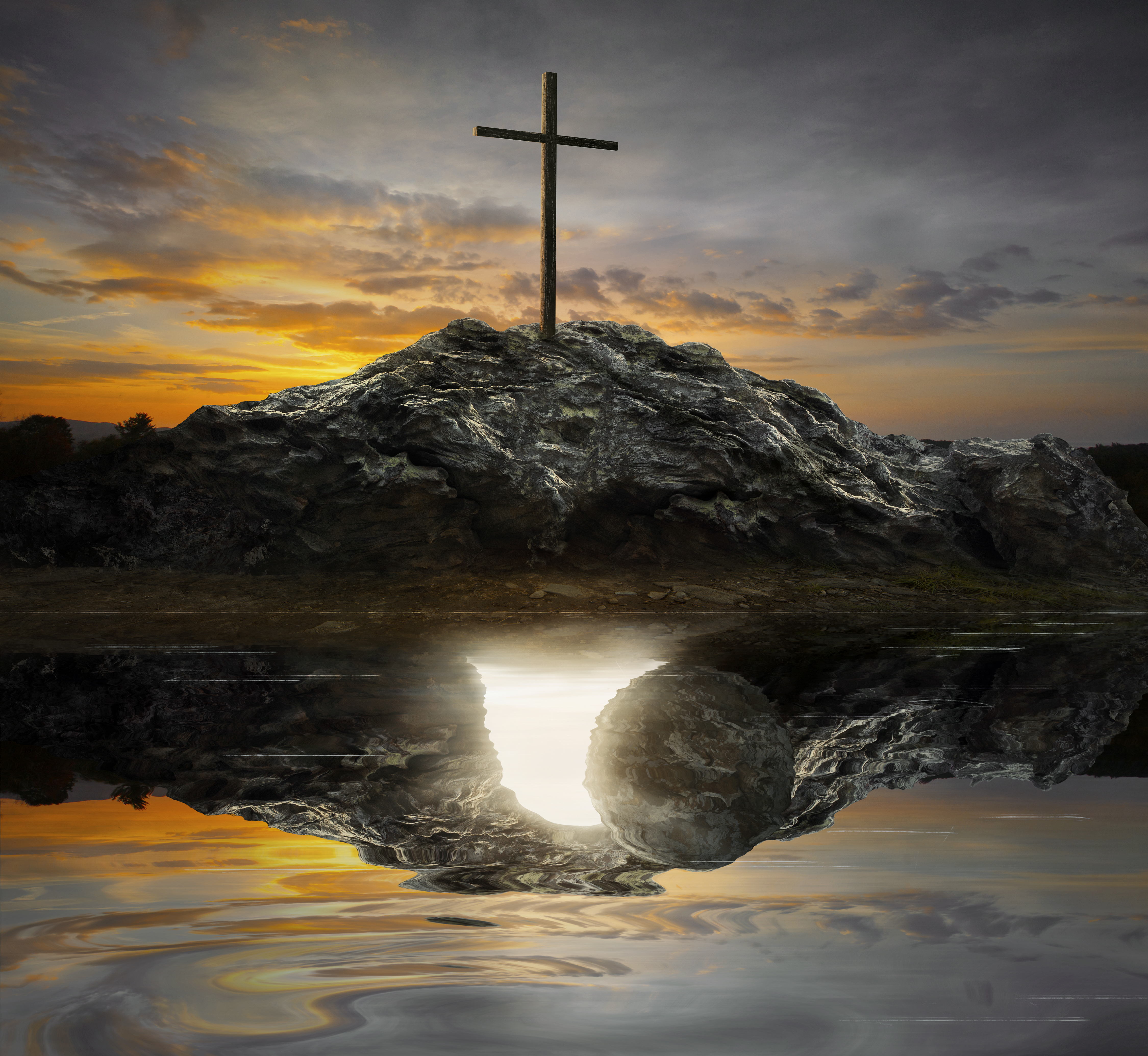
A single cross with the reflection of an empty tomb.

Matthew 27:62-28:15

62 The next day, that is, after the day of Preparation, the chief priests and the Pharisees gathered before Pilate 63 and said, “Sir, we remember how that impostor said, while he was still alive, ‘After three days I will rise.’ 64 Therefore order the tomb to be made secure until the third day, lest his disciples go and steal him away and tell the people, ‘He has risen from the dead,’ and the last fraud will be worse than the first.” 65 Pilate said to them, “You have a guard of soldiers. Go, make it as secure as you can.” 66 So they went and made the tomb secure by sealing the stone and setting a guard. 

1 Now after the Sabbath, toward the dawn of the first day of the week, Mary Magdalene and the other Mary went to see the tomb. 2 And behold, there was a great earthquake, for an angel of the Lord descended from heaven and came and rolled back the stone and sat on it. 3 His appearance was like lightning, and his clothing white as snow. 4 And for fear of him the guards trembled and became like dead men. 5 But the angel said to the women, “Do not be afraid, for I know that you seek Jesus who was crucified. 6 He is not here, for he has risen, as he said. Come, see the place where he lay. 7 Then go quickly and tell his disciples that he has risen from the dead, and behold, he is going before you to Galilee; there you will see him. See, I have told you.” 8 So they departed quickly from the tomb with fear and great joy, and ran to tell his disciples. 9 And behold, Jesus met them and said, “Greetings!” And they came up and took hold of his feet and worshiped him. 10 Then Jesus said to them, “Do not be afraid; go and tell my brothers to go to Galilee, and there they will see me.”

11 While they were going, behold, some of the guard went into the city and told the chief priests all that had taken place. 12 And when they had assembled with the elders and taken counsel, they gave a sufficient sum of money to the soldiers 13 and said, “Tell people, ‘His disciples came by night and stole him away while we were asleep.’ 14 And if this comes to the governor’s ears, we will satisfy him and keep you out of trouble.” 15 So they took the money and did as they were directed. And this story has been spread among the Jews to this day.

Alleluia! Christ is risen!
He is risen indeed! Alleluia!

In the name of Jesus. Amen.

When Jesus died on Friday, things happened quickly and somewhat haphazardly because the Sabbath was about to begin at dusk. Joseph of Arimathea asked for the body of Jesus and laid it in his own new tomb (Mt. 27:57-61). Jesus had His Sabbath rest in that tomb from all the work that He had done (Gen. 2:2), but the chief priests and Pharisees don’t rest because they can’t rest. Instead, they work. They work like busy, busy bees. Even though it is the Sabbath day (and a high Sabbath because of the Passover), they go to Pilate and ask that a guard be set because they remember that Jesus had said He would rise after three days (Mt. 27:63-64). In a sad twist of irony, the enemies of Christ take His prediction of the resurrection more seriously than Jesus’ own disciples do.

Pilate seems to be a little annoyed by the request. He figures Jesus is dead and is no longer a threat, but here are these chief priests completely obsessed with a guy who has been crucified and is dead. So, Pilate says, “You have a guard of soldiers.” The Greek here is a little ambiguous. Pilate’s words there could be either a statement – which is how it is in our translation – or a command, “Here, have/take a guard of soldiers. Go, make it as secure as you can.”

I bring this up because it would make a difference as to which soldiers are stationed to guard the tomb. If it is a command, “Have a guard of soldiers,” it would be Roman soldiers. But if it is a statement, “You have a guard of soldiers,” then it would be soldiers from the Jewish Temple guard. I used to think that they were Roman soldiers (probably because of all the artwork I’ve seen depicts them as Roman soldiers). It could very well be that they were Roman soldiers, but I think there are enough clues to see that it is a real possibility that these guards are part of the Jewish Temple guard, and that is the assumption I’ll be using through the rest of the sermon tonight.

Toward the dawn of the first day of the week, the women go “to see the tomb” (Mt. 28:1), but they are invited by the angel to see that the place where Jesus lay and rested was now empty because Jesus has risen (Mt. 28:6). The angel sends them to tell the disciples the good news, but on the way, Jesus meets them. If you want to hear more about that exchange (which is so rich and beautiful), you’ll have to come back tomorrow morning.

While the women restart their journey to tell the disciples, the guard that had been stationed at the tomb go not to Pilate but to the chief priests and report everything that had taken place (Mt. 28:11). And the chief priests don’t accuse the soldiers of being crazy or drunk. Imagine someone came to your front door and said, “I was in the cemetery, and a guy came out of his grave,” your first reaction would not be, “Here’s some money, don’t tell anybody.” But that is what the chief priests do. They pay the guards to lie about what had happened, and it took a significant payment. Our text says, “a sufficient sum of money,” or, literally, “silver” (Mt. 28:12). That “hush silver” was the price of the soldiers’ lie. The chief priests instruct the soldiers to say, “Jesus’ disciples came while we were asleep and stole the body.”

This is why I think these soldiers were part of the Temple guard. Roman soldiers knew that falling asleep while on duty was a death sentence. Roman soldiers were well-trained and well-armed, so even lying about a bunch of fishermen being able to steal what they were guarding would be humiliating. And excuses from the chief priests would not satisfy Pilate to keep them out of trouble (Mt. 28:14), no matter how elaborate those excuses were. But the soldiers take the silver, and the “stolen body theory” spread to deny the fact of Jesus’ resurrection.

Now, all of that was to set this up: Everyone has a price. Judas’ price to betray Jesus was thirty pieces of silver (Mt. 26:15). The soldiers’ price to lie and defame their own honor was a large sum of silver (Mt. 28:12, 15). Now, ask yourself, “What is my price?” 

I don’t think anyone here would betray Jesus, like Judas did, for any amount of money. And I would guess that all of us would say that we are willing to die rather than deny Christ, but so did Peter (Mt. 26:35). We might not think that we have a price. And yet, we are all bought with a lower price for lower things.

Every time we sin, we are easily bought. We sin and despise God’s Word by skipping church and neglecting to gather with our brothers and sisters in Christ because we don’t want to pay the price of getting extra sleep on Saturday night, missing our kids’ tournament, or researching to find a church while we are on vacation. We sin and lie because we aren’t willing to pay the price of our reputation when the truth will cost us. Whenever we fall into sin, we sell our souls for the deadly wages that sin pays us (Ro. 6:23). Dear saints, repent.

Repent and know that the price of your sins has been paid by Jesus. Everyone has a price, even God. The story of Abraham and Isaac (Gen. 22:1-18) showed what kind of price, what kind of sacrifice, was needed. There, Abraham places his son on the altar, and even though God stopped the sacrifice of Isaac, it gives us an idea of the price and what kind of sacrifice needed to take place for our redemption.

God the Father took His Son, His only Son, Jesus whom He loved and sacrificed Him on Calvary. God didn’t just forgive your sin willy-nilly. No. He sent Jesus to pay the price for every sin you have committed. Your God and Lord has paid the debt you owed to Him. And because the price has been paid, you are now Jesus’ brothers and children of God.

And the resurrection proves that God has accepted the payment. Because of Jesus’ death and resurrection, you have been brought out of slavery. You have been delivered through the sea of your Baptism and through the flood of God’s wrath against your sin. You have been saved from the fiery furnace and brought to dawn of the New Creation and into the life everlasting.

And now that the, you are invited to your seat at the Lord’s table where Jesus gives you His Body and His Blood. God invites you, “Come, everyone who thirsts, come to the waters; and he who has no money, come, buy and eat! Come, buy wine and milk without money and without price” (Is. 55:1). And you have this invitation because Jesus, your crucified and risen Savior, has fully paid the price for you.

Alleluia! Christ is risen!
He is risen indeed! Alleluia!

Amen.The peace of God, which surpasses all understanding, will guard your hearts and minds in Christ Jesus. Amen.

Sabbath Rest – Sermon on Genesis 1:1-2:3 and Luke 23:50-24:7 for the Vigil of Easter

Genesis 1:1-2:3 & Luke 23:50-24:7

Alleluia! Christ is risen!
He is risen indeed! Alleluia!

In the name of Jesus. Amen.

As we read through Genesis 1, there was a line that kept repeating. “And there was evening and morning the first day.” “And there was evening and morning the second day.” “And there was evening and morning the third, fourth, fifth, and sixth day.” But then, when we get to the account of the seventh day and expect to hear, “And there was evening and morning the seventh day,” we get nothing but crickets. Moses didn’t write that. But in and through that Holy Spirit inspired silence, there is an indication that the Sabbath day is incomplete. Yes, it was blessed with rest and holiness, but that day was still waiting for its completion and fulfillment.

That fulfillment came today, for us Westerners, or in the Jewish mind yesterday, Holy Saturday. The way days were reckoned in Jesus’ day, the new day began when the first two stars appeared in the sky. That’s why we start celebrating the Resurrection tonight, well before midnight. It’s why we celebrate Christ’s birth on the eve of His birth.

Jesus was crucified on Friday. In our Gospel lesson (Lk. 23:50-24:7), we heard how Joseph of Arimathea asked Pilate for the body of Jesus. Joseph took Jesus down from the cross and wrapped Him in a linen shroud and laid him in a new tomb. But because the Sabbath about to begin, Joseph, Nicodemus (Jn. 19:39), and the women weren’t able to finish the burial of Jesus. The sun was setting, and they didn’t have time to get the job done. The last verse of Luke 23 says, “On the Sabbath they rested according to the commandment.”

So, Joseph rested. The women rested. And, most importantly, Jesus rested, fulfilling the seventh day of creation.

Scripture says that after God finished creating everything on Friday, the sixth day, “God saw everything that He had made, and behold, it was very good” (Gen. 1:31). Then, God rested the following day, the seventh day, and made it holy.

On the Friday we call ‘good,’ the day of the re-creation and redemption of all things, Jesus saw everything He had done – His miracles, His teaching, His faithfulness to God and neighbor, how He perfectly obeyed God, how He had borne our griefs and carried our sorrows, and how He purchased and won us back – and behold, it was very good. That is why He could cry out, “It is finished,” before He breathed His last (Jn. 19:30).

Dear saints, Jesus, your slain Creator and Redeemer, endured the cross and labored in love for your peace and so you could have eternal rest. After completing His work, He entered His Sabbath rest as He lay there in the tomb.

Jesus’ task was done. Your sins were atoned for. He had finished His work that He had done, so He rested from all His work that He had done in creation. And now, Jesus has burst from the tomb, spitting in the face of death. The devil’s head has been crushed. Jesus has rested in the grave, and the Sabbath has been fulfilled so you can also enter into that perfect rest (Heb. 4:10).

And this has eternal significance for you. When you bury your loved ones, and when you yourself are buried, they and you follow Jesus into that rest. This is why Christian burial places are called ‘cemeteries.’ The word ‘cemetery’ comes from a Greek word koimeteria which means ‘sleeping place.’ We bury our brothers and sisters in Christ knowing that God isn’t done with them. We put them where they can rest and await the wake-up call that will be the trumpet blast on the Last Day when Jesus returns to raise them.

Dear saints, Christ has completely stripped death and the grave of its victory and sting (1 Cor. 15:55-56). Jesus lives, and so do you. And you have entered into His rest.

Alleluia! Christ is risen!
He is risen indeed! Alleluia!

Amen.

The peace of God, which surpasses all understanding, will guard your hearts and minds in Christ Jesus. Amen.

The Easter Angel – Sermon on Matthew 28:1-7 for the Easter Vigil

Listen here.

Matthew 28:1-7

Alleluia! Christ is risen!
He is risen indeed! Alleluia!

In the name of Jesus. Amen.

The angel caused the earthquake that Easter morning. Our translation says, “there was a great earthquake, for an angel of the Lord descended from heaven” (Mt. 28:2), but it should probably be, “becausean angel of the Lord descended.” The earth shook because the angel caused it to. And it isn’t the quake that moves the stone. The angel rolls it away after the quake then sits on it.

This angel is quite the character. We don’t know his name, but he certainly is a rabble rouser. He has the appearance of lightening and clothing white as snow.

This flashy, showy angel doesn’t sit on the stone because he is tired. Angels don’t get fatigued like we do. He sits there to mock the stone and the tomb that it had sealed. You could almost say that he’s dancing on the grave. But with a different meaning than we usually give to that phrase. He’s dancing on the grave of death.

It would have taken several strong, well-bodied people to roll that stone away. You’ll hear in tomorrow’s Gospel reading from Mark (16:3) that the women were concerned about who was going to move it for them when their plan is to return to the tomb and finish preserving Jesus’ body. Their plans had to change. But for this angel, that stone was puny and totally insignificant. The angel just tosses it aside. It wasn’t capable of keeping Jesus in the grave, and the angel sits on it to show how inconsequential the attempts were to keep Jesus dead.

The guards are terrified by all of this and rightly so. They trembled just like the ground. Their armor, swords, and training were nothing in the presence of this angel. They became like dead men. As they lay there on the ground, they were probably glad that this electrified angel hadn’t sat on them.

But then, Matthew mentions the women. They arrive to this dominant display of angelic power, and the angel tells them, “Do not be afraid,” even though there is no mention of them being fearful. The women had been scared previously. Scared to tears after the death of Jesus. But the time for weeping is over. Psalm 126:5 says, “Those who sow in tears shall reap with shouts of joy.” For these women, and for all believers in Christ, the harvest has come.

Our time of sowing tears is finished. Jesus lives. It is time to gather in the crop of resurrection joy. Because Jesus is risen, our mouths are filled with laughter and our hearts with cheer. The angel sits on that stupid, weak, trivial stone because nothing can stop the victory parade of life.

Jesus had gone weak as a newborn lamb to the cross, but there He stripped the devil of all his strength. The trickster serpent has been tricked. On Good Friday, Satan was tempted just like Eve was in the Garden. The devil saw the forbidden fruit that hung on the tree of Calvary. He took it and ate. But now his belly bursts, and he is the one who has to hide.

He is done, finished, defeated. The devil has no accusations left. He threw all his accusations at Christ, and Jesus has answered for all of them. So now, when Satan tries to accuse you, all you have to do is point him to Christ, and his mouth is silenced. He has no allegations left for you because Jesus has died to take them all away, and Christ is risen to show they are nothing.

Did Satan think that a rock and some guards could keep Jesus dead? Maybe, but this resurrection angel, and all the angels, laugh at the thought. It would be easier to fit the oceans in a styrofoam cup or to ride a unicycle to Pluto than to keep God in the grave.

God wouldn’t let what is His be stolen. He takes it back. He takes back Adam and Eve. He delivers Noah and his family. He frees the whole people of Israel from slavery. He restores to Himself Ezekiel and that valley of dead, dry – very dry – bones. He restores the fortunes of Zion and exalts over them with loud singing. He pulls His people safely from the burning fiery furnace and walks with us in every trouble.

God does all of this because Christ has bought and paid for you on the cross. The devil has no claim – none whatsoever. Satan got what he thought he wanted. He took a bite out of God. The devil bruised His heel by putting Him to death. But Jesus has crushed his head. Jesus died, but He lives.

Every day of our lives now, let’s join this rambunctious angel in mocking sin, death, and the devil. Daily don the robes of righteousness that Christ has given you in your Baptism (Gal. 3:27). Daily let the God-given light of salvation shine through you (Mt. 5:14-16).

The grave is open. It couldn’t hold Jesus. It won’t hold your loved ones who have departed with the sign of faith. And It won’t hold you either.

We don’t know this rambunctious resurrection angel’s name. But one day, God be praised, we will. Amen.[1]

Alleluia! Christ is risen!
He is risen indeed! Alleluia!

The peace of God, which surpasses all understanding, will guard your hearts and minds in Christ Jesus. Amen.


[1] This sermon was adapted from Rev. David Petersen of Redeemer Lutheran Church, Ft. Wayne, ID.

Death Be Not Proud – Sermon on Matthew 28:1-7 for the Vigil of Easter

Listen here.

Matthew 28:1-7

Now after the Sabbath, toward the dawn of the first day of the week, Mary Magdalene and the other Mary went to see the tomb. And behold, there was a great earthquake, for an angel of the Lord descended from heaven and came and rolled back the stone and sat on it. His appearance was like lightning, and his clothing white as snow. And for fear of him the guards trembled and became like dead men. But the angel said to the women, “Do not be afraid, for I know that you seek Jesus who was crucified. He is not here, for he has risen, as he said. Come, see the place where he lay. Then go quickly and tell his disciples that he has risen from the dead, and behold, he is going before you to Galilee; there you will see him. See, I have told you.”

In the name of the Father and of the Son and of the Holy Spirit. Amen.

Alleluia! Christ is risen!
He is risen indeed! Alleluia!

In 1609 the English pastor and poet John Donne nearly died after being a pastor for eight years. After he recovered, he wrote a poem titled “Death Be Not Proud.” You would think that after nearly escaping death, you would be relieved and grateful. But Donne wrote his sonnet mocking death.

You would think death has a good reason to be proud. To our eyes, it appears that death never loses. Eventually, death gets all of us and our loved ones. We try to fight death with cancer screenings, seat belts, air bags, eating healthy, and a good fitness routine. Some fight death by coloring gray hairs and anti-aging serums. But, in the end, nothing works. And as much as you try to escape his grasp, death is happy and willing to be patient. If he doesn’t get you at sixty, he’ll wait around until seventy or eighty or ninety.

We try to ignore death. Sometimes, death is given more reverence than God Himself. In the Old Testament, people would avoid speaking God’s name because it was so sacred and holy. The same happens with death today. People don’t like to talk about death. Instead, they talk about their loved ones ‘passing away,’ or ‘going to a better place.’ Some insist that their loved ones not have a funeral but a ‘celebration of life.’

Death is lord in our culture and is seen as the answer to many problems in society today. The suicide rate continues to rise. States continue to pass “right to die” laws. And abortion – the murder and death of children in the womb – is viewed as a fundamental right by some.

Death casts a wide shadow, and we live in its shadow every day of our lives. But death has no reason to be proud because of what happened this day.

Death’s pride was death’s undoing. In his pride, death opened his jaws too wide and went too far. Death swallowed up the One who is Life (Jn. 11:24; 14:6) and it was death’s undoing. Our risen Lord and Savior Jesus Christ shows that death has been defeated forever.

Life and death fought against each other, and the Prince of Life came out of that contest victorious. Death stuck his stinger right into Jesus’ hands, feet, and side. And because of that, death has lost his sting (1 Cor. 15:54-56).

King Jesus rode into Jerusalem on a royal donkey to face death. Christ carried His cross to answer for all your faithlessness and sin. Jesus has drowned death in His blood which cleanses you from all your sin.

Death is defeated – now and forever. Even if death takes you, Jesus, the death Destroyer, says that you are not dead. Instead, Christ says, “I am the Resurrection and the Life. Whoever believes in Me, though he die, yet shall he live. And everyone who lives and believes in Me shall never die” (Jn. 11:25-26).

Dear Christian, even in death you are not dead. Instead you are Christ’s. In your Baptism, you have already been joined to Christ’s death, which means that your death will not and cannot last (Ro. 6:3-5). In this Holy Sacrament, Jesus feeds you with His living Body and gives you to drink of His living, life-giving Blood.

Death has no reason to be proud. Not anymore. Jesus has conquered the bitter tyrant of death. And He has connected you to that victory. Amen.[1]

Alleluia! Christ is risen!
He is risen indeed! Alleluia!

The peace of God, which surpasses all understanding, will guard your hearts and minds inChrist Jesus. Amen.

[1]The idea for this sermon comes from a sermon by Pr. Ralph Tausz which can be found here (http://www.apostlesmelrosepark.org/index.php?page=Sermons&sid=380).