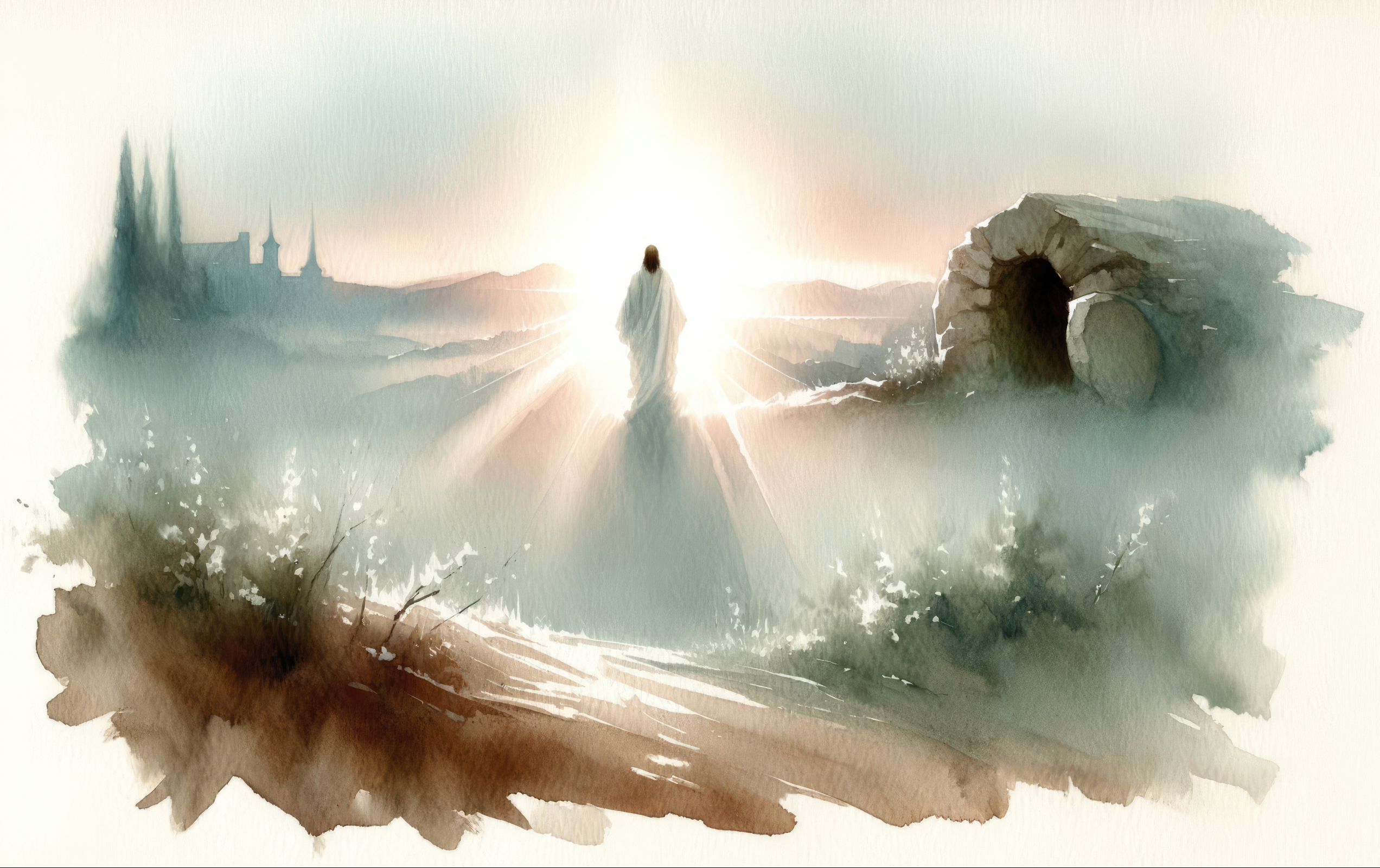
Replay – Sermon for the Resurrection of Our Lord

Today’s sermon is a chronology of the morning of our Lord’s resurrection from Matthew 28:1-15Mark 16:1-8Luke 24:1-12; and John 20:1-18.

A .pdf showing the Scriptural references for the chronological events of our Lord’s resurrection can be found here.


Alleluia! Christ is risen! 
He is risen indeed! Alleluia!

In the name of Jesus. Amen.

Because Jesus is risen, your sin and your guilt are forgiven. They are removed from you as far as the east is from the west (Ps. 103:12). Jesus has died for you. He is risen. Now, nothing can keep you in the grave. Nothing can legitimately cause you fear. The victory is won. God be praised.

This Easter sermon is going to be a little different than what I normally do on Easter. As a preacher, it’s easy for me to jump to the meaning of Christ’s Resurrection to the neglect of the fact of the Resurrection. After He died a real death on Good Friday, Jesus really rose and came out of His tomb. This happened. As surely as you walked through those front doors, picked up a bulletin, and are now in this sanctuary, Jesus walked out of the tomb on this very day, 1,993 years ago.

I want to impress this on you because you can hear all sorts of false preachers who will say stupid things like, “Jesus may or may not have risen. We’re not really sure. But Easter isn’t about the event; it’s about the message.” That’s terrible. You can’t say that and still claim to be a Christian. Who cares about the message if the event didn’t happen? Today, we’re going to simply let Easter be what it is: Jesus is risen.

To do that, imagine that we could sit in that garden, looking toward Jesus’ tomb, and watch everything that happens that morning. While you settle into your lawn chair, let me say this quickly: The year is 33 AD. It is April 5th. Yes, April 5th of 33 AD, the same date as today. I know the date we celebrate Easter moves around on our calendar. That’s simply because we use a slightly different calendar than the Jewish people used back then.

Anyway. We’re there in the garden, and it’s well before sunrise. Ready?

As you look toward the tomb, you will see that there are soldiers. They’re awake, probably mumbling to each other because they’ve been assigned to guard a dead body. They probably think it’s a demotion or something. They’ve been assigned to keep people from stealing the body (Mt. 27:62-66). You can also see the stone rolled across the entrance and it’s sealed tight.

Now, you can’t see this part, but behind that stone Jesus’ human soul is reunited to His human body. And His body is perfected. Jesus opens His eyes. He breathes again. He stands up and walks out of the tomb through the stone. The stone has not been rolled away—not yet. Jesus passes right through it and walks away. You don’t follow Him. You couldn’t—even if you tried. In 1 Peter 3:18-19, Peter tells us that Jesus, in His risen body, descends into hell to proclaim His victory over death.

But you’re still at the tomb. Soon after Jesus leaves the tomb, angels come down from heaven. One of those angels is a little rambunctious. He causes an earthquake, rolls the stone away, and sits on it (Mt. 28:2). He doesn’t sit on it because he’s tired. He’s mocking the stone. He’s laughing at it because it already failed to hold Jesus. This angel is bright like lightning, and his clothes are white as snow (Mt. 28:3).

The soldiers feel the earthquake, see this angel, and they are terrified. These big, strong, armed soldiers begin to shake in fear and fall down like dead men (Mt. 28:4). At some point—and I think it makes here before the women show up—the soldiers wake up again. They check the tomb, and it’s empty. This terrifies them even more. They’ve failed in their mission. They run off to tell the chief priests what happened (Mt. 28:11)

Now, the sun is starting to rise. You can hear footsteps and voices. The women are coming. There are at least five of them: Mary Magdalene, another Mary (the mother of James and Joseph [Mt. 27:56], the wife of Clopas [Jn. 19:25]), Salome, Joanna, and Luke says there are ‘others’ (Mt. 28:1Mk. 16:1Lk. 24:10Jn. 20:1). They’ve prepared their spices (Mk. 16:1Lk. 24:1) but forgot an important detail. Only as they get close do they realize they have no one to roll away the stone (Mk. 16:3).

But when they get close enough, they see that the stone is already rolled away (Mk. 16:4Lk. 24:2). That’s not what they expected. At this point Mary Magdalene turns and sprints away to tell Peter and John (Jn. 20:2). She’s going to tell them that someone has taken Jesus’ body. That’s what she assumes because she hasn’t seen the angels or heard them proclaim that Jesus is risen.

The rest of the women walk into the tomb (Mk. 16:5Lk. 24:3). It must have been a big tomb for all of them to fit inside. They enter and see two angels (Lk. 24:4). God gave one of them the task of announcing the Resurrection. (I wonder what race he won to get this privilege.) I like to imagine this angel has been rehearsing his speech for a while. He begins with a gentle joke (Lk. 24:5): “Why do you seek the Living One among the dead ones?” It’s almost like they are at the grocery store and he’s saying they’re in the wrong aisle. “You’re looking for avocados and salsa, but you’re in the aisle with cleaning chemicals.” “Why are you in a cemetery looking for the Living One? Silly ladies! That doesn’t make any sense.” Then, he goes on as we heard from Mark’s Gospel, “Don’t be alarmed. You seek Jesus of Nazareth, who has been crucified. He has risen. He is not here. See the place where they laid Him. Go. Tell His disciples and Peter that He is going before you to Galilee. There you will see Him, just as He told you” (Mk. 16:6-7Mt. 28:5-7Lk. 24:5-7).

Now those women run back to tell the disciples. As they’re going—so we don’t see this from our lawn chairs—Jesus appears to them and tells them the same good news the angel had (Mt. 28:8-10). Now, for a little while, it’s just us and the angels in the garden.

It’s maybe another half hour or longer—depending on how fast Peter and John can run. John comes running into the garden first because he’s a little younger than Peter. Remember, Mary Magdalene had run back to tell them. John wins the footrace and makes sure to record his victory in his Gospel (Jn. 20:3-4). John stops at the entrance and looks in. But Peter thinks the entrance of the tomb is the finish line and barges right in (Jn. 20:5-6). Peter doesn’t see any angels. He and John only see the burial cloth folded up neatly—as though Jesus simply made His bed (Jn. 20:7). It seems like Peter reaches the same conclusion that Mary Magdalene had: someone has stolen the body (Lk. 24:12). But John has a different look on his face. He begins to believe—even though he didn’t hear any angel announce it (Jn. 20:8). He simply remembers what Jesus had said and is the first to believe. Peter and John catch their breath and head back to where they were staying (Jn. 20:9). 

Now comes final scene of the morning. Mary Magdalene arrives back at the tomb. She’s all alone (Jn. 20:11-12). This is her second trip to the tomb. She’s probably walked or run about five miles this morning. She stands at the entrance and sees the two angels, but she is not afraid. The angels ask her, “Woman, why are you weeping?” She says, “They have taken away my Lord, and I do not know where they have laid Him” (Jn. 20:13).

Then, she turns around and sees Jesus standing there, but she doesn’t recognize Him. She thinks He’s the gardener (Jn. 20:14-15). Of course she thinks He’s the gardener! She sees the resurrected Jesus, the New Adam (1 Co. 15:45-49Ro. 5:14) in His perfected Body. Anyone who looked at Him would think He is a gardener. Like the angels, Jesus asks, “Woman, why are you weeping?” Then He adds, “Whom are you seeking?” (Jn. 20:15). She thinks that this gardener has taken Him, so she pleads, “Sir, if you have carried Him away tell me where you have laid Him” (Jn. 20:15).

Then Jesus simply says, “Mary” (Jn. 20:16). Only when she hears Jesus speak her name does she recognize Him. She falls at His feet. But Jesus says, “Don’t cling to Me yet. I have not yet ascended to the Father. Go and tell My brothers (i.e. the disciples) that I’m going to My Father and your Father, to My God and your God” (Jn. 20:17). It’s beautiful. The very men who had abandoned Him—Jesus now calls them His brothers. Mary turns from the tomb, leaves the garden, and runs back again to tell them that she has seen the risen Lord (Jn. 20:18).

Then Jesus Himself leaves the tomb. He never comes back. That’s it. That’s everything that happens in the garden that morning. You can pack up your lawn chair. Jesus isn’t coming back to the grave—never, ever, ever. Well… not until He returns to your grave, to your burial spot. In His resurrected and glorified body, Jesus will stand at your grave and call you out. And you won’t have to imagine it. You’ll see it with your own eyes (Job 19:27). Your Redeemer lives. And through faith in Him, so will you—for all eternity.

Alleluia! Christ is risen! 
He is risen indeed! Alleluia!

The peace of God, which surpasses all understanding, will guard your hearts and minds in Christ Jesus (Php. 4:7). Amen.

Enoughness – Sermon on 2 Corinthians 3:4-11 for the Twelfth Sunday after Trinity

2 Corinthians 3:4-11

4 Such is the confidence that we have through Christ toward God. 5 Not that we are sufficient in ourselves to claim anything as coming from us, but our sufficiency is from God, 6 who has made us sufficient to be ministers of a new covenant, not of the letter but of the Spirit. For the letter kills, but the Spirit gives life. 

7 Now if the ministry of death, carved in letters on stone, came with such glory that the Israelites could not gaze at Moses’ face because of its glory, which was being brought to an end, 8 will not the ministry of the Spirit have even more glory? 9 For if there was glory in the ministry of condemnation, the ministry of righteousness must far exceed it in glory. 10 Indeed, in this case, what once had glory has come to have no glory at all, because of the glory that surpasses it. 11 For if what was being brought to an end came with glory, much more will what is permanent have glory.

In the name of Jesus. Amen.

Imagine that you received an invitation to a banquet. You get yourself ready and put on your best suit or dress. You drive to the location and enter the building to find that this banquet is a lot fancier and way more formal than you realized. The crystal chandeliers and candles cast a golden light over an exquisitely decorated room. The tables are set with fine china and crystal flutes. You look at all the other guests and discover that they are wearing either designer tuxedos with cufflinks and cummerbunds or sparkling gowns and jewelry. There you are sticking out like a pigeon in a peacock parade.

You try to mingle with the glittering guests, but they mostly ignore you. The only acknowledgement you get are cold smiles and people saying, “Oh, I love your outfit,” as they turn away laughing and asking each other, “Who’s that guy?” You pull out the invitation, and, sure enough, it’s got your name and address. But you’ve had it. It must have been a mistake. So, you start looking for an exit, one that will allow you to avoid as many people as possible.

As you’re leaving, the host of the gala approaches and calls you out by name saying, “I’m so glad you’re here. I’ve got all sorts of people I want to introduce you to.” You try to explain that you should probably leave because you don’t fit in. You point out that you aren’t as polished as everyone else there and mention how the crowd has already rejected and made fun of you. But the host simply says, “You aren’t here to be fancy. You’re here because I invited you. My choice is enough to make you belong. Just stick with me.” The rest of the evening, he takes you around the room showing you off, bragging about you, and highlighting how important you are to him. He seats you next to himself at the head table. The rest of the evening, your confidence grows. Now, you are treated with respect and honor by everyone else – not because you’ve won them over. Your importance is rooted in the host’s attitude toward you, and his opinion carries a weight that no one can challenge. It is enough.

Dear saints, such is the confidence you have through Christ toward God.

In this text, Paul is defending his office of being an apostle. There were some false teachers in the congregation at Corinth who were saying that Paul didn’t have the authority to say anything in the church. They questioned the sufficiency of Paul’s preaching. They were saying that Paul’s preaching of God’s grace through Christ was not enough. That’s why he says that God had made him sufficient to be a minister of the ‘new covenant’ of the Gospel that points people to Jesus as the Messiah (2 Cor. 3:6). And that’s why Paul goes on in v. 7-11 of this text to compare his ministry of the Gospel to Moses’ ministry under the old covenant.

Now, this would be a really good text to preach at an ordination service as a man is called by God to be a pastor. All pastors, myself included, need to recognize that when they preach, they aren’t doing it by their own authority but by the authority that God has given (1 Pet. 4:11). When God puts a pastor into a congregation, he is there to deliver God’s gifts to God’s purchased and redeemed people.

Pastors are called to speak two different words to their congregations. First, pastors are to preach ‘the letter that kills’ also called here ‘the ministry of condemnation.’ In other words, pastors are to preach the Law. And second, pastors are to preach ‘the ministry of righteousness,’ the Gospel. God sends pastors to declare that people are sinners so they can be pointed to repentance and faith in Christ. That’s the main point of this passage. But what Paul says here can be applied to other callings and vocations as well.

Dear saints, you have been called out of the darkness of your sin into God’s kingdom. You are called to be God’s hands and feet to the people around you so you can render service to them. And you can have confidence as you serve and carry out those vocations. You are not sufficient on your own. God Himself has made you sufficient. In this text, the word translated ‘sufficient’ means enough.

There are all sorts of places we might look to build confidence and find our enoughness, but there is only one legitimate source of confidence. Any other source will lead to bad outcomes. The most common place we look is inside ourselves – our abilities, our eloquence, our strengths or skills. There are certainly productive, able people who are successful at many things. The problem is that when those moments of success come and we think it’s because we’re sufficient in ourselves, pride sneaks in. We start comparing ourselves to others and look down on them. We get puffed up, and when that happens, we’re setting ourselves up for a big fall. Even when you are successful and humble, the devil will attempt to draw your attention back to yourself and your humility, and again, pride sprouts up.

If you to think that you are strong and capable on our own, you will start to think that you can handle the challenges in life by yourself. When that happens, you’ll quickly find that your own strengths and abilities fade and fail. And when you fail, it’s easy to fall into despair.  The devil wants you to be constantly looking at yourself because there you’ll see that your strength and ability isn’t enough to do all that God has called you to do. Any setback or misstep can be used by the demons to paralyze you.

But when God is the source of your confidence, and He is, then, you lack in nothing. Look at the sheer holiness and privilege of your callings – spouses, parents, children, teachers, friends. When you first recognize the massive, holy responsibilities that God has given you, you realize that these things are beyond you. And you aren’t adequate to carry those vocations out. You can’t claim anything – any ability, any strength, any eloquence, any skill – as coming from you. But God Himself has given you everything. He has won and purchased you by giving His Son, Jesus to die on the cross as your Savior. Everything you are, everything you have, every calling and responsibility has been given to you as a gift. And what God has given you is enough.

As citizens of God’s kingdom, recognize that God has given you more than enough, more you can imagine. He has given His gifts in full measure, pressed those gifts down into you to make room for more and His gifts are always running over (Lk. 6:38).

The same Holy Spirit who blew through the upper room at Pentecost now fills you with everything you need to carry out the tasks entrusted to you. The Holy Spirit who abides in and with you is like that host at the gala. He accompanies you and makes you worthy to be in His kingdom. Anyone who questions that worthiness insults Him directly and isn’t worth listening to. God Himself has made you sufficient and enough. 

By His calling, His redeeming, His grace, His sanctifying, He has made you enough. And that is enough. Dear saints, your enoughness is from God, and from God alone. So, go; boldly carry out the tasks that He has given you. Amen.

The peace of God, which surpasses all understanding, will guard your hearts and minds in Christ Jesus (Php. 4:7). Amen.

The Easter Angel – Sermon on Matthew 28:1-7 for the Easter Vigil

Listen here.

Matthew 28:1-7

Alleluia! Christ is risen!
He is risen indeed! Alleluia!

In the name of Jesus. Amen.

The angel caused the earthquake that Easter morning. Our translation says, “there was a great earthquake, for an angel of the Lord descended from heaven” (Mt. 28:2), but it should probably be, “becausean angel of the Lord descended.” The earth shook because the angel caused it to. And it isn’t the quake that moves the stone. The angel rolls it away after the quake then sits on it.

This angel is quite the character. We don’t know his name, but he certainly is a rabble rouser. He has the appearance of lightening and clothing white as snow.

This flashy, showy angel doesn’t sit on the stone because he is tired. Angels don’t get fatigued like we do. He sits there to mock the stone and the tomb that it had sealed. You could almost say that he’s dancing on the grave. But with a different meaning than we usually give to that phrase. He’s dancing on the grave of death.

It would have taken several strong, well-bodied people to roll that stone away. You’ll hear in tomorrow’s Gospel reading from Mark (16:3) that the women were concerned about who was going to move it for them when their plan is to return to the tomb and finish preserving Jesus’ body. Their plans had to change. But for this angel, that stone was puny and totally insignificant. The angel just tosses it aside. It wasn’t capable of keeping Jesus in the grave, and the angel sits on it to show how inconsequential the attempts were to keep Jesus dead.

The guards are terrified by all of this and rightly so. They trembled just like the ground. Their armor, swords, and training were nothing in the presence of this angel. They became like dead men. As they lay there on the ground, they were probably glad that this electrified angel hadn’t sat on them.

But then, Matthew mentions the women. They arrive to this dominant display of angelic power, and the angel tells them, “Do not be afraid,” even though there is no mention of them being fearful. The women had been scared previously. Scared to tears after the death of Jesus. But the time for weeping is over. Psalm 126:5 says, “Those who sow in tears shall reap with shouts of joy.” For these women, and for all believers in Christ, the harvest has come.

Our time of sowing tears is finished. Jesus lives. It is time to gather in the crop of resurrection joy. Because Jesus is risen, our mouths are filled with laughter and our hearts with cheer. The angel sits on that stupid, weak, trivial stone because nothing can stop the victory parade of life.

Jesus had gone weak as a newborn lamb to the cross, but there He stripped the devil of all his strength. The trickster serpent has been tricked. On Good Friday, Satan was tempted just like Eve was in the Garden. The devil saw the forbidden fruit that hung on the tree of Calvary. He took it and ate. But now his belly bursts, and he is the one who has to hide.

He is done, finished, defeated. The devil has no accusations left. He threw all his accusations at Christ, and Jesus has answered for all of them. So now, when Satan tries to accuse you, all you have to do is point him to Christ, and his mouth is silenced. He has no allegations left for you because Jesus has died to take them all away, and Christ is risen to show they are nothing.

Did Satan think that a rock and some guards could keep Jesus dead? Maybe, but this resurrection angel, and all the angels, laugh at the thought. It would be easier to fit the oceans in a styrofoam cup or to ride a unicycle to Pluto than to keep God in the grave.

God wouldn’t let what is His be stolen. He takes it back. He takes back Adam and Eve. He delivers Noah and his family. He frees the whole people of Israel from slavery. He restores to Himself Ezekiel and that valley of dead, dry – very dry – bones. He restores the fortunes of Zion and exalts over them with loud singing. He pulls His people safely from the burning fiery furnace and walks with us in every trouble.

God does all of this because Christ has bought and paid for you on the cross. The devil has no claim – none whatsoever. Satan got what he thought he wanted. He took a bite out of God. The devil bruised His heel by putting Him to death. But Jesus has crushed his head. Jesus died, but He lives.

Every day of our lives now, let’s join this rambunctious angel in mocking sin, death, and the devil. Daily don the robes of righteousness that Christ has given you in your Baptism (Gal. 3:27). Daily let the God-given light of salvation shine through you (Mt. 5:14-16).

The grave is open. It couldn’t hold Jesus. It won’t hold your loved ones who have departed with the sign of faith. And It won’t hold you either.

We don’t know this rambunctious resurrection angel’s name. But one day, God be praised, we will. Amen.[1]

Alleluia! Christ is risen!
He is risen indeed! Alleluia!

The peace of God, which surpasses all understanding, will guard your hearts and minds in Christ Jesus. Amen.


[1] This sermon was adapted from Rev. David Petersen of Redeemer Lutheran Church, Ft. Wayne, ID.