The Scripture readings for tonight’s service are Psalm 111:1-6; Deuteronomy 8:1-3; Hebrews 9:11-15; and John 6:35-51.
In the name of Jesus. Amen.
On this very night—1,993 years ago—Jesus celebrated the final Passover feast with His disciples. When that meal was done, Jesus took bread, gave thanks, broke it, and gave it to His disciples, saying, “Take, eat; this is My Body, which is given for you. This do in remembrance of Me.”Then He took the cup, blessed it, and gave it to the disciples, saying, “Drink of it, all of you; this Cup is the New Covenant in My Blood, which is shed for you for the forgiveness of sins. This do, as often as you drink it, in remembrance of Me” (Mt. 26:26-28; Mk. 14:22-24; Lk. 22:19-20; 1 Co. 11:23-25).
One year before that, right around this time of year—1,994 years ago (Jn. 6:4)—Jesus fed 5,000 men, plus women and children, near the Sea of Galilee. The very next day Jesus stood before that same crowd and declared, “I Am the Bread of Life.”
To understand this text, it’s helpful to have an idea of just who these people are. Like every child of Adam, they lived under the curse of sin which meant they could only eat bread by the sweat of their brow until they returned to the ground (Gen. 3:19). They lived in Galilee, which was a very fruitful land. But heavy taxes and tributes took 30-50% of what they earned. Those taxes meant that most of them could not own their own lands. Instead, they had to find work each day as day laborers. Getting daily bread first required them to find a job for that day. Then, they could eat by the sweat of their brow. They were not utterly destitute, but their lives were far more precarious ours. The line between food and starvation was always just a step behind them.
Then, Jesus came. With five loaves and two fish, He fed a stadium-sized crowd so that every stomach was full. And He could do that in an instant. That’s the kind of man you want to keep around. No more searching. No more sweating. No more fear that the table might be empty tonight. Here was security. Here was stability. Here was a Man who could roll back the curse of eating bread through sweat and toil.
The people tasted that bread. It filled them and carried them through the night. So, the next day they went looking for Jesus. Yes, they were chasing daily bread, but that desire wasn’t evil. They were trying to reach for Eden again. They longed to return to the initial goodness of God’s creation where He would feed them. They wanted to be done with the curse. Done with the thorns and thistles. Done with the pain and sweat and toil of getting daily bread. They wanted life as God had first given it.
In the verses leading up to our text, Jesus sees their hearts. He says, “You are seeking Me… because you ate your fill of the loaves.” But listen to what our Lord says next: “Do not work for the food that perishes, but for the food that endures to eternal life, which the Son of Man will give to you” (Jn. 6:26-27). Jesus is pointing them to something more and better than daily bread: “Don’t just chase after the kind of bread that keeps you alive for one more hour or day. Instead, chase after the Bread that gives you eternal life. I Am the Bread of Life.” Jesus had come to give them far more than a steady supply of bread for their bellies.
In our reading, Jesus presses the point even deeper: “I Am the Bread of Life. Your fathers ate the manna in the wilderness, and they died” (Jn. 6:48-49). Think about it. Their great-great-great-great-grandfathers ate heavenly bread that God rained down on them every morning for forty years in the wilderness. Each day, God gave what they needed to sustain them. Even though they were fed by very the hand of God, they still died. Every last one of them. God humbled them. God let them hunger so they would learn that man does not live by bread alone, but by every Word that comes from the mouth of God (Dt. 8:1-3).
Then, Jesus says something astonishing: “This is the Bread that comes down from heaven, so that one may eat of it and not die. I Am the Living Bread that came down from heaven. If anyone eats of this Bread, he will live forever. And the bread that I will give for the life of the world is My flesh” (Jn. 6:50-51).
Dear saints, do you hear echoes of something more, something better, than the daily manna that God provided? Here is a promise: Eat and never die. Eat and live forever. This is more than the reversal of thorns and thistles. Here is the undoing of death itself!
Jesus is promising a food that results in eternal life. Jesus is offering a new and better Tree of Life. At the end of Genesis 3, God would not let Adam and Eve eat from the original Tree of Life because that would mean living forever in their sin. So, God drove them out and sent the cherubim with a flaming sword to guard them from an eternal life in sin (Gen. 3:22-24).
But now the Son of God steps forward and says, “I have come to give you more than daily bread. I have come to give you Myself as Living Bread that will give you eternal life.”
Dear saints, the Tree that gives eternal life does not grow out of the ground in Eden. It was carried by Simon of Cyrene and planted on Golgotha by a Roman soldier (Mk. 15:21-25). The Fruit of that Tree does not blossom from a flower. It was nailed to that cross with iron spikes. Jesus Himself is the Tree of Life because He is the Bread of Life. He is the way to life without end.
Tonight, dear saints, Jesus has gathered you here so that you would eat that Bread.
He has brought you here to taste and see that the Lord is good (Ps. 34:8). He has brought you here so you would hear His Word and live. Jesus promises that you will live forever because you believe in Him. Your sins are forgiven. Jesus carried them in His Body to the cross. He has died for them. Christ has taken upon Himself not just your flesh and blood, but also your sin and shame. He suffered it all so He could give you Himself—the Bread that never perishes and the Life that never ends. With His Own blood your great High Priest has won an eternal redemption for you. He has cleansed your consciences so you can now serve the living God. Through Him and the New Covenant in His Blood, you have the promised inheritance (Heb. 9:11-14).
Dear saints, come. Come, eat. Come, drink. Come, believe. Come, live because your Savior is the Bread of Life. Amen.
The peace of God, which surpasses all understanding, will guard your hearts and minds in Christ Jesus (Php. 4:7). Amen.


 Our English word ‘desolation’ contains the word ‘solo,’ and that gives a sense of what ‘desolation’ means. Adam and Eve went solo. Rather than trusting God, they went solo and trusted the devil’s lie bringing sin, death, condemnation, and desolation into the world.
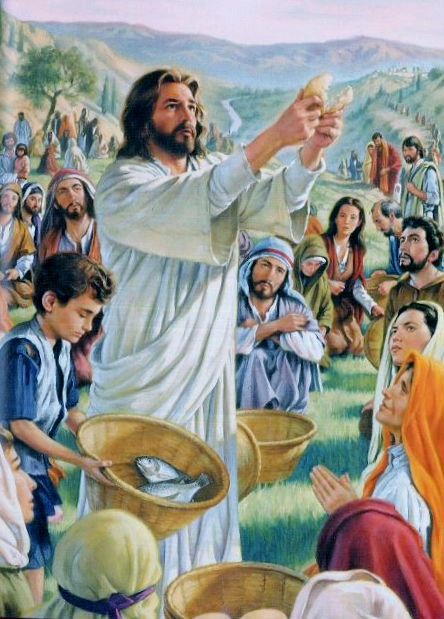 Look at what Jesus, God in the flesh does – notice the verbs. He calls the disciples. Jesus directs the crowd to sit down. He takes the bread. Christ gives thanks for the bread. He breaks the bread. He gives the bread to the disciples to set before the people. Jesus blesses the fish. He gives the fish to the disciples to set before the people. And Jesus watches them all eat until every last one of them is satisfied. Jesus continues to do this for us today.
 Pastorsamwise
You must be logged in to post a comment.