Today’s sermon is a chronology of the morning of our Lord’s resurrection from Matthew 28:1-15; Mark 16:1-8; Luke 24:1-12; and John 20:1-18.
Alleluia! Christ is risen!
He is risen indeed! Alleluia!
In the name of Jesus. Amen.
Because Jesus is risen, your sin and your guilt are forgiven. They are removed from you as far as the east is from the west (Ps. 103:12). Jesus has died for you. He is risen. Now, nothing can keep you in the grave. Nothing can legitimately cause you fear. The victory is won. God be praised.
This Easter sermon is going to be a little different than what I normally do on Easter. As a preacher, it’s easy for me to jump to the meaning of Christ’s Resurrection to the neglect of the fact of the Resurrection. After He died a real death on Good Friday, Jesus really rose and came out of His tomb. This happened. As surely as you walked through those front doors, picked up a bulletin, and are now in this sanctuary, Jesus walked out of the tomb on this very day, 1,993 years ago.
I want to impress this on you because you can hear all sorts of false preachers who will say stupid things like, “Jesus may or may not have risen. We’re not really sure. But Easter isn’t about the event; it’s about the message.” That’s terrible. You can’t say that and still claim to be a Christian. Who cares about the message if the event didn’t happen? Today, we’re going to simply let Easter be what it is: Jesus is risen.
To do that, imagine that we could sit in that garden, looking toward Jesus’ tomb, and watch everything that happens that morning. While you settle into your lawn chair, let me say this quickly: The year is 33 AD. It is April 5th. Yes, April 5th of 33 AD, the same date as today. I know the date we celebrate Easter moves around on our calendar. That’s simply because we use a slightly different calendar than the Jewish people used back then.
Anyway. We’re there in the garden, and it’s well before sunrise. Ready?
As you look toward the tomb, you will see that there are soldiers. They’re awake, probably mumbling to each other because they’ve been assigned to guard a dead body. They probably think it’s a demotion or something. They’ve been assigned to keep people from stealing the body (Mt. 27:62-66). You can also see the stone rolled across the entrance and it’s sealed tight.
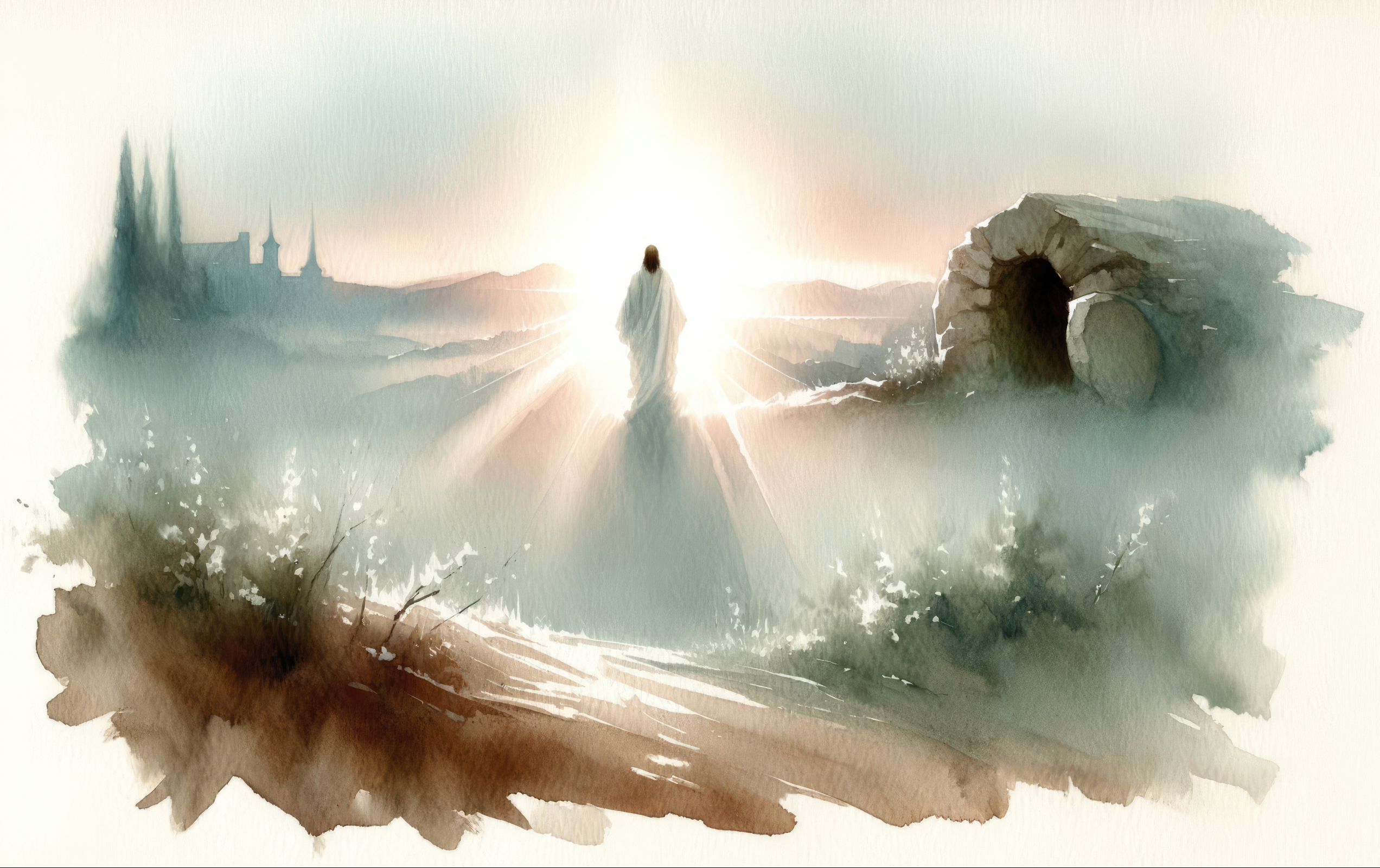
Now, you can’t see this part, but behind that stone Jesus’ human soul is reunited to His human body. And His body is perfected. Jesus opens His eyes. He breathes again. He stands up and walks out of the tomb through the stone. The stone has not been rolled away—not yet. Jesus passes right through it and walks away. You don’t follow Him. You couldn’t—even if you tried. In 1 Peter 3:18-19, Peter tells us that Jesus, in His risen body, descends into hell to proclaim His victory over death.
But you’re still at the tomb. Soon after Jesus leaves the tomb, angels come down from heaven. One of those angels is a little rambunctious. He causes an earthquake, rolls the stone away, and sits on it (Mt. 28:2). He doesn’t sit on it because he’s tired. He’s mocking the stone. He’s laughing at it because it already failed to hold Jesus. This angel is bright like lightning, and his clothes are white as snow (Mt. 28:3).
The soldiers feel the earthquake, see this angel, and they are terrified. These big, strong, armed soldiers begin to shake in fear and fall down like dead men (Mt. 28:4). At some point—and I think it makes here before the women show up—the soldiers wake up again. They check the tomb, and it’s empty. This terrifies them even more. They’ve failed in their mission. They run off to tell the chief priests what happened (Mt. 28:11)
Now, the sun is starting to rise. You can hear footsteps and voices. The women are coming. There are at least five of them: Mary Magdalene, another Mary (the mother of James and Joseph [Mt. 27:56], the wife of Clopas [Jn. 19:25]), Salome, Joanna, and Luke says there are ‘others’ (Mt. 28:1; Mk. 16:1; Lk. 24:10; Jn. 20:1). They’ve prepared their spices (Mk. 16:1; Lk. 24:1) but forgot an important detail. Only as they get close do they realize they have no one to roll away the stone (Mk. 16:3).
But when they get close enough, they see that the stone is already rolled away (Mk. 16:4; Lk. 24:2). That’s not what they expected. At this point Mary Magdalene turns and sprints away to tell Peter and John (Jn. 20:2). She’s going to tell them that someone has taken Jesus’ body. That’s what she assumes because she hasn’t seen the angels or heard them proclaim that Jesus is risen.
The rest of the women walk into the tomb (Mk. 16:5; Lk. 24:3). It must have been a big tomb for all of them to fit inside. They enter and see two angels (Lk. 24:4). God gave one of them the task of announcing the Resurrection. (I wonder what race he won to get this privilege.) I like to imagine this angel has been rehearsing his speech for a while. He begins with a gentle joke (Lk. 24:5): “Why do you seek the Living One among the dead ones?” It’s almost like they are at the grocery store and he’s saying they’re in the wrong aisle. “You’re looking for avocados and salsa, but you’re in the aisle with cleaning chemicals.” “Why are you in a cemetery looking for the Living One? Silly ladies! That doesn’t make any sense.” Then, he goes on as we heard from Mark’s Gospel, “Don’t be alarmed. You seek Jesus of Nazareth, who has been crucified. He has risen. He is not here. See the place where they laid Him. Go. Tell His disciples and Peter that He is going before you to Galilee. There you will see Him, just as He told you” (Mk. 16:6-7; Mt. 28:5-7; Lk. 24:5-7).
Now those women run back to tell the disciples. As they’re going—so we don’t see this from our lawn chairs—Jesus appears to them and tells them the same good news the angel had (Mt. 28:8-10). Now, for a little while, it’s just us and the angels in the garden.
It’s maybe another half hour or longer—depending on how fast Peter and John can run. John comes running into the garden first because he’s a little younger than Peter. Remember, Mary Magdalene had run back to tell them. John wins the footrace and makes sure to record his victory in his Gospel (Jn. 20:3-4). John stops at the entrance and looks in. But Peter thinks the entrance of the tomb is the finish line and barges right in (Jn. 20:5-6). Peter doesn’t see any angels. He and John only see the burial cloth folded up neatly—as though Jesus simply made His bed (Jn. 20:7). It seems like Peter reaches the same conclusion that Mary Magdalene had: someone has stolen the body (Lk. 24:12). But John has a different look on his face. He begins to believe—even though he didn’t hear any angel announce it (Jn. 20:8). He simply remembers what Jesus had said and is the first to believe. Peter and John catch their breath and head back to where they were staying (Jn. 20:9).
Now comes final scene of the morning. Mary Magdalene arrives back at the tomb. She’s all alone (Jn. 20:11-12). This is her second trip to the tomb. She’s probably walked or run about five miles this morning. She stands at the entrance and sees the two angels, but she is not afraid. The angels ask her, “Woman, why are you weeping?” She says, “They have taken away my Lord, and I do not know where they have laid Him” (Jn. 20:13).
Then, she turns around and sees Jesus standing there, but she doesn’t recognize Him. She thinks He’s the gardener (Jn. 20:14-15). Of course she thinks He’s the gardener! She sees the resurrected Jesus, the New Adam (1 Co. 15:45-49; Ro. 5:14) in His perfected Body. Anyone who looked at Him would think He is a gardener. Like the angels, Jesus asks, “Woman, why are you weeping?” Then He adds, “Whom are you seeking?” (Jn. 20:15). She thinks that this gardener has taken Him, so she pleads, “Sir, if you have carried Him away tell me where you have laid Him” (Jn. 20:15).
Then Jesus simply says, “Mary” (Jn. 20:16). Only when she hears Jesus speak her name does she recognize Him. She falls at His feet. But Jesus says, “Don’t cling to Me yet. I have not yet ascended to the Father. Go and tell My brothers (i.e. the disciples) that I’m going to My Father and your Father, to My God and your God” (Jn. 20:17). It’s beautiful. The very men who had abandoned Him—Jesus now calls them His brothers. Mary turns from the tomb, leaves the garden, and runs back again to tell them that she has seen the risen Lord (Jn. 20:18).
Then Jesus Himself leaves the tomb. He never comes back. That’s it. That’s everything that happens in the garden that morning. You can pack up your lawn chair. Jesus isn’t coming back to the grave—never, ever, ever. Well… not until He returns to your grave, to your burial spot. In His resurrected and glorified body, Jesus will stand at your grave and call you out. And you won’t have to imagine it. You’ll see it with your own eyes (Job 19:27). Your Redeemer lives. And through faith in Him, so will you—for all eternity.
Alleluia! Christ is risen!
He is risen indeed! Alleluia!
The peace of God, which surpasses all understanding, will guard your hearts and minds in Christ Jesus (Php. 4:7). Amen.
 Pastorsamwise
You must be logged in to post a comment.