Serving the Body – Sermon on Romans 12:6-16 for the Second Sunday after Epiphany

Romans 12:6–16

6 Having gifts that differ according to the grace given to us, let us use them: if prophecy, in proportion to our faith; 7 if service, in our serving; the one who teaches, in his teaching; 8 the one who exhorts, in his exhortation; the one who contributes, in generosity; the one who leads, with zeal; the one who does acts of mercy, with cheerfulness. 

9 Let love be genuine. Abhor what is evil; hold fast to what is good. 10 Love one another with brotherly affection. Outdo one another in showing honor. 11 Do not be slothful in zeal, be fervent in spirit, serve the Lord. 12 Rejoice in hope, be patient in tribulation, be constant in prayer. 13 Contribute to the needs of the saints and seek to show hospitality. 

14 Bless those who persecute you; bless and do not curse them. 15 Rejoice with those who rejoice, weep with those who weep. 16 Live in harmony with one another. Do not be haughty, but associate with the lowly. Never be wise in your own sight.

In the name of Jesus. Amen.

When you stub a toe, your whole body reacts. Your face scrunches and grimaces in pain. Your arms and hands reach down to clasp the toe. Your throat groans, shrieks, or shouts. All of that happens naturally and instinctively. When you stub your toe, the rest of the parts of your body don’t say, “Who cares? That’s the toe’s problem.” I’ve never heard someone with knee, hip, or neck pain say, “The knee that is attached to me hurts,” or, “The neck that holds up this head hurts.” Instead, people say, “My knee hurts. My neck hurts.” And the whole body does what it can to help the part that hurts.

Dear saints, the Body of Christ is no different. When one part of the body suffers, the whole body is involved in that suffering. When one part rejoices, the whole body is involved (see also 1 Cor. 12:26). Being part of this congregation isn’t just about coming to hear the sermon. It’s about being a body, Christ’s Body. No one here is free to consider yourself separate or independent from anyone else here.

The reason I mention the Body of Christ is that today’s reading continues from last week’s. One time, Martin Luther preached on this text, and he said that starting the reading at v. 6 was the idea of someone who doesn’t understand the Bible. I think that’s an overstatement, but it is unfortunate to start at v. 6. Let me reread the final couple verses of last week’s Epistle, which lead up to this text but you didn’t hear today. Starting back at Ro. 12:4-5, “For as in one body we have many members, and the members do not all have the same function, so we, though many, are one body in Christ, and individually members one of another.” Then, our text continues, “Having gifts that differ according to the grace given to us, let us use them….”

The context of today’s text is that you are a member of a body – that’s what Christ intends for you. Yes, the whole Christian Church throughout the world and throughout time is the Body of Christ. Jesus is the One Head, and all Christians are the Body. But there’s no way this matters unless there is a local, in-person group of members. In other words, a congregation. Yes, there are Christians in Australia, Uganda, Brazil, and even Iowa. But you aren’t close enough to them geographically to do much for them. I know for a fact that there are Christians in Papua New Guinea because I know missionaries who have been there. But I haven’t met a single one of those believers. For them, I can’t do most of the things this text calls for. I can’t exhort, teach, or honor them. I can’t rejoice with them when they rejoice or weep with them when they weep. It’s just not possible.

This text wants each believer to focus on the parts of the Body of Christ that God has gathered around them. In other words, care for the people here, in this congregation. That’s why this is written to the Christian church in Rome. It’s why Paul uses the same analogy in his letter to the church in Corinth (1 Cor. 12). And God wants this same arrangement for us here and in every Christian congregation. That’s why it has been preserved for us in the Bible. God wanted this in Rome and Corinth 2,000 years ago, and He wants it here, now, among us.

And I have to say: You do a good job of this. When I teach new member classes, one of the most common things I hear is, “This place just feels like family.” So, please know that I’m not preaching this text to get on your case. I’m not rebuking you. Instead, just like a sprinter will keep training to get a faster time, there is always room for improvement.

We can improve at serving, contributing, leading, being merciful, loving, abhorring evil, holding fast to the good, honoring, and showing hospitality. Let’s consider one area where we can improve today from v. 15, “Rejoice with those who rejoice, weep with those who weep.” The reason for diving into this is that I recognize my own shortcomings in this. So, yes, your preacher today is preaching to himself. This is a, “Do as I say,” because it is what Scripture says, “not as I do,” because I fall short here.

Again, “Rejoice with those who rejoice, weep with those who weep.” First off, notice the prepositions there – with. God calls you to take on the joy and sadness of others. You aren’t called to fix people’s emotions or make them feel certain things. Instead, you join them in those emotions. As a poor example of this, think of Job’s friends; they got it half right. Job is sitting there in his horrific suffering, and his friends come to him. They were exactly right to do that. That’s where they should be. But their problem, which becomes a problem for Job, is that they try to fix everything, and they do an incredibly bad job at it.

Sure, there are times to rebuke, exhort, and encourage people. Scripture does call for that too (1 Tim. 5:20; 2 Tim. 4:2; Tit. 1:13; 2:15). But, dear saints, there are also times where you are to simply close your mouth, sit with others, cry and mourn with them if they’re sad, or jump and sing with them if they’re joyful.

This can be really hard, and for a variety of reasons. Again, we might be too quick to give advice, but another trap we easily fall into is comparing. When someone is struggling with something, it can be easy to share about a past struggle we had and make sure the other person knows how much worse we had it. Sometimes, just being there and listening to a person pour out their heart in sadness is exactly that that person needs.

As a good example of weeping with others, think about Jesus in Jn. 11. On Wednesday night, I taught through Jn. 11 where Jesus raises Lazarus from the dead. We won’t go through the whole thing, and I’m sorry to those of you who already heard this. But it’s worth hearing again. Jesus’ approach to Lazarus’ two sisters, Martha and Mary, and their grief is so interesting. Each sister talks to Jesus separately (Jn. 11:20-27, 32-34). Both of them say the same thing to Jesus when they see Him, “Lord, of You had been here, my brother wouldn’t have died.” But Jesus’ interaction with each of them is completely different.

So, the two sisters are dealing with the exact same problem – the sorrow for over the death of a brother. They both begin interacting with Jesus the exact same way. But Jesus comforts each of these sisters differently. For Martha, Jesus has words of consolation. “Your brother will rise again. I am the Resurrection and the Life” and so on (Jn. 11:23, 23, 25-26). But just a few verses later when Jesus consoles Mary, all He does is go to the tomb with her and weep with her (Jn. 11:33-35). Yes, Jesus calls Lazarus from the tomb and restores his life. But it’s that initial consoling Jesus has for each sister has a lot to teach us.

Here’s the lesson: get to know the different parts of Christ’s Body well enough so you know how to weep with them when they weep. If they’re already weeping, just be there for them. Join them in their sorrow. But when they aren’t weeping, make the effort to get to know them well enough so that, when they are weeping, you have a better idea of how to console them.

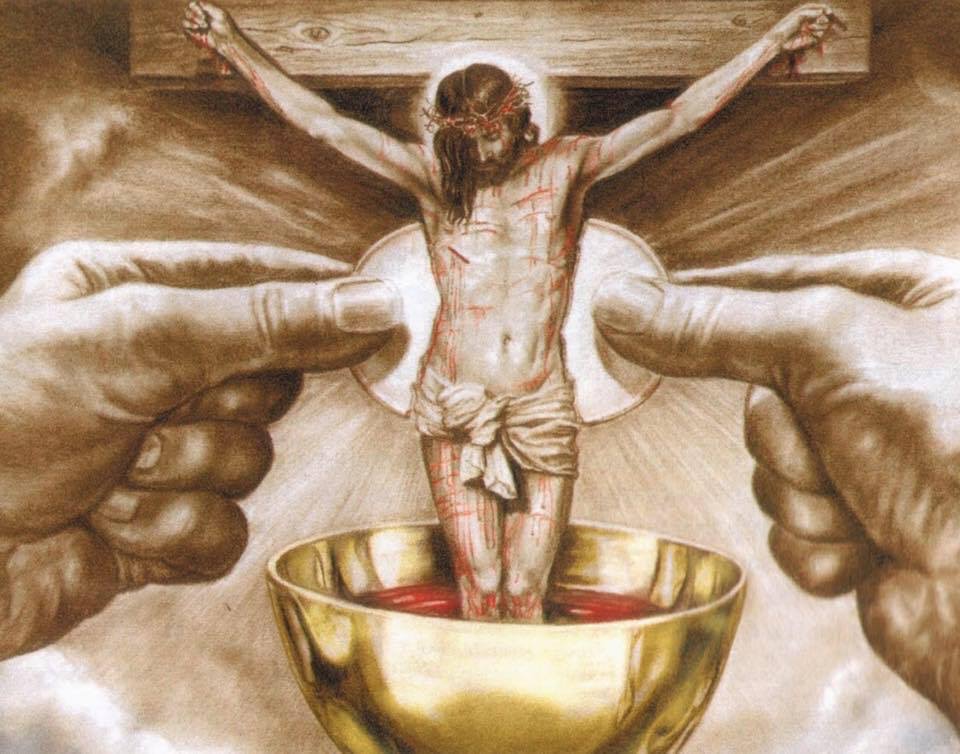
Finally, when you are weeping, know that people might not be able to do this well. But also know that Jesus does. Christ knows how to give you exactly what you need exactly when you need it. Jesus is here now. He invites you to His table to receive His Body and Blood. Here, Christ, the Great Consoler, continues to unite you as His Body and strengthen you in faith toward Him and in love toward one another. Amen.

The peace of God, which surpasses all understanding, will guard your hearts and minds in Christ Jesus. Amen.

Love & Respect – Sermon on Ephesians 5:22-33 for the Second Sunday after Epiphany

Ephesians 5:22–33

22 Wives, submit to your own husbands, as to the Lord. 23 For the husband is the head of the wife even as Christ is the head of the church, his body, and is himself its Savior. 24 Now as the church submits to Christ, so also wives should submit in everything to their husbands. 

25 Husbands, love your wives, as Christ loved the church and gave himself up for her, 26 that he might sanctify her, having cleansed her by the washing of water with the word, 27 so that he might present the church to himself in splendor, without spot or wrinkle or any such thing, that she might be holy and without blemish. 28 In the same way husbands should love their wives as their own bodies. He who loves his wife loves himself. 29 For no one ever hated his own flesh, but nourishes and cherishes it, just as Christ does the church, 30 because we are members of his body. 31 “Therefore a man shall leave his father and mother and hold fast to his wife, and the two shall become one flesh.” 32 This mystery is profound, and I am saying that it refers to Christ and the church. 33 However, let each one of you love his wife as himself, and let the wife see that she respects her husband.

Stepping In – Sermon on John 2:1-11 for the Second Sunday after Epiphany

John 2:1-11

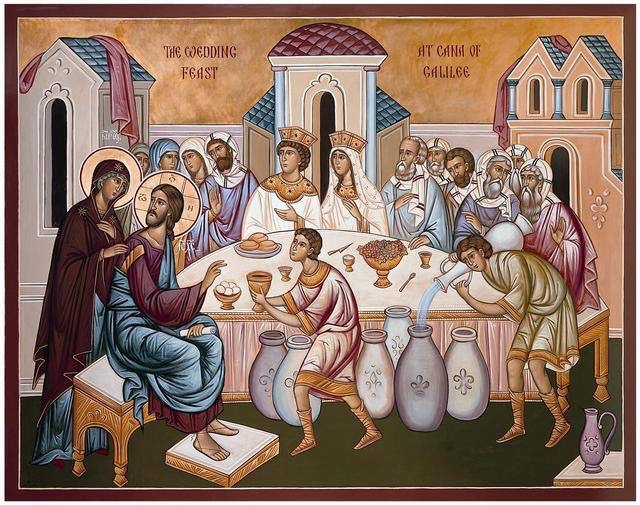
1 On the third day there was a wedding at Cana in Galilee, and the mother of Jesus was there. 2 Jesus also was invited to the wedding with his disciples. 3 When the wine ran out, the mother of Jesus said to him, “They have no wine.” 4 And Jesus said to her, “Woman, what does this have to do with me? My hour has not yet come.” 5 His mother said to the servants, “Do whatever he tells you.” 6 Now there were six stone water jars there for the Jewish rites of purification, each holding twenty or thirty gallons. 7 Jesus said to the servants, “Fill the jars with water.” And they filled them up to the brim. 8 And he said to them, “Now draw some out and take it to the master of the feast.” So they took it. 9 When the master of the feast tasted the water now become wine, and did not know where it came from (though the servants who had drawn the water knew), the master of the feast called the bridegroom 10 and said to him, “Everyone serves the good wine first, and when people have become drunk, then the poor wine. But you have kept the good wine until now.” 11 This, the first of his signs, Jesus did at Cana in Galilee, and manifested his glory. And his disciples believed in him.

In the name of Jesus. Amen.

This text is so rich; it’s a pile of treasure for preachers. This whole week, I felt like Scrooge McDuck taking a daily swim in all the wealth.

The main point of the text is that Jesus supplies more mercifully and abundantly than we can ask or imagine (Eph. 3:20). Christ manifests His glory by turning 120-180 gallons of water into wine for a bunch of people who are drunk. Most English translations have the master of the feast say in v. 10, “Everyone serves the good wine first, and when people have drunk freely, then the poor wine.” Every other place that word gets used in the New Testament (Lk. 12:45; Eph. 5:18; 1 Th. 5:7; and Rev. 17:2), it is a reference to drinking too much alcohol and is condemned. Do not – I repeat, DO NOT – take this text to mean that Jesus is ok with getting drunk. Instead, see that in turning water into wine, Jesus is giving sinful people good things they do not deserve and cannot fully appreciate. That is the definition and nature of mercy, and God’s glory is to give mercy (Jn. 1:14).

My fellow failures, Jesus gives you the full forgiveness of your sins even though He knows that you will turn around and fall into the same sin tomorrow. And when you fall into the same sin over and over, repent, and confess again. Jesus will answer with His mercy again. That is the main point of this text.

But there are many other gems here. We could consider how Jesus removes all human efforts to purify ourselves. He makes the stone jars that are there for man-made purification rites hold wine instead of water. Or, we could spend a lot of time talking about how much God loves marriage and weddings. Jesus makes sure that the celebration of the union of man and woman as husband and wife keeps going by providing for the feast. God created marriage, He blesses marriage, and He sustains joy in marriage.

Again, this text is a treasure-trove for preachers. But today, we are going to consider what this text has to preach to us about prayer. Yes, Jesus turning water into wine has a lot to teach us about prayer, so let’s get to that.

In Jesus’ day, wedding feasts would last several days, typically a whole week. At some point during this feast, [1] the wine runs out. The custom in Jesus’ day was for the groom and his family to pay for the wedding and the feast that followed. But here, Mary steps in, “They have no wine.” The wine wasn’t Mary’s responsibility. It isn’t one of her kids getting married; if it were, she would have told Jesus, “We have no wine.” But she says, “They have no wine.”

Having no wine is a fairly trivial thing and something we probably wouldn’t think Jesus would get involved in. It isn’t like someone is demon possessed, leprous, blind, lame, or dead. Those are typically the times Jesus steps in for a miracle. Even in the feeding of the five and four thousand, Jesus is concerned that the people won’t make it home because they will faint on the way. No one is in physical or spiritual danger at this feast because they ran out of wine. 

Now that being said, running out of wine at a wedding feast in that culture would mean public humiliation and disgrace. It’s impossible to make a direct equivalent between the customs of Jesus’ day and ours, but here’s my best shot. Imagine you get invited to a wedding. You love the couple and excited for their marriage, and you RSVP indicating that you would like the bone-in tomahawk ribeye (rare, of course) and chicken cordon bleu for the reception. (And yes, that would be a really fancy wedding reception.) But after the wedding, you go to where the reception is supposed to be only to find out the party has been cancelled because the couple didn’t pay the caterer and venue, so the doors are locked. For the rest of your life, you would remember that the wedding gift you bought for the couple was way too expensive. (In saying that, I’m assuming the custom is to buy a gift that is similar to the amount spent on the reception.)

Again, Mary has or nothing to do with this quandary of the wine running out. But here, she presents this problem to Jesus as though she is responsible for keeping the feast kept going. And Jesus initially responds, “What is that to you and to Me. My hour has not yet come.” In the Gospel of John, Jesus’ hour is His Passion and cross (see Jn. 12:23, 27; 17:1). In other words, according to Jesus, fixing this problem will cost Jesus His life – eventually. (There is a whole sermon there too.)

Even though His response sounds rude, Mary trusts that Jesus will do what is right and good. So, she steps in a little further telling the servants, “Do whatever He tells you.” Jesus directs the servants to fill the six jars full of water, and He miraculously turns them into wine. This would be equivalent to between 750 and 900 bottles of wine. Jesus steps in because Mary had stepped in seeking Jesus’ help in a problem that is fairly minor and more of a luxury than a need, and Jesus responds with abundance. And this is where the text has something to say about prayer – or, even more importantly, the grace and mercy of our God who answers prayer.

Only a few people know where the wine came from. The servants, the disciples, and Mary knew, but no one else at the feast did. The master of the feast, the guests, and the groom didn’t know the Source of the wine. For the most part, the miracle is done in secret. As best as we can tell, the groom has no clue about the embarrassment and shame he was spared because Mary stepped in by her prayer, and Jesus stepped in to answer her petition. So, here are the two things this text teaches us about prayer. 

First, we benefit from the prayers of others when they step in and intercede for us. Dear saints, we are like the groom in this account. The way John records this miracle, the groom is a necessary character, but he’s almost invisible. The groom doesn’t say or do anything except listen to the master of the feast call him an idiot for serving the good wine to guests who can’t appreciate it. The groom goes stumbling through the wedding feast unaware of what is happening behind the scenes and completely dependent on the prayers of others who interceded for him. He simply benefits from Jesus’ miraculous provision because Mary stepped in and prayed.

Now, I don’t think you and I can even begin to imagine how many millions of people have stepped in and prayed for us, maybe not by name, but with a general prayer that God has answered in a way that blesses you. If we could see how God answers those prayers through governing all of creation; by commanding His angel armies to protect and defend us; and by using His infinite power, wisdom, and might to cause all things to work together for our good (Ro. 8:28), if we could see all of that, we would fall on our faces in humility and praise.

And the second thought on prayer from this text is that we should pray for others because Jesus steps in by answering our prayers with His grace, mercy, and abundant provision. Each week in our corporate prayer we pray for all sorts of people we will never meet. We pray that they would hear God’s Word taught and preached; that God would protect families, husbands, wives, children, widows, and orphans; that God would provide our nation with good leaders, good economic conditions, and good laws; that God would heal those who are sick; etc. I don’t know what your thought is about that prayer, but I would encourage you to imagine it as all of us going into battle together. As we pray corporately, we aren’t individual soldiers fighting on our own. We are a while squad or battalion fighting a spiritual battle together as one. So, each week, listen to that prayer, and as it concludes with, “Lord, in Your mercy…” you pray with me, “hear our prayer.”

And as you go through your week, be a soldier fighting the spiritual battles around you through prayer. When you hear of someone in need, pray for them. It can be as simple as, “Lord, have mercy.” When you hear that something good has happened, pray, “God be praised.” 

Don’t be concerned with how trivial or silly your prayer might sound to God. In Romans 8:26, Paul says that none of us, and he includes himself in this, none of us know how to pray as we should, but the Holy Spirit intercedes for us with groanings too deep for words. God loves to hear your prayers, the Holy Spirit loves to interpret those prayers, and the almighty God of armies will always answer those prayers in the way He knows is best.

Dear saints, God gives better than we deserve and better than we can even appreciate. And He invites you now to come to this altar where He will do another miracle by giving you His very Body and Blood for the forgiveness of your sin. Here, Christ gives better than you deserve and more than you can appreciate. Come to His table and receive a foretaste of the great wedding feast to come. Amen.

The peace of God, which surpasses all understanding, will guard your hearts and minds in Christ Jesus. Amen.


[1] We don’t know how many days had elapsed during this wedding feast before the wine ran out. When John talks about “the third day” in v. 1, he’s making a connection to the sixth day of creation when God created mankind and instituted marriage. If you go back to John 1, you see John start to number days. Day 1 – Jn. 1:19-28. Day 2 – Jn. 2:29-34. Day 3 – Jn. 1:35-42. Day 4 – Jn. 1:43-51. Day 6 begins in our text with the phrase “on the third day” (i.e. ‘after, but including, day four’).

A Strange Thing about Love – Sermon on Romans 12:6-16 for the Second Sunday after Epiphany and Life Sunday

Romans 12:6-6

6 Having gifts that differ according to the grace given to us, let us use them: if prophecy, in proportion to our faith; 7 if service, in our serving; the one who teaches, in his teaching; 8 the one who exhorts, in his exhortation; the one who contributes, in generosity; the one who leads, with zeal; the one who does acts of mercy, with cheerfulness. 

9 Let love be genuine. Abhor what is evil; hold fast to what is good. 10 Love one another with brotherly affection. Outdo one another in showing honor. 11 Do not be slothful in zeal, be fervent in spirit, serve the Lord. 12 Rejoice in hope, be patient in tribulation, be constant in prayer. 13 Contribute to the needs of the saints and seek to show hospitality. 14 Bless those who persecute you; bless and do not curse them. 15 Rejoice with those who rejoice, weep with those who weep. 16 Live in harmony with one another. Do not be haughty, but associate with the lowly. Never be wise in your own sight.

In the name of Jesus. Amen.

On January 22nd 1973, the United States Supreme Court issued its ruling on the case Roe vs. Wadewhich legalized on-demand abortion in all fifty states of our country. It remains a sad day for our nation. Eleven years after that ruling, President Regan made January 22nd National Sanctity of Human Life Day. Many churches in our country have made the third Sunday of January, which is today, Life Sunday. So today, we are going to do that in the sermon by mainly focusing on v. 9 of this text.

Our translation makes it sound like v.9 has three commands, “Let love be genuine. Abhor what is evil; hold fast to what is good.” But actually, in the Greek, there aren’t any commands or imperatives. In fact, there isn’t even a single verb in v. 9. It is fairly common for Greek to not include a verb, especially when the verb is ‘is.’ When that happens, a verb needs to be supplied. The translators of the ESV have decided to translate participles as imperative verbs or commands, but there is a more natural way to translate the sentence and keep the sense truer to the original Greek. If we were using the Wellumson translation, v. 9 would read, “Love without hypocrisy is abhorring what is evil, holding fast to what is good.” What Paul seems to be doing here is giving a description of love similar to how he does in 1 Cor. 13. And how he describes love gives us a lot to consider.

First of all, hypocritical love is not really love. There are times when someone puts on a show of care and compassion for others, but they are doing it simply in an effort to make themselves look good. The term that often gets used for that today is “virtue signaling.” If the only reason you are being kind to someone is to make yourself look good, it is not loving. It is motivated by selfish ambition. So, Paul here tells us what unhypocritical love looks like.

The strange thing about love that this text teaches is that true, unhypocritical love is that it abhors what is evil. That’s the first description of love – it hates evil. Normally, we think love and hatred are opposites, but Scripture teaches us that genuine love must hate evil. So, I ask you, “Is there evil in this world?” Ok. Then to be a loving person, you must hate what is evil. Now, if there was a universe where there was no evil, then there would be no need for love to hate anything. But to really love means abhorring and hating evil things. That means you can’t be a wishy-washy person and be a loving person. That isn’t possible. Love isn’t always smooth and easy.

Hating and abhorring evil is the way that God has loved us. God’s love has a holy hatred of evil and sin. God be praised that His hatred of evil is perfectly coupled with His mercy. God could have hated evil and simply wiped out the whole human race at any point. But because of His mercy God hasn’t done that. And because of what Christ has done, He will not. Not ever. Because of Jesus’ sacrifice on the cross, God has hated evil; poured out His complete wrath and abhorrence of evil; and still forgiven you of all your sin. And that – that is true love. Love in its purest form. God’s hatred of evil is what has put a stop to evil and still delivered us from evil and sin. And, dear saints, we are called by Scripture to love as God loves (Jn. 13:3415:9). And if we are to love as God loves, that means we are to hate and abhor evil things.

But also, if we love as God loves, we cannot only hate the things that are evil. Love also must hold fast and cling to what is good. What that means for today as we recognize Life Sunday is this: As Christians, we hold fast to the goodness and sacredness of life that God gives. Life is a good gift from God. Life is a good gift of God in the womb and throughout the life of each individual, for the pre-born, infants, children, teenagers, adults, the elderly, and those receiving hospice care. Life is a good gift from God for those with Down Syndrome, cancer, and ALS. And Christians affirm that. We stand for life from conception to natural death because God is the author and giver of life. We hold fast to God’s good gift of life as we abhor and hate abortion, doctor-assisted suicide, and euthanasia.

Satan attacks life. Jesus Himself says that the devil was a murderer from the beginning (Jn. 8:44). The devil has always hated human life because humans are created in the image of God, but Satan hates humans even more now because God has become one of us in Christ. In every fetus, the devil is reminded of the Christ Child. That is why Satan loves abortion. Through abortion, the devil attacks God’s gift of life. So, we need to say it as plainly as possible. Christians abhor abortion, and Christians love God’s good gift of life.

Now, all of this means, Christian, that you have been called by God to walk a tightrope, so to speak. You are to love the single mother, the pregnant teenager, the woman who has had an abortion, the abortionist, and the politicians and judges who enable and further the culture of death. You are to love each of them unhypocritically. And Eph. 6:12 gives us insight into this calling. Eph. 6:12 says that our struggle is not against flesh and blood but against the cosmic powers over this present darkness, against the spiritual forces of evil in the heavenly places.

Our struggle is not against any people who have flesh and blood. God Himself did not hate people; instead, He sent Jesus to die for the sins of all people. By Jesus’ work on the cross, God has dealt with the evil within every person. If a person has flesh and blood, your struggle is not against them. You are to love them. And that does mean calling sin what it is. But you show every person love every chance you get. Paul will go on to say at the end of Ro. 12, “If your enemy is hungry, feed him; if he is thirsty, give him something to drink…. Do not be overcome by evil, but overcome evil with good.” Dietrich Bonhoeffer was absolutely right when he said, “The will of God is that men should defeat their enemies by loving them.”

Again, this is what Christ has done for you. Christ is your Savior and has identified with you in every area of your life (Heb. 2:1517). And while you were still a sinner and enemy of God, Christ died for you (Ro. 5:8). He shed His holy and precious blood to forgive you of all your sin, and He is about to give His forgiving, life-giving blood to you once again.

So, dear saints, God would have us hate and abhor abortion. We pray for an end to it. Pray for the Supreme Court today as they prepare to make another ruling on abortion. Pray that they would recognize God’s gift of life. But even beyond that, we don’t simply pray for an end to abortion in our nation. We pray that even the thought of abortion would be abhorrent to every person in the world. We pray that every heart would be changed to honor and hold fast to God’s good gift of life. And while we pray, we rejoice in hope, contribute to the needs of the saints, show hospitality to all, and we bless. Bless those who persecute you. And we pray for God’s love to shine through us every moment. Amen.

The peace of God, which surpasses all understanding, will guard your hearts and minds in Christ Jesus. Amen.

Manifest Glory – Sermon on John 2:1-11 for the Second Sunday after Epiphany

Listen here.

John 2:1-11

1 On the third day there was a wedding at Cana in Galilee, and the mother of Jesus was there. 2 Jesus also was invited to the wedding with his disciples. 3 When the wine ran out, the mother of Jesus said to him, “They have no wine.” 4 And Jesus said to her, “Woman, what does this have to do with me? My hour has not yet come.” 5 His mother said to the servants, “Do whatever he tells you.” 6 Now there were six stone water jars there for the Jewish rites of purification, each holding twenty or thirty gallons. 7 Jesus said to the servants, “Fill the jars with water.” And they filled them up to the brim. 8 And he said to them, “Now draw some out and take it to the master of the feast.” So they took it. 9 When the master of the feast tasted the water now become wine, and did not know where it came from (though the servants who had drawn the water knew), the master of the feast called the bridegroom 10 and said to him, “Everyone serves the good wine first, and when people have become drunk, then the poor wine. But you have kept the good wine until now.” 11 This, the first of his signs, Jesus did at Cana in Galilee, and manifested his glory. And his disciples believed in him.

In the name of Jesus. Amen.

If you ask a woman about a wedding, you are going to hear about the colors of the bridesmaids’ dresses. You’ll hear the flowers described as only a botanist or florist could. She’ll tell you about the style of the bride’s dress – A-line, mermaid, trumpet, column, bell gown. (Yes, I had to look those up.) Then, she’ll go on to describe the more specific details of the gown. She’ll tell you about the décor of the reception and the menu of the meal. You’ll probably even get a lot of details about the wedding cake. Finally, you’ll hear about the dance and the DJ. If you ask a man about a wedding, he’s likely to say, “It was good.” Or, if you ask me, I’ll probably say, “It was successful.” I have yet to attend an unsuccessful wedding.

The Apostle John tells us about a wedding, and he does it as a man would. He mainly tells us about these six stone water jars that are there for the Jewish rites of purification. To our ears, that detail is brief and mundane. But these stone jars tell us more about the wedding and the miracle than we might expect.

Stone jars were especially desirable for the purification rites because they did not become unclean when they came into contact with things that were unclean. When clay jars, which were more common, when clay jars were used for purification, they became unclean and, according to God’s command, had to be broken afterward (Lev. 11:33). But stone jars didn’t become unclean, which meant they were great for the purification rites, but it also meant they were expensive. The fact that this wedding had stone jars indicates that either the couple or their relatives were somewhat wealthy. But even with their wealth, this couple has a problem because they run out of wine during the feast.

Mary lets Jesus know about the lack of wine. And based on Jesus’ response, it doesn’t sound like He’s going to do anything about it. Of course, He does. He provides 120-180 gallons of the finest wine to people who have already had enough wine that they cannot appreciate the goodness of the wine Jesus provides. In fact, the master of the feast figures it’s a mistake. When he tastes it, He assumes someone messed up. You’re supposed to serve the top-shelf stuff first, only later do you break out the boxes of wine. Our English translations soften the master’s words, but he literally says, “Everyone serves the good wine first, and when people have become drunk” (same word that is repeatedly condemned in the New Testament [Ro 13:131 Co. 5:116:10Gal. 5:21Rev. 17:26, etc.]), “when people have become drunk, then the poor wine.” In short, Jesus is giving people what they do not deserve and cannot fully appreciate.

Dear saints, this Is the definition and nature of grace and mercy.

Can you imagine John the disciple, who was there at that wedding, later in life? John, by the way, was the only disciple to die of old age. He became the bishop of Ephesus. Pastor John would have been the guest at many dinners in many houses. But at every meal, he would taste the wine, remember this wedding in Cana, and smile and say, “Not as good.”

The amazing thing is how few people at the feast actually know the Source of this fine vintage. The bride and the groom didn’t know. The master of the feast didn’t know. The guests didn’t know. Only the disciples and the servants know. The humble and the lowly see the work of Jesus.

Yet John tells us that this is how Jesus manifested (lit. “epiphanied”) His glory. That is the main point John wants us to take from this text. He wants us to see Christ’s glory, but we have a problem with that. We don’t see the big deal. Turning water into wine seems like a nice party trick, but nothing compared to walking on water, feeding the hungry, cleansing lepers, making the lame walk, causing the blind to see the deaf to hear, or raising the dead. In our minds, those are the “real” miracles. What’s the big deal about turning water into wine? That is something God does all the time. Every drop of wine across the world in all of history was once water inside a grape. All Jesus does here is speed things up a bit.

Dear saints, this is a call for us to open our eyes to the everyday, manifest glory of your God. Every moment, you are surrounded by the glory of our God. We notice it, at times, when we see a beautiful sunset, a pristine meadow covered in fresh snow, beautiful sun dogs, etc. But don’t miss the more regular manifestations of the glory of God. Don’t let the regularity of glorious things you see every day cause you to think they are mundane. See the glory of God in how a mom feeds her infant, how our food comes up from the ground, and how a child learns to read. If we would just open our eyes we would see the wonders of God all around us, and we would be surprised at every turn.

Especially, don’t let the manifest glory of God pass by you when you are here in church. When you hear the Scriptures read, the Holy Spirit is working on you in a miraculous way. When you hear the absolution, God is actually removing your sins from you. When you come to the altar today, Jesus is actually feeding you with His Body and Blood for the forgiveness of your sins. Every week throughout the entire service, God is visiting you with His mercy and grace to give you what you could not earn or deserve. He is purifying you, cleansing you, and strengthening you to live holy lives because no amount of your own efforts to cleanse yourself will ever work.

Which brings us back to those stone water jars. The sad thing with the stone water jars is that we see how far from the Gospel God’s people had fallen. Their religion had declined to a cold set of laws and rituals. When God had given the purification laws in Leviticus, it was to remind His people of their uncleanness and that true purity and holiness comes only from God. But the rabbis had added to God’s laws all sorts of unnecessary ceremonies and rituals. You remember when the Pharisees accused Jesus’ disciples of eating with unwashed hands (Mk. 7:1-8). They had certain ritual washings that you had to do in order to interact with others socially. You had to pour the water a certain number of times over each hand. And each of pouring had to be in a prescribed direction. These were invented regulations from the Pharisees to be spiritually clean. All of these things were works to make yourself right.

But now what happens once those jars are no longer filled with water and instead are filled with wine? That ritual washing is no longer possible. We are invited to imagine another woman go to the stone jars and find that they aren’t filled with water, so she goes to her Pharisee son and says, “They have no water.”

These jars had been set apart for self-purification, and Jesus uses them to bring the joy of wine (Ps. 104:15) to a wedding feast. Jesus overtakes the works and efforts of man and brings them into submission to Him. Whenever Jesus comes, all human efforts to become righteous and holy are taken away and only joy is left in its place.

When Jesus comes to forgive your sins, He takes away all your works and efforts to make yourself holy or righteous. In their place, Jesus brings His eternal joy. This sign is not just pointing to Jesus’ power, this sign is pointing to what Christ has come to do. He has come to bring the best, to overflow your cup, and to bring you to His eternal kingdom.

Dear saints, our Lord manifests His glory with His first sign at a wedding in Cana because Jesus has come to end the divorce. Jesus came to end the divorce between men and women, between Jews and Gentiles (Gal. 3:28), and most importantly between God and man. Because of what Christ has done, we will be reunited with God just as we were meant to be. And this same God now welcomes you to His altar to have a foretaste of the great wedding feast to come. Amen.

The peace of God, which surpasses all understanding, will guard your hearts and minds in Christ Jesus. Amen.

Genuine – Sermon on Romans 12:6-16 for the Second Sunday after Epiphany

Listen here.

Romans 12:6-16

6 Having gifts that differ according to the grace given to us, let us use them: if prophecy, in proportion to our faith; 7 if service, in our serving; the one who teaches, in his teaching; 8 the one who exhorts, in his exhortation; the one who contributes, in generosity; the one who leads, with zeal; the one who does acts of mercy, with cheerfulness.Romans 12_2 - Christian Calling

9 Let love be genuine. Abhor what is evil; hold fast to what is good. 10 Love one another with brotherly affection. Outdo one another in showing honor. 11 Do not be slothful in zeal, be fervent in spirit, serve the Lord. 12 Rejoice in hope, be patient in tribulation, be constant in prayer. 13 Contribute to the needs of the saints and seek to show hospitality. 14 Bless those who persecute you; bless and do not curse them. 15 Rejoice with those who rejoice, weep with those who weep. 16 Live in harmony with one another. Do not be haughty, but associate with the lowly. Never be wise in your own sight.

In the name of Jesus. Amen.

How do you know if someone is really a Christian? I mean reeeeally a Christian. Well, according to the ESV’s heading on this text (which the translation we are using), this is it. The ESV adds its own title to v. 9 and following “Marks of the True Christian.”

In fact, do this: Take out one of the pew Bibles and turn to Romans 12. The ESV has this text falling under two headings. The first comes before v. 3 and is “Gifts of Grace” which is used for v. 3-8. I think that is an accurate heading for those verses. But then you get to v. 9 and all the way to the end of the chapter, all of that falls under the heading “Marks of the True Christian.” Those headings are not part of the Scriptures. The translators and editors of the various translations added them. Sometimes, they are fine introductions to what is going to come. But I would encourage you to ignore them more often than not because they influence the way you read the text.

From the heading there before v. 9 and the way the ESV reads here, I counted twenty-two commands/imperatives that follow in the translation. Twenty-two things that Christians are commanded to do if they, at least according to that heading, are true Christians. With that understanding, it would be easy for a sermon on this text to turn into a stern lecture on what you should be doing; how you are not doing it; and how you would be blessed if you actually got around to doing it. But here’s the problem.

First, there is no Gospel in the translation of those verses. And, second, if true Christians have genuine love; abhor evil; hold fast to the good; love with brotherly affection; outdo one another in showing honor; are never slothful in zeal; fervent in spirit; serve the Lord; rejoice in hope, etc. If these are the marks of the true Christian and you take an honest assessment of yourself, how are you doing so far?

Speaking for myself, I would have to conclude that I’m not a true Christian because I’m missing a lot of those marks most of the time. And, when I don’t have those marks but still confess that I am a Christian, I need to find some comfort for myself. So, the easiest thing for me to do is to start comparing myself to others. I look at myself, and then I look at you and you and you. Then, I figure, “Well, at least I’m better than that person at obeying these ‘Christian’ laws.”

You have maybe heard the joke about when Sven and Ole were out walking in the forest and see a bear. Ole bends down and starts tightening his shoelaces, and Sven says, “Ole, you don’t think you can outrun a bear, do you?” And Ole responds, “I don’t have to run faster than the bear, Sven. Angry BearI just have to run faster than you.” Well, guess what. When the bear of God’s Law is finished eating the guy who is slower to obey than you, it picks up your scent and resumes its pursuit of you because its appetite is never satisfied by eating up sinners.

Lord, have mercy. If our response to our failures and shortcomings is to compare ourselves to others, we are not doing what this text wants to inspire in us. We are not showing brotherly affection. We are not associating with the lowly. Instead, we are being haughty and wise in our own sight. Lord, have mercy. Comparing ourselves to others is not what the Holy Spirit intended when He inspired these words of Scripture. Only Jesus can satisfy the Law’s appetite. And, God be praised, by His death and resurrection He has done exactly that.

In reality, there are only four commands in this text. Three of them are in v. 14: Bless those who persecute you, bless and do not curse them. And one at the very end in v. 16: Never be wise in your own sight.

In reality, to be a Christian is not to keep twenty-some commands. Instead, Paul here is holding up a picture of what genuine love looks like (similar to how he does in 1 Cor. 13). Listen to this translation of v. 9-12. “Love is genuine/without hypocrisy, abhorring the evil and clinging to the good. [Genuine love] is showing brotherly affection for one another, in honor leading the way for one another, in zeal not [being] lazy, in the Spirit fervent, serving the Lord, rejoicing in hope, enduring persecution, holding fast to prayer.”

These verses are, in fact, perfectly describing Christ. Remember, that God is love (1 Jn. 4:8, 16), and that means that Jesus is love embodied. And, yes, as Christians – which means ‘little Christs’ – we should be like Christ. But because we are sinners, we fail to live up to God’s Law. God’s Law always accuses us.

Sacred LogoThere’s a better way to understand these verses, and to get at that understanding, I’m going to connect this text to our theme for the year – “Sacred.” In Lev. 19:2, God speaks to His people, Israel, and says, “You shall be holy, for I the Lord your God am holy.” And Peter repeats those words for us Christians in 1 Pet. 1:16. In English, this sounds like a command because of the word ‘shall.’ But in both Hebrew and Greek it isn’t a command/imperative. A better translation for both is, “You will be holy.”

When the original people (both Old and New Testament) heard that, they would hear three things at the same time. First, it is an unfinished action – something like, “You will become holy.” Second, and closely related, it can be a future promise, “You will be holy.” And third, it is a soft command/imperative, “You are called to be holy.”

Yes, God wants our behavior to be consistent with His holiness. God is your heavenly Father, and He wants you to be chips off the old block. But it is also a process that God has begun in your Baptism, and He will be faithful to bring it to completion (Php. 1:6). God will continue to make and shape you after the image of Christ.

Dear saints, the genuine love that is pictured here is what God has called you to be. When you don’t measure up to your sacred calling as Christians, when you don’t have the marks of a true Christian, run in faith to Christ. Romans 8:3-4 says, “For God has done what the law, weakened by the flesh, could not do. By sending his own Son in the Romans 8_1-4 - Walk according to the Spirit Law weakened by the fleshlikeness of sinful flesh and for sin, he condemned sin in the flesh, in order that the righteous requirement of the law might be fulfilled in us, who walk not according to the flesh but according to the Spirit.”

In the arms of Jesus’ love and mercy, you will find forgiveness for your failure and love despite your lack. Receive what God gives to you. He gives you Jesus. Because He has died and risen again, Jesus delivers the very mercy and forgiveness that you need.

“Are you really a Christian?” Well, do you trust in Christ for the forgiveness of your sins? That is the mark you need. Yes, you fail in your calling. But faith in Christ, and faith alone by grace alone, makes you a genuine child of God. Amen.

The peace of God, which surpasses all understanding, will guard your hearts and minds in Christ Jesus. Amen.

Gifts and Mercy – Sermon on John 2:1-11 for the Second Sunday of Epiphany

Listen here.

John 2:1-11

On the third day there was a wedding at Cana in Galilee, and the mother of Jesus was there. Jesus also was invited to the wedding with his disciples. When the wine ran out, the mother of Jesus said to him, “They have no wine.” And Jesus said to her, “Woman, what does this have to do with me? My hour has not yet come.” His mother said to the servants, “Do whatever he tells you.” wedding at cana water into wineNow there were six stone water jars there for the Jewish rites of purification, each holding twenty or thirty gallons. Jesus said to the servants, “Fill the jars with water.”And they filled them up to the brim. And he said to them, “Now draw some out and take it to the master of the feast.”So they took it. When the master of the feast tasted the water now become wine, and did not know where it came from (though the servants who had drawn the water knew), the master of the feast called the bridegroom 10 and said to him, “Everyone serves the good wine first, and when people have become drunk, then the poor wine. But you have kept the good wine until now.” 11 This, the first of his signs, Jesus did at Cana in Galilee, and manifested his glory. And his disciples believed in him.

In the name of the Father and of the Son and of the Holy Spirit. Amen.

Notice first that John doesn’t call this miracle of Jesus a ‘miracle.’ It is, of course, a miracle to take somewhere between 120-180 gallons of water and turn it into wine in an instant. But John doesn’t call it a miracle, he calls it a ‘sign.’ And importantly, this is the first of Jesus’ signs and manifests His glory. This sign becomes the standard by which all other signs of Jesus are known. This sign shows how Jesus loves to give good gifts even when they aren’t known, recognized, or appreciated. And, therefore, this sign shows us how beautiful is Christ’s love and mercy.

Jesus attends a wedding at Cana in Galilee. Galilee is a region that isn’t all that important. The kings, rulers, religious leaders are mainly in Judah to the south. And Cana is a town that was so small and insignificant we still aren’t sure where it is – archeologists haven’t discovered it yet.

At that wedding feast, the wine had run out. Either those planning the wedding didn’t plan properly, or (and probably more likely) the guests had been too busy refilling their glasses. The master of the feast (and we’re going to come back to his statement) will say that the good wine that Jesus provides is a mistake because the guests have become drunk using the same word that the Scriptures will repeatedly warn against.

So, this first sign, this first miracle of Jesus isn’t like His other miracles in the Gospels where Jesus gives sight to the blind, makes the lame walk, gives hearing to the deaf, cleansing to the lepers, freedom to those possessed by demons, and resurrection to the dead. But this turning water into wine is not simply a parlor trick that Jesus does to impress people. It is an act of pure mercy. Jesus turns water into good wine for a bunch of people who already had wine.

Mary lets Jesus know the party has run out of wine. And Jesus doesn’t seem to want to get involved. But Mary has faith that Jesus will do what is good, so she tells the servants, “Do whatever He tells you.” Jesus could have told everyone the feast is over, pack up, and go home. But He doesn’t. His mercy extends far beyond our imagination.

Jesus tells the servants to fill six stone water jars that are there for the Jewish rites of purification. These rites of purification were an addition to God’s commands for His people to be clean. The Pharisees had a bunch of rules about washing before eating (see Mk. 7:1-5where the Pharisees will accuse Jesus’ disciples of not following these man-made rules). So, these jars aren’t there to hold drinking water. In fact, you probably wouldn’t want to drink water from these jars as much as you wouldn’t want to drink from a bowl of water that people had used to wash their hands.

Water into Wine at the Wedding in Cana.jpgJesus tells the servants to fill the jars with water, and they fill them up to the brim. And, at Jesus’ command, they take some of it to the master of the feast. The master tastes it, and it isn’t water anymore. It is wine. The master didn’t know. The guests didn’t know. Only Jesus, Mary, the servants, and the disciples know that this had been water miraculously turned into wine.
Now, we have to slow down for a minute and consider the words of the master of the feast: “Everyone serves the good wine first, and when people have become drunk, then the poor wine. But you have kept the good wine until now.”

Practically speaking, the master is absolutely right. You don’t waste the good stuff on people whose taste buds are numbed and who are probably going to throw it up anyway. You serve the good tasting wine first and serve the crummy wine when they don’t really care what it tastes like any more.

But in doing this, the master of the feast takes on a satanic role. And, I think (you can disagree) that is why John quotes the master of the feast. He is saying that there is a huge waste in giving good wine to people who cannot appreciate it, people who are going to abuse it, and to people who have been abusing it. You could almost say that the master goes to the groom and says, “You are some fool for giving people good wine when they can not appreciate it.”

This is what the devil says about God as God continually gives us His gifts of grace and mercy. Satan is enraged that God would love and forgive us who do not appreciate His gifts and mercy.

Cross and CommunionBut, dear saint, that is precisely the point. God is willing to give His gifts and mercy anyway. This isn’t a license to go on and sin because God will forgive you anyway. In fact, you are to abhor what is evil and hold to fast to what is good. Love one another. Outdo one another in showing honor (Ro. 12:9-11). And do all of that as you remember that God gives better than you deserve or appreciate.
Finally, remember that this sign occurs, as John says, ‘on the third day.’ This third day is the last in a series of days that John tells us about. The first day was back in Jn. 1:29where John the Baptizer says, “Behold the Lamb of God who takes away the sin of the world.” Then, John says ‘the next day’ Jesus called His first few disciples. Then, this miracle occurs ‘on the third day.’ John could have kept his reckoning of time any way he wished. He could have said Jesus is proclaimed to be the Lamb of God who takes away the sin of the world on Tuesday; on Wednesday, Jesus gets His first disciples; and on Thursday, Jesus was at a wedding in Cana. Or, John could have just kept saying, ‘the next day, the next day, the next day…’ But John doesn’t. John is pointing us to the fact that this is ‘the third day’ which is a foreshadow of the resurrection. ‘On the third day,’ the day of the Resurrection, Jesus gives wine is not earned, deserved, or even appreciated to sinners who at best deserved to be told to go home.

Dear saints, you live in the time of ‘the third day.’ Jesus lives. The shadow is past. Your sins are died for and forgiven. The resurrection is now. The marriage feast has begun. The Holy Spirit is given. You receive the best wine and all of Jesus’ gifts. But it is still not what it will be.

Jesus will return. The trumpet will sound, and then the wedding of the Lamb of God will begin in earnest. And never forget that you are His bride, His beloved. Come and receive now what you have not earned, deserved, or can even fully appreciate. Receive it knowing that your Lord is not afraid to give it to you. His love reaches to the heavens; His faithfulness stretches to the sky (Ps. 108:4). Come and receive His gifts and mercy. Amen.

The peace of God, which surpasses all understanding, will guard your hearts and minds in Christ Jesus. Amen.

God Has Options – Sermon for the Second Sunday after Epiphany on John 2:1-11

Listen here.

John 2:1-11

1 On the third day there was a wedding at Cana in Galilee, and the mother of Jesus was there. 2 Jesus also was invited to the wedding with his disciples. 3 When the wine ran out, the mother of Jesus said to him, “They have no wine.” 4 And Jesus said to her, “Woman, what does this have to do with me? My hour has not yet come.” Jesus Turns Water into Wine John 25 His mother said to the servants, “Do whatever he tells you.” 6 Now there were six stone water jars there for the Jewish rites of purification, each holding twenty or thirty gallons. 7 Jesus said to the servants, “Fill the jars with water.” And they filled them up to the brim. 8 And he said to them, “Now draw some out and take it to the master of the feast.” So they took it. 9 When the master of the feast tasted the water now become wine, and did not know where it came from (though the servants who had drawn the water knew), the master of the feast called the bridegroom 10 and said to him, “Everyone serves the good wine first, and when people have become drunk, then the poor wine. But you have kept the good wine until now.” 11 This, the first of his signs, Jesus did at Cana in Galilee, and manifested his glory. And his disciples believed in him.

Grace, mercy, and peace be to you from God our Father and from our Lord and Savior, Jesus Christ. Amen.

When you think through all the miracles of Jesus, turning water into wine is probably the miracle you think is least significant. Jesus did so many other, more important, miracles. He fed the masses and healed diseases. He made the lame to walk, the blind to see, and the deaf to hear. He cast out demons and raised the dead. Turning water into wine just seems like a nifty party trick especially when you consider that Jesus did this for people who are drunk. (The word that the master of the feast uses in v. 10 is the drunkenness that Scripture warns about [1 Cor. 6:9-11; Eph. 5:18]). And yet, Scripture says this was the first sign Jesus does to manifest His glory.

Jesus, Mary, and the first few disciples are all at a wedding, and the wine runs out. Either the guests were enjoying the wine quicker than respectable people should, or the bride and groom didn’t plan well enough. Mary informs Jesus, “They have no wine.” Notice that she doesn’t ask for anything in particular. She doesn’t offer a solution. She doesn’t ask Jesus to rebuke the drunks. She gives no stipulations and doesn’t tell Jesus how to act. She simply puts the situation in front of Him, “They have no wine.”

But Jesus doesn’t seem too interested. “Woman, what does this have to do with Me? My hour has not yet come.”

But Mary doesn’t give up hope. She tells the servants, “Do whatever He tells you.” She leaves every option to Jesus believing that Jesus knows and will do what is good and right. And this is a beautiful expression of faith.

Mary has no idea what Jesus will tell them. Jesus might not tell them anything, or He might tell everyone, “Go home. The party is over.” When Jesus does tell the servants to fill the jars, He might be setting up a purification station. He might start dunking their heads in hot and cold water to sober them up like Fezzik does to Inigo in “The Princess Bride.”

Mary doesn’t know what Jesus will do, but she trusts. She believes that Jesus is compassionate. She knows that God loves weddings, celebrations, and joy. Whatever Jesus tells them to do will be good – even if it is uncomfortable and unpleasant.

This is faith. Faith expects good things from God. Faith trusts God to keep His promises, to be a loving heavenly Father. But faith also recognizes that God has options.

Open Prayer HandsWhen you or a loved one is plagued with sickness and disease you pray for healing. You pray for a clean scan. You pray that the next doctor appointment will show that everything is normal. You pray for a miracle. These are all good things to pray for.

But remember, God has options. Yes, God can heal you instantaneously. But He can also allow the disease to spread. He can allow the sickness to remain. God can even use that disease to be your death or the death of your loved one.

Does that mean that God hasn’t heard your prayer? Does that mean that God is angry with you? Does that mean that God has abandoned or failed you? Does that mean God doesn’t love you? No. Absolutely no!

You look around and see a world filled with injustice. You see people starving. You see nations at war. You see corrupt governments and politicians. So, you pray. You pray that this person would get elected or that policy will be enacted.

But if God doesn’t submit to your solution, if the wicked continue to prosper and the world stays evil, you are tempted to doubt. You start to wonder if God really cares. But does He care? Does God still love justice and hate wickedness? Yes. Absolutely, yes!

Now, should you pray for things you want? Of course. God already knows the desires of your heart. But also, be ready to accept what God gives you because it will be, it absolutely will be, a good beyond comprehension. He is your loving heavenly Father, and He withholds no good thing from His children (Ps. 84:11; Mt. 7:11).

Remember, just before He was arrested, Jesus prayed three times, “Father, let this cup pass from Me” (Mt. 26:39-44). Never in the history of mankind was there a more futile petition prayed to God. Jesus Himself said that it was necessary for Him to suffer and die (Lk. 9:22). Yet, each time He prayed to be delivered from the crucifixion, Jesus also prayed, “Your will be done.”

Let God have His options. He will always do what is good, right, and best. Don’t let Satan fill your head with his lies that God is holding out on you. Remember that God delights in your prayers. And remember that He has answered all the sickness, pain, suffering, and The Resurrectionsin of this world. He has answered them by sending His Own, beloved Son to die and rise again. He has glory for you that is unspeakable and unimaginable.

Remember, you will never suffer anything that the Resurrection cannot fix. Look for that. God has promised it. He who has promised is faithful (Heb. 10:23), and He will surely do it. Amen.

The peace of God, which surpasses all understanding, will guard your hearts and minds in Christ Jesus. Amen.