Matthew 8:1-13
1 When [Jesus] came down from the mountain, great crowds followed him. 2 And behold, a leper came to him and knelt before him, saying, “Lord, if you will, you can make me clean.” 3 And Jesus stretched out his hand and touched him, saying, “I will; be clean.” And immediately his leprosy was cleansed. 4 And Jesus said to him, “See that you say nothing to anyone, but go, show yourself to the priest and offer the gift that Moses commanded, for a proof to them.”
 5 When he had entered Capernaum, a centurion came forward to him, appealing to him, 6 “Lord, my servant is lying paralyzed at home, suffering terribly.” 7 And he said to him, “I will come and heal him.” 8 But the centurion replied, “Lord, I am not worthy to have you come under my roof, but only say the word, and my servant will be healed. 9 For I too am a man under authority, with soldiers under me. And I say to one, ‘Go,’ and he goes, and to another, ‘Come,’ and he comes, and to my servant, ‘Do this,’ and he does it.” 10 When Jesus heard this, he marveled and said to those who followed him, “Truly, I tell you, with no one in Israel have I found such faith. 11 I tell you, many will come from east and west and recline at table with Abraham, Isaac, and Jacob in the kingdom of heaven, 12 while the sons of the kingdom will be thrown into the outer darkness. In that place there will be weeping and gnashing of teeth.” 13 And to the centurion Jesus said, “Go; let it be done for you as you have believed.” And the servant was healed at that very moment.
In the name of Jesus. Amen.
Today we have two very different people approaching Jesus. The first is a leper (people with leprosy are called ‘lepers’ not ‘leopards’ as some seem to think – kids and adults alike). This leper has absolutely nothing. Leprosy was a terrible skin infection that would eat away at a person’s flesh and destroy the nerves. One of the worst things about leprosy was that you could cut or burn or injure yourself and not even know it.
Leprosy did damage to a person’s body, but even worse, it damaged society. Lepers would live separately from everyone else to avoid infecting others. Even while leprosy ate away at a person’s flesh, it also ripped apart relationships – husbands and wives, parents and children. And if a leper did encounter someone who was uninfected, they would have to cry out, “Unclean! Unclean!” to avoid spreading the disease. If you heard a leper warning you of his presence, you would get out of the way to avoid becoming leprous yourself.
Contrast all of that with the second person who approaches Jesus, the centurion. 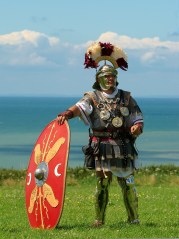 “Centurion” was his title and meant he was a commander over one-hundred soldiers. Centurions wore impressive armor including a helmet with all the feathers sticking out of the top, a shiny breastplate, a metal skirt, and a huge shield. Like a leper, a centurion’s command was also obeyed, but not to avoid becoming one of them. A centurion could say, “Go,” and the soldier would go. “Destroy,” and they would destroy. “Kill,” and they would kill.
Roman centurions were also very religious. The Romans believed in many pagan gods, but their chief god was Jupiter, the god of the sky. They believed that Jupiter threw lightning bolts when he was angry. Romans, like many other pagan religions, believed that if you wanted something from your god, you had to offer a gift or bribe to get that god on your side like Naaman did with his silver, gold, and cloths in our Old Testament text (2 Kgs. 5:1-15). But here in this text, the centurion approaches Jesus in Capernaum with completely empty hands. His beloved servant is paralyzed and dying at home, and he can’t do anything about it. He recognizes that he has no strength, no authority, no power over the condition of his servant.
Don’t miss the significance of this. A man with his power, influence, and strength could easily replace a measly servant. All he had to do was say the word, and the soldiers under his command would find another person with better skills or more strength to be his slave. For this centurion to go to Jesus would have been a despicable display of weakness not only in the eyes of his peers but also for the soldiers under his command. More on this later. And now he approaches Jesus with no gifts, no bribes, no promises. This centurion comes with nothing but a plea, “My servant is lying at home and dying. Don’t come to my house because I am not worthy to have You under my roof. Just say the word, and he will be healed.”
Jesus marvels. And if Jesus marveled at this man’s faith, so should we. Here is “a man of strength coming in weakness, a man of wealth coming in poverty, a Gentile coming in faith” (Rev. David Petersen). With no attempt to bribe, he simply trusts in the mercy of Jesus, God in the flesh, the One with real authority and power, full of mercy and compassion.
It is no marvel that Jesus found no such faith in Israel. But instead of casting stones at them, we should ask ourselves: would Jesus find such faith among us? How often are our prayers attached to promises of living a better life, being more obedient or more faithful? How often do we try to bargain with God in order to gain His favor? Repent.
Even if from this moment on, you promised to be perfectly obedient (which is impossible), without God’s mercy you and I are still unworthy for the Lord to come under our roof. The only thing we are worthy of is to be cast into the outer darkness of hell for all eternity.
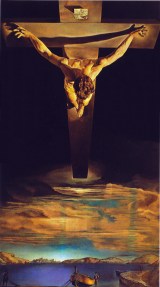 Repent, but do not despair. Jesus, God in the flesh, comes down from the mountain in order to save us. He is a God of mercy and grace. He comes to make the unworthy worthy and the unholy sacred. Jesus willingly approaches the untouchable leper to touch and heal. And Christ has compassion upon a centurion who appeared to have everything, but in reality, had nothing.
May we also have such faith as we approach our compassionate God who willingly and marvelously went to the cross to bear our sins. Christ was cast out of society with nothing but a cross and a crown of thorns. Though Jesus is the Lord of hosts, He did not call the angels to deliver Him as He was pinned to the cross. Instead, in love He shed His holy and precious blood to heal our souls. He bears all our sin in His body on the cross and proves that He is stronger than the devil. He shuts Satan’s mouth and triumphs over sin, death, and hell by His resurrection. He says, “Go,” to your sins and they go. He says, “Come to Me, all who labor and are heavy laden,” and you come and find rest for your soul (Mt. 11:28).
Remember, for this centurion to come to Jesus was an act of humility. He could have simply found another servant, but the centurion humbles himself to seek Jesus’ help because of his love for his servant. The centurion becomes a picture of what it means to be a Christian. His faith in Christ is manifested in love for his neighbor in a marvelous way.
The centurion is a Christ figure for his servant. Though he had power and authority, the centurion humbles himself to serve his servant. And, Christian, so do we. Through faith, we have everything since we are children of the Most High God. Yet, through love, we use our access to God in order to serve our neighbor by interceding on their behalf. Through faith, we receive treasures from above, from God. Through love we release those treasures below to our neighbors (Luther).
May our faith in Christ manifest itself in love for our neighbor so that the earth may know the mercies of our Lord and Savior, Jesus Christ. Amen.
The peace of God, which surpasses all understanding, will guard your hearts and minds in Christ Jesus. Amen.

 I just have to run faster than you.” Well, guess what. When the bear of God’s Law is finished eating the guy who is slower to obey than you, it picks up your scent and resumes its pursuit of you because its appetite is never satisfied by eating up sinners.
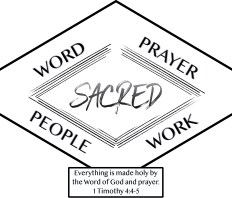 There’s a better way to understand these verses, and to get at that understanding, I’m going to connect this text to our theme for the year – “Sacred.” In Lev. 19:2, God speaks to His people, Israel, and says, “You shall be holy, for I the Lord your God am holy.” And Peter repeats those words for us Christians in 1 Pet. 1:16. In English, this sounds like a command because of the word ‘shall.’ But in both Hebrew and Greek it isn’t a command/imperative. A better translation for both is, “You will be holy.”
 likeness of sinful flesh and for sin, he condemned sin in the flesh, in order that the righteous requirement of the law might be fulfilled in us, who walk not according to the flesh but according to the Spirit.”
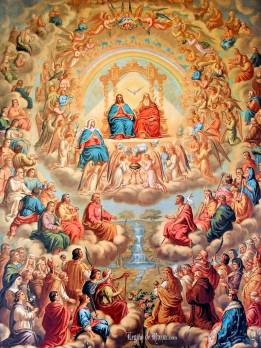 9 After this I looked, and behold, a great multitude that no one could number, from every nation, from all tribes and peoples and languages, standing before the throne and before the Lamb, clothed in white robes, with palm branches in their hands, 10 and crying out with a loud voice,
 While death may come suddenly and abruptly here, those who die in the faith are not surprise arrivals in heaven. The company in heaven is not startled or shocked by those who show up at the doors of glory. The gates are open, and the believers who arrive there have been anticipated and are welcomed into the great multitude to be with the Lamb who shepherds them. Their arrival into glory is no shock to the residents of heaven. It is perfectly ordinary and on time.
 Because of this, we can have joy in the midst of sorrow. Here and now, as we are gathered together in God’s house and are invited to God’s table, we come to what is described in Hebrews 12(:22-24). This very morning in a small church on the north end of East Grand Forks, MN, we have come, “to Mount Zion and to the city of the living God, the heavenly Jerusalem, and to innumerable angels in festal gathering, and to the assembly of the firstborn who are enrolled in heaven, and to God, the judge of all, and to the spirits of the righteous made perfect, and to Jesus, the mediator of a new covenant.”
 She prays because she remembers that the God of Israel promised to deliver His people from the devil, which is why she addresses Jesus as the Son of David – to remind Him of His promises. And she remembers that she doesn’t deserve Jesus’ help because of her sins, so her prayer is, “Have mercy on me.”
 Boone, and all of you, be bold in your prayers. Even when it seems that God is distant and ignoring you, He hears you. He loves you. Jesus has died and risen for you and is even now interceding for you before His Father in heaven (1 Jn. 2:1).
 But Satan comes along and puts a question into the mind of the woman. “Did God actually say?” This is the one attack of the devil. He always is trying to get us to doubt the Word and promise of God. “Did God actually say, you should not eat of any tree in the garden?” And notice that the woman adds to God’s promise. She says, “We may eat of the fruit of the trees in the garden, but God said, ‘You shall not eat of the fruit of the tree that is in the middle of the garden, neither shall you touch it, less you die.’” God had never said anything about not touching the tree of the knowledge of good and evil (at least, it isn’t recorded for us). Satan is attacking God’s Word, but Adam and the woman have not fallen yet. The serpent sees his opening and tells an outright lie, “You will not surely die! For God knows that when you eat of it your eyes will be opened, and you will be like God, knowing good and evil.”
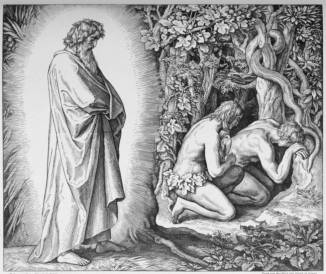 But even as God does this, we will see the horrific consequences that sin and evil has brought into God’s good creation. God calls to Adam, “Where are you?” God still wants to have fellowship with Adam and the woman even though they have sinned, broken His commandment, and lost their faith. But rather than confessing and repenting of his sin, Adam dodges the opportunity saying, “I hid from You because I was naked and afraid.” So, God gives Adam a second chance to repent, “Who told you that you were naked? Have you eaten of the tree of which I commanded you not to eat?”
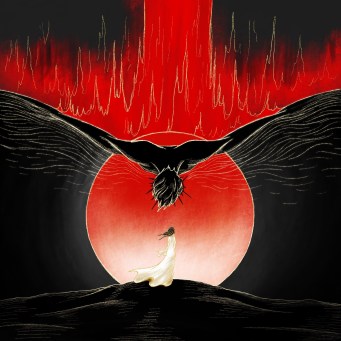 gives her the name Eve. She wasn’t called this at any point before in Scripture. Adam gives her the name ‘Eve’ which means ‘life-giver.’ Here’s how we know faith is restored. Eve was already going to be the mother of everyone who would be born. But Adam, the father of faith, changes her name to Eve because she is the mother of all who would believe in the promised Seed who would crush the serpent’s head.
 Imagine Matthew in this storm. Remember, Matthew – unlike Andrew and Peter and James and John – Matthew wasn’t a fisherman. He was a tax collector when Jesus called him to be a disciple (Mk. 2:14). Typically, he had hands stained from handling coins all day not clammy, saltwater-drenched hands. Matthew was used to sitting in a tax booth not on the rail of a boat bailing water so that it doesn’t sink. Matthew had seen Jesus rebuke demons, rebuke sickness, and rebuke the Pharisees and religious elite. But now, in the middle of a storm that threatened Matthew’s life, the Man who had called him saying, “Follow Me,”lay peacefully sleeping and undisturbed in the back of the boat on a cushion (Mk. 4:38).
 f that storm, in the middle of the wind and the saves and terror, Jesus asked the disciples, “Why are you afraid, O you of little faith?” This question from our Lord’s lips confronts us today. What are you afraid of? The devil may be behind the things you fear. Satan may want you to enter “emergency mode,” “crisis mode,” “God doesn’t care and is sleeping mode.” The devil wants nothing more than to rob you of the peace and security that comes from being a child of God. So repent. The devil is very cunning and dangerous, but he is also totally and completely predictable.
 If you want to know what God thinks about you, you need look no further than the cross. While you were still weak, at the right time, Christ died for you (Ro. 5:6,8). If you are going through a storm of sickness, a storm of family strife, or whatever it might be, look at it through the lens of Christ crucified and risen for you. And know that God is in control and He will never leave you nor forsake you.
 20 And behold, a woman who had suffered from a discharge of blood for twelve years came up behind him and touched the fringe of his garment, 21 for she said to herself, “If I only touch his garment, I will be made well.” 22 Jesus turned, and seeing her he said, “Take heart, daughter; your faith has made you well.” And instantly the woman was made well.
 He says to the mourners, “Go away, for the girl is not dead but sleeping.” And the mourners laugh, mocking Jesus and His words.
 He will raise you from the dead when He returns in glory. Even if you don’t get the things you want now, Christ will give you everything on the Last Day.
 So, the picture is this: These Christians have crossed the finish line. But instead of going to the locker room and getting into an ice bath, they go into the stands to cheer us on as we run our race. And again, this is multitudes of people – more than you could count – people from every nation, tribe, people, and language (Rev. 7:9). Imagine the cheers, chants, clapping, and whooping encouraging you as you run.
 So, maybe you are tired and struggling with quarrels in your family, and you want to quit running. But there is Abel cheering you on, “Keep going. I know it’s hard. My brother hated me for my faith in Jesus and killed me. But Christ was faithful to me and brought me to the end of my race. Keep going.”
 Look to Jesus. Fix your eyes on Him. Look to Christ, the author, the founder, and the perfecter of your faith. For the joy what was set before Him, He endured the cross, despising the shame, and is seated at the right hand of the throne of God.”
 They thought, wrongly, that Cain was the promised offspring who would crush the serpent’s head.
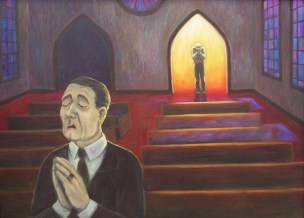 You see, the only way to approach God is through an offering, a sacrifice. Examine your life and ask yourself why you believe God will hear your prayers, why God will notice you, why God will have regard for you. But remember, you don’t get to pick which sacrifices are pleasing to God. Your good works are not enough, and your perceived lack of sin is nothing but an illusion of your own fallen mind. If you think and believe otherwise, sin isn’t just crouching at your door. Sin is your master. Repent.
 Pastorsamwise
You must be logged in to post a comment.