Humbled – Sermon on Luke 14:1-11 for the Seventeenth Sunday after Trinity

Luke 14:1-11

1 One Sabbath, when [Jesus] went to dine at the house of a ruler of the Pharisees, they were watching him carefully. 

2 And behold, there was a man before him who had dropsy. 3 And Jesus responded to the lawyers and Pharisees, saying, “Is it lawful to heal on the Sabbath, or not?” 4 But they remained silent. Then he took him and healed him and sent him away. 5 And he said to them, “Which of you, having a son or an ox that has fallen into a well on a Sabbath day, will not immediately pull him out?” 6 And they could not reply to these things. 

7 Now he told a parable to those who were invited, when he noticed how they chose the places of honor, saying to them, 8 “When you are invited by someone to a wedding feast, do not sit down in a place of honor, lest someone more distinguished than you be invited by him, 9 and he who invited you both will come and say to you, ‘Give your place to this person,’ and then you will begin with shame to take the lowest place. 10 But when you are invited, go and sit in the lowest place, so that when your host comes he may say to you, ‘Friend, move up higher.’ Then you will be honored in the presence of all who sit at table with you. 11 For everyone who exalts himself will be humbled, and he who humbles himself will be exalted.”

In the name of Jesus. Amen.

Jesus eats with all sorts of people. He eats at His friends’ house with Mary, Martha, and Lazarus (Lk. 10:38-42). He eats at His disciples’ houses. He eats in Peter’s house and Peter’s mother-in-law serves Him (Lk. 4:38-39). Jesus calls Matthew the tax collector to be His disciple and eats with him and other sinners. And you remember that the reason Jesus tells the parable of the Lost Sheep, Lost Coin, and Prodigal Son is the Pharisees accusing Jesus of welcoming and eating with sinners (Lk. 15:1-2).

We aren’t surprised that Jesus would eat with His friends and disciples. We do that too. And as Christians, we are comfortable with the fact that Jesus eats with sinners. But we might find it surprising that Jesus would even eat with Pharisees. The Pharisees were our Lord’s enemies. From the beginning of His ministry, the Pharisees were butting heads with Jesus (Lk. 5:21Jn. 5:18).

Think of the person in your class or at work that you most regularly butt heads with – no matter what you just can’t seem to get along. He takes everything you say and turns it into an accusation against you, so you’re always on your toes, always analyzing everything word out of your mouth. Being around a guy like that is exhausting. Now, if that person invited you over for dinner, you’re going to decline. (Unless they tell you that they are going to be serving dry-aged Wagyu steaks. Then, you probably go, you just don’t stay for dessert.) But as difficult as the person you are imagining is, he probably isn’t trying to find some way to get you the death sentence. That’s exactly what the Pharisees wanted for Jesus, but our Lord still repeatedly ate with the Pharisees.

Once, Jesus went to Simon the Pharisee’s house where He was anointed by the sinful woman who washed Jesus’ feet with her tears (Lk. 7:36-50). Another time, Jesus was invited to eat at a Pharisee’s house and didn’t wash His hands the way the Sabbath traditions requires (Lk. 11:37-54). When Luke finishes recording that meal, he notes that the scribes and Pharisees were lying in wait for Him, to catch Him in something He might say.

Now here, in our text, an important Pharisee has invited Jesus to his house for a Sabbath dinner. And, what d’ya know? Jesus goes. 

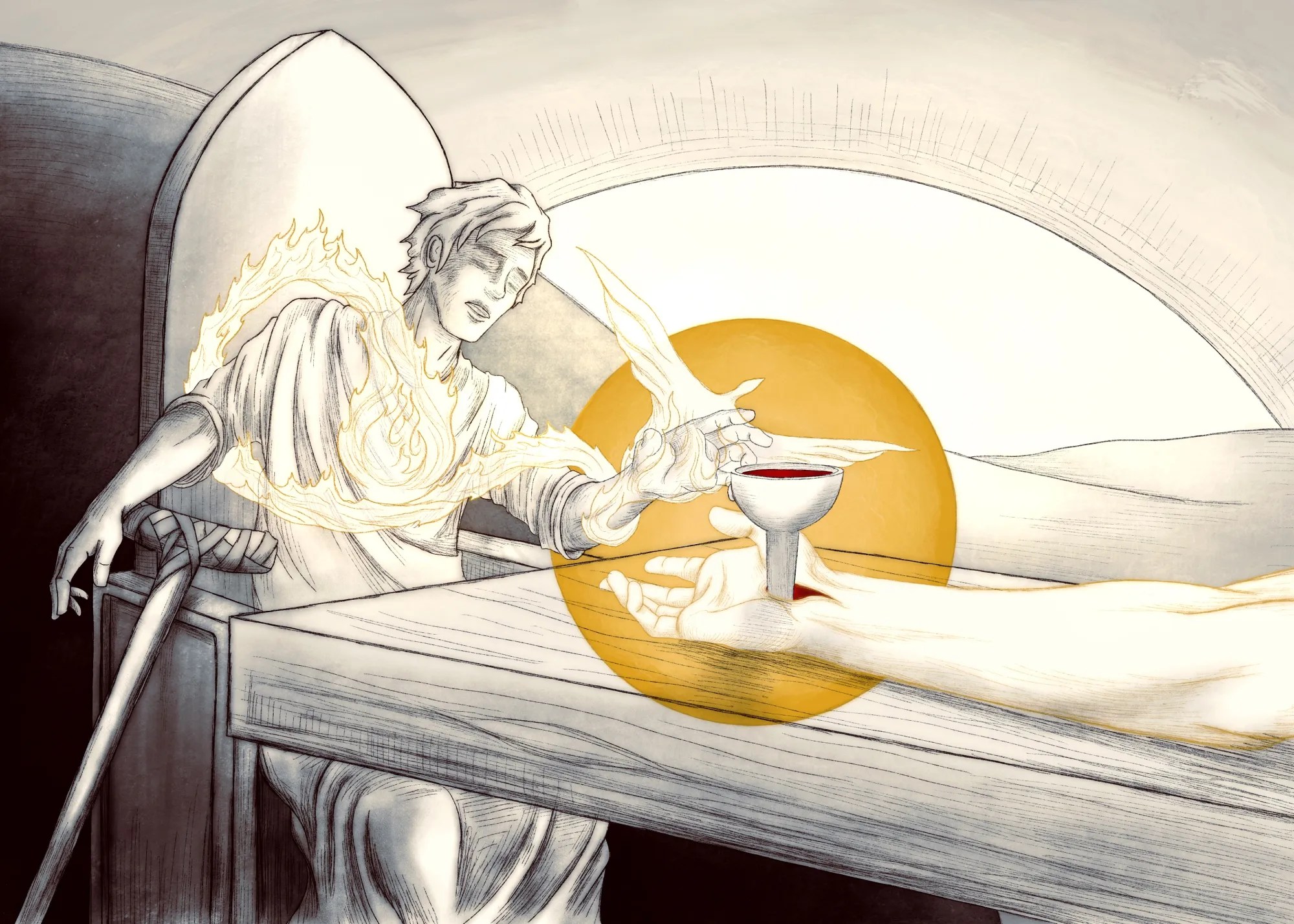
Now, we have to imagine this scene of everyone arriving for the fancy dinner. Luke here gives us enough details to sketch this out, but they are interspersed in the account. So, let’s bring them together into one picture. Jesus arrives at this ruling Pharisee’s swanky house. As the guests arrive, they might give a nod or a handshake to their friends, but each of them is more interested in positioning themselves to get the best seats. They are cutting in front of each other to get as close as possible to the head of the table. I don’t know how a Pharisee would save a seat – maybe he’d drink half of whatever was in the cup or lick the silverware. Who knows? But they are all claiming their spots and making sure their position is secure and no one else takes it from them. Then, their gaze turns towards Jesus.

When Jesus arrived, He wasn’t concerned with sitting in the high, prominent spots. So, we can assume that there was only one spot left at the table – the lowest. Jesus finds His place, and the eyes of all the Pharisees are on Him. If you were there and watching Jesus approach His seat, you wouldn’t notice the fine dining couch or the fancy china. The only thing that would catch your attention was this man.

Luke, the doctor, tells us that the man before Jesus has ‘dropsy.’ The term does appears in medical literature about 300 years before Jesus by a guy named Hippocrates (from whom, we get the Hippocratic oath). The word is actually two words mushed together – “water” and “appearance.” In other words, the guy was swollen, grossly bloated. It is not stretching the text at all to assume the Pharisees brought this man in so they could accuse Jesus of breaking the 3rd Commandment, “Remember the Sabbath day to keep it holy.”

Now, the Pharisees had lengthy discussions on what was and what wasn’t permitted on the Sabbath. They wrote all sorts of rules that defined what you could and couldn’t do on the day of rest. It went so far as to define where you could spit. Every other day of the week, you could spit wherever you wanted, but on the day of rest, you could only spit on rocks because spitting on soil might be watering a plant and considered work. Also in their discussions, they considered how much help you could give to a person who was sick or injured. For example, if someone had a cut you could apply a bandage to keep the wound from getting worse, but you couldn’t apply the bandage in a way that would help the person get better because that would be considered work.

These Pharisees are all closely watching as Jesus sees this man, ballooned up with disease. But Jesus turns the tables. Notice, they don’t ask Jesus a question, but He responds to the situation asking, “Is it lawful to heal on the Sabbath or not?” The Pharisees don’t say a word. Jesus heals the man. His swelling is gone. His features return to normal, and Jesus sends him away. Then, Jesus exposes the Pharisees’ hypocrisy. “Which of you, having a son or an ox that has fallen into a well on a Sabbath day, will not immediately pull him out?”After this question, the Pharisees aren’t just silent. They aren’t able to answer. With two pointed questions, Jesus humbles the Pharisees into deafening silence.

Then, our Lord throws the knock-out punch. They had been watching Jesus carefully as He approached the table, but He had been watching them too. They had been scrambling, shoving, jolting, and jockeying for the best places. It’s interesting: for all the discussion and debate the Pharisees had on what was and wasn’t considered work on the Sabbath, they didn’t debate about contending for prominent positions in their regulations. And Jesus echoes what we had in the first two verses of our Old Testament lesson (Pro. 25:6-14). Basically, if you put yourself forward as being important, you’re likely going to be humbled, and it’s going to be a public spectacle. Instead, be humble, and wait for your host to exalt you.

Now, of course, this is some solid, practical advice. Any motivational speaker could take what Jesus says here and teach a helpful lesson: Don’t strut around blowing smoke about how important you are. Instead, go about your business quietly, and your recognition will come in due time. But this isn’t a self-help seminar, and I’m not a motivational speaker.

Instead, notice what happened at this meal. Jesus, who was by far the most important person there, ended up in the lowest seat. And even though no one changed positions, Christ elevated His place back the peanut gallery to be the prominent place, and those who were at the head of the table end up in the bleachers.

Dear saints, as our Epistle lesson (Eph 4:1-6) said, “Walk in a manner worthy of your calling.” Humble. Gentle. Patient. Bearing with one another in love. Paul will say a similar thing in Php. 2:5-11, “Have this mind among yourselves, which is yours in Christ Jesus, who, though he was in the form of God, did not count equality with God a thing to be grasped, but emptied himself, by taking the form of a servant, being born in the likeness of men. And being found in human form, he humbled himself by becoming obedient to the point of death, even death on a cross.” But Jesus didn’t remain humbled and lowly in death. The text goes on, “Therefore God has highly exalted him and bestowed on him the name that is above every name, so that at the name of Jesus every knee should bow, in heaven and on earth and under the earth, and every tongue confess that Jesus Christ is Lord, to the glory of God the Father.”

Dear saints, this humbled mind is yours. You, Christian, are saved by God’s grace. Live that out. You were sinful and low, but Christ has invited you, by the cleansing of His blood, to sit at His table. He has given you the seat of honor next to Him. Through His death and resurrection, you have been raised with Him. Your life is even now hidden with Christ in God. And the day is coming when Christ who is your life appears, you also will appear with Him in glory (Col. 3:1-4). Christ will call to you, “Friend, move up higher.” And you, and all believers, will be honored in the presence of all creation. Amen.

The peace of God, which surpasses all understanding, will guard your hearts and minds in Christ Jesus. Amen.

Invited – Sermon on Proverbs 9:1-10 for the Second Sunday after Trinity

Proverbs 9:1-10

1   Wisdom has built her house;
she has hewn her seven pillars.

2   She has slaughtered her beasts; she has mixed her wine;
she has also set her table.

3   She has sent out her young women to call
from the highest places in the town,

4   “Whoever is simple, let him turn in here!”
To him who lacks sense she says,

5   “Come, eat of my bread
and drink of the wine I have mixed.

6   Leave your simple ways, and live,
and walk in the way of insight.”

7   Whoever corrects a scoffer gets himself abuse,
and he who reproves a wicked man incurs injury.

8   Do not reprove a scoffer, or he will hate you;
reprove a wise man, and he will love you.

9   Give instruction to a wise man, and he will be still wiser;
teach a righteous man, and he will increase in learning.

10 The fear of the Lord is the beginning of wisdom,
and the knowledge of the Holy One is insight.

In the name of Jesus. Amen.

Today, we’re diving right in. Jesus is Wisdom who speaks in this text. Jesus is the one who has prepared this banquet and invites the simple (probably best understood as ‘gullible’) and those who lack sense to a feast He has prepared. Don’t be offended by that interpretation just because Wisdom here is given feminine pronouns. “Wisdom has built her house, hewn her pillars, slaughtered her beasts, mixed her wine…” etc. The word “wisdom” in both Hebrew and Greek is a feminine noun, so don’t let that confuse you. This text is not teaching that God is a woman. Wisdom is the everlasting, eternal, infinite, almighty Son of God.

A bit of context helps cement this interpretation. Back in Pro. 8:22-23, 27-31, Wisdom says of Himself,

“The Lord possessed me at the beginning of his work, the first of his acts of old.
Ages ago I was set up, at the first, before the beginning of the earth….
When he established the heavens, I was there; when he drew a circle on the face of the deep,
when he made firm the skies above, when he established the fountains of the deep,
when he assigned to the sea its limit, so that the waters might not transgress his command,
when he marked out the foundations of the earth, then I was beside him, like a master workman.”

In other words, God created with and through Wisdom, and all of that echoes the opening of the Gospel of John. “In the beginning was the Word, and the Word was with God, and the Word was God. He was in the beginning with God. All things were made through him, and without him was not any thing made that was made…. And the Word became flesh and dwelt among us, and we have seen his glory, glory as of the only Son from the Father, full of grace and truth” (Jn. 1:1-3, 14). And if that isn’t enough to prove that Jesus is Wisdom who is speaking here, in Lk. 11:31 Jesus calls Himself the Wisdom greater than Solomon. And in 1 Cor. 1:30, Paul says that Jesus is the wisdom from God.

Jesus, the eternal Son of God and wisdom of God, is the Father’s voice to the world. Jesus reveals God’s heart. And Christ gives us true wisdom that remains when everything else is gone. And look at this beautiful invitation:

He prepares the food, sets the table, and calls all people – even the gullible and senseless – to come to the banquet. This feast is free by grace. God charges no admission fee, and the guests have no bill at the end of the meal. They don’t even have to cover the tip. Those who have no money are invited to come and have their fill. This beautiful picture is also what we saw in our Gospel lesson (Lk. 14:15-23). There, the king doesn’t care if the guests are poor, crippled, blind, or lame. He doesn’t even care if they are citizens of his kingdom. He tells his servants, “Go out to the highways and hedges and compel people to come in that My house may be filled.” God has a banquet. He wants His tables to be filled with guests. He desires that all be saved and come to a knowledge of the truth.

The past three times these readings have come up, I’ve preached on that Gospel text and highlighted the importance of coming to church because the riches of the feast that God gives us right here, in this sanctuary, are so grand, elaborate, and infinitely valuable. But I’m not preaching on the Gospel lesson today. The main overlap of the Gospel lesson and this lesson from Proverbs is the invitation and how we are commissioned by God to spread that invitation to the divine feast far and wide. So, for the rest of this sermon, let’s consider evangelism and witnessing.

Honestly, there is a lot of bad theology when it comes to evangelism and sharing the Gospel. I want to consider three truths about evangelism today. There are more, but these three are central. And I want to be very clear at the outset here. I’m going to criticize some of the common trends and ideas about evangelism. Just because I criticize them doesn’t mean that those things have never worked to share the Gospel.  Instead, I hope that as we consider what the Scriptures have to say about salvation and how we see that Christianity spread in the book of Acts, you are encouraged and emboldened to simply be who you are in Christ. Be a sinner who has been washed in Christ’s forgiveness. That is all the equipping you need to be a faithful inviter to God’s eternal feast.

The first truth about sharing the Gospel is that evangelism is nothing more than simply announcing that there is a feast that is ready and free to any who will come. As v. 4 of our text said, Wisdom sends us to proclaim, “Whoever is simple, let him turn in here.” And as they arrive at the banquet, Wisdom – in other words Jesus – says to them, “Come, eat of my bread and drink of the wine I have mixed. Leave your simple ways, and live, and walk in the way of insight” (v. 5-6).

God gives us opportunities to invite to a banquet; He doesn’t call us to scare people into heaven. Plays like “Heaven’s Gates, Hell’s Flames” and fire-and-brimstone-street-corner preaching aren’t what Christians are about. Christians are about the free Gospel, the abundant mercy of Christ, and the joy of the eternal banquet. Yes, the horrors of hell are real. But if people are scared into believing in God, they are more slaves than children. And God wants children to love and cherish. Christian, you have the Gospel – the greatest news ever. Jesus has died and shed His blood for the forgiveness of your sins. That message is for all people. Out of His pure mercy, Jesus says, “Fear not, little flock for it is your Father’s good pleasure to give you the kingdom” (Lk. 12:32). God’s greatest delight is to give sinners His kingdom and have them as His guests at His banquet.

The second truth about evangelism is that you don’t have to go out and find people to evangelize. I’ve been through (and even taught) evangelism models that encourage you to seek people out, strike up a conversation, and then turn that conversation to spiritual matters so you can share about Jesus. First off, not a lot of people are comfortable doing that. And very few people who are comfortable doing that can do it naturally – especially when the person they are trying to evangelize tries to change the subject away from spiritual matters. I’ve been a victim (and I’m using that word a little sarcastically) of people who are part of pyramid schemes. Of course, they don’t call it a pyramid scheme – it’s ‘multi-level-marketing.’ At first, they are very friendly and outgoing, but then comes the moment when they try to feel me out about their great, wonderful product. When they realize I’m not interested in purchasing or selling their product, they aren’t interested in me anymore. And you know what that does to my opinion of them? Yeah.

Dear saints, you don’t have to seek out potential converts to Christianity. Repeatedly in the book of Acts, the apostles would proclaim the Gospel in the synagogues – to the people who were already familiar with God’s Word. In those synagogues, some would believe in Christ, but many would reject. The interesting thing is that the apostles never sought out people who were unfamiliar with God’s Word. They never made cold calls. God would simply bring people to the apostles, they would preach, point to Jesus, and people would believe.

Just a few examples: At Pentecost, God brought people together by the sound of the rushing wind (Act. 2:5-6) and the apostles pointed them to Jesus. In Acts 3, Peter and John go to the Temple for prayer one afternoon and encounter a paralyzed man who was begging. Peter tells the guy, “I don’t have any silver or gold for you, but in the name of Jesus Christ of Nazareth, rise up and walk.” The guy does, and whole crowds get drawn to Peter and John to hear more about Jesus (Act. 3:1-4:37). God dropped the Ethiopian eunuch into Phillip’s life (Act. 8:26-38). And when Phillip was done baptizing the eunuch, God teleported him somewhere else to share the Gospel (Act. 8:39-40). God told Cornelius to send for Peter (Act. 10:1-8). We could go on and on. But I’d encourage you, read the book of Acts this week, and notice how God just drops people into the lives of the apostles. Then they simply share the Gospel and point the people whom God put in their lives to Jesus.

Dear saints, you don’t have to seek people out. Be faithful in the vocations and callings that God has given you. Be a good spouse, parent, child, worker, student, neighbor, whatever. Have the best, most genuine relationship possible with the people God brings into your life. Be an authentic person and be ready to give an answer for the reason for the hope that is in you (1 Pet. 3:15-16). As you have opportunity, point them to Jesus, and invite them here where Jesus has prepared His banquet. The most recent survey I saw showed that 86% of people who attend a church go to that congregation because a friend invited them. Be friendly to people not in an effort to convert them – that isn’t true friendship. Just be a friend, and be ready for God to open doors to sharing the Gospel. Like Phillip did for Nathaniel, invite people to come and see Jesus (Jn. 1:46).

Finally, the third truth about evangelism is this: Rest in the fact that you can’t mess it up. Dear saints, Scripture is clear on this. No one will go to hell because you failed in sharing the Gospel with them. It isn’t possible. Jesus promises in Jn. 10:27-29, “My sheep hear my voice, and I know them, and they follow me. I give them eternal life, and they will never perish, and no one will snatch them out of my hand. My Father, who has given them to me, is greater than all, and no one is able to snatch them out of the Father’s hand.”

There is a fascinating verse in Acts 13 about this. Just to give a bit of the context here: Paul and his companions arrive in the city of Antioch (Act 13:13ff). As was their custom, they go to the synagogue and are asked by the rulers if they have a word of encouragement. Paul preaches a little sermon about Jesus (Act. 13:16-41). Some believe, and Paul and Barnabas are invited to come again the next Sabbath. When they do, the whole city of Antioch gathered together to hear the Word of the Lord (Act. 13:44). Paul and Barnabas again share about Jesus. Some were filled with jealousy and were contradicting what Paul was preaching and reviling him (Act. 13:45). But then (and this might be the most important verse you can memorize to encourage you as you think about evangelism), Acts 13:48b, “As many as were appointed to eternal life believed.”

Dear saints, salvation belongs to God (Jon. 2:9; Ps. 3:8; Rev. 7:10). You and all Christians are saved by grace (Eph. 2:8-9). Since you aren’t the source of either salvation or grace, the work of saving people belongs exclusively to God. God can and does use you to be His salt and light (Mt. 5:13-16), and when He does, God be praised! But know that no one, not a single soul, will end up in hell because you have failed. You aren’t that powerful. You cannot erase someone’s name from the book of life (Rev. 3:5). Romans 8:38-39 says, “Neither death nor life, nor angels nor rulers, nor things present nor things to come, nor powers, nor height nor depth, nor anything else in all creation, will be able to separate us from the love of God in Christ Jesus our Lord.”

Dear saints, evangelism, inviting anyone to Jesus’ banquet is zero risk, infinite reward.

Dear saints, there is a banquet. It is free to you and to all. You are invited, and you have the privilege and joy of inviting others. So, invite them. Invite them because of the joy of being part of that feast yourself.

The banquet is prepared. The gifts are ready. Jesus calls you, “Come, eat of my bread and drink of the wine I have mixed. Leave your simple ways, and live, and walk in the way of insight.” Because the fear of the Lord is the beginning of wisdom, and the knowledge of the Holy One is insight. Amen.

The peace of God, which surpasses all understanding, will guard your hearts and minds in Christ Jesus. Amen.
A Seat at the Table – Sermon on Luke 14:1-11 for the Seventeenth Sunday after Trinity

Listen here.

Luke 14:1-11

1 One Sabbath, when [Jesus] went to dine at the house of a ruler of the Pharisees, they were watching him carefully.

2 And behold, there was a man before him who had dropsy. 3 And Jesus responded to the lawyers and Pharisees, saying, “Is it lawful to heal on the Sabbath, or not?” 4 But they remained silent. Then he took him and healed him and sent him away. 5 And he said to them, “Which of you, having a son or an ox that has fallen into a well on a Sabbath day, will not immediately pull him out?” 6 And they could not reply to these things.

7 Now he told a parable to those who were invited, when he noticed how they chose the places of honor, saying to them, 8 “When you are invited by someone to a wedding feast, do not sit down in a place of honor, lest someone more distinguished than you be invited by him, 9 and he who invited you both will come and say to you, ‘Give your place to this person,’ and then you will begin with shame to take the lowest place. 10But when you are invited, go and sit in the lowest place, so that when your host comes he may say to you, ‘Friend, move up higher.’ Then you will be honored in the presence of all who sit at table with you. 11 For everyone who exalts himself will be humbled, and he who humbles himself will be exalted.”

In the name of Jesus. Amen.

All of the Ten Commandments should do two things. First, the Commandments should expose how sinful we are and cause us to repent. Second, the Commandments should make us realize that God is good and that He is concerned for us and cares about all aspects of our lives. For example, the 5th Commandment about murder should expose our anger and hatred toward others, but it should also show you that God values your life and wants to protect it. The 7th Commandment about stealing should expose our greed and idolatry of money and stuff, but it should also show you that God wants you to have and enjoy the things He has given you. The 8th Commandment about bearing false witness should convict us of how we use our tongues to lie, gossip, and speak negatively of others, but it should also show you that God loves truth and wants to protect you from false accusations, gossip, etc. This is true of all Ten Commandments, but because this Gospel lesson focuses our attention on what Jesus does at this Sabbath feast, we are going to focus on the 3rdCommandment.

Hopefully, you have the 3rd Commandment (and all the Commandments) memorized: “Remember the Sabbath Day, to keep it holy.” While that one sentence captures the essence of the Command, there is more to it when it is given by God on Mt. Sinai. Here’s the full thing (Ex. 20:8-11):

“Remember the Sabbath day, to keep it holy. Six days you shall labor, and do all your work, but the seventh day is a Sabbath to the Lord your God. On it you shall not do any work, you, or your son, or your daughter, your male servant, or your female servant, or your livestock, or the sojourner who is within your gates. For in six days the Lord made heaven and earth, the sea, and all that is in them, and rested on the seventh day. Therefore the Lord blessed the Sabbath day and made it holy.” 

The 3rd Commandment shows God’s concern and care for us. In this Command, God guarantees a day of rest every week. And we didn’t even have to unionize to get it! As far as I know, there is no other religion where people are commanded to rest and receive. Foreigners, servants, and even animals get a day off. This rest not only makes people more productive, but it also honors and protects them. God created the universe in six days and rested on the seventh. And because we are created in God’s image, we should follow His example and have the same privilege of rest.

God’s intent with this day of rest was that we should not only rest our bodies and minds, but more importantly God wants us to use the Sabbath to find rest for our souls. The day of rest is kept holy when we concern ourselves with holy things – especially hearing God’s Word preached and explained to us (Mt. 11:28-30Act. 13:274415:21). God knows that we need to work to provide food for our bodies, so He gives us six days to do that. And God knows that we need to be fed spiritually, so He set aside the Sabbath for that as well. According to Jesus, “The Sabbath was made for man, not man for the Sabbath” (Mk. 2:27).

Truly keeping the Sabbath by resting from our regular work to hear God’s Word is a witness to God’s grace. The gift of rest that God gives in the Command reminds us that salvation is never earned or achieved by our efforts. Eternal life is always freely given and received as a gift from God. If salvation is not received as pure gift, it will always be beyond our reach and we will never have it. Now, with all of that in mind, we turn to the text.

The good and merciful Command about the Sabbath was being abused by the Pharisees. Instead of rejoicing in the rest God was giving them in the Command, these legalists took the Commandment and used it as a club to beat others over the head. A legalist is not someone who takes the Law extra seriously in order to keep it, nor is a legalist someone who avoids temptation and sin because they love God’s Law. Instead, a legalist is someone who uses the Law of God to serve himself and make others feel inferior (Rev. David Petersen).

These Pharisees were feasting on the Sabbath but ignoring the man sick with dropsy. Basically, dropsy means this man had some condition that made fluid build up making him bloated and swollen. The man would have looked gross, and his condition might have led people to believe that he was a glutton who was getting what he deserved. It is even possible that the Pharisees had invited this man to the feast in order to test Jesus and see what He would do because they were “watching [Jesus] carefully” (Lk. 14:1).

So, notice that they aren’t resting on the Sabbath at all. They are working, and their task is to catch and trap Jesus. They are taking the Sabbath feast, which was meant to be a time for everyone to bask in God’s forgiveness and mercy, and turning it into a private party where they would ridicule our Lord and pat themselves on the back for keeping God’s Law all while not lifting a finger to help this poor man. Some rest that is!

But while they are working to test Jesus, He turns the tables and puts them under the microscope by asking, “Is it lawful to heal on the Sabbath or not?” Of course, it is obviously in accordance with the Law to heal and do good to others on the Sabbath. God had even addressed this in the books of Moses (Dt. 22:1-4). In Ex. 23:4-5, God says, “If you meet your enemy’s ox or his donkey going astray, you shall bring it back to him. If you see the donkey of one who hates you lying down under its burden, you shall refrain from leaving him with it; you shall rescue it with him.” And God never says, “Go ahead and forget about it if it’s the Sabbath.” 

They knew the answer, but the Pharisees refuse to respond to Jesus’ question. So, Jesus does what He always does and heals the guy. After sending him away, Jesus asks the Pharisees, “Would you leave your son or even an ox that fell into a well on the Sabbath and not pull him out?” And still they refuse to answer. Their pride and hypocrisy is exposed, but Jesus isn’t done going after them yet. Jesus continues to run after them to give them rest. Christ wants these hard-working Pharisees to put down their labors and burdens and enter His rest. So, Jesus tells them this parable, which isn’t like most of Jesus’ parables. Instead, this particular parable is more akin to the wisdom we heard in our Old Testament Lesson (Prov. 25:6-14).

Now, we could take this parable as an etiquette lesson: Sit low and get honor by being paraded through the party to a higher seat. But that flies in the face of what Jesus is actually doing. Jesus wants to show them true humility. Pretending to be humble in order to get the praise of others is not true humility.

Notice what Jesus says is the lesson of the parable, “Everyone who exalts himself will be humbled, and he who humbles himself will be exalted.” In the parable, Jesus doesn’t give you something to do by saying, “Be humble.” Yes, pride is your problem, but you can’t overcome your pride by being humble. Even thinking that you can fix your pride is, by definition, prideful. The anecdote for your pride is not you being humble – it is grace. Grace is humbling because it is never merited or earned. Grace is pure mercy, pure love, pure gift.

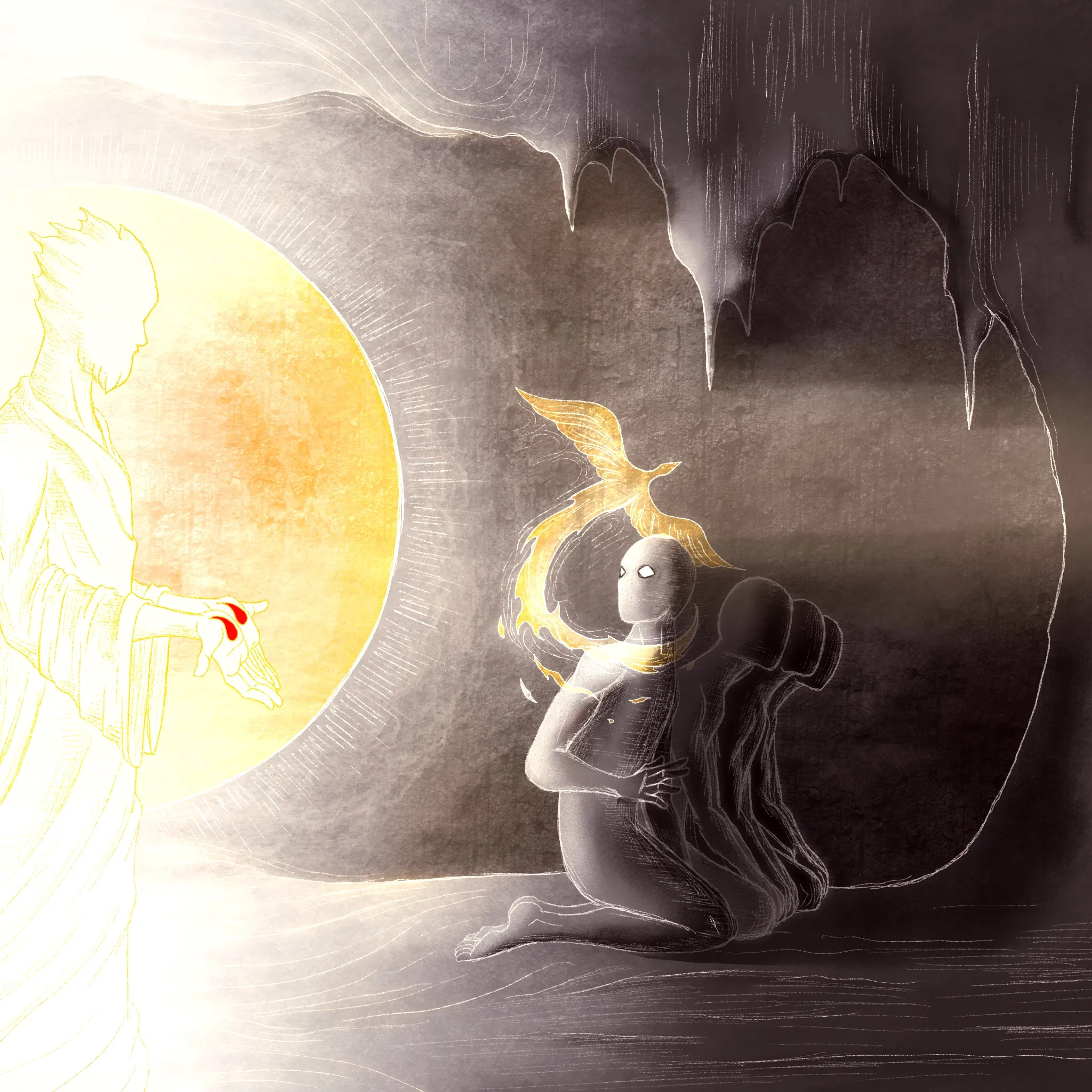
The parable is really all about Jesus. It tells of Christ’s path from glory down to earth and the grave and back again (Php. 2:5-11). Jesus removed Himself from the place of honor at His Father’s right hand in order to make room for you. Jesus was humiliated. He took the form of a servant. God was found in human form. Then, when we sinners saw God in the flesh, we pinned Him to the cross. But after all this, God does the strangest thing.

He sees that Jesus’ seat is open and that you are sitting down low in the muck and mire of your sin. He invites you to move up. You are invited to sit at the table He prepares for you. He anoints your head with oil and makes sure your cup overflows (Ps. 23:5) and is never set down empty. Then, on the third day, from the lowest place, Jesus is raised up. At His name, every knee shall bow and every tongue confess that He is King of kings and Lord of lords. All of this has been done for you so that you can be honored by Jesus’ humility.

Dear sinners, we have fallen into the well of our sin, so Christ has come down into the well of sin for us. He dies in the lowest place of that well. And He invites you to step on His back, so you can get out and move to a seat of honor at His table. 

Remember how each of the first six days of creation in Genesis end by saying, “There was evening and morning”? The seventh day, the Sabbath, the day of rest doesn’t mention that. The picture is of an eternal rest with God that doesn’t end. Well, today is our Sabbath, our day of rest. God now invites you to His feast, and there is a place of honor for you here at His Table. Leave your work, your striving, your pride, and your sin. Come, there is a seat for you here at God’s table. Come and receive what you have not earned or deserved. Your God has good things for you here. Amen.

The peace of God, which surpasses all understanding, will guard your hearts and minds in Christ Jesus. Amen.

Feasting with Sinners – Sermon on Luke 15:1-32 for the Third Sunday after Trinity

Listen here.

In the name of Jesus. Amen.

You can take each of these parables out of their context, and they will correctly teach you about the Kingdom of God and His grace and mercy. When these parables are taken out of context, they become nice stories about how Jesus seeks out you who are lost sheep, lost coins, and lost sons, and the angels in heaven rejoice at your being brought into the fold. To view yourself as the lost sheep, coin, or son is not entirely wrong, but neither is it entirely right.

So first, let’s consider the context of these parables. The reason Jesus tells them is the grumbling of the Pharisees when Jesus is eating with and welcoming sinners. So, the point of each of the parables is to pound into our heads the joy of heaven over one sinner who receives grace. The parables show us the ludicrous feasting and joy of God’s mercy, pardon, and steadfast love over sinners.

Lost Sheep from Luke 15.jpgIn each of these parables, what is lost – the sheep, the coin, and even the son – is not valuable. That is the point of the parables. This is most apparent in the parable of the lost coin. The party the woman throws costs more than the coin that she recovered. That one sheep was worth less than the cost of the party that the shepherd threw. Even that one son was not worth the cost of the party. And don’t pish-posh that statement.

The son had told his father to drop dead. The twerp demanded that his father sell off everything. The little brat went off, blew the inheritance, and returned only when he is tired of sharing swill with swine and thinks he has a chance at getting some bread. He came sauntering back to negotiate a job for himself. Had the father brought him on as a hired hand, it would have been gracious. Restoring him to sonship is merciful. Throwing a party about the whole business is unimaginable. No, the son is not worth a party.

But that is the point. The point is that God is like an obsessive and foolish shepherd, woman, and father who loves too much. God pays for work not performed and for merchandise not delivered.

If these parables give you a picture of a God who seems reasonable, then you are reading them wrong. Your heavenly Father turned His back on His perfectly good, entirely faithful, and completely obedient Son to purchase those who killed Him. Jesus laid down His precious life for sinners.

To paraphrase our Old Testament text (Mic. 7:18-20), “Who is a God like You, pardoning iniquity and passing over transgression? You do not retain Your anger forever, because You delight in steadfast love. You have compassion on us, and You will have compassion us again and again.”

ShadenfreudeBecause of our sin, we are broken. No one wants to admit it, but we are happy when our neighbor suffers and we are sad when he rejoices. The Germans created a word for this by combining their words for ‘harm’ and ‘joy’ into one word, Schadenfreude. The worst part is we justify our Schadenfreude. We enjoy others’ pain because we figure they deserved it. We want others to get what we think is justice. But this is the opposite of compassion and is from the devil.
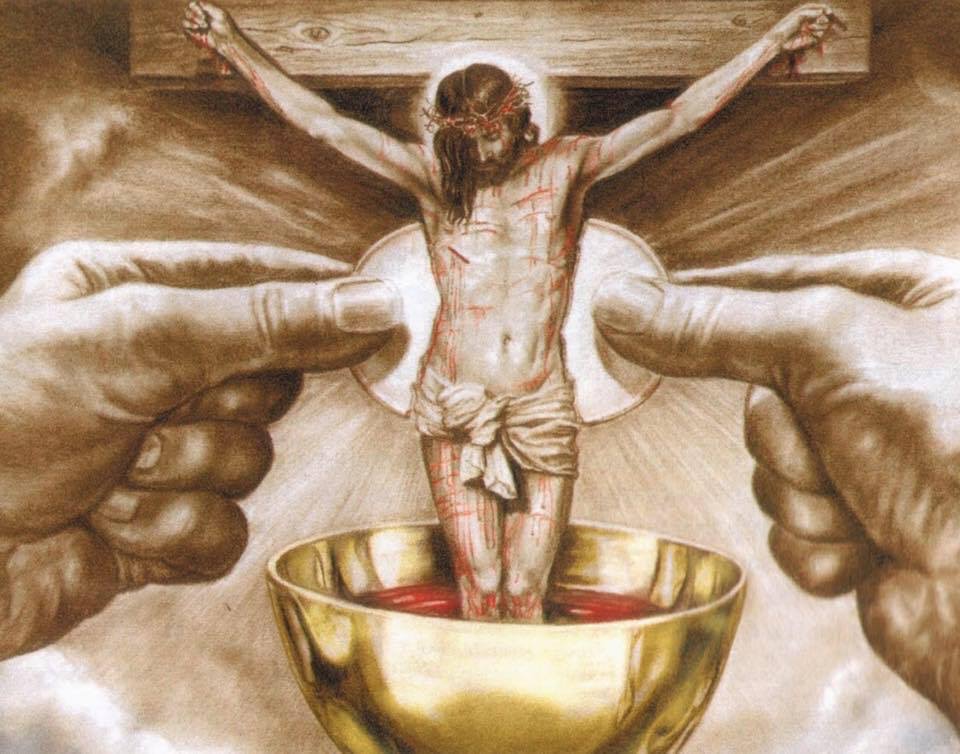
Satan wants justice for others. His desire is that you get the wages of your sin – death. And when we desire and demand justice, we join our voices to the serpent and receive nothing but hell and condemnation.

Like the Pharisees, we live good, respectable lives but only in an outward way. We mow our lawns and use our turn signals. We volunteer, pay our bills, and give to charities. And we think we deserve good, peaceful lives because of it. When we encounter any trouble or trial or cross, we conclude that God isn’t being fair. And worse than that, when God showers blessings on others, we figure God is rewarding bad behavior. And instead of repenting, we judge God to be unjust. We are entirely foolish for thinking so.

The Pharisees were angry at Jesus for receiving sinners, so they are damned and go home condemned. They refuse to repent. And they refuse to repent because they hate grace – even though they will never admit it. Irritation at God for accepting sinners through grace is the height of hubris and pride.

Instead of being encouraged that God forgives sinners whom we deem worse than us, we get jealous and think that God should simply accept us as we are because we are so much better than others. It is the same as saying, “I don’t need mercy, so others shouldn’t get mercy.”

Repent. The sheep, the coin, and the son are not worth the cost to restore them nor the party thrown afterwards. And, sinner, you are not worth the cost of your redemption. Let me repeat that and let it sink in: You are not worth the cost of your redemption.

But God does it anyway. How great is God’s steadfast love toward us and others?

No one is worthy of the banquet. No one is worthy to enter the feast. The feast is full of sinners accepted by God’s grace alone. Otherwise, what is Jesus doing on the cross?

The father in the parable slaughtered the fattened calf in order to celebrate the fact that Cross and Communionhe restored and received his son back into the family. Sinner, your heavenly Father has fattened up Jesus, His faithful Son, to serve as food for you who are unworthy.

Come, you poor, lame, cripple, and blind. Come, you who have no other options or choice. You and I are sinners received entirely by God’s grace without any merit or worthiness of our own.

Heavenly Father, teach us to rejoice in this and in nothing else. Amen.

The peace of God, which surpasses all understanding, will guard your hearts and minds in Christ Jesus. Amen.

Ready – Sermon on Luke 14:15-24 for the Second Sunday after Trinity

Listen here.

Luke 14:15-23

15 When one of those who reclined at table with him heard these things, he said to him, “Blessed is everyone who will eat bread in the kingdom of God!”

16 But he said to him, “A man once gave a great banquet and invited many. 17 And at the time for the banquet he sent his servant to say to those who had been invited, ‘Come, for everything is now ready.’ 18 But they all alike began to make excuses. The first said to him, ‘I have bought a field, and I must go out and see it. Please have me excused.’ 19 And another said, ‘I have bought five yoke of oxen, and I go to examine them. Please have me excused.’ 20 And another said, ‘I have married a wife, and therefore I cannot come.’ 21 So the servant came and reported these things to his master. Invite as many as you find to the wedding feastThen the master of the house became angry and said to his servant, ‘Go out quickly to the streets and lanes of the city, and bring in the poor and crippled and blind and lame.’ 22 And the servant said, ‘Sir, what you commanded has been done, and still there is room.’ 23 And the master said to the servant, ‘Go out to the highways and hedges and compel people to come in, that my house may be filled. 24 For I tell you, none of those men who were invited shall taste my banquet.’”

In the name of Jesus. Amen.

Our God is a God of order (1 Cor. 14:33; Heb 13:20). Because God is eternal, all-powerful, and all-knowing, God is never surprised, never caught off guard. He is always prepared, always ready. This is very basic stuff, but it is good to dwell on it for a bit.

When God created the universe, He didn’t create cows until everything was ready for cows. God waited until the sixth day so cows would have grass, land, atmosphere, and light. God didn’t create fish or birds until He had created the sky and sea for them to dwell in. And God didn’t create Adam and Eve until very last so that they could be brought into a perfectly prepared world and perfectly prepared Garden. God made everything ready for them.

We can go further. When God sent the Flood in Noah’s days, God patiently waited for Noah to build the ark so that it would be ready to save his family and the animals. When God sent Jacob’s family into Egypt, God made everything ready by first sending Joseph down to Egypt so he could rise to power and provide food and a good, safe place for God’s chosen people. And God doesn’t bring His people out of Egypt until the Promised Land is already flowing with milk and honey.

When God drove the inhabitants of Canaan out so His people could dwell there, He doesn’t do it all at once. God said that He would drive the idol-worshipping pagans out little by little so the wild beasts wouldn’t become too many (Ex. 23:29-30Dt. 7:22-23). On top of that, God also said that would first make the people afraid of the Israelites (Ex. 23:27-28). And when His people got to Jericho, that is exactly what Rahab said had happened (Josh. 2:9-11). God is never in emergency mode. He always makes everything ready.

But even above and beyond all of that, God makes sure that everything is prepared and ready when it comes to the salvation of sinners. Galatians 4:4-5 says, “But when the fullness of time had come, God sent forth his Son, born of woman, born under the law, to redeem those who were under the law, so that we might receive adoption as sons.” God is always ready.

In this parable, Jesus tells us about God’s plan of salvation. The man giving the banquet in this parable had sent out invitations. You can think of this as a “save the date,” even though no exact date was given. The people are simply invited by the host, “I’m going to have a feast, and you are invited.” And the people respond, “Sounds great. We’ll be sure to come when you call us.” That is understood in v. 16.

This initial invitation is God’s repeated promise to send the Messiah, His Son, our Savior, Jesus Christ. God repeatedly invited people to come to Him through Christ, but He didn’t announce exactly when Jesus would arrive.

Heavenly Banquet TableSo, the man has sent out this invitation without saying exactly when the banquet would begin. Then in v. 17, the preparations are finished – the food is cooked, the table is set, the decorations are hung, the wine is poured, everything is ready. The man sends his servant to tell all those who were invited, “Come, for everything is now ready.” But they all make excuses, and their excuses are lame and stupid.

No one buys a field without looking at it first to see if it is worth the asking price. No one buys a yoke of oxen without checking if they are old, decrepit, and sickly. And you just got married? Well, bring your wife, you simpleton! Your host won’t mind. Besides, this banquet will be a more exquisite honeymoon than you could afford or imagine.

Now, we need to pause here because a question lies before us: What things keep you from the long-prepared banquet? What do you value more than the kingdom of God? What are your excuses? It doesn’t matter what excuses you have; they are just as lame and stupid as the ones offered in the parable.

Is your schedule so full that you can’t eek out time to pray and study God’s Word for yourself or as a family? God sees that as a rejection of Him. Do you not come to church everySunday because it is your only time to sleep in or because that is when the tournament is scheduled? God sees that as a rejection of Him. Do you withhold your tithe because you don’t know how you would be able to make ends meet even though you can always justify all other kinds of frivolous spending? God sees that as a rejection of Him.

Hear what the master of the feast says, “None of those who were invited shall taste my banquet.”

Repent. Your excuses are all statements that you are perfectly happy and fine as you are and that don’t need a banquet. Confess your excuses for despising the things of God as what they really are – a rejection of the God who personally loves you.

Confess yourself to be poor and unable to pay the debt you owe to God. Confess yourself to be lame and cripple and unable to walk in the way that God’s Law demands. Confess yourself to be blind and unable to grasp the depth of your sin and the heights of God’s mercy toward you.

When beggars – the poor, lame, cripple, and blind – get invited to come to a ready feast, they come. God loves you and has made everything ready for you. God’s feast is ready, and His feast is not sometime in the future. His feast is now.

Jesus tells this parable while He is at a feast. Jesus had just told His host, “When you give a dinner or a banquet, do not invite [people who can] invite you in return and you be repaid. But when you give a feast, invite the poor, the crippled, the lame, the blind, and you will be blessed, because they cannot repay you. For you will be repaid at the resurrection of the just” (Lk. 14:12-14).

Immediately after Jesus says that, another guest responded to Jesus, “Blessed are those who will eat bread in the kingdom of God.” Then, Jesus tells this parable in response to that statement. Now, if you take that statement, “Blessed are those who will eat bread in the kingdom of God,” out of its context, that blessing, that benediction, that beatitude is one-hundred percent true. But in context, that statement is damnably ludicrous.

Whoever it was who said it was, at that exact moment, eating and drinking with Jesus, God in the flesh. The blessing he spoke of was not something in the distant future that would happen eventually. It was already present with him, and he completely missed it.

Because Jesus was there, the kingdom of God was there. The feast was ready, and that man made an excuse to not enjoy what had been made ready for him.

Last week, we heard the parable of Lazarus who desired to eat from the rich man’s table. But God blessed Lazarus in his poverty, hunger, illness, and loneliness. Lazarus’ dissatisfaction with the world made him dependent upon God and ready to receive the joys and comforts of heaven for eternity. This week, we hear a parable of people who have no desire for food. They have been invited to a banquet that is ready, but they are full of excuses.I said it before, but I’ll say it again: When beggars – the poor, lame, cripple, and blind – get invited to come to a ready feast, they come.

We started with the premise that God is always ready. Ready to have mercy, ready to save those who are lost, and ready to usher them into His feast. The only thing that will keep you out of His banquet is your stubborn unwillingness to recognize your need and His gracious invitation.

Sinner, your sin has made you unworthy to come to God’s feast. And God could have made a lot of excuses for leaving you out of His heavenly banquet, but He didn’t. It is His good pleasure to give the kingdom to those who are unworthy.

Cross and CommunionChristian, God has ushered you into His paradise. You receive the benefit of the sacrifice of Christ’s death. You are promised the resurrection. And, now, in this feast you are about to receive, God nourishes you and declares you to be the object of His love and His perfect bride.

Your God says to you, His beloved, “Come for everything is now ready.” Amen.

The peace of God, which surpasses all understanding, will guard your hearts and minds in Christ Jesus. Amen.

Good & Bad – Sermon on Matthew 22:1-14 for the Twentieth Sunday after Trinity

Listen here.

Matthew 22:1-14

And again Jesus spoke to them in parables, saying, “The kingdom of heaven may be compared to a king who gave a wedding feast for his son, and sent his servants to call those who were invited to the wedding feast, but they would not come. Again he sent other servants, saying, ‘Tell those who are invited, “See, I have prepared my dinner, my oxen and my fat calves have been slaughtered, and everything is ready. Come to the wedding feast.”’ But they paid no attention and went off, one to his farm, another to his business, while the rest seized his servants, treated them shamefully, and killed them. The king was angry, and he sent his troops and destroyed those murderers and burned their city. Then he said to his servants, ‘The wedding feast is ready, but those invited were not worthy. Invite as many as you find to the wedding feastGo therefore to the main roads and invite to the wedding feast as many as you find.’ 10 And those servants went out into the roads and gathered all whom they found, both bad and good. So the wedding hall was filled with guests. 11 But when the king came in to look at the guests, he saw there a man who had no wedding garment. 12 And he said to him, ‘Friend, how did you get in here without a wedding garment?’ And he was speechless. 13 Then the king said to the attendants, ‘Bind him hand and foot and cast him into the outer darkness. In that place there will be weeping and gnashing of teeth.’ 14 For many are called, but few are chosen.”

In the name of the Father and of the Son and of the Holy Spirit. Amen.

When Jesus tells a parable, you want to watch for something unexpected, something weird because that is usually the important clue to understanding the whole parable. But this parable is almost entirely unexpected.

The parable starts out great. A king is throwing a wedding feast for his son. So far, so good. A nice king, a nice event, good food. Let’s get this party started. The king sends out his servants to call the invited guests to come. So, notice this is the second invitation. The first one came in the mail, and now the king’s servants are out to let everyone know that it’s time to party. But nobody comes. Normally, people would fight and clamor to be at such an event, but not in this parable. The people don’t come. The parable is already getting weird.

The king issues a third invitation. He again sends out his servants to tell the guests, “Come to the wedding feast. The food is ready. The meat is laid out. The table is set. Come to the wedding feast.” But some pay no attention to the servants. One heads off to his farm, another walks off to his business. But it’s about to get more shocking.

The rest of the people seize the king’s servants, treat them shamefully, and kill them. Some way to treat the king. Ignore his letters, brush off his messengers, and then grab his servants, beat them up, treat them shamefully, and murder them. Usually, a murderer has some motive. Rarely, there are random murders – just being in the wrong place at the wrong time. But this goes beyond that – it makes no sense.

Destruction of Jerusalem by Ercole de' Roberti

Word of the murderous mob gets back to the king, and he is angry. (Ya think?) Yes, he’s angry – righteously so. The king is done sending his servants. Now, he sends in the troops. Justice falls swiftly. His army invades the city, destroys the murderers, and burns everything to the ground.

A day that began with the anticipation of the king for his party has turned into a day of blood, ruin, smoke, and ashes. You would think the king would be sitting in a tower of his castle looking over the smoldering ruins and just give up on his party. But the surprises keep coming because this king’s ways are not our ways, and His thoughts are not our thoughts (Is. 55:8-9).

The king turns around, almost as though nothing has happened, and says to his servants, “The wedding feast is ready, but those invited were not worthy.” (Notice that. Those who were invited were not worthy.) “Go to the main roads and invite to the feast as many as you can find.”

This is the fourth invitation from the king and the third time the king sends out his servants to bring people into the wedding feast. And I bet those servants go out a little timidly, but they don’t dare refuse to go. They find people here and there. And you can almost imagine the first time the servants start to tell random people about the feast they are hesitant. “Excuse me. Yeah, um, hi. The king is throwing a wedding feast. What’s that? Yeah, ignore the smoke. The king would like you to come to his banquet. Um, there’s like a lot of good food. And, um, yeah. You should come.”

And they do. People start to come. In fact, now everyone these servants meet is eager to go to the feast. Good people, respectable people, and average Joes come. And bad people, ugly and smelly people, loosers, and even shady characters come. Everyone this third group of servants meet is invited to the banquet hall, and every seat is taken.

Finally, the king has what he wanted – a party, a hall full of guests celebrating the wedding of his son.

Now, the parable isn’t done, but we have to pause briefly here. The guests who were invited first, the guests who didn’t come and now lie on the ground dead, the king has called ‘unworthy.’ And the guests who finally fill the king’s hall are ‘both good and bad.’ This is an important detail, so don’t miss it.

This parable is about being worthy to be at the feast. But that worthiness has nothing to do with being good or bad. Nothing whatsoever.

The rest of the parable drives this home. The king’s hall is filled. The music is playing. The food is being distributed. The guests are having a good time. And, now, the king comes into the banquet room. He looks over the crowd smiling at the guests who have come to his feast. The Marriage Feast published 1864 by Sir John Everett Millais, Bt 1829-1896But there over at table 72 is a man who has no wedding garment. He is there in his smelly, sweat-stained cloths with dusty, dirty feet.

The king makes his way through the crowd, dodges waiters with trays, and bumps the backs of a few chairs. He stands before the man with no wedding garment and says, “Hey pal, how did you get in here without a wedding garment?”

Remember, all these guests had been pulled off the street, so none of them would have had the proper attire to be at such a fancy feast. The wedding garments the king expected everyone to have would have been paid for by the king and given out by his servants at the door.

So, when the king addresses this rascal, “Hey buster, how did you get in here without a wedding garment?” the man is speechless. The man had no excuse because he knows that he has been caught refusing and rejecting the king’s gift.

So, the king says to his servants, “Bind him hand and foot and cast him into the outer darkness. In that place there will be weeping and gnashing of teeth.”

Fellow sinners, the Jesus who tells this parable is not soft. He isn’t a Precious Moments Jesus. Jesus tells this parable today to shake us up and remind us who He is – He is the Lord, the King of all Creation, the Holy Ruler of all things. And Jesus tells this parable to remind you who you are – unworthy beggars brought in from the street. Yet, He has graciously, lovingly, carefully made you worthy to be at His feast by His grace and His provision.

Bride of Christ Full of EyesYour God is into feasts and parties and merry-making. His feast goes on, and He wants you there. He wants you to celebrate with Him, so He has provided you with everything you need to be at the feast. Don’t reject His invitation. Don’t reject His robe of righteousness.
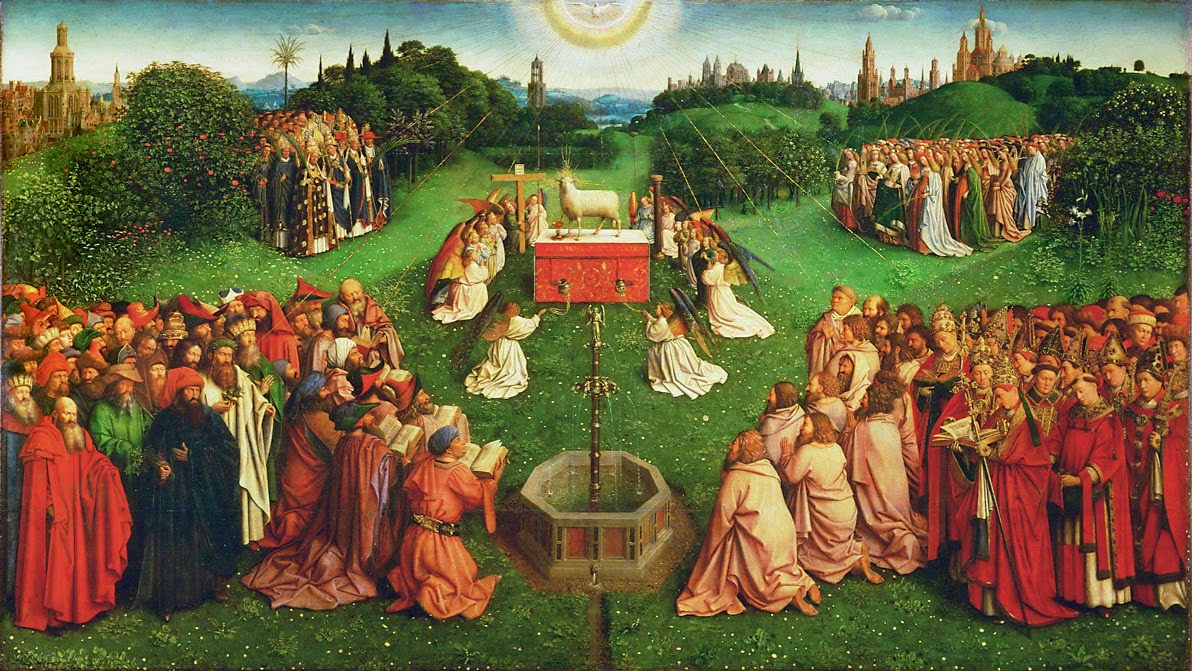
On the cross, Jesus provided everything for you. He gave everything so you could have it all. His poured out His own blood for you. He gives His perfect righteousness to you. In Christ, you are washed. In Christ, you are clothed. In Christ, you have no spot or wrinkle. In Christ, you are holy and without blemish (Eph. 5:26-27).

So repent. Be dressed in the holiness and perfection of Jesus. Come to the wedding feast. Hear His invitation that your soul may live. And don’t be afraid to invite others to this feast no matter who they are.Amen.

The peace of God, which surpasses all understanding, will guard your hearts and minds in Christ Jesus. Amen.

The Father’s Feast – Sermon for the Third Sunday of Trinity on Luke 15:1-32

Listen here.

In the name of the Father and of the Son and of the Holy Spirit. Amen.

Three parables. A shepherd seeks and finds his lost sheep. A woman seeks and finds her lost coin. And a father seeks and finds his lost son. Yes, the father is the one doing all the work to restore his son – not the other way around.

Jesus teaches these parables in response to the Pharisees and scribes who were grumbling about the company Jesus was keeping. Christ was eating with tax collectors (read thieving traitors) and sinners (read prostitutes and adulterers).

Now, it is not as though the Pharisees and scribes would say they were sinless and perfect. They would admit their sin, that they weren’t perfect. But in their minds, their sin certainly wasn’t as bad as those shady characters surrounding Jesus.

In fact, these grumblers might have argued that they cared about the tax collectors and sinners more than Jesus because they didn’t want them to continue in their sin. They would have called them to repent and change their ways. Try harder. Live better. Do some good works.

The Pharisees and scribes see Jesus associating and eating with these sinners as though their behavior doesn’t matter at all. Is Jesus soft when it comes to sin? Is Jesus liberal when it comes to lifestyles? Is He tolerant and affirming of their evil? Does Jesus’ mercy mean that sin doesn’t matter to Him?

Tuck that question in the back of your mind because we will find the answer when we compare the parables. The three parables all have the same outline and progression. Something is lost; that thing is found and restored; and there is a party. But Jesus tells all three. He could have just told the parable of the shepherd seeking and finding his lost sheep, but He didn’t. Each parable helps us to see what is happening in the others.

First, we have to see who the hero is in each of the parables, and it is the one who finds, restores, and invites to the feast. As the shepherd finds and restores the sheep and as the woman finds and restores the coin, we have to remember the father finds and restores the lost son.

The son is not the hero. The son’s pig-pen plan is not to become a son again. As he is sitting in the slop, he realizes that his life would be better as a servant of his father. But the father is like the shepherd who does the work of searching out and carrying home the lost sheep. He sees his son from a distance, runs to him, and brings him home. The father is like the woman sweeping her house. He picks up his son from the dust of his slavish plan. The father cleans the piggy poo from his boy and brings him back into his home.


You see, the heroes in each story all do the same thing. They seek, find, and save the lost. Then, the hero throws a feast. So back to our question: By eating with these sinners, is Jesus implying that the sin doesn’t matter?

Well, again, look at the parables. Consider each thing that gets lost. Sheep get lost, and shepherds don’t blame the sheep. And the only time a coin gets lost is when its owner messes up. So, if Jesus had only told the first two parables, we might think that sin doesn’t matter. In fact, if we only consider the second parable the lostness is God’s fault.

But then, comes the third parable, and we see what causes that separation. The son who wishes his father was dead. The son who wastes his father’s living. The son who brings embarrassment and shame to his entire family. The son who squanders his father’s good gifts until there is nothing left. The son is to blame for his lostness.

The scribes and Pharisees were tough on sin, but Jesus is even more so. Jesus knows who He is eating with. He knows what these sinners have done. And He knows what you have done.

Jesus knows what you have taken. Jesus knows what your eyes have seen when they should have turned away. Jesus isn’t blind to your sin. He knows it all. He knows that you have acted like the lost son wishing that He were dead and out of your life.

And, yet, He still sees you as His lost sheep. He cherishes you and searches for you. He loves you regardless of yourself. He spares no cost in restoring you and rejoicing over you. This is how your heavenly Father is toward you, sinner.

Today, on Fathers’ Day it is good for us to remember that God is the source of all fatherhood. Too often, we flip the script. When the Bible talks about God being our Father, we think that our earthly fathers are where we can get an idea about who God is. It’s the other way around.

Fathers, learn your vocation from your Heavenly Father. Be the loving, seeking, restoring, patient, kind, merciful father to your family in the same way that God has been toward you. And remember that God and all the hosts of heaven rejoice over one sinner who repents and is restored.

You see, God cares about all the lost. He cares about the one out of one hundred. He cares about the one out of ten. He cares about the one out of two. And He still cares about the one who will not come and feast with Him. Your heavenly Father cares about all. He cares about you.

Because Jesus has died and lives again, He invites you to His feast. So, come. Come and celebrate your Father’s mercy toward you and toward all. Rejoice with God in what He is doing and what He has done. Amen.

The peace of God, which surpasses all understanding, will guard your hearts and minds inChrist Jesus. Amen.

Excuses – Sermon for the Second Sunday of Trinity on Luke 14:15-24

Listen here.

Luke 14:15-23

15When one of those who reclined at table with him heard these things, he said to him, “Blessed is everyone who will eat bread in the kingdom of God!”

16But he said to him, “A man once gave a great banquet and invited many. 17And at the time for the banquet he sent his servant to say to those who had been invited, ‘Come, for everything is now ready.’ 18But they all alike began to make excuses. The first said to him, ‘I have bought a field, and I must go out and see it. Please have me excused.’ 19And another said, ‘I have bought five yoke of oxen, and I go to examine them. Please have me excused.’ 20And another said, ‘I have married a wife, and therefore I cannot come.’ 21So the servant came and reported these things to his master. Then the master of the house became angry and said to his servant, ‘Go out quickly to the streets and lanes of the city, and bring in the poor and crippled and blind and lame.’ 22And the servant said, ‘Sir, what you commanded has been done, and still there is room.’ 23And the master said to the servant, ‘Go out to the highways and hedges and compel people to come in, that my house may be filled. 24For I tell you, none of those men who were invited shall taste my banquet.’”

In the name of the Father and of the Son and of the Holy Spirit. Amen.

Once, there was a young child whose parents loved him very much. They taught him the Scriptures, and the child was gradually learning to repeat the passages his parents read to him. The child grew, and it was time to train him to use the toilet. His parents would sit him on the potty chair and give him privacy to do his business. This child, schooled in the Scriptures, had a signal to his parents when he needed help cleaning himself after going number 2. He would recite from our text, “Come, for everything is now ready.” Thankfully, his parents were not like those who offered excuses in the parable. They were loving and went and cared for his needs.

The men who make excuses to escape going to the king’s banquet are treating the invitation like it is a call to help wipe a toddler’s derriere. They simply aren’t interested in going to the banquet because they thought they had something better to do, and they don’t care about the repercussions if they are absent. They are comfortable insulting the king, his invitation, and his feast because they have treasures on earth. They don’t realize that, unlike the feast, the invitation is not eternal.

The point of the parable is easy to see. Not everyone goes to heaven. Those who do not think they need God’s grace will find that, outside of His grace, there is only eternal loneliness and torment. As our hymn just said:

But they who have … resisted His grace
And on their own virtue depended,
Shall then be condemned and cast out from His face,
Eternally lost and unfriended.
Have mercy upon us, O Jesus![1]

At the time of death or when Jesus returns, the invitation is withdrawn. Those who reject the invitation will get what they want. They won’t have to offer any more excuses to the king and his messengers. Those who continually reject God’s invitation will one day be free of God, but they will be eternal prisoners of themselves.

Invite as many as you find to the wedding feastSo, this parable should give us an urgency. There is still room for more at the feast. We should be those who go out and call more of the poor, crippled, blind, and lame. We should go out to the highways and hedges and compel more to come in. And we wouldn’t even have to go far from this very place. How many Muslim refugees do we have living less than one block away? They play in our yard and use our trees for shade. Jesus wants them to come to His feast as much as He wants you.

But this parable should hit each and every one of us harder because of the context. And when this parable hits us harder, we will become more eager to extend the invitation of Christ the King.

Here is why this parable should crush us – it isn’t just that it exposes our sinful hesitation to share the Gospel with others. Jesus tells this parable in response to a statement, “Blessed is everyone who will eat bread in the kingdom of God.” In its context, that is a heretical benediction.

Now, don’t get me wrong. At face value, it is true. Everyone who eats bread in the kingdom of God is blessed. But the person who says this is, at that very moment, eating with Jesus. In that context, this statement would be like a newlywed husband getting to the hotel on his wedding night and saying to his bride, “Today was nice, but I’m really looking forward to my retirement party.” The man who says, “Blessed is everyone who will eat bread in the kingdom of God,” doesn’t realize that he is, in truth, living in that present blessing. The blessed existence he that would come sometime in the future was going on right around him.

Wherever Jesus is, there is the kingdom of God. Jesus came preaching that the kingdom of God was at hand (Mk. 1:14-15). And just a couple of chapters earlier in Luke’s Gospel, Jesus said that because He was casting out demons by the finger of God that God’s kingdom had come (Lk. 11:20).

You see, the person sitting there with Jesus at the table was sitting with the present King and eating with God incarnate. So, this parable speaks to us today about being at church. When God’s people gather together to hear God’s Word and receive His gifts, there is the kingdom of God. So, if you are looking forward to going to heaven and being with Jesus, you should also look forward to coming to church because it is a foretaste of eternity with Jesus.

Each of the men who offer excuses in the parable aren’t saying that they never want to go to the party; they just want to go when it is more convenient for them. And their excuses show that they view the things of the world as more important than eternal things.

The pleasures and cares of this world are dangerous to faith when we appreciate and love them more than the blessing of gathering with our Lord and Savior and brothers and sisters in Christ here every Sunday morning.

Wedding Feast of the LambWeekends at the lake, sport tournaments, and even time with family are all blessings from God. But when those things keep us from gathering around God’s Word in the place where God says He meets with us, they are deadly. They are idols. When you are not in church for whatever reason on any given Sunday, you are missing the blessing of being and feasting with God.

The king is angry with those who offer excuses. And notice – this is the most amazing thing that is hard to wrap our minds around – the king is angry because all he wants is for them to be there with him. The king is angry because he wants these people to have the good and joyous things he has for them. God is much more desirous of giving to and helping us than we are of receiving or asking for those things (Luther).

Repent. Repent of your excuses. Jesus has died and shed His blood so that the sinful excuses you would offer are washed away. They are removed as far from you as the east is from the west. And know that God’s invitation stands. “Come. Come to my feast. Come and receive what you could never earn or deserve. Come, you who are worthy. Come, you who are unworthy. Come, for all the blessings of heaven are here for you for free. Come, for everything is now ready.”Amen.

The peace of God, which surpasses all understanding, will guard your hearts and minds inChrist Jesus. Amen.

[1]“There Many Shall Come” Ambassador Hymnal #627. Magnus Brostrup Landstad.