The King’s Test – Sermon on John 6:1-15 for the Fourth Sunday of Lent

John 6:1-15

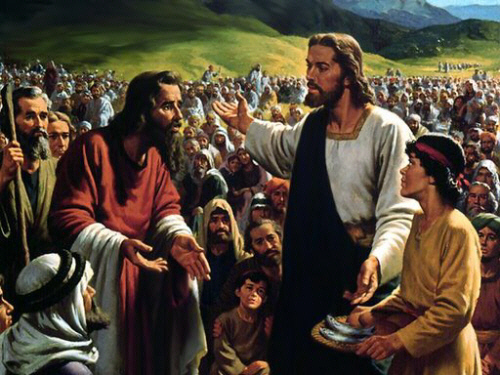
1 After this Jesus went away to the other side of the Sea of Galilee, which is the Sea of Tiberias. 2 And a large crowd was following him, because they saw the signs that he was doing on the sick. 3 Jesus went up on the mountain, and there he sat down with his disciples. 4 Now the Passover, the feast of the Jews, was at hand. 5 Lifting up his eyes, then, and seeing that a large crowd was coming toward him, Jesus said to Philip, “Where are we to buy bread, so that these people may eat?” 6He said this to test him, for he himself knew what he would do. 7 Philip answered him, “Two hundred denarii worth of bread would not be enough for each of them to get a little.” 8 One of his disciples, Andrew, Simon Peter’s brother, said to him, 9 “There is a boy here who has five barley loaves and two fish, but what are they for so many?” 10 Jesus said, “Have the people sit down.” Now there was much grass in the place. So the men sat down, about five thousand in number. 11Jesus then took the loaves, and when he had given thanks, he distributed them to those who were seated. So also the fish, as much as they wanted. 12 And when they had eaten their fill, he told his disciples, “Gather up the leftover fragments, that nothing may be lost.” 13 So they gathered them up and filled twelve baskets with fragments from the five barley loaves left by those who had eaten. 14 When the people saw the sign that he had done, they said, “This is indeed the Prophet who is to come into the world!” 

15 Perceiving then that they were about to come and take him by force to make him king, Jesus withdrew again to the mountain by himself.

In the name of Jesus. Amen.

Jesus asks Philip, “Where are we to buy bread, so that these people may eat?” And John gives us insight as to why Jesus asks the question. It was to test Philip. Now, Jesus didn’t just find Himself in the midst of the wilderness surrounded 5,000 men plus women and children – in all likelihood a crowd of ten to twenty thousand people – with no food and sees an opportunity for a test. No, Christ sets the entire thing up.

The feeding of the 5,000 is one of the few events recorded in all four Gospels (Mt. 14:13-21; Mk. 6:30-44; Lk. 9:10-17; and Jn. 6:1-15). The picture the texts collectively paint is that Jesus intentionally draws this crowd out into the wilderness (Mk. 6:31). He takes the time to heal many of them (Mt. 14:14) and preaches late into the evening (Mk. 6:34-35). In other words, Jesus means to bring them to that desolate place where there is no food, but food is needed. On top of that, He is the King who created everything (Jn. 1:1-2, 14). Jesus can cause rain to fall in one place but not another (Am. 4:7). Throughout the entire world, Jesus was the One providing bread and food for all mankind (Ps. 145:15-16), but Christ brought this massive crowd out into the wilderness to this particular mountain in order to set this test up for Philip. And the test has one question, “Where are we to buy bread, so that these people may eat?” Jesus isn’t looking for information. He’s not asking Philip to devise a plan or order something through Door Dash. The text tells us, “[Jesus] knew what He would do” (Jn. 6:6).

Now, put yourself in Philip’s position. It isn’t hard to imagine. When was the last time you were in a seemingly impossible situation? Your bank account got low, and suddenly your car needs significant, expensive repairs. You wonder, “Where’s the money going to come from?” Your kid or your spouse gets sick, and while you are doing everything you can to care for them, you get sick too. You don’t know where you will get the strength care for yourself much less your kid. You’re in a really busy time at work, then there is a blizzard, so you have to dig yourself out and help your aging parents clear out their driveway too. You don’t know where you will find the time to do everything that needs to be done. How often do you look at your calendar or think through all the things you need to accomplish and have no idea how you are going to make it through the week? Whether it is resources and money, strength and endurance, time and skills, there are moments in your life where you are buried under the expenses, responsibilities, and tasks, and all you can see is what you don’t have.

That is why Philip fails Jesus’ test. He sees what they have, and he concludes it isn’t enough. His response is, basically, “You’re jumping the gun, Jesus. Look around. We’re in the wilderness, not the marketplace. Even if we were surrounded by stores fully stocked with bread, we don’t have enough money. Two-hundred denarii wouldn’t be enough for all of them to even get a bite.”

The test was for Philip, but Andrew, Peter’s brother, takes a shot at the exam. This is just an aside, but this text really shows how similar Andrew and Peter are. Peter will jump into situations like a madman (Mt. 14:28-29) and will speak when he should just be silent (Mk. 9:5-6). Andrew does the same when he says, “This boy has five barley loaves and two fish, but that’s not going to cut it with this crowd.”

Both Philip and Andrew fail the test even though they knew the answer. The correct answer was, “I don’t know where we will buy bread, Jesus. But I do know You are here. You have provided food in bleaker situations than this, so You’ve got it all under control.” Philip and Andrew knew that Jesus was the Messiah (Jn. 1:41). They knew He was the fulfillment of what Moses and the prophets wrote (Jn. 1:45). In other words, they both knew that Jesus was the one who rained bread from heaven and sent quail in abundance for His people in the wilderness (Ex. 16:4, 13). They knew Jesus was the one who sent the ravens to feed Elijah by the brook (1 Kgs. 17:3-7) and through the widow’s jars of oil and flour that never ran out during the drought (1 Kgs. 17:14-16). They know that God promises in Psalm 34:10 which says, “Those who seek the Lord lack no good thing.”

Both Philip and Andrew know all of this, but they still fail the test, just like you and I do. They fail, notbecause they don’t know enough, weren’t taught well, or needed to go back to Sunday School. They fail for the same reasons we do – because we are sinners. All of us sinners fail to trust God’s promises to provide everything we need. Instead, we fall into despair, weakness, unbelief, and a ‘woe-is-me’ attitude.

Dear saints, repent and then rejoice.

When God brings tests and trials your way, remember that He is with you. And because He is with you, it doesn’t matter what you have or don’t have. Jesus doesn’t need soil and seed and rain and time and the right weather conditions and combines and grain elevators and flour mills and factories and bakers and truck drivers and grocers to give people bread. Jesus doesn’t need boats and bait and poles and nets and processing plants or even water to feed people fish. Just because those are the normal methods God delivers bread and meat to us, that doesn’t mean that is the only way He does it. Jesus is always free and able to cut all of that out and give exactly what is needed when it is needed – just like He does here.

Christ provides what Philip, Andrew, and all the disciples could not buy, bake, grow, earn, catch, or deserve. He provides this meal to the crowds and enough to last His flunked disciples for days afterward.

But most importantly, Jesus lavishly pours out His mercy and grace on His sinful disciples. We see it here as He doesn’t scold them for their unbelief and sin. In fact after this, Jesus will feed another crowd – four thousand that time (Mk. 8:1-10). And right after that the disciples are with Jesus in a boat, and they realize they only have one loaf of bread, and they will worry about their lack of food again (Mk. 8:14-21).

Jesus is always in control of every situation. The crowds here are about to try and take Christ by force to make Him king, but Jesus simply withdraws. And one year later, at the next Passover, the crowds will come with force to arrest Jesus, but He will not withdraw. They will put a royal purple robe on Him, crown Him with thorns (Jn. 19:2-3), crucify Him, and place a placard above His head that says, “Jesus of Nazareth, King of the Jews” (Jn. 19:19). There, on the cross, He will give and shed His blood for the forgiveness of sinners who fail the tests.

But the cross is no test. Instead, it is where Jesus, your Savior and King, demonstrated and proved His love and mercy for you, and for all us failures. Here and now, He delivers that mercy to you as He gives you His kingly Body and His royal Blood given and shed for the forgiveness of all your sins and failures.

Dear saints, come and receive. Amen.

The peace of God, which surpasses all understanding, will guard your hearts and minds in Christ Jesus. Amen.

Know-It-All Jesus – Sermon on Luke 5:1-11 for the Fifth Sunday after Trinity

Luke 5:1-11

1 On one occasion, while the crowd was pressing in on him to hear the word of God, he was standing by the lake of Gennesaret, 2 and he saw two boats by the lake, but the fishermen had gone out of them and were washing their nets. 3 Getting into one of the boats, which was Simon’s, he asked him to put out a little from the land. And he sat down and taught the people from the boat.

4 And when he had finished speaking, he said to Simon, “Put out into the deep and let down your nets for a catch.” 5 And Simon answered, “Master, we toiled all night and took nothing! But at your word I will let down the nets.” 6 And when they had done this, they enclosed a large number of fish, and their nets were breaking. 7 They signaled to their partners in the other boat to come and help them. And they came and filled both the boats, so that they began to sink. 8 But when Simon Peter saw it, he fell down at Jesus’ knees, saying, “Depart from me, for I am a sinful man, O Lord.” 9 For he and all who were with him were astonished at the catch of fish that they had taken, 10 and so also were James and John, sons of Zebedee, who were partners with Simon. And Jesus said to Simon, “Do not be afraid; from now on you will be catching men.” 11 And when they had brought their boats to land, they left everything and followed him.

In the name of Jesus. Amen.

How many miracles do you see in this text? Obviously, the huge catch of fish is one. Peter, James, and John leaving everything to follow Jesus is probably a second. But some of you might see a third miracle. How often does a man get told to go fishing and doesn’t jump at the opportunity? It’s a miracle!

One thing we need to understand when considering this text is that this is not Jesus and Peter’s first encounter – not even close. Somehow, we have gotten a view of the disciples that they just jump right on the Jesus bandwagon and follow Him wherever He goes from the start. But actually, this is the third time Jesus calls Peter to follow Him. We have to consider the other Gospels to realize this. Back in John 1, John the Baptizer sees Jesus and proclaims Him to be the Lamb of God who takes away the sin of the world (Jn. 1:29). Peter’s brother, Andrew, had been one of John’s disciples, but after John says this Andrew starts following Jesus. Andrew went and found Peter and said, “We have found the Messiah” (Jn. 1:41), so Peter also started following Jesus. The second call comes at the beginning of Mark’s Gospel where Jesus is walking along the shore of the Sea of Galilee and says to Andrew and Peter, “Follow Me, and I will make you fishers of men” (Mk. 1:17).

Now, when we come to this text, we see another different scene. Crowds are pressing in on Jesus to hear Him preach. Jesus asks Peter to help Him get a little space for preaching. (Maybe, this is the precedence for Lutherans sitting in the back rows. Give the preacher enough room to preach!) Peter stops cleaning his nets and puts the boat out a little from the land so Jesus can preach while sitting on the boat and not get trampled by the crowds.

When Jesus’ sermon is over, He tells Peter to grab his freshly cleaned nets, put the boat out into the deep waters, and have a catch. But Peter isn’t too keen on the idea. That previous night of fishing had been frustrating. All his work had led to zero fish, and now this Son of a carpenter is telling him to go out in the middle of the day and have a catch. No! Peter knows fishing. He thinks Jesus should stick to making tables and chairs and preaching. Daytime is not the time to fish, and the deep waters aren’t where you find fish. But Peter relents; he does as Jesus says almost like he is humoring this know-it-all Jesus.

Peter and Andrew row out into the deep, drop the nets, and enclose such a large number of fish that the nets begin to break. Even though this text is just twelve verses, we have to understand that it would have taken a long time of tugging and pulling and grunting to load up their boat with all these fish, and there still isn’t enough room. So, Peter and Andrew signal to their partners, James and John, to bring their boat out into the deep water and fill that second boat up until both boats begin to sink because there are so many fish.

Again, this is clearly a miracle which, you would think, would excite Peter and have him try to sign Jesus to a contract as a full partner in his fishing business. But that isn’t Peter’s reaction. He says, “Depart from me, for I am a sinful man, O Lord.”

Now, Peter had seen Jesus do miracles before this. We know that Peter had been at the wedding in Cana when Jesus turned water into wine in Jn. 2:1-11. That text tells us that when Peter and the other disciples saw the miracle they believed in Jesus. And, if you look back to Luke 4, you see that Jesus had done several other miracles. It is very possible that Peter was in the synagogue when Jesus cast out a demon (Lk. 4:31-37). After that, Jesus goes to Peter’s house and healed Peter’s mother-in-law of a fever (Lk. 4:38-39). Peter would have been there for that miracle. It’s likely that Peter was with Jesus later that same evening while Jesus healed all sorts of people who were sick (Lk. 4:40-41). Never after any of those miracles does Peter ask Jesus to leave. So, why does Peter ask Jesus to go away after this catch of fish?

Probably, it is because this miracle is taylor-made to teach Peter that he doesn’t know it all. Sure, Peter is a successful fisherman, but his knowledge and wisdom and expertise has its limits. And Peter is going to have to learn to simply trust Jesus’ word, especially when Peter enters the new vocation that Jesus is about to call him to.

With this miracle, Jesus is teaching Peter something very important about preaching. You might be wondering, “What does a massive catch of fish that nearly sinks two boats have to do with preaching?” Well, you notice at the end of this text Jesus says to Peter, “Do not be afraid; from now on you will be catching men.” In other words, this catch of fish is a set up. It is a preview of what is going to happen when Peter begins his new calling and vocation of preaching the Gospel. From this point forward, Peter is going to learn from Jesus how to be a minister of the Word.

We heard in our Epistle lesson (1 Cor. 1:18-25) that the message that Jesus is going to have Peter preach is called “the word of the cross” and is folly to those who are perishing. That Epistle text goes on to say, “Jews demand signs and Greeks seek wisdom, but we preach Christ crucified, a stumbling block to Jews and folly to Gentiles.” In other words, this new vocation that Jesus is calling Peter into – catching men with the preaching of the Gospel – it isn’t going to be flashy and impressive. It isn’t going to sound wise and knowledgeable. Instead, it’s going to sound as silly as trying to catch fish at the wrong time of day in the wrong spot when everything you would expect to work will fail. But the results, the results will be unimaginable.

And that’s what we see at Peter’s first opportunity to proclaim the Gospel after Jesus’ resurrection. On the day of Pentecost, Peter preaches a sermon that isn’t overly profound or insightful or persuasive. He simply preaches Christ crucified and risen, and 3,000 souls are saved (Act. 2:14-41). God worked through His Word on that day of Pentecost to bring in a large catch of men through the net of the Gospel, just as Jesus worked through His Word to Peter here with the catch of fish.

Dear saints, God will continue to work through that the proclamation of that Word. He has promised! While we see our country slide into greater and greater sin and unbelief, we don’t need to start figuring out how to make the Gospel more appealing to people. Again, the message of the Gospel is folly to those who are perishing. The Gospel we preach and believe is that sin separates you from God and is damnable. But God Himself has taken the punishment you deserve, and you get off scot free. And if we try to repackage the Gospel so that it doesn’t sound so foolish, it will cease being the Gospel. As a congregation, we need to do nothing more than to be faithful in proclaiming Christ crucified for sinners, and God will use that net of the Gospel (Mt. 13:47-50) to do His work.

Dear saints, you aren’t called to be like Peter in this text. I know there are a lot of sermons on this account that conclude with a challenge to leave everything behind and follow Christ. And because Peter is a towering figure in the Christian church, a lot of people have the idea that they should do as Peter does here. But honestly, the only thing Peter does in this text that all Christians should emulate is listen to Jesus – even when Jesus seems to be a know-it-all and calls you to do something that seems as ridiculous as fishing at the wrong time in the wrong place. Otherwise, there’s nothing that Peter does in this text for you to mimic.

Honestly, Peter is kind of a mess in this text. Even when he confesses his sin, he is only half right. He recognizes his sinfulness which is good, but then he asks Jesus to depart which is silly. Dear saints, when you recognize your sin, that is when you ask Jesus to come and wash away your sin.

And, no. You aren’t called to be like Peter and leave everything to follow Jesus. It is an amazing thing that Peter does this, but Jesus hasn’t called you to do that. God has put you into particular relationships where He uses you as His hands and feet to minister to the needs of your neighbor. Don’t leave those vocations and relationships. Instead, serve Jesus where you are.

Scripture is clear on this. 1 Corinthians 7:20-24 says, “Each one should remain in the condition in which he was called. Were you a bondservant when called? Do not be concerned about it. (But if you can gain your freedom, avail yourself of the opportunity.)… So, brothers, in whatever condition each was called, there let him remain with God.”

Dear saints, God needs you in the stations and vocations where He has placed you. Jesus knows how He can use you best in the kingdom of God. Jesus knew what He was doing when He placed you into your family, into this congregation, in your job, in your neighborhood. He has placed you there to be a faithful husband, wife, child, employer, worker, and neighbor. You don’t need to leave that in order to serve God more faithfully. God has placed you there to serve Him by serving those neighbors He has given you. Even if you think Jesus has made a mistake by putting you there, just trust that Jesus actually does know it all. And He will use you in the way that He sees fit.

Finally, if you want to see yourself in this text, you are the fish caught up in the net of the Gospel. You have been brought safely into the boat of the holy Christian Church by Jesus who went to the cross and shed His blood so you could be forgiven and saved. And Jesus Your Savior now calls and invites you to come to this altar and receive His Body and Blood given and shed for you for the forgiveness of your sins.

So, come. Receive. The holy Son of God does know it all, and He is here for you now and forever. Amen.

The peace of God, which surpasses all understanding, will guard your hearts and minds in Christ Jesus. Amen.

Provision – Sermon on John 6:1-15 for the Fourth Sunday in Lent

Listen here.

John 6:1-15

1 After this Jesus went away to the other side of the Sea of Galilee, which is the Sea of Tiberias. 2 And a large crowd was following him, because they saw the signs that he was doing on the sick. 3 Jesus went up on the mountain, and there he sat down with his disciples. 4 Now the Passover, the feast of the Jews, was at hand. 

5 Lifting up his eyes, then, and seeing that a large crowd was coming toward him, Jesus said to Philip, “Where are we to buy bread, so that these people may eat?” 6 He said this to test him, for he himself knew what he would do. 7 Philip answered him, “Two hundred denarii worth of bread would not be enough for each of them to get a little.” 8 One of his disciples, Andrew, Simon Peter’s brother, said to him, 9 “There is a boy here who has five barley loaves and two fish, but what are they for so many?” 10 Jesus said, “Have the people sit down.” Now there was much grass in the place. So the men sat down, about five thousand in number. 11Jesus then took the loaves, and when he had given thanks, he distributed them to those who were seated. So also the fish, as much as they wanted. 12 And when they had eaten their fill, he told his disciples, “Gather up the leftover fragments, that nothing may be lost.” 13 So they gathered them up and filled twelve baskets with fragments from the five barley loaves left by those who had eaten. 14 When the people saw the sign that he had done, they said, “This is indeed the Prophet who is to come into the world!” 

15 Perceiving then that they were about to come and take him by force to make him king, Jesus withdrew again to the mountain by himself.

In the name of Jesus. Amen.

All of us Christians are tempted to divide our life into two separate, distinct parts. On one side is all the spiritual things: God, Jesus, Holy Spirit, forgiveness, going to church, reading the Bible, praying, eternal life, etc. On the other side is all the physical things that we have to deal with every day: food, clothing, money, house, chores, jobs, etc. When we do this, we figure that we need God and Jesus and mercy over here and hard work, effort, diligence, and maybe a little bit of luck over here. In this mindset, God takes care of our spiritual life, but we have to take care of ourselves and those under our protection in our physical life.

We need to stop thinking that way. That kind of division simply doesn’t exist. And when we have that dividing line in our minds, we suffer both physically and spiritually. The God who richly provides you with His mercy, love, and forgiveness is the exact same God who provides you with food, gas, a job, money, house, shoes, and toilet paper. Jesus is Lord in heaven, and He is Lord on earth. He cares for your all spiritual and all your physical needs.

We got a glimpse of this in our Old Testament reading (Ex. 16:2-21). There, the people of Israel had just been brought of Egypt by God’s mighty hand through the ten plagues which brought judgment on their Egyptian masters. God had parted the Red Sea to deliver them from Pharoah’s army. But almost right away, they begin to complain to Moses, “It’s too bad we didn’t die in Egypt where we had meat and bread. Moses, why did you bring us out in the wilderness to kill us by starvation?” Which is a ludicrous thing to say. As if Moses had brought them out of Egypt by his power! I mean, had they forgotten that it was God who delivered them from their slavery? Apparently, they had! Notice how Moses and Aaron respond to the people (Ex. 16:6-7), “At evening you shall know that it was the Lord who brought you out of the land of Egypt, and in the morning you shall see the glory of the Lord, for He has heard your grumbling against the Lord. For what are we, that you grumble against us?” 

So, God provides mana for the people. The reason it’s called ‘mana’ is that’s what the people asked. In Hebrew, “What is it?” is מָ֣ן ה֔וּא (pronounced, “man hu”). You have to love the Scriptures; v. 15 is one of my favorite, “Duh,” moments in the Bible. “When the people of Israel saw it, they said to one another, ‘What is it?’ For they did not know what it was.”

But the point we need to see is how God was providing for His people physically and spiritually. We see it in how they were to gather the mana. For five days, they were to gather just enough for that day, but on the sixth morning, they were to gather enough for the sixth and seventh day. All the other days, they were to keep nothing for the next morning. But when a few of them tried to keep some leftovers, it rotted, and got all wormy and stinky. God had promised to feed the people’s stomachs each day, but only for the day. And by taking only enough for each day, God was feeding the people’s faith. They had to trust that God would do for them tomorrow what He had done today – which, it’s important to note, is exactly what they were struggling with.

In this Gospel text, we see Jesus providing for His people spiritually by teaching the people late into the evening then providing for His people physically by multiplying the bread and fish. Every indication is that Jesus set this whole dilemma up. It isn’t as clear here in John’s Gospel, but in Mark’s account (Mk. 6:30-44) of this same event, Jesus sees the people coming and has compassion on them because they are like sheep without a shepherd. Mark tells us that Jesus begins to teach them many things, and our Lord teaches them until late into the evening (Mk. 6:35). Jesus knows what it is to be hungry (Lk. 4:2), and He could have taught them for several hours and then told them, “You know what guys it’s getting late. You should go home and get some supper, and we can pick up tomorrow.” But He doesn’t.

Another indication that Jesus set this whole thing up is His conversation with Philip (there’s sort of two of them wrapped up together, here). John tells us that Jesus, “knew what He was going to do.” But the other thing is this: Notice how Jesus words His question to Phillip, “Where are we to buy bread, so that these people may eat?” It’s specific. “Where are we to buy bread.” There are all sorts of logistical problems with trying to feed a crowd this size. But Jesus doesn’t ask, “Where are the Sam’s Clubs and Hugo’s around here with large inventories of bread?” He doesn’t ask, “How are we going to get the bread delivered? Where will we get the carts and animals get all that food into this desolate place?” He doesn’t inquire as to how they would distribute the food to all those people. Jesus asks Phillip, “Where are we to buy bread?” In other words (and I know I’m belaboring the point) Jesus is asking Phillip, “How is money going to help us here, Phillip?”

Phillip must have had the same problem that we have in dividing up his life into two categories of physical and spiritual. And Phillip apparently trusted in money as the solution to physical problems. If you’re like me, you probably think the same way. When you think through your life and all the things that could be better and make you comfortable, there is probably a dollar amount that you have in your mind that would make all your problems go away. Will the coming $1,400 of COVID money fix your problems? Probably not. So, how much do you need? $10,000? $100,000? $5 million? But even if you got that amount, what other problems would spring up that would require more? I say this to you, and I say this to myself, repent.

Phillip throws out 200 denarii as his answer. But why didn’t Phillip say 500 denarii or 800 denarii? Let’s do a little budgeting. A denarius is equal to one day’s wage. So, for the sake of making the math easier, let’s just say feeding your family cost 1/3 of a denarius per meal. Back then, they didn’t have mortgages, car payments, utility bills, or student loans. The main expense was putting food on the table. There are 5,000 men and their families who need a meal. At 1/3 of a denarius per meal that totals 1,667 denarii. But Phillip throws out 200 which isn’t even close to a logical estimate to feed a crowd this size. So, why that number; why 200?

The best guess that I have seen suggested is that is how much money Jesus and the disciples had. Now Judas, the disciple who betrayed Jesus, was the one who kept track of the moneybag (Jn. 12:613:29). But Phillip probably kept a pretty close eye on it too. Phillip knows they have 200 denarii, and it isn’t going to be enough.

The Old Testament Israelites in the wilderness only saw the barrenness around them and figured they would starve. Phillip looks at their 200 denarii and figures it won’t be enough to feed the crowd. Here’s the thing, whenever we look only at what we have, it’s never going to appear to be enough. Instead of focusing on what we have, we need to look past that and see Whom we have.

Dear saints, we have Jesus on our side. All things were made by Him (Jn. 1:3), and He spent every drop of His blood to redeem and save us while we were His enemies (Ro. 6:8-10). Don’t think for one second that He is going to leave you in a lurch either spiritually or physically.

Jesus is your Savior who taught you to pray, “Give us this day our daily bread and forgive us our trespasses as we forgive us who trespass against us.” Jesus Himself ties those two petitions together with that little word, ‘and.’ Your Savior wants you to look to Him as the provider of both your spiritual and your physical needs.

I have one final consideration for you today. The other three Gospels help shape this point (see Mt. 14:13-21Mk. 6:30-44; and Lk. 9:10-17). They tell us that Jesus feeds the 5,000 in the wilderness. In Greek, the word is where we get our word ‘arid’ which means there is not enough rain there to support vegetation. It’s desolate and barren. The same word gets used to describe the place where Jesus fasted for forty days and nights and was tempted by the devil (Mt. 4:1Mk. 1:12-13; and Lk. 4:1) – not that it was necessarily the same place.

The first temptation that the devil threw at Jesus in that arid wilderness, in that deserted place, was to turn stones into bread. Jesus refused. But now, in a deserted, arid, wilderness Jesus multiplies bread so that others can fill their bellies as full as they want. What Jesus did not do for Himself, He does for others. Christ won’t destroy rocks to put food in His own stomach. He certainly could have, but He would have been altering creation. But He will and does work within creation to multiply the bread and provide more than enough to fill the stomachs of others – even those who will reject him in the coming days (see the rest of Jn. 6).

Here’s the point, dear saints. Jesus, your Savior, came not to be served but to serve (Mt. 20:28), and He serves you. Rejoice. He has and will continue to provide for all your needs – physically and spiritually. He has and will provide everything, absolutely everything, you need for this life and the next. Amen.

The peace of God, which surpasses all understanding, will guard your hearts and minds in Christ Jesus. Amen.

Scary Success – Sermon for the Fifth Sunday of Trinity on Luke 5:1-11

Listen here.

Luke 5:1-11

Jesus Teaches from Peter's BoatOn one occasion, while the crowd was pressing in on him to hear the word of God, he was standing by the lake of Gennesaret, and he saw two boats by the lake, but the fishermen had gone out of them and were washing their nets. Getting into one of the boats, which was Simon’s, he asked him to put out a little from the land. And he sat down and taught the people from the boat.

And when he had finished speaking, he said to Simon, “Put out into the deep and let down your nets for a catch.” And Simon answered, “Master, we toiled all night and took nothing! But at your word I will let down the nets.” And when they had done this, they enclosed a large number of fish, and their nets were breaking. They signaled to their partners in the other boat to come and help them. And they came and filled both the boats, so that they began to sink. But when Simon Peter saw it, he fell down at Jesus’ knees, saying, “Depart from me, for I am a sinful man, O Lord.” For he and all who were with him were astonished at the catch of fish that they had taken, 10 and so also were James and John, sons of Zebedee, who were partners with Simon. And Jesus said to Simon, “Do not be afraid; from now on you will be catching men.” 11 And when they had brought their boats to land, they left everything and followed him.

In the name of the Father and of the Son and of the Holy Spirit. Amen.

God gives better than you ask, and His promises exceed everything that you desire.

Peter was tired. He had spent the whole night fishing. Well, ‘fishing’ is too strong of a word. He caught nothing. If he had been using a pole and hook, he would have been up all night drowning worms, but Peter and his partners used nets to catch fish. Through the dark hours of the night, they cast their nets again and again and again only to bring them up empty each and every time.

You can imagine their frustration as they pulled the boats to shore while the sun broke on the horizon. They probably talked with each other about what went wrong. Maybe, they wondered how they would provide for their families and where their money would come from the next week. Now, they simply wanted to clean their nets, go home, and sleep.

But while they clean their nets, Jesus is there on the shore teaching God’s Word to a massive crowd. Everyone is trying to get close to hear Him. So, Jesus says, “Hey Peter, why don’t you row Me out a bit so I can keep preaching?”Peter obliges, and the boat becomes a pulpit.

Jesus’ sermon ends. Unlike me, Jesus doesn’t, apparently, slip into what I call a ‘post-liturgical coma.’ Instead, Jesus has an idea. “Hey Peter, why don’t we row out a bit further and catch some fish?”

Now, Peter knew fishing. There was a reason he and his partners had been out all night and not during the day – that’s when you catch fish. He had just finished cleaning his nets so they would be ready for their next excursion. Peter just wanted to go home and find his pillow.

Peter could have said, “Listen here, Jesus. Sure, You can teach the Scriptures like nobody else. But listen, Mr. Carpenter, fishing is my game. Why don’t You stick to teaching and woodworking?” But he doesn’t. Peter responds, “At Your word, I will let down the nets.” This statement is as good as faith gets on this side of eternity.

Now, imagine this. Peter and Andrew put down the nets and sail around a bit, knowing this isn’t the time to do this. They reach down to draw the net into the boat. That night, they had gotten used to lifting nothing but the weight of the net, but this time they feel resistance. They pull and tug and heft. The nets start creaking and breaking because of all the weight. They signal to their partners to come and help. All of them together can’t lift the net into the boat, so they start scooping fish into both boats as fast as they can. They are wet, slimy, and breathless as both boats become so full of fish that they begin to sink.

Pause here for a minute. Peter and his partners, apparently, had quite an operation going for themselves. They weren’t simply recreational fishermen. This was a business – several professionals operating several boats. They had never had a catch like this. You would think the first thing to go through Peter’s mind would be to sign Jesus as their navigator and guide. He could tell them when and where to cast their nets. They could buy a fleet of boats, hire more fishermen, and find a crew to clean and mend the nets. How slick would this be? Peter could retire early and live on easy street. But none of that enters his mind.

Catch of Fish from Luke 5Getting a catch like that would be the dream any fisherman. But it is too much of a good thing. This catch is threatening their livelihood, nearly breaking the nets and causing the boats to sink; it is killing them. And these fish – which had been their life and livelihood – could not save them. This fishing expedition is a massive success. Surrounded by what would provide for his life for months if not years, Peter can only see his sin.
Consider your life. What do you do each and every day? Where do you spend your time and effort? What are you focused on? What are your goals and dreams? What do you pray for and ask God to give you? Do you ever get frustrated with God when He does not answer? And when God does give you what you ask, how long are you satisfied?

Repent. Your goals and dreams are not what they should be. God knows what is good for you even better than you do. God is still good when He doesn’t give you what you what you ask for. God was good when He allowed the disciples to catch nothing that night. And Jesus is good by denying Peter’s request to depart.

“Depart from me, for I am a sinful man, O Lord,” is a stupid prayer. If Jesus answered that prayer, Peter would not only drown, he would go to hell because hell is where God is not present in His mercy for sinners.

Jesus knows how to answer better than Peter knows how to ask. Jesus answers Peter’s prayer in a way that exceeded anything sinful Peter could have desired. Jesus says, “Do not be afraid.”

Two weeks ago, we heard the scribes and Pharisees grumbling about Jesus, “This Man receives sinners and eats with them.” What they meant as mocking and jest is your faithful and holy confession.

Yes, Jesus does receive sinners. In fact, Jesus has this in mind when He gives Peter his new calling, “From now on, Peter, you will be catching men alive.”Jesus uses a particular word here. It doesn’t simply mean to catch, it means to catch alive.

Jesus does not depart. Instead, He draws closer to Peter so that Peter and the other apostles can have a new calling – to catch men alive with the net of the life-giving Gospel.

Cross and CommunionJesus’ will is that you be caught by the net of the Gospel, that you be brought into the boat of the church, and that you have fellowship with Him now and forever. It is Jesus’ will that He not depart from you but that He draw you to Himself.

Jesus says to you, “Fear not. I give to you My Body which was crucified but lives. I give to you My shed Blood which is the source of your life and forgiveness.”Jesus says, “Come and receive what you wouldn’t dare ask for, but I freely and happily give to you.”And you? You say, “At Your word, Lord, I will do as You say.” Amen.

The peace of God, which surpasses all understanding, will guard your hearts and minds in Christ Jesus. Amen.