
Living Redeemer – Sermon on Job 19:23-27 & Mark 16:1-8 for the Resurrection of Our Lord

Job 19:23-27 & Mark 16:1-8 

Alleluia! Christ is risen! He is risen indeed! Alleluia!

In the name of Jesus. Amen.

Imagine someone plopped a thousand piece puzzle in front of you – not the box with the picture of the final product, just the thousand pieces. Those pieces sit in front of you, and the person says, “Put it together.” Sure, it would be daunting at first, but you’d start using your brain and logic. Maybe, you’d start searching for the corner and edge pieces. Once they’re sorted out, you start to fit all the boarder together. Then, you’d start looking at the colors. You continue to sort the pieces out, match the ones with the same color, find the right fits. You’d start to see that this matches with this and that matches with that. You’d see how this one piece has blue on one side and green on the other side and, yup, it fits with that one.

So long as you kept at it, there’s nothing that would stop you from eventually solving that puzzle. Sure, it might take really long time, but you’d figure it out. All puzzles are solvable when you have enough determination, information, and time.

Too often, we approach life as though it’s all a big puzzle to be solved, and we don’t have a picture of the final product. But we still think that if we can just figure out this then that will fall in place. We imagine that finishing this thing will make that portion easier. We try arranging the pieces of finances and family, school and career, the busy schedule and the need to rest. Sometimes, it feels like you make progress; sometimes, you’re completely stuck and confounded. A new problem pops up over here, and the pieces doesn’t seem to fit in quite the right way. 

That’s the wrong approach to life. Life is not a puzzle for you to figure out and solve with enough logic and time and effort. Instead, your life is a mystery. Mysteries are different from puzzles. Mysteries are things that you can’t figure out. It doesn’t matter how much information you have, how many details you know, or how much you piece together. Mysteries can’t be solved with logic. We can’t use our reason to get everything to fit nice and neat into a complete picture. With mysteries, you might get periodic glimpses of potential solutions, but final solution always seems to be just beyond your grasp.

When Job was suffering all the horrible things that did, he approached his life as a puzzle. He thought that if he could just get enough information that everything would make sense and fit together. But the information Job needed wasn’t available to him. It was hidden in what was taking place in the heavenly council (Job 1:6-122:1-6Jer. 23:18-22).

When we read the book of Job, we get information that wasn’t available to Job. We have the 30,000 ft. overview of what is happening. We get to know what’s going on behind the curtain. We have a window into all the things that God is doing. The whole time of his suffering, we know why Job had all these crosses placed on him. But Job – he never knows. He never gets told. He just trudges through his pain and suffering. He is simply experiencing a life that is filled with trouble, and all Job can do is slog through it.

Even though we might not suffer the same things Job suffers or to the same degree or for the same reasons that Job suffers, we are like Job. We can only live our lives one moment at a time. You can only go through the experiences of this life by living in them. And you don’t always get to know why certain things happen. You don’t get to know why the one you love died. Why you lost our job. Why your kids are misbehaving. Why your parents are so unreasonable and unbending. You don’t get to know why everything happens. And the book of Job is a great reminder that God doesn’t owe us an answer to the why. God isn’t obligated to show us the picture on the box of a puzzle. He doesn’t need to precisely because He hasn’t given you the responsibility of piecing all the parts of your life neatly together. That’s nor your job. It’s not what God has called you to do.

Instead, God has given you something far, far better. God has given you the assurance that He’s given you a Redeemer, and not just any redeemer. God has given you a living Redeemer who can place all the jagged corners and complex pieces of your broken life into one big, grand masterpiece.

Dear saints, God has given you His promise that, at the last, you will stand upon the earth with your Living Redeemer, Jesus Christ, in the new heavens and earth. You will stand resurrected in the kingdom of God when all sorrow and sighing have been put away for eternity.

That’s God’s promise, and His promise is worth believing. Job had that faith as he was going through all the things that he suffered. God gave Job the faith to know and believe that his Redeemer lives.

Those verses you heard from Job’s lips today (Job 19:23-27) have become so connected to Jesus’ resurrection – probably because of the hymn. And, yes, we’ll sing it near the end of the service. But the fact that these words are so connected to Easter makes it easy to forget that Job spoke those words thousands of years before the eternal Son of God took on flesh.

Even then, Job knew that he had a Redeemer, and that faith was what carried Job through his horrible suffering. But what Job believed back then is even more true now than when Job confessed it.

You have a Redeemer who not only lives, but who died and now lives again and forevermore. You have a Redeemer who marched straight, right into the jaws of death and the grave. And He has come out on the other side alive. Your Living Redeemer is the same Redeemer that Job confessed. That Redeemer was living when Job confessed and trusted and He lives even more assuredly now.

So, when life seems like a puzzle, when it seems like you have to figure all sorts of things out and piece it all together in just the right way, forget about it. Instead, listen to what the angel says to the women on the morning of the resurrection. “Do not be alarmed. You seek Jesus of Nazareth, who was crucified. He has risen” (Mk. 16:6). In other words, “Your Redeemer lives. He is not here. And your Living Redeemer is going before you” (Mk. 16:7). This is still true.

Your Living Redeemer has gone before you to death and the grave. He has also gone before you to the resurrection and life eternal. And your Living Redeemer continues to go before you each and every day of your life.

So, no matter what you go through, no matter what puzzling trials, tribulations, and sufferings you face, Jesus has already gone before you through all of them. Your living Redeemer is the first fruits of the resurrection (1 Co. 15:20). He stepped before you and did what was needed. He bore all of your sins upon His cross. He went to His grave to sanctify your grave. He walked out of that grave alive. And you will too.

Jesus has won and purchased your forgiveness. All your sins – all of your envy, malice, and laziness; all of your unwillingness to help others, all of your attempts to dodge responsibilities, and all of your attempts to make excuses for your failures and the pain you have caused others – all of it is forgiven. All of it can be blotted out.

None of that sin can stand next to your Living Redeemer, but you can. You can stand with Him because all of that sin has been dealt with and laid aside by His perfect forgiveness.

Faith in Jesus, your Living Redeemer doesn’t just give you the picture on the lid of a thousand piece puzzle so you can put it all together yourself. Instead, it makes you see further, beyond the puzzle.

The confusing, dark, and evil complexities of this life, they’re all fading away, because the light is coming. The sun of a new, eternal day is rising. Your Redeemer lives. And at the last, so will you. Amen.

Alleluia! Christ is risen! He is risen indeed! Alleluia!

The peace of God, which surpasses all understanding, will guard your hearts and minds in Christ Jesus. Amen.

Follow – Sermon on Matthew 26:1-27:66 for Palm Sunday

Matthew 26:1-27:66 & John 12:12-19

In the name of Jesus. Amen.

Most of you here today have known the story of Jesus’ life for as long as you can remember. For that, God be praised! You know that the Palm Sunday welcome will quickly move to the bitter account of Jesus’ Passion that we just finished reading.

But imagine that you didn’t know. Imagine attending our service and hearing all of this for the first time. Imagine all of it was new. You hear about Jesus being welcomed into Jerusalem with the shouts of, “Hosanna,” as He rides into Jerusalem on a donkey. Then, not even half an hour later, you hear about Jesus’ crucifixion. You might wonder, “What changed? How did this turn around so quickly? Why are the people who were shouting, ‘Hosanna, blessed is he who comes in the name of the Lord,’ now shouting for Jesus to be crucified?”

Hearing all of this for the first time would probably be shocking to you. But, again, you know the story of Jesus’ life. You know how it begins with Jesus being born in Bethlehem. You know how it ends with Jesus’ resurrection and ascension. Jesus knew this too.

As He rode into Jerusalem on that day nearly 2,000 years ago, Jesus knew. He knew that the palm branches that were being waved to welcome Him as the king would be followed by the whip that would be waved across His back. Jesus knew that the shouts of, “Hosanna,” would soon turn to shouts of, “Crucify.” Jesus knew that the jackets across the road would morph into the soldiers, gambling for His clothes. Riding into Jerusalem on a donkey, Jesus knew that He would ride out of Jerusalem lifeless and laid on a bier. We don’t know if Jesus heard the Pharisees saying, “The whole world is going after him.” But Jesus knew that, in a few short days, almost everyone would turn their back on Him. Christ knew that, soon, it would be just a couple of men – Joseph of Arimathea and Nicodemus (Jn. 19:38-40) – and a few women who would lay Him in the tomb.

Jesus knew all of this as He triumphantly went into Jerusalem. He wasn’t surprised by anything that happened the following Thursday or Friday. That was the reason He went into Jerusalem. Christ wasn’t surprised by the change between that Sunday and Friday. He went knowing exactly what was going to happen, knowing exactly what was going to take place, knowing that He would be betrayed, knowing that Judas mark Him as the one the soldiers should arrest, knowing that Peter would deny Him, knowing that His disciples would flee.

Jesus knew all of it. He knew that he would suffer. He knew that He would be mocked. He knew that He would be ridiculed and beaten. He knew that He would be stripped. He knew the crown of thorns would be pressed onto His head and nails driven through His hands and feet. Jesus knew all of this. Christ knew that the reason He was going to Jerusalem was so that He could suffer, die, and rise again for you (Lk. 18:31-33).

Jesus knew that He was going to bear all of humanity’s sins before God, the Judge. Jesus – the perfect, sinless Son of God, who knew no sin – He became sin so that you, through faith, might become the righteousness of God (2 Co. 5:21). And Jesus followed through with His Father’s plan to save you.

Conceivably, we could plead innocent of all the injustices that Jesus faced – the betrayal, the denial, the false accusations, the beating, the whipping, the mocking, the scorning. We weren’t there. We didn’t do those things to Him. We would probably not be convicted of killing of Jesus before any earthly judge and jury. We could honestly say that we weren’t shouting, “Crucify, crucify Him!” We weren’t calling for Barabbas to be released and innocent Jesus be crucified. We weren’t daring God by calling for the guilt Christ’s blood to be upon us and upon our children.

Dear saints, we could say Jesus did not die because of us, but please believe that He dies for us. He goes to the cross on our behalf and in our place. Isaiah says that the Lord laid on Jesus the iniquity of us all (Is. 53:6). That leaves no doubt, no question, we – you and I – are why Jesus is on the cross.

Yet, that isn’t the entire story either, is it? Out of His love for you, Jesus willingly went to the cross. He went for the joy that was set before Him (Heb. 12:2) – the joy of winning you as His own.

The eternal Son of God did not count equality with God a thing to grasp at all costs. Instead, He emptied Himself and took the form of a servant. He was born in the likeness of men. In other words, God Himself was willing to be seen in your flesh and blood. But Jesus went lower. He humbled Himself by becoming obedient to the point of death, even a cursed (Gal. 3:13) cross kind of death (Php. 2:5-8) so that you could be reconciled to Him. Dear saints, have that same mind of Christ.

Even as the whip followed the palm branches; the shouts of, “Crucify,” followed the, “Hosannas”; the gambling for Jesus’ clothes followed the coats laid out on the road; let us also follow Jesus this Holy Week.

Follow Him to the upper room, where He gives His Body and Blood for the forgiveness of sins (Mt. 26:26-28). Follow Him to His trial, where He is falsely accused. Follow Jesus out to the hill of Golgotha, where He is forsaken by God (Mt. 27:46). Follow Jesus as He goes to the tomb, but let’s not stop there either.

Continue to follow Jesus out of the tomb, out of death, out of all that we deserve because of our sins. Follow Jesus, having His mind, having His humble attitude, having received His gracious love and mercy by faith. Follow Him and extend His humble, sacrificial love to others until that great day when every knee shall bow and every tongue confess that Jesus Christ is Lord. Amen.

The peace of God, which surpasses all understanding, will guard your hearts and minds in Christ Jesus. Amen.

Pause – Sermon on Luke 18:31-43 for Quinquagesima Sunday

Luke 18:31–43

31 And taking the twelve, he said to them, “See, we are going up to Jerusalem, and everything that is written about the Son of Man by the prophets will be accomplished. 32 For he will be delivered over to the Gentiles and will be mocked and shamefully treated and spit upon. 33 And after flogging him, they will kill him, and on the third day he will rise.” 34 But they understood none of these things. This saying was hidden from them, and they did not grasp what was said. 

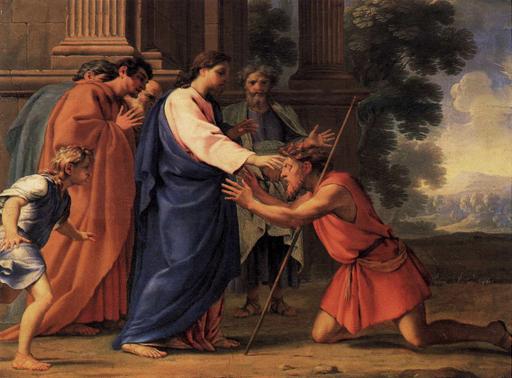
35 As he drew near to Jericho, a blind man was sitting by the roadside begging. 36 And hearing a crowd going by, he inquired what this meant. 37 They told him, “Jesus of Nazareth is passing by.” 38 And he cried out, “Jesus, Son of David, have mercy on me!” 39 And those who were in front rebuked him, telling him to be silent. But he cried out all the more, “Son of David, have mercy on me!” 40 And Jesus stopped and commanded him to be brought to him. And when he came near, he asked him, 41 “What do you want me to do for you?” He said, “Lord, let me recover my sight.” 42 And Jesus said to him, “Recover your sight; your faith has made you well.” 43 And immediately he recovered his sight and followed him, glorifying God. And all the people, when they saw it, gave praise to God.

In the name of Jesus. Amen.

Generally, when we let our imagination go wild, we like to be the heroes. Boys imagine hitting a grand slam in Game 7 bottom of the 9th two outs down by three, or they imagine they are the receiver who dives to catch the hail Mary as time expires to win the Super Bowl. Girls imagine they are Cinderella dancing the night away with Prince Charming, and getting engaged after he returns her glass slipper. Even when it comes to Bible stories, we like to imagine that we are Joshua toppling the walls of Jericho or David slaying Goliath or Elijah defeating the prophets of Baal.

In the two parts of today’s text – the Passion prediction and the healing of the blind man – the only hero is clearly Jesus, and He fully embodies the perfect love that was described in our Epistle reading (1 Co. 13:1-13). This is the third time Jesus explains to the disciples that He is going to Jerusalem to be betrayed, mocked, shamefully treated, spit upon, flogged, crucified, and raised from the dead. But the disciples don’t understand Jesus, the saying is hidden from them, and they could not grasp what Jesus said.

Still, Jesus’ love is on full display. Jesus is patient with and kind toward them. He is not irritated or resentful at their thick skulls. Jesus is going to Jerusalem and will endure all these things because His love does not insist on its own way. Instead, Christ submits to His Father’s will in perfect obedience.

By going to the cross, Jesus will bear all things. All the burdens, all the sins, all the transgressions, all the iniquities, all the wrongdoings, all the evil, all the brokenness of this fallen world – Jesus will bear all of it in His body (1 Pet. 2:24). He does it all for you. Jesus’ journey from His throne in heaven, down into your flesh. His fasting and temptation in the wilderness. His path through the lands of Israel with no place to lay His head (Lk. 9:58). His teaching, healing, casting out demons, forgiving, and restoring. His triumphal entry. His betrayal. His suffering. His death. His burial. His three day rest in the tomb. His resurrection. His ascension. And His continual rule and authority over all things is a journey of love for you.

Jesus’ entire work is directed outward. He didn’t need to do any of that to benefit Himself, and He doesn’t do it for His own, personal gain. He does it because He loves you. And this love of Jesus wasn’t based on your loveliness. It was based on the fact that the God the Father loves you and wanted to rescue you. So, Jesus, God the Son, loved you and did everything necessary to save you.

God hated seeing what sin and death had brought to His creation, so He did something about it by undoing sin and death by the death and resurrection of Jesus. Christ lived the life we were unable to live. He obeyed the whole will and Law of God that we were unable to obey. He took up His cross, endured punishment that you and I deserved, and gave up His dying breath. All of this is done for you.

Jesus does all of this with full knowledge. None of it surprised Him. Christ knew exactly what is going to happen to Him. And still, He goes and does all of this to love you with His perfect, pure love. 

Back in Lk. 9:51, we are told that Jesus had “set His face to go to Jerusalem.” In other words, Jesus is determined to do this loving thing for you. He was focused on redeeming creation, on getting there, and accomplishing it. He goes toward Jerusalem in love.

Day after day, Jesus gets closer to His goal until He arrives in the city of Jericho, which is about fifteen miles from Jerusalem. He’s close – about a day’s journey from the city. But Jesus isn’t in a rush. Sometimes, when you have to do things that you know are going to be unpleasant and painful, you just want to get it over with and put in your rearview mirror. Again, Jesus doesn’t do that. Instead, He paused along His way through Jericho.

Christ hears the blind man’s cry, “Son of David have mercy on me.” Jesus doesn’t say, “I’ve got more important things to do. I’m going to have mercy on you when I get to Jerusalem and go to the cross.” No. Our Lord stops.

The cry for mercy from any corner of His creation gets Jesus’ full attention. He commands that the blind man be brought to Him. Jesus asks him, “What do you want Me to do for you?” “Lord, let me recover my sight.” And in love, Jesus gives the man the mercy he desired. “Recover your sight; your faith has made you well.”

Jesus’ mission to be the Savior of all creation does not stop Him from pausing to give His mercy to the individual He meets along the way. He pauses and heals him.

Dear saints, Lent begins on Wednesday, and Lent is a good time for us to pause and consider all that God has done for us. Today, pause and ponder whom you are most like in this text. Again, we’re not the hero; we’re not Jesus. Instead, sometimes, we’re like the disciples who do not understand or grasp what God is doing for us and saying to us. Sometimes, even though God has plainly and clearly spoken, we are blind and don’t understand what God is doing.

Sometimes, we are broken like the blind man. Even though the blind man could not see with his physical eyes, he understands who Jesus is and what He has come to do. Despite his physical blindness, he has faith that Jesus can and will restore what is broken. So, when Jesus is present, he cries out for mercy. And Jesus gives him the mercy, restoration, and healing that he needed. Maybe, like the blind man, you look foolish to the world how you relentlessly call out to Jesus for His mercy.

Whom are you more like? It probably depends on the day, maybe even the moment.  Whether you don’t have any clue of what God is up to like the disciples or whether all you can do is cry out for mercy, the thing to do is follow Jesus.

Notice that even though the disciples don’t get all the things that God had said through Jesus and through the Scriptures, even though they are blind in their hearts and minds – what do they do? They go with Jesus. They follow Him to Jerusalem and the cross. The blind man, even though he could not see anything until Jesus gave him the sight he desperately wanted, what did he do? He followed too.

Whether you understand what God is up to or not, the conclusion is the same. Follow Jesus. Follow Him to the cross. No matter where you are in your journey through life, no matter how much you understand what God is doing, no matter how much you need from God, no matter how much God has already given you, follow Jesus to the cross.

Stay the course. And as you go with Christ, He will give you ample reasons to glorify God and give Him praise. Amen.

The peace of God, which surpasses all understanding, will guard your hearts and minds in Christ Jesus. Amen.