
Scene 2 – Sermon on Matthew 18:21-35 for the Twenty-second Sunday after Trinity

Matthew 18:21-35

21 Then Peter came up and said to him, “Lord, how often will my brother sin against me, and I forgive him? As many as seven times?” 22 Jesus said to him, “I do not say to you seven times, but seventy-seven times.

23 “Therefore the kingdom of heaven may be compared to a king who wished to settle accounts with his servants. 24When he began to settle, one was brought to him who owed him ten thousand talents. 25 And since he could not pay, his master ordered him to be sold, with his wife and children and all that he had, and payment to be made. 26 So the servant fell on his knees, imploring him, ‘Have patience with me, and I will pay you everything.’ 27 And out of pity for him, the master of that servant released him and forgave him the debt. 

28 “But when that same servant went out, he found one of his fellow servants who owed him a hundred denarii, and seizing him, he began to choke him, saying, ‘Pay what you owe.’ 29So his fellow servant fell down and pleaded with him, ‘Have patience with me, and I will pay you.’ 30 He refused and went and put him in prison until he should pay the debt. 31 When his fellow servants saw what had taken place, they were greatly distressed, and they went and reported to their master all that had taken place. 

32 “Then his master summoned him and said to him, ‘You wicked servant! I forgave you all that debt because you pleaded with me. 33 And should not you have had mercy on your fellow servant, as I had mercy on you?’ 34 And in anger his master delivered him to the jailers, until he should pay all his debt. 35 So also my heavenly Father will do to every one of you, if you do not forgive your brother from your heart.”

In the name of Jesus. Amen.

Jesus gives a sober warning at the end of this text. I’m going to reorder and tweak the way Jesus says it to make it crystal clear. Our Lord says, “If you do not forgive your brother from your heart, My heavenly Father will do to you what the king did to that first servant. He will demand you pay your debt and hand you over to the jailers for eternity.” Christian, you are forgiven, so you also must forgive. This is what Jesus is teaching with this parable. The parable has three scenes. And the order in which they happen is what makes Jesus’ point so powerful.

In Scene 1, the first servant (let’s call him ‘Vinnie’). Vinnie is hauled into the palace owing 10,000 talents to the king. Normally, a ‘talent’ is a unit of weight, not currency. Commentators are split on how we should understand what a talent’s value is. Some figure it’s a years’ pay; some say 20 years of wages. Either way, this is an impossible debt for an individual to pay off. After Vinnie’s debt is announced, the king commands that Vinnie, his wife, his children, and everything he has be sold. And Vinnie – notice what he begs for – he says, “Have patience with me, and I’ll pay you everything.” In other words, he asks for time. It’s ridiculous. Time? Time isn’t going to help! So, the king forgives the debt, he releases it. But debts are always paid by someone. They don’t just magically vanish. Here, the king pays. He swallows the debt and releases Vinnie. This is utter, unmerited mercy on the part of the king. End scene one.

The curtain rises and the spotlights illumine Scene 2, and we find Vinnie outside the palace. We’d expect him to be in a fantastic mood – smelling flowers and singing with birds. He’s forgiven and freed. But it sure doesn’t look like it by his actions. Vinnie spots his buddy (let’s call Vinnie’s buddy ‘Chuck’) who owed him 100 denarii, which is 100 days’ wages. That’s not an insignificant amount. But compared to what Vinnie was just forgiven – it’s pittance. Immediately, Vinnie grabs Chuck by the throat, throttles him, and demands, “Pay what you owe me.” And Chuck echoes almost word-for-word what Vinnie said in Scene 1. Chuck asks for time, but Vinnie doesn’t even give Chuck that. He has Chuck thrown into prison. Scene 2 ends with other servants informing the king how Vinnie had acted.

Now, just pause here. It’s intermission in the play of this parable. Let’s say you arrived late to the play and didn’t see Scene 1. All you know about it was that Vinnie is the character who owed 10,000 talents to the king. But you did watch all of Scene 2. What would you suppose happened in Scene 1? You would imagine that the king was still expecting Vinnie to pay the entire debt. The king must be breathing threats down Vinnie’s neck. That’s the only logical explanation. It’s the only way Vinnie’s actions are justified. And they would be just. It’s still futile; Vinnie won’t be able to choke enough throats to get out from under his debt. But at least it would make sense of his actions.

Dear saints, how many people know you are a Christian, but don’t have any idea about what goes on here? I mean, they might have an obscure idea that you’re coming here to meet with God. But they don’t necessarily know what goes on in this sanctuary between you and God while you’re here. So, ponder this: What does your Scene 2 say about the kind of God you have? Do your actions throughout the week accurately reflect on what God does here? Do people have the impression that the God you meet here is loving, kind, merciful, forgiving; or do they think your God is a harsh, cruel, punitive tyrant?

That’s all the time we have. Intermission’s over. The warning bell for Scene 3 just rang. And because we know what happened in the Scenes 1 and 2, we know exactly what’s going to happen in Scene 3. The king treats Vinnie precisely the way he deserves to be treated. Vinnie was given mercy, but he rejected that mercy by his actions. Vinnie demanded justice, so justice is what he gets. The king reinstates Vinnie’s debt, and justly so.

Dear saints, mercy has two sides. The first side of mercy is not getting what you deserve. Vinnie deserved to lose everything. He deserved to be sold with his family and possessions, but the king wanted to be merciful and not give Vinnie what he deserved. The second side of mercy is being given what you do not deserve. Vinnie had his debt forgiven and released by the king. He didn’t deserve it. I mean, Vinnie didn’t even have a grasp on how much debt he owed. Again, he had the delusion that time would help him. But the king doesn’t laugh at his idiotic request. No, the king was willing to release the debt and swallow it himself. Vinnie was given mercy, but he desperately demanded justice.

Here’s the thing: Mercy and justice are something only God can possess simultaneously. Only because of what Jesus has done on the cross can God be merciful and just to forgive and cleanse you from your sin (1 Jn. 1:9). Dear saints, God gives His mercy to you. It’s yours, but it is not something that you can keep for yourself and withhold from others. As soon as you try to hold on to God’s mercy and keep it only for yourself, you lose it. Forgiving others and being a forgiving person is not optional for a Christian. And this is hard.

Forgiving others, releasing someone from the retribution and retaliation that they deserve, is difficult. Some of you have been sinned against in ways that are so painful that I can’t even imagine. So, how do you go about being a person who forgives?

Let me give you two pastoral pieces of advice on how to be better forgivers. First, know that to forgive from the heart is something only a Christian can do, and the only reason a Christian can do it is what has happened in your Scene 1. Because of Christ’s death, God forgives your debt of sin. He separates it from you as far as the east is from the west (Ps. 103:12). The best way to grow as a forgiver is to recognize the massive debt that God has released for you.

Second, know that you aren’t going to forgive as perfectly God does. Pain and distrust will still be there. And forgiving someone does not mean that you have to become best friends. You can, and sometimes you must, forgive and still have boundaries to keep the one who has sinned against you away from you.

Forgiving is hard, but you can choose to forgive. That Holy Spirit-led choice is an act of a reborn disciple of Jesus. The emotions of pain and hurt and anger you have may slowly follow along in agreement. But, you might need to drag your emotions kicking and screaming behind you. Your emotions might take a long time to get on board with the choice to forgive. But one thing I would encourage you to do to help with that process is this: Name the sin.

If you’re angry and frustrated with someone for something, think concretely and specifically how you were sinned against. Figure out what commandment was broken when that person hurt you. We live in a sinful world. It’s naive to think that we are going make it out of here without having someone sin against us. You are going to be hurt in this world, and it will be painful. Your natural reaction to that hurt will be frustration, anger, and resentment. If you have that, name it. Name the sin that has been committed against you because then, it becomes something concrete, something you can identify. And being able to identify it, helps you realize what to do with that sin. It helps you realize that sin has been taken away by the Lamb of God.

You might be justified to want to strangle someone. But remember that God was justified to do that to you, and He didn’t. He didn’t. Instead, your God has released you and your debt for the sake of the complete payment of Jesus for your sin. He’s already done that here for you today in the Absolution, and He’s about to do it again here, at His Table. This is your Scene 1. Let that be reflected out there in your Scene 2. Amen.

The peace of God, which surpasses all understanding, will guard your hearts and minds in Christ Jesus (Php. 4:7). Amen.

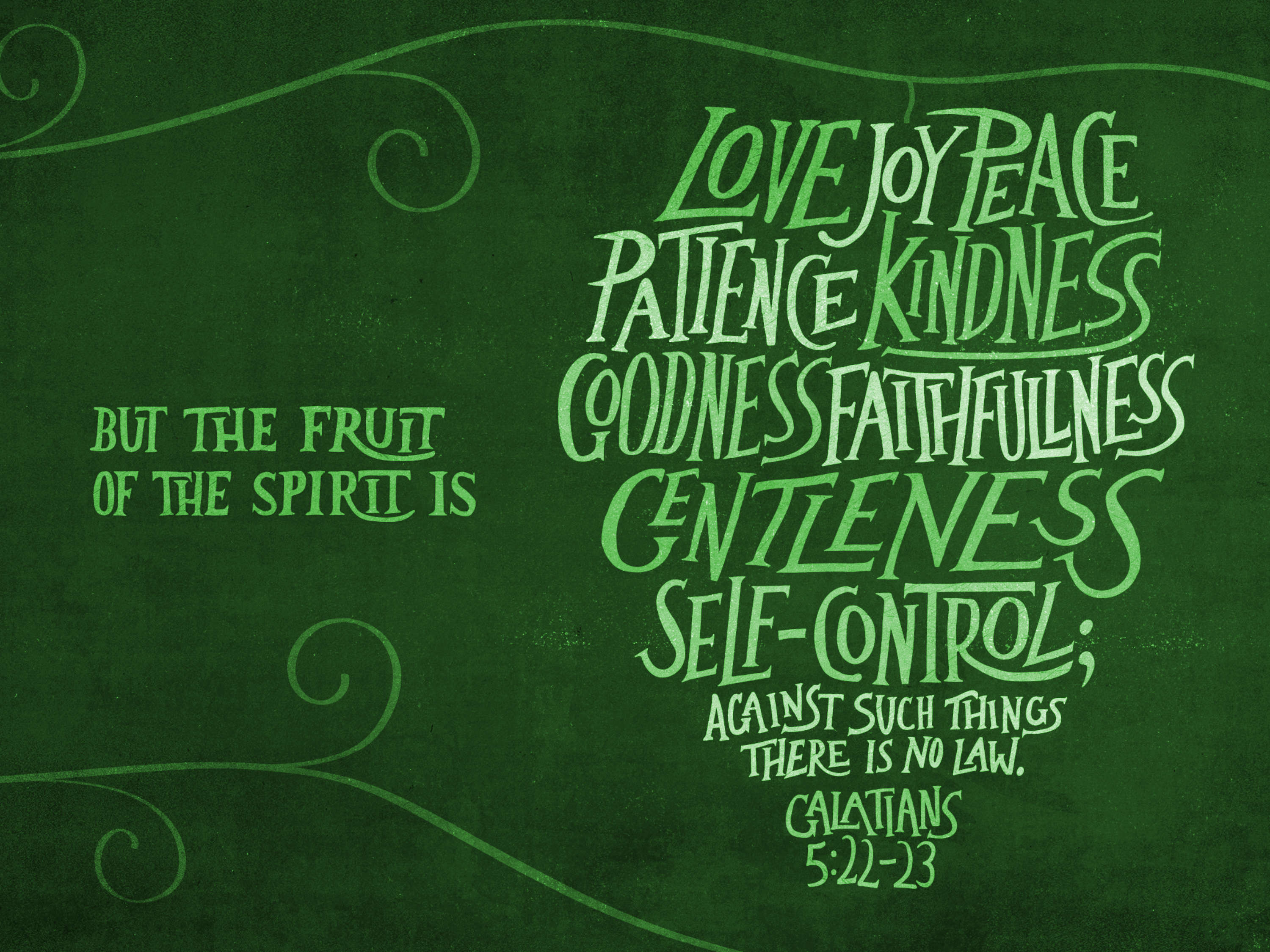
Fruit – Sermon on Galatians 5:16-24 for the Fourteenth Sunday after Trinity

Galatians 5:16–24

16 But I say, walk by the Spirit, and you will not gratify the desires of the flesh. 17 For the desires of the flesh are against the Spirit, and the desires of the Spirit are against the flesh, for these are opposed to each other, to keep you from doing the things you want to do. 18 But if you are led by the Spirit, you are not under the law. 19 Now the works of the flesh are evident: sexual immorality, impurity, sensuality, 20 idolatry, sorcery, enmity, strife, jealousy, fits of anger, rivalries, dissensions, divisions, 21 envy, drunkenness, orgies, and things like these. I warn you, as I warned you before, that those who do such things will not inherit the kingdom of God. 22 But the fruit of the Spirit is love, joy, peace, patience, kindness, goodness, faithfulness, 23 gentleness, self-control; against such things there is no law. 24 And those who belong to Christ Jesus have crucified the flesh with its passions and desires.

In the name of Jesus. Amen.

Scripture uses many different metaphors when it comes to salvation and being a Christian. There are the optical metaphors of darkness vs. light (Is. 9:2; Jn. 1:5, 3:19; 1 Pet. 2:9) and blindness vs. seeing (Is. 35:5, 42:7; Act. 26:18). There are the medical metaphors of death vs. life (Eph. 2:5; Col. 2:13) and heart of stone vs. a heart of flesh (Ezk. 11:19, 36:26). Scripture uses familial metaphors of adoption (Ro. 8:15; Gal. 4:5; Eph. 1:5), being a son (Mt. 6:8-9; Lk. 15:11f) and child (1 Jn. 3:1-2). There is the metaphor of sheep and shepherd (Ps. 23; Ezk. 34-35; Jn. 10:1-18). There are many, many more, but today, we get the botanical metaphor of fruit.

The thing about fruit is that plants don’t produce fruit for themselves. The main function of a plant’s fruit is so it can reproduce. The fruit provides water and protection for the seeds of the plant. God also designed fruit to be tasty so it would be eaten, and the seed(s) in the plant is spread to produce other plants.

When this text contrasts the flesh and the Spirit, it talks about the ‘works’ of the flesh and the ‘fruit’ of the Spirit. Notice how the works of the flesh are all directed inwardly. These works are self-interested and self-serving. Paul lists 15 “works of the flesh.” The first 3 – sexual immorality, impurity, and sensuality – all have to do with carnal, bodily appetites or a desire for the flesh to assert itself over others. The next 2 – idolatry and sorcery – are sins against God, trying to put the self in place of God. The next 8 – enmity, strife, jealousy, fits of anger, rivalries, dissensions, division, and envy – are all things that separate individuals by prioritizing the self over another. And the final 2 – drunkenness and orgies – are sins of excess. Then, when Paul adds, “and things like these,” he admits that this list isn’t all the works of the flesh. He could have added more.

And Paul says all these works of the flesh are “evident.” You can see them. They are apparent, clear, plain, and obvious. It is certainly easy to see all these things in our world and in our culture. But do you suppose that Paul gives us this list so we can point out other people’s faults? No. If they’re evident, they don’t need to be pointed out. They’re out there for everyone to see. Instead, Paul wants us to see how these things are present in each of us. They are in and of our flesh. And by ‘flesh’ he doesn’t mean our skin, muscles, tissue, tendons, and bones. By ‘flesh’ here, Paul is saying that these things come from the poisonous root of our heart.

If we sinners were an apple tree, every apple we produced would be infected with disease, blight, and worms; it would be rotting, and withering. If you saw a tree like that, you wouldn’t think the problem was the individual apples. You’d know something was wrong with the tree. It has a disease that infects every branch and goes deep down to the roots. That tree needs to be torn down. In other words, we all need to repent.

There is a penalty for these works of the flesh. You don’t need to wonder if you deserve eternity in hell. You can know that you do. Scripture is crystal clear, “Those who (lit.) are doing such things will not inherit the kingdom of God” (Gal. 5:21b).

God be praised, there is a solution, a fix. Christ Jesus has come to deliver you from these works of the flesh. “Those who belong to Christ Jesus have crucified the flesh with its passions and desires” (Gal. 5:24). Christian, God has removed your heart of stone and given you a heart of flesh (Ezk. 11:19, 36:26). He has put a new spirit within you. He has given you the Holy Spirit. And the Holy Spirit produces fruit.

These nine different qualities are called ‘fruit.’ Notice that the word ‘fruit’ is singular. It’s not many fruits like the 15 works of the flesh. But these 9 fruit (sic.) of the Spirit belong together; love, joy, peace, patience, kindness, goodness, faithfulness, gentleness, and self-control. This fruit all grows on the same tree – out of you. And remember that fruit needs time to grow. It isn’t like you can manufacture this fruit artificially or mechanically. No. It needs to be planted, pruned, watered, and nourished (1 Co. 3:6-7).

Remember that the works of the flesh are evident, plain, visible. The same thing isn’t said about the fruit of the Holy Spirit. If you don’t see this fruit, continue to pray that the Holy Spirit will nourish all these things in you. The Holy Spirit will cause that fruit to grow, bloom, ripen, and spread. So, let’s just go through each of these 9 fruit individually. 

Love: This is the chief characteristic of how God is disposed toward you, believer. Scripture explicitly says that nothing can separate you from God’s love for you (Ro. 8:35, 38-39). The Spirit takes God’s love and pours it into your heart (Ro. 5:5). This love of God isn’t just warm, nice feelings; it is action evidenced by Jesus’ sacrificial love for you as He gave His life on the cross. That love of God is given to you so you can give it to others.

Joy: God’s love provides you a sure confidence about the future (Ro. 5:11). Whatever circumstances come your way, you know that you will be in eternal bliss. So, the darkness and pain of this world will cease. That brings joy as well as…

Peace: Your relationship with God is no longer filled with strife. Christ has ended your hostility toward God. You have God’s peace that surpasses understanding (Php. 4:7), and then, you can be at peace with others as well.

Patience: Because you have God’s love which gives joy and peace, you can be patient. Even though the world throws all sorts of chaotic things at you, you can patiently endure it (Ro. 8:25). And beyond that you have…

Kindness: Kindness is the active, merciful goodness that mirrors God’s kindness. You grow to forgive others as God has forgiven you (Eph. 4:32).

Goodness: The word here can also mean ‘generosity.’ Because God has infinite resources, you know that you will receive all good things from Him (Ro. 8:32). This frees you to be God’s conduit to generously give your good things to others.

Faithfulness: Again, God proves His faithfulness to you as He died for you on the cross. He is faithful to keep you from tests and temptations that are beyond your strength (1 Cor. 10:13). This creates a faithfulness in you toward others.

Gentleness: This is an interesting one. Gentleness means that you don’t get excessively angry when things are out of step with how God created the world. There are times when you will need to say hard things to others, things that cause them grief. But you say those hard things in a gentle way which produces repentance. Paul talks about this quite a bit in 2 Cor. 7:8-13. To be gentle requires the final aspect of the Spirit’s fruit…

Self-control: The Holy Spirit leads you to resist your own passions through self-control.

These nine fruit (sic.) of the Holy Spirit are under no compulsion or requirement. Unlike the works of the flesh that exclude sinners from the kingdom of God, these fruits aren’t how you earn entrance to God’s kingdom. Instead, as the Spirit has begun to create these things in you, He will bring all of it to completion (Php. 1:6).

How will the Holy Spirit cultivate this fruit? Jesus has the answer. In John 15:1-5, Jesus says, “I am the true Vine, and My Father is the Vinedresser. Every branch in Me that does not bear fruit He takes away, and every branch that does bear fruit He prunes, that it may bear more fruit. Already you are pruned,” (the ESV says ‘clean’ but it’s the same word Jesus just used). “Already you are pruned because of the Word that I have spoken to you. Abide in Me, and I in you. As the branch cannot bear fruit by itself, unless it abides in the vine, neither can you, unless you abide in Me. I am the vine; you are the branches. Whoever abides in Me and I in him, he it is that bears much fruit, for apart from Me you can do nothing.”

Dear saints, the Spirit will use Christ’s Word and create this fruit in you. Abide, remain steadfast in that Word, and this fruit will be produced. Again, if you don’t see things in your life, know that God continues to work on you, and that fruit will be there for the benefit of others. Amen.

The peace of God, which surpasses all understanding, will guard your hearts and minds in Christ Jesus. Amen.

The Fruit & the Foundation – Sermon on Matthew 7:15-27 for the Eighth Sunday after Trinity

Matthew 7:15–27

15 “Beware of false prophets, who come to you in sheep’s clothing but inwardly are ravenous wolves. 16 You will recognize them by their fruits. Are grapes gathered from thornbushes, or figs from thistles? 17 So, every healthy tree bears good fruit, but the diseased tree bears bad fruit. 18 A healthy tree cannot bear bad fruit, nor can a diseased tree bear good fruit. 19 Every tree that does not bear good fruit is cut down and thrown into the fire. 20 Thus you will recognize them by their fruits.

21 “Not everyone who says to me, ‘Lord, Lord,’ will enter the kingdom of heaven, but the one who does the will of my Father who is in heaven. 22 On that day many will say to me, ‘Lord, Lord, did we not prophesy in your name, and cast out demons in your name, and do many mighty works in your name?’ 23 And then will I declare to them, ‘I never knew you; depart from me, you workers of lawlessness.’

24 “Everyone then who hears these words of mine and does them will be like a wise man who built his house on the rock. 25 And the rain fell, and the floods came, and the winds blew and beat on that house, but it did not fall, because it had been founded on the rock. 26 And everyone who hears these words of mine and does not do them will be like a foolish man who built his house on the sand. 27 And the rain fell, and the floods came, and the winds blew and beat against that house, and it fell, and great was the fall of it.”

In the name of Jesus. Amen.

I thought about beginning this sermon by yelling, “Look out!” But I have a mic, and I don’t want to hurt anyone’s ears or cause a heart attack. Jesus’ first word in this Gospel reading really sets the tone for everything else in it. “Beware.” It’s the kind of thing you shout when someone is in imminent, immediate danger. Throughout the Gospels, the thing Jesus regularly tells Christians to beware of is false teaching. In Jesus’ opinion – which, by the way, is the only opinion that matters – the thing you need to watch out for is false teaching and incorrect doctrine taught by ravenous wolves wearing sheep’s clothing.

One of the difficulties about these false teachers is spotting and recognizing them for what they are. False teachers don’t go around wearing t-shirts or name tags that say, “False teacher.” Instead, they are cleverly camouflaged. Under their soft, wooly exterior are jaws filled with fangs that are stained with the blood of sheep. They might bleat about Jesus and call Him, “Lord, Lord.” They might strut around like sheep, casting out demons in Jesus’ name, and doing many mighty works in Jesus’ name. But, on the Last Day, Jesus will say to them, “I never knew you; depart from Me you workers of lawlessness.”

So, how are you supposed to recognize these dangerous false prophets? Well, Jesus switches pictures and imagery. Now, it isn’t wolves and sheep; instead, it’s trees and fruit. Jesus says twice, “You will recognize [false prophets] by their fruits.” Now, we need to be clear here. Usually when the Bible uses a fruit analogy, it is talking about Christians’ service of love and good works, like the fruit of the Spirit. A false prophet, a false teacher, could very well appear to have all of those fruits. But here Jesus isn’t talking about the fruit of Christians in general; instead, He’s talking about the fruit of prophets.

So, think through this: What is the fruit of an apple tree? Apples. What is the fruit of a raspberry bush? Raspberries. You don’t go to a raspberry bush looking for apples, potatoes, or beets. Now, take that to different areas of work. What is the fruit of a baker? Bread, doughnuts, pastries, and cake. What is the fruit of an auto mechanic? A fixed car. You don’t go to a baker when you need your transmission fixed.

So, what is the fruit of a prophet? Their prophesizing, in other words, their teaching. In v. 16, when Jesus is talking about grapes and thornbushes and figs and thistles, He is saying that you must judge a prophet (which is just a teacher of God’s Word) by what he teaches. It doesn’t matter if they look good, are a nice person, or speak eloquently. What that person teaches is all that matters. A diseased apple tree is going to produce bad apples, but even if it produces nice shade, it isn’t really worth anything. When Jesus says you will know a prophet by his fruit, He means that you have to evaluate a prophet by the content of his teaching, by the doctrine. A false teacher will produce rotten, worthless, evil teaching. I know v. 18 talks about bad fruit and diseased trees, but ‘rotten, evil, and worthless’ are better translations of the words Jesus uses to describe the nature of those trees and their fruit. 

What that means, dear saints, is that you must, for the good of your soul, you must pay attention to and constantly evaluate what you are being taught. Don’t blindly trust whomever you hear on the radio, or who wrote a national best-seller, or who happens to be in your podcast playlist, or has a YouTube channel. Listen, and evaluate the fruit, evaluate the teaching – even if it’s a boring sermon or study on something you’ve heard a thousand times.

You have to do this because the most dangerous false teachers will be very subtle and deceptive. It might just be one little thing that slips in. But the more often you hear something, the more likely you are to believe it. In fact, it’s even possible that a false teaching might slip in without the person being aware of it. Some of the most important conversations I’ve had as a pastor have come about because I taught something that threw up a theological red flag. A person came to me, told me what they heard, and challenged me on it. Those conversations can give me a chance to clarify what I taught and go back to Scripture. They help me be more careful, clear, and thorough when I preach and teach.

So, this warning from Jesus about you needing to be on the lookout for false teaching definitely applies to me. It doesn’t matter how nice and good looking I am. It doesn’t matter how many sermons you’ve heard me eloquently preach. Don’t blindly trust me. You have to discern if what you are hearing from my lips lines up with the Bible; if it points you to Jesus as the incarnate, crucified, and risen Savior; if it calls you to repent of your sins; if it encourages you to believe in Christ; if it urges you toward love for God and your neighbor.

You have to beware because false teaching might make you feel good and give you the warm-fuzzies. But that doesn’t always mean that it is the teaching God wants you to hear. In our Old Testament lesson (Jer. 23:16-29), God says that the false prophets say things like, “It will be well with you,” and, “No disaster will come upon you.” Because of our sinful nature, false teaching is often right in line with what we want to hear. But you have to evaluate the fruit of every teacher and every teaching you encounter because when you stand before God on Judgment Day, you don’t get to claim ignorance and deception for following wrong theology. Eve didn’t get a pass in the Garden of Eden just because the serpent deceived her (Gen. 3:13; 2 Cor. 11:3; 1 Tim. 2:14).

And, I have to briefly add this: Theology is all round you. The nightly news has a theology. Gretta Thunberg and the whole climate change crowd have a theology. The commercials you see on TV, the songs you listen to, and the videos you watch all have a theology. Here, Jesus says that you must evaluate and discern the theology even of those things. I’m not necessarily saying you have to completely eliminate your intake of those things. That might be the case. But when those inputs cause you anxiety and despair, remind yourself of the true theology that Jesus is crucified, risen, has all authority in heaven and on earth, and is with you always even to the end of the age (Mt. 28:18-20).

Remember, false teaching is rotten, worthless, evil fruit. But it’s effects are more devastating than eating a bad orange. It is completely ruinous. False theology is like building a house with a foundation on sand. When the rains fall and the winds and the floods come, that house is going to have a catastrophic, disastrous fall.

But, God be praised, a house built on the foundation and rock of right, good, sound theology will withstand everything the devil and the world can throw at it. Dear saints, be wise. Eat the good fruit of sound theology. Build your house on the solid foundation of the rock of Christ. And you will never be moved. Amen.

The peace of God, which surpasses all understanding, will guard your hearts and minds in Christ Jesus. Amen.

The Seed – Sermon on Luke 8:4-15 for Sexagesima Sunday

Listen here.

Luke 8:4-15

1 And when a great crowd was gathering and people from town after town came to him, he said in a parable, 5 “A sower went out to sow his seed. And as he sowed, some fell along the path and was trampled underfoot, and the birds of the air devoured it. 6 And some fell on the rock, and as it grew up, it withered away, because it had no moisture. 7 And some fell among thorns, and the thorns grew up with it and choked it. 8 And some fell into good soil and grew and yielded a hundredfold.” As he said these things, he called out, “He who has ears to hear, let him hear.”

9 And when his disciples asked him what this parable meant, 10 he said, “To you it has been given to know the secrets of the kingdom of God, but for others they are in parables, so that ‘seeing they may not see, and hearing they may not understand.’ 11 Now the parable is this: The seed is the word of God. 12 The ones along the path are those who have heard; then the devil comes and takes away the word from their hearts, so that they may not believe and be saved. 13 And the ones on the rock are those who, when they hear the word, receive it with joy. But these have no root; they believe for a while, and in time of testing fall away. 14 And as for what fell among the thorns, they are those who hear, but as they go on their way they are choked by the cares and riches and pleasures of life, and their fruit does not mature. 15 As for that in the good soil, they are those who, hearing the word, hold it fast in an honest and good heart, and bear fruit with patience.”

In the name of Jesus. Amen.

This is Jesus’ first parable, so a quick note about parables is important here at the outset. We get some insight as to the reason Jesus teaches in parables when the disciples ask Jesus what the parable means. Jesus tells them, “I speak to them in parables, because seeing they do not see, and hearing they do not understand.” In short, parables are not intended to make things clearer. The parables, according to Jesus, are meant to obscure things. And here’s why:

The crowds had begun to reject Jesus’ teaching. Basically, what Jesus says He is doing is teaching these know-it-alls in riddles, so they realize just how dumb they really are (see esp. Mt. 13:10-17). You know how it is when you are around a group of people and there is a joke that you aren’t in on. You get curious and want to be ‘in.’ So you ask questions and dig deeper to be part of the ‘in’ crowd.

God be praised, the disciples fall for the bait and do exactly that. Please notice, that. These guys who have been called by Jesus to be fishers of men, even they have to ask Jesus what the parable means. When the disciples ask Jesus what He means by this parable, they are exercising and growing in their faith. They go to the right place with their misunderstanding; they go straight to Jesus. “Dude, what are you talking about?” Whenever you have doubts or questions or feel like outsiders, you do well to follow the disciples’ example here. Let’s all go to Jesus, the Word made flesh, and get things cleared up.

Honestly, this particular parable really is quite simple. And to make it idiot-proof and so we don’t get it wrong, Jesus gives us the cheat sheet. We can thank the Holy Spirit for inspiring the Gospel writers to help us dense folk today. So, since you have ears, hear what God desires you to hear.

In the parable, the seed is the Word of God. The different places where the seed falls – the path, the rocks, the thorns, and the good soil – are the various conditions of the heart. While we might be tempted to ask, “What kind of soil am I?” it is probably better to recognize that you and I are each of these types of soil at different times. And even though Jesus doesn’t explicitly say this, I think the types of soil that are presented in the parable are in a particular order. Jesus starts with what is easiest for the devil to attack and prevent fruit from being produced and moves to the types of hearts that are more difficult. So, let’s go through each of them.

First, the path, and listen most closely right now. Open your ears here for two minutes. If you don’t listen to any other part of this sermon, listen to this. The path represents those who hear the Word of God, but then, the devil comes and takes away the Word from their hearts. Look again at the end of v. 12. Our translation, the ESV, has Jesus explaining what happens to the seed on the path by saying, “so they may not believe and be saved.” Now, the ESV is a faithful translation (I wouldn’t be using it for our services if I didn’t think so), but I think the translators unintentionally mislead us a little bit here (and to be fair to the ESV, other translations do the same thing). They make it sound like there are two verbs there – ‘not believe’ and ‘not be saved.’ But, actually, there is only one verb. ‘Not believe’ is a participle and ‘not be saved’ is the verb. In other words, more literally, Jesus says, “so that having believed they may not be saved.” In other words, these people hear God’s Word, and they believe it. But before that Word can begin to grow and sprout, the devil simply snatches it away. This is the devil’s easiest attack on the Word of God. And I think we’ve all experienced this.

To my great shame, I will admit that there are times when I hear God’s Word and it goes right in one ear and out the other. For example, after I drop my kids off for school, I will listen as my phone plays one of my daily Bible readings while I drive here to work. And there are days when I get distracted by something – thinking about my day, or another driver who doesn’t come to a complete stop or use their turn signal or whatever. The reading ends, and I honestly couldn’t tell you what I heard. Other times, I’ve listened to sermons – good, solid, biblical sermons – but once the sermon is over, I couldn’t tell you what the sermon was about. Again, this is the easiest way for the devil to attack the powerful, effective Word of God. He simply snatches it away because it falls on the hard, concrete path.

People of God, when you hear God’s Word, when you read the Bible, when you sit in those chairs and hear the preaching, listen up. Do whatever it takes to pay attention. Get enough sleep on Saturday. Have some caffeine before you come. Don’t let your heart be a paved, hardened path where the devil can simply come and snatch God’s Word from you.

Now, that you’ve heard that, I hope I have your attention and you keep listening.

The second place the seed of God’s Word falls is the rock. This ground is a little more difficult for Satan. This is when we hear God’s Word and receive it with joy. But then those promises get scorched by the heat of trials. We believe the Word for a while, but when times of trouble and testing come, we abandon those promises and fall away.

How many times does God promise to be with you always, but then, when hot trials come, we think God is angry with us and has abandoned us? Trials, tribulations, and troubles are not the time to doubt God’s promises! Think about it the terms of this parable. The heat from the sun represents the trials. But it isn’t the hot sun that kills plants. If plants have good, deep roots that reach down to where the moisture is, the heat from the sun is what causes plants to grow and bear fruit.

Think of when Shadrach, Meshach, and Abednego faced death – they faced the hottest trial that anyone can encounter, literally! But they refused to let that trial wither their faith. They had roots that went down to the moisture and their faith prevailed and even flourished when Jesus walked with them in the burning fiery furnace. If you know even a little bit of church history, you know that the church typically grows when it is persecuted. Dear saints, when trials and tribulations come, that is not the time to abandon God’s promises. That is the time to sink your roots deep into them and find the moisture you need. Those trials will in fact cause you to grow and not wither away.

The third place the Word of God falls is among the thorns. The thorns are the cares and riches of this life. Jesus here is warning us that trials and tribulations aren’t the only enemy to our faith. Good gifts that God gives can also be bad for our faith. We are tempted to think that when we are comfortable and not facing trials that we will be left alone, but that isn’t the case. We cannot let our guard down when things are going well. The devil will still attack us, but this is also where he has the hardest time. Satan hasn’t been able to simply snath the promises of God away, and he hasn’t succeeded with his fiery trials. So, the devil has no other choice but to try and choke out God’s Word. But this attack takes the longest and is the hardest for him to accomplish. Here, the devil has to try to slowly introduce weeds to choke out God’s Word. He can’t do it all at once, otherwise we would recognize the attack and be on guard against it. So, he works slowly to choke out God’s Word from your heart.

This is just a reminder. Those weeds – the riches, pleasures, and cares of this life – will always be a threat and nuisance to you. Christian, there will be times where you will need to go out and pick weeds from your life. You can’t simply trim weeds. You have to pull them up by the root. Dear saints, ask yourself, “What has gotten in the way of the Word of God? What things keep me from hearing the blessings God would give me through His Word?” When Jesus talks here about the cares and riches of this life, He doesn’t get specific. Instead, He wants us to constantly assess ourselves and see what is hindering us from rejoicing in God’s Word and being participants in God’s family.

Now, we are ten days away from the beginning of Lent. Today is February 7th and Lent begins February 17th. Scripture doesn’t give specifics for each of us as to what chokes out our faith; instead, God’s Word gives us wisdom to discern what might be slowly strangling us. I am calling on you now to use that wisdom.

Lent is typically a time to remove particular hinderances to our devotion to God’s Word. The Scriptures call it fasting. Fasting is not commanded, but Jesus does assume that His disciples will fast at times (see. Mt. 6:16-18). Fasting is not a way to make God more pleased with you. God couldn’t be more pleased with you who believe that Jesus has forgiven you of all your sins. Instead, fasting is a way to uproot the thorns that the devil would use to choke out your faith. Fasting curbs your sinful, fleshly desires. Fasting, basically, tells your flesh, “You are not in charge of me.”

Lent is a time to pull out those weeds and thorns that would choke out your faith. You have ten days to consider what you might remove from your life for the forty days of Lent. Maybe, there is something that would be beneficial for you to give up in order to discipline your flesh and give extra attention to God’s Word. Again, God doesn’t command this. It’s not something you have to do, but it is a good practice. Don’t think that God will be more pleased with you if you fast. Instead, know that it is a good and beneficial discipline to deny yourself something so that thing, whatever it is, doesn’t become a choking, strangling thorn in your life of faith. Lent is a good time to pick weeds from your spiritual life.

Finally, the Word falls on good soil. Just as you, sinner, are the soil of the path, the rocks, and the thorns, you, Christian, are also the good soil. You are both and all at the same time. God’s Word comes and produces an abundance of fruit that yields a hundred-fold and provides for others.

When we hear this parable, one of the most shocking things is how the recklessly the sower throws around the seed. He throws it around willy-nilly and it lands all over the place. Well, right here at this altar, the sower is about to carefully plant the Seed of His Word deeply into you. You are about to come and receive Christ, the Word made flesh, His very Body and Blood. Let this careful, deliberate planting of God’s Word and the deliverance of God’s forgiveness of all your sins bear, let it bear the fruit of joy and love. Amen.

The peace of God, which surpasses all understanding, will guard your hearts and minds in Christ Jesus. Amen.

Genuine – Sermon on Romans 12:6-16 for the Second Sunday after Epiphany

Listen here.

Romans 12:6-16

6 Having gifts that differ according to the grace given to us, let us use them: if prophecy, in proportion to our faith; 7 if service, in our serving; the one who teaches, in his teaching; 8 the one who exhorts, in his exhortation; the one who contributes, in generosity; the one who leads, with zeal; the one who does acts of mercy, with cheerfulness.Romans 12_2 - Christian Calling

9 Let love be genuine. Abhor what is evil; hold fast to what is good. 10 Love one another with brotherly affection. Outdo one another in showing honor. 11 Do not be slothful in zeal, be fervent in spirit, serve the Lord. 12 Rejoice in hope, be patient in tribulation, be constant in prayer. 13 Contribute to the needs of the saints and seek to show hospitality. 14 Bless those who persecute you; bless and do not curse them. 15 Rejoice with those who rejoice, weep with those who weep. 16 Live in harmony with one another. Do not be haughty, but associate with the lowly. Never be wise in your own sight.

In the name of Jesus. Amen.

How do you know if someone is really a Christian? I mean reeeeally a Christian. Well, according to the ESV’s heading on this text (which the translation we are using), this is it. The ESV adds its own title to v. 9 and following “Marks of the True Christian.”

In fact, do this: Take out one of the pew Bibles and turn to Romans 12. The ESV has this text falling under two headings. The first comes before v. 3 and is “Gifts of Grace” which is used for v. 3-8. I think that is an accurate heading for those verses. But then you get to v. 9 and all the way to the end of the chapter, all of that falls under the heading “Marks of the True Christian.” Those headings are not part of the Scriptures. The translators and editors of the various translations added them. Sometimes, they are fine introductions to what is going to come. But I would encourage you to ignore them more often than not because they influence the way you read the text.

From the heading there before v. 9 and the way the ESV reads here, I counted twenty-two commands/imperatives that follow in the translation. Twenty-two things that Christians are commanded to do if they, at least according to that heading, are true Christians. With that understanding, it would be easy for a sermon on this text to turn into a stern lecture on what you should be doing; how you are not doing it; and how you would be blessed if you actually got around to doing it. But here’s the problem.

First, there is no Gospel in the translation of those verses. And, second, if true Christians have genuine love; abhor evil; hold fast to the good; love with brotherly affection; outdo one another in showing honor; are never slothful in zeal; fervent in spirit; serve the Lord; rejoice in hope, etc. If these are the marks of the true Christian and you take an honest assessment of yourself, how are you doing so far?

Speaking for myself, I would have to conclude that I’m not a true Christian because I’m missing a lot of those marks most of the time. And, when I don’t have those marks but still confess that I am a Christian, I need to find some comfort for myself. So, the easiest thing for me to do is to start comparing myself to others. I look at myself, and then I look at you and you and you. Then, I figure, “Well, at least I’m better than that person at obeying these ‘Christian’ laws.”

You have maybe heard the joke about when Sven and Ole were out walking in the forest and see a bear. Ole bends down and starts tightening his shoelaces, and Sven says, “Ole, you don’t think you can outrun a bear, do you?” And Ole responds, “I don’t have to run faster than the bear, Sven. Angry BearI just have to run faster than you.” Well, guess what. When the bear of God’s Law is finished eating the guy who is slower to obey than you, it picks up your scent and resumes its pursuit of you because its appetite is never satisfied by eating up sinners.

Lord, have mercy. If our response to our failures and shortcomings is to compare ourselves to others, we are not doing what this text wants to inspire in us. We are not showing brotherly affection. We are not associating with the lowly. Instead, we are being haughty and wise in our own sight. Lord, have mercy. Comparing ourselves to others is not what the Holy Spirit intended when He inspired these words of Scripture. Only Jesus can satisfy the Law’s appetite. And, God be praised, by His death and resurrection He has done exactly that.

In reality, there are only four commands in this text. Three of them are in v. 14: Bless those who persecute you, bless and do not curse them. And one at the very end in v. 16: Never be wise in your own sight.

In reality, to be a Christian is not to keep twenty-some commands. Instead, Paul here is holding up a picture of what genuine love looks like (similar to how he does in 1 Cor. 13). Listen to this translation of v. 9-12. “Love is genuine/without hypocrisy, abhorring the evil and clinging to the good. [Genuine love] is showing brotherly affection for one another, in honor leading the way for one another, in zeal not [being] lazy, in the Spirit fervent, serving the Lord, rejoicing in hope, enduring persecution, holding fast to prayer.”

These verses are, in fact, perfectly describing Christ. Remember, that God is love (1 Jn. 4:8, 16), and that means that Jesus is love embodied. And, yes, as Christians – which means ‘little Christs’ – we should be like Christ. But because we are sinners, we fail to live up to God’s Law. God’s Law always accuses us.

Sacred LogoThere’s a better way to understand these verses, and to get at that understanding, I’m going to connect this text to our theme for the year – “Sacred.” In Lev. 19:2, God speaks to His people, Israel, and says, “You shall be holy, for I the Lord your God am holy.” And Peter repeats those words for us Christians in 1 Pet. 1:16. In English, this sounds like a command because of the word ‘shall.’ But in both Hebrew and Greek it isn’t a command/imperative. A better translation for both is, “You will be holy.”

When the original people (both Old and New Testament) heard that, they would hear three things at the same time. First, it is an unfinished action – something like, “You will become holy.” Second, and closely related, it can be a future promise, “You will be holy.” And third, it is a soft command/imperative, “You are called to be holy.”

Yes, God wants our behavior to be consistent with His holiness. God is your heavenly Father, and He wants you to be chips off the old block. But it is also a process that God has begun in your Baptism, and He will be faithful to bring it to completion (Php. 1:6). God will continue to make and shape you after the image of Christ.

Dear saints, the genuine love that is pictured here is what God has called you to be. When you don’t measure up to your sacred calling as Christians, when you don’t have the marks of a true Christian, run in faith to Christ. Romans 8:3-4 says, “For God has done what the law, weakened by the flesh, could not do. By sending his own Son in the Romans 8_1-4 - Walk according to the Spirit Law weakened by the fleshlikeness of sinful flesh and for sin, he condemned sin in the flesh, in order that the righteous requirement of the law might be fulfilled in us, who walk not according to the flesh but according to the Spirit.”

In the arms of Jesus’ love and mercy, you will find forgiveness for your failure and love despite your lack. Receive what God gives to you. He gives you Jesus. Because He has died and risen again, Jesus delivers the very mercy and forgiveness that you need.

“Are you really a Christian?” Well, do you trust in Christ for the forgiveness of your sins? That is the mark you need. Yes, you fail in your calling. But faith in Christ, and faith alone by grace alone, makes you a genuine child of God. Amen.

The peace of God, which surpasses all understanding, will guard your hearts and minds in Christ Jesus. Amen.

Fruit Inspector – Sermon for the 8th Sunday of Trinity on Matthew 7:15-23

Listen here.

Matthew 7:15-23

15 “Beware of false prophets, who come to you in sheep’s clothing but inwardly are ravenous wolves. 16 You will recognize them by their fruits. Are grapes gathered from thornbushes, or figs from thistles? 17 So, every healthy tree bears good fruit, but the diseased tree bears bad fruit. 18 A healthy tree cannot bear bad fruit, nor can a diseased tree bear good fruit. 19 Every tree that does not bear good fruit is cut down and thrown into the fire. 20 Thus you will recognize them by their fruits.

21 “Not everyone who says to me, ‘Lord, Lord,’ will enter the kingdom of heaven, but the one who does the will of my Father who is in heaven. 22 On that day many will say to me, ‘Lord, Lord, did we not prophesy in your name, and cast out demons in your name, and do many mighty works in your name?’ 23 And then will I declare to them, ‘I never knew you; depart from me, you workers of lawlessness.’”

In the name of the Father and of the Son and of the Holy Spirit. Amen.

Brothers and sisters in Christ, Scripture matters. God’s Word is important. “The B-i-b-l-e, yes that’s the book for [you and] me,” because the Word of God is how God delivers Jesus’ work to us. The Word of God is what gives us life and salvation.

Today, Jesus gives you the most important work a Christian can do.To neglect this work is the most dangerous thing in this life – more dangerous than fake news, ISIS, and bears roaming the streets of our town.[1] Jesus says that you must be on guard against false teachers and their teaching. You must sort out true doctrine from false doctrine. Youmust do this because you can’t have someone else do it for you.

As your pastor, I love you all. And I can honestly say that I want nothing more for each of you than for you to hear, read, study, believe, and grow in the true, clear, inerrant, infallible words of Scripture. You don’t need to do this so that you can become expert theologians. You need to do this because you are Christians, and this is what Christians do. Christians grow in the faith (Heb. 5:12; 1 Cor. 3:2).

You need to remember that I am not immune from the deadly effects of false teaching and doctrine. I could start preferring the fruits of false teaching over the life-giving and life-nourishing fruit of Jesus’ Words. The Apostle Paul warned the believers in Galatia about the possibility of him failing to remain faithful to the Gospel. He says, “But even if we or an angel from heaven should preach to you a gospel contrary to the one we preached to you, let him be accursed. As we have said before, so now I say again: If anyone is preaching to you a gospel contrary to the one you received, let him be accursed” (Gal. 1:8-9). So, pray for me.

Pray that I, as your pastor and shepherd, would be defended against wolves. And if you hear me preach something that is not in accord with the Scriptures, let me know. Show me from God’s Word that I am not in step with what the Bible teaches. Rebuke me. Call me to repentance. And, if I refuse to repent, throw me out of this church. And if that doesn’t work, find a church and pastor who is true to the Word because your salvation depends on it.

Wolf in the Church with SheepThe false teachers that Jesus warns about are cleverly disguised. Under their soft, wooly exterior are teeth filled with the blood of sheep. The devil always disguises himself and his lies. He doesn’t wear a t-shirt that says, “Caution: I’m the devil.” Instead, he comes and offers you the things that you want, things that seem good and right. In our Old Testament lesson (Jer. 23:16-29), God says that the prophets of the devil say to those who despise God’s Word, “It will be well with you.” And to those who follow their own heart, the devil says, “No disaster will come upon you.”
The devil is smarter than you and I are. Satan has been watching you for a long time, and all he wants is to draw and lure you away from Jesus. He will tell you what you want to hear and try to convince you that he is offering you good fruit. The devil is always urging you to justify yourself and your sinful actions rather than receiving God’s rebuke, confessing that sin, and being justified by Christ’s forgiveness won on the cross.

Dear sheep, the devil and all false prophets see us, this flock of Christians, and try to pick us off one by one.

To the greedy, the devil says, “You aren’t greedy. You are thrifty. You’re economical and a good steward.” In this way, the devil slowly and surly nudges you to hold more tightly to your stuff. So, you grow more selfish and less generous. And this changes your view on God. You hold good things back from the one who needs it, and you start to believe that God holds back good things from you. And you use your treasures to pursue the things of this world rather than eternal things.

To the one who holds grudges and refuses to forgive, Satan whispers, “You aren’t unforgiving. You are in the right and just want justice. He isn’t really sorry anyway. When he sincerely asks for forgiveness, then you can let it go.” As you listen to the devil’s words, you grow more self-righteous. But do you see what happens? You get a warped view of forgiveness. You start to see forgiveness as something that is earned and deserved. This will crush your faith.

While the devil and false prophets try to pick off individual sheep, they also run in packs and try to destroy the whole flock.

In John 17just before He was arrested, Jesus prays for all believers, “May they be perfectly one”(Jn. 17:22-23). The devil and false prophets take these words of Jesus and say, “It is so horrible that Christians are divided. God isn’t happy with all these denominations. We need to unite. Let’s get rid of our differences. Let’s stop being Lutherans, Roman Catholics, Methodists, and Baptists. Let’s just be Christians. We shouldn’t let silly things like ‘doctrines’ divide us.” And to our ears, that sounds good. It sounds like what Jesus wants.

Romans 16_17Beware. Do the Scriptures teach, as Roman Catholics believe, that when the pope speaks officially, his words have the same authority as the Scriptures? No. Does the Bible say, as Methodists teach, that Christians reach a point where they no longer sin? No. Does God’s Word say, as many churches say today, that baptism is the first act of obedience of a Christian? No.
Even though ‘doctrine’ has become a dirty word, it isn’t. ‘Doctrine’ simply means ‘teaching.’ If we go along with others who say that doctrine shouldn’t divide us, what we are really saying is one of two things:

Either we say that Scripture isn’t clear and one person’s opinion about what the Bible teaches is as valid as another’s. But if the Scripture isn’t clear, how can you know the clearest teaching of Scripture, that God forgives you? Here’s the thing, and this is going to sound harsh (are you ready?): Your opinion of what Scripture teaches doesn’t matter. The only thing that matters is what the Bible actually says and teaches.

Or, the other thing we say if ‘doctrine’ is a dirty word, is that what Scripture says doesn’t matter. And this is false. The Bible matters because it is God’s clear, inerrant, infallible Word. When God says something, it is true whether you believe it or not, whether you understand it or not. You’ve probably heard the expression, “God says it. I believe it. That settles it.” The order there is wrong and dangerous. Your belief doesn’t settle the matter. Instead try this, “God said it. That settles it. I believe it.” It’s much better.

At Jesus’ command, we need to be on guard against false doctrine and teaching because that is the thorny, rotten, diseased fruit of false prophets. And it isn’t fun work. It is sad, and we have no pleasure in pointing out false teaching. But we must do it because Jesus says we must. So, judge the fruits of every preacher you hear. The fruit of a preacher is his words. Compare the words of every preacher to what Jesus has given you.

Jesus has given you His saving blood. Christ has given you peace with God. Jesus gives you the assurance your sins have been forever erased by His death and resurrection. And Jesus gives you eternal life in His resurrection.

If a preacher points you to yourself, he is giving you nothing but thorns, thistles, and rotten fruit. If a preacher won’t declare to you that your sins are forgiven for Jesus’ sake, he is no sheep. If a preacher says that the sins you feel in your conscience are no big deal and don’t need to be forgiven, he’s a wolf. Run.

Blessings from the CrossYou need the good fruit of God’s Word. It is your source of life. It is your nourishment that sustains you in this life and the next. Pluck that good fruit from the cross which has become the tree of life.

Nourished by Jesus’ forgiving blood, may we all eat and live at His table. Amen.

The peace of God, which surpasses all understanding, will guard your hearts and minds in Christ Jesus. Amen.

[1]A bear was roaming through Grand Forks this week.

Successful Sowing – Sermon for Sexagesima on Luke 8:4-15

Listen here.

Luke 8:4–15

4 And when a great crowd was gathering and people from town after town came to him, he said in a parable, 5 “A sower went out to sow his seed. And as he sowed, some fell along the path and was trampled underfoot, and the birds of the air devoured it. 6 And some fell on the rock, and as it grew up, it withered away, because it had no moisture. 7 And some fell among thorns, and the thorns grew up with it and choked it. 8 And some fell into good soil and grew and yielded a hundredfold.” As he said these things, he called out, “He who has ears to hear, let him hear.”

The Sower9 And when his disciples asked him what this parable meant, 10 he said, “To you it has been given to know the secrets of the kingdom of God, but for others they are in parables, so that ‘seeing they may not see, and hearing they may not understand.’ 11 Now the parable is this: The seed is the word of God. 12 The ones along the path are those who have heard; then the devil comes and takes away the word from their hearts, so that they may not believe and be saved. 13 And the ones on the rock are those who, when they hear the word, receive it with joy. But these have no root; they believe for a while, and in time of testing fall away. 14 And as for what fell among the thorns, they are those who hear, but as they go on their way they are choked by the cares and riches and pleasures of life, and their fruit does not mature. 15 As for that in the good soil, they are those who, hearing the word, hold it fast in an honest and good heart, and bear fruit with patience.”

In the name of the Father and of the Son and of the Holy Spirit. Amen.

Success is measured by goals. The Titanic was a massive success, if the goal was to produce the world’s largest luxury ocean liner. It was a complete failure if the goal was for it to remain world’s largest luxury ocean liner.

As we consider this parable, we might be tempted to ask, “Is the Sower successful?” On the one hand, He is massively successful. The seed is sown. But, on the other hand, He is a massive failure because of how recklessly and wastefully the seed is tossed around. Most of the seed fails to grow, mature, and bear fruit. It ends up all over the place. On the path where Satan will snatch the seed. On the rocks where it doesn’t get nourishment. Among the weeds and thorns that choke it to death.

Now, rather than judging the Sower’s success, we need to recognize that Jesus is teaching us some very important truths with this parable and the places where the seed fails.

First, God is perfectly willing to let His Word go out to places where there will be no fruit.

Second, we see that the Word has enemies. With the seed that falls on the path, Jesus wants us to recognize that Satan is a real threat, and he always attacks where the Word is present – where it is preached, taught, and heard. Don’t be surprised when you are attacked. Also, with the seed that falls on the rocks, Jesus wants us to know that the Word needs to be continually nourished. Christian, you never outgrow your need for the Word and Sacraments so that your faith does not wither and die.

ThornsThird, Jesus blows away any misconceptions we may have that if the devil left us alone and the seed gets the nourishment that it needs, then everything would be hunky dory. The seed that falls among the thorns – that is the riches and pleasures of this life – it dies too. Even good things in this life are a threat to your faith. Thorns don’t just prick you like a needle leaving a little pain behind. They entangle and trap. Enjoy the good gifts God gives you in this life, but also recognize how easily they choke out your faith.

If we focus on those things, we may be tempted to think that God is mostly a failure when He sends out His Word. God forbid even the thought.

The Sower is successful. The seed that falls on the good soil produces, and it produces a hundredfold. But even when the seed falls on the path, the rocks, and among the thorns, we need to remember that, though there is no fruit, the Sower is still successful. Jesus is teaching exactly what we heard on our Old Testament text (Is. 55:10-13). God’s Word never returns void. It always accomplishes God’s purpose. Always.

Now, since we clearly know that God is successful, we might instead be tempted to think that we are unsuccessful. Do you see in yourself the hundredfold fruit that Jesus describes the good soil producing? Probably not. Instead, you see yourself being choked out. You feel malnourished and starving. You know the devil’s attacks. All these things are extremely evident to you, and so you’re tempted to doubt that God’s Word accomplishes what Jesus describes.

But that is the remarkable nature of the Seed of God’s Word. The Seed, unlike any other seed, is able to transform the ground. That is why God sows it in inhospitable places.

Bear Fruit with Patience SowerAnd hear again what Jesus says in the last verse of our text: “As for that in the good soil, they are those who, hearing the word, hold it fast in an honest and good heart, and bear fruit with patience.”

That honest and good heart comes from the work of the Word of God itself. The Word cleanses and forgives you. The Seed of the Word is what makes your heart clean (Jn. 15:2-3). And the fruit comes with patience.

Don’t be surprised if you don’t see the massive, hundredfold production. Be patient. God is the one who will bring it about. Don’t fall into the devil’s temptation to measure how successful God’s Word is. If we measure the how successful God’s Word is by looking for our fruit, we will surely be discouraged.

Instead, remember that the success of God’s Word Is not dependent on what you see or experience. The success of God’s Word is dependent on His promise.

Dear Christians, to you it has been given to know the secrets of the kingdom of God. Hear and receive Christ’s Word. Hold it fast. Be continually nourished by that Word as you hear it, read it, learn it, and receive it now in the Lord’s Supper. And be patient. He who has begun a good work in you will be faithful to bring it to completion (Php. 1:6). Amen.

The peace of God, which surpasses all understanding, will guard your hearts and minds in Christ Jesus. Amen.