Odd Wolf – Sermon on Matthew 7:15-23 for the Eighth Sunday after Trinity

Matthew 7:15-23

In the name of Jesus. Amen.

We live in a dangerous world. Because sin and death have entered God’s good creation, there are all sorts of things that can harm you. You could get hit by a drunk driver on the way home. A lunatic could shoot and kill you at the grocery store. Smoke from wildfires can do damage to your lungs. An asteroid could fall from the sky. But Jesus doesn’t tell you to beware of any of those things. The reason Jesus doesn’t warn you about those things isn’t that He is naïve and thinks they are harmless. Rather, He doesn’t warn you about them because they can only temporarily harm you. Christ does warn you—and it’s a stern warning—against false prophets.

Don’t get the wrong idea about these false prophets. A prophet isn’t only someone who predicts the future. Isaiah, Jeremiah, Ezekiel, and Daniel were all prophets who spoke accurately about things that were still in the future. King David was a prophet when he wrote about Christ’s death, resurrection, and rule in many of the Psalms. They did that because they were inspired by the Holy Spirit to declare God’s Word. And sometimes, that Word dealt with things that were still to come. But the Bible also gives the title of prophet to those who publicly preach and teach God’s Word (Act. 15:321 Co. 14:1329-32). That is what Jesus is referring to here when He warns against false prophets. They are people who preach and teach God’s Word, but they do it falsely.

Jesus describes these false prophets as ravenous wolves who dress up in sheep’s clothing. It’s a stern warning. It’s a solemn warning. It’s right up there among the most dire warnings that Jesus speaks in all of Scripture. As serious as this warning is, we should find comfort even in the warning. Let me explain that first, then we’ll get to the warning.

Imagine you were sick. You’re in pain. Your strength keeps declining as you become more and more lethargic. Your body is slowly shutting down. You’ve tried all sorts of things, but none of them work. Doctor after doctor can’t figure out what’s wrong. You know that if this sickness keeps progressing, it’ll kill you. Imagine you finally went to a doctor who had the answer. He diagnoses your illness perfectly, gives you a prescription, and it works. After the first dose, the sickness is gone. Your energy returns. You get back to normal. You go back to that doctor for a follow-up.

He is pleased after he looks at your vitals, sees how well you’re doing, and is delighted. Then the doctor’s face becomes utterly serious. He looks intently at you and says, “Listen to me. Don’t ever stop taking this medicine. Never miss a single dose. Take it exactly as I’ve prescribed it to you. If you ever stop taking it, you’ll die. If anyone tries to tell you about another remedy, they’re wrong. This is the only cure. I’ll always make sure you have it for free. No cost to you ever, but you need to keep taking it.”

Now, would that warning from the doctor be good or bad news? Of course it’s good news. There’s medicine that keeps you healthy, and it’s free. That’s the way we should hear Jesus’ warning against these false prophets. Yes, it’s a stern, sober warning. But it also means that there are true prophets and shepherds who give the medicine of immortality for free.

As you receive the free medicine of the Gospel, beware of false prophets. Beware of the ravenous wolves who would lure you away from this Gospel. They are the most serious danger you face, Christian.

Jesus tells you why they’re dangerous. Sure, Jesus calls them ‘ravenous,’ but that isn’t what makes these wolves a threat to you. The danger isn’t in their sharp teeth and powerful jaws. It isn’t their speed and strength. No, the wolves Jesus warns against are strange. They are odd wolves.

This might sound a little silly but, as I studied this text this week, I kept thinking of children’s stories. I first thought about “The Three Little Pigs.” In that story, the wolf is dangerous because he huffs, puffs, and blows the houses of straw and sticks down. I don’t know for sure, but I don’t think wolves are known for their lung capacity. That wolf at least warns before he comes after the pigs.

Then I thought of “Little Red Riding Hood.” In that story, the wolf doesn’t barge in the door or announce himself with a roar. Instead, he puts on the grandmother’s nightgown, pulls the cap over his ears, softens his voice, and climbs into the bed. For Little Red, the most dangerous thing in the room looked and sounded like the safest person she knew.

That’s the kind of wolf Jesus warns about here. What makes these wolves dangerous is their deception. They come disguised in sheep’s clothing. The wolves who will destroy you look like sheep. They sound right. They will talk about Jesus. They can quote the Bible. They may even do mighty works in Christ’s name (Mt 7:22). The danger is not their strength. The danger is their clothing. 

If these false prophets came to you and looked like a wolf, you would run. If they came preaching open blasphemy, you would barricade the door. But that’s not how they come. They come dressed as a Christian teacher. They appear with a Bible in their hand and a smile on their face. These false prophets come saying things that sound almost right. That is how they get into the house.

Jeremiah warned about the same thing centuries earlier in our Old Testament reading (Jer. 23:16-29). The false prophets of his day did not stand up and say, “Forget about Yahweh,” or, “Follow these other gods.” No! They sounded nice. They softened God’s Law. They proclaimed false things to sinners. “Everything will be fine, and no disaster will come upon you” (Jer 23:17). They spoke visions of their own minds and called it the Word of the Lord. They filled the unrepentant people with false hopes and false comforts. And, sadly, the people listened, because the message felt safe, soft, and comforting. Like a grandmother’s voice. We face the same deception.

But Jesus tells us how to spot the difference. Christ gives us one test: “You will recognize them by their fruits” (Mt 7:16). You don’t recognize them by their personality, by how nice they are, or even by whether they can quote Scripture. Remember, the devil himself used Scripture when he tempted our Lord in the wilderness (Mt. 4:1-11).

According to Jesus, you spot these false prophets by their fruits. The fruit of a prophet is his teaching—just like the fruit of a baker is the bread he bakes, or the fruit of a doctor is the healing he brings. For anyone who prophesies—anyone who proclaims God’s Word—you have to ask two questions: First, “Does this point out where I have sinned? Does it faithfully proclaim that I am a sinner in need of God’s grace and mercy?” Or, “Does this tell me that God loves me and others just the way we are without any repentance?” The second question to ask is, “Does this point me to Christ crucified and risen, freely, without my works?” Or, “Does this put the weight back on my shoulders? Am I being told that my salvation depends on me putting in a little more effort or sincerity or a few more good works?”

Jesus says that a healthy tree cannot bear bad fruit, and a diseased tree cannot bear good fruit (Mt 7:18). In other words, the teaching will eventually show itself. But you need to know the real thing well enough to compare.

That is why Christ keeps driving us back to the Scriptures. That is why studying the Bible is not just some optional busy-work. You can’t turn off your ears and mind the moment a sermon starts. Jesus is calling you to be fruit inspectors. Not because you are smarter than everyone else, but because the wolves are that good at disguise.

God’s Word doesn’t always flatter you. It doesn’t always say, “Peace, peace,” because there isn’t always peace (Jer. 6:148:11Ezk. 13:13). Scripture isn’t always pleasant. It isn’t always what you want to hear. God’s Word kills our old, sinful nature so that it can make us alive. It shows you the wolf and then points you to the only refuge—Christ Himself.

Whenever someone claims to proclaim God’s Word, be suspicious. Watch for red flags. That discernment is a good work that Jesus gives you to do today and every day.

Be wary of every teacher and preacher—including the one standing in this pulpit. Don’t just trust me because I’m so smart, handsome, and friendly. (I’m not much of any of those things.) Test the teaching. Compare it to the Scriptures. Hold fast to God’s Word. See the goodness of His Law. And cling to the Gospel—the full, free forgiveness of sins that the Gospel delivers to you. Build on that.

The wolves are always out there in their soft, wooly, sheepish disguise. But the Good Shepherd has already laid down His life for you, His sheep. His voice, His Word, is what will keep you safe now and for eternity. Amen.

The peace of God, which surpasses all understanding, will guard your hearts and minds in Christ Jesus (Php. 4:7). Amen.

The Fruit & the Foundation – Sermon on Matthew 7:15-27 for the Eighth Sunday after Trinity

Matthew 7:15–27

15 “Beware of false prophets, who come to you in sheep’s clothing but inwardly are ravenous wolves. 16 You will recognize them by their fruits. Are grapes gathered from thornbushes, or figs from thistles? 17 So, every healthy tree bears good fruit, but the diseased tree bears bad fruit. 18 A healthy tree cannot bear bad fruit, nor can a diseased tree bear good fruit. 19 Every tree that does not bear good fruit is cut down and thrown into the fire. 20 Thus you will recognize them by their fruits.

21 “Not everyone who says to me, ‘Lord, Lord,’ will enter the kingdom of heaven, but the one who does the will of my Father who is in heaven. 22 On that day many will say to me, ‘Lord, Lord, did we not prophesy in your name, and cast out demons in your name, and do many mighty works in your name?’ 23 And then will I declare to them, ‘I never knew you; depart from me, you workers of lawlessness.’

24 “Everyone then who hears these words of mine and does them will be like a wise man who built his house on the rock. 25 And the rain fell, and the floods came, and the winds blew and beat on that house, but it did not fall, because it had been founded on the rock. 26 And everyone who hears these words of mine and does not do them will be like a foolish man who built his house on the sand. 27 And the rain fell, and the floods came, and the winds blew and beat against that house, and it fell, and great was the fall of it.”

In the name of Jesus. Amen.

I thought about beginning this sermon by yelling, “Look out!” But I have a mic, and I don’t want to hurt anyone’s ears or cause a heart attack. Jesus’ first word in this Gospel reading really sets the tone for everything else in it. “Beware.” It’s the kind of thing you shout when someone is in imminent, immediate danger. Throughout the Gospels, the thing Jesus regularly tells Christians to beware of is false teaching. In Jesus’ opinion – which, by the way, is the only opinion that matters – the thing you need to watch out for is false teaching and incorrect doctrine taught by ravenous wolves wearing sheep’s clothing.

One of the difficulties about these false teachers is spotting and recognizing them for what they are. False teachers don’t go around wearing t-shirts or name tags that say, “False teacher.” Instead, they are cleverly camouflaged. Under their soft, wooly exterior are jaws filled with fangs that are stained with the blood of sheep. They might bleat about Jesus and call Him, “Lord, Lord.” They might strut around like sheep, casting out demons in Jesus’ name, and doing many mighty works in Jesus’ name. But, on the Last Day, Jesus will say to them, “I never knew you; depart from Me you workers of lawlessness.”

So, how are you supposed to recognize these dangerous false prophets? Well, Jesus switches pictures and imagery. Now, it isn’t wolves and sheep; instead, it’s trees and fruit. Jesus says twice, “You will recognize [false prophets] by their fruits.” Now, we need to be clear here. Usually when the Bible uses a fruit analogy, it is talking about Christians’ service of love and good works, like the fruit of the Spirit. A false prophet, a false teacher, could very well appear to have all of those fruits. But here Jesus isn’t talking about the fruit of Christians in general; instead, He’s talking about the fruit of prophets.

So, think through this: What is the fruit of an apple tree? Apples. What is the fruit of a raspberry bush? Raspberries. You don’t go to a raspberry bush looking for apples, potatoes, or beets. Now, take that to different areas of work. What is the fruit of a baker? Bread, doughnuts, pastries, and cake. What is the fruit of an auto mechanic? A fixed car. You don’t go to a baker when you need your transmission fixed.

So, what is the fruit of a prophet? Their prophesizing, in other words, their teaching. In v. 16, when Jesus is talking about grapes and thornbushes and figs and thistles, He is saying that you must judge a prophet (which is just a teacher of God’s Word) by what he teaches. It doesn’t matter if they look good, are a nice person, or speak eloquently. What that person teaches is all that matters. A diseased apple tree is going to produce bad apples, but even if it produces nice shade, it isn’t really worth anything. When Jesus says you will know a prophet by his fruit, He means that you have to evaluate a prophet by the content of his teaching, by the doctrine. A false teacher will produce rotten, worthless, evil teaching. I know v. 18 talks about bad fruit and diseased trees, but ‘rotten, evil, and worthless’ are better translations of the words Jesus uses to describe the nature of those trees and their fruit. 

What that means, dear saints, is that you must, for the good of your soul, you must pay attention to and constantly evaluate what you are being taught. Don’t blindly trust whomever you hear on the radio, or who wrote a national best-seller, or who happens to be in your podcast playlist, or has a YouTube channel. Listen, and evaluate the fruit, evaluate the teaching – even if it’s a boring sermon or study on something you’ve heard a thousand times.

You have to do this because the most dangerous false teachers will be very subtle and deceptive. It might just be one little thing that slips in. But the more often you hear something, the more likely you are to believe it. In fact, it’s even possible that a false teaching might slip in without the person being aware of it. Some of the most important conversations I’ve had as a pastor have come about because I taught something that threw up a theological red flag. A person came to me, told me what they heard, and challenged me on it. Those conversations can give me a chance to clarify what I taught and go back to Scripture. They help me be more careful, clear, and thorough when I preach and teach.

So, this warning from Jesus about you needing to be on the lookout for false teaching definitely applies to me. It doesn’t matter how nice and good looking I am. It doesn’t matter how many sermons you’ve heard me eloquently preach. Don’t blindly trust me. You have to discern if what you are hearing from my lips lines up with the Bible; if it points you to Jesus as the incarnate, crucified, and risen Savior; if it calls you to repent of your sins; if it encourages you to believe in Christ; if it urges you toward love for God and your neighbor.

You have to beware because false teaching might make you feel good and give you the warm-fuzzies. But that doesn’t always mean that it is the teaching God wants you to hear. In our Old Testament lesson (Jer. 23:16-29), God says that the false prophets say things like, “It will be well with you,” and, “No disaster will come upon you.” Because of our sinful nature, false teaching is often right in line with what we want to hear. But you have to evaluate the fruit of every teacher and every teaching you encounter because when you stand before God on Judgment Day, you don’t get to claim ignorance and deception for following wrong theology. Eve didn’t get a pass in the Garden of Eden just because the serpent deceived her (Gen. 3:13; 2 Cor. 11:3; 1 Tim. 2:14).

And, I have to briefly add this: Theology is all round you. The nightly news has a theology. Gretta Thunberg and the whole climate change crowd have a theology. The commercials you see on TV, the songs you listen to, and the videos you watch all have a theology. Here, Jesus says that you must evaluate and discern the theology even of those things. I’m not necessarily saying you have to completely eliminate your intake of those things. That might be the case. But when those inputs cause you anxiety and despair, remind yourself of the true theology that Jesus is crucified, risen, has all authority in heaven and on earth, and is with you always even to the end of the age (Mt. 28:18-20).

Remember, false teaching is rotten, worthless, evil fruit. But it’s effects are more devastating than eating a bad orange. It is completely ruinous. False theology is like building a house with a foundation on sand. When the rains fall and the winds and the floods come, that house is going to have a catastrophic, disastrous fall.

But, God be praised, a house built on the foundation and rock of right, good, sound theology will withstand everything the devil and the world can throw at it. Dear saints, be wise. Eat the good fruit of sound theology. Build your house on the solid foundation of the rock of Christ. And you will never be moved. Amen.

The peace of God, which surpasses all understanding, will guard your hearts and minds in Christ Jesus. Amen.

Beware – Sermon on Matthew 7:15-23 for the Eighth Sunday after Trinity

Matthew 7:15-23

15 [Jesus says,] “Beware of false prophets, who come to you in sheep’s clothing but inwardly are ravenous wolves. 16 You will recognize them by their fruits. Are grapes gathered from thornbushes, or figs from thistles? 17 So, every healthy tree bears good fruit, but the diseased tree bears bad fruit. 18 A healthy tree cannot bear bad fruit, nor can a diseased tree bear good fruit. 19 Every tree that does not bear good fruit is cut down and thrown into the fire. 20 Thus you will recognize them by their fruits.

21 “Not everyone who says to me, ‘Lord, Lord,’ will enter the kingdom of heaven, but the one who does the will of my Father who is in heaven. 22 On that day many will say to me, ‘Lord, Lord, did we not prophesy in your name, and cast out demons in your name, and do many mighty works in your name?’ 23 And then will I declare to them, ‘I never knew you; depart from me, you workers of lawlessness.’”

In the name of Jesus. Amen.

Christian, the greatest danger you face is not a virus, riots, or any natural or manmade disaster. The greatest danger to a Christian is not politicians, persecution, or even martyrdom. The greatest danger you face, dear Christian, is false teaching. The worst any of those other things could do is send you to be with your Savior. But false teaching from false prophets, who are ravenous wolves, can lead you to eternal hell.

I came across an illustration that is based on a true story: There was a train operating during a severe blizzard, and the spaces between the stops for this train were empty, barren country. A woman was on that train with her infant child and was very nervous about the whiteout conditions. Whenever the train would stop, she would ask the conductor if she was supposed to get off. She couldn’t tell by looking out the window because it was storming too hard.

This happened several times. The train would stop, and the woman would ask the conductor, “Are you sure this isn’t my stop?” “No, mam. This isn’t it.” After this happened a couple more times, and the conductor reassured the woman, “No, this still isn’t your stop, but when we do get to your stop, I’ll come and let you know. I’ll make sure you get off when it’s time.” The train went on and stopped a few more times, when a man in a seat near the woman leaned over to her and said, “We’re at your stop.” And the woman hesitated, “But, the conductor told me he would come and let me know.” The man replied, “It’s ok. He must have had to take care of something else. I’ve been riding this train for years. I heard where we were two stops ago, and trust me, this is your stop.” So, the woman grabbed her things, carried her infant to the door, and stepped off into the blizzard.

The train started again and eventually came to another stop. The conductor walked to the seat where the woman had been, but as he looked around the woman wasn’t there. So, the conductor asked the man, “Where’s the woman and her baby?” The man said, “Don’t worry. I took care of it for you. Even though you missed it, I let her know the last stop was hers. She got to her destination.”

The conductor shouted, “You told her to get off! The last time the train stopped wasn’t at a station. We had to stop in the middle of nowhere because of snow on the tracks!” They immediately threw the train in reverse and went back. But when they got there it was too late. They found the woman holding her baby, and both were frozen to death. That woman and her child needlessly died because of bad information from a well-intentioned individual who was simply wrong.

Dear saints, that story has a lot to say about the last paragraph of this Gospel text. According to Jesus, there are those who have all the appearances of being genuine and biblically informed. They will refer to Jesus as Lord. They will teach and prophesy in Jesus’ name. They will do many mighty works claiming the power of Jesus. But when they stand before Christ on the Last Day, they will hear Jesus say, “I never knew you; depart from me, you workers of lawlessness.”

On that day, many will be shown to be false teachers and false prophets. Even though they seem to be knowledgeable and can to point to a high worship attendance, their impressive buildings, and their many podcast downloads and views of YouTube, it won’t matter. Numbers and statistics are meaningless to Christ. The only thing that matters is if that teacher faithfully preached Jesus Christ and Him crucified.

Now, good intentions but bad information is one thing. But Jesus also warns us about false prophets who come in sheep’s clothing but inwardly are ravenous wolves. Dear saints, Jesus cautions us that there are those who intentionally lead people astray into false theology and doctrine.

It has been said that the most common command in Scripture is to not fear, and that’s probably true. There is nothing that we need to fear except God alone. But the Scriptures do a lot of warning when it comes to false doctrine and teaching. And you have heard some of that in our readings today. This Gospel text is filled with Jesus’ own words warning against false, misleading teaching. Our Old Testament lesson (Jer. 23:16-29) was also a lengthy diatribe on the dangers of false prophets and the ruin that they bring instead of the preaching of repentance that God wants His people to hear. And the Scriptural warnings don’t stop there.

1 Timothy 4:1 says, “Now the Spirit expressly says that in later times some will depart from the faith by devoting themselves to deceitful spirits and teachings of demons.” Did you catch that? Some “will depart from the faith” – that means Christians will stop believing in Jesus for the forgiveness of their sins. And in the place of the Gospel, those people will devote themselves to deceitful spirits and the teachings of demons.

In 2 Peter 2:1, Peter recounts how false prophets arose in the past and goes on to say, “[T]here will be,” notice this isn’t just a hypothetical, “there will be false teachers among you, who will secretly bring in destructive heresies, even denying the Master who bought them, bringing upon themselves swift destruction.”

In Acts 20:17-35, Paul says his final goodbye to the leaders of the church in Ephesus. Paul had been pastor there for three years (Act. 20:31), but he knows that he won’t see them again. So, Paul spends his last moments with these believers warning them about the danger of false teachers. He says, “I know that after my departure fierce wolves will come in among you, not sparing the flock; and from among your own selves will arise men speaking twisted things, to draw away the disciples after them. Therefore be alert” (Act. 20:29-31).

Dear saints, you need to be alert. When Jesus says, “Beware of false prophets,” Your Savior is giving you a command. Again, there is no need to fear but you do need to beware, and Jesus gives you a sure way to detect when ravenous wolves and even good-intended people teach falsely in His name. You will know them by the fruit of their teaching. Any teaching that does not ultimately point you to Jesus’ work of purchasing your forgiveness by His death and resurrection is bad fruit that comes from the thorns, thistles, and bad trees of false doctrine.

The best way to recognize the bad fruit of ravenous wolves and those who are well-intentioned but misguided is to know good theology yourself. That means – know your Bible. Be in the Word. Read it. Study it. Immerse yourself in it every chance you get. Check the sermons and theology you hear – even from this pulpit and this mouth – with what the Bible says. If you hear me preach or teach something that doesn’t line up with what Scripture says, call me out. And if I can’t back it up from the Bible, run me out of here.

And, parents, train your children in the Word of God. Teach them the Bible stories. Constantly point them to Jesus for the forgiveness of sins. Help them memorize the Catechism. It teaches the main doctrinal truths of the Bible and has stood the Scriptural test for 500 years. We will be starting Sunday School and Confirmation again in a little more than a month, and, as a congregation, we are to help you teach the Bible to your children. But don’t think for one second that coming to church and Sunday School for two hours a week is enough Bible for your kids. Your kids need to see you model the importance of studying the Scriptures.

Dear saints, Jesus is everything. Without Christ’s death, resurrection, and forgiveness, nothing else matters. In Jesus is life, eternal life. He has done what was necessary to deliver you from sin, death, and the devil. Because of what He has done, you can walk through the valley of the shadow of death fearing no evil because He promises to be with you (Ps. 23:4).

And, ultimately, take comfort. Jesus tells us to beware false teachers and their hellish doctrines, but He also makes a promise. Just after this text, Jesus concludes the Sermon on the Mount by saying, “Everyone then who hears these words of mine and does them will be like a wise man who built his house on the rock. And the rain fell, and the floods came, and the winds blew and beat on that house, but it did not fall, because it had been founded on the rock” (Mt. 7:24-25).

May this be true of us all as we stand firm upon the sure and certain promises of our Lord. Amen.

The peace of God, which surpasses all understanding, will guard your hearts and minds in Christ Jesus. Amen.

The Council of the Lord – Sermon on Jeremiah 23:16-29 for the Eighth Sunday after Trinity

Listen here.

Jeremiah 23:16-29

16 Thus says the Lord of hosts: “Do not listen to the words of the prophets who prophesy to you, filling you with vain hopes. They speak visions of their own minds, not from the mouth of the Lord. 17 They say continually to those who despise the word of the Lord, ‘It shall be well with you’; and to everyone who stubbornly follows his own heart, they say, ‘No disaster shall come upon you.’”

18 For who among them has stood in the council of the Lord
to see and to hear his word,
or who has paid attention to his word and listened?

19 Behold, the storm of the Lord!
Wrath has gone forth,

a whirling tempest;
it will burst upon the head of the wicked.

20 The anger of the Lord will not turn back
until he has executed and accomplished
the intents of his heart.

In the latter days you will understand it clearly.

21 “I did not send the prophets,
yet they ran;

I did not speak to them,
yet they prophesied.

22 But if they had stood in my council,
then they would have proclaimed my words to my people,

and they would have turned them from their evil way,
and from the evil of their deeds.

23 “Am I a God at hand, declares the Lord, and not a God far away? 24 Can a man hide himself in secret places so that I cannot see him? declares the Lord. Do I not fill heaven and earth? declares the Lord. 25 I have heard what the prophets have said who prophesy lies in my name, saying, ‘I have dreamed, I have dreamed!’ 26 How long shall there be lies in the heart of the prophets who prophesy lies, and who prophesy the deceit of their own heart, 27 who think to make my people forget my name by their dreams that they tell one another, even as their fathers forgot my name for Baal? 28 Let the prophet who has a dream tell the dream, but let him who has my word speak my word faithfully. What has straw in common with wheat? declares the Lord. 29 Is not my word like fire, declares the Lord, and like a hammer that breaks the rock in pieces?”

In the name of Jesus. Amen.

I was talking to a few other pastors about this text and mentioned that I was having a hard time with an introduction for my sermon. One of them suggested that I start by saying, “I had a dream from God the other night…” He was joking of course, but it provided an introduction.

In this text, we heard about a very important theme in the Scriptures, and that is the theme of the council of the Lordor sometimes called the heavenly council. And it is important to differentiate here that this is the council with a ‘c’ which means a group of people who come together to consult, deliberate, and make decisions. We are not talking about counsel with an ‘s’ which is giving advice.

Through His faithful prophet Jeremiah, God is warning the people against listening to the false prophets who are not preaching faithfully. If you are following along in our chronological Bible reading plan, you started Jeremiah a few days ago and know about the evil in Jeremiah’s day. If you aren’t following that plan (or aren’t caught up), here’s a brief summary.

Jeremiah was living and preaching to God’s people just before and through the time when the kingdom of Judah fell and was taken captive into Babylon. The kings were sacrificing their sons to pagan gods and abandoning the worship of God. Even though God was sending faithful prophets like Jeremiah and others, the people would not listen. And the kings would kill the faithful prophets who were calling the people to repentance.

The false prophets would tell people who despised the word of God, “Everything will be fine,” and to sinners they would say, “Don’t worry about punishment, God doesn’t mind.” Well, God did mind, and punishment was coming. And yet those false prophets ran and spoke false messages to the people claiming that God had sent them even though they had not stood in the council of the Lord.

Picture it like this – this council of God is like a heavenly throne room or courtroom where important matters are discussed. This picture about the council of God appears all over the Bible.

The council of God began back in creation. In the very beginning, there was a conversation between the Father, Son, and Holy Spirit. Creation of Adam.jpgOut of that conversation came creation, and most importantly, out of that conversation came the creation of humanity. We get to hear that conversation in Gen. 1:26 where the Triune God says, “Let Us make man in Our image, after Our likeness.” It was so, and it was good – very good.

After Adam and Eve were created, they become part of that heavenly conversation. God would come walking and talking with them in the cool of the day, and they would hear God’s Word and speak back to God. But there was another voice in that conversation – a voice of discord, violence, and evil. Satan, the devil, had been part of that council of God and had rebelled against the Lord. The devil comes to Adam and Eve and speaks to them about faithlessness, evil, and death. From that conversation, Adam and Eve fall.

After the Fall, the topic of discussion in the council of God changes. The council is no longer focused on the creation of mankind. But, thank God that, in His mercy, the conversation doesn’t change to destroying us. Instead, the conversation is now about the redemption and salvation of mankind. The conversation is about the death of Jesus. And Adam and Eve get to hear this when God says to the devil that the Seed of the woman would crush his head (Gen. 3:15).

Now, we can’t hear this council of God with the ears that God has given us, so God sent His faithful prophets to declare what is being discussed in the heavenly council. Amos 3:7 says, “The Lord God does nothing without revealing His secret to His servants the prophets.” And from the text here before us, God says of the false prophets, “I did not send the prophets, yet they ran; I did not speak to them, yet they prophesied. But if they had stood in My council, they would have proclaimed My words to My people, and they would have turned the from their evil way, and from the evil of their deeds” (Jer. 23:21-22). This was the job of the prophets. Prophets are those who stand in God’s council and bring God’s Words to God’s people. Words of Law and words of Gospel.

When you were growing up, did you ever get sent out of the room so your parents could have a conversation? They might have done this to figure out how to punish you and your siblings for something you had done wrong. Or they might have done this to plan a vacation or get a puppy or some other good. Whatever the reason was, they were having an important conversation that would impact you. But you weren’t invited into the conversation – at least not initially.

But then your parents call you into the conversation. They would tell you what they were talking about and send you to announce it to your siblings. “We’re getting a puppy,” or, “We’re going to Disneyland.” And you get to be their spokesperson and proclaim it. That’s what the all the faithful prophets of Scripture did.

Sometimes, the prophets were to bring news of judgment and destruction. “There won’t be rain,” or, “The Babylonians are going to come and destroy our capitol.” Sometimes, the prophets were to proclaim news of Gospel and deliverance, “A remnant will be saved. God will send a Savior who will bear our griefs, carry our sorrows, and with His wounds we will be healed.”

Heavenly CouncilOne of the most amazing things is that God even gives His prophets a seat and a voice in this council. You remember when God was going to destroy Sodom and Gomorrah, and Abraham speaks up and gets God to agree to not destroy the cities if ten righteous people are found there (Gen. 18:22-33). Or, when God is going to destroy the Israelites for making the golden calf, Moses speaks up in the council and says, “God, if You go down and destroy them, the Egyptians will say that You only brought them out of slavery to destroy them.” And God relents of the disaster He had said He would bring on the people (Gen. 32:1-14).

This idea of the council of God is important for us to understand the Old Testament, but it even comes into the New Testament. Probably the most important glimpse of the council of God we get in the New Testament is in Luke’s account of the Transfiguration (Lk. 9:28-36). You remember that Peter, James, and John are there. They see Jesus’ face change and His clothes shine like the sun. Moses and Elijah appear with Jesus and are talking with Him. There is the council of God on earth, and Luke says that they are talking about Jesus’ ‘departure’ (lit.His ‘exodus’) which He was about to accomplish at Jerusalem.

In other words, they were talking about Jesus’ death and resurrection. They were talking about Jesus’ redemption of creation and mankind. When Peter later recalls being at the Transfiguration and overhearing that council of God, he concludes that having the Bible is even better, “We have the prophetic word more fully confirmed…. No prophecy of Scripture come from someone’s own interpretation or was produced by the will of man, but men spoke from God as they were carried along by the Holy Spirit” (2 Pet. 1:16-21).

What this means, dear saints, is that when you hear the words of Scripture, you are hearing the council of God. You are hearing God’s call to repent of your sins, and you are hearing about God delivering you from sin, death, and the devil through Jesus’ death and resurrection. This is important for us to always remember. God is constantly calling us to repentance and faith through His Word.

Over the last week, there has been a lot of chatter in our country about politics and guns and all sorts of things because of the evil and wickedness in El Paso and Dayton. Those conversations are important and necessary. But there is something you won’t hear in the media, and that is a call to repentance and faith after evil has struck those parts of our country.

In Luke 13:1-5, some people were with Jesus and asked Him what He thought about some Galileans who had been killed by Pilate. The people thought that Jesus should speak out against the leaders in government, but Jesus has a different take. He says, “Do you think that those Galileans were worse sinners because they suffered in this way? No, I tell you; but unless you repent, you will all likewise perish.”And Jesus mentions another event when the tower of Siloam fell and killed eighteen people. Jesus says the same thing, “Unless you repent, you will all likewise perish.”

Dear saints, according to Jesus and according to the council of God, when you see evil in the world – whether it is the evil acts of the wicked or the evil brokenness of creation – know that God is calling you to repent. He is calling you to repent and trust in His mercy won and given through faith in Christ Jesus.

Council of GodNow, Jesus has ascended to the right hand of the Father. Today, your Savior is talking with the Father, your Creator, and with the Holy Spirit, your Sanctifier. And do you know what they are talking about? They are talking about you and the cross. They are talking about how Jesus won your salvation there. How His blood shed there made a place in heaven for you forever. And the Holy Spirit is there, translating your prayers and interceding for you with groanings too deep for words (Ro. 8:26). The Holy Spirit whispers into your ear that you are an adopted child of God and heir with Christ. And you respond by crying, “Abba, Father” (Ro. 8:12-17).
And know that, whenever you hear the Scriptures, God is inviting you into that conversation, into that council where He calls you Himself through Jesus’ sacrifice. This is what the council of God is always about. This is God’s focus and intention, that you turn from your sins and that you trust in His Son, your Savior, Jesus Christ.

As we hear the Scriptures, may we heed God’s council. May we repent of our sins and believe in Christ. Amen.[1]

The peace of God, which surpasses all understanding, will guard your hearts and minds in Christ Jesus. Amen.

[1] I am thankful for an interview that Pr. Bryan Wolfmueller did with Pr. Warren Graff on the heavenly council for portions of this sermon. https://wolfmueller.co/table-scraps-heavenly-council-with-warren-graff/

Fruit Inspector – Sermon for the 8th Sunday of Trinity on Matthew 7:15-23

Listen here.

Matthew 7:15-23

15 “Beware of false prophets, who come to you in sheep’s clothing but inwardly are ravenous wolves. 16 You will recognize them by their fruits. Are grapes gathered from thornbushes, or figs from thistles? 17 So, every healthy tree bears good fruit, but the diseased tree bears bad fruit. 18 A healthy tree cannot bear bad fruit, nor can a diseased tree bear good fruit. 19 Every tree that does not bear good fruit is cut down and thrown into the fire. 20 Thus you will recognize them by their fruits.

21 “Not everyone who says to me, ‘Lord, Lord,’ will enter the kingdom of heaven, but the one who does the will of my Father who is in heaven. 22 On that day many will say to me, ‘Lord, Lord, did we not prophesy in your name, and cast out demons in your name, and do many mighty works in your name?’ 23 And then will I declare to them, ‘I never knew you; depart from me, you workers of lawlessness.’”

In the name of the Father and of the Son and of the Holy Spirit. Amen.

Brothers and sisters in Christ, Scripture matters. God’s Word is important. “The B-i-b-l-e, yes that’s the book for [you and] me,” because the Word of God is how God delivers Jesus’ work to us. The Word of God is what gives us life and salvation.

Today, Jesus gives you the most important work a Christian can do.To neglect this work is the most dangerous thing in this life – more dangerous than fake news, ISIS, and bears roaming the streets of our town.[1] Jesus says that you must be on guard against false teachers and their teaching. You must sort out true doctrine from false doctrine. Youmust do this because you can’t have someone else do it for you.

As your pastor, I love you all. And I can honestly say that I want nothing more for each of you than for you to hear, read, study, believe, and grow in the true, clear, inerrant, infallible words of Scripture. You don’t need to do this so that you can become expert theologians. You need to do this because you are Christians, and this is what Christians do. Christians grow in the faith (Heb. 5:12; 1 Cor. 3:2).

You need to remember that I am not immune from the deadly effects of false teaching and doctrine. I could start preferring the fruits of false teaching over the life-giving and life-nourishing fruit of Jesus’ Words. The Apostle Paul warned the believers in Galatia about the possibility of him failing to remain faithful to the Gospel. He says, “But even if we or an angel from heaven should preach to you a gospel contrary to the one we preached to you, let him be accursed. As we have said before, so now I say again: If anyone is preaching to you a gospel contrary to the one you received, let him be accursed” (Gal. 1:8-9). So, pray for me.

Pray that I, as your pastor and shepherd, would be defended against wolves. And if you hear me preach something that is not in accord with the Scriptures, let me know. Show me from God’s Word that I am not in step with what the Bible teaches. Rebuke me. Call me to repentance. And, if I refuse to repent, throw me out of this church. And if that doesn’t work, find a church and pastor who is true to the Word because your salvation depends on it.

Wolf in the Church with SheepThe false teachers that Jesus warns about are cleverly disguised. Under their soft, wooly exterior are teeth filled with the blood of sheep. The devil always disguises himself and his lies. He doesn’t wear a t-shirt that says, “Caution: I’m the devil.” Instead, he comes and offers you the things that you want, things that seem good and right. In our Old Testament lesson (Jer. 23:16-29), God says that the prophets of the devil say to those who despise God’s Word, “It will be well with you.” And to those who follow their own heart, the devil says, “No disaster will come upon you.”

The devil is smarter than you and I are. Satan has been watching you for a long time, and all he wants is to draw and lure you away from Jesus. He will tell you what you want to hear and try to convince you that he is offering you good fruit. The devil is always urging you to justify yourself and your sinful actions rather than receiving God’s rebuke, confessing that sin, and being justified by Christ’s forgiveness won on the cross.

Dear sheep, the devil and all false prophets see us, this flock of Christians, and try to pick us off one by one.

To the greedy, the devil says, “You aren’t greedy. You are thrifty. You’re economical and a good steward.” In this way, the devil slowly and surly nudges you to hold more tightly to your stuff. So, you grow more selfish and less generous. And this changes your view on God. You hold good things back from the one who needs it, and you start to believe that God holds back good things from you. And you use your treasures to pursue the things of this world rather than eternal things.

To the one who holds grudges and refuses to forgive, Satan whispers, “You aren’t unforgiving. You are in the right and just want justice. He isn’t really sorry anyway. When he sincerely asks for forgiveness, then you can let it go.” As you listen to the devil’s words, you grow more self-righteous. But do you see what happens? You get a warped view of forgiveness. You start to see forgiveness as something that is earned and deserved. This will crush your faith.

While the devil and false prophets try to pick off individual sheep, they also run in packs and try to destroy the whole flock.

In John 17just before He was arrested, Jesus prays for all believers, “May they be perfectly one”(Jn. 17:22-23). The devil and false prophets take these words of Jesus and say, “It is so horrible that Christians are divided. God isn’t happy with all these denominations. We need to unite. Let’s get rid of our differences. Let’s stop being Lutherans, Roman Catholics, Methodists, and Baptists. Let’s just be Christians. We shouldn’t let silly things like ‘doctrines’ divide us.” And to our ears, that sounds good. It sounds like what Jesus wants.

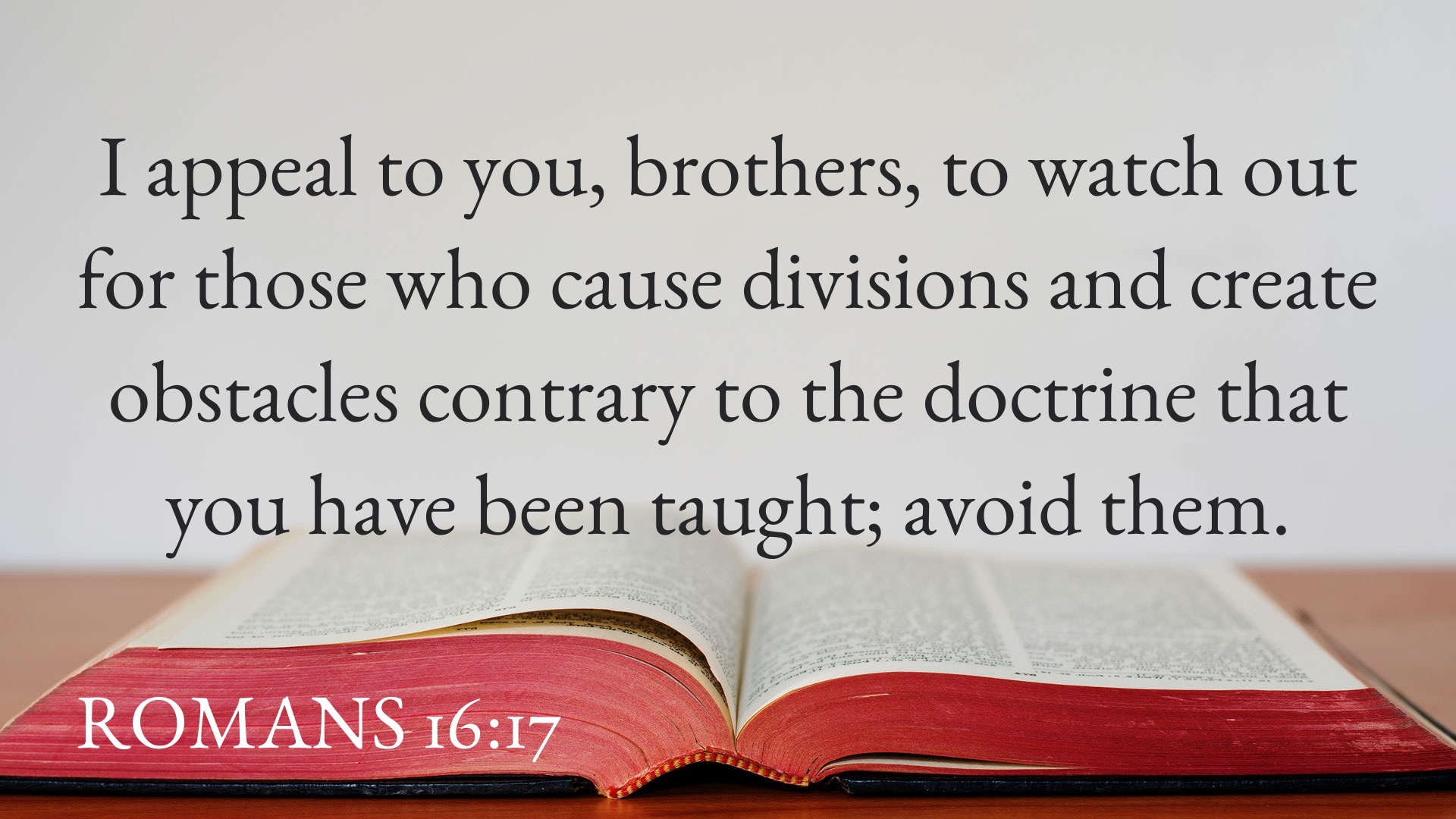
Romans 16_17Beware. Do the Scriptures teach, as Roman Catholics believe, that when the pope speaks officially, his words have the same authority as the Scriptures? No. Does the Bible say, as Methodists teach, that Christians reach a point where they no longer sin? No. Does God’s Word say, as many churches say today, that baptism is the first act of obedience of a Christian? No.
Even though ‘doctrine’ has become a dirty word, it isn’t. ‘Doctrine’ simply means ‘teaching.’ If we go along with others who say that doctrine shouldn’t divide us, what we are really saying is one of two things:

Either we say that Scripture isn’t clear and one person’s opinion about what the Bible teaches is as valid as another’s. But if the Scripture isn’t clear, how can you know the clearest teaching of Scripture, that God forgives you? Here’s the thing, and this is going to sound harsh (are you ready?): Your opinion of what Scripture teaches doesn’t matter. The only thing that matters is what the Bible actually says and teaches.

Or, the other thing we say if ‘doctrine’ is a dirty word, is that what Scripture says doesn’t matter. And this is false. The Bible matters because it is God’s clear, inerrant, infallible Word. When God says something, it is true whether you believe it or not, whether you understand it or not. You’ve probably heard the expression, “God says it. I believe it. That settles it.” The order there is wrong and dangerous. Your belief doesn’t settle the matter. Instead try this, “God said it. That settles it. I believe it.” It’s much better.

At Jesus’ command, we need to be on guard against false doctrine and teaching because that is the thorny, rotten, diseased fruit of false prophets. And it isn’t fun work. It is sad, and we have no pleasure in pointing out false teaching. But we must do it because Jesus says we must. So, judge the fruits of every preacher you hear. The fruit of a preacher is his words. Compare the words of every preacher to what Jesus has given you.

Jesus has given you His saving blood. Christ has given you peace with God. Jesus gives you the assurance your sins have been forever erased by His death and resurrection. And Jesus gives you eternal life in His resurrection.

If a preacher points you to yourself, he is giving you nothing but thorns, thistles, and rotten fruit. If a preacher won’t declare to you that your sins are forgiven for Jesus’ sake, he is no sheep. If a preacher says that the sins you feel in your conscience are no big deal and don’t need to be forgiven, he’s a wolf. Run.

Blessings from the CrossYou need the good fruit of God’s Word. It is your source of life. It is your nourishment that sustains you in this life and the next. Pluck that good fruit from the cross which has become the tree of life.

Nourished by Jesus’ forgiving blood, may we all eat and live at His table. Amen.

The peace of God, which surpasses all understanding, will guard your hearts and minds in Christ Jesus. Amen.

[1]A bear was roaming through Grand Forks this week.