1 Now concerning the times and the seasons, brothers, you have no need to have anything written to you. 2 For you yourselves are fully aware that the day of the Lord will come like a thief in the night. 3 While people are saying, “There is peace and security,” then sudden destruction will come upon them as labor pains come upon a pregnant woman, and they will not escape. 4 But you are not in darkness, brothers, for that day to surprise you like a thief. 5 For you are all children of light, children of the day. We are not of the night or of the darkness. 6 So then let us not sleep, as others do, but let us keep awake and be sober. 7 For those who sleep, sleep at night, and those who get drunk, are drunk at night. 8 But since we belong to the day, let us be sober, having put on the breastplate of faith and love, and for a helmet the hope of salvation. 9 For God has not destined us for wrath, but to obtain salvation through our Lord Jesus Christ, 10 who died for us so that whether we are awake or asleep we might live with him. 11 Therefore encourage one another and build one another up, just as you are doing.
9 After this I looked, and behold, a great multitude that no one could number, from every nation, from all tribes and peoples and languages, standing before the throne and before the Lamb, clothed in white robes, with palm branches in their hands, 10 and crying out with a loud voice, “Salvation belongs to our God who sits on the throne, and to the Lamb!” 11 And all the angels were standing around the throne and around the elders and the four living creatures, and they fell on their faces before the throne and worshiped God, 12 saying, “Amen! Blessing and glory and wisdom and thanksgiving and honor and power and might be to our God forever and ever! Amen.”
13 Then one of the elders addressed me, saying, “Who are these, clothed in white robes, and from where have they come?” 14 I said to him, “Sir, you know.” And he said to me, “These are the ones coming out of the great tribulation. They have washed their robes and made them white in the blood of the Lamb.
15 “Therefore they are before the throne of God, and serve him day and night in his temple; and he who sits on the throne will shelter them with his presence. 16 They shall hunger no more, neither thirst anymore; the sun shall not strike them, nor any scorching heat. 17 For the Lamb in the midst of the throne will be their shepherd, and he will guide them to springs of living water, and God will wipe away every tear from their eyes.”
In the name of Jesus. Amen.
Dear saints of God. Has anyone ever shown you a photo and said, “That’s a picture of me when I was younger”? The snarky, obvious reply would be, “Isn’t every picture of you a picture of when you were younger?” It doesn’t matter if the picture is almost immediately available on the screen of your phone or if the picture has been sitting in some dusty photo album for years. They’re all a picture of you when you were younger.
Photos are a great way to preserve memories and pass along the stories of our lives and the lives of our loved ones. Even though those pictures captured just one moment in time, they remind us of so much more than the fraction of a second that it took for the shutter to open and close. They are a window into the lives of people in them, some of whom are no longer with us. Those pictures of the past have tremendous value.
When you take the time to look at old photos with family, you learn more about the people you love and can connect with them in a deeper way. You might find out that your quiet, tough, deer-hunting grandpa played the clarinet his freshman year of high school. You get the opportunity to tell your kids about the time you visited Mt. Rushmore as a kid just like they did. But when you went in 3rd grade, Aunt Jane got carsick on the drive up there. Two years ago at Thanksgiving, I learned that a pastor friend of mine has an uncle who was a groomsman for my father-in-law. Without looking through a photo album, I never would have known that my family was already tied to his.
With Thanksgiving coming up, I’d encourage you to do this. I know some of you kids might think it’ll be boring, but maybe you can make a game of it. See if grandma says, “That’s a picture of me when I was younger.” Just don’t make fun of her if she does.
In our text today we get to see an old picture, nearly 2,000 years old. But it is still a vivid, vibrant picture. It’s especially magnificent and spectacular because, even though it’s an old picture, it’s a picture of you in the future. The Apostle John sees the entire church – every Christian being welcomed into God’s presence. It’s a picture of the Church triumphant.
Now, before we look at the details of this picture, something needs to be crystal clear. This is not something in a galaxy far, far away. Nope! What is contained in this picture is right here and all around us. Hebrews 12:22-24a says that when you are here at church, “[Y]ou have come to Mount Zion and to the city of the living God, the heavenly Jerusalem, and to innumerable angels in festal gathering, and to the assembly of the firstborn who are enrolled in heaven, and to God, the Judge of all, and to the spirits of the righteous made perfect, and to Jesus, the mediator of a new covenant.” Can you see it? No. But does that mean it is any less real? Not at all!
Now, to the picture. The major details of the picture are a great multitude – more than anyone could count. People from every nation, tribe, and language. They stand before the Lamb who is on the throne. They wear white robes, wave palm branches, and sing, “Salvation belongs to our God who sits on the throne and to the Lamb.” That’s what you see with a quick glance at the picture.
Next, our text gives the caption that’s under the picture which lets us know the identity of this multitude. One of the elders asks John, “Who are these people clothed in white robes, and from where have they come?” Maybe John could have mustered up a good guess. Already in Revelation, John has seen a lot of awesome, amazing, wonderful things. But he’d rather hear the elder say who they are, so he punts the question back to him, “Sir, you know.” And the elder gives the caption, “These are the ones coming out of the great tribulation.”
Now, that’s a good, accurate translation so long as we see that this is a present, ongoing thing – a continual process. To get the idea gets across, it could be translated, “These are the ones who are coming out of the great tribulation.” In other words, this already massive crowd keeps growing bigger and bigger all the time as believers leave this life and enter the next, and they are leaving the great tribulation.
Now, there are some very smart Christians who disagree with me on this, but because of how Scripture uses the word for ‘tribulation,’ I do not think this is some future thing. In the opening verses of Revelation, John writes that he is our brother and partner of the tribulation and the kingdom (Rev. 1:9). Jesus, in Jn. 16:33, says, “In this world you have tribulation.” The word for ‘tribulation’ is θλῖψις (thlipsis) and it can be translated tribulation, affliction, trouble, and suffering. Different translations will tend to favor using one of those words more often than others. But when you look at all the different places the word is used, you can see that it is a description of our life in this broken, fallen world. It is to be in this veil of tears. The people in this picture John puts before us are coming out of this tribulation.
If you look back at the previous chapter (Rev. 6), you see that this multitude has come out of war, famine, sickness, economic hardship, persecution, and political turmoil. But now they are standing before the Lamb and singing His praise. What this means is that all the believers we love but have died, they are still singing God’s praise. They are all there in the great host. They made it.
They’re holding the palm branches, singing the songs, standing in the presence of Jesus, the Lamb who shed His blood and was slaughtered to forgive them all of their sins. Jesus, the Lamb who died and rose again is now their Shepherd. All of them are in this picture because they are the saints who have gone before us. God be praised.
But, dear saints, remember that this is All Saints’ Sunday. You are part of that host too. You are also coming out of the great tribulation. Yes, you’re still in it, but you are in the process of coming out of it as you hold to faith in Christ. It is a picture of you when you are older, and because you have this picture, your life in this great tribulation becomes a little more bearable.
The troubles and trials of this world that leave your robes tattered, torn, stained, and defiled, they will all be plunged into the blood of the Lamb and come out dazzling white. The afflictions and persecutions you endure now will go away because you will be sheltered by and in His presence. You know that your hunger and thirst for peace and security will be satisfied. The tribulations that make your pillow wet with tears, they will all be wiped away.
Yes, you, dear saint, are part of this endless, uncountable crowd, but you aren’t lost in the host. For you, for each and every one of you, God will wipe away every last tear. The whole host is there. Not one is missing. Yet, every individual is intimately cared for by the Lamb.
This is true because Jesus, your Savior, has come and made you His saint. He has and will make everything sad come untrue. Everything that has been broken because of sin will be all the more beautiful because it has been redeemed and made new by the blood of Christ.
You, believer, are part of that host. Come quickly, Lord Jesus. Amen.
The peace of God, which surpasses all understanding, will guard your hearts and minds in Christ Jesus. Amen.
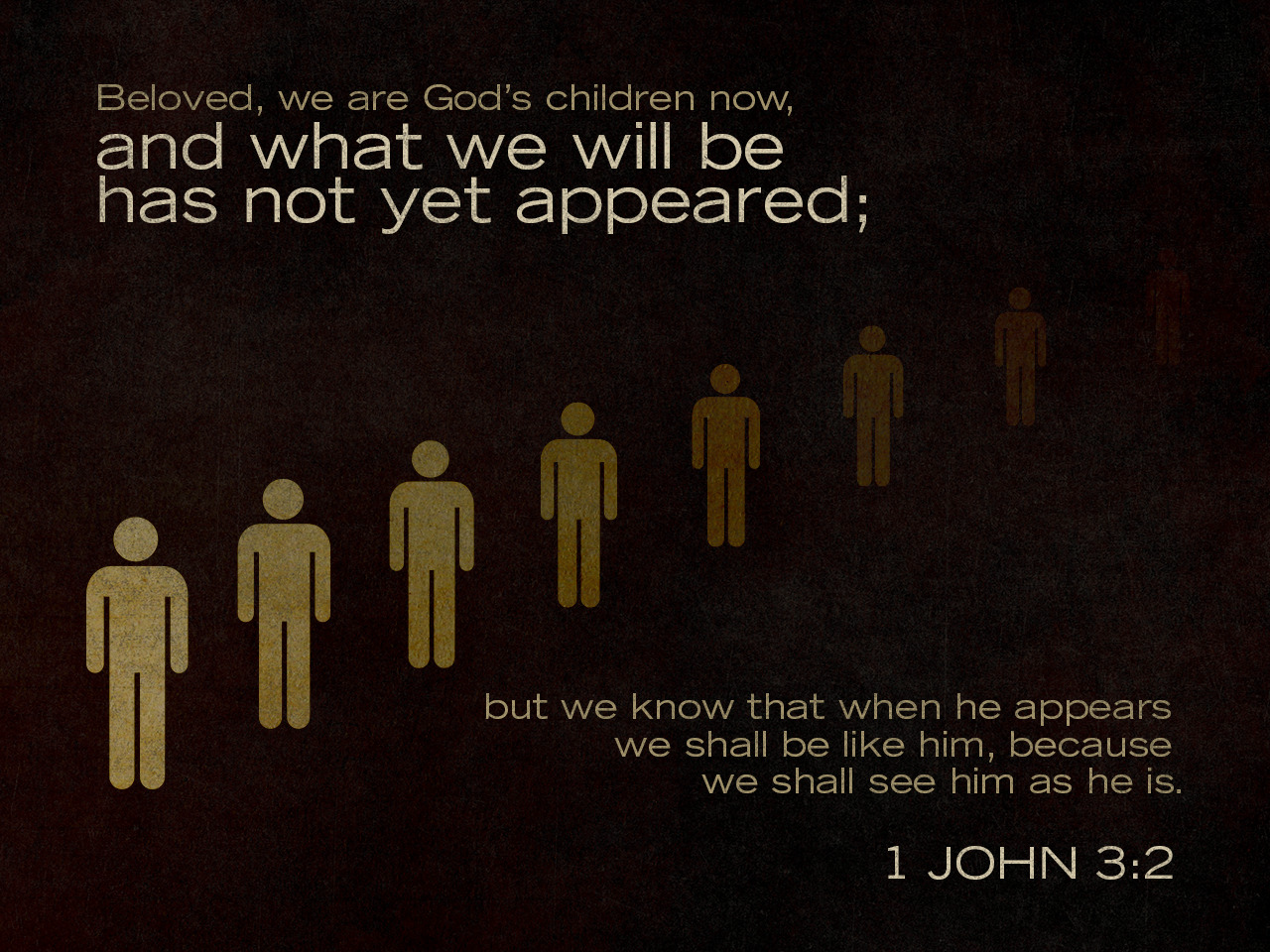
1 See what kind of love the Father has given to us, that we should be called children of God; and so we are. The reason why the world does not know us is that it did not know him. 2 Beloved, we are God’s children now, and what we will be has not yet appeared; but we know that when he appears we shall be like him, because we shall see him as he is. 3 And everyone who thus hopes in him purifies himself as he is pure.
Alleluia! Christ is risen! He is risen indeed! Alleluia!
In the name of Jesus. Amen.
We live in a noisy world. On any given day, all sorts of things are constantly trying to grab your attention. We get dings and vibrations and taps that let us know who sent a message, what news story is breaking, or who liked that thing you posted. If you have to spend even ten minutes in a waiting room or a restaurant, you’ll find televisions turned to a game or news channel with the constant crawl of information that isn’t important enough, at least at that moment, to be on the main part of the screen. You’re watching the news about what’s going on in the Middle East and get the latest OJ Simpson’s death. Or you’re watching the NBA playoffs and learn about some guy’s hot take on what the Vikings are going to do in the first round of the NFL draft. And on and on it goes.
Now, this isn’t a sermon about how pointless and exhausting this barrage of information is. It’s just an acknowledgement of the conditions in which we live. Our attention is being constantly pulled in a myriad of directions, and all sorts of things shout at you, “Pay attention to me!” Well, this epistle reading (1 Jn. 3:1-3) is calling for your attention. In fact, it’s commanding you to pay attention. So, for the next few minutes, don’t be distracted, don’t be pulled, don’t be thinking about what’s going to happen this afternoon or this week or next summer. Right now, God, through His holy Word, calls you to focus and see. See this.
See the kind of love the Father has given to us. It is the kind of love that calls you, believer, a child of God. It is a love that calls all y’all, Christians, children of God. That is who you are – a child of God. Look around at the believers surrounding you here today, people whom you love and who love you, see that they through faith are also children of God.
See the kind of love that turns sinners and enemies of God into children. See the kind of love that isn’t earned or deserved. See God’s love for you that is demonstrated in that while we were still sinners, Christ died for us (Ro. 5:8). This is the purest kind of love. It’s God’s love that is not based on the lovableness of the individual. It’s a love that is freely given because, in spite of our unloveliness, God determined to seek your highest good and make you His child.
God’s own child, that is what you are, believer. That is what God has called you, and what God says creates reality. Everything in this world – including your own thoughts, opinions, and experiences – will try to convince you otherwise. It will attempt to get you to believe this isn’t true. Don’t listen to any of that. See. Behold. God’s love has made you His child.
Christian, God’s love has given you a new birth. In his Gospel, John says this explicitly. To all who did receive Jesus, those who believe in His name, He gives the right to become children of God (Jn. 1:12), and this right came when you were born again of water and the Spirit (Jn. 3:3, 5-6).
You confirmands, you have this new birth as a child of God. Logan, you received this new birth when you were Baptized on July 3rd, 2011 at Bigwoods Lutheran Church in Bigwoods, MN. Brayden, you were born again as God connected His Word to water on November 16th, 2013 at St. Henry’s in Perham, MN. Maddie, same place, but for you on April 16th, 2011 that was when and where you were born as a child of God. Brady, July 7th, 2013 right there at that font, you became a child of God. And Asher, same font, on November 25th2012, God declared that you are His child. The rest of you here, I’m sorry, but I don’t have your exact information in front of me.
This command to see this kind of love is in the present tense. That means it is a command that you always and continually see this kind of love. That love is to color everything else in your life. Keep holding on to that love because it is the most precious thing you could ever have. That love makes you God’s children now. Right now. What will we children of God be when we grow up? We don’t know, not yet.
John admits that even he doesn’t know exactly what glorious things are in store for us children of God. Think of that. John had seen some glorious things. He saw Jesus’ miracles and transfiguration. John saw the empty tomb. It was so glorious that he kept bragging about the fact that he outran Peter and was the first disciple to see it (Jn. 20:2-5, 8). The evening of Jesus’ resurrection, John had seen Jesus’ resurrected hands, feet, and side (Jn. 20:19-20; Lk. 24:36-43). As best as we can tell, John wrote this epistle after he had seen the vision of recorded in Revelation. That means John had seen Jesus clothed in a robe with a golden sash. He saw Christ’s eyes like a glorious flame of fire. John saw Jesus’ face shining like the sun in full strength (Rev. 1:13-16). And still John says here, “I don’t know what we children of God will grow up to be. I haven’t seen it yet because it hasn’t appeared” (1 Jn. 3:2). “But,” John says, “But we know that when Jesus appears we will be like Him, because we shall see Him as He is.”
You confirmands and everyone here today, it can be dangerous to look to the past. And it can be troubling to think about the future. If you do look to the past, look at it through the lens of being God’s beloved child. When you consider your present, keep this command and see the constant love God has for you. When you look to the future, have in mind that you, through faith, are a child of God. And keep longing and hoping for that moment when Christ, your Savior, returns knowing that then you will be like Jesus.
That faith, that hope is what makes you pure – pure as Jesus is pure. God wants to orient you to the present reality that you are His child. Because of His love, you have a seat at His table where He gives you His Body to eat and His Blood to drink for the forgiveness of all your sin. You have a seat at His table. Child of God, as you wander through this world, know that you belong among God’s family. Welcome home, children of God. Amen.
Alleluia! Christ is risen! He is risen indeed! Alleluia!
The peace of God, which surpasses all understanding, will guard your hearts and minds in Christ Jesus. Amen.
1 Now when they drew near to Jerusalem and came to Bethphage, to the Mount of Olives, then Jesus sent two disciples, 2saying to them, “Go into the village in front of you, and immediately you will find a donkey tied, and a colt with her. Untie them and bring them to me. 3 If anyone says anything to you, you shall say, ‘The Lord needs them,’ and he will send them at once.” 4 This took place to fulfill what was spoken by the prophet, saying,
5 “Say to the daughter of Zion, ‘Behold, your king is coming to you, humble, and mounted on a donkey, on a colt, the foal of a beast of burden.’”
6 The disciples went and did as Jesus had directed them. 7 They brought the donkey and the colt and put on them their cloaks, and he sat on them. 8 Most of the crowd spread their cloaks on the road, and others cut branches from the trees and spread them on the road. 9 And the crowds that went before him and that followed him were shouting, “Hosanna to the Son of David! Blessed is he who comes in the name of the Lord! Hosanna in the highest!”
In the name of Jesus. Amen.
Dear saints, welcome to Advent. ‘Advent’ means ‘coming.’ One of my goals with this sermon and the rest of the sermons leading up to our Christmas Eve service is to deepen your appreciation for the season of Advent and cultivate the attitude Advent gives us. And I want to be clear: I’m not going to chide you if you put up your Christmas tree and decorations immediately after putting the Thanksgiving leftovers in your fridge, and I’m not going to call you to repent if you started watching Hallmark Christmas movies or listening to Christmas music weeks ago. Don’t worry about that.
So, about Advent. Yes, Advent precedes Christmas, but Advent isn’t “pre-Christmas.” The season of Advent isn’t meant to only prepare us to celebrate that Jesus was born. The dominant idea of Advent is the thought of our Lord’s coming in three ways. First, God has come in the flesh of Jesus. Second, God will come again; Jesus will return in His body to judge the living and the dead. And third – and maybe most importantly – God continually comes to us now in grace in His Body and Blood given in Holy Communion, in the preaching and hearing of His Word, and in the fellowship of the Church which is His body (Col. 1:24).
Dear saints, God came, God is coming, and God comes. And this is exceptionally Good News because, as Psalm 16:11 says, “In Your presence there is fullness of joy.” God’s coming brings joy. But too often, we prefer to substitute the joy of God’s presence with other things.
In his book Mere Christianity, C.S. Lewis wrote, “[H]uman history… [is] the long terrible story of man trying to find something other than God which will make him happy” (p. 49). We see this playing out at the beginning of human history. I know you know all of this, but it’s good to hear it again. The devil enticed Adam and the woman to take what God had forbidden. Rather than trusting God’s promise that gaining the knowledge of good and evil would turn out badly, the couple took the fruit and ate. They got the knowledge of evil, but it didn’t make them happy.
Instead, they realized their nakedness and shame, so they tried to cover themselves with fig leaves. Their own attempt at finding an answer to their sin and guilt apart from God providing a solution didn’t make them happy either. But something made the first couple even more unhappy. They heard God coming into the Garden. The all-powerful Creator of the universe was coming, and they thought He was coming for their destruction. Rather than running toward God, they ran away from Him. God was coming with power, but He was coming in mercy and grace to give them chance after chance to repent. This is why we need Advent; it helps us see that God’s coming is Good News because He comes to restore sinners unto Himself.
God asks, “Where are you?” (Gen. 3:9). God knew where they were, but God was coming in peace and love, begging them to confess and be forgiven. But Adam responded that he was afraid because he was naked. So, God asks, “Who told you were naked? Have you eaten the forbidden fruit?” (Gen. 3:11). In other words, “Adam, repent.” But Adam starts pointing his finger, “The woman, whom You gave to be with me, she gave me the fruit, and I ate” (Gen. 3:12). Basically, Adam is saying, “God, it’s all Your fault.” So, God turns to the bone of Adam’s bones and the flesh of Adam’s flesh, and asks her, “What did you do?” which is yet another call for repentance. But the woman also passes the buck, “The serpent deceived me, and I ate” (Gen. 3:13). All of this running from God, passing the blame for our own sin, and blaming God is, sadly, how we sinners naturally react to God’s coming.
In a real sense, the rest of Genesis 3 along with the rest of the Bible is God promising to restore the fullness of joy in His presence (Ps. 16:11). Yet still, we fallen sinners seek happiness apart from God and His coming because we wrongly think that God’s coming means our judgment and condemnation. Now, yes, on the Last Day when Jesus returns that will be true for unbelievers who keep seeking a false, temporary happiness apart from God’s gracious presence. But for you, while you still breathe, God comes in grace and mercy. That is why we read this Gospel text today to open the season of Advent. It occurred on Palm Sunday just days before Jesus’ crucifixion. Look how God comes:
King Jesus comes to His royal city, and there is power in His coming. The cattle on a thousand hills are His (Ps. 50:10), so is the donkey and its colt. If He needs them, they are His to use. This crowd of people welcomes Him as the King without anyone telling them what to do. Yes, His coming is an unstoppable force. But, unlike other kings, He comes humbly. He didn’t ride into the city as a regal conqueror on an impressive war horse. He came riding on a colt. He didn’t come with legions of armies. He came with crowds of lowly, common people crying out, “Hosanna,” which means, “Save us.” He didn’t enter a lavish palace with a high and lofty throne. His battered, beaten, bloodied body hiked up a hill carrying His own cross to the place where He gave His life for sinners. Even when Jesus came as King, He came to give His life for sinners to bring them back into the joy of His presence (Ps. 16:11).
And this kind of humble coming marked His entire life. During His ministry, Jesus dined and associated with tax collectors and sinners (Lk. 15:1-2, 7:39). He surrounded Himself with an entourage of fishermen. And, of course, His arrival in the flesh was also meek, lowly, and gracious. Conceived by a young fiancée of a carpenter from Nazareth, born in a barn, and laid in a feeding trough, God came in the flesh of a swaddled infant.
Until He comes again in glory, God comes to forgive, redeem, and purchase you from all your sins and trespasses against Him. God comes to you to restore you back into a right relationship with Himself.
Believer, in a sense, you have always been living in Advent. Until Jesus returns, you are always looking, waiting, and watching for His coming even as He comes to You now in His Word and Sacrament. Yes, He always comes in power, but He humbly uses His power to forgive, redeem, restore, and save you.
Christ came, He is coming, and Christ comes now inviting you to His table where He will show you His steadfast love and grant you His salvation (Ps. 85:7). Dear saints, Christ doesn’t to judge you. He comes to bring you forgiveness, life, salvation, and the joy of His presence. Amen.
The peace of God, which surpasses all understanding, will guard your hearts and minds in Christ Jesus. Amen.


 Pastorsamwise
You must be logged in to post a comment.