
Comfort to the Heart – Sermon on Isaiah 40:1-8 for the Third Sunday of Advent

Isaiah 40:1-8

In the name of Jesus. Amen.

In your lowest moments – and even before those lowest moments arrive – God is there tenderly speaking, “Comfort, comfort,” to you, His people. He speaks that comfort to remove the burden of the debt of sin, and this changes everything for us sinners.

Just before our text, in Isaiah 39, Hezekiah, the king of Judah, welcomes an envoy of ambassadors from the king of Babylon. That empire was growing in strength and power, and Hezekiah wanted to have Babylon as an ally in case the Assyrian Empire attacked Judah. While those ambassadors were there, Hezekiah does what kings often do. He shows off. He gives the ambassadors a tour of his palace and shows them all of his treasure. He flaunted his silver, gold, and spices. Hezekiah displayed all the weapons of his armory – his entire treasury. He left nothing hidden. Basically, Hezekiah was boasting about himself and the greatness of his kingdom, but he doesn’t boast about his Lord and God who had given it all to him.

After the Babylonian delegation leaves, the prophet Isaiah visits the palace to confront Hezekiah about all this. Isaiah rebukes him for being so foolish and prophesies that the Babylonians will come again in a hundred years to strip the palace and the Temple of everything. All the gold and wealth and treasure and weaponry of Hezekiah’s kingdom – it will all be taken by the Babylonians because Hezekiah’s pride did nothing more than make himself a target by showing off. Isaiah says that Hezekiah’s descendants would pay the price of his foolish actions.

And Hezekiah’s response is, frankly, disgusting. Basically, he says, “Let me get this straight, Isaiah. You’re saying that I get to keep the treasure? Babylon isn’t going to come and ransack and pillage as long as I’m alive?” And Isaiah says, “Yeah, but listen. It’s going to happen to your descendants.” But Hezekiah doesn’t care. Instead, he says, “Cool. Everything will be safe and secure in my days.” That, of course, is the wrong response.

Hezekiah should have fallen to his knees and begged for God to forgive him or, at least, ask that the payment of his foolishness not fall upon his children and grandchildren. Instead, Hezekiah callously says, “This is great. I don’t have to deal with it.”

Just over 100 years later, the price of Hezekiah’s foolishness and pride was paid. Babylon came. They destroyed the Temple. Men, women, and children were slaughtered in the streets. The nation was torn apart. People were ripped from their country, their lands, and their homes. And they were taken into exile in Babylon (2 Kgs. 25:1-212 Ch. 36:17-21Jer. 52:1-30).

Imagine enduring all of that. Imagine being part of that generation who paid the debt of Hezekiah’s pride. They watched as all these things happened, and because they were familiar with the book of Isaiah, they knew that they were paying Hezekiah’s debt because he was totally fine with passing that debt of his sin off to a future generation.

If you were part of that generation who endured that destruction, how would you handle and process that? How could you be anything but bitter and resentful that your forefather had been totally willing to pass the punishment of his sin off to you? How would you cope? Where would you find comfort?

Well, you would find it here in these verses that come immediately after Isaiah recorded Hezekiah’s foolish and callous actions. And dear saints, these verses aren’t only for the people who were carried into exile in Babylon. They are also for you today. Now. “Comfort, comfort My people, says your God. Speak tenderly to Jerusalem.” And that phrase, ‘speak tenderly,’ is a lot stronger in Hebrew. It’s an idiom that is literally translated, “speak to the heart.” God isn’t just speaking cliché platitudes from a far, distant place. No. Your God leans in close to speak comforting words directly into the heart of you, His people.

These words of comfort here in Isaiah 40 are for you because you are God’s people through faith in Christ. And these words cut through the noise and chaos of sin and suffering to touch you where your ache is sharpest and deepest. In the midst of the pain that has come to you because of sin – both your sin and the sins of others – God speaks tenderly, He speaks directly to your heart, “Be comforted. Be comforted. [Your] warfare and hardship is ended; [your] iniquity is pardoned.”

This whole text is beautiful, and dozens sermons could be preached on each line of the text. We could focus on the lines concerning John the Baptizer who would proceed Jesus and make a straight, level highway in the wilderness for the coming of the God who brings this comfort. We could ponder the arrival of God’s glory that will be seen by all flesh for eternity.

Earlier this week, I considered focusing this sermon on the lines about all flesh being like grass. Remember how Adam and Eve – who, after the Fall, became like the grass that withers and fades – they tried to cover themselves with foliage when they heard the sound of God walking in the Garden of Eden (Gen. 3:7-8). But God had come to give them the comfort that He would send the Seed of the woman to crush the serpent’s head (Gen. 3:15). And that Word of promise endures forever. Maybe, I’ll preach that sermon sometime in the future. Anyway, there’s an eternity of sermons that could be preached from these nine verses.

But the thing I want to focus on today is that phrase from the last line of v. 2 about receiving, “from the Lord’s hand double for all [your] sins.” And I want to focus on it because, even though it sounds like Law, it is sweet, sweet Gospel spoken from God’s mouth directly into your heart. But we need to do a little groundwork first.

In Is. 40:2, Isaiah uses two of the three most common Hebrew words for breaking God’s Law – ‘iniquity’ and ‘sin.’ The third word that Isaiah doesn’t use here is ‘transgression.’ And each of these words give a slightly different picture of what sin is.

The Hebrew word that regularly gets translated ‘transgression’ means to cross a boundary. In each Commandment, God sets a line and crossing over that line is a ‘transgression’ or a ‘trespass.’ The Hebrew word that most often gets translated as ‘sin’ means to miss the mark. God has a standard for us, but we keep missing it. Think of an archer who never hits the target, let alone the bullseye. Finally, the Hebrew word that gets translated ‘iniquity’ refers to the guilt and shame caused by sin. Think of the weight and indebtedness you feel when you’ve wronged someone – that’s the iniquity. All three words deal with the same thing (our sin), but each one focuses on a different aspect of that sin.

Well, here God says that your iniquity, that debt and weight of sin, is pardoned and that you have received from His hand double for all your sins. Again, this should be comforting. God isn’t saying that He’s giving you double punishment for your sin. No!

Instead, God has taken that debt of sin. He pays for it. Imagine your sin as a pile debt on your account. Because of Jesus, the billions of debt that you owe because of your sin is all paid off. But God doesn’t stop and just get you to an even balance. In place of that massive debt, God credits your account with the righteous deeds and the perfect obedience of Jesus.

You can imagine a chalkboard where all your sins are written down. Through faith, Jesus comes and wipes every last speck of that chalk and dust off. But He doesn’t stop once your slate is wiped clean. He writes over that chalkboard all of the holy, righteous, and perfect works that He has done (see Mt. 25:31-40).

God knows the full debt of your sin down to the last penny. And when Jesus pours out His forgiveness, mercy, and salvation on you, it is in double measure of your debt.

In Jer. 31:34, God says that He forgives your iniquity and remembers your sin no more. Dear saints, be comforted. God doesn’t remember the kind or type of sins you have committed. He doesn’t remember the specific ways you have transgressed against Him and against your neighbor. The only thing that He remembers about your sin is the amount of debt you owe. And the only reason God remembers that is so He can give you a double portion of His grace and mercy (Jn. 1:16).

That is the comfort He gives to you. That is the comfort He speaks to directly into your heart today and every day. Your Redeemer will continue to speak that comfort to you, and His Word of grace, mercy, and comfort endures forever. Amen.

The peace of God, which surpasses all understanding, will guard your hearts and minds in Christ Jesus (Php. 4:7). Amen.

Even the Greatest Struggle – Sermon on Matthew 11:2-11 for the Third Sunday of Advent

Matthew 11:2-11

2 Now when John heard in prison about the deeds of the Christ, he sent word by his disciples 3 and said to him, “Are you the one who is to come, or shall we look for another?” 4 And Jesus answered them, “Go and tell John what you hear and see: 5 the blind receive their sight and the lame walk, lepers are cleansed and the deaf hear, and the dead are raised up, and the poor have good news preached to them. 6 And blessed is the one who is not offended by me.”

7 As they went away, Jesus began to speak to the crowds concerning John: “What did you go out into the wilderness to see? A reed shaken by the wind? 8 What then did you go out to see? A man dressed in soft clothing? Behold, those who wear soft clothing are in kings’ houses. 9 What then did you go out to see? A prophet? Yes, I tell you, and more than a prophet. 10 This is he of whom it is written,

“‘Behold, I send my messenger before your face, 
who will prepare your way before you.’

11 Truly, I say to you, among those born of women there has arisen no one greater than John the Baptist. Yet the one who is least in the kingdom of heaven is greater than he.”

In the name of Jesus. Amen.

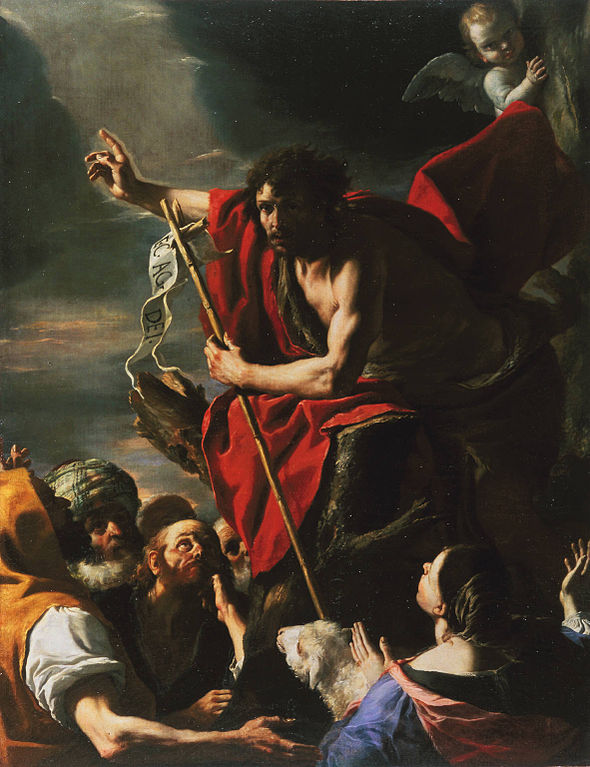
John the Baptizer, you know him. You love him. That camel hair wearing, locust eating, outspoken prophet in the wilderness is a combination of a biker gang member, wilderness survivalist, and street-corner preacher. John preached, “Repent for the kingdom of heaven is at hand.” He announced that Jesus was coming after him, and John said he wasn’t worthy to stoop down and untie Christ’s sandals (Mk. 1:7). Scripture tells us that the people of Jerusalem, all Judea, and all the region around the Jordan were going to be baptized by John (Mt. 3:5). John came to bear witness to Jesus as the true Light who gives light to everyone (Jn. 1:6-9). And he pointed people to Jesus as the Lamb of God who takes away the sin of the world (Jn. 1:29ff).

John preached the Gospel, but he also preached the Law. He would call out the Pharisees and Sadducees, calling them a brood of vipers (Mt. 3:7). And when Herod the tetrarch married his brother’s wife, John spoke out against this evil thing (Lk. 3:19-20). That is why John is in prison when we meet him here. (Just a side note: Yes, there are times that a preacher should call out the evil things politicians do.) For his whole life, John had been a faithful steward of the mysteries of God’s Word (1 Cor. 4:1-2).

But here, in this text, John is nearing the end of his life and is soon to be executed. He is in a dank, dark prison cell. He probably had no heat or light, wasn’t being fed well, and was shackled in some way. But even though he is in prison, John was able to visit with his disciples. From that dark place, John sends his disciples to ask Jesus an important but surprising question, “Are You the one who is to come, or should we look for another?”

The question, in and of itself, is a great question, but we should be surprised and utterly shocked at the source and originator of this question. John already knew the answer. On top of everything I’ve already mentioned about him, John is the one who baptized Jesus. After that baptism, John saw the Holy Spirit descend and remain on Jesus (Jn. 1:31-33). John heard God the Father say, “This is My beloved Son, with whom I am well pleased” (Mt. 3:17). And John publicly proclaimed that Jesus is the Son of God (Jn. 1:34).

But now, John asks Jesus, “Are You really the Messiah?” It’s shocking. So shocking, in fact, that after Jesus answers the question with all the proofs – the blind see, the lame walk, lepers are cleansed, the deaf hear, and the dead are raised up – Jesus then turns to the crowds and defends John for even asking this question and talks him up a bit. Christ basically says, “Listen, you didn’t go out in the wilderness to listen to a reed shaken by the wind or to see a guy dressed up funny clothes.” And, quite honestly, what Jesus says there is at least PG-13, just ask me after the service. Jesus goes on to say that John the Baptist is a prophet, and more than a prophet. He is the long-promised messenger who would prepare the way of the Messiah (Mal. 3:1). On top of that, Jesus says that John the Baptizer is the greatest of all men ever born. This is absolutely stunning.

Just think about this. According to Jesus, John is greater than Noah, Abraham, Moses, David, Solomon, Elijah, Isaiah, Jeremiah, Ezekiel. So, the question before us this morning is why does John ask Jesus, “Are You he one who is to come, or should we look for another?”?

Now, there are two schools of thought as to why John would ask this question. Some say that John is having legitimate doubts and is second-guessing his entire ministry of pointing people to Jesus, but others completely dismiss that possibility and say that John is asking this question to get his disciples to follow Jesus. But I don’t think we can simply dismiss the theory that John doubted. Here’s why.

Everything we know about John is that is he was direct and doesn’t beat around the bush. If he wanted his disciples to follow Jesus, he would have told them straight out, and we have passages of Scripture where John does exactly that (Jn. 1:26-30). Another reason to reject the theory that John is trying to get his disciples to follow Jesus is that Jesus doesn’t go along with the plan. Christ sends those disciples back to John to report what they hear and see. If John was trying to get his disciples to follow Jesus, you would think that Jesus would invite them to follow Him. But Jesus takes John’s question seriously. Finally, the speculation that John is trying to get his disciples to follow Jesus typically works under the assumption that Christians cannot or should not ever have serious doubts or difficulties. And that assumption is wrong.

All sorts of strong believers in Scripture went through times of struggle and doubt. Abraham, Jacob, Job, Moses, David, Elijah, Peter, and Paul all faced serious doubts – some of them more than once. Why wouldn’t John, even though he is the greatest man ever born, face that too?

Dear saints, even the greatest struggle in the faith. Just consider, for a moment: how many people did John minister to? How many did he point to Jesus when they faced temptation, guilt, pain, suffering, and struggles? But, now, as John is sitting in prison, he is the one who needs the ministry of the Gospel. He needs to be reminded. He needs to be pointed to the same Jesus he pointed others to as he travels down his own dark road. If John the Baptizer gets to that place, so will you, if you haven’t already.

So, I want to leave you with two thoughts, which should also be encouraging. First of all, there is a difference between John’s question here, where he is struggling and panicking a bit (I think we can categorize his question that way), there is a difference between that and real intellectual questions about Christianity, God, the resurrection, and other aspects of our faith. None of us are immune to the struggle that John is going through here. If even the greatest man ever born struggles in this way, expect that you will as well. So, when (not if but when) you face these spiritually dark times, don’t panic. Do as John does here and bring those questions to Jesus. Dive into Scripture and hear God’s promises again. Pull out the Psalms and see how often they deal with these spiritually low places. And know that I am here to help. I’m here to minister to you in those times, and so are all your brothers and sisters in Christ.

Now, there might be times where you have intellectual questions about the faith. That is a different thing entirely. If that’s the case, if you have a question about creation because of what you have heard in a science class that is teaching the theory of evolution, or a question about if the Resurrection of Jesus actually happened, or about Christianity in general, ask someone who knows more than you do. I can help answer a lot of those questions or I can help you search for and find the answers. Don’t be a fool and think there aren’t answers for those types of questions. You aren’t so smart that you have found a hole in our faith that hasn’t already been answered. Christianity is intellectually rigorous and can answer even your most difficult questions. So don’t be afraid to ask them. But remember that is a different thing than going through a dark, difficult time spiritually.

The second thing I want you to observe is how gently Jesus answers John’s question. Consider this question from Jesus’ perspective. Throughout the Gospels, Jesus hardly gets a break. He’s always teaching, healing, ministering. Even when Christ does try to get away from the crowds for a bit, He ends up being found and having to do more (Mk. 6:30-34), or Jesus will try to sit down to rest but ends up ministering to another lost soul (Jn. 4:6-26), or Christ tries to catch a quick nap and His disciples will wake Him up with their problems (Mt. 8:23-27). When this question comes from John, Jesus doesn’t throw up His hands, groan, and say, “What! John needs help too? Isn’t he supposed to be the greatest? I don’t have time for this.” No, Jesus answers John’s question kindly, softly, and without a single, solitary shred of impatience.

Jesus doesn’t rebuke John. He doesn’t complain about how busy and tired He is. Jesus simply says exactly what John needs to hear. Jesus is patient and gentle with John, and He is with you too.

I know this text of John the Baptizer sitting in prison and struggling in his faith doesn’t sound very Christmassy, but it is very practical, real life, and down to earth stuff. This can be a dark and lonely time of year. But the same Lord who loved John and gave him the encouragement he needed in the moment he needed it is here for you to speak peace to you and encourage you. Rejoice! He will see you through because He has promised. Amen.

The peace of God, which surpasses all understanding, will guard your hearts and minds in Christ Jesus. Amen.

Comfort Doubled – Sermon on Isaiah 40:1-8 for the Third Sunday of Advent

Listen here.

Isaiah 40:1-8

1 Comfort, comfort my people, says your God. 
2  Speak tenderly to Jerusalem, 
and cry to her 
     that her warfare is ended, 
that her iniquity is pardoned, 
     that she has received from the Lord’s hand 
double for all her sins. 

3   A voice cries: 
     “In the wilderness prepare the way of the Lord; 
make straight in the desert a highway for our God. 
4   Every valley shall be lifted up, 
and every mountain and hill be made low; 
     the uneven ground shall become level, 
and the rough places a plain. 
5   And the glory of the Lord shall be revealed, 
and all flesh shall see it together, 
for the mouth of the Lord has spoken.” 
6   A voice says, “Cry!” 
And I said, “What shall I cry?” 
     All flesh is grass, 
and all its beauty is like the flower of the field. 
7   The grass withers, the flower fades 
when the breath of the Lord blows on it; 
surely the people are grass. 
8   The grass withers, the flower fades, 
but the word of our God will stand forever.

In the name of Jesus. Amen.

I titled this sermon “Comfort Doubled,” but it maybe should have been “Infinite Comfort” because the whole text is dripping with comfort. Dear saints, whenever God comes, He comes to comfort you. Listen to what He says in v. 1 again, “Comfort, comfort my people, says your God.” These words are akin to what Jesus, who came not to call the righteous but sinners (Mt. 9:13), says in Mt. 11:28, “Come to Me, all who labor and heavy laden, and I will give you rest.” To any and all who are troubled, afflicted, and uncomfortable, God says, “Here is a double dose – two shots of comfort.”

Who gets this comfort? God’s people – whenever they are troubled. That means you. You are those for whom Christ was born. You are those whom God has claimed as His Own. You are the people for whom Christ has died. God says so Himself. He is the One who calls you, “My people,” and He is not ashamed to call Himself, “Your God.” If you play the first verse of this text backwards, God says to you, “I am your God. You are My people. And I give to you comfort on top of comfort.”

The context in which these verses were originally written helps us see just how comforting these words from God are. God has Isaiah tell Jerusalem that her warfare is ended, but when Isaiah writes these words Jerusalem isn’t even at war. Eventually, Babylon will come and besiege Jerusalem, and God’s people will be taken into exile. But even before any of that has happened, God comforts His people with the promise that her warfare will end.

Dear saints, God’s anger is but for a moment, and His favor is for a lifetime. Weeping may tarry for the night, but joy comes with the morning (Ps. 30:5). And before the suffering begins God preaches comfort to His people.

This is in line with God’s character, and we see this repeatedly in Scripture. Isaiah experienced this when God called Him to be a prophet. Isaiah saw God’s holiness and was terrified because he recognized his sinful lips. But God sent the seraph with a flaming coal to take away Isaiah’s guilt and atone for his sin (Is. 6:1-7). 

Remember how the shepherds saw the glory of God (Is. 40:5) and were terrified? But the angel assured and calmed them saying that God’s appearance in the birth of Jesus was “good news of great joy that would be for all people” (Lk. 2:10).

And even think to our Gospel lesson. John the Baptizer was sitting in a dank, dark prison cell, likely knowing that he would soon be executed. In that dark moment, John sent some of his disciples to confirm that Jesus was indeed the coming Messiah. And Jesus sends them back to John with those beautiful words of reassurance, “The blind receive their sight and the lame walk, lepers are cleansed and the deaf hear, and the dead are raised up, and the poor have good news preached to them. And blessed is the one who is not offended by me” (Mt. 11:4-6). All of these are fulfillments of what the coming Messiah would do (Is. 29:1835:5-6). John’s disciples return to John to reassure him with Jesus’ words. And after John’s disciples leave, Jesus goes on to talk to the crowd about John, and I think there is comfort for you in how Jesus speaks of John.

Think of this. After John’s disciples leave, Jesus affirms the fact that John was the prophet who was going to prepare the way of the Messiah. And Christ confirms to this large crowd that there is no one born of women who is greater than John the Baptizer. Now, here’s why you should find this comforting:

When you are in the lowest moments in life, when you have doubts and grow weak, you would be pleasantly surprised to know who was defending you even though you might not know it. While John sits alone in prison, Jesus is in front of that large crowd gushing John’s praise. Remember that. Remember that especially when you get down on yourself for your shortcomings. Know that God doesn’t think of you in low terms even though you might. You are God’s beloved child. And do not forget what Jesus says, “Whoever acknowledges me before men, I will acknowledge before My Father and before the angels” (Mt. 10:32Lk. 12:8). Dear saints be comforted. In any and every time of suffering, God brings His comforting words to you.

Ok. Back to our text from Isaiah. That final line of v. 2 may still make you scratch your head a little bit. This talk of receiving “from the Lord’s hand double for all her sins.” What is that all about? 

Be careful with what you do with that verse in your mind. Unfortunately, we are often tempted to add a word to that sentence. We read it and add, “she has received double punishment for her sins.” 

Why do we do that? Well, we all know what Scripture says, “The wages of sin is death” (Ro. 6:23). So, it is natural to think of punishment whenever we think of receiving something for our sins. But that can’t be what God means when He says His people have received double for all her sins. You wouldn’t speak tenderly and tell someone, “Your warfare is ended. Your iniquity is pardoned. And it’s ok. I’ve punished you twice for your sins.” That doesn’t fit the context.

Again, what is God giving here? Comfort. A reminder of punishment isn’t comforting. God has given double comfort. Christ came giving double for your sins.  First, He took them away which brings comfort, and second, He gave you His righteousness which brings even more comfort. 

You see, God doesn’t want you to receive any of His wrath or judgment. He doesn’t want you to pay for any of your sin.

Be comforted. Christ has come. Jesus has ended your warfare and pardoned you. You receive double from God for all your sins because your sin is already punished – not on you but on Christ. And in return, you are given Jesus’ righteousness, holiness, innocence, and good works.

This is how God’s accounting works; here is how God manages the debt of your sin. Jesus doesn’t just simply get you out of debt; He gives you an increase. In other words, imagine you stole $1,000 worth of stuff from God. Instead of simply forgiving the debt and calling it even, God gives you $1,000 more (Pr. David Petersen). That is how your God is for you.

Here is your hope, Christian. You have God’s comfort in all things. 

There is nothing sure or lasting or certain in this world. Not the trees, not the mountains, not the grass or the flowers. Only this: the Word of your God stands forever. You can be sure of that. And by that Word you are forgiven, you are justified, you are sanctified, you are glorified, you are comforted, all in Jesus, and all for Jesus‘ sake.

Heaven is on your side. Your warfare is ended. Your iniquity pardoned. And no one, not even God Himself, will charge you for your sins because His Word of comfort stands forever.

You heard it at the beginning of our service, but it bears repeating. “Rejoice in the Lord always; again, I will say, rejoice” (Php. 4:4). Rejoice, rejoice, Emmanuel, God with you, shall come to you. Amen.

The peace of God, which surpasses all understanding, will guard your hearts and minds in Christ Jesus. Amen.

Comfort & Rejoicing – Sermon on Matthew 11:2-11 for the Third Sunday in Advent

Listen here.

Matthew 11:2-11

Now when John heard in prison about the deeds of the Christ, he sent word by his disciples and said to him, “Are you the one who is to come, or shall we look for another?” And Jesus answered them, “Go and tell John what you hear and see: the blind receive their sight and the lame walk, lepers are cleansed and the deaf hear, and the dead are raised up, and the poor have good news preached to them. And blessed is the one who is not offended by me.”

As they went away, Jesus began to speak to the crowds concerning John: “What did you go out into the wilderness to see? A reed shaken by the wind? What then did you go out to see? A man dressed in soft clothing? Behold, those who wear soft clothing are in kings’ houses. What then did you go out to see? A prophet? Yes, I tell you, and more than a prophet. 10 This is he of whom it is written,

“‘Behold, I send my messenger before your face,
who will prepare your way before you.’

11 Truly, I say to you, among those born of women there has arisen no one greater than John the Baptist. Yet the one who is least in the kingdom of heaven is greater than he.”

In the name of Jesus. Amen.

Here we are – just over a week away from Christmas, and now we hear John the Baptizer. He is the fore-runner. He is the voice of one crying in the wilderness, “Prepare the way of the Lord.” He came tearing down mountains as he preached the Law and raising up valleys as he preached the Gospel.

John is an interesting character. He is one of only three people I can think of – Isaac, John, and Jesus – whose birth was promised from heaven before the child was even conceived (maybe you can think of more). God sent the angel Gabriel to tell Zechariah that God would open Elizabeth, his wife’s, womb; Gabriel also said that John would be filled with the Holy Spirit before he was even born (Lk. 1:15). When Mary was pregnant with Jesus and went to visit Elizabeth, Mary greeted Elizabeth, and John leapt in Elizabeth’s womb (Lk. 1:39-41).

John the BaptizerJohn was born and grew up as a Nazarite, so his hair was never cut. Imagine his big, bushy beard and his long, tattered hair. John preached out in the wilderness wearing clothes made of camel hair and leather belt. He had a peculiar diet of locusts and wild honey (Mk. 1:6). Imagine having locust breath – probably even worse than coffee breath. Matthew summarizes John’s preaching as this message: “Repent for the kingdom of heaven is at hand” (Mt. 3:2). People would come out to the wilderness to hear him preach, and when he saw them he said, “You brood of vipers! Who warned you to flee from the wrath to come?” (Mt. 3:7). He would preach about the axe that was laid to the root of every tree that would cut down each tree that didn’t bear fruit and throw it into the fire (Mt. 3:10). So, John was a preacher of the Law. But still all the country of Judea and Jerusalem was going out to John and being baptized and confessing their sins (Mk. 1:4-5).

But John was also a preacher of the Gospel. He would point people to Jesus. He told them about the One who was coming after him, whose sandals he was unworthy to stoop down and untie (Mk. 1:7). He pointed to Jesus and said, “Behold the Lamb of God, who takes away the sin of the world!” (Jn. 1:29, 35-36). John was a wild man frantically calling people to repent and pointing them straight to Jesus.

But that is not the John we hear about today. In today’s Gospel, John is in prison. He had preached against the sin of Herod, and Herod didn’t like it. The John in today’s Gospel reading isn’t standing in the wilderness next to the Jordan River with his hair blowing in the wind as he preaches repentance and the Lamb of God. Instead, John is behind bars in a stuffy, dank, dark cell. And the last words we hear of John the Baptizer don’t even come directly from his mouth. His last recorded words in Scripture are a question brought by John’s disciples to Jesus. “Are you the One who is to come, or shall we look for another?”

Even John who, according to Jesus, was the greatest among those born of women, even John struggled with doubt. So, when you struggle with doubt (and please, notice, it I didn’t say ‘If you struggle with doubt’), when you struggle with doubt, know that you are sitting next to John. Maybe, you wouldn’t word your question the same way that John did. Maybe, your question is, “Is my spouse really going to rise again?” or, “Am I ever going to get better and be healed?” or, “Jesus, did You really die and rise again for me?” or, “Jesus do you really forgive me?” All of those questions also fall under John’s question, “Are you the One who is to come?”

It’s a simple ‘yes/no’ question. But Jesus, in typical Jesus fashion, doesn’t give a ‘yes/no’ answer. Instead, Jesus sends John’s disciples back with a message, “Go and tell John what you hear and see:the blind receive their sight and the lame walk, lepers are cleansed and the deaf hear, and the dead are raised up, and the poor have good news preached to them.And blessed is the one who is not offended by me.”

john-in-prison-with-disciplesJohn was anxious in prison knowing he was probably going to be executed for what he had preached. Probably, John was wondering if he had preached rightly. And Jesus’ response points John and you to the Scriptures. In particular, Jesus points John to Isaiah 35:4-6, and you have to hear the context of those verses because it shows how beautifully Jesus answers John’s question, “Are you the One who is to come?” Here it is Isaiah 35:4-6, “Say to those who have an anxious heart, ‘Be strong; fear not! Behold, your God will come with vengeance, with the recompense of God. He will come and save you.’ Then the eyes of the blind shall be opened, and the ears of the deaf unstopped; then shall the lame man leap like a deer, and the tongue of the mute sing for joy….”

Jesus directs imprisoned, anxious, troubled, doubting John and you, to the comforting promises of Scripture because the word of the Lord endures forever (Is. 40:8). The blind seeing, the deaf hearing, the lame walking, and the mute singing are evidence that God has come, and He has come to save. The comfort is notin the signs. The signs point back to the comforting news that God has come to bring salvation to you.

This is the good news, the Gospel, that John needs to hear. This is the good news that all sinners need to hear, that you need to hear. God has come. Jesus has come and saved you. christ-of-st-john-on-the-cross-salvador-daliHe opened the eyes of the blind. Christ made the deaf hear, the lame walk, and the mute to sing. All of that means that salvation has come to you who are anxious and poor in spirit. Rejoice.

Believer, you can have joy because of the comforting message that Jesus has come. He has come and saved you. Joy is not the same as happiness. Happiness and sadness cannot coexist, but joy and sadness can. Joy is not the absence of sadness or anger. Joy is confidence and contentment that God is in control and is taking care of things. Even when everything seems dark and fading, God is in control, and He has come. He has died and risen again. He has come and saved you. Amen.

The peace of God, which surpasses all understanding, will guard your hearts and minds in Christ Jesus. Amen.

Comfort – Sermon for the Third Sunday in Advent on Isaiah 40:1-8

Listen here or subscribe to a podcast of these sermons on iTunes or Spreaker under the the title “Christ the King Free Lutheran.”

Isaiah 40:1-8

Comfort, comfort my people, says your God.Isaiah 40 1
Speak tenderly to Jerusalem,
and cry to her
that her warfare is ended,
that her iniquity is pardoned,
that she has received from the Lord’s hand
double for all her sins.

3 A voice cries:
“In the wilderness prepare the way of the Lord;
make straight in the desert a highway for our God.
Every valley shall be lifted up,
and every mountain and hill be made low;
the uneven ground shall become level,
and the rough places a plain.
5 And the glory of the Lord shall be revealed,
and all flesh shall see it together,
for the mouth of the Lord has spoken.”

A voice says, “Cry!”
And I said, “What shall I cry?”
All flesh is grass,
and all its beauty is like the flower of the field.
7 The grass withers, the flower fades
when the breath of the Lord blows on it;
surely the people are grass.
8 The grass withers, the flower fades,
but the word of our God will stand forever.

Grace, mercy, and peace be to you from God our Father and from our Lord and Savior, Jesus Christ. Amen.

Do these verses scare you? After all, they talk about warfare, iniquity, sins. Wilderness, desert. Mountains pressed down. Valleys raised. And you are in the midst of it all. Frail. Like grass that withers and like flowers that fade.

No. These verses don’t cause you to worry. They do not cause anxiety. You probably don’t give any of those things a second thought T because through it all you hear of the constant, abiding, eternal Word of your God who speaks comfort to you.

You heard it at the beginning of our service, but it bears repeating. “Rejoice in the Lord always; again, I will say, rejoice” (Php. 4:4). Why should you rejoice? Because God comes to comfort you. “Comfort, comfort my people, says your God.” Those seven words are enough for endless sermons.

Luther Isaiah 40 ComfortThe only people who can be comforted are those who are troubled, afflicted, and uncomfortable. And God says, “Give them a double dose. Give them two shots of comfort.”

Who gets this comfort? God’s people do. That means you. You are those for whom Christ was born. You are those whom God claims as His own. You are the people for whom Christ has died. Christ is the Lamb of God who takes away the sin of the world. That means your sin is included. The Creator, Redeemer, and Sanctifier of all people calls you, “My people.”

And just in case you don’t get the fact that you are God’s people, His children, God calls Himself, “Your God.” He is not ashamed to claim you as His.

So, play the first verse of this text backwards. God says to you, “I am your God. You are My people. And I give to you comfort on top of comfort.”

The context in which these verses were written helps us see how comforting these words from God are. God tells Isaiah to tell Jerusalem that her warfare is ended. But, when Isaiah writes these words, Jerusalem isn’t even at war. Now, Babylon will come and besiege Jerusalem, and God’s people will be taken into exile. But even before it begins, God comforts His people with the promise that her warfare will end.

Advent Wreath 3God’s anger is but for a moment, and His favor is for a lifetime. Weeping may tarry for the night, but joy comes with the morning (Ps. 30:5). And even before the suffering begins God preaches comfort to His people.

That final line of v. 2 may still make you scratch your head a little bit. This talk of receiving “from the Lord’s hand double for all her sins.” What is that all about? It sounds like punishment, but it is not.

The people of Isaiah’s day didn’t pay double for their sins, not even close. The wages of sin is death. The people of Jerusalem didn’t die twice; they didn’t’ get a double dose of hell. These words are not about punishment. Instead, they are about God’s mercy and grace.

You see, God doesn’t want you to receive any of His wrath or judgment. He doesn’t want you to pay for any of your sin. He doesn’t want you to spend eternity in hell. So be comforted. Christ has come. Jesus has ended your warfare and pardoned you. You receive double from God for all your sins because your sin is punished – not on you but on Christ. And in return, you are given His righteousness, holiness, innocence, and His good works.

This is how God’s accounting works. Here is how God manages the debt of your sin. Jesus doesn’t just simply get you out of debt. He gives you an increase. Imagine if you stole from God $1,000 worth of stuff. Instead of simply forgiving the debt and calling it even, God gives you $1,000 more (Pr. David Petersen). That is how your God is for you.

God with UsHere is your hope, Christian. You have God’s comfort in all things. Heaven is on your side. Your warfare is ended. Your iniquity pardoned. And no one, not even God Himself, can charge you for your sins because His Word of comfort stands forever.

So, rejoice. Rejoice in the Lord always. Rejoice, rejoice, Emmanuel, Jesus, God with you, shall come to you. Amen.

The peace of God, which surpasses all understanding, will guard your hearts and minds in Christ Jesus. Amen.