Hope that Heralds – Sermon on 1 Peter 3:8-17 for the Fifth Sunday after Trinity

1 Peter 3:8-17

In the name of Jesus. Amen.

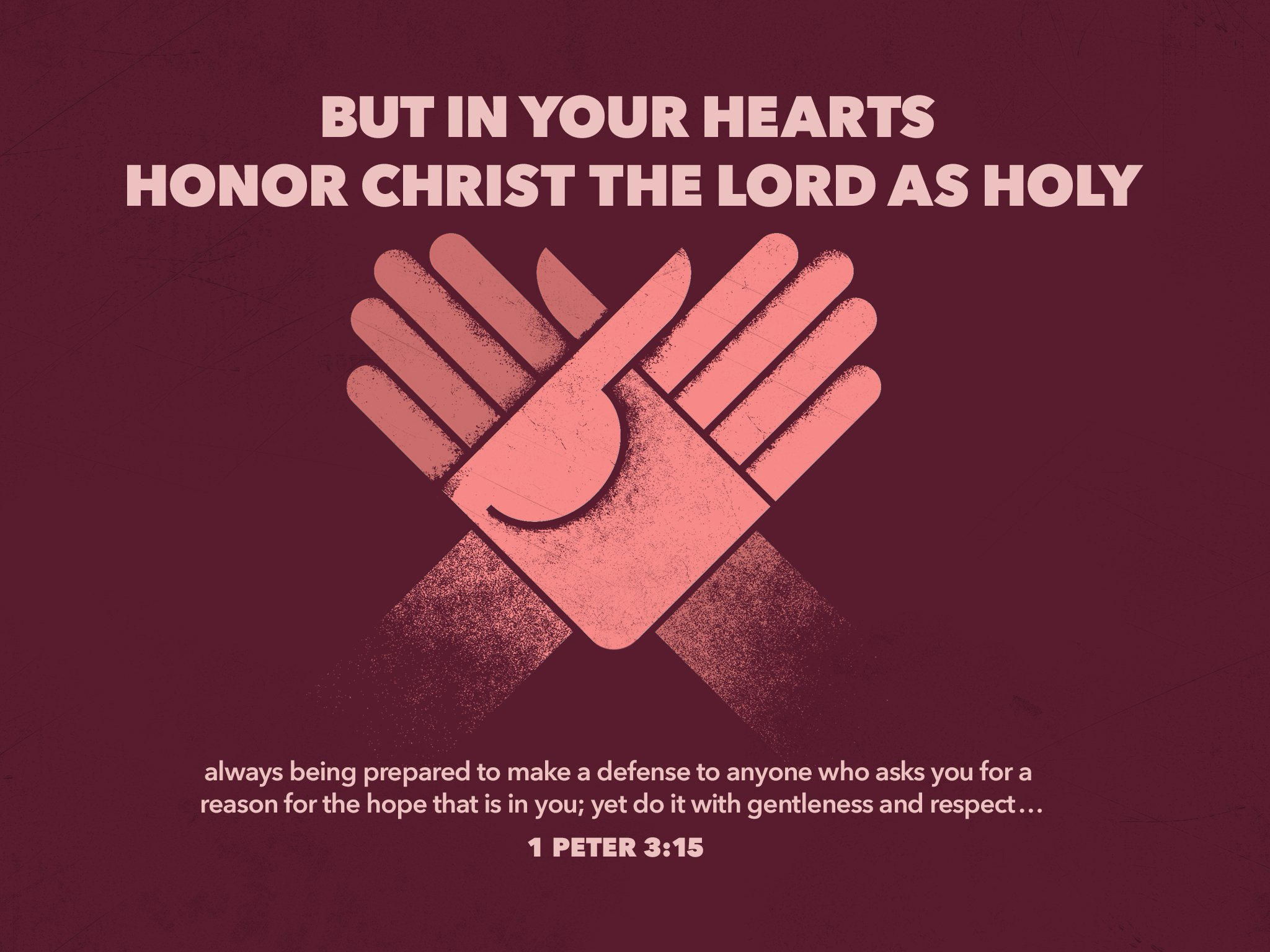
Look again at v. 15. (I’m sorry the sermon reading fell on a page turn in your bulletin.) Peter encourages you to always be ready to make a defense to anyone who asks you for a reason for the hope that is in you. So, Peter anticipates that you, Christian, will face a particular question about your hope. This question implies that hope isn’t only something that’s deep inside you—in your mind or heart. No, dear saints, your hope is something that will manifest itself. Your hope speaks. Your hope heralds to the world because your hope changes, guides, and directs who you are. Your hope influences how you use your words and how you behave in such a way that the world is going to recognize that there is something different about you. Believer, Jesus declares that you are the light of the world (Mt. 5:14). When you are asked about the reason for the hope within you, that is because Jesus has made you the light of the world that shines in a dark place.

So, I have a question: When was the last time somebody asked you that? When was the last time somebody asked you, “Why do you hope the way you do?” or, “What’s the reason for your hope?” Maybe some of you get asked this question regularly—all the time. But I would guess that most of us aren’t fielding that question too often. And there are a couple possible reasons we aren’t asked this question.

One reason is that you don’t actually hope in anything different than what the world hopes. You just blend right in with them. Like the world, you hope that your income will cover your expenses. Like the world, you hope that your retirement account will keep growing or (if you’re already retired) will last long enough. Like the world, you hope that the wars and violence and troubles you see will settle down. The world might not see any difference between your hopes and theirs, so they aren’t going to ask you why you hope the way they do. Now, just to be clear, none of those hopes are bad or sinful per se. But if that’s all you hope for and you don’t have higher hopes, you should repent and examine your priorities. As a Christian, your priorities and hopes should be much higher and have a lot longer view than that.

The second reason you might not be asked for the reason for the hope in you is that you actually are being asked this question—you just don’t realize it. And I think this reason is much more likely. That’s why Peter tells us that we need to be prepared. I’m willing to wager that people really are asking about your hope, but they aren’t asking verbatim, “What is the reason for the hope that is in you?”

Instead, they might just start talking about things that are happening in their life because their life isn’t going well. Or they might comment on the news and how chaotic things are all over the world. They are concerned about things going on around them and talk about that, but they’re actually asking you for a reason for your hope, they just don’t say it straight out because they’re embarrassed or scared to admit their fears and worries.

You’ve probably gotten used to people ‘testing the waters’ (so to speak) with other kinds of questions. We Midwesterners are especially known for this. You’ve probably had people ask you about your plans for the weekend, but what they’re really asking is if they can tag along with you. (I’m not saying that’s wrong or that the person is lying, but being direct is usually a better way to converse with others.) 

Some people will talk to you about things that they don’t feel comfortable talking about with others. What they’re doing—even though they don’t realize it—is asking you to explain why you’re different or why you have the hope that you have as a believer. Part of being prepared to make a defense is being able to discern when someone is opening a door for you to give the reason for your hope.

So, what is the reason for your hope? What makes a Christian’s hope so different that it shows, that it is manifest, that it heralds? At the end of v. 14, Peter says, “Have no fear of them, nor be troubled.” Literally, the Greek there reads, “Do not fear what they fear.” Most translations do something similar to what the ESV does. (I don’t want to get too deep into the reason it’s translated that way because it takes a while. You can ask me later.) Basically, the verse is specifically addressing the topic of believers who might be suffering and face persecution for doing what is right. But the principle reaches further than just that. The reason you believers have a hope that will bring inquiries is the simple fact that you aren’t afraid of the things this world is afraid of. The things that terrify unbelievers don’t cause you any concern.

Think of how anxious you would be if you didn’t have faith in Christ. Unbelievers live in the false idea that they have to make their own way in this world without a loving Creator who is their heavenly Father. Without a merciful Redeemer who died for all their sins. And without a comforting Sanctifier who advocates for them in heaven’s courtroom. That would be horrible, but even beyond that, unbelievers have to earn their own happiness. If they want any sense of security and safety, it would have to come from their own hands. Basically, they would have to fight for it. Their conscience testifies against them, so they struggle with always having to excuse their sin or live under that constant accusation. For an unbeliever every aspect of life is full of uncertainty. If they believe this world and life is all there is, then it truly is a survival of the fittest. Even if they believe there is a god (little ‘g’ god), they don’t know for certain how to get that god on their side.

In our Gospel reading (Lk. 5:1-11), we saw how Peter had known that kind of fear firsthand. He was going about his life with his boat, his nets, and his fish trying to make a living in this world. Suddenly, Peter realized that he was standing before the almighty Son of God. He fell to his knees and cried out, “Depart from me, for I am a sinful man, O Lord” (Lk. 5:8). Everything that mattered to Peter evaporated in a moment because he realized God was there with him in the boat and that he was a sinner. Unbelievers know the same thing could happen to them at any moment. Anyone who doesn’t have faith in Christ knows—deep down, they know—that any sense of security they have could be pulled out from under them in a flash because their security and their hopes are all a facade.

But for you, dear saints, you don’t fear what the world fears. You don’t have to worry about your future because it is in God’s omnipotent, merciful hands. You don’t have to be afraid for your health, your home, your children, your job. You have nothing to fear because you have God’s promise to forgive you all of your sins.

As a believer, you know that you are now a child of God. You know that, because you have the forgiveness of your sins, you are a citizen of the kingdom of heaven. Sure, you are still a citizen of this world and fall into similar worries of unbelievers. But you also believe in the life of the world to come. Yes, you have an earthly citizenship and a heavenly one, so the trials and tribulations of this world hit you differently because you have a higher hope.

Stick with me as I change gears for a minute to reflect on your hope in light of the 250th birthday of our country.

America isn’t perfect. (There’s an understatement for you.) America isn’t perfect, but it is still one of if not the most blessed nations God has ever given throughout the history of the world. I’m not talking about the country we had 10, 20, 50, or however many years ago. I’m talking about the country you woke up in this morning. We should be extremely and profoundly thankful for the nation we have right now.

You live in a nation where the Word of God is plentiful. You probably have several Bibles in your home. Even if you don’t have a physical Bible, you can get one on a device. You are free to gather with other Christians. In fact, you could move anywhere in this country and be within an hour’s drive to a faithful Lutheran congregation where the Word is taught in its truth and purity and the Sacraments are given as Christ instituted them. God has richly blessed us. We should make it a point today (and every day) to thank Him.

Yet even in this blessed nation, people live in fear. They are anxious about the news, about division, about the economy, about the future. They are afraid of what might happen if things keep going the way they are or if they don’t return to something else in the past. But you, believer, you do not have to live that way because your hope is different. You have Christ. And in Christ, you have a good conscience before God.

You are prepared to give a defense of your hope because you have a good conscience. That’s why you aren’t afraid of what they fear. That’s why you are ready to give a defense for the hope that is in you. You have a good conscience.

Sure, you have plenty going on in your life, just like everyone else in this world does. But unlike them, you can live unafraid, with a clean conscience before your heavenly Father for the sake of Christ Jesus. God is not against you—He is for you. Christ has cleansed you from all your sins by His blood. He has sprinkled you clean in Baptism. He feeds you with His own Body and Blood in the Supper. He promises to bring you to the home of your hope in heaven.

That is why your hope heralds. It shows, and people notice the difference. They ask—sometimes directly—but often in roundabout ways. Dear saints, be ready. The reason for the hope that is in you is Jesus. He has taken away your sin. He has given you a good conscience. He is your hope now and forever. Amen.

The peace of God, which surpasses all understanding, will guard your hearts and minds in Christ Jesus (Php. 4:7). Amen.

Even the Greatest Struggle – Sermon on Matthew 11:2-11 for the Third Sunday of Advent

Matthew 11:2-11

2 Now when John heard in prison about the deeds of the Christ, he sent word by his disciples 3 and said to him, “Are you the one who is to come, or shall we look for another?” 4 And Jesus answered them, “Go and tell John what you hear and see: 5 the blind receive their sight and the lame walk, lepers are cleansed and the deaf hear, and the dead are raised up, and the poor have good news preached to them. 6 And blessed is the one who is not offended by me.”

7 As they went away, Jesus began to speak to the crowds concerning John: “What did you go out into the wilderness to see? A reed shaken by the wind? 8 What then did you go out to see? A man dressed in soft clothing? Behold, those who wear soft clothing are in kings’ houses. 9 What then did you go out to see? A prophet? Yes, I tell you, and more than a prophet. 10 This is he of whom it is written,

“‘Behold, I send my messenger before your face, 
who will prepare your way before you.’

11 Truly, I say to you, among those born of women there has arisen no one greater than John the Baptist. Yet the one who is least in the kingdom of heaven is greater than he.”

In the name of Jesus. Amen.

John the Baptizer, you know him. You love him. That camel hair wearing, locust eating, outspoken prophet in the wilderness is a combination of a biker gang member, wilderness survivalist, and street-corner preacher. John preached, “Repent for the kingdom of heaven is at hand.” He announced that Jesus was coming after him, and John said he wasn’t worthy to stoop down and untie Christ’s sandals (Mk. 1:7). Scripture tells us that the people of Jerusalem, all Judea, and all the region around the Jordan were going to be baptized by John (Mt. 3:5). John came to bear witness to Jesus as the true Light who gives light to everyone (Jn. 1:6-9). And he pointed people to Jesus as the Lamb of God who takes away the sin of the world (Jn. 1:29ff).

John preached the Gospel, but he also preached the Law. He would call out the Pharisees and Sadducees, calling them a brood of vipers (Mt. 3:7). And when Herod the tetrarch married his brother’s wife, John spoke out against this evil thing (Lk. 3:19-20). That is why John is in prison when we meet him here. (Just a side note: Yes, there are times that a preacher should call out the evil things politicians do.) For his whole life, John had been a faithful steward of the mysteries of God’s Word (1 Cor. 4:1-2).

But here, in this text, John is nearing the end of his life and is soon to be executed. He is in a dank, dark prison cell. He probably had no heat or light, wasn’t being fed well, and was shackled in some way. But even though he is in prison, John was able to visit with his disciples. From that dark place, John sends his disciples to ask Jesus an important but surprising question, “Are You the one who is to come, or should we look for another?”

The question, in and of itself, is a great question, but we should be surprised and utterly shocked at the source and originator of this question. John already knew the answer. On top of everything I’ve already mentioned about him, John is the one who baptized Jesus. After that baptism, John saw the Holy Spirit descend and remain on Jesus (Jn. 1:31-33). John heard God the Father say, “This is My beloved Son, with whom I am well pleased” (Mt. 3:17). And John publicly proclaimed that Jesus is the Son of God (Jn. 1:34).

But now, John asks Jesus, “Are You really the Messiah?” It’s shocking. So shocking, in fact, that after Jesus answers the question with all the proofs – the blind see, the lame walk, lepers are cleansed, the deaf hear, and the dead are raised up – Jesus then turns to the crowds and defends John for even asking this question and talks him up a bit. Christ basically says, “Listen, you didn’t go out in the wilderness to listen to a reed shaken by the wind or to see a guy dressed up funny clothes.” And, quite honestly, what Jesus says there is at least PG-13, just ask me after the service. Jesus goes on to say that John the Baptist is a prophet, and more than a prophet. He is the long-promised messenger who would prepare the way of the Messiah (Mal. 3:1). On top of that, Jesus says that John the Baptizer is the greatest of all men ever born. This is absolutely stunning.

Just think about this. According to Jesus, John is greater than Noah, Abraham, Moses, David, Solomon, Elijah, Isaiah, Jeremiah, Ezekiel. So, the question before us this morning is why does John ask Jesus, “Are You he one who is to come, or should we look for another?”?

Now, there are two schools of thought as to why John would ask this question. Some say that John is having legitimate doubts and is second-guessing his entire ministry of pointing people to Jesus, but others completely dismiss that possibility and say that John is asking this question to get his disciples to follow Jesus. But I don’t think we can simply dismiss the theory that John doubted. Here’s why.

Everything we know about John is that is he was direct and doesn’t beat around the bush. If he wanted his disciples to follow Jesus, he would have told them straight out, and we have passages of Scripture where John does exactly that (Jn. 1:26-30). Another reason to reject the theory that John is trying to get his disciples to follow Jesus is that Jesus doesn’t go along with the plan. Christ sends those disciples back to John to report what they hear and see. If John was trying to get his disciples to follow Jesus, you would think that Jesus would invite them to follow Him. But Jesus takes John’s question seriously. Finally, the speculation that John is trying to get his disciples to follow Jesus typically works under the assumption that Christians cannot or should not ever have serious doubts or difficulties. And that assumption is wrong.

All sorts of strong believers in Scripture went through times of struggle and doubt. Abraham, Jacob, Job, Moses, David, Elijah, Peter, and Paul all faced serious doubts – some of them more than once. Why wouldn’t John, even though he is the greatest man ever born, face that too?

Dear saints, even the greatest struggle in the faith. Just consider, for a moment: how many people did John minister to? How many did he point to Jesus when they faced temptation, guilt, pain, suffering, and struggles? But, now, as John is sitting in prison, he is the one who needs the ministry of the Gospel. He needs to be reminded. He needs to be pointed to the same Jesus he pointed others to as he travels down his own dark road. If John the Baptizer gets to that place, so will you, if you haven’t already.

So, I want to leave you with two thoughts, which should also be encouraging. First of all, there is a difference between John’s question here, where he is struggling and panicking a bit (I think we can categorize his question that way), there is a difference between that and real intellectual questions about Christianity, God, the resurrection, and other aspects of our faith. None of us are immune to the struggle that John is going through here. If even the greatest man ever born struggles in this way, expect that you will as well. So, when (not if but when) you face these spiritually dark times, don’t panic. Do as John does here and bring those questions to Jesus. Dive into Scripture and hear God’s promises again. Pull out the Psalms and see how often they deal with these spiritually low places. And know that I am here to help. I’m here to minister to you in those times, and so are all your brothers and sisters in Christ.

Now, there might be times where you have intellectual questions about the faith. That is a different thing entirely. If that’s the case, if you have a question about creation because of what you have heard in a science class that is teaching the theory of evolution, or a question about if the Resurrection of Jesus actually happened, or about Christianity in general, ask someone who knows more than you do. I can help answer a lot of those questions or I can help you search for and find the answers. Don’t be a fool and think there aren’t answers for those types of questions. You aren’t so smart that you have found a hole in our faith that hasn’t already been answered. Christianity is intellectually rigorous and can answer even your most difficult questions. So don’t be afraid to ask them. But remember that is a different thing than going through a dark, difficult time spiritually.

The second thing I want you to observe is how gently Jesus answers John’s question. Consider this question from Jesus’ perspective. Throughout the Gospels, Jesus hardly gets a break. He’s always teaching, healing, ministering. Even when Christ does try to get away from the crowds for a bit, He ends up being found and having to do more (Mk. 6:30-34), or Jesus will try to sit down to rest but ends up ministering to another lost soul (Jn. 4:6-26), or Christ tries to catch a quick nap and His disciples will wake Him up with their problems (Mt. 8:23-27). When this question comes from John, Jesus doesn’t throw up His hands, groan, and say, “What! John needs help too? Isn’t he supposed to be the greatest? I don’t have time for this.” No, Jesus answers John’s question kindly, softly, and without a single, solitary shred of impatience.

Jesus doesn’t rebuke John. He doesn’t complain about how busy and tired He is. Jesus simply says exactly what John needs to hear. Jesus is patient and gentle with John, and He is with you too.

I know this text of John the Baptizer sitting in prison and struggling in his faith doesn’t sound very Christmassy, but it is very practical, real life, and down to earth stuff. This can be a dark and lonely time of year. But the same Lord who loved John and gave him the encouragement he needed in the moment he needed it is here for you to speak peace to you and encourage you. Rejoice! He will see you through because He has promised. Amen.

The peace of God, which surpasses all understanding, will guard your hearts and minds in Christ Jesus. Amen.