
Deuteronomy 10:12-21
12 “And now, Israel, what does the Lord your God require of you, but to fear the Lord your God, to walk in all his ways, to love him, to serve the Lord your God with all your heart and with all your soul, 13 and to keep the commandments and statutes of the Lord, which I am commanding you today for your good? 14 Behold, to the Lord your God belong heaven and the heaven of heavens, the earth with all that is in it. 15 Yet the Lord set his heart in love on your fathers and chose their offspring after them, you above all peoples, as you are this day. 16 Circumcise therefore the foreskin of your heart, and be no longer stubborn. 17 For the Lord your God is God of gods and Lord of lords, the great, the mighty, and the awesome God, who is not partial and takes no bribe. 18 He executes justice for the fatherless and the widow, and loves the sojourner, giving him food and clothing. 19 Love the sojourner, therefore, for you were sojourners in the land of Egypt. 20 You shall fear the Lord your God. You shall serve him and hold fast to him, and by his name you shall swear. 21 He is your praise. He is your God, who has done for you these great and terrifying things that your eyes have seen.”
In the name of Jesus. Amen.
Don’t put the cart before the horse. When we hear this text, it is very easy to focus on all the things we are called to do because the text opens with the question: “What does the Lord your God require of you?” Then all these directives come. Fear God. Walk in His ways. Love Him. Serve Him with all your heart and with all your soul. Keep His commandments and statutes. Don’t be stubborn. Love the sojourner. Hold fast to Him. There is a lot to do there – so much, in fact, that we recognize that we have not even begun to do what God requires of us. Right away we find that we have a lot of repenting to do, and repent we should. But, again, don’t put the cart before the horse.
Notice who wants you to do all these things – the Lord your God. Six times in this text, that is God’s title – the Lord your God. And just to make sure you get it drilled into your head, you are reminded in the final verse that He is your God (v. 21).
Know, dear saints, this God of gods and Lord of lords – the One who owns heaven and the heaven of heavens, the earth with all that is in it – He is your God. He has chosen you. He could have chosen anyone, but He chose you. He did not choose you because you were bigger, stronger, smarter, more obedient, or more faithful than others. He has not chosen you because of anything you have thought, said, or done. You belong to God. You, dear saints, according to 1 Pet. 2:9, are His chosen people, His royal priesthood, His holy nation, and a people for His own possession. You are these things because the Lord God of heaven and earth has chosen you and set His heart in love on you (v. 15). He is your God because He has called you out of darkness into His marvelous light. And the Lord your God has done all of this because of what Jesus has done for you.
Jesus, your Savior, lived a perfect life. He was perfectly obedient to God. He took all your sin to the cross (1 Pet. 2:24) where God poured out all His wrath upon your sin, and not one bit of that wrath is left for you. Jesus paid it all, and He paid it all for you. Your sin had left a crimson stain, but Jesus has washed you white as snow. To God belongs heaven and the heaven of heavens, the earth and all that is in it, and Jesus has restored you to your proper place – your proper place before God and your proper place in His creation. That’s the horse that pulls the cart, and now we can turn to the cart.
As this text lays out all the things the Lord your God requires of you, it is nothing more than a call for you to be like Him and follow after His image. In other words, if we boil down all these things God calls us to be, it is a call for us to be the stewards He has created us to be.[1]
So, think back to the creation. God created Adam and Eve in His image and blessed His image-bearers saying, “Be fruitful and multiply and fill the earth and subdue it, and have dominion over the fish of the sea and over the birds of the heavens and over every living thing that moves on the earth.” Because of our sinful nature, we hear those instructions “have dominion” and “subdue” and think that we get to call all the shots and beat creation into submission so that it conforms to our will. But that wasn’t the case originally. Because Adam and Eve were created in God’s image and perfectly reflected the will and heart of the God who created and owns all things, they were simply stewards of everything God created.
As Genesis 2 closes, Adam and Eve were doing exactly what God had created them to do. They were perfectly stewarding God’s creation. They were receiving from God all that He wanted to give to them. God had created the entire universe to bless mankind, the crown of His creation. God designed them to have open hands that received all the blessings they needed for life. But then, in Genesis 3, the serpent comes slithering into the picture. He lies and convinces them that God was holding out on them and not giving them everything He had to give. After hearing this lie, Eve begins to look at things differently. Watch what her hands do. Instead of having an open hand to receive all of God’s blessings, her hand turns over to take. Both Adam and Eve take and eat. This taking betrays their identity. Instead of being stewards, they wrongly thought they were the owners, but there had been no transfer of ownership.
The creature cannot be the Creator, and the steward cannot be the Owner. Adam and Eve’s attempt to change their identity ends up destroying the perfect relationship that existed between Creator, steward, and creation. Because of that, life became hard. All creation, which God designed to be a blessing that supported life, will cause them pain and suffering. Now their work, will be filled with sweat, toil, pain, and, ultimately, death.
The interesting thing in all of this, though, is that God did not remove them from their calling and duty of being stewards. And this is where you come into the story. You, as God’s creature, are still a steward of God’s creation. Even though you daily and regularly fail in this role, it is still yours. Even though your hands turn over to reach out and take what is not yours, Jesus has come to redeem you and forgive you of all your sins. On the cross, your debt was paid. The empty tomb on Easter is the receipt (Ro. 4:25).
This means, dear saints, that you are a new creation; the old has passed away and the new has come. And now, God has entrusted you with being a steward of the Gospel which is the message of reconciliation (2 Cor. 5:17-20). With an open hand, you receive God’s forgiveness and mercy, and that open hand allows that forgiveness and mercy to also flow to others. And it is those same open hands that freely receive and freely give all of God’s other gifts too. And one of the ways that you continue in your role as a steward is by giving to the work of God’s church.
On the back of your Scripture insert, I’ve included two passages about Christian stewardship (1 Cor. 16:2 and 2 Cor. 9:6-8) and four points to consider about how to give.[2] I would encourage each of you to read through those texts and points as you consider how you steward what God has given to you. In the Old Testament, the stewardship of tithing was set at a certain amount, 10%. Now I want to be clear: there is no New Testament command on what percentage you should give to the work of God’s kingdom. Let that be between you and God. But I do want to highlight one thing from those verses.
2 Cor. 9:6 says, “Whoever sows sparingly will also reap sparingly, and whoever sows bountifully will also reap bountifully.” If you plant one tomato plant, you can only expect so many tomatoes. If you plant ten, fifty, or one hundred plants, well, you’ll get a lot more. The text goes on to tie that analogy to what you give to the church. And the interesting thing about this is what the Old Testament has to say about where those tithes end up.
Just a few chapters after our text, God talks about what was to be done with the tithes. In Dt. 14:22-26, God says that the tithes given to Him are given back to the one who brought that tithe, and it is given back as a feast. God tells His people to bring the tithe of their crops, their wine, their oil, and their herds to the Temple.[3]If the trip to the Temple was too far to bring all of it, they should sell those things and turn them into money. Then, they would go to Jerusalem and purchase whatever things they wanted to eat. Then, they would offer their tithe and eat it before God with rejoicing.
Dear saints, the gifts, offerings, and tithes you give to God are returned back to you as gifts from the Lord your God. Those gifts bless you as you come here and receive God’s mercy, and they also bless your neighbor who needs to receive that mercy and love. The offerings and gifts that you have placed on the Lord’s table will be used by God to continue to further His kingdom.
And now, Jesus, your God, invites you to come and receive a priceless treasure that could never be bought with money. He invites you to come to His table and receive His Body and blood given and shed for the forgiveness of all your sin. Come into the presence of the Lord your God. Receive and rejoice. Amen.
The peace of God, which surpasses all understanding, will guard your hearts and minds in Christ Jesus. Amen.
Christian Stewardship
1 Corinthians 16:2
2 On the first day of every week, each of you is to put something aside and store it up, as he may prosper, so that there will be no collecting when I come.
2 Corinthians 9:6–8
6 The point is this: whoever sows sparingly will also reap sparingly, and whoever sows bountifully will also reap bountifully. 7 Each one must give as he has decided in his heart, not reluctantly or under compulsion, for God loves a cheerful giver. 8 And God is able to make all grace abound to you, so that having all sufficiency in all things at all times, you may abound in every good work.
From these two texts, we see that Christians are to give…
- …voluntarily & cheerfully. Giving should not be done under compulsion or grudgingly. Giving is God’s gracious call to join Him in His work.
- …of our first-fruits. Giving should be from the first-fruits of our labor. Our giving is what we do on the first day of the week before our other expenses are due.
- …proportionately. Giving is not to be an arbitrary set dollar amount each week. Instead, it is to be in accordance with ‘how we have prospered’ each week. In other words, setting aside a certain proportion (percentage) of our income for God’s work through the Church.
- …faithfully. We have God’s promise that He will take care of all our needs in this body and life. As we give, we are trusting God to keep that promise.
[1] The following five paragraphs are an adaptation of chapter 2 of the book Stewardship: For the Care of Souls by Pr. Nathan Meador and Pr. Heath R. Curtis.
[2] I’ve included those below under the title “Christian Stewardship.”
[3] The text says to bring the tithe to “the place that He will choose, to make His name dwell there.” I am simply condensing that because the Temple is where God chose to make His name dwell (2 Chron. 6:16-20).

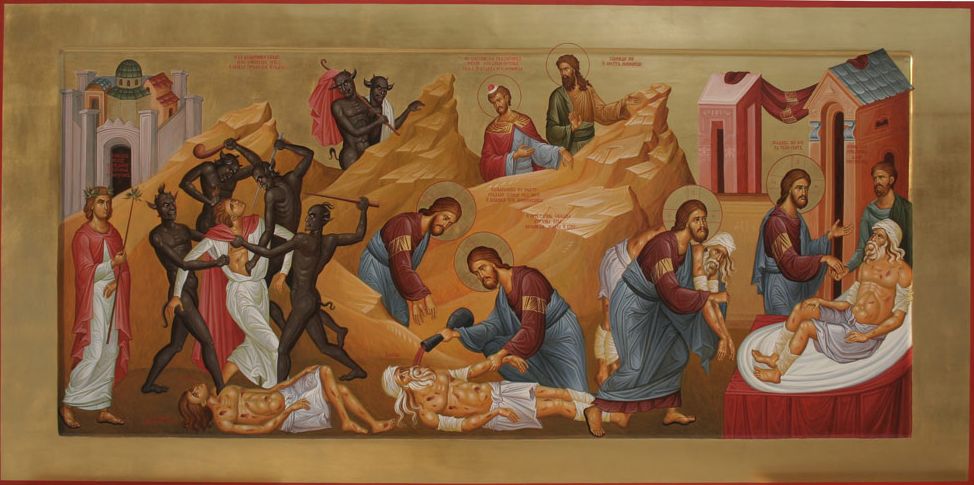 Because, first and foremost, the parable of the Good Samaritan is a picture of what Jesus has done for you. Jesus, and Jesus alone, is the Good Samaritan who has compassion. He left His throne in the glory of heaven to become your neighbor. He risks His own safety while scoundrels and robbers are roaming about. He stops to give you aid. He pours on you oil and wine. He gives up His own comfort and convenience to bring you to the inn of the holy Christian Church. And Jesus sets up an all-expenses-paid stay there promising to return. Jesus is the one who has and continues to show you mercy. Amen.
 Pastorsamwise
You must be logged in to post a comment.